
International Research Journal of Engineering and Technology (IRJET) e-ISSN: 2395-0056
Volume: 12 Issue: 04 | Apr 2025 www.irjet.net p-ISSN: 2395-0072
International Research Journal of Engineering and Technology (IRJET) e-ISSN: 2395-0056
Volume: 12 Issue: 04 | Apr 2025 www.irjet.net p-ISSN: 2395-0072
Dr. Shaikh Zeeshan Akil1 , Mr. Shaikh Gulam Gaus Shafique2 , Monde Gulam Shaddan Dastagir3 , Shaikh Faiz Shadab4
1HOD, Mechanical Engineering, Jumma Masjid Charitable Trust Polytechnic, Nashik (MH, India) 2,3,4Diploma Scholar, Mechanical Engineering, Jumma Masjid Charitable Trust Polytechnic, Nashik (MH,India) ***
Abstract - With the continuous rise in vehicle numbers, it has become essential to install speed breakers at strategic locations to control vehicle speed and reduce accidents. Typically, two or three speed breakers are placed in sequence to effectively slow down traffic. In this context, the author proposes a new concept where the first speed breaker is rigid, while the others are equipped with a spring-loaded rack and pinion mechanism designed to harness the mechanicalenergy generated by vehicles for power generation. As energy is a fundamental need across all sectors from cooking to operating machinery there is a growing demand for alternative sources. Currently, fossil fuels are the primary energy source, but they are limited, non-renewable, and becoming increasingly expensive. This has led to a push for alternative, sustainable energy sources.Significantresearchis being conducted in the field of renewable energy, including solar, wind, and ocean power, todevelopefficientwaystomeet energy demands. The proposed speed breaker systemfeatures a flexible component integrated with a spring and rack-andpinion setup. Additionally, it includes a small dynamo that converts the mechanical energy from passing vehicles into electrical power.
Key Words: SpeedBreaker,Accident,PowerRequirement, FossilFuel,LimitedSource,RenewableEnergy,etc.
Conventional energy sources rely heavily on fossil fuels, whichcontributetoenvironmentalpollution,arefinite,and are becoming increasingly expensive. To extend the availabilityoffossilfuelsandhelpprotecttheenvironment, thereisagrowingneedtoadoptalternativeorrenewable energysources eitherincombinationwithfossilfuelsoras complete replacements. Renewable sources such as solar, wind, geothermal, tidal, and hydropower offer significant potential for energy generation and, importantly, are environmentallyfriendlyastheydonotproducepollution. Oneinnovativemethodofgeneratingelectricityinvolvesthe useofaspeedbreakermechanism.Withtherisingnumber ofvehicles,speedbreakersarecommonlyinstalled usually insetsoftwoorthree tocontrolvehiclespeed.However, the first speed breaker is typically sufficient to slow the vehicle,whilethesubsequentonesservetofurtherreduce speed. This setup presents an opportunity to harness the
mechanicalenergyfrommovingvehiclesandconvertitinto electricalenergyusingspeciallydesignedspeedbreakers.

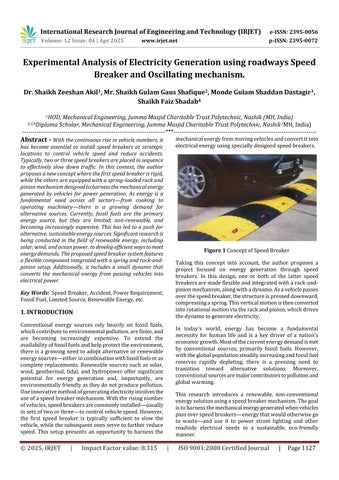
Taking this concept into account, the author proposes a project focused on energy generation through speed breakers. In this design, one or both of the latter speed breakersaremadeflexibleandintegratedwitharack-andpinionmechanism,alongwithadynamo.Asavehiclepasses overthespeedbreaker,thestructureispresseddownward, compressingaspring.Thisverticalmotionisthenconverted intorotationalmotionviatherackandpinion,whichdrives thedynamotogenerateelectricity.
In today’s world, energy has become a fundamental necessity for human life and is a key driver of a nation's economicgrowth.Mostofthecurrentenergydemandismet by conventional sources, primarily fossil fuels. However, withtheglobalpopulationsteadilyincreasingandfossilfuel reserves rapidly depleting, there is a pressing need to transition toward alternative solutions. Moreover, conventionalsourcesaremajorcontributorstopollutionand globalwarming.
This research introduces a renewable, non-conventional energysolutionusingaspeedbreakermechanism.Thegoal istoharnessthemechanicalenergygeneratedwhenvehicles passoverspeedbreakers energythatwouldotherwisego to waste and use it to power street lighting and other roadside electrical needs in a sustainable, eco-friendly manner.
International Research Journal of Engineering and Technology (IRJET) e-ISSN: 2395-0056
Volume: 12 Issue: 04 | Apr 2025 www.irjet.net p-ISSN: 2395-0072
2. WORKING PRINCIPLE:
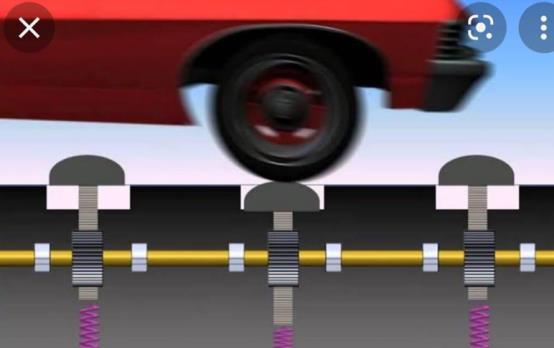
The pinion is connected to a dynamo, which generates electricity that can be utilized for street lighting or other related applications. Figure 1 illustrates the concept of a speed breaker designed to reduce vehicle speed. Figure 2 presentsaconceptualdiagramofthespeedbreakerpower generationsystem.Inthissetup,eachspeedbreakerunitis equippedwitharackandpinionmechanism.Whenavehicle passesoverthespeedbreaker,therackmovesdownward, causingthepiniontorotate.Thisrotationalmotiondrivesthe dynamo,resultinginelectricitygeneration.
3. GENERALISED COMPONENTS:
3.1 Coil Spring:
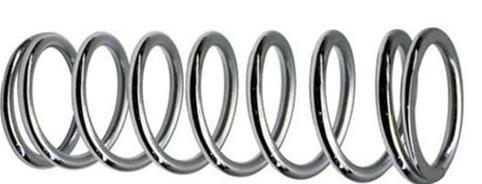
Aspringisanelasticdeviceusedtostoremechanicalenergy, typically made from spring steel. While there are various typesofsprings,thetermcommonlyreferstocoilspringsin everydayusage.Whenastandardspring withoutvariable stiffness iscompressedorstretchedfromitsequilibrium
position,itexertsarestoringforceroughlyproportionalto the displacement. This relationship holds true for small deflections but may deviate with larger ones. The spring constant,orrate,measureshowmuchforcethespringexerts per unit of deflection. It is represented as the slope of the force versus deflection curve and is typically expressed in unitssuchasnewtonspermeter(N/m)orpounds-forceper inch(lbf/in).
3.2 Rack and Pinion:

5 RackandPinion
Arackandpinionisatypeoflinearactuatorconsistingoftwo interlockinggearsthatconvertrotationalmotionintolinear motion. The system includes a circular gear, knownas the pinion,whichmesheswithalineargearbarcalledtherack. Whenthepinionrotates,itdrivestherackinastraightline, effectively transforming rotational input into linear movement.Onecommonexampleisinrackrailways,wherea rotating pinion on a train engages with a rack mounted betweenthetracks,allowingthetraintoclimbsteepinclines. In gear theory, every pair of conjugate involute gears correspondstoabasicrack essentiallythegearprofileofan infinitelylargegear,representedasatoothedstraightedge.
3.3 DC Motor:
6 DCMotor
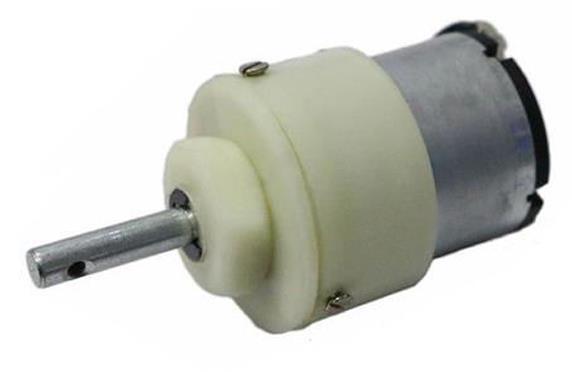
Inthecontextofelectricitygeneration,agenerator suchas oneintegratedwithaspeedbreakermechanism converts mechanical energy into electrical energy for use in an external circuit. Mechanical energy can be sourced from devices like steam turbines, gas turbines, water turbines, internalcombustionengines,orevenmanualtoolslikehand cranks. The first electromagnetic generator, known as the Faraday disk, was developed in 1831 by British scientist Michael Faraday. Today, generators are responsible for producingthevastmajorityofelectricitysuppliedtopower
International Research Journal of Engineering and Technology (IRJET) e-ISSN: 2395-0056
Volume: 12 Issue: 04 | Apr 2025 www.irjet.net p-ISSN: 2395-0072
grids.Thereverseprocess convertingelectricalenergyinto mechanical motion is performed by electric motors. Interestingly,motorsandgeneratorssharemanysimilarities, andinsomecases,motorscanbemechanicallyoperatedto function as generators, making them useful for manual electricitygenerationaswell.
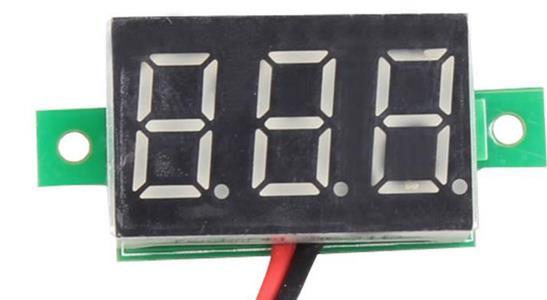
Voltageindicatorsarecompactdevices,oftenintegrated with systems like speed breaker mechanisms, designed to measure both alternating current (AC) and direct current (DC) voltages. These indicators continuously display the current voltage level and are commonly used to monitor battery status or mains voltage. In industrial settings and research facilities, voltage monitoring is critical, making voltage indicators an essential tool. Additionally, many physical quantities are represented in the form of voltage, and scalable voltage indicators can convert these voltage valuesintomeaningfulmeasurements.Ourvoltageindicators areversatileandsuitableforawiderangeofapplications.In additiontomeasuringACandDCvoltage,somemodelsalso supportcurrentandtemperaturemeasurement.Readingsare typicallyshownonanLEDdisplay.Forinstance,thePCE-N20 seriesvoltagetransducersfeaturecolor-codeddisplaysthat changewhenpredefinedlimitvaluesareexceeded,providing clearvisualalerts.
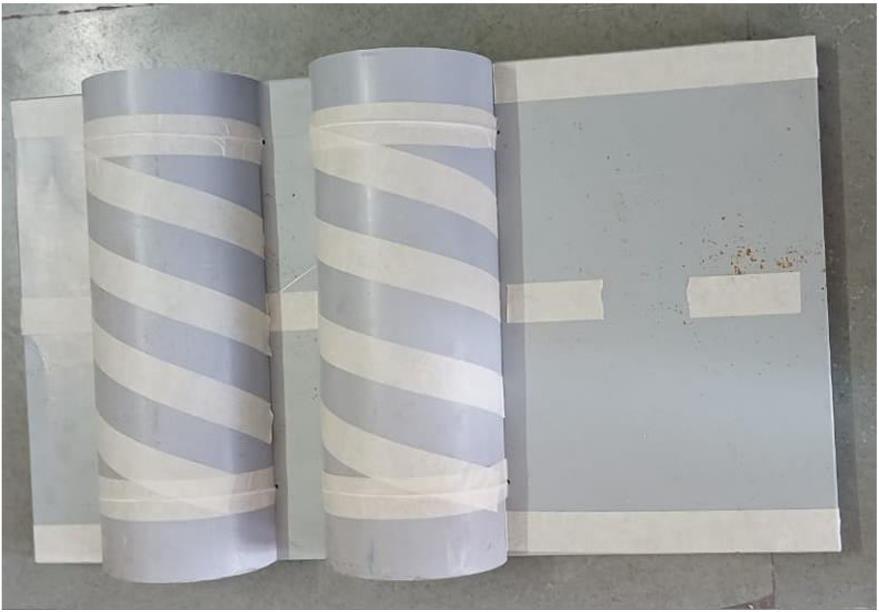
Toharnessmechanicalenergyfromthemovementofa vehicle, a platform must be constructed that responds to pressurewhensomeonestands,jumps,orpressesonit.The platformmaterialiscarefullyselectedtoensureitisstrong anddurableenoughtowithstandtheappliedloadwithout deforming.
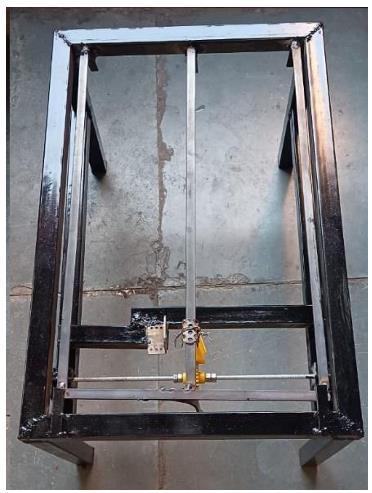
Theframeandbodyofthepowergenerationsystemplaya crucial role, as they house all the subsystem components. Theyalsoprotecttheinternalmachinepartswhileproviding thenecessarystructuralsupportandfreedomofmovement forthesystem'soperation.
International Research Journal of Engineering and Technology (IRJET) e-ISSN: 2395-0056
Volume: 12 Issue: 04 | Apr 2025 www.irjet.net p-ISSN: 2395-0072
3.5 Semi Circular Roller:

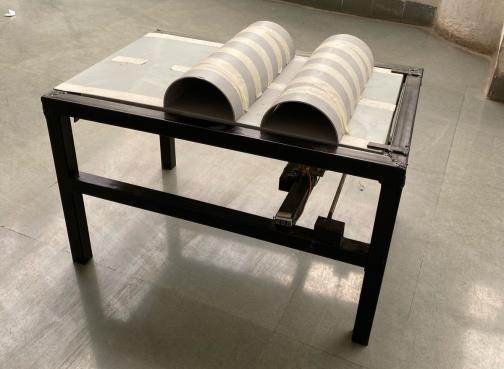
Inordertohavethestructuresimilartothespeedbreaker the PVC pipe are used by cutting axially in two halves as showninfigure10.
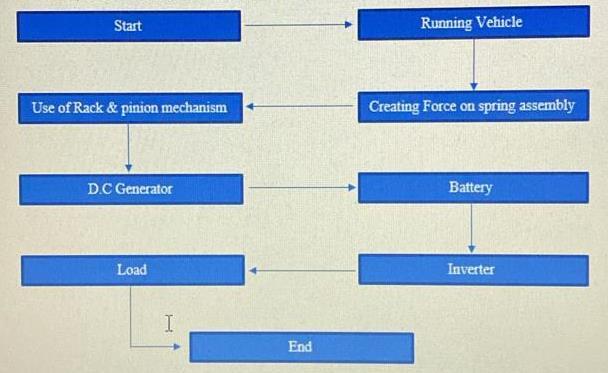
The speed breaker power generation unit utilizes vehicle movementasitsenergysource,operatingontheprincipleof convertingmechanicalenergy(vehiclemotion)intoelectrical energy. The system is integrated into a speed breaker mechanism,wheretheforceexertedbyavehicle’smovement causes the stair-like step to move upward. This motion presses the platform, which in turn compresses the rack attached to it. As the rack moves downward, it generates rotary motion in the gear that meshes with it. The linear motionofthestepisthusconvertedintotherotarymotionof theshaftconnectedtothegearpinion.
This rotary motion is then transferred to a sprocket arrangement welded to the same shaft, which drives the coupling(speciallydesigned)viaachaindrivemechanism. Ultimately,thismotionpowersaDCmotorfunctioningasa generator,producingelectricalenergy.
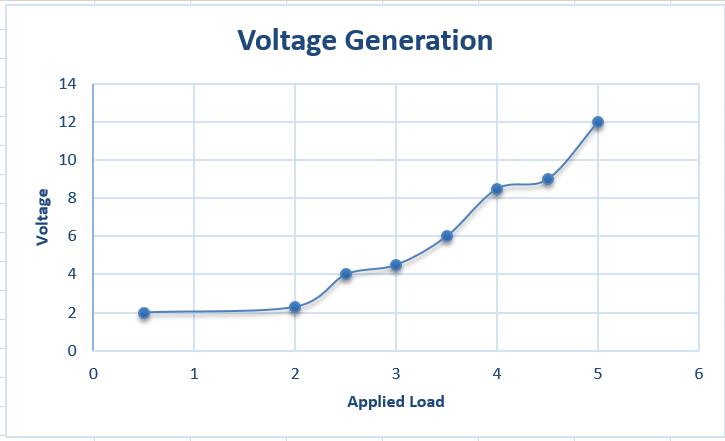
Since the amount of energy produced is relatively small comparedtotheoperatingvoltageandcurrent,thegenerated powerisstoreddirectlyinabattery.Thisstoredenergycan thenbeusedtochargethebatteryandaccessedasneeded.
Thespeedbreakerpowergenerationunit,whichharnesses vehicle movement to generate electricity, is an innovative conceptwithsignificantpotential.Thissystemisparticularly suitableforuseinareassuchaslawnsoropenspaceswhere pedal-poweredtransportationiscommon.Itcapturesenergy intheformofelectricity,whichcanbestoredinbatteriesfor applicationslikestreetlightingormobilechargingstations. Additionally,thesystemcanbeintegratedintoplayground equipment,providingbothentertainmentforchildrenanda source of electricity. It can also be combined with other renewableenergysources,suchassolarorwindpower,to enhanceitsefficiency.
Thesystem’sperformancecanbeoptimizedbyadjustingthe generator's operation through a well-designed electrical circuittobettermanagetheoutputenergy.Usinglightweight materials,suchascomposites,canhelpreducetheweightof the speed breaker mechanism without compromising its load-bearing capacity. Moreover, the system can be made more advanced by incorporating an electric grid to consolidatetheoutputpowerfrommultiplespeedbreaker units operating in tandem. Overall, the speed breaker mechanism has a wide range of applications based on its outputpower.Asingleorafewunitsmaygenerateenough energytopowerlightsandsmallelectronicdevices(suchas computers and mobile phones), while a larger network of unitscangeneratesufficientpowertofeedintothepublic electricitygrid.
[1] VedantAjayUtikar,ArnavAshutoshKulkarni,SurajRamu Gowda and Manas Milind Kulkarni, “Power Generation usingSpeedBreaker”InternationalJournalofEngineering Research&Technology(IJERT),ISSN:2278-0181, Vol.10 Issue09,September-2021.
International Research Journal of Engineering and Technology (IRJET) e-ISSN: 2395-0056
Volume: 12 Issue: 04 | Apr 2025 www.irjet.net p-ISSN: 2395-0072
[2] Jude Ezechi Dara, Christian Munachiso Odazie *, Paul ChukwulozieOkolie,AndrewOnyemazuwaAzaka,“Design and construction of a double actuated mechanical speed breaker electricity generator”Department of Mechanical Engineering,NnamdiAzikiweUniversity,PMB5025,Awka, Anambra,Nigeria,Heliyon6(2020)e04802.
[3] Alok Kumar Singh, Deepak Singh, Madhawendra Kumar, Vijay Pandit and Prof.SurendraAgrawal, “Generation of Electricity through Speed Breaker Mechanism” , International journal of Innovations in Engineering and Technology(IJIET).
[4] Aniket Mishra, Pratik Kale and Atul Kamble, “Electricity GenerationfromSpeedBreakers”TheInternationalJournal Of Engineering And Science (IJES), Volume- 2, Issue-11, Pages25-27,2013.
[5] Laukik Kharche, Kalpesh Jadhav, Pranay Gawas, Chaitali Gharat, “SPEED BREAKER POWER GENERATION” International Research Journal of Engineering and Technology(IRJET), Volume:06Issue:02|April2019
[6] T. Starner, "Human-poweredWearable Computing", IBM systemsJournal,Vol.35.3.4,pp.618-629,1996.
[7] J. Kymissis, C. Kendall, J. Paradiso, and N. Gershenfeld, "Parasitic Power Harvesting in Shoes", Digest of Papers, SecondInternationalSymposiumonWearableComputers, IEEE,pp.132-139,1998.
[8] T.Starner,andJ.A.Paradiso,"HumanGeneratedPowerfor MobileElectronics",Low-PowerElectronicsDesign,pp.135,2004.
[9] J. A. Paradiso, "Systems for Human-powered Mobile Computing", Proceedings of the 43rd Annual Design AutomationConference(ACM),2006.
[10] S.S.Taliyan,B.B.Biswas,R.K.Patil,G.P.Srivastava, and T. K. Basu, "Electricity From Footsteps", BARC NEWSLETTER,IssueNo.313,Mar.-Apr.2010.
[11] J. V. Tom, B. Boban, and M. T. Sijo, "Electricity Generation from Footsteps; A Regenerative Energy Resource",InternationalJournalofScientificandResearch Publications,Vol.3,Issue3,March2013.
[12] S.D.Mendhule,andV.K.Kankal,"HarvestingElectrical Energy from Footsteps", International Journal of Science andEngineering,Vol.1,No.2,pp.49-52,2013.