
International Research Journal of Engineering and Technology (IRJET) e-ISSN:2395-0056
Volume: 12 Issue: 03 | Mar 2025 www.irjet.net p-ISSN:2395-0072

International Research Journal of Engineering and Technology (IRJET) e-ISSN:2395-0056
Volume: 12 Issue: 03 | Mar 2025 www.irjet.net p-ISSN:2395-0072
Pranjali Chaudhari1 , Medha Rahate2 , Mahek Pokale3, Khekhasha Shaikh4, Sakshi Kasbe5
1Assistant Professor, Dept. of Information Technology and Computer Science, D.G. Ruparel College, Mumbai, Maharashtra, India
2,3,4,5 Students, Dept. of Information Technology and Computer Science, D.G. Ruparel College, Mumbai, Maharashtra, India ***
Abstract - Programming languages have evolved significantly over the decades, influenced by advancements in hardware, software development paradigms, and industry demands. The trends in programming languages continue to evolve with innovations like cross-platform development, the rise of modern frameworks, and increased demand for real-time applications, prompting the development of languages that cater to speed, concurrency, and efficiency This paper explores the milestones in the evolution of programming languages, key factors driving their evolution, current trends, and future directions shaping software development. The study examines the transitionfromlow-leveltohigh-levellanguages,theimpact of object-oriented and functional programming, the rise of domain-specific languages, and the increasing focus on performance,security,anddeveloperproductivity.
Key Words: Programming language evolution, Trends, History, low-level language, high-level language, Future & Comparative Analysis in Programming languages.
Programming languages are tools that allow humans to communicate with computers by writing instructions. Programming languages serve as the foundation of software development, enabling developers to communicate instructions to computers. Early programming languages were designed for specific machines and were often low-level, meaning they were closer to the hardware and required the programmer to manage many details manually. However, as computing needs expanded and diversified, higher-level languages emerged, allowing programmers to focus on solving problems rather than managing machine-level details. Thesehigher-levellanguagesintroducedmoreabstraction, making programming more accessible, efficient, and flexible. Additionally, domain-specific languages (DSLs) have become increasingly prevalent, as they offer specialized tools for specific problem domains, such as webdevelopment,dataanalysis,andartificialintelligence. Languages have evolved significantly over the decades, driven by the need for better performance, portability, security,and maintainability.Fromthefirstmachinecode and assembly languages, we saw the rise of procedural
programming with languages like Fortran and C, which provided clearer structures and more powerful abstractions. Later, object-oriented programming (OOP) languages, such as C++ and Java, introduced new paradigms that allowed for the development of more modular,scalable,andmaintainablesystems.
In the modern era, the emergence of functional programming, with languages like Haskell and Scala, and theincreasingimportanceofconcurrencyandparallelism, have shaped the way developers approach problemsolvingintheageofmulti-coreprocessorsanddistributed computing.
Since the advent of assembly language, programming paradigms have shifted to accommodate efficiency, usability, and evolving computing needs. This paper examines the historical evolution of programming languages, the driving factors behind their changes, and the emerging trends shaping the future. This research explorestheirevolution,keytrends,andfuturedirections.
2.
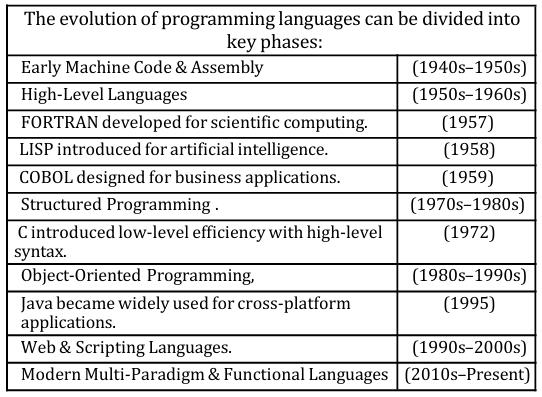
The first steps toward programmable machines were taken with the work of Charles Babbage, who conceptualized the "Analytical Engine" in the 1830s. This early design was programmable through punched cards, laying the groundwork for the idea of programming languagesinthefuture.
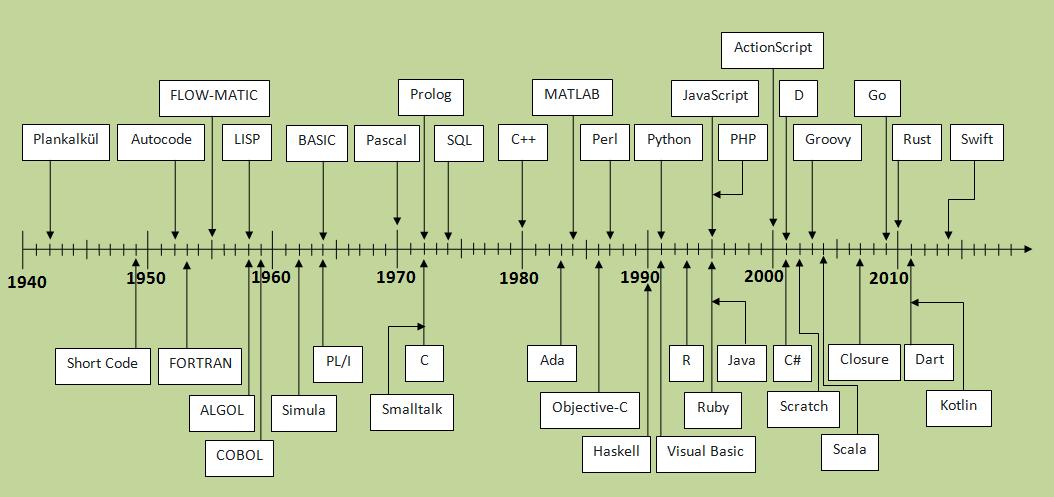
2.1 Early Programming Languages (1940s-1950s)
MachineLanguage(FirstGeneration) It consisted of Binary instructions and had direct hardwarecontrol.
Examples:ENIAC,UNIVACmachinecode.
Assembly Language (Second Generation): Introduction of mnemonics making it more readableforprogrammers.(e.g.MOV,ADD).
2.2 High-Level Programming Languages (1950-1970s)
Third-GenerationLanguages(3GLs) Move from hardware dependency to humanreadablecode.
Majorlanguagesandtheircontributions:
FORTRAN(1957):Scientificcomputing.
COBOL(1959):Businessapplications.
International Research Journal of Engineering and Technology (IRJET) e-ISSN:2395-0056
Volume: 12 Issue: 03 | Mar 2025 www.irjet.net p-ISSN:2395-0072
LISP(1958):Artificialintelligence.
BASIC(1964):Educationalprogramming.
2.3. The Rise of Object-Oriented and Functional Programming (1980s-1990s)
ObjectOrientedProgramming(OOP): The 1980s were a decade where object-oriented programming(OOP)principlesbegantotakehold on concepts of reusability, encapsulation and inheritance.
Key languages: C++ (1983), Python(1991), Java(1995)
FunctionalProgrammingEvolution: Itemphasizesonimmutabilityandrecursion. Notablelanguages:Haskell,Scheme.
Growthofdatabaseandscriptinglanguages: SQL(1974)forrelationaldatabases. Perl(1987)fortextprocessingandautomation.
2.4. Modern Programming Languages and Trends (2000s-Present)
Multi-ParadigmLanguages: It refers to the blending of procedural, OOP and functionalprogramming. Examples:Python,JavaScript,C#.
LanguagesforPerformanceandSecurity: Go(2009):Scalablewebapplications. Rust(2010):Memory-safesystemsprogramming.
MobileandCloud-OrientedLanguages: Swift(2014)foriOSdevelopment. Kotlin(2016)forAndroiddevelopment.
AIandDataScienceProgramming: Python’sdominanceinmachinelearningandAI.
2.5 Evolutionary Factors Influencing Programming Languages
TechnologicalAdvancements: Fasterprocessors,cloudcomputing,andAI.
SoftwareDevelopmentPractices: Agile,DevOpsandCI/CDpipelines.
Industry Needs: Security, scalability and automation.
Open Source Movement: Collaboration and rapid innovation.
2.6 Comparative Analysis of Major Programming Languages
Strengths and Weaknesses of different generations: Earlylow-levellanguages(likeassembly)provide high performance and control but are complex and hard to maintain, while high-level languages (like Python and Java) offer ease of development
and portability, but with performance trade-offs duetoabstractionsandoverhead.
UseCasesacrossIndustries: Programming languages are used across industries for various applications: low-level languages (like C and C++) power system software, embedded systems, and performancecritical applications; high-level languages (like Python, Java, and JavaScript) drive web development, data analysis, artificial intelligence, and enterprise applications, while domainspecific languages cater to specialized fields like scientific computing, game development, and financialmodeling.
3. Key Programming Languages
3.1 Python
Withitsversatilityandrichlibraries,Pythoncontinuesto bethetopprogramminglanguageintheworld.Itsgrowth is continuous due to its application in the field of data science, AI, and web development. Therefore, it is one of theimportantlanguagestowatchoutfor.
International Research Journal of Engineering and Technology (IRJET) e-ISSN:2395-0056
Volume: 12 Issue: 03 | Mar 2025 www.irjet.net p-ISSN:2395-0072
3.2 Java
Java is valued for its portability and robustness. It is well knownforextensivelibrariesandframeworks.Knownfor its "write once, run anywhere" capability, Java is a top choice for enterprise-level applications and Android development.
3.3 JavaScript
JavaScript is a versatile, high-level, and dynamic programming language that is primarily used for building interactiveanddynamicwebpages.Itsupportsclient-side scripting, asynchronous operations, and both objectoriented and functional programming paradigms, with dynamictypingandwidebrowsercompatibility.
3.4 Kotlin
Interoperable with Java, and with modern language features, Kotlin stands out and is increasingly used for developing Android. It keeps on evolving and soon, it will be a strong player in both mobile and server-side development
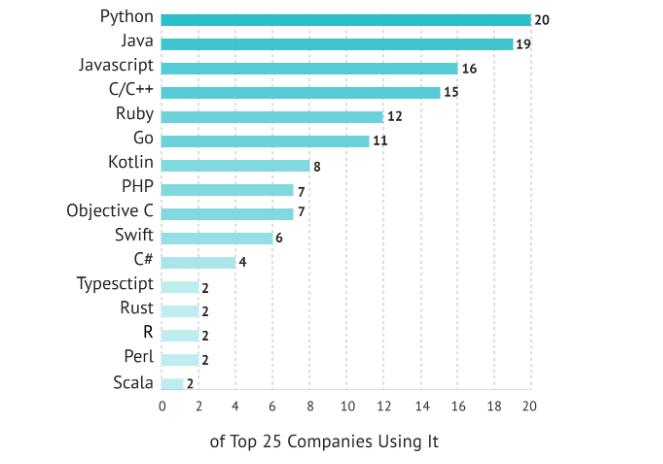
Chart-1:KEYLANGUAGES
4. MAJOR TRENDS IN PROGRAMMING LANGUAGES
4.1 Rise of Multi-Paradigm Languages
Languages: Python,JavaScript,Kotlin,Swift
Trend: Modern programming languages integrate procedural, functional, and object-oriented paradigms for flexibility.
Example: Python supports functional programming (lambdafunctions)whilebeingprimarilyobject-oriented.
4.2 Dominance of Python in AI, Machine Learning, and Data Science
Languages:Python,R,Julia
Trend: AI and data science drive Python’s popularity due to frameworks like Tensor Flow, PyTorch, Scikit-learn. Example: Python is the preferred language for AI models, while Julia is gaining traction for high-performance computations.
4.3 Decline of Legacy Languages
Languages:COBOL,Perl,VB.NET
Trend: Olderlanguages face a declineduetomaintenance challenges.
Example: COBOL is still used in banking, but demand for COBOLprogrammersisshrinking.
4.4 Growth of Performance-Oriented Languages
Languages:Rust,C++,Go
Trend: Increasing demand for memory safety and high performance.
Example: Rust is replacing C in system programming due tobettermemorysafety.
4.5 Evolution of Web Development Languages Languages:JavaScript,TypeScript,WebAssembly Trend: Strong demand for front-end and full-stack development.
Example: TypeScript(a super-set of JavaScript) is growing duetoitsstatictypingbenefits.
4.6 Cloud Computing and DevOps-Focused Languages
Languages:Go,Python,Bash Trend: Cloud computing frameworks and Develops automationdrivetheselanguages.
Example:GopowersKubernetes,Dockerandcloud-native applications.
4.7 Rise of Functional Programming Languages Languages:Scala,Kotlin,Elixir,F# Trend: Functional programming is growing due to the needforparallelcomputingandcleanercode.
Example: Scala is widely used in big data processing frameworkslikeApacheSpark.
4.8 Expansion of Mobile and Cross-Platform Development
Languages: Dart(Flutter), JavaScript(ReactNative), Swift, Kotlin
Trend: Developers prefer frameworks that enable cross platformcompatibility.
Example: Flutter(Dart)and ReactNative (JavaScript) allow buildingappsforbothiOSandAndroid.
4.9 Security-Focused Languages
Languages:Rust,Swift,TypeScript Trend: Rising security concerns increase demand for memory-safelanguages.
Example: Rust eliminates memory vulnerabilities in system-levelprogramming.
4.10 AI-Assisted Coding and Automation
Tools: GitHub Copilot, Open-AI Codex, AI-based IDEs Trend: AI-assisted programming automates code completionanddebugging.
Example: GitHub Copilot helps developers write code fasterbysuggestingentirefunctions.
International Research Journal of Engineering and Technology (IRJET) e-ISSN:2395-0056
Volume: 12 Issue: 03 | Mar 2025 www.irjet.net p-ISSN:2395-0072
5. Design and Development in Programming Languages:
Principles, Developments and Future Trends.
5.1 Principles of Programming Language Design.
A well-designed programming language balances expressiveness,performance,safety,andeaseofuse.
Keyprinciplesinclude:
1. Readability and Simplicity: Clear and concise syntax improvescodemaintainability.
Example:Pythonemphasizesindentation-basedstructure forreadability.
5.2 Expressiveness and Abstraction
High-level constructs reduce complexity and enhance developerproductivity.
Example: Functional languages like Haskell promote conciseanddeclarativecode.
5.3 Performance and Efficiency
Execution speed, memory management and concurrency handlingimpactsystemperformance.
Example: C++and Rust offer fine-grained control over memorymanagement.
5.4 Safety and Reliability
Features like static typing and memory safety prevent runtimeerrors.
Example: Rust eliminates memory leaks through ownershipandborrowingmechanisms.
5.5 Paradigm Support
Languages may support multiple paradigms (e.g. procedural,object-oriented,functional).
Example: JavaScript combines imperative, functional and event-drivenprogramming
6. Development Methodologies
6.1 Grammar and Syntax Design
Definestherulesforvalidprogramstructure.
Example: Context-free grammar (CFGs)describe syntax rules.
6.2 Compilation vs. Interpretation
Compiled languages (e.g., C, Rust): Convert source code intomachinecodeforperformanceoptimization.
Interpreted languages (e.g., Python, JavaScript): Execute codedynamicallyatruntime.
6.3 Type Systems
Static typing (e.g., Java, C#): Detects errors at compiletime.
Dynamic typing (e.g., Python, JavaScript): Allows more flexibilitybutintroducesruntimerisks.
6.4 Memory Management
Manual (e.g., C, C++): Developers control memory allocationanddeallocation.
Garbage Collection (e.g. Java, Go): Automates memory managementbutaddsruntimeoverhead.
Ownership Model (e.g. Rust): Ensures safety without garbagecollection.
6.5 Concurrency and Parallelism
Efficient handling of multi-threading and parallel execution.
Example:Gousesgoroutinesforlightweightconcurrency
7.1 AI-Assisted Code Generation
Tools like GitHub, Copilot and Open AI Codex enhance productivity. Languages will integrate AI-powered suggestionsforoptimizeddevelopment.
7.2 Quantum Computing Languages
Qiskit, Silq, Quipper: Designed for quantum algorithms andcomputing.
7.3 Domain-Specific Languages(DSLs)
Tailored languages for specialized fields (e.g. SQL for databases,Verilogforhardwaredesign).
7.4 Memory Safety and Secure Development
Increased adoption of Rust and similar memory-safe languagesinsecurity-criticalapplications.
7.5 Web-Assembly(Wasm) and Cross-Platform Development
Web-Assembly enables high-performance execution of compiled code in browsers, expanding web development capabilities.
8.Future Directions and Challenges
Discuss the potential impact of quantum computing on programminglanguages.Exploreethicalconsiderationsin language design[22]. Anticipate the role of languages in addressing global challenges (e.g., climate change, cybersecurity).
9.Current trends under the microscope
A. Dominance of Python and JavaScript:
Explore the current landscape dominated by Python and JavaScript. Examine their strengths, versatility, and how they have become essential for modern web and data scienceapplications.
B. Rise of Domain Specific Languages:
Investigate the rise of domain specific languages tailored to specialized needs, like SQL for databases, R for statistics, and Swift for IOS development. Examine how
International Research Journal of Engineering and Technology (IRJET) e-ISSN:2395-0056
Volume: 12 Issue: 03 | Mar 2025 www.irjet.net p-ISSN:2395-0072
these languages enhance efficiency in their respective fields.
C. Paradigm Diversity: Functional Programming: Examine the resurgence of interest in functional programming languages like Haskell and Scala. Understandtheiruniquefeaturesandbenefits.
The design and development of programming languages require a balance between performance, usability, security,andmaintainability.EmergingtrendssuchasAIassisted coding, domain-specific languages, and secure memory management are shaping the future of software development. As technology evolves, programming languages will continue to adapt to meet the growing demands of developers and industries. Programming languages continue to evolve, driven by emerging technologies and shifting industry needs. While older languages like C and Java remain relevant, newer languages such as Rust, Go, and Julia are gaining traction. The future of programming will likely emphasize automation, security, and efficiency, shaping the next generationofsoftwaredevelopment
[1]Aho,A.V.,&Ullman,J.D.(1992). PrinciplesofCompiler Design.
[2]Stroustrup,B.(2013).TheC++ProgrammingLanguage.
[3] Krishnamurthi, S.(2018).Programming Languages: ApplicationandInterpretation.
[4]Hickey,R.(2008).TheDesignofClojure
[5]https://www.geeksforgeeks.org/the-evolution-of programming-languages/
[6]https://www.semion.io/doc/on-the-evolution-of programming-languages.
[7]https://en.wikipedia.org/wiki/History_of_programmin g_languages
[8] The evolution of computer languages (infographic) | Extremetech
[9] P. V.Kishorchandra, B. Vadher,R. Meghnathi,M. Raychura, and K. Keshwala, "A Comprehensive ReviewBuilding A Secure Social Media Environment for KidsAutomated Content Filtering with Biometric Feedback, "Int. J. Innov. Res. Comput. Sci. Technology, vol. 12, no. 4, pp.25–30,2024.Availablefrom: https://10.55524/ijircst.2024.12.4.4
[10]N. Mehta and H. Thaker, "Study of Nutrition Based RecommenderSystemforDiabetesand Cardiovascular Patients Based on Various Machine Learning Techniques: A Systematic Review," Adv. Inf. Commun. Technol. Comput.Proc.AICTC2022,pp.317–327,2023. Availablefrom:https://10.1007/978-981-19-9888-1_24
[11]A. Roscoe, The Theory and Practice of Concurrency. 2005from: https://www.researchgate.net/publication/200032080_T he_Theory_and_Practice_of_Concurrency
[12]Z. Thakrar and A. Gonsai, "Comparing Fish Finding Techniques using Satellite and Indigenous Data based on Different Machine Learning Algorithms," in Advances in Information Communication Technology and Computing: Proceedings of AICTC 2022, Springer, 2023, pp. 329–340. Availablefrom: https://doi.org/10.1007/978-981-19-9888-1_25
[13]C.HesselmanandC.Giannelli,Eds.,"Development,"in Mobile Wireless Middleware, Operating Systems, and Applications Workshops.MOBILWARE2009.Lecture Notes of the Institute for Computer Sciences, Social Informatics and Telecommunications Engineering, vol. 12, Springer, Berlin,Heidelberg.Availablefrom: https://doi.org/10.1007/978-3-642-03569-2_6
[14]A. W. Roscoe, "The Theory and Practice of Concurrency,"1997.Available from: https://www.researchgate.net/publication/200032080
[15]B.G.Mateus andM.Martinez,"AnEmpirical Study on Quality of Android Applications written in Kotlin language," Jul. 2018, doi: 10.1007/s10664-019-09727-4. Availablefrom: https://doi.org/10.1007/s10664-019-09727-4




Asst.Prof.PranjaliD.Chaudhari M.Sc.InformationTechnology
B.Ed(Sci./Maths)
Asst.Professor,Mumbai Dept.ofIT/CS
StudentofB.Sc.ComputerScience
D.G.RuparelCollege MedhaRahate
StudentofB.Sc.ComputerScience

D.G.RuparelCollege MahekPokale
International Research Journal of Engineering and Technology (IRJET) e-ISSN:2395-0056
Volume: 12 Issue: 03 | Mar 2025 www.irjet.net p-ISSN:2395-0072

StudentofB.Sc.ComputerScience
D.G RuparelCollege
KhekashaShaikh

StudentofB.Sc.ComputerScience
D.G.RuparelCollege
SakhsiKasbe