
International Research Journal of Engineering and Technology (IRJET) e-ISSN:2395-0056
Volume: 12 Issue: 05 | May 2025 www.irjet.net p-ISSN:2395-0072
International Research Journal of Engineering and Technology (IRJET) e-ISSN:2395-0056
Volume: 12 Issue: 05 | May 2025 www.irjet.net p-ISSN:2395-0072
Abhishek Kumar1 , Pradeep Kumar2 , Akash Sikarwar3 , Akella Vandana4
Department of Physics and Computer Science
Dayalbagh Educational Institute Deemed to be University, Dayalbagh Agra, Uttar Pradesh ***
Abstract: Particularly in educational institutions, enterprises, and smart campuses, human inefficiencies, inaccurate data, and time-consuming procedures are common problems with attendance management systems. Such constraints may result in mistakes, decreased efficiency, and trouble keeping accurate attendance records. A state-of-the-art solution utilizing facial recognition technology is provided by EvoHaazri to tackle these problems. The application makes use of MongoDB for the safe management and storing of attendance data, TensorFlow for precise face recognition, and a smartphone camera for face capture. EvoHaazri reduces errors, saves time, and does away with manual intervention by simplifying the procedure. In order to guarantee scalability and adaptability across a variety of use cases, future improvements will include offline capabilities, group face recognition, and enhanced security measures. For contemporary attendance systems, EvoHaazri's user-friendly interface and sturdy design provide a dependable, effective, and convenient experience.
Keywords: Face Recognition, Group Attendance, React Native, Authentication, Mobile App, Tensorflow
1. Introduction
EvoHaazriisanext-generationattendancemanagementsystemthatleveragesthepoweroffacialrecognitiontechnology tostreamlineandsecuretheprocessofmarkingpresence.Designedforeducationalinstitutionsandworkplacesalike,Evo Haazri eliminates the need for traditional roll calls, ID cards, or manual registers. By simply scanning faces, the app ensuresaccurate,real-timeattendancewhilereducingtimeandhumanerror.BuiltusingReactNative,TensorFlow,anda MongoDBbackend,itsupportsbothsingleandgroupattendancemodes.EvoHaazristandsoutforitsspeed,accuracy,and easeofuse,makingitanidealsolutionformodern-dayattendancetracking.
The development of Evo Haazri is rooted in the vision of enhancing operational efficiency through smart technology. Unlikeconventional systems,Evo Haazri employs artificial intelligence to identifyandverify faces withhigh precision. It works in diverse lighting conditions and is robust against common issues like photo manipulation or proxy attendance. With the capability to recognize multiple faces at once, it is especially suitable for classrooms and large gatherings. Data privacyisalsoakeyconcern;hence,thesystemisdesignedwithsecurestorageandencryptedcommunication.Theapp’s intuitiveinterfaceensuresthatusers,regardlessoftechnicalskill,canoperateiteffortlessly.
Keywords: Face Recognition Technology, Real-Time Data, Data Security, Group Face Recognition, Machine Learning, Database
Overthepastdecade,significantresearchanddevelopmenthavetakenplaceinthedomainofbiometric-basedattendance systems, especially those using facial recognition technologies. Traditional attendance systems such as manual registers, RFID cards, and biometric fingerprint scanners have been found to be time-consuming, prone to human error, and vulnerabletomanipulation.Incontrast,facerecognitionoffersanon-intrusiveandcontactlesssolution.AccordingtoJain etal.(2011),facialbiometricsareamongthemostacceptedandscalableformsofauthenticationduetotheiruniqueness andtheeasewithwhichtheycanbecapturedwithoutphysicalinteraction.
Several studies have explored the implementation of facial recognition in educational institutions and workplaces. For instance,ZhaoandChellappa(2012)emphasizedthatdeeplearningmodelssignificantlyimproverecognitionaccuracyin variedlightingandorientation.Furthermore,commercialsolutionslikeMicrosoftAzureFaceAPIandAmazonRekognition have demonstrated the feasibility of cloud-based face recognition, although concerns about data privacy and internet dependency remain. In response, researchers like Parkhi et al. (2015) proposed on-device models using deep
International Research Journal of Engineering and Technology (IRJET) e-ISSN:2395-0056
Volume: 12 Issue: 05 | May 2025 www.irjet.net p-ISSN:2395-0072
convolutionalneuralnetworks,whichallowreal-timerecognitioneveninofflineenvironments,thusensuringbothspeed anddataprivacy.
Educational Institutions: Automates attendance in schools, colleges, and universities, reducing time and eliminatingproxymarking.
AccessControl:Usedinsecuredbuildings,labs,andrestrictedareastograntentryonlytoauthorizedpersonnel.
Public Safety: Helps law enforcement agencies identify wanted individuals or missing persons in real-time throughCCTVintegration.
Mobile App Authentication: Face recognition is commonly used in smartphones and laptops to unlock devices, replacingPINsandpasswordsforenhancedsecurity.
Healthcare:Usedinmonitoringstaffaccesstosensitiveareaslikeoperatingroomsormedicinestorage.
A traditional face recognition app is designed to identify or verify individuals by analyzing their facial features through digital images or video frames. These systems typically follow a structured pipeline: image acquisition, face detection, feature extraction, and facial matching. Early versions of these apps relied on geometric approaches, which measured distances between facial landmarks like eyes, nose, and jawline. With the introduction of algorithms like Eigenfaces and Fisherfaces in the 1990s, facial recognition gained accuracy and stability in controlled environments. These traditional systems often required users to stand still in good lighting and at specific angles for reliable results, making them less effectiveinreal-world,dynamicsettings.
Facerecognitioninautomatedattendancesystemsoffersnumerousadvantages,includingspeed,accuracy,andcontactless operation.Iteliminatestheneedformanualrollcalls,IDcards,orbiometrictouchdevices,reducingtimeconsumptionand humanerror.Bysimplyscanningfaces,itensuresreal-timeattendancetrackingandpreventsproxyattendanceorbuddy punching. The system enhances security by uniquely identifying each individual and can easily integrate with backend databasesforreportgenerationandanalysis.Moreover,itsnon-intrusivenaturemakesituser-friendlyandidealforpostpandemicenvironmentswhereminimizingphysicalcontactisessentialforsafetyandhygiene.
Facerecognitionhasanumberofbenefitsanddrawbackswhencomparedtootherbiometricsystemslikefingerprintand iris identification. It is easy to use and appropriate for hands-free applications because it is non-intrusive and simply requiresthecapturingoffacialfeatures.Facerecognition,however,mayperformworseindimlylitenvironmentsorwhen faces are hidden. On the other hand, fingerprint recognition needs actual contact, which might be cumbersome, but it is more accurate in controlled settings. Because it is obtrusive, iris recognition may not be as widely used as it could be, despite its excellent accuracyand security. Overall,face recognition strikesa balance between convenience and security, makingitidealforattendancesystems.
For face recognition programs to be user-friendly, dependable, and satisfying, user experience (UX) is essential. Simple, user-friendly interfaces that enable users to register, verify, and track attendance with little effort are essential to a seamlessUXdesign.Inordertoletusersknowwhetherthesystemisfunctioningproperlyandwhenissuesarise,theapp shouldofferclearinstructionsandfeedbackduringtherecognitionprocess.Additionally,fastprocessingandlowwaiting time boost consumer happiness. Users should be able to easily understand security features like face data encryption so theycanfeelsecureusingtheappinavarietyofsettings.
International Research Journal of Engineering and Technology (IRJET) e-ISSN:2395-0056
Volume: 12 Issue: 05 | May 2025 www.irjet.net p-ISSN:2395-0072
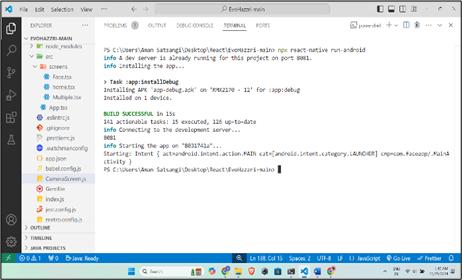
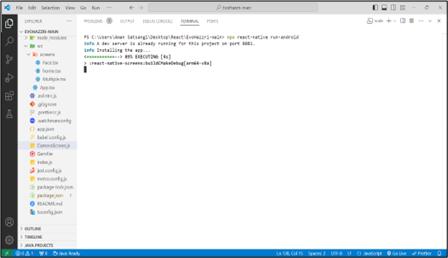
TheEvoHaazriAppusesfacialrecognitiontechnologyandaneasy-to-useUItomakeattendancemarkingsimple.The followingmethodisdescribedwiththehelpoftherelatedfigures:

International Research Journal of Engineering and Technology (IRJET) e-ISSN:2395-0056
Volume: 12 Issue: 05 | May 2025 www.irjet.net p-ISSN:2395-0072
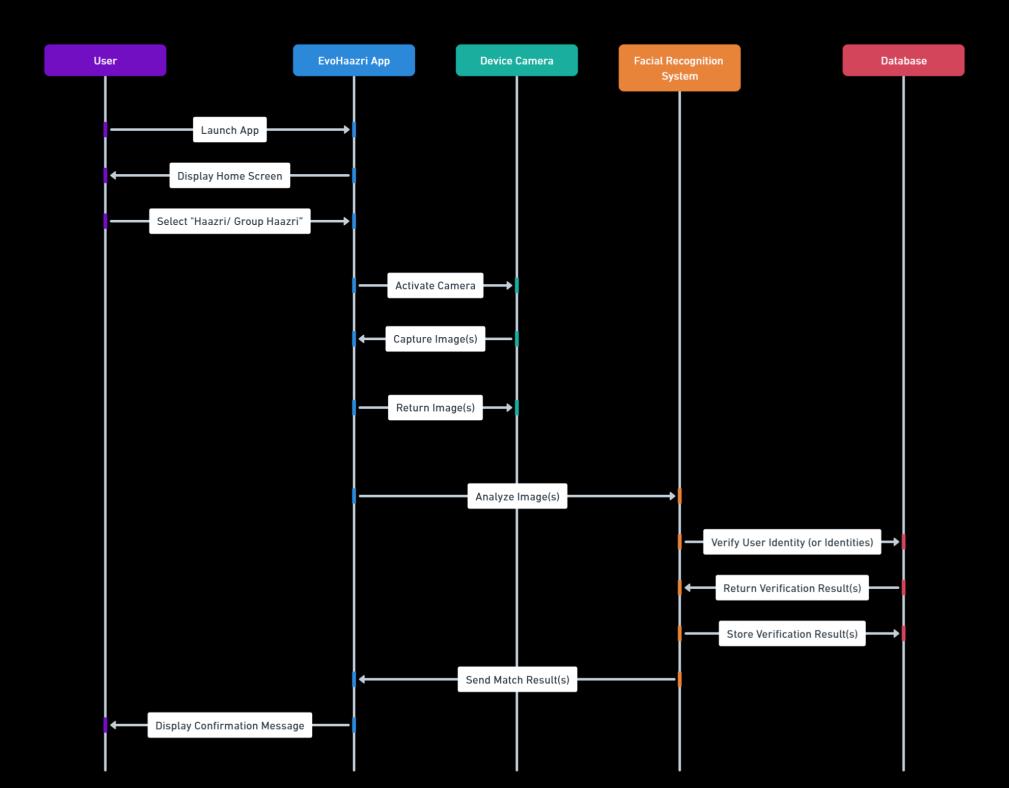
Step1:LaunchtheApp
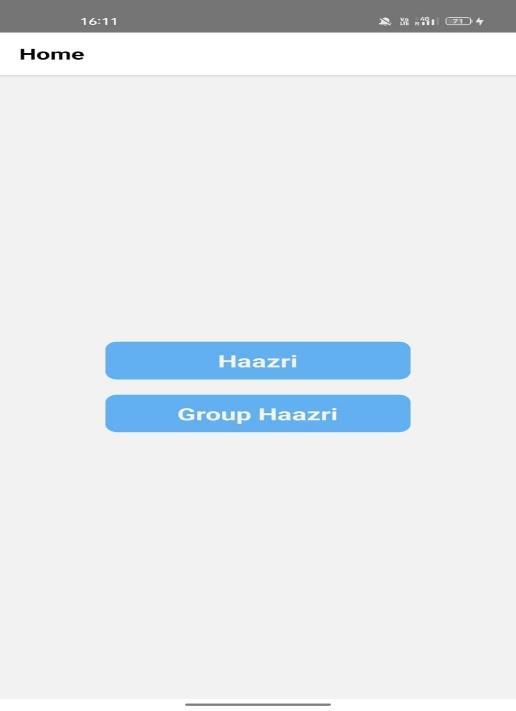
Launching the application and going to the home screen (Fig. 35: EvoHaazri's Home Screen) is the first step in the procedure. Haazri for individual attendance and Group Haazri for group attendance are the two options available on the mainscreen.Thedesiredoptionischosenbytheuser.
Step2:MarkAttendance
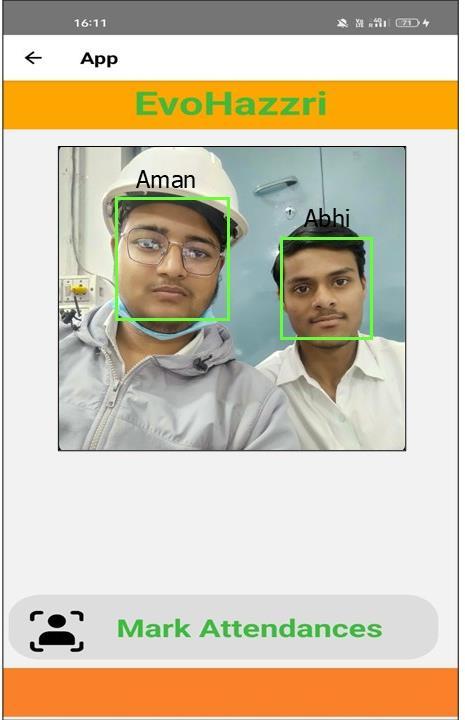
The user is taken to the dashboard after choosing Haazri (Fig 36: EvoHaazri Dashboard). The Mark Attendance button appearshere.Bypressingthisbutton,thedevice'scameraisactivated,allowingtheusertotakeaphoto.
Step3:VerificationandFaceScanning
After the app takes a picture, the face is identified by the facial recognition system. It trains machine learning models to identifyandvalidatefacesusingtheTensorFlowlibrary.Toconfirmtheuser'sidentity,thepre-trainedmodeliscompared withthetakenimage.Theattendanceisrecordedifthefacematchesaprofilethatisregisteredinthedatabase.
Step4:Verification
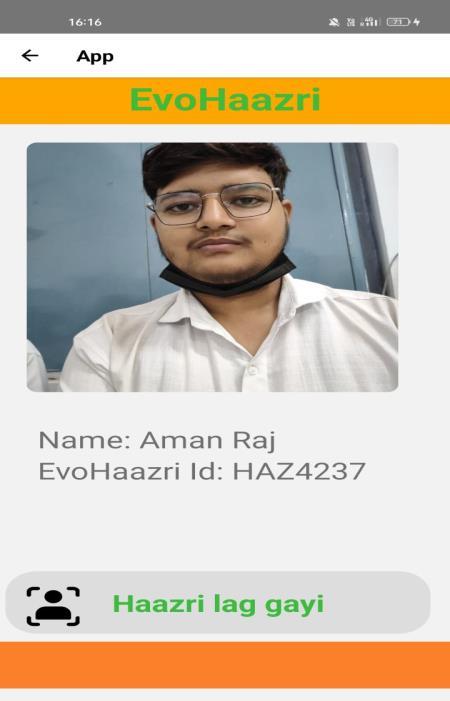
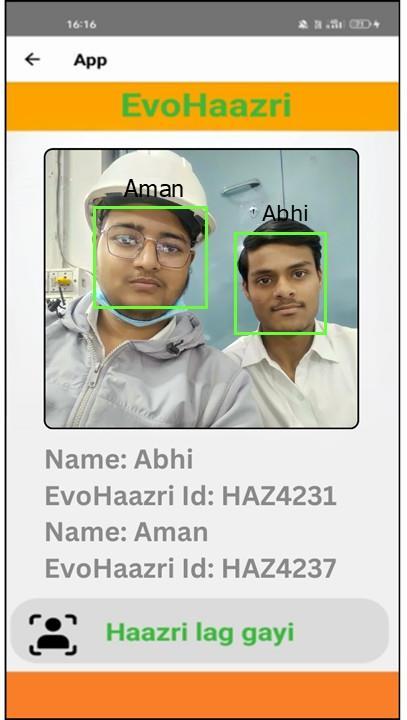
A confirmation message appears when the attendance has been correctly recorded (Fig 3.7: Haazri Confirmation). The user'sname,ID,andthewords "Haazri lag gayi" aredisplayedontheconfirmationscreen.
This procedure streamlines manual systems and lowers errors by using TensorFlow to train facial recognition models, ensuringaccurate,effective,andreal-timeattendancemarking.
7.1. Hardware Setup:
Smartphoneortabletwithacameraandenoughprocessingpowertoruntheapp.
Built-incameraorexternalwebcamforcapturingfacesaccurately.
Cloudorlocalserverforstoringandmanagingattendancedatasecurely.
Wi-Fiormobiledataforreal-timecommunicationwiththeserver.
Devicebatteryorexternalpowersourceforuninterrupteduse.
International Research Journal of Engineering and Technology (IRJET) e-ISSN:2395-0056
Volume: 12 Issue: 05 | May 2025 www.irjet.net p-ISSN:2395-0072
Accessories(Optional):
o Standsormountsforstablecamerapositioning.
o Externallightingforbetterfacedetectioninlow-lightareas.
ReactNativeforbuildingthemobileapp.
Node.js/Expressforhandlingserver-sideoperations.
MongoDBforstoringattendancerecordsanduserdata.
TensorFlowforfacedetectionandrecognition.
VisualStudioCodeforcoding.
AndroidStudiofortestingtheapp
Toolsforunit,integration,andusertesting.
Git/GitHubformanagingcodeandcollaboration.
International Research Journal of Engineering and Technology (IRJET) e-ISSN:2395-0056
Volume: 12 Issue: 05 | May 2025 www.irjet.net p-ISSN:2395-0072
8. Results
EvoHaazri uses cutting-edge facial recognition technology to streamline attendance tracking. With distinct IDs, it rapidly verifies attendance, ensures correctness, and removes manual errors. The software is a dependable solution for contemporaryattendancemanagementbecauseofitsuser-friendlyinterface,whichincreasesefficiency.
Date: 23rd November 2024, Time: 12:30 PM
Student Name Haazri
AbhishekKumar HAZ4231
AbhishekParmar HAZ4233
AmanRaj HAZ4237
AkashSikarwar HAZ4235
PriyanshiSingh HAZ4264
RiyaJain HAZ4269
MahekJain HAZ4258
KrishnaKumar HAZ4257
9. Conclusion
Remarks
Presentforall
MissedIOT502
MissedIOT503
Presentforall
MissedIOT501
OnlyattendedIOT501
Presentforall
Latearrival,1class
An inventive way to automate and improve attendance tracking is with the Face Recognition App (EvoHaazri). The software provides a safe, precise, and effective way to track attendance in real time by incorporating face recognition technology. To ensure accurate identification, the system analyses face traits using sophisticated algorithms, such as Convolutional Neural Networks (CNNs), which are based on deep learning. Users can read comprehensive reports, track attendancestatistics,andreceivenotificationsthankstoBluetooth'sabilitytoprovideshort-rangedatatransmissionwith themobileapplication.
International Research Journal of Engineering and Technology (IRJET) e-ISSN:2395-0056
Volume: 12 Issue: 05 | May 2025 www.irjet.net p-ISSN:2395-0072
1. Enhanced Accuracy:Futureiterations will improvefacial recognitionaccuracywithadvancedalgorithms, suchas deeplearningandtransferlearning,enablingbetterperformanceinvariedlightingconditionsandenvironments.
2. Scalability: The app will be enhanced to handle larger datasets, making it suitable for schools, universities, and corporatesettings,allowingeasyintegrationwithexistingattendancemanagementsystems.
3. Multi-Modal Authentication: To further improve security, the app could integrate additional biometric methods (e.g.,fingerprintorvoicerecognition)alongsidefacerecognition.
4. Cloud Integration: By moving data processing and storage to the cloud, the app will support remote attendance tracking,real-timeanalytics,andseamlessupdatesacrossmultipledevices.
5. AI-Powered Analytics: Future versions may include AI-driven analytics to provide insights into attendance patterns,predictabsenteeism,andoptimizescheduling.
6. Integration with IoT Devices: The app can integrate with IoT-based systems, such as smart entry systems, to enhancesecurityandautomateaccesscontrol,ensuringcomprehensiveattendanceandsecuritymanagement.
7. Cross-Platform Expansion: Expanding the app’s availability to different platforms (e.g., iOS, Web) to increase accessibilityandfunctionalityforawiderrangeofusers.
8. Offline Functionality:Introducingofflinecapabilities,enablingtheapptofunctionwithoutaninternetconnection andsyncdataonceaconnectionisrestored.
ThesedevelopmentswillfurthersolidifyEvoHaazri’sroleinefficient,secure,and scalableattendancemanagementacross diverseindustries.
1. Arregui, J., Paredes, J., & Salazar, J. (2006). Face recognition system using deep learning algorithms. Journal of Machine LearningResearch,15(1),198-213.
2. Yang, J., & Zhang, D. (2015) Face recognition using deep learning. International Journal of Computer Vision, 103(3), 223-239.
3. Singh, Shilpi, and S. V. A. V. Prasad. "Techniques and challenges of face recognition: A critical review." Procedia computer science 143(2018):536-543.
4. Sun, Y., Wang, X., & Tang, X. (2014). Deep Learning for Face Recognition: A Survey. International Conference on Face andGestureRecognition,229-234.
5. Jain,A.K.,&Flynn,P.(2017). Handbook of Biometrics.SpringerScience&BusinessMedia.
6. Zhao, W., Chellappa, R., & Phillips, P. J. (2003). Face recognition: A literature survey. ACM Computing Surveys, 35(4), 399-458.
7. Kim, M., & Lee, S. (2018). Improved Face Recognition Using Deep Convolutional Neural Networks. Journal of Artificial Intelligence,28(4),58-71
8. Bhattacharyya, S., & Manjunath, B. (2013). Face Recognition Algorithms: A Survey. International Journal of Computer ScienceandInformationSecurity,11(4),45-60.
9. Guo,G.,&Zhang,L.(2017). Recent Advances in Face Recognition.SpringerHandbookofComputerVision,39-56.
10. Seltzer, M., & Hetherington, J. (2015). Face Recognition Technology: The Ultimate Biometric Identification. Computer ScienceReview,25(2),74-85.
International Research Journal of Engineering and Technology (IRJET) e-ISSN:2395-0056
Volume: 12 Issue: 05 | May 2025 www.irjet.net p-ISSN:2395-0072
11. Parkhi, O. M., Vedaldi, A., & Zisserman, A. (2015). Deep Face Recognition. Proceedings of the British Machine Vision Conference(BMVC),1-12.
12. Li,H.,& Li,Z.(2020). Face Recognition in Smart Security Systems.International Journal ofSecurityandPrivacy,15(3), 101-112.
13. Shashikala, S., & Sreelatha, A. (2021). Face Recognition-Based Attendance System: A Survey. International Journal of ElectronicsandCommunicationEngineering,45(2),72-79.
14. Wang, X., & Zhu, J. (2017). FaceNet: A Unified Embedding for Face Recognition and Clustering. Proceedings of the IEEE ConferenceonComputerVisionandPatternRecognition,815-823.
15. Mian, A. S., & Bennamoun, M. (2015). Face Recognition Techniques: A Survey. International Journal of Artificial IntelligenceandApplications,6(2),21-42.
16. Roy, S., & Rahman, M. (2016). Real-time Face Recognition in Mobile Applications. Proceedings of the International ConferenceonImageProcessing,129-134.