
International Research Journal of Engineering and Technology (IRJET) e-ISSN: 2395-0056
Volume: 12 Issue: 08 | Aug 2025 www.irjet.net p-ISSN: 2395-0072
International Research Journal of Engineering and Technology (IRJET) e-ISSN: 2395-0056
Volume: 12 Issue: 08 | Aug 2025 www.irjet.net p-ISSN: 2395-0072
Agni J1 , Dr. Ashwini L K2
1PG Student (MTech) in Structural Engineering, Dr Ambedkar Institute of Technology, Bangalore, Karnataka, India
2Assistant Professor, Department of Civil Engineering, Dr Ambedkar Institute of Technology, Bangalore, Karnataka, India
Abstract -The increasing demand for sustainable constructionmaterialshasdrivenresearchintonaturalFiberreinforced composites as an alternative to conventional reinforcements.Thisstudyfocusesonevaluatingthestructural behaviour of composites made from kenaf Fiber and HDPE plastic Kenaf Fiber are lightweight, sustainable, biodegradable,andlowenvironmentalimpact whereasHighDensity Polyethylene (HDPE) is a commonly utilized plastic recognized for its low strength and resistance to both chemicals and physical impact. A range of composite specimenswillbe madeutilizingdifferentKenafFibercontent of 10kg/m3 and 20kg/m3 with a varying plastic aggregates 10%,15%and 20% to accomplish this objective. However, the experimentalanalysisiscarriedoutbyfour-point bendingon six beams of above-mentioned composites. This experiment results in promising enhancement of load carrying capacity. Key Words: Kenaf Fiber, HDPE plastic, Flexural Strength, Load carrying capacity
Duetoitstremendouscompressivestrength,adaptabilityto different structural forms, and versatility, concrete is the most extensively used building material worldwide. However,oneofitskeylimitationsisitslowtensilestrength, which is typically overcome by embedding reinforcement materials.Steelreinforcement,whilehighlyeffective,comes with drawbacks such as susceptibility to corrosion, high productioncosts,andasignificantenvironmentalfootprint intermsofcarbonemissionsduringmanufacturing.Thishas prompted the exploration of alternative reinforcement strategiesthatcan maintain structural performance while addressing sustainability concerns. The demand for sustainable and eco-friendly construction materials has spurredsignificantresearchintotheuseofalternativeFibers and polymers in concrete. One such promising composite materialisthecombinationofKenafFiberandHigh-Density Polyethylene (HDPE) plastic, both of which offer notable environmental benefits. Kenaf,a natural Fiber,has gained attention due to its abundance, biodegradability, and strength, while HDPE plastic is widely recognized for its recyclability.
Incorporating Kenaf Fiber and HDPE plastic into concrete hasthe potential to enhance itsstructural properties.The interaction between these materials within the concrete matrixcouldleadtoacompositewithimprovedmechanical performance,makingitaviablealternativeforconstruction
applications.However,thestructuralbehaviourandstrength characteristics of such composites need thorough investigation to understand their effectiveness and limitations in practical applications. Integrating such composites into concrete structures can contribute to lighter, more durable, and environmentally friendly constructionsystem
This study aims to evaluate the structural behaviour and strength characteristics of Kenaf Fiber and HDPE plastic composites when integrated into concrete. Through comprehensive experimental analysis, we seek to explore theLoadvsDeflection,andbehaviourofBeamisanalysed. Byassessingthesefactors,thisresearchwillcontributeto theongoingexplorationofsustainablematerialsandtheir potential integration into the construction industry, fosteringgreenerandmoreresilientinfrastructuresolutions. Globalawarenesshasincreasedinrecentyearsforaneedof more sustainable and eco-friendly construction practices. Thishasledtoasurgeinthedevelopmentandexplorationof alternative materials that can reduce the environmental impactofconstructionwithoutcompromisingthestructural integrityorperformanceofconcrete.
Kenaf Fiber: Kenaf is a fast-growing, sustainable, and renewable plant that produces long, strong fibers. These fibers are considered a suitable reinforcing material in concreteduetotheirhightensilestrength,lightweight,and biodegradableproperties.Additionally,kenaffibershavethe ability to enhance flexural strength of concrete while reducingcrackingandbrittleness.
HDPE Plastic: High-Density Polyethylene (HDPE) is a polymer material that is commonlyused in packaging and plastic products. While HDPE waste poses significant environmental challenges due to its non-biodegradable nature, it can be repurposed as a composite material in concrete.ByincorporatingHDPEplasticwasteintoconcrete, there isan opportunity to reduce environmental pollution whileimprovingthematerial’sproperties,suchasincreased ductility,toughness,andresistancetowaterabsorption.
The combination of kenaf fibers and HDPE plastic in concrete composites is an innovative approach that could potentiallyimprovethesustainability,strength,andoverall performanceofconcretestructures.
International Research Journal of Engineering and Technology (IRJET) e-ISSN: 2395-0056
Volume: 12 Issue: 08 | Aug 2025 www.irjet.net p-ISSN: 2395-0072
A natural, biodegradable substance that comes from the plant Hibiscus cannabinus, kenaf Fiber is becoming more well-likedasanalternatereinforcementforconcrete.Kenaf Fibers are lightweight, flexible, and possess excellent mechanicalproperties,makingthemasuitablecandidatefor enhancingthemechanicalstrengthofconcrete.Inaddition, they have the potential to improve the sustainability of concreteduetotheirlowcarbonfootprint,availabilityasan agriculturalby-product,andbiodegradability.Furthermore, Kenaf Fibers are known to improve the impact resistance and thermal properties of concrete, potentially leading to longer-lasting and more durable structures. In infrastructure.OneofthekeyusesofKenafisasasourceof naturalFiber,whichisextractedfromitsstalks.TheFibers arelong,strong,andhaveahighcellulosecontent,making them ideal for various industrial uses, including reinforcementinconcrete.
Properties of Kenaf Fiber
1. Mechanical Strength:KenafFibersareknownfor theirconsiderabletensilestrengthandhighstiffness,which makethemsuitableasareinforcementmaterialinconcrete. The Fibers improve the mechanical properties of the compositematerial,enhancingitsabilitytowithstandtensile and impact forces. Concrete becomes more ductile and resilient when Kenaf Fibers are added, increasing its resistancetocrackingunderstresses.
2. Biodegradability: As a natural Fiber, Kenaf is biodegradable, which adds an eco-friendly dimension to concrete composites. Unlike synthetic fibers, which can contributetolong-termenvironmentalwaste,Kenaffibers decomposenaturallyovertime,reducingtheenvironmental burden when used in concrete or other construction materials.
3. Sustainability: Kenaf is considered an environmentallyfriendlycropbecauseitgrowsquicklyand requiresfewerpesticidesandfertilizerscomparedtoother Fiber-producingplants.
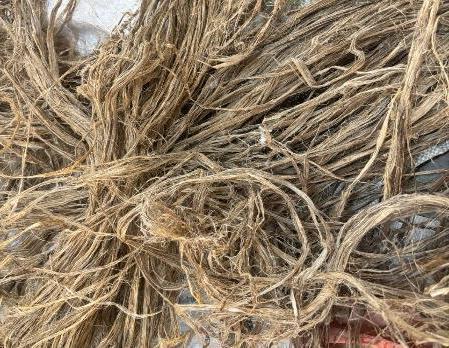
Kenaffiberisincorporatedintoconcretemixat 10kg/m3 and 20kg/m3 of 30mm length with diameter between 0.1mmto0.2mm.
High-Density Polyethylene (HDPE) aggregate is a petroleum-basedthermoplasticpolymerwithmanyuses.It isextensivelyutilizedinmanydifferentapplicationsandis well-known for having a high strength-to-density ratio, rangingfromplasticbottles,piping,andgeomembranesto toys and packaging materials. HDPE has a crystalline structure, which contributes to its strength and impact resistance. Despite its robust properties, it remains lightweight,makingitidealforbothindustrialanddomestic uses.
ThekeyadvantageofHDPEisitsresistancetoanextensive variety of chemicals, including solvents, acids, and alkalis. Thismakesitanexcellentchoiceforcontainerspipesthat areincontactwithcorrosivesubstances.Additionally,HDPE exhibits resistance to UV radiation, which prevents degradationfromprolongedexposuretosunlight,makingit suitable for outdoor applications like water and gas pipelines.HDPEisalsohighlyrecyclable,whichcontributes to its environmental appeal. Recycling HDPE can significantlyreduceplasticwaste,asitcanbereprocessed intonewproductswithoutsubstantiallossofquality.Inthe constructionindustry,itisusedforcreatingdurablepiping systems for water, sewage, and gas. Its adaptability also facilitates convenience installation in a wide range of environments, including rugged terrains. In conclusion, HDPE is a widely used material due to its durability, chemicalresistance,recyclability,andcost-effectiveness.Its ability to be moulded into a variety of shapes and forms, coupled with its environmental benefits, ensures its continuedrelevanceacrossindustries.
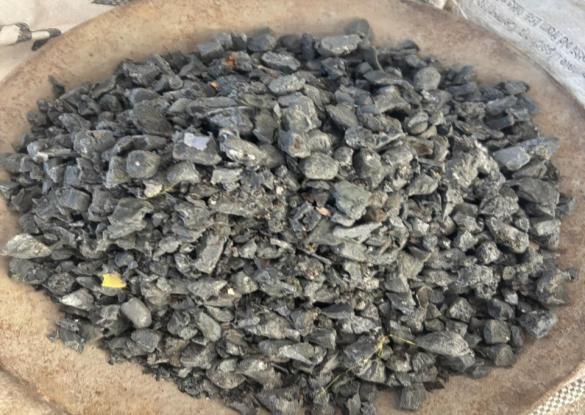
LocalwastedisposalstationsinBangalore,Karnataka,were the source of the plastic waste. Following collection, the plasticwastewascategorizedintoHDPE.Theplasticgarbage wassortedandthenproperlycleaned.Theplasticwassent toashreddingmachinetoshrinktheHDPEafterithadbeen cleaned. After that, the HDPE was heated to 200° to 250° Celsiusanddeliveredtoscreeningchamberstogetridofthe
International
Volume: 12 Issue: 08 | Aug 2025 www.irjet.net
contaminants.Aftercooling toroomtemperature,thehot, moltenHDPEwilltakeontheunevenshapesofrocks.Ajaw crusher will be used to smash the cooled HDPE to the necessarysize.
Sl no.
2.3
• Gradeofconcrete:M25
• Slump -assumed 75 to 100mm for a controlled beam
• Watercementratio:0.45
• Cementcontent:425.73kg/m3
• Fineaggregate:621.12kg/m3
• Watercontent:191.6kg/m3
• Coarseaggregate:1106.145kg/m3
Mix ratio: 1:1.45:2.6
2.4 BEAM
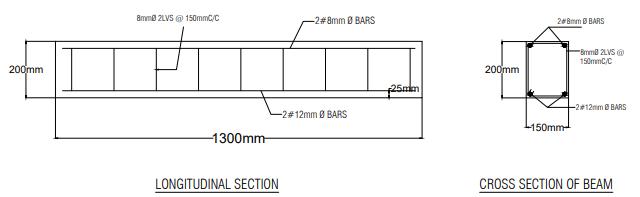
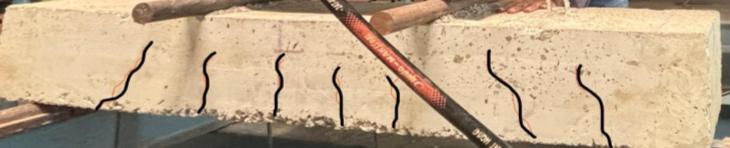
Seven beams were casted in the laboratory as per above DetailswhereHDPEaggregateswerepartiallyreplacedwith Coarseaggregateinarangeof10%,15%and20%alongwith admixture(KF)Of10kg/m3and20kg/m3. ThebeamswerecastinthecastinglaboratoryofDr. AmbedkarInstituteofTechnologyusinganM25mix proportion.
Throughoutthecastingprocess,allsafetymeasureswere adheredto.Materialsweremeasuredusingtheweight batchingmethod.
Tampingwasmeticulouslyperformedtoachieveproper compaction.
Aftercompaction,thetopsurfaceofthebeamisleveled andsmoothedtomeetthedesiredfinish.Thismayinclude aroughfinish(forfurtherfinishinglater)orasmooth surfaceforaestheticorfunctionalpurposes.
Thebeamswereremovedfromthemouldsafter24hours andthencuredfor28daysusingtheImmersioncuring method





International Research Journal of Engineering and Technology (IRJET) e-ISSN: 2395-0056
Volume: 12 Issue: 08 | Aug 2025 www.irjet.net p-ISSN: 2395-0072
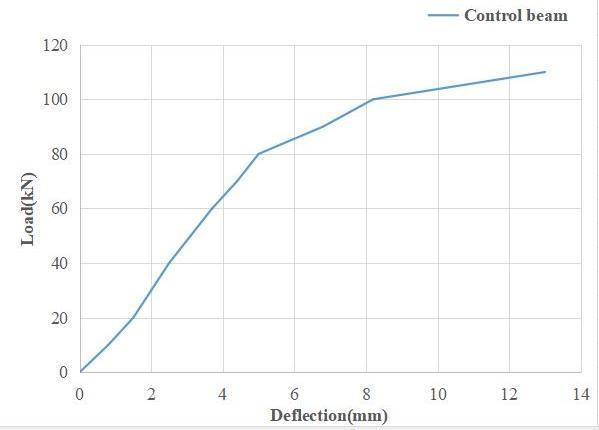
Chart-1:LoadvsDeflectionCurveofControlledBeam
• The control beam's deflection increases from 0.8 mmat10KNto15mmat110KN.
• Therelationshipbetweenloadanddeflectionisnonlinear, with the deflection increasing rapidly after around80KN.
• The beam shows significant deflection even at relativelylowloads,suggestingpotentiallimitations initsstructuralcapacity.
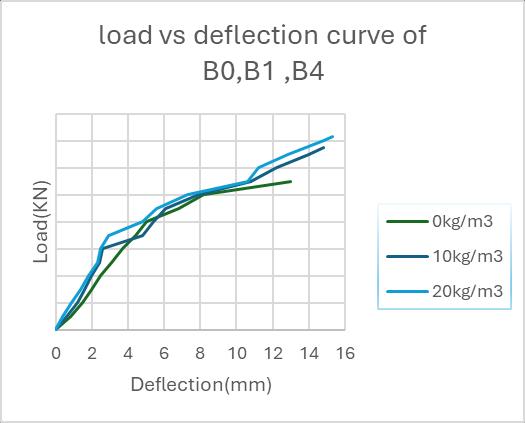
Chart-2:LoadvsDeflectionofB0,B1,B4
Beam 1 carried an ultimate load of 112KN with a max Deflectionof14.8mmandBeam4carriedanultimateloadof 115KNwithamaxdeflectionof15.3mm
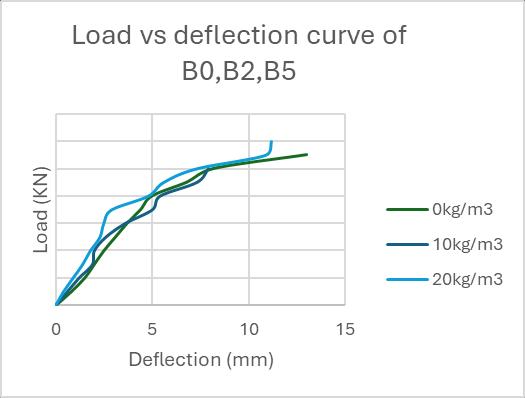
Chart-2:LoadvsDeflectionCurveofB0,B2,B5
Beam 2 carried an ultimate load of 105KN with a max deflectionof7.9mmandBeam5carriedanultimateloadof 108KNwithamaxdeflectionof11.2mm
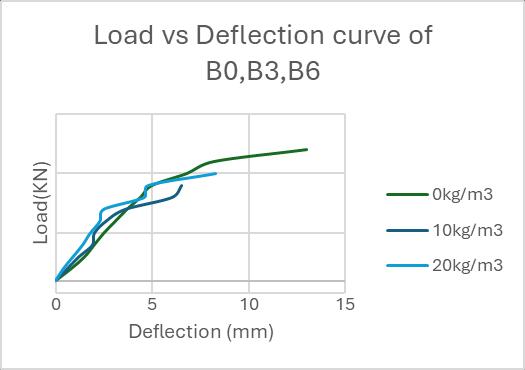
Chart-3:LoadvsDeflectionCurveofB0,B3,B6
Beam 3 carried an ultimate load of 80KN with a max deflectionof6.5mmandBeam8carriedanultimateloadof 90KNwithamaxdeflectionof8.3mm.
Pcr:InitialCrackLoad,Pu:UltimateLoad,∆cr:InitialCrack deflection,∆u:Ultimatedeflection
International Research Journal of Engineering and Technology (IRJET) e-ISSN: 2395-0056
Volume: 12 Issue: 08 | Aug 2025 www.irjet.net p-ISSN: 2395-0072
• Asfromtheanalysisofbeams,beam1with 10kg/m3ofkenafFiberand10%ofHDPEplastic carriedanultimateloadof112KNWithmax deflectionof14.8mmwhichis2KNgreaterthan thecontrolledbeam.
• Beam2with10kg/m3ofkenafFiberand15%of HDPEplasticcarriedanultimateloadof105KN Withmaxdeflectionof7.9mmwhichis5KN Weakerthanthecontrolledbeam.
• Beam3with10kg/m3ofkenafFiberand20%of HDPEplasticcarriedanultimateloadof80KN Withmaxdeflectionof6.5mmwhichis30KN weakerthanthecontrolledbeam.
• Beam4with20kg/m3ofkenafFiberand10%of HDPEplasticcarriedanultimateloadof115KN Withmaxdeflectionof15.3mmwhichis5KN greaterthanthecontrolledbeam.
• Beam5with20kg/m3ofkenafFiberand15%of HDPEplasticcarriedanultimateloadof108KN Withmaxdeflectionof11.2mmwhichis2KN Weakerthanthecontrolledbeam.
• Beam6with20kg/m3ofkenafFiberand20%of HDPEplasticcarriedanultimateloadof90KN Withmaxdeflectionof6.5mmwhichis20KN weakerthanthecontrolledbeam.
From the experimental study, It is determined that the structuralbehaviourofreinforcedconcretebeamsisgreatly impactedwhen HDPE plasticaggregate isusedinplace of natural coarse aggregate. Among the varying replacement levels, the beam with 10% HDPE aggregate exhibited the maximum flexural strength and load-carrying capacity, indicatingthatthispercentageprovidesanoptimumbalance between strength and sustainability. Higher replacement levelsshowedagradualreductioninstrength,highlighting that controlled incorporation of HDPE at 10% is most suitableforenhancingbeamperformancewhilepromoting eco-friendlyconstructionpractices. The results of this project would likely show a promising combination of kenaf Fibers and HDPE plastic waste as composite materials for concrete. The potential outcomes could include enhanced mechanical properties, improved sustainability, and reduced environmental impact, which wouldofferaviablealternativetoconventionalconcretein certainapplications.Theresearchmightconcludethat,with the correct mix design, kenaf Fiber and HDPE plastic composite concrete can be a cost-effective and environmentallyfriendlymaterial suitable for a variety of structuralapplications,contributingtoamoresustainable construction industry, waste management and greener constructionpracticeswithoutsignificantlycompromising structuralIntegrity.
[1] AbdulhaiKaiwaan,2SayedJavidAzimi,3SayedAlem Azimi(2023)“StructuralBehaviorofKenafFibre ReinforcedConcreteBeams”-Eídos,2024revistas.ute.edu.ec
[2] VMahalingam,AVeeramani(2023)estimatingthe structuralstrengthofkenaffiberreinforcedconcreteresearchgate.net
[3] AHBirniwa,SSAbdullahi,MYYakasai
[4] MRMAsyraf,MRafidah,AAzrina,MRRazmanCellulose,2021-Dynamicmechanicalbehaviourof kenafcellulosicfibrebiocomposites:acomprehensive reviewonchemicaltreatments
[5] Performanceofkenaffiberconcreteunderstaticand dynamicloadingMRazavi-FacultyofCivil EngineeringUniversityofTechnology…,2017eprints.utm
[6] Mechanicalpropertiesofconcretereinforcedwiththe HDPEplasticFiberPešić,SŽivanović,RGarcia…Constructionandbuilding…,2016-Elsevier
[7] Engineeringperformanceofconcreteincorporated withrecycledhigh-densitypolyethylene(HDPE) A systematicreviewSAbeysinghe,CGunasekara,C Bandara,KNguyen…-Polymers,2021-mdpi.com
[8] Areviewontheuseofhighdensitypolyethleneplastic inconcretemixtureTWani,SAQPasha,SPoddar…Int.J.Eng.Res…,2020-pdfs.semanticscholar.org
[9] Tamrin,JNurdiana-Recycling,2021-mdpi.comusing CFRP,GFRPandhybridFRPsheet”, Elsevier,2012.The effectofrecycledHDPEplasticadditiononaconcrete performance.
[10] CSuksiripattanapong,KUraikhot,STiyasangthong…Infrastructures,2022-mdpi.comperformanceof asphaltconcretereinforcedinhighdensity polyethyleneplastic.
[11] RJGravina,TXie,BBennett,PVisintin-Journalof BuildingEngineering,2021–ElsevierHDPEandPET asAggregateReplacementinConcrete:Life-cycle assessment,MaterialDevelopment,andacasestudy.