
International Research Journal of Engineering and Technology (IRJET) e-ISSN:2395-0056
Volume: 12 Issue: 06 | Jun 2025 www.irjet.net p-ISSN:2395-0072
International Research Journal of Engineering and Technology (IRJET) e-ISSN:2395-0056
Volume: 12 Issue: 06 | Jun 2025 www.irjet.net p-ISSN:2395-0072
Dr. Chitra B T1, Aakash Amar Murthy2, Aditya Saiprasad3, Advaith A4, Akshat D5
1Assistant Professor, Dept. of Industrial Engineering and Management, R. V. College of Engineering, Karnataka
2Student, Dept. of Computer Science and Engineering, R. V. College of Engineering, Karnataka
3Student, Dept. of Computer Science and Engineering, R. V. College of Engineering, Karnataka
4Student, Dept. of Computer Science and Engineering, R. V. College of Engineering, Karnataka
5Student, Dept. of Computer Science and Engineering, R. V. College of Engineering, Karnataka
Abstract - Artificial intelligence voice cloning technology is now so advanced that it can generate highly realistic human voice copies from minute samples, allowing the recreation of the voice of deceased artists to be used in new works. This technology poses deep ethical, legal, and social questions about consent, posthumous personality rights, and integrity of artistic heritage. This paper discusses ethical complexities of posthumous voice recreation technology, examines current regulatory frameworks, and formulates ethical standards for responsible use in art and commercial environments. Key findings identify that while AI voice recreation unlocks creative and commercial potential, its ethical use necessitates transparent consent models, transparent attribution practices, and proper regard for cultural and family interests.
Key Words: Voice Cloning, Artificial Intelligence, Posthumous Rights, Digital Legacy, Artistic Integrity, Voice Synthesis
The rapid advancement of artificial intelligence has made it possible to develop sophisticated voice cloning technologies with the capacity to imitate human voices in a very close approximation with high accuracy and authenticity. This capability has far-reaching implications in the entertainment industry since it can "bring back to life" the voices of dead creatives after death to be used in newcreativeworks,commercials,orotherpurposes.Even though the technology is of immense creative potential andpotentialeconomicworth,italsoraisesseriousethical concerns regarding consent, intellectual property rights, andrespectingthememoryofthedead.
The moral implications of exploiting AI to make copies of thevoicesoflateartistsareatthenexusofsomeintricate fields:digitalrightsmanagement,posthumouspersonality rights, artistic integrity, and preservation of cultural heritage. Who-if anyone-should have the right to sanction suchcopiesisanissueofdebate,asisthequestionofhow such content should be released to the public. With the emergence of technology that can clone a voice based on
only minutes of audio samples, the barrier to produce unauthorized vocal copies has dropped dramatically, furtherfuelingthesemoralissues.
This research examines the ethics of reviving dead voices through AI technologies, such as current practices, law, harms, and remedies. By combining AI ethics, entertainment law, and cultural studies in an interdisciplinary framework, it aims to contribute to the development of ethical recommendations that are sensitivetotherightsandlegaciesofthedeadauthorsand facilitateresponsibleinnovationinthecreativeindustries.
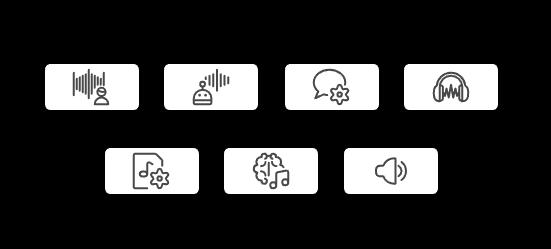
Voice cloning technology (Fig-1) has advanced significantlyin recentyears, withAIsystemsnowcapable of producing speech that is nearly indistinguishable from human voice patterns. These systems analyze speech samples to identify unique vocal characteristics and then generate new speech that maintains these distinctive features. According to industry research, the number of voice-assisted devices is expected to grow exponentially, indicating the growing prevalence and sophistication of voicesynthesistechnologies.
Modern voice synthesis platforms allow for precise manipulation of voice characteristics through Speech Synthesis Markup Language (SSML), giving users control over pitch, pronunciation, rate, and volume of the generated speech. This level of control enables the creationofhighlypersonalizedandrealisticvoiceoutputs, making the technology particularly appealing for applications in entertainment, customer service, and accessibilitytools.
International Research Journal of Engineering and Technology (IRJET) e-ISSN:2395-0056
Volume: 12 Issue: 06 | Jun 2025 www.irjet.net p-ISSN:2395-0072
2.2
A major court case arose in America with Main Sequence, Ltd. v. Dudesy, LLC, which was filed on January 25, 2024, in the U.S. District Court for the Central District of California.Theestateoflate comedianGeorgeCarlinsued producers of the AI-made special George Carlin: I'm Glad I'm Dead, claiming that the defendants utilized thousands ofhoursofCarlin'soriginalstand-upmaterialtocreatean AImodelthatmimickedhisvoiceandstyleofcomedy.The estate argued that such unauthorized use was both copyright infringement and publicity rights infringement. Though the case was settled on April 2, 2024, it was a landmarkmomentincourtargumentsabouthowmuchAI training on copyrighted content constitutes infringement, and whether mimicry of the voice of a deceased person mightbeprohibitedundercurrentpublicitylaws.
Inyetanothercelebritycase,rapperTupacShakur'sestate threatened suit against Drake in April 2024, in California jurisdiction. The complaint was against Taylor Made Freestyle, a diss track that used AI to simulate Tupac's voice. The estate, represented by attorney Howard King, requested the song be taken down within 24 hours, condemning its unauthorized and disrespectful use, especiallyinthecontextofabeefTupacneverparticipated in. Although this was a threatened and not commenced case, it expressed growing discomfort over the manipulationofTupac'slegacyormisappropriationofAIgeneratedvoicestomakethemappearasiftheyaretaking positions they never took. The estate also challenged the process of AI training and demanded disclosure over the creation of the voice model, showing how discovery in suchproceedingsmayevolve.
In India, a landmark judgment was delivered by the BombayHighCourtinArijitSinghv.CodibleVenturesLLP, withCaseNo.COMIPRSUIT(L)NO.23443of2024,which was delivered on July 26, 2024. Arijit Singh still being alive, the case is of utmost significance for posthumous rights matters. Singh claimed that the defendant used artificialintelligencetoolstogeneratehisvoiceandimage withoutpermissionsothatitappearedthathepromoteda
virtual concert platform for commercial and advertisementpurposes.ThecourtheldthatSingh'svoice, likeness,andpersonaweresubjecttoprotectionunderthe rights of personality and publicity, thus unequivocally establishing the dangers of unauthorized generative AI. Justice R.I. Chagla noted the increasing susceptibility of public personalities to online impersonation. This judgment established a precedent in India for protection against artificial intelligence exploitation of artistic identity.
The United States District Court for the Southern District of New York is presently hearing the case of Lehrman v. LOVO,Inc.,aclass-actioncasefiledonMay15,2024.Voice overactorsPaulSkyeLehrmanandLinneaSageallegethat LOVO Inc. tricked them into recording on the freelance platform Fiverr for research purposes, which were then utilized without permission to develop commercial AI voice products. The case, now pending a motion to dismiss, has important questions of law concerning informed consent, fair use, and how platform-based businesses such as Fiverr terms of service adequately protect creators' rights. It also highlights how artificial intelligencebusinessescanleveragecontractualloopholes to avoid direct responsibility, revealing the loopholes faced not only by living performers but also by estates of thedeadifthesametacticisfollowedtorevivevoicesafter death.
Together, these legislative and legal innovations demonstrate an increasing awareness of the ethical and legal subtleties of AI voice cloning. Whether their targets aredeceased,asinthecasesofCarlinandTupac,orliving, as in the cases of Singh and Lehrman, the fundamental issues are consent, control, and safeguarding individual identity. These examples demonstrate the manner in which current legal tools copyright, publicity rights, unfair competition, and newly enacted statutory protections comeunderscrutinyandrevisiontoaddress the challenges of AI-generated voice technology. As the speedoftechnologicalchangeincreases,therespectfuland lawful use of artists' vocal representations past and present continues to be a compelling problem in the areasoflawandethics.
On the other hand, the European Union has, however, shown an interest in reforming copyright law to address relevant issues in the digital age. In 2021, the European CommissionlaunchedtheArtificialIntelligenceAct,which is meant to govern and control both the use and
International Research Journal of Engineering and Technology (IRJET) e-ISSN:2395-0056
Volume: 12 Issue: 06 | Jun 2025 www.irjet.net p-ISSN:2395-0072
development of artificial intelligence by setting standards for developers and users. Nonetheless, in spite of the current draft of the AI Act demanding openness and data control, the AI Act has been faulted for failing to sufficiently address the generative AI technologies developedtoproducevideoandaudiocontent.
The UVA, an international organization of 35 European voice actors' guilds, associations, and unions, made a complaint and has since joined hands with organizations locatedinSwitzerland,theUSA,andAsiatoprotectartistic heritage and human creativity from potential harm that canbeinflicted byusingAI inthevoice-overanddubbing industry.
Also, Section 57 of the Copyright Act of 1957 deals with the specific rights of authors, which are known as "Moral rights." In Genda Phool, a modern adaptation of a traditional Bengali folk song sung by Ratan Khar was charged with infringing upon the performance as well as moralrightsofthesinger.
Previously, artists did not have the privilege of copyright or earn royalties. After the historic 2012 amendment of the Copyright Act, 1957, the Act recognized "Performer's Rights,"underSection38whichprovidessingersroyalties and requires permission for public performance of their recordsfor50yearsfromtheyearofperformance.
UndervoicecloningunderAItechnology,theprinciplesof traditional performance are rendered obsolete. The AI technology replicates the vocal traits of legendary artists without replicating a specific performance, thus avoiding the original artist from claiming infringement of traditionalperformancerights.IntheIndianlegalcontext, the copyright law does not offer any kind of legal protection to the vocal performances of singers. The definitionunderSection2(q)oftheCopyrightActof1957 defines a "performance" in the context of performers' rightsasplayedlivebyoneormorepersons,whichcanbe either in the form of visual or sound forms. For this reason,ownersofvocalpropertydonotholdperformance rights,northerighttoclaimroyalties,astheperformance is not being performed by the individual vocalist. However, an argument can be made on infringement of moralrightsorspecialrights.
The ELVIS Act, or the Ensuring Likeness Voice and Image Security Act, was signed into law by Tennessee Governor BillLeeonMarch21,2024,andisalandmarkachievement inartificialintelligencepolicyandpublicsectorregulation addressing artists in the context of artificial intelligence
(AI) and AI alignment. The act has been identified as the first United States law to explicitly empower the protection of musicians from unauthorized use of their vocal characteristics through artificial intelligence technology, such as audio deep fakes and voice cloning. The act is notable for clearly stating punitive measures againstthecopyingofaperformer'svoice.
Contemporary copyright law is primarily interested in safeguarding 'fixed' and material forms of creativity, such as music works, lyrics, recorded music, and artwork. In contrast, intangible forms, such as an individual's voice, are largely unsecured. Especially in America, the ownership rights that occur with an individual's voice have not been incorporated into federal copyright legislation,giventhatsoundsofthevoicedonotconstitute 'fixed,'asthelegislationrequires.
In addition, although law meant to protect personal privacy, prevent fraud, and regulate consent can theoretically be applied to voice cloning, as yet no particular legislation or regulations were drafted specifically to be sensitive to the special problems posed bythetechnology.
Also, in America, the principle of 'fair policies' allows the use of copyrighted material in limited ways, without permission from the copyright holders. However, no definition exists for 'limited fair use,' particularly with regardstoAItechnology.
This study employs a hybrid, mixed-methods design to provide a rich and multi-dimensional analysis of AI voice cloning. This design combines the contextual depth of qualitative rapid review with the empirical strength of quantitative statisticalanalysis.Thequalitativestrand explores the complex ethical, legal, and social issues embedded within the use of AI to clone artists' voices posthumously. In contrast,the quantitative strand measures the technology's market growth, popularity, usage patterns, and documented cases of misuse. By combining the approaches, this study triangulates evidence to enhance the validity and reliability of the analysis, hence gaining in-depth understanding of the phenomenon.
The rapid review technique is utilized in this research in exploring the ethical issues that come with the utilization of artificial intelligence in mimicking the voices of deceased artists. Rapid reviews constitute systematic reviews of the literature conducted within a shorter time
International Research Journal of Engineering and Technology (IRJET) e-ISSN:2395-0056
Volume: 12 Issue: 06 | Jun 2025 www.irjet.net p-ISSN:2395-0072
frame, and as such, are especially suited for new ethical considerations in technology that are typified by fast development Thetechniqueallowsforquickidentification and exploration of major ethical issues with less methodologicaleffort.
Data Collection and Analysis
The aim of the review was to find relevant literature that discussed the ethical, legal, and social implications involved in voice cloning technology, specifically in terms of its use with deceased persons. Sources were chosen based on relevance to the research question, in terms of worksthathadtouchedon:
● Technical limitations and capabilities of current voicecloningtechnology
● Legal frameworks regulating posthumous personalityrights
● Ethical principles and proper standards of AI usage
● Posthumous voice recreation case studies in entertainmentsectors
● Perceptions of different stakeholders, such as artists,legalprofessionals,ethicists,andtechnologists.
Thedatacollectedwassubjectedtothematicanalysiswith the view to uncovering important ethical problems, legal considerations, and recommendatory solutions The analysis was premised on existing ethical principles of artificial intelligence such as transparency, fairness, nonmaleficence,accountability,andprivacy.
Analysis and Discussion
Ethical frameworks for voice recreation
The ethical use of AI voice simulation requires setting up strict frameworks that respond to the specific issues of this technology. A number of Responsible AI frameworks have been proposed to facilitate ethical deployment of AI technologies;however,themajorityoftheframeworksare centered on the requirements elicitation phase of development, hence missing other dimensions of the software development life cycle. A robust framework for voice simulation technologies must include norms of consent, transparency, fairness, and maintaining human dignityinallphasesofdevelopmentanddeployment.
The "ethical AI" idea goes beyond legal compliance to include wider considerations of moral accountability, social accountability, and respect for human dignity. In mimickingthevoiceoflateactors,thisinvolvesdedication topreserving theartistic heritageandintegrityofthelate actor and the cultural and familial interests in the representationoftheirvoiceandwork.
There are substantial obstacles to the establishment of open consent processes for voice utilization after death Although many jurisdictions have statutory regimes controlling posthumous personality rights, the regimes differ substantially in scope and application. In the absenceofcleardirectionfromthedeceasedartist,control over voice recreation typically vests in estate managers, family,orotherrepresentativesunderlaw
The morally responsible application of consent protocols fortheutilizationofvoicesafterdeathmustconsider:
● The stated desires of the deceased artist concerningtheposthumoususeoftheirvoiceorimage.
● Cultural and family motives to keep the artist's memoryalive.
● Damage to the artist's reputation or long-term effectprobability.
● Adherencetoset standards andcreative visionof theartist.
● Transparency in the articulation of the artificial qualityofre-createdvoicestolisteners
The reproduction oflateartists' singingvoices is typically a multifaceted combination of artistic and commercial interests.Commercialusesmightbenewmusicalreleases, commercial advertising, or other profitable uses, and artistic interests might be creative use, cultural heritage preservation, or education. Ethical concerns must reconcile potential conflicts of interest among purposes, establish standards of commercial acceptability of reconstructed voices, and determine conditions under which profits will be divided. These concerns go beyond legally imposed duties to fulfill moral duties to preserve the artistic legacy of the creators and to make reasonable compensationtotheirestatesorbeneficiaries.
The transparency required in the use of AI-generated content is necessary to ensure trust and respect for viewers' autonomy. In the use of synthetic voices in commercial or creative environments, viewers need to be informed about the following by transparent attribution practices:
● The application of AI for modifying or producing voicematerial
● The degree of manipulation or synthesis employed
● Consentoftheaffectedrightholders.
International Research Journal of Engineering and Technology (IRJET) e-ISSN:2395-0056
● Therationaleandbackgroundforthere-creation.
The application of these practices of transparency works toensurethataudiencesarenotdeceivedas tothenature or origin of the content to which they are being exposed, thus allowing them to make well-informed choices regardingtheirinvolvementinposthumousrecreations.
Drawing on the ethical analysis and frameworks, the following are recommended for the beneficial application of AI voice recreation technology in the case of deceased artists:
● AuthorizationandConsent
● Get written permission from estates, legal guardians, or other authorized bodies prior to recreating thevoiceofadeceasedartist
● Honor any wishes stated by the artist while he was alive concerning the posthumous application of his voice
● Establish specific agreements that define the scope,intent,andtimeframeoflawfulvocalduplications.
● TransparencyandDisclosure
● Explicitly reveal the utilization of AI-generated voicecontenttolisteners
● Don't feature remastered voices in a manner that couldmisleadviewersaboutwheretheyoriginated.
● Providecontextualdetailaboutthemanufacturing processandauthorisationstatus
● ArtisticIntegrity
● Use remastered voices in a manner that best reflectstheartist'sestablishedstyleandvalues.
● Consider the potential impact on the artist's legacyandculturalinfluence.
● Involve professionals who are well versed in the artist's works to provide input on the construction of creativesolutionstovoicereconstruction.
● ConfidentialityandProtection
● Implement strong security controls to safeguard voicedataagainstunauthorizedaccess.
● Limit the storage and collection of voice samples tovalidpurposes
● Periodically review voice recreation systems to ensuretheymeetethicalstandardsandsecurityprotocols.
● JustCompensation
● Describeclear payment schedules forvoiceusage followingrestoration
● Provide equitable compensation to the legitimate recipients(estates,foundations,namedbeneficiaries)
● Charitableorculturalpreservationelementsmust betakenintoaccountincommercialagreements
Volume: 12 Issue: 06 | Jun 2025 www.irjet.net p-ISSN:2395-0072 © 2025, IRJET | Impact Factor value: 8.315 |
The voice cloning industry has seen explosive growth, with market valuations reflecting cross-industry usage. In 2024,theglobalvoicecloningmarkethadanapproximate value of USD 2.0 billion and was projected to grow up to USD 12.8 billion by 2033 at a compound annual growth rate (CAGR) of 22.97%. Other projections reflect even more aggressive growth trends, with some projecting the market to be USD 25.75 billion by 2031 at a CAGR of 29.8%, while others project an increase to USD 31.41 billionby2035,alongwithaCAGRof28%.
The AI voice cloning segment, in particular, showcases staggering growth, with the market size anticipated to grow from USD 2,430.3 million in 2024 to USD 20,943.8 million by 2033 at a 27.0% CAGR. In the United States alone, the AI voice cloning market is anticipated to grow fromUSD859.7millionin2024toUSD6,545.6millionby 2033ata25.3%CAGR.
● Fraud and Scam Statistics: Voice cloning technology has increasingly been used for fraudulent activities, with extensive consequences for public safety and security. In the United States alone, in 2024, there were more than 845,000 reports of imposter scams, even though the Federal Trade Commission does not maintain credible records of voice cloning scam utilization. AIdrivenvoicecloningusesawawhoppingincreaseof442% from the first half of 2024 to the second half of 2024. In the same year, every second company in the world reportedincidentsofdeepfakefraudwithaudiodeepfakes witnessing a 12% increase compared to survey data conducted in 2022. Video deepfakes also saw an even stronger growth, with a 20% increase in the number of companies reporting incidentscompared to 2022. 49% of the companies surveyed reported being impacted by deepfakeincidents,asteepincreasecomparedtoprevious years.
● Deepfake Incident Trends: Closely monitoring deepfake incidents shows rising trends in unauthorized voice duplication. From 2017 to 2022, there were just 22 deepfake cases across the world, but in 2023 this figure nearly doubled to 42 cases. Incidents rose 257% to 150 incidentsin2024.Inthefirstquarterof2025alone,there were already 179incidents, a 19% rise fromthe whole of 2024. 31% of all deepfake incidents since 2017 are for fraud, with 17% for political figures, 27% for celebrities, and 56% for other forms of fraud. Celebrities were
International Research Journal of Engineering and Technology (IRJET) e-ISSN:2395-0056
Volume: 12 Issue: 06 | Jun 2025 www.irjet.net p-ISSN:2395-0072
impersonated 47 times for the first quarter of 2025, an 81% rise from the whole of 2024. Politicians were impersonated 56 times, nearly reaching the 2024 total of 62incidents.
● Market Leadership by Geography: North America is the leading geography in the global voice cloning market, holding approximately 40.2% of the overall market share in 2024. The reason for the position of the region is the technological developments in the region, significant research and development investments, and the presence of the top technology players. The AsiaPacificregionwillexhibitthehighestgrowthratebecause of the rapid adoption of technology, increasing penetration of smartphones, and significant research and development investments in artificial intelligence. China, India,andJapanarepropellingtheAIinnovationprograms driven by significant government investments and encouragement of AI initiatives. Additionally, the region's huge, heterogeneous population offers enormous opportunitiesforlocalizedandcustomizedAIsolutions.
● RegionalVulnerabilitytoDeepfake-RelatedFraud: There are regional differences in vulnerability to deepfake-related fraud, with some being more vulnerable thanothers.TheUnitedArabEmiratesandSingaporehave higher-than-average vulnerability to deepfake fraud, with 56% of companies in the UAE and 56% of companies in Singapore reporting cases of video and audio deepfakes, respectively. Mexico has the lowest reported impact, with only 35% and 38% of companies reporting video and audio deepfakes, respectively. Regional case studies demonstratethegeographicextentofvoicecloningabuse. In India, instances of voice cloning misuse by cybercriminals to cheat elderly individuals are evident, demonstrated by a specific instance of AI-generated children's voices being used to commit fraudulent transactions for 50,000 rupees in an artificial kidnapping case. These cases demonstrate the global reach of voice cloningmisuseandlocaladaptationtosusceptibilitiesand environments.
● Entertainment Industry Adoption: The entertainmentindustryencompassesalargeproportionof legalvoicecloningusecases.ADittoMusicstudyrevealed that 59.5% of musicians are already utilizing artificial intelligenceintheirmusicproductionprocess.40%ofthe musicproducerssurveyedhadpositiveperceptionsabout AImusicsoftware,withmorethan500producersusingAI technology directly in their works. Entertainment voice cloningusecasesspanawiderangeofformatsandgenres.
The software segment occupies the largest proportion of the current AI voice cloning market, at 64.8% market share by 2024. Voice cloning is used in voiceovers, digital characterdevelopment,andposthumousartistrecreations inentertainmentusecases.
● Sector-Specific Patterns of Fraud: Various industry sectors experience different frequencies and patternsofvoicecloningfraud.Audiodeepfakesaremore prevalent than video deepfakes in three sectors surveyed and queried Financial Services (51%), Aviation (52%), and Cryptocurrency (55%). Video-based deepfake scams are reported at higher levels by Law Enforcement (56%), Technology (57%), and FinTech (57%). The frequency of business fraud with the use of deepfake technology has reached substantial financial levels, with some leading cases including employees being duped into transferring over USD 25 million via complex deepfake frauds. Statistics compiled from a survey conducted by Deloitte show that 25.9% of executives said that their organizations had been hit by one or more deepfake attacks on their financial and accounting data during the previous12months.
● Deployment Models and Access Patterns: Voice cloning market leaders are based on cloud-based deployment, while on-premises deployment holds 63.1% of the market share in 2024. This split indicates the scalability and price sensitivity requirements of organizations adopting voice cloning technologies. The customer service and call centers application is expected to achieve a CAGR of 29.4% during the forecast period, reflecting high adoption in automated customer interaction use cases. Consumer-level access to voice cloning technology has grown manyfold, with Consumer Reports discovering that four out of six voice cloning products reviewed enabled users to "easily create" voice clonesfrompubliclyavailableaudiowithminimalsecurity measures in place. Free custom voice cloning capabilities were available on four of these platforms, reducing barrierstounauthorizedaccess.
● DetectionandPreventionCapabilities:Thepaceof innovation in voice cloning technology has outpaced the development of detection tools. An analysis of frequency ranges in deepfake audio shows that the majority of the human vs. synthetic voice contrasts are prominent in higher-frequency ranges, relative to lower-frequency ranges. The datasets utilized for deepfake detection are largecorpora,suchastheWaveFakedataset,aswellasinthe-wilddatasetscomprising37.9hoursofaudiosamples, where 17.2 hours are tagged as synthetic and 20.7 hours
International Research Journal of Engineering and Technology (IRJET) e-ISSN:2395-0056
Volume: 12 Issue: 06 | Jun 2025 www.irjet.net p-ISSN:2395-0072
are tagged as real. Government agency projections estimate that around eight million deepfakes will be in circulation by 2025, a dramatic increase from 500,000 in 2023.Thisexponentialgrowthtrendmeansthatdeepfake technologyisshiftingfromaspecialisttechnicalcapability to a mass resource accessible to high-end and opportunisticactors.
● To supplement the qualitative research and quantitativemarketresearch,thispresentstudyincludesa third methodological component: a quantitative survey that seeks to directly measure public attitudes toward AI voicecloning.Thesurveyeffectivelyharvestssubtlepublic opinion regarding the ethical implications and use of the technology.
● Data Acquisition: The survey collects information of public opinion categorized in terms of necessary demographic attributes, i.e., age categories and occupational categories (artists, general public, legal professionals).
● Measuring Perceived Ethicality: The survey captures the extent to which the participants feel voice cloningis ethical in differentcontexts, ona categorization scale of "Ethical," "Neutral," or "Unethical." This approach allows the collection of richer views that go beyond agreementordisagreement.
● Analysis of Specific Application Situations: To measure respondents' comfort with specific applications, participants rate a set of deepfake use scenarios (such as Commercial Advertisements, Documentaries, Posthumous Albums,andDeepFakeParodies)ona5-pointLikert-type scale.
● Data Visualization: The results are analyzed throughdescriptive statisticsandrepresented byselected visualizationsdue to theirconceptual ease. Barcharts are used for comparing commercial use perceptions between demographic groups, while diverging stacked bar charts are used to clearly show the distribution of sentiment (negative, neutral, positive) for selected use cases in the Likertscaledata.
The final step of this process is the integration and triangulation of the results from all three research components:thequalitativerapidreview(Section4.1),the quantitative statistical analysis of market and incident
data (Section 4.2), and the quantitative survey of public opinion(Section4.3).
This combined strategy pairs theoretical interest with empirical fact and public opinion. Thus, for instance, the qualitative analysis-based ethical guidelines of transparency and consent will be anchored by the survey data presented in Section 4.3, which quantifies public comfortwithapplicationssuchasposthumousalbumsand endorsements. The discussion of the balance between artistic and commercial agendas will be aided by the market extension data (Section 4.2) and varying attitudes toward commercialization presented in the survey (Section4.3).
In the same manner, the accelerated market expansion and increased cases of fraud covered under the statistical analysiscanbecomparedwithtrendsinpublicopinionin ordertodeterminewhetherpublicacceptancealignswith, or is deviating from, technology adoption and abuse. The diversified integration guarantees that the research findings and the suggested ethical recommendations are guidedbyethicaltheory,empiricalmarketconditions,and rawstakeholderviews.
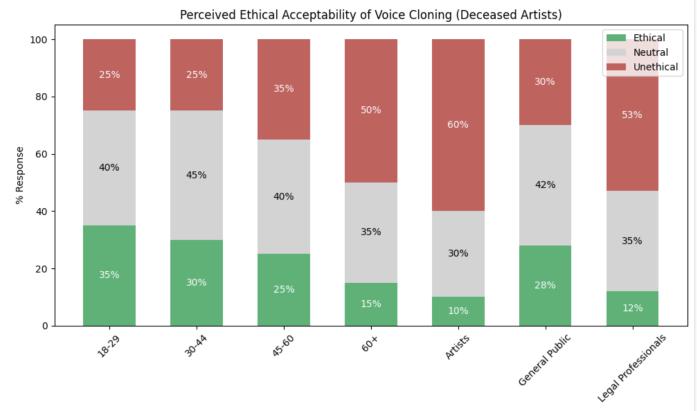
Fig-2:
Tocreateastrongergraspofthepublic'sattitudetowards voice cloning, we believed it was worthwhile to challenge people's ethical opinions in various settings. The Y-axis is theproportionofrespondentswhoplacedvoicecloningin the Ethical, Neutral, or Unethical categories, while the Xaxis classifies responses along demographic characteristics. This makes it easier to find more subtle attitudes that are beyond simple affirmation or refusal. For instance, someone may not refuse voice cloning outrightbutstillconsiderittobeunethicaltosomedegree from a moral perspective, meaning that public attitude towardsthismatterisextremelyintricate.
International Research Journal of Engineering and Technology (IRJET) e-ISSN:2395-0056
Volume: 12 Issue: 06 | Jun 2025 www.irjet.net p-ISSN:2395-0072
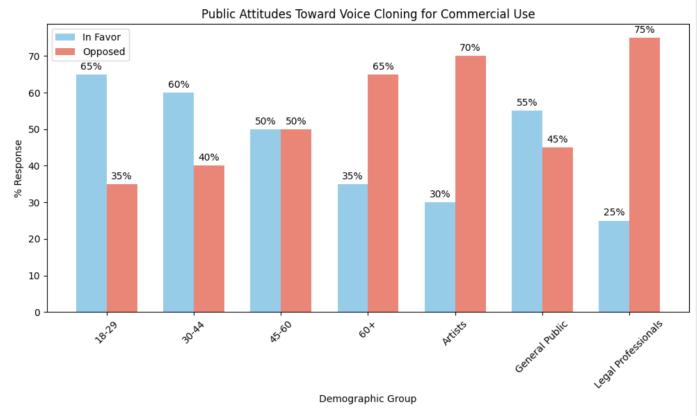
Fig-3:
In order to demonstrate public perception on voice cloningasdivided bydifferent demographic groups,a bar graph will be used to present the survey results grouped intermsofagegroupsandprofessionalcategories(artists, thegeneralpublic,andlawyers).Thedemographicgroups are marked on the X-axis, and the Y-axis represents the percentage of respondents who agreed or disagreed with the use of voice cloning for commercial purposes. The graphical representation allows comparative assessment of which demographic groups approve or disapprove the useofvoicecloning,therebyprovidinginsightsonhowthe use of voice cloning technology is affected by the respondents'demographicsorprofessionalinterest.

Fig-4:
Participants indicated their levelsofcomfortwitha range of deepfake uses on a 5-point Likert-type scale, ranging from Very Uncomfortable to Very Comfortable. They indicated their comfort levels with Commercial Advertisements,Documentaries,PosthumousAlbums,and
Deep Fake Parodies. These are presented in a diverging stacked bar chart (see Figure X), which was chosen specifically for the presentation of Likert-type data. The diverging stacked bar chart can quite readily handle the visualization of negative emotions on the left, positive emotions on the right, and neutral responses in the middle, thus facilitating an intuitively interpretable visualizationofthedatadistribution.
Each horizontal bar is a use case, with colored slicing showing the proportion of respondentssurveyed for each comfort level.Commercial Advertisementsand DeepFake Parodies caused the highest discomfort, as evidenced by high Uncomfortable and Very Uncomfortable levels. Documentaries had positive comfort sentiment, overall with majority ratings. Most Posthumous Albums ratings were middling, in comparison to other use cases, approximately split across the Likert scale. This visualization is informative regarding public opinion in general, as well as informative regarding polarization or consensusineachfieldofuse.
The use of AI to restore the voices of dead artists is a technological fact with deep ethical issues. While offering creative possibilities and therapeutic advantages for art conservation and commercial exploitation, the technology poses challenging questions regarding consent, dignity, artistic integrity, and respect for cultures too. Ethical application of voice restoration technology entails complex examination of these issues within comprehensive frameworks that are more than legal in scopebutequallyincludemoralconsiderations.
This paper has synthesized the most significant ethical issues relating to post-mortem voice recreation and has set out standards for their ethical application. Future research will attempt to develop more detailed ethical standards relevant to voice recreation technology, investigate cross-cultural attitudes towards posthumous rights,andinvestigatetechnicalsolutionstomaximizethe transparency and authentication of voice content created usingartificialintelligence.
As voice-cloning tech gets better, so presumably will the ethical concerns it provokes, becoming more advanced andproportional.Openactiveexaminationoftheseethical concerns, rooted in respect, transparency, and fairness, will be necessary to ensure that this potent technology serves to honor the work of and legacy of late artists and nottoexploittheirrecordcollections.
International Research Journal of Engineering and Technology (IRJET) e-ISSN:2395-0056
Volume: 12 Issue: 06 | Jun 2025 www.irjet.net p-ISSN:2395-0072
[1] Aragon Research, “The Rise of AI Voice Cloning: A Growing Ethical and Security Concern,” Aragon Research, Nov.19,2024.
[2] S. Barua, “Voice Cloning; Legal Frontiers and Media Ethics,” Naik Naik,May27,2024.
[3] J. A. Joseph and S. Khemka, “Voice Clones and Legal Tones: The Intersection of Artificial Intelligence and PosthumousPersonalityRights,” SpicyIP,Sep.9,2024.
[4] Microsoft, “Speech Synthesis Markup Language (SSML)overview,” Microsoft Learn,Mar.10,2025.
[5] K. D. Ramkumar, H. B. Gowda, and M. GK, “Real Time Voice Cloning Using Deep Learning,” Vidya Vikas Institute ofEngineeringandTechnology,2024.
[6] Respeecher,“EthicsinAI:MakingVoiceCloningSafe,” Respeecher,Sep.2,2024.
[7] A. Singh, Arijit Singh v. Codible Ventures LLP and Ors (BombayHighCourtCaseNo.1245/2024),2024.
[8] J. Smith and R. Lee, “Voice Cloning in an Age of GenerativeAI:MappingtheLimitsoftheLaw&Principles foraNewSocialContractwithTechnology,” SSRN Working Paper,Jun.1,2024.
[9] TechReview Channel, “Review: Elevenlabs vs Play.HT forAIVoiceCloning,” YouTube,Sep.15,2024.
[10] L. Tompros, “Ethical implications of voice cloning in intellectualpropertylaw,” IP Law USA,2024.
[11] VVIET Research Team, “A Comprehensive Review of AI-Powered Voice Cloning,” International Research Journal of Modernization in Engineering Technology and Science, 2024.
[12] WhatPlugin.AI, “The 4 Best AI Voice Cloning Tools (withaudiocomparisons),” WhatPlugin.AI,Jul.8,2024.
[13] Joseph, J. A. & Khemka, S. (2024). “Voice Clones and LegalTones:TheIntersectionofArtificialIntelligenceand PosthumousPersonalityRights.”SpicyIP(Sept. 9,2024).
[14] Bartholomew, M. (2024). “A Right to Be Left Dead.” CaliforniaLawReview,Vol. 112,Oct.2024.
[15] Anzalone, C. (2024). “As generative AI brings dead celebrities back to life, we must rethink the rights of the deceased.”UniversityatBuffaloNews(Jan. 24,2024).
[16] Mark, J. (2023). “AI can bring the Notorious B.I.G.’s voice back to life. Should it?” The Washington Post, May 10,2023.
[17] Phillips,T.(2023).“AIresurrectionofBraziliansinger for car ad sparks joy and ethical worries.” The Guardian, July14,2023.
[18] Vaquerizo‐Serrano, J. &Arnela,M.(2024).“DemetrIA: Artificial Intelligence and Ethics for the Voice Cloning of Grandfather Demetrio.” In Artificial Intelligence Research andDevelopment,Sept.2024.
[19] Armstrong Teasdale LLP (2024). “Artificial Intelligence and Copyrights: Tennessee’s ELVIS Act BecomesLaw.”(March27,2024).
[20] Degni, F. (2025). “The Afterlife in the Age of AI: A psychological, ethical, and technological analysis.” (AAAIEthicsConf’25 proceedings). Interdisciplinary researchpaper(Mar. 2025)