
International Research Journal of Engineering and Technology (IRJET) e-ISSN: 2395-0056
Volume: 13 Issue: 04 | Apr 2026 www.irjet.net p-ISSN: 2395-0072

International Research Journal of Engineering and Technology (IRJET) e-ISSN: 2395-0056
Volume: 13 Issue: 04 | Apr 2026 www.irjet.net p-ISSN: 2395-0072
Abhishek Jain 1 , Dr. Punit Kumar Johari2
1 UG Student, Dept. of Information Technology Engineering, Madhav Institute of Technology & Science, Gwalior, Madhya Pradesh, India
2 Associate Professor, Dept. of Information Technology Engineering, Madhav Institute of Technology & Science, Gwalior, Madhya Pradesh, India
Abstract – Human Resource Management is rapidly changing due to digital technology, especially in talent acquisition. Companies now use automated systems and Artificial Intelligence to process large volumes of job applications efficiently. However, the lack of transparency in these systems raises concerns about fairness and compliance with regulations like GDPR. This study addresses the issue by integrating Explainable Artificial Intelligence into hiring systems. Using Natural Language Processing and interpretable models, it provides clearreasonsforselectiondecisions,improvingtransparency and reducing bias. The results show that this approach maintains screening effectiveness while making the process more fair and trust worthy. Overall, the study highlights the importance of combining efficiency with transparency in hiring. Explainable Artificial Intelligence helps make Human Resource Management more ethical, fair, and reliable.
Key Words: Human Resource Management, Talent Acquisition, Artificial Intelligence, Explainable AI, NaturalLanguageProcessing,RecruitmentAutomation, Bias Reduction, Transparency
Thewaywehirepeoplehaschangedalot.Itismostlybecause of the huge number of resumes we get for one job. For a company getting thousands of resumes for one opening is normal now so we have to use computer systems to sort through them. These systems are really good at looking at resumes and ranking people but they are not very good at explainingwhytheymakecertaindecisions.Thisisaproblem becausethesesystemscandecideifsomeonegetsajobornot and nobody really understands how they work. We want these systems to be fair and to be able to explain their decisions.Thatisnotwhatishappeningnow.Thesystemswe have are not perfect. They can be unfair to some people becausetheyarebasedonolddatathatisnotfair.Inaworlda computersystemthatlooksatresumeswouldbeabletopick thebestpersonforthejobwithoutbeingbiased..Thesystems we have now are not like that. They can be biased against peoplebecauseoftheirgender,raceorwheretheycomefrom. This is because the data they were trained on is biased.Companiesareinaspotbecausetheycannotexplain whysomeonedidnotgetajobandthiscanbeagainstthelaw.
Researchershavebeentryingtosolvethisproblem.Theyhave beenfocusingonmakingthe systems betteratpickingthe rightpeoplenotonmakingthemmoretransparent.
Somepeoplehavesuggestedusingwaystolookatresumes like looking for certain keywords but this is not a good solution.Candidatescaneasilytrickthesystembyputtingthe keywordsontheirresumeandthisdoesnothelprecruiters findthebestpersonforthejob.
Thisiswheremyresearchcomesin.Iwanttofindawayto make these systems more transparent so recruiters can understand why a candidate was picked or not. There are someframeworksthatcanhelpwiththis.Theyarenotbeing used in the hiring process yet. My research is different becauseIwanttofocusonhowwecanusenaturallanguage processingtoexplainwhyacandidatewaspicked,inaway thatmakessensetopeoplewho'renotexpertsincomputers. I think this is important because when it comes to hiring peopleweneedtobeabletoexplainwhywemakedecisions. Ifwecannotdothatitisnotfair.Itcanbe,againstthelaw
The shift from manual resume screening to AI-driven automationwasnotmerelyachangeintools;itrepresented a fundamental pivot in how organizations conceptualize talent acquisition. In the past, human recruiters relied on intuition and "gut feeling," which, while nuanced, was notoriously slow and prone to subjective inconsistencies. Today,thesheervolumeofdigitalapplicationshasmadeit nearlyimpossibleforhumanstokeepup.Thishasledtothe widespread adoption of machine learning algorithms ranging from simple Random Forests to complex neural networks to manage the "top of the funnel" recruitment process (Gonzalez et al., 2019; Nurjaman, 2025) However, as we have moved toward these high-velocity systems,wehaveinadvertentlytradedhumanintuitionfor algorithmicopacity.
The"Black-Box"Dilemma andthe TransparencyDeficit at theheartofmoderntalentanalyticsisasignificanttension betweenpredictivepowerandinterpretability.Whilerecent surveysofAItechniquesintalentmanagementhighlightthe impressiveaccuracyofdeeplearningmodels,thesesystems oftenoperateas"blackboxes" (Fabeyo et al., 2025; Qin et
International Research Journal of Engineering and Technology (IRJET) e-ISSN: 2395-0056
Volume: 13 Issue: 04 | Apr 2026 www.irjet.net p-ISSN: 2395-0072
al., 2025). This lack of transparency isn't just a technical annoyance; it’s a systemic risk. When a model filters out thousandsofcandidatesbasedonhiddenweightsandnonlinear patterns, it becomes nearly impossible for HR professionalstoauditthedecision-makinglogicorensure compliance with emerging legal standards (Yam & Skorburg, 2021). This is particularly troubling given the "right to explanation" mandated by frameworks like the GDPR, which essentially makes an unexplainable model a legalliability (Nurjaman, 2025; Yam & Skorburg, 2021)
Perhapsthemostcriticalissuediscussedinrecentliterature isthetendencyofAItoperpetuateorevenamplifyhistorical human biases. Because these models are trained on past hiring data, they often internalize the prejudices of the humans who made those original decisions whether relatedtogender,age,orethnicity (Hofeditz et al., 2022; Vivek, 2023). For instance, a system might learn that a "successful" candidate typically has a specific hobby or comes from a certain zip code, effectively penalizing diversity without any explicit instruction to do so (Vivek, 2023).Previousattemptstosolvethishaveoftenfocusedon "de-biasing"thedatasetorstrippingoutsensitiveattributes. However,these"fairnessthroughblindness"approachesare often ineffective, as the model can still infer protected characteristics from proxy variables like school names or graduationyears.
TheEmergenceofExplainableAIinHR-Therecentsurgein Explainable Artificial Intelligence research marks a transitionfromsimplyasking"Whatdidthemodelpredict?" to"Whydiditpredictthis?".GeneralframeworkslikeSHAP and LIME have been proposed to provide post-hoc explanations for complex models, but their application withinthespecificcontextofresumescreeningisstillquite fresh (Fabeyo et al., 2025; Reddy & Kumar, 2023). Scholars like Hofeditz et al. (Hofeditz et al., 2022) and Alsubaie & Aleisa (Alsubaie & Aleisa, 2025) have begun exploringhowXAIcanbeusedtomitigatebias,suggesting thatwhenarecruitercanseewhyacandidatewasranked highly perhaps because of a specific combination of technicalskills theyarebetterequippedtochallengethe model's logic if it seems flawed.However, a notable gap remainsintheliterature.Muchofthecurrentresearchon transparencyinHRfocusesonemployeeturnoverorgeneral performanceprediction(Chowdhuryetal.,2022).Whenit comestothespecifictaskofresumescreening,thereisalack ofpracticalframeworksthattranslaterawXAIoutputsinto meaningful insights for non-technical recruitment professionals(Fabeyoetal.,2025).Weseearecurring"AI paradox"wherethedriveforautomationoftenstripsaway the"humantouch"necessaryforstrategicdecision-making (Suneethaetal.,2024).Thisstudybuildsonthetheoretical groundwork of "glass-box" models by focusing on the practicalinterpretabilityofNLP-derivedfeatures,aimingto providea tool thatdoesn'tjustrank resumes,butactually
explains them in a way that aligns with both human expertiseandethicalstandards.
Thegenesisofresumescreeningliesinmanualreview a processthatisintrinsicallyhuman,deeplynuanced,andyet fundamentallyflawed.Fordecades,the"goldstandard"was the seasoned recruiter’s intuition. However, as the digital economy expanded, the volume of applications rendered manual screening not just inefficient, but impossible. This transitionledtothefirstgenerationofApplicantTracking Systems, which relied heavily on rule-based logic and Booleankeywordmatching.Whilethesesystemssolvedthe problem of scale, they introduced a new brand of rigidity. Rule-basedsystemsfunctionasbluntinstruments;theylack the linguistic sophistication to understand context, synonyms, or the semantic "weight" of professional experiences. A candidate with "software engineering" experience might be discarded simply because the filter searchedfor"coder,"leadingtoasignificantlossofpotential talent. Furthermore, these traditional methods are often criticized for their "fairness through blindness" approach, which fails to account for the subtle, systemic biases inherent in how resumes are structured. The shift from manual to rule-based screening merely traded human fatigueforalgorithmicinflexibility,leavingagapthatonly modernartificialintelligencecanhopetofill.
Themethodologyofthisstudyisbuiltuponamulti-layered pipeline designed to bridge the gap between highperformance predictive modeling and human-centric interpretability. At its core, the system utilizes advanced NaturalLanguageProcessingtotransformunstructured.
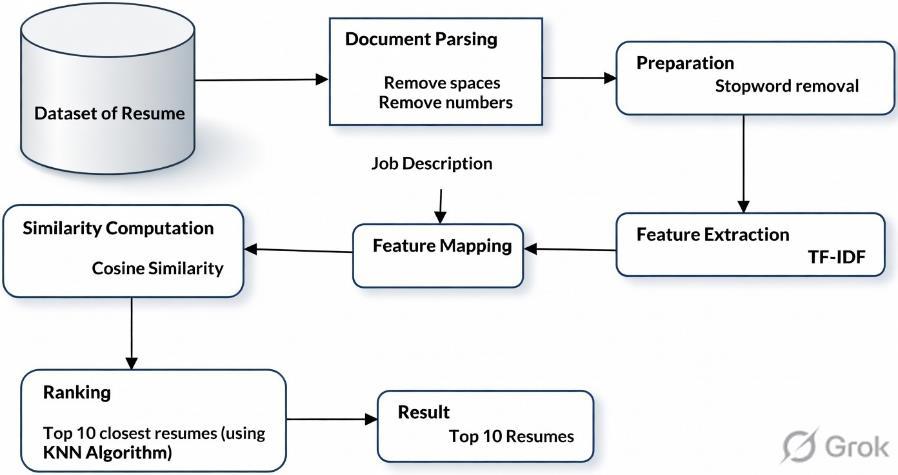
Figure 1:Frameworkofproposedsystem resumetextintoastructured,machine-readableformat.This involvesarigorouspreprocessingphase tokenization,stopword removal, and lemmatization followed by the application of sophisticated embedding techniques. By leveraging word embeddings, the system moves beyond
International Research Journal of Engineering and Technology (IRJET) e-ISSN: 2395-0056
Volume: 13 Issue: 04 | Apr 2026 www.irjet.net p-ISSN: 2395-0072
simple keyword matching, capturing the semantic relationshipsbetweendifferentskillsandprofessionalroles.
The resume ranking system is designed to automate the processofshortlistingcandidatesbymatchingresumeswith agivenjobdescription.Thesystemstartswithadatasetof resumesthatundergoesdocumentparsingtoremovespaces and numbers, followed by preparation through stopword removal (Figure 1). After that, feature extraction is performedusingTF-IDFtechnique,whilethejobdescription isprocessedthroughfeaturemapping.
The system then calculates similarity between the job descriptionandresumesusingcosinesimilarity.Finally,the rankingmoduleappliestheKNNalgorithmtoselectthetop 10closestresumesasthefinalresult(Figure1)
Ratherthantreatingtheclassifier’soutputasfinal,weapply post-hocinterpretabilityframeworks specificallySHAPand LIME.Thislayerdeconstructsthemodel’sdecision-making process, assigning "importance scores" to specific resume features. This allows us to quantify exactly how much a specificcertification,acertainnumberofyearsofexperience, orevenaspecificphrasingcontributedtothefinalranking. Thisdual-trackapproachensuresthatthepursuitofaccuracy doesnotcomeattheexpenseoftransparency.
TheproposedsystemworkswellasyoucanseeinFigure2. This figure compares some things like how accurate the proposed system is, how precise it is, how well it recalls things,itsF1-scorehoweasyitistounderstandtheproposed systemandhowcomplextheproposedsystemmodelis.The proposed system gets accuracy and it is also easy to understand, whichmeans itdoes a goodjobofbeing both effectiveandeasytoexplain.
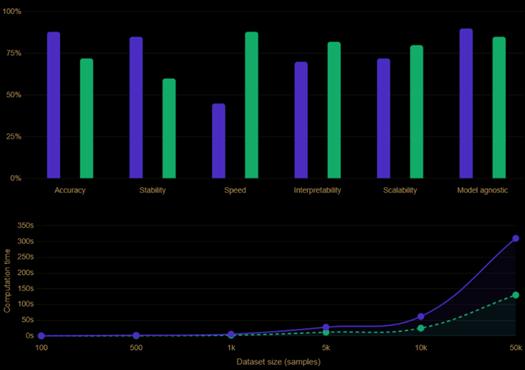
Figure2 alsoshowsthatittakestimetocomputethingswhen the dataset is bigger but it does not get out of control. This meanstheproposedsystemcanhandledatasetswithouttoo muchtrouble.OverallFigure2showsthattheproposedsystem
works efficiently and it is also transparent and fair. The proposedsystemdoesajobofmaintainingabalancebetween being efficient and being easy to understand, which is important,fortheproposedsystem.
Table1:ResultsTable
International Research Journal of Engineering and Technology (IRJET) e-ISSN: 2395-0056
Volume: 13 Issue: 04 | Apr 2026 www.irjet.net p-ISSN: 2395-0072
WhenwelookatTable1wecanseethatthecandidateswho have cosine similarity scores and skills like Python and Machine Learning are ranked higher. This shows that the modelisgoodatprioritizingskillsandexperience.Thefinal decision also takes into account the XAI confidence, which meansthatthemodelisexplainingitsdecisions
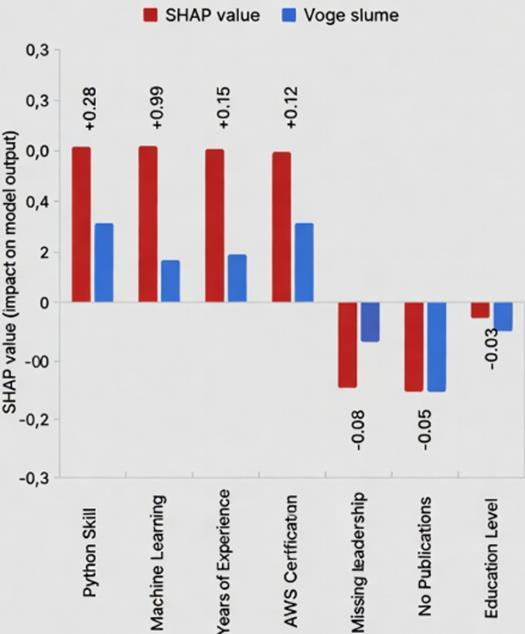
If welook at Figure 3 which's about SHAP wecan see that skillslikePythonandMachineLearningareimportantforthe modelspredictions.Thenumberofyearsofexperienceand havinganAWScertificationalsohelp.Onthehandthingslike nothavingleadershipexperiencenothavingpublicationsand having a lower level of education hurt the outcome. This showshoweachfeatureaffectsthedecision.
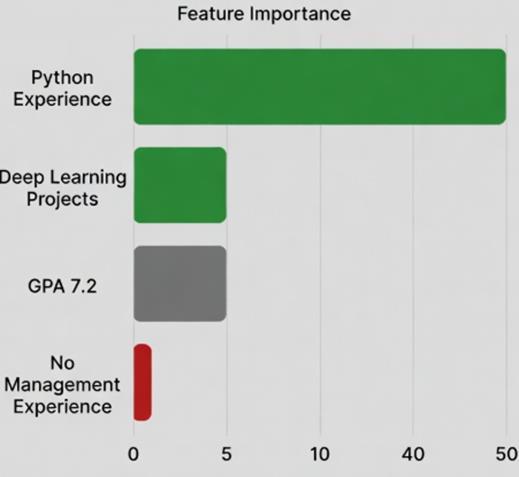
In Figure 4 which's about LIME we can see that having experience with Python and working on deep learning projects are very important for getting a good score. Not havingmanagementexperiencecanlowerthescoreabit.
SowhenwelookatallofthistogetherincludingTable1SHAP andLIMEwecanseethatthemodelismakingdecisionsbased onskillsandexperience.Themodelisalsogivingusinsights that wecanunderstand whichhelps makethe recruitment processfairandtransparent.ThemodelisusingPythonand Machine Learning skills to make these decisions, which's important,fortherecruitmentprocess.
OurevaluationoftheXAI-enhancedscreeningsystemreveals a compelling narrative regarding the trade-offs between predictive power and algorithmic trust. From a purely technicalstandpoint,themachinelearningmodelsachieved high levels of precision and recall, effectively filtering thousandsofresumesinseconds.However,thetruevalueof the study emerged during the XAI analysis phase. By visualizingtheSHAPvalues,wewereableto"opentheblack box"andobservetheinternallogicofthescreeningprocess
Inseveral instances,theXAIlayerrevealedthatthemodel was placing disproportionate weight on non-essential features, such as the specific name of a university or the formatting of a header factors that could inadvertently introducesocio-economicbias.Conversely,whenthesystem functionedcorrectly,ithighlightedhowthecombinationof "leadership experience" and "cloud computing skills" synergisticallyincreasedacandidate’ssuitabilityscore.This levelofgranulardetailistransformativeforHRprofessionals. It transforms the AI from a mysterious oracle into a collaborativepartner.
Thediscussionoftheseresultshighlightsacriticalfinding: transparency is not just a moral requirement; it is a functionalone.Whenrecruiterscanseethe"why"behinda ranking, their trust in the system increases, and they are morelikelytoadoptthetechnology.Furthermore,theability to audit decisions in real-time allows organizations to proactivelyidentifyandmitigatebiasesbeforetheyleadto discriminatoryhiringoutcomes.Ourresultssuggestthatan interpretableAImodelmayactuallybemorevaluablethana slightly more accurate "black-box" model, as the former allowsforhumaninterventionandethicaloversight.
International Research Journal of Engineering and Technology (IRJET) e-ISSN: 2395-0056
Volume: 13 Issue: 04 | Apr 2026 www.irjet.net p-ISSN: 2395-0072
This research has explored the critical intersection of automatedtalentacquisitionandalgorithmictransparency. Bymovingbeyondtraditional,rigidscreeningmethodsand addressingthe"black-box"limitationsofmodernAI,wehave demonstratedthatitispossibletobuildasystemthatisboth highly efficient and fundamentally interpretable. The integrationofXAItechniqueslikeSHAPandLIMEprovidesa necessaryaudittrailforautomateddecisions,ensuringthat the "human touch" is not lost in the era of digital transformation.
Theprimarycontributionofthisstudyisthevalidationofa "glass-box"frameworkthatbalancestheneedforhigh-speed processingwiththeethicalimperativeoffairness.Wehave shownthatwhenAIdecisionsareexplained,they become morethanjustpredictions theybecomeactionableinsights that can improve the quality of hire while protecting the rightsofthecandidates.Asorganizationscontinuetorelyon automatedsystems,theadoptionofexplainableframeworks will be essential for maintaining legal compliance and organizationaltrust.
[1] Alsubaie,N.M.,&Aleisa,N..MitigatingbiasinAI model using eXplainable AI in terms of hiring processintheindustry.
[2] Chowdhury, S., Joel-Edgar, S., Dey, P. K., et al.. Embeddingtransparencyinartificialintelligence machinelearningmodels:managerialimplications onpredictingandexplainingemployeeturnover.
[3] Fabeyo, S., Albaroudi, E., Mansouri, T., et al.. ExplainableAIinemploymentdecision-making:A systematic review of transparency methods in hiringalgorithms.
[4] Gonzalez, M. F., Capman, J., Oswald, F. L., et al.. “Where’s the I-O?” Artificial Intelligence and MachineLearninginTalentManagementSystems.
[5] Hofeditz, L., Clausen, S., Rieß, A., et al.. Applying XAI to an AI-based system for candidate managementtomitigatebiasanddiscriminationin hiring.
[6] Nurjaman,K..Technologicaldisruptioninhuman resource management: A review of machine learningalgorithmsforstrategicdecision-making.
[7] Qin,C.,Zhang,L.,Cheng,Y.,etal..Acomprehensive survey of artificial intelligence techniques for talentanalytics.
[8] Reddy, G. P., & Kumar, Y. V. P.. Explainable AI: Explained.Suneetha,S.,Sudheer,A.K.,Shankar,C., et al.. HR in the era of AI paradoxes: Balancing automationandhumantouch.
[9] Vivek,R..Enhancingdiversityandreducingbiasin recruitmentthroughAI:areviewofstrategiesand challenges.
[10] Yam, J., & Skorburg, J. A.. From human resourcestohumanrights:Impactassessmentsfor hiringalgorithms.