
International Research Journal of Engineering and Technology (IRJET) e-ISSN: 2395-0056
Volume: 12 Issue: 04 | Apr 2025 www.irjet.net p-ISSN: 2395-0072
International Research Journal of Engineering and Technology (IRJET) e-ISSN: 2395-0056
Volume: 12 Issue: 04 | Apr 2025 www.irjet.net p-ISSN: 2395-0072
Ganesh Sanap1, Dhruv pandey2 , Ayush Khopatkar3 , Sagar Gaud4 and Dr Rohini Patil5
1,2,3,4 Student, Computer Engineering Department, Terna Engineering College, Mumbai University 5Assistant Professor, Computer Engineering Department, Terna Engineering College, Mumbai University
Abstract - House rental management systems are essentialinmodernizingtherentalprocessbyimproving efficiencyandaccessibilityforbothlandlordsandtenants. Thisresearchpaperpresentsacomprehensiveanalysisof existing rental platforms, focusing on their core functionalities such as property listings, user authentication, communication features, and security mechanisms.Throughcomparativeevaluation,thestudy identifies key limitations, including low landlord engagement,rigiduserinterfaces,andminimaladoption of emerging technologies. It further proposes enhancements like intuitive design elements, real-time analytics,andintegrationofAIandmachinefordynamic rent prediction. The findings provide a foundation for developing more user-centric, adaptive, and intelligent houserentalsystems,aimingtoenhanceusersatisfaction and optimize the overall rental experience.
KeyWords: House Rental Management, Landlords, Tenants, AI and Machine Learning, Property Listing, Rental Prediction, System Performance
Thehouserentalmarketisgrowingquickly,fueledbyrising urbanizationandtheincreasingdemandfromlandlordsand tenants for digital, streamlined solutions. House rental managementsystemshavebecomeessentialinthisspace, offering platforms that handle everything from property listingsandtenantscreeningtorentcollection,maintenance tracking, and communication. These systems provide significant advantages over traditional methods, boosting efficiency, transparency, and overall satisfaction for everyoneinvolved[1].
Fortenants,theseplatformsmaketherentalprocesseasier with features like secure online payments, automated reminders, and real-time communication. Landlords, meanwhile, gain centralized control over their properties, less administrative work, and better rent tracking and maintenance management [2]. However, even with these benefits,manycurrentrentalmanagementsystemsstillfall shortinimportantareaslikecustomization,scalability,and userexperience particularlywhentryingtoserveawide rangeofuserswithdifferentlevelsoftech-savviness.
Withtheriseofmodernwebtechnologiesandframeworks liketheMERNstack,CodeIgniter,webscraping,andmachine learning,there'snowhugepotentialtobuildsmarter,more user-focusedsystems[3].Forexample,machinelearningcan predict rental prices and provide personalized property recommendations based on user behaviour, while web scrapingcanautomatetheupdatingofpropertylistingsand pricesfromexternalsources.
This research aims to thoroughly analyse existing house rental management systems, assessing their features, benefits,andlimitations.Byidentifyinggapsandexploring the potential integration of emerging technologies like AI, mobile-firstdesign,andreal-timeanalytics,thepaperlooks to uncover opportunities for future growth. The goal is to offer practical insights that can help developers, property managers, and landlords create or adopt more efficient, accessible,andsmartrentalmanagementsolutionsthatmeet theneedsoftoday’shousingmarket.
A bunch of studies have looked into how house rental managementsystemswork,whatthey’regoodat,andwhere theyfallshort.OnestudybyFazlietal.[1]cameupwitha mobileappjustforstudenthousing.Thegoalwastomakeit easierforlandlordsandtenantstotalk,andtocutdownon rentalscamssomethingstudentsdealwithalot.Theyreally focusedonmakingtheplatformsecureandpointedoutthat mobileappsareasolidfitforyoungeruserswhoarealready comfortablewithtech.
Harunetal.[2]cameupwitharentalmanagementsystem thatmadehandlingpaymentsandkeepingtenantinfoway moreorganized.Theirsetupshowedhowusefulgoodadmin toolscanbeforpropertymanagersstuffliketrackingwho’s paid,sendingoutrentreminders,andkeepingrecordstidy.It alsohelpedlandlordsandtenantsstayintheloopwitheach other,makingthewholerentalprocessalotsmoother.
Nairetal.[3]wentadifferentrouteandfocusedonhelping studentsfindplacestostay.Theybuiltawebappthatwas supereasytouse,withonlineformsandarecommendation system to help match students with spots that actually fit what they’re looking for. By using data to guide the suggestions, the app made it way quicker and easier for studentstofindhousingthatcheckedtheirboxes.
International Research Journal of Engineering and Technology (IRJET) e-ISSN: 2395-0056
Volume: 12 Issue: 04 | Apr 2025 www.irjet.net p-ISSN: 2395-0072
Voumicketal.[4]rolledoutaweb-basedplatformmadefor therentalsceneinBangladesh.Theyputabigfocusonsecure communicationandmakingsureuserscouldverifyidentities whicharesuperimportantinamarketwheretrustbetween landlordsandtenantsisabigdeal.Theplatformalsohada solidsearchfeature,sopeoplecouldeasilyfindplacesthatfit whattheywerelookingfor.Thewholestudyreallypushed how key security and transparency are when it comes to buildingtrustwithusers.
Misyametal.[5]cameupwitharentalmanagementsystem aimed at making communication and transparency better between landlords and tenants. Their platform had all the essentials propertylistings,usersign-ups,searchtools,and evenawaytohandlecomplaints.Thestudypointedouthow thesesystemsaren’tjustforhandlingrentstuff,butalsohelp withday-to-daymanagement,makingsurebothsidesstayon thesamepageandthingsrunsmoothly.
Galleraetal.[6]builtanonlinerentalsystemjustforbeach house rentals. It made managing properties and bookings wayeasierforowners,whilealsogivingrentersclear,up-todateinfoonwhatwasavailable.Sinceitfocusedspecifically on vacation rentals, the study really showed how rental platforms are branching out and adapting to different markets,eventhemorenicheones.
Kalbandeetal.[7]cameupwithasmartrentalmanagement system that used automation to handle stuff like payment tracking,tenantinfo,andgeneratingreports.Thegoalwasto makerentalmanagementmoreefficientbycuttingdownon manualwork,givingpropertymanagersmoretimetofocus onthebiggerpicture.Theautomationalsoshowedhowthese systemscould work forlarger property portfolios, making themscalableastheoperationgrows.
Ajeokumola et al. [8] came up with a mobile, cloud-based rental management system that really focused on data security.Theybuiltinsecureaccesscontrolsandencryption toprotectsensitiveinfofromtenantsandlandlords,tackling thegrowingworriesarounddigitalsecurity.Thestudyreally highlightedhowimportantstrongsecurityfeaturesarefor earning user trust and making sure rental management systemscanstickaroundforthelonghaul.
Onyenweetal.[9]builtaproductupdate-alertsystemthat keepstrackofdealsandupdatesfrome-commercesitesby pullingdata like productnames, prices,and posting times. Whileitworkswell,thesystemreliesalotonwebscraping, whichcanbetrickyifwebsitestructureschange.Theauthors recommend adding price comparison tools to make the systemevenmoreuseful.
Khatter et al. [10] came upwith a web app that compares product prices across e-commerce sites using Python and Selenium. The system automates the whole comparison process,whichsavesuserstime.But,itdoesrunintoissues witherrorhandlinganddependsheavilyonHTMLstructures.
To fix these problems, the authors suggest adding better errorhandlingandusingmachinelearningformoreadaptive webscraping.
Rastogi et al. [11] built a web-based Rental House ManagementSystemtomakefindingaplacetorenteasier. Theirsystemcutoutthemiddleman nomorebrokers by connectingusersdirectlywithpropertyowners,whichmade the whole process more transparent and efficient. It was designed to help people moving for work or school by offeringaneasywaytofindverifiedrentalproperties.The studyreallyshowedhowdigitalsolutionscansimplifyhousehunting,savingtimeandeffortwhensearchingfortheright place.
Dhamodaranetal.[12]lookedatwaystoimprovee-rental apps by adding GPS and in-app messaging. Their research showed how these features boosted user experience and madecommunicationbetweenlandlordsandtenantseasier. The study pointed out how important it is for rental platformstobemobile-friendlyandautomated,showinghow thesetechupgradescanmakethingsmoreefficient,cutdown on paperwork, and simplify transactions for everyone involved.
Magnoetal.[13]createdanApartmentRentalManagement Systemtohandletransactionsandtasksinreal-time.Their system aimed to make rental property management more organizedandautomated,cuttingdownontheinefficiencies of manual record-keeping. By using a Rapid Application Development(RAD)model,theymadeoperationssmoother, billingmoreefficient,andcommunicationbetweentenants andlandlordsbetter.Thestudyreallystressedhowtechcan solve common problems in rental management and highlightedtheneedfordigitaltransformationinrealestate.
Chiwaneetal.[14]introducedadata-drivenrentalanalysis systemcalledEstimaRenttohelpwithdecision-makinginthe rentalmarket.Theirstudyuseddataanalyticstogiveinsights into trends, tenant preferences, and the best pricing strategies.Theyhighlightedhowimportantitistointegrate AI into rental platforms to make landlords and property managers more competitive and improve their decisionmaking.
Abidoyeetal.[15]didasystematicreviewtofigureoutthe key success factors (CSFs) for the Build-to-Rent (BTR) housingmodel.Theirstudyfocusedonthingsliketheroleof institutional investors, affordability, and the impact of regulatorypoliciesonmakingBTRprojectswork.Theywent throughliteraturefrom2011to2021andcameupwith32 keyCSFs, withinvestor interest,affordability,andhousing reforms being the top priorities. The research highlighted how BTR housing could help solve housing shortages and provide long-term rental options, especially for younger peopledealingwithaffordabilityissues.
International Research Journal of Engineering and Technology (IRJET) e-ISSN: 2395-0056
Volume: 12 Issue: 04 | Apr 2025 www.irjet.net p-ISSN: 2395-0072
Srivastava et al. [16] did a deep dive into house rental websites,lookingathowuser-friendlytheyare,theirsecurity features, and how they’re using AI and machine learning. Their study pointed out how online rental platforms are becomingabiggerdealforconnectinglandlordsandtenants, whilealsoidentifyingareasthatneedwork likeimproving userexperience,betterdataencryption,andstrongerfraud prevention. The research stressed the need for ongoing innovation to boost trust and security in digital rental platforms,makingthemmoreefficientandeasiertouse.
Rana et al. [17] built a house rental search system using Laravel,Vue.js,andPHPMachineLearningLibrary.Theirgoal was to make the rental search easier by using machine learning techniques like Linear Regression and K-Nearest Neighbors (K-NN) to give personalized property recommendations.Thesystemalsopredictedrental prices and boosted search capabilities, showing just how much machinelearningcanbringtorealestate.
Uma et al. [18] came up with an E-Housing Rental System (EHRS)tomaketherentalsearchprocesssmootherandmore automated. Their system helped house owners, people moving to new places, and agencies by offering a digital platform to list and find rentals efficiently. By using fuzzy logic andcollaborative filtering, thesystem improvedhow accurate property recommendations were. The study highlighted how combining different user-focused approaches can make rental housing more accessible, all whileusingtechlikeAngularFrameworkandSpringBootfor betterperformanceandscalability.
Table 1. ComparisonofExistingandProposedFeaturesin RealEstatePlatforms
Feature Category
Listings
Existing Features
Residential, commercial, and landlistingswith details.
Search Filters
Property Comparison
Verified Listings
Customizable filters and mapbasedsearch.
Side-by-side comparison.
Verified properties for authenticity.
Notification Price drop and new listing alerts.
Proposed Features
EnhancedRentalListings: Includereviewsandrealtimeavailability.
Advanced Filters: Add filtersforleaseduration, pet policies, and furnished/ unfurnished properties.
Advanced Comparison: Including AI for comparision
Expanded Verification: Optional verification for landlordsandtenants.
Custom PriceAlerts:Set specific thresholds for pricedropalerts.
Tools & Calculators EMI calculator, areaconverter.
Communication No in app communication available
Budget Tracker: Track rent and related expenses.
In-AppMessaging:Secure communicationbetween tenantsandlandlords.
TheaboveTable1showsthecomparisonbetweenexisting systemandproposedfeaturesinRealEstatePlatforms[19], [20].
A. Design Methodology
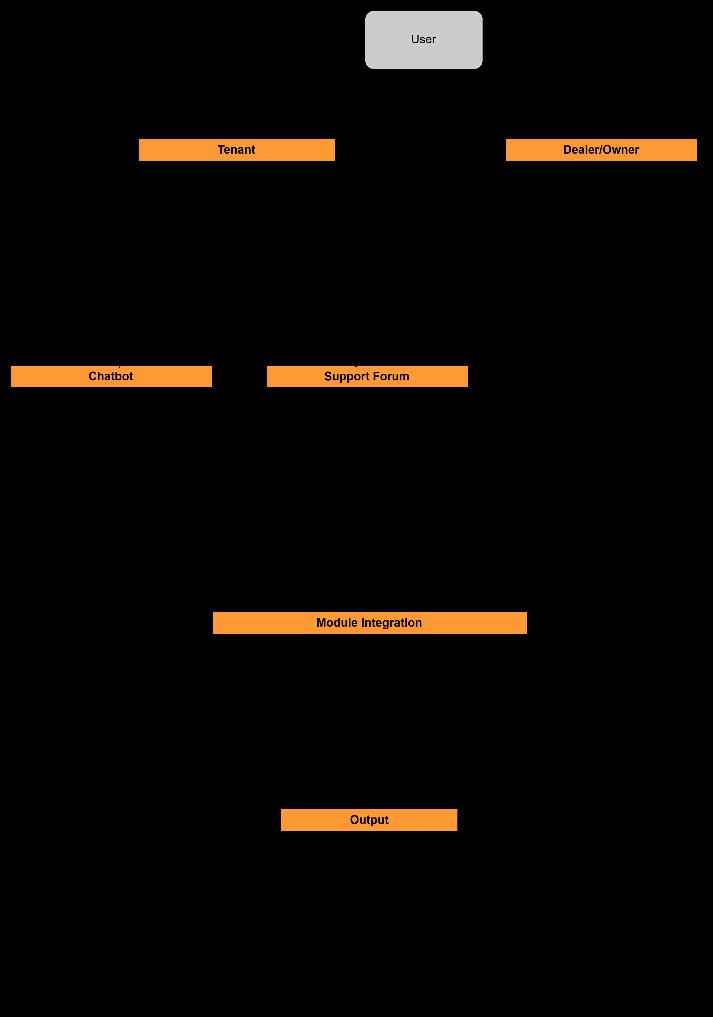
Fig.1 ProposedMethodology
Fig. 1 shows how the House Rental Management System worksinternally.Thesetupisdesignedtocreateasmooth, interactive experience for everyone like tenants, property dealers/owners,andadminsbyputtingeverythingtogether in a modular way. The system splits the roles between tenantsanddealers,soeachhasaccesstowhattheyneed. Tenantscanusetheplatformwithoutloggingin,lettingthem search,view,andaskaboutpropertiesdirectly.Dealersor propertyowners,ontheotherhand,needtologintopost their property listings, making sure everything listed is verified.
Atitscore,thesystemisbuilttoservetwomainusergroups which are tenants and property owners (dealers) while keeping things easy to use, transparent, and efficient. It
Volume: 12 Issue: 04 | Apr 2025 www.irjet.net p-ISSN: 2395-0072
startsbyclearlydefiningthesetworoles.Tenantsarecasual userswhodon’tneedtologin.Theycanbrowseavailable properties, contact property owners, and even reach out withquestionsthroughbuilt-infeatures.Propertyownersor dealersmustloginbeforetheycanpostlistings.Thislogin systemkeepseverythingsecureandensuresonlylegitimate propertyownersareaddingproperties.
To improve the experience and offer continuous help, the system has a dual-support setup with a chatbot and a support forum. The chatbot is available 24/7 to answer FAQs,guideusers,andhelpthemnavigatetheplatform.The support forum is where users especially tenants can flag suspiciouslistingsordealerbehavior.Thesereportsaresent to the admin team, who take action when needed. This feedback loop makes sure the platform stays safe and responsive,givingusersmoretrustinthesystem.
Allofthisuserinteractionandsupportrunsthroughastrong integration module. This module is what ties everything together,combiningbothfront-endandback-endtoensurea smooth experience. The front-end uses HTML5, Tailwind CSS, and JavaScript for a modern, responsive design that works across devices. The back-end is powered by Spring Boot,aJava-basedframeworkthatkeepseverythingsecure, scalable, and efficient. The front-end and back-end talk to eachotherthroughRESTfulAPIs,handlingeverythingfrom browsing properties to posting listings and filing reports. Thismodularsetupmakesthesystemeasytomaintainand scaleinthefuture.
Attheendoftheday,thesystemdeliversseveralkeyresults. Verifiedpropertylistingsarepubliclyavailablefortenantsto browse, while dealer registration and login ensure only legitimateuserscanpostproperties.Everythingtenantsdo from viewing listings to contacting owners is logged and managed. The admin panel allows the backend team to monitorreports,moderatecontent,andkeeptheplatformin check. This setup makes the rental process smoother, ensuresusersatisfaction,andkeepsthesystemscalableand reliableforthefuture.
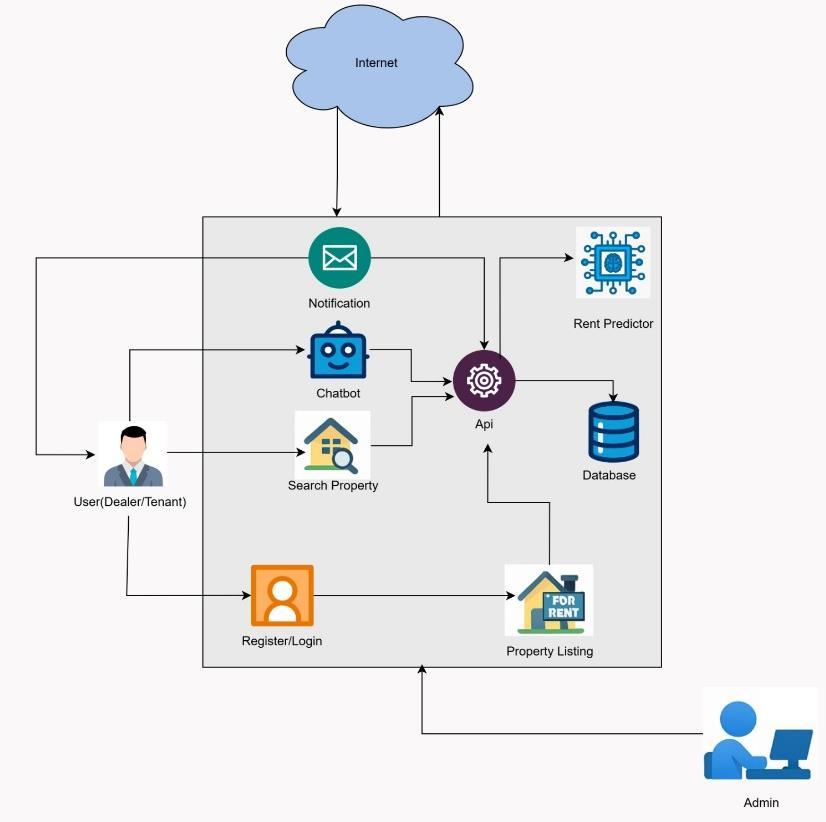
Fig.2 illustrates the system architecture for the House RentalSystem.Thearchitectureisdesignedtosupporta responsive, user-friendly, and intelligent rental platform whereusers,tenants,landlords(dealers),andadminscan interact with the system through a series of integrated modules.
ThesystemisaccessedviatheInternet,allowingseamless connectivitybetweenusersandsystemcomponents.
User (Dealer/Tenant):
Userscanregisterorlogintothesystemthrough theRegister/Loginmodule.Uponsuccessfullogin, they can access other features such as property searching,listing,andchatbotsupport.
Register/Login Module:
This module handles authentication and user management. It allows different roles (tenant, dealer,oradmin)tologinsecurelyandaccessrolespecificfunctionalities.
Property Listing:
Dealers or landlords can list rental properties throughthismodule.Theselistingsarestoredinthe Databaseandaremadesearchablefortenants.
Search Property:
Tenantscansearchforavailablepropertiesbased onfilterssuchaslocation,price,andpropertytype.
International Research Journal of Engineering and Technology (IRJET) e-ISSN: 2395-0056
Volume: 12 Issue: 04 | Apr 2025 www.irjet.net p-ISSN: 2395-0072
This module interacts with the API to fetch the requireddatafromthedatabase.
Chatbot Integration:
Achatbotis embedded withinthesystemto offer instant assistance to users by answering queries and guiding them through available features. It communicates with the API for real-time informationaccess.
Notification System:
The system sends notifications (e.g., property updates,verificationalerts,orrentalconfirmations) to users through integrated email or in-app messagingservices.
Rent Predictor:
This intelligent module uses machine learning or pre-trained models to analyze property data and predictsuitablerentalprices.Itinteractswiththe API and database to fetch input data and return predictions.
API (Application Programming Interface): Servingasthecentralcommunicationhub,theAPI facilitates data exchange between the front-end modules (search, chatbot, notification) and the back-end components (database and rent predictor).
Database:
A centralized relational database stores user credentials, property listings, and reviews. It ensures data persistence and security across all systemfunctions.
Admin Panel:
The admin has access to a backend interface to manage user activities, verify property listings, monitor system usage, and handle maintenance operations.
Thismodularandlayeredarchitectureensuresscalability, maintainability,andefficientdataflow,whilemaintaining separationofconcernsamongdifferentcomponentsofthe system.
This section presents the outcomes of the system developmentandevaluatesitsperformancebasedonuser interactionandfunctionality.Theresultsdemonstratehow effectivelytheHouseRentalSystemmeetsitsobjectives.
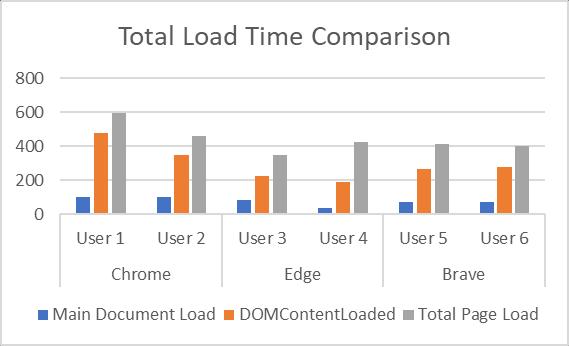
Fig.3 shows the load time results that Chrome browsers generally have higher DOMContentLoaded and Total Page LoadtimescomparedtoEdgeandBrave.User1onChrome experiencedthehighestDOMContentLoadedtime,exceeding 400ms, while Edge (Users 3 and 4) consistently showed balancedandrelativelylowerloaddurationsacrossallthree metrics. Brave (Users 5 and 6) also performed efficiently, with stable Total Page Load times and moderate Main DocumentLoadspeeds,makingitacompetitivealternative forperformance-focusedusers.
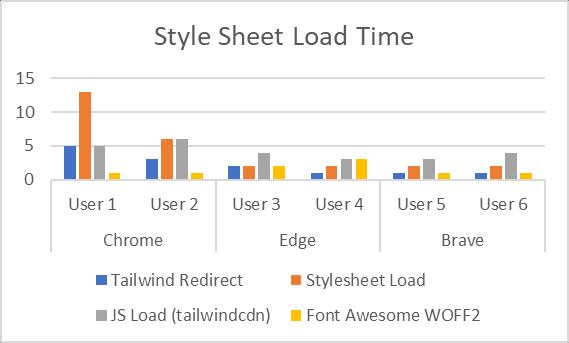
Fig.4showstheStyleSheetLoadTimeanalysishighlightsa notablevariance,especiallyintheChromebrowserforUser 1,wherethestylesheetloadtimepeakedaround13ms.This is significantly higher than other users across browsers. Edge and Brave showed more uniform performance, with minimal differences between Tailwind Redirect, JS Load (tailwindcdn), and Font Awesome WOFF2 times. The smoother and more consistent load behavior in Edge and Bravebrowsersindicatesbetteroptimizationandresource handlinginthoseenvironments.
International Research Journal of Engineering and Technology (IRJET) e-ISSN: 2395-0056
Volume: 12 Issue: 04 | Apr 2025 www.irjet.net p-ISSN: 2395-0072
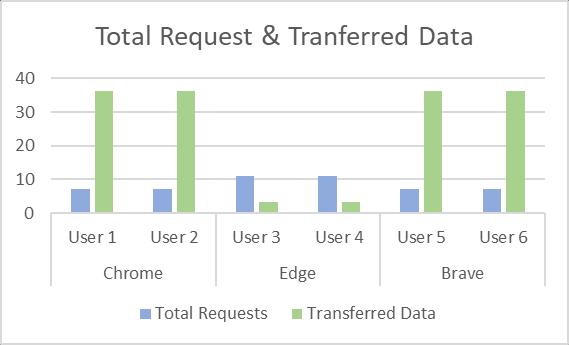
Fig.5 shows that ,across all users and browsers, the transferred data remained constant at around 38 units, showing minimal variation. However, the number of total requests was slightly higher in Edge (Users 3 and 4), followedbyChromeandBrave.Thissuggeststhatwhiledata volume remained consistent, resource loading efficiency varied,withChromeandBraveslightlyoutperformingEdge inminimizingthenumberofHTTPrequests.
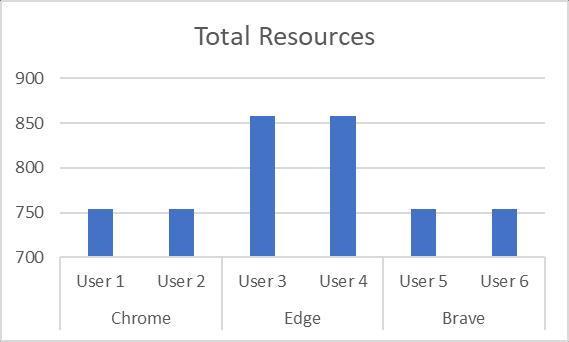
Fig.6 shows that, In terms of total resource usage, Edge browser users (User 3 and User 4) recorded the highest resource counts, exceeding 850. Chrome and Brave had lowerresourceusage,remainingbelowthe750mark.This implies that Edge may load more supporting files or background elements, potentially impacting load time despitehavingefficientcontentloadingperformance.
Fromtheanalysis,it’sclearthatbrowserchoiceplaysabig role in system performance. Chrome showed higher load times,especiallywithDOMContentLoadedevents,likelydue toitsrenderingorresourceinterpretationprocesses.Onthe other hand, Edge, despite having higher total resource countsandrequestrates,keptitsloadtimeslowandsteady, suggestingithandlesresourcesefficiently.Braveoffereda
balanced performance, with quick load times, fewer requests,andlowerresourceusage.
Overall,thesefindingsshowthattheHouseRentalSystem works reliably across modern browsers, with Edge and Braveslightlyoutshiningintermsofresourcehandlingand rendering efficiency. This comparison highlights the system'srobustnessandadaptability,makingitwell-suited for real-world deployment across a variety of user environments
Thehouserentalmanagementsystemenhancestherental experience with features like chatbot support, real-time notifications,machinelearning–basedrentprediction,anda unified property listing interface. Testing across major browsersconfirmedconsistentperformancewithminimal differencesinloadtimeandresourcehandling.
Despiteitsstrengths,challengesremaininboostinglandlord engagement, improving UI customization, and expanding intelligent automation. Many landlords prefer traditional methodsorstruggle with digital tools issues thatcan be easedthroughintuitiveonboarding,simplifiedworkflows, andclear,data-drivendashboards.
WhileAIfeatureslikerentpredictionandchatbotsupport arepromising,there'spotentialto deepenpersonalization withsmartpropertyrecommendations,dynamicpricing,and adaptiveservice.Futureupgradesmayincludeblockchain for secure contracts, customizable dashboards, and PWA support for offline use enhancing engagement, security, andaccessibilityforallusers.
[1]MuhammadImranFazli,&MunirahMohdYusof.(2023). BookingSystemandProceduresforUTHMHouseRental Application in Parit Raja. Applied Information TechnologyAndComputerScience,4(2),1471-1485.
[2]HARUN,Napisah;MOHDZAIN,Suhaila.“TenantRental System Using CodeIgniter and Bulma”. International JournalofBusinessandTechnologyManagement,[S.l.], v.4,n.3,p.340-349,oct.2022.ISSN2682-7646.
[3]A.Nair,A.Damle,S.Damle,andN.Kudu,"Revolutionizing StudentAccommodation:AMERN-BasedRentalSystem forSeamlessPropertyManagement," IJFMRVolume6, Issue 3, May-June 2024. DOI 10.36948/ijfmr.2024.v06i03.19547
[4]Voumick,D.,Deb,P.,Sutradhar,S.andKhan,M.M.(2021) DevelopmentofOnlineBasedSmartHouseRentingWeb Application. Journal of Software Engineering and Applications, 14, 312-328. https://doi.org/10.4236/jsea.2021.147019
International Research Journal of Engineering and Technology (IRJET) e-ISSN: 2395-0056
Volume: 12 Issue: 04 | Apr 2025 www.irjet.net p-ISSN: 2395-0072
[5] Misyam, M. R., & Selamat, N. (2021). House Rental ManagementSystem.AppliedInformationTechnology AndComputerScience,2(2),1745-1754.
[6]Gallera,J.M.(2023).Designandevaluationofanonline beach house rental system: Streamlining accommodation management and enhancing user experience. International Research Journal of EngineeringandTechnology(IRJET),10(05)
[7]M.Kalbande,S.Sarkar,S.Farkase,andP.Verma,"Design andDevelopmentofSmartHouseRentalManagement System,"JournalofPropertyManagementTechnology, vol.5,no.2,pp.123-135,July2023.
[8]Ajeokumola,etal.(2020,April).Asecuredmobilecloudbasedhouserentalmanagementsystem.InProceedings of the 3rd International Conference on Applied InformationTechnology(AIT).
[9] I. Onyenwe, E. Onyedinma, C. Nwafor, and O. Agbata, "Developing Products Update-Alert System for ECommerceWebsitesUsersUsingHTMLDataandWeb ScrapingTechnique,"InternationalJournalonNatural LanguageComputing(IJNLC)Vol.10,No.5,October2021
[10] H. Khatter, Dravid, A. Sharma and A. K. Kushwaha, "WebScrapingbasedProductComparisonModelforECommerce Websites," 2022 IEEE International Conference on Data Science and Information System (ICDSIS), Hassan, India, 2022, pp. 1-6, doi: 10.1109/ICDSIS55133.2022.9915892.
[11] Rastogi, R., et al. (2023). Rental house management system: An empirical approach with simulation. Acta ScientificComputerSciences,5(4),88-102.
[12]Dhamodaran,S.,Reddy,G.V.S.,Saivinay,G.,Gongada,P. K., Refonaa, J., & Shabu, S. L. J. (n.d.). House rental application system. In Article 53. https://doi.org/10.13052/rp-9788770040723.053
[13] Magno, J. M., Pelayo, R. S., & Soberano, K. T. (2024). Houserentalsystemresearch.InternationalJournalof Multidisciplinary Research and Analysis, 7(7). https://doi.org/10.47191/ijmra/v7-i07-29
[14]Chiwhane,S.,Bagane,P.,Sourabh,A.,Nagrale,S.,Jha,S., & Pandey, S. (2023). EstimaRent: Data driven rental housingoptimizationandmarketanalysisforenhanced decision-making. International Journal of Intelligent SystemsandApplicationsinEngineering,12(2),20-28. Retrieved from https://ijisae.org/index.php/IJISAE/article/view/4216
[15] Abidoye, R., Ayub, B., & Ullah, F. (2022). Systematic literaturereviewtoidentifythecriticalsuccessfactors ofthebuild-to-renthousingmodel.Buildings,12(171). https://doi.org/10.3390/buildings12020171
[16] RENT X: House and home rental websites – A comprehensiveanalysis.(2023).InternationalJournalof InnovativeResearchinTechnology,11(6),2274-2279. Retrieved from https://ijirt.org/Article?manuscript=169792
[17]Rana,M.S.,Omar,S.I.,&Pranta,M.F.M.(2024).House rental finding system using Laravel, Vue.js, and PHP machine learning library. IOSR Journal of Computer Engineering, 26(5), 8-12. https://doi.org/10.9790/0661-2605010812
[18]Uma,P.,Rao,M.S.,Balaji,M.J.,Kalyan,R.P.,&Mahesh, P.V.(2022).E-housingrentalsystemusinghybridusercentricprivateorpublicpropertyrecommendersystem usingfuzzylogicanditem-basedcollaborativefiltering. InternationalJournalofScientificResearchinComputer Science,EngineeringandInformationTechnology,8(3), 354-358.https://doi.org/10.32628/CSEIT228383
[19] 99acres.com. (n.d.). Property in India, Real Estate Property for Sale/Rent in India. Retrieved September 20,2024,fromhttps://www.99acres.com/
[20]MagicBricks.com.(n.d.).RealEstate|PropertyinIndia| Buy/Sell/RentProperties.RetrievedOctober17,2024, fromhttps://www.magicbricks.com/
[21] Yuan, J., Li, W., Xia, B., Chen, Y., & Skibniewski, M. J. (2019, June 26). OPERATION PERFORMANCE MEASUREMENT OF PUBLIC RENTAL HOUSING DELIVERY BY PPPS sss WITH FUZZY-AHP COMPREHENSIVEEVALUATION.InternationalJournal of Strategic Property Management. https://doi.org/10.3846/ijspm.2019.9820
[22] Kim, S. K., & Huh, J. (2020, October 27). Autochain platform: expert automatic algorithm Blockchain technology for house rental dApp image application model.EurasipJournalonImageandVideoProcessing. https://doi.org/10.1186/s13640020-00537-z
[23] Gill, R., Kalwar, S., & Memon, I. A. (2021, January 5). Yeh’sSatisfactionIndexModellingofTenantsinRental Appartments (A Case Study of Latifabad Hyderabad). Sukkur IBA Journal of Computing and Mathematical Sciences.https://doi.org/10.30537/sjcms.v4i2.654
[24]Sidhu,N.,Pons-Buttazzo,A.,Muñoz,A.,&Terroso-Sáenz, F. (2021, July 1). A Collaborative Application for AssistingtheManagementofHouseholdPlasticWaste throughSmartBins:ACaseofStudyinthePhilippines. Sensors.https://doi.org/10.3390/s21134534
[25]S.Satapathy,S.M.,Jhaveria,R.,Khanna,U.,&Dwivedi,A. K. (2014). Smart Rent Portal Using Recommendation System Visualized By Augmented Reality. “Procedia
International Research Journal of Engineering and Technology (IRJET) e-ISSN: 2395-0056
Volume: 12 Issue: 04 | Apr 2025 www.irjet.net p-ISSN: 2395-0072
Computer Science”, 197-206. Retrieved From Www.Elsevier.Com/Locate/Procedia
[26] Afzal, S., Rouf, T., Qadir, S., & Shah, S. (2021). Online RentalHousing.“JournalOfEmergingTechnologiesAnd Innovative Research (Jetir)”, 8(11). Retrieved From Https://Www.Jetir.Org
[27]Misyam,M.R., et al.(2021).House Rental Application System. River Publishers. An article which considers web application of houses being implemented in the rentingprocedurebypeopleofBangladeshtotenants andlandlords
[28]Rathore K, et al. The Rental Zone (House Renting Website). International Research Journal of ModernizationinEngineeringTechnologyandScience, 4(8),2243-2251.Itbringsapaperontheimportanceof theonlinehouserentingsystemagainstthebackdropof thedemandforhousesincities.
[29]ZengY.,&ChenH.,(2019).Methodsofevaluatinguser experiences for online rental platforms: International InformationSystemsReview.
[30]Setyarsih,E.(2017).OnlineRentalHousingManagement System. Journal Article on Housing Management Systems that discusses various existing systems for houserentingwebapplications.
2025, IRJET | Impact Factor value: 8.315 |