
International Research Journal of Engineering and Technology (IRJET) e-ISSN: 2395-0056
Volume: 11 Issue: 12 | Dec 2024 www.irjet.net p-ISSN: 2395-0072

International Research Journal of Engineering and Technology (IRJET) e-ISSN: 2395-0056
Volume: 11 Issue: 12 | Dec 2024 www.irjet.net p-ISSN: 2395-0072
Aishwarya V. Nayak1
1PG Student, Dept. of CSE Engineering, VTU University, Karnataka, India
Abstract - The proliferation of online communication has led to an increase in both positive and negative content. While considerable efforts have been directed toward detecting and mitigating hate speech, the identification and promotion of hope speech, which has the potential to foster positive social change, has garnered less attention. This study explores the application of various machine learning and deep learning models to detect hope speech in online textual content. The models evaluated include Logistic Regression (LR), Support Vector Machine (SVM), Bidirectional Encoder Representations from Transformers (BERT), and Recurrent Neural Networks (RNN). The models' performance was measured using metrics such as accuracy, precision, recall, and F1-score. BERT and RNN models outperformed LR and SVM, emphasizing the importance of contextual understanding in hope speech detection. This study demonstrates that deep learning models, particularly BERT, outperform traditional machine learning methods in detecting hope speech.
Key Words: Hope Speech Detection, Machine Learning, Deep Learning, LR, SVM, BERT, RNN, TF-IDF, GloVe, Word2VecandBERTEmbeddings.
Socialmediasitesandonlineforumshavereplaced traditional ways of communication for millions of people globallyinthecurrent digital era.Social mediaprovidesa virtualplatformforpeopletodevelop,exchange,andwork with each other on ideas, facts, and opinions [1]. Even thoughEnglishisthemostwidelyusedlanguageonsocial mediaplatforms,peoplefromvariouslinguisticbackgrounds connectandexchangeideasintheirnativetongues.
Socialmediaprovidesdeepinsightsintopeople's behaviourandisavaluablesourceofscientificresearchon topicspertainingtoNaturalLanguageProcessing(NLP).We exchangeourexperiences,includingthosethatarenecessary foreveryonetohaveduringdifficulttimes,suchasgratitude forachievements,joy,anger,sadness,andinspirationfrom defeats [1]. These remarks, sometimes known as "hope speech," convey the well-being of the speaker. "Not hope speech"referstotheothersortsofremarksthatdemoralize, mistreat,ordiscouragesomeonebasedontheirgender,race, handicap,orotherminority.Thepositiverecommendations from other viewers improve the video's coherence or substance.[1] On the other hand, remarks like "not hope
speech" might demotivate the speaker and reduce the importanceofthetopic.Itimportanttorecognizethem in ordertomakeaninformedchoice,giventhegreatereffectof comments that express hope versus those that do not in socialmediasettings.
Hopespeechincludessayingsthatuplift,encourage, andassistpeoplewhilepromotingpositivityandasenseof community.Detectinghopespeechcanbenefitapplications such as increasing mental health support, improving the overall ambiance of online platforms, and creating more engagingandsupportiveenvironments[2].Thisinvestigates theconceptofhopespeech,thedifficultiesinidentifyingit, andtechniquesforanticipatinghopespeech
Ahopespeechisatypeofspeechintendedtouplift, encourage, and assist people or groups. Hope speech, in contrast to other positive communication techniques, is concentratedonfosteringafeelingofhopeandoptimism.[3] These speeches work well in a range of contexts, such as socialmovements,crisiscommunication,andmentalhealth assistance.
Inordertolessenthenegativeeffectsofpoisonous content on the internet, hope speech is crucial. People's mental health can be greatly impacted by supportive and community-buildingrelationships.[2]Onlineplatformsmay becomesafer,friendlierplaceswherepeoplefeelappreciated and supported by encouraging hope speech. Furthermore, hope speech has the power to favorably affect society attitudesandbehaviors.
Regardlessofitsimportance,detectinghopespeech posesspecialobstacles.Unlikeharmfulmaterial,whichmay be easily classified based on negativity or aggressiveness, hopespeechisdistinguishedbyitsconstructiveanduplifting quality,makingitmorenuancedandcontext-dependent.[3] Detecting and distinguishing hope speech necessitates sophisticated procedures and a comprehension of context, tone,andintent.
International Research Journal of Engineering and Technology (IRJET) e-ISSN: 2395-0056
Volume: 11 Issue: 12 | Dec 2024 www.irjet.net p-ISSN: 2395-0072
Identifying hope speech is important for a number of reasons:
MentalHealth:Positivereinforcementandsupportive remarkscansignificantlyimprovementalhealthby providingencouragementandreducingemotionsof loneliness.
Social Cohesion: Hope speeches can bring communities together during turbulent social or political times by encouraging a sense of unity and groupresilience.
Counteracting Negativity: Hope speech can help create a more positive and constructive debate by balancing out damaging and negative speech in the hugeoceanofonlinecontent.
Platform Safety: By recognizing and encouraging hope speech, [2] social media platforms and online communitiesmakeitsmembersfeelsaferandmore welcome.
Morphological analysis and ML algorithms are two sophisticated approaches used by NLP (natural language processing) to understand and manage the complicated syntax and word formations.[8] By breaking down words and looking at the relationships among them, natural languageprocessing(NLP)systemscanproduceandanalyse textinaextensivevarietyoflanguages.Featureextraction techniques such as TF-IDF vectorization and Word2Vec embeddings,GloVeembeddingsaidintheconversionoftext inputintonumericalfeaturesthatprototypescanprocess.
MachineLearningclassifierssuchasSupportVector Machines(SVM’s)andLogisticRegression(LR)thatextract features from the content to categorize the text data. Comparedtomoretraditionalmachinelearningprototypes similar to Support Vector Machines (SVM’s) and Logistic Regression (LR), Deep Learning Prototypes like RNN (Recurrent Neural Networks) and BERT (Bidirectional Encoder Representations from Transformers) use largescaledatasetsandcomplexarchitecturestobetterinterpret andcategorizehopespeech.
Hope discourse is characterized as dialect that passesongoodfaith,support,and positiveestimations.Its location is vital for cultivating steady and elevating online communities.Thiswritingauditgivesanoutlineofexisting strategies for trust discourse location, highlighting conventional machine learning and profound learning approaches.Thechapterconcludeswiththeinspirationand issueexplanationforthecurrentresearch.
The writing looks included investigating scholarly databasessuchasGoogleResearcher,IEEEXplore,andACM
AdvancedLibrary.Catchphrasesutilizedinthelookincluded "trustdiscoursediscovery,""opinioninvestigation,""content classification," "machine learning," "profound learning," "BERT," "RNN," "calculated relapse," and "bolster vector machines."Thelookcanteredonarticlesdistributedinside the final decade to guarantee the consideration of later headwaysinthefield.
Logistic Regression relapse is a broadly utilized strategyforparallelclassificationerrands.Itprototypesthe likelihoodthatagiveninputhasaplacetoaspecificlesson. ThinksaboutsuchasSharmaetal.(2022)[4]haveillustrated the viability of calculated relapse in recognizing confident discoursebyleveraginghighlightsliketermrecurrenceand estimationscores.JurafskyandMartin(2020)[6]examine Calculated Relapse in their book on Discourse and Dialect Preparing, enumerating its application to opinion investigation and content classification. They give experiencesintohowCalculatedRelapsecanbeutilizedto classify content based on enthusiastic substance, counting trust.NgandJordan(2002)[7]investigatedregularization procedures for Calculated Relapse, making strides its execution on high-dimensional content information. This approach can improve the prototype’s capacity to foresee cheerfuldiscoursebyviablyoverseeinghighlightsextricated from content. Le and Mikolov (2014) [11] expanded Word2VecwithPassageVectors,movingforwarditscapacity to capture document-level semantics. This expansion upgrades the prototype’s capability to get it and produce contentwithparticularpassionatetones,countinghope.
SupportVectorMachinesarecapableclassifiersthat discovertheidealhyperplaneisolatingdiverseclasses.SVMs have been connected to different content classification assignments,countingtrustdiscoursediscovery.Zhangetal. (2018)[13]highlightedtheVigorofSVMsintakingcareof high-dimensionalinformation,makingthemreasonablefor feeling and sentiment-based content classification. Jones (2004) [5] utilized SVMs for estimation examination in motion picture surveys. Their approach highlighted the adequacyofSVMsinrecognizingbetweendiversepassionate tones,aguidelinethatcanbeadjustedforclassifyingcontent sentences based on cheerfulness. Joachims (1998) [9] connected SVMs to content classification, counting assumption investigation, illustrating their adequacy in isolating classes with a clear edge. SVMs appeared to be viable for categorizing content, counting positive and negativeestimations,andidentifyingconfidentversusnonhopefulcontent.Jones(2004)[5]surveyedtheapplicationof TF-IDFincontentclassification,highlightingitsadequacyin recognizing imperative terms for recognizing between distinctivesortsofsubstance.Joachims(1998)[9]Connected SVMs to content classification, counting estimation examination,illustratingtheirefficacy.
Volume: 11 Issue: 12 | Dec 2024 www.irjet.net p-ISSN: 2395-0072
RNNs,particularlyLSTM(LongShort-TermMemory) and GRU (Gated Repetitive Unit), are outlined to handle successive information and capture transient conditions. HochreiterandSchmidHuber(1997)[14]presentedLSTMs, which have been successfully connected to estimation examination and feeling location errands, counting trust discourse discovery. Sebastiani (2002) [17] investigated differentcontentclassificationmethods,emphasizingthepart ofTF-IDFinincludeextractionanditseffectondemonstrate execution. Sebastiani (2002) [17] investigated different contentclassificationmethods,emphasizingthepartofTFIDF in highlight extraction and its effect on demonstrate execution.Jones(2004)[5]checkedontheapplicationofTFIDF in content classification, highlighting its viability in recognizing critical terms for recognizing between diverse sortsofsubstance.Gersetal.(2002)[19]investigatedGated RepetitiveUnits(GRUs),anotherRNNvariationthatmoves forward learning proficiency. GRUs have been utilized in differentNLPapplications,countingrecognizingpassionate tonesintext.Santosetal.(2017)[17]connectedLSTMsto assumption investigation, illustrating their adequacy in capturingtransientconditionsincontent,whichisvaluable forforeseeingcheerfulspeech.
BERT, displayed by Devlin et al. (2018) [20], is a transformer-based appear pre-trained on sweeping substance corpora. BERT has showed up predominant executionindistinctiveNLPerrands,checkingestimationand feeling disclosure. Fine-tuning BERT for believe talk revelationcanutilizeitssignificantimportantunderstanding tofulfiltallaccuracy.Liuetal.(2019)[10]evaluatedBERT’s executiononsuspicionexaminationbenchmarks,showingits ampleness in understanding nuanced eager substance. Research has shown that BERT outperforms conventional machinelearningapproachesincontentclassificationtasks because of its ability to understand context and semantic relationshipsatadeeperlevel.Foroccasion,Liuetal.(2019) [10] assessed BERT's execution on opinion investigation benchmarks, exhibiting its prevalent capability in dealing with nuanced enthusiastic substance, counting trust discourse. Social media stages are overflowing with both positiveandnegativesubstance.BERThasbeenlinkedtothe recognition of trust discourse in internet posts, giving insightfulinformationaboutpublicopinionandfacilitating thepromotionofconstructiveconversation.Forillustration, Huangetal.(2020)[21]utilizedBERTtoclassifytweetsand illustratedthattheshowmaysuccessfullydistinguishtweets containing confident messages, hence contributing to endeavors in mental wellbeing and community bolster activities.
Effective moderation is essential for encouraging positiveonlineinteractions.Whilemanysystemshavebeen
developed to detect toxicity, a common drawback is their inability to identify specific portions responsible for the sentiment.Thisgapiscritical,astheabilitytohighlightthese spansishighlybeneficialforhumanmoderatorswhoneedto manage lengthy comment threads. Addressing this gap by developingsystemscapableofrecognizinganddistinguishing hopeful instances within textual content is a crucial step towardsuccessfulsemi-automatedmoderation.Byachieving thisgoal,webridgethegapbetweenautomatedanalysisand human intuition, providing moderators with detailed explanationsofwherehopefulnessexists.Thisenablesusers to make more informed and focused decisions, thereby improvingtheoverallqualityofonlineinteractions.
The goal is to identify whether a particular social media content contains hope speech in order to solve the issueofbinarycategorization.Eachinputtextisclassedas eitherhopespeech.Determineifagiventextonsocialmedia contains hope speech, structured as a binary classification issue, with each input text classed as either hope speech (positiveclass)ornot(negativeclass).Let��={��1,��2,…,����} be the set of input texts and ��={��1,��2,…,����} be the correspondinglabels,where����∈{0,1}indicatesthepresence orabsenceofhopespeech.Thecontextualizedembeddings ���� are extracted from the input texts usinga transformerbased prototype called BERT. A BERT network then processes the extracted embeddings to create hidden representations ℎ��.Foreverysentence,adenselayerwitha sigmoidactivationfunctionproducestheprobabilityscore ��^��. The training process of the prototype aims To find a function��:��→��thataccuratelydetermineswhetherornot texts contain hope speech. The aim is to enhance the identificationofhopespeechinsocialmediainformationby optimizingtheprototypeparameters��tomaketoreducethe lossfunction.
We collected the dataset from Chakravarthi, B. R. (2022)[15].Theirprimarygoalwasgatheringinformation fromsocialmediacommentsonYouTube,themostpopular medium for expressing opinions worldwide. For English, informationwasgatheredfromYouTubevideocommentson current EDI subjects, such as women in STEM, LGBTIQ concerns,COVID-19,BlackLivesMatter,theUKagainstChina, theUSAversusChina,andAustraliaversusChina.Thisdatais unbalancedsotoattainbalanceapproachknownasunder sampling, weeliminatedsamples derivedfromtheheavily representedclassfromtheoriginal,unbalanceddata upto theclassesofmajorityandminorityhadanequalseparation ofdata.Undersamplingoffersafewbenefits,includingbeing reasonably easy to apply and having the potential to minimize training data, which can improve prototype run time.Topredictthehopespeech,wealsobuiltadatasetthat wecomparedwiththeunbalanced,balanceddataset.
International Research Journal of Engineering and
Volume: 11 Issue: 12 | Dec 2024 www.irjet.net p-ISSN: 2395-0072
Themethodologyforpredictinghopefulspeechin textsentencesinvolvesseveralkeyphases:datacollection, preprocessing, feature extraction, prototype selection and training,evaluation,anddeployment.Eachphaseiscrucial fordevelopinganaccurateandefficientpredictionsystem.

The system will process input text sentences and predictwhethertheyexhibitahopefultone.Itwillinclude text preprocessing, feature extraction, prototype training, andpredictionfunctionalities.
4.1
We collected the dataset from Chakravarthi, B. R. (2022)[15].Theirprimarygoalwasgatheringinformation fromsocialmediacommentsonYouTube,themostpopular medium for expressing opinions worldwide. For English, informationwasgatheredfromYouTubevideocommentson current EDI subjects, such as women in STEM, LGBTIQ concerns, COVID-19, Black Lives Matter, the UK against China,theUSAversusChina,andAustraliaversusChina.This dataisunbalancedsotoattainbalanceapproachknownas under sampling, we eliminated samples derived from the heavilyrepresentedclassfromtheoriginal,unbalanceddata up to the classes of majority and minority had an equal separation of data. Under sampling offers a few benefits, including being reasonably easy to apply and having the potential to minimize training data, which can improve prototyperuntime.Topredictthehopespeech,wealsobuilt adatasetthatwecomparedwiththeunbalanced,balanced dataset.
Wecarryoutanumberofpreprocessingprocedures to get the data ready for hope speech detection before implementingthemodels.Thepre-processingactionslisted belowarecarriedout:
Replacing Tagged User Names: To exclude personally identifiable information from the text, wereplacealltaggedusernameswiththe"@user" token.
• EliminatingNon-AlphanumericCharacters:Allnonalphanumeric characters are eliminated, with the exceptionoffullstopsandpunctuationsymbolslike
"|"and"."Thisstageguaranteesthatthemachine cancorrectlyrecognizethecharactersequence.
• EliminatingFlags,Emotions,andEmojis:Sincethese elements don't add to the semantic substance of hopespeech,wealsoeliminatethemfromthetext.
• URLRemoval:AllURLsareremovedfromthetext in order to weed out any links that might not be pertinenttothedetectionofhopespeech.
Wemakesurethatthetextdataisclearandwell-suitedfor theclassificationtaskbycarryingoutthesepreprocessing methods.
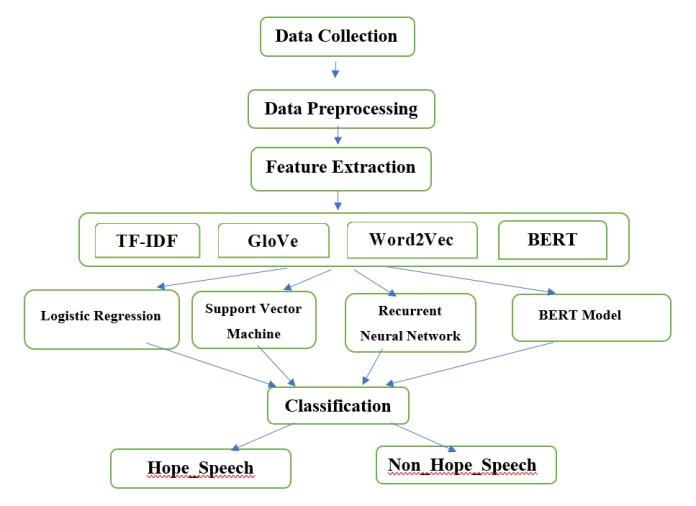
Fig 4.2
This diagram provides a modular and scalable approach to predicting hopeful speech in text, leveraging multipleNLPmethodsandmachinelearning.
In hope speech detection, GloVe embeddings provideastaticwordrepresentationthatcapturesgeneral contextfromvastcorpora,whereasTF-IDFemphasizesthe valueofsinglewordsinthetext.Word2Vecoffersdynamic embeddings based on local context, allowing for more comprehensivesemanticunderstanding.BERTembeddings outperformbecausetotheirbidirectionalnature,capturing deeper,context-awaremeaningsofwords.Whencomparing thesealgorithms,BERTgenerallyoutperformsthembecause toitsincreasedcontextualawareness.however,combining thesetechniquescanprovidecomplementarycapabilitiesfor morerobustidentification.
4.4
Speechdetectioncanbeapproachedusingavariety of models, including Logistic Regression (LR), Support VectorMachines(SVM),RecurrentNeuralNetworks(RNN),
International Research Journal of Engineering and Technology (IRJET) e-ISSN: 2395-0056
Volume: 11 Issue: 12 | Dec 2024 www.irjet.net p-ISSN: 2395-0072
and BERT. Traditional machine learning models include linear regression and support vector machines. RNN is a deeplearningmodel,whereasBERTisatransformer-based model.
LogisticRegression(LR):Anexcellentstartingpoint forclassificationtasks.It'ssimple,understandable, andfrequentlyperformswellonsmalltomediumsizeddata sets. LR provides a basic,interpretable baseline based on linear connections between variablesandlabels.
SupportVectorMachines(SVM):Effectiveinhighdimensional spaces and applicable to both regressionandtasksinvolvingclassification. SVM provide a more complex method, managing nonlinear boundaries and doing well on smaller datasets.
Recurrent Neural Nets (RNNs): Recurrent Neural Networks (RNN) use sequential processing to recorddependenciesovertime,whichisessential forinterpretingtheflowofhopespeechincontext.
Bidirectional Encoder Representations from Transformer (BERT): BERT is advanced, with its transformer-based architecture that captures bidirectional context, resulting in an extensive understandoflanguage.
While LR and SVM work well for simpler tasks, RNNs have an advantage in sequence handling, and BERT frequently beats all, particularly in capturing complex, sensitivestatementsofhopespeech.Whencomparingthese models, BERT typically outperforms them because to its advanced contextual embeddings, albeit requiring more processingresources.
Thecompleteexperimentalmethodologywhichhas been used for the development of the prototype. For the experiment, traditional machine learning methods of Support Vector Machines (SVMs) and Logistic Regression (LR)arechosen.Theseprototypes'performanceisevaluated usingtheF1score,Precision,andRecallmetrics.Inorderto achievebalanceddata,weremovedsamplesfromtheheavily represented class from the unbalanced data until the minorityandmajorityclasseshadanequaldistributionof data with 3,365 features, of which 1,804 were non_hope_speechand1561hope_speech.Initially,atotalof unbalanced data 18,192 features, of which 16,630 were non_hope_speech and 1,562 hope_speech, were extracted from the processed data [15]. There were 1,098 hope speeches and 1512 non-hope speeches out of the 2,610 generateddatapoints.
Followingthat,thetrainingdatasetwasgiveninto MLclassifiersusingfeatureextractionmethodsincludingTFIDF, Word2Vec, and GloVe. We used every possible
combination of feature extraction methods and carefully chosenclassifiers.Inaddition,thisproblemisaddressedby implementing Deep Learning neural networks such as Recurrent Neural Networks (RNN), Transformer-Based BidirectionalEncoderRepresentations(BERT),BERTwith LSTM,andBERTembeddingswithSVMclassifier.Chapter6 discussesthecomparativeresultsoftheMLclassifiersand DeepLearningclassifierwithfeatureextractiontechniques includingTF-IDF,Word2Vec,GloVe,andBERTembeddings onthecreated,unbalanced,andbalanceddataset.
Table-5.1: DatadistributionfortheUnbalanceddata.
Hope_speech 1562
Non_hope_speech 16630
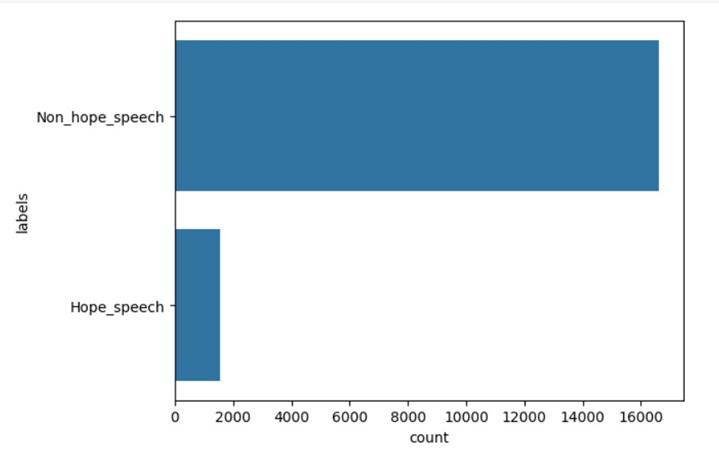
Chart-5.1: DatadistributionfortheUnbalanceddata.
Atotaloforiginaldatawith18,192features,ofwhich16,630 were Non_hope_speech and 1,562 Hope_speech, were extractedfromtheprocesseddata[15].
Table-5.2: DatadistributionfortheBalanceddata.
Hope_speech 1561
Non_hope_speech 1804
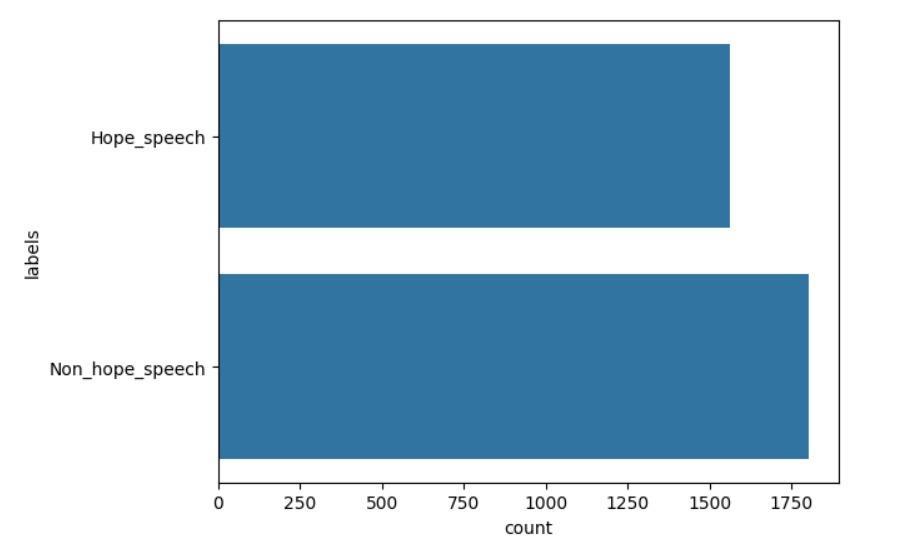
Chart-5.2: DatadistributionfortheBalanceddatabase.
International Research Journal of Engineering and Technology (IRJET) e-ISSN: 2395-0056
Volume: 11 Issue: 12 | Dec 2024 www.irjet.net p-ISSN: 2395-0072
The unbalanced data was reduced until the minority and majorityclasseshadanequaldistributionofdatawith3,365 features,ofwhich1,804wereNon_hope_speechand1561 Hope_speech.
Table-5.3: DatadistributionfortheGenerateddata.
Hope_speech 1512
Non_hope_speech 1098
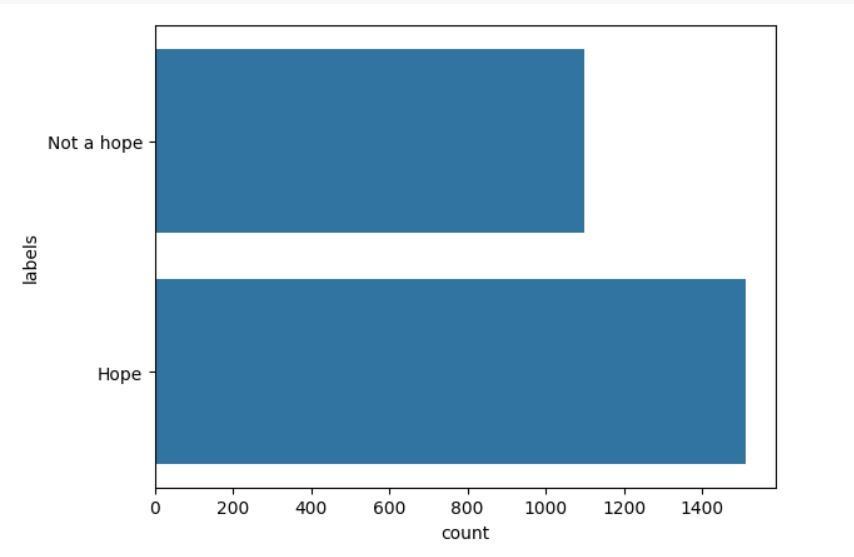
Chart-5.3: DatadistributionfortheGenerateddata. Thenewdatasetpreparedwith1,098Hope_speechand1512 Non hope_speechoutofthe2,610generateddata.
ManyMLandNLPMethodsmightbeutilizedtoeffectively identifyhopespeech.Wefocusedontheexecutionofvarious cutting-edgeprototypesandalgorithms,including:
Logistic Regression (LR): Thestatisticalapproach employedintheanalysisofbinaryclassificationis known as logistic regression. It computes the likelihood of an outcome being binary by consideringoneormorepredictorfactors.Basedon characteristics taken from the text or voice data, LogisticRegressioncancategorizespeechsamples in order to determine whether or not the speech contentishopeful.
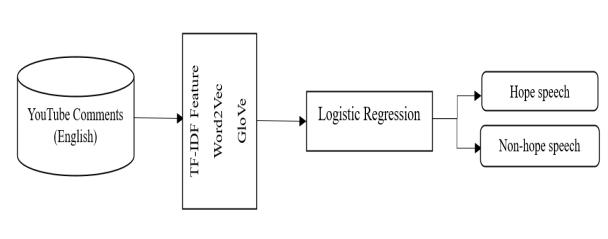
1. Input Features: Text data is turned into a numericalfeaturevectorusingTF-IDForword embeddingslikeWord2VecandGloVe.
2. Logistic Regression Model: The model calculatesaweightedsumoftheinputdatato createalineardecisionboundaryinthefeature space.
3. Sigmoid Function: The linear output is converted into a probability score using the sigmoidfunction.
ThesigmoidfunctionforaLRcanbeexpressed as:1/(1+e^(-z)).
4. Output:Thefinalclassificationisdeterminedby usingadecisionthreshold.
This architecture offers an easy technique to recognizing hope speech, using the linear decision boundary to distinguishhopefulmessagesfromothersbasedontextual properties.
Support vector machines (SVM’s): SVM are effective supervised learning prototypes that are applied to problems with classification and regressionboth.SVMsareknownforbeingflexible inhigh-dimensionalspacesandareespeciallyuseful whenworkingwithsmallerdatasets.Bycollecting relevantinformationfromthespokentext,suchas tone, pitch, and specific word usage, SVMs can be utilizedinthecontexttocategorizespeechdatainto categorieslike"hopeful"or"non-hopeful".
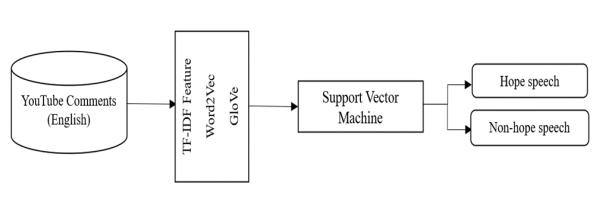
1. Input Features: Text data is turned into a numericalfeaturevectorusingTF-IDForword embeddingssuchasWord2VecandGloVe.
2. SVM Model: SVM determines the best hyperplanethatmaximizesthemarginbetween thetwoclasses.
3. Decision Function: The input text's class is determined by the linear combination of its featuresandlearningweights.
Thedecisionfunctionfora linearSVMcanbe expressedas:f(x)=w⋅x+b
4. Support vectors: These crucial data points determine the ideal hyperplane and thus the decisionboundary.
5. Output:TheSVMclassifiestheinputaccording to the sign of the decision function. If f(x) is greaterthanzero,theinputislabeledashope speech;otherwise,itisclassifiedasnon-hope.
International Research Journal of Engineering and Technology (IRJET) e-ISSN: 2395-0056
Volume: 11 Issue: 12 | Dec 2024 www.irjet.net p-ISSN: 2395-0072
ThisdesignmakesSVManexcellentalternativefordetecting hopespeech,especiallyifthefeaturespaceiswell-defined andseparable.
Recurrent Neural Networks (RNN): RNNs are goodatcomprehendingthecontextofhopespeech because they are especially well-suited for sequential data and can capture temporal connectionsintext.Innaturallanguageprocessing, recurrent neural networks (RNNs) are crucial, particularlyforcategorizedtextapplications.Unlike typical feedforward networks, RNNs have the uniqueabilitytocapturesequentialdependenciesin input,whichmakesthemperfectforprocessingand understandingsequentialinformation.
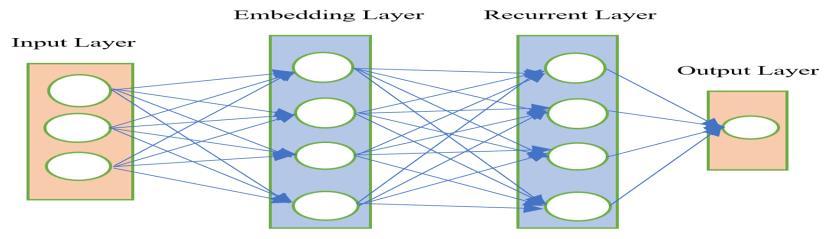
1. Input Sequence: The text data is input into the model word by word. The Embedding Layer transformseachwordintoadensevector.
2. RecurrentLayer:TheRNNprocessesthesequence, updatingitshiddenstatewitheachofthewordsin ordertocapturesequentialcontext.
3. Output Layer: The final hidden state is utilized to determineifthetextshowshope.
ThisarchitectureenablestheRNNtoaccuratelycapturethe temporal connections and variations in the text, which is criticalfortaskssuchashopespeechdetection.
BERT (Bidirectional Encoder Representations from Transformer): Thislanguagerepresentation prototype is revolutionizing NLP by utilizing the strength of transformer architecture to produce contextualized embeddings. BERT uses a bidirectionalapproachtoevaluateinputsequences in forward as well as backward directions. This allows it to identify minute linguistic nuances, contextualdependencies,andcomplicatedsemantic linkages.
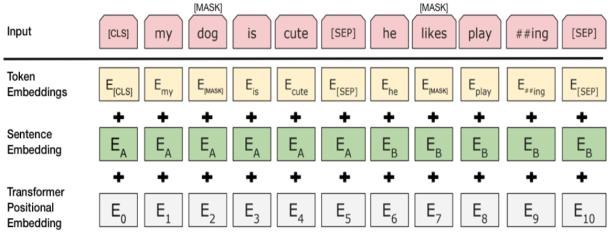
5.4: BERTArchitecture
1. Input Representation: The input text is tokenized and integrated with additional relative and categorizedata.
2. Transformer Encoder: The embedded tokens are passedthroughvariouslayersofself-attentionand feed-forward networks to capture the complex relationshipsbetweentokensinthesequence.
3. [CLS] Token Representation: The vector corresponding to the [CLS] token captures the entire meaning of the input and is used for classification.
4. OutputLayer:Thisrepresentationismappedtothe target classes (hope speech or not) using a fully connectedlayerfollowedbySoftMax.
This design allows BERT to successfully interpret and classify text depending on the context provided by the completesentenceorstatement,makingithighlyeffectiveat recognizinghopespeech.
Metrics:Precision,recall,andtheF1score
Precision: Precision assesses the accuracy of positivepredictions.
Formula:
Precision= TruePositives(TP). TruePositives(TP)+FalsePositives(FP).
Recall (Sensitivity): Recall assesses the ability to identifyallpositiveinstances.
Formula:
Recall= TruePositives(TP). TruePositives(TP)+FalseNegatives(FN).
F1-Score: The F1-Score, which is the harmonic average of Precision and Recall and is useful for unbalancedclasses[1]
Formula:
F1-Score=2* PrecisionxRecall.
Precision+Recall
International Research Journal of Engineering and Technology (IRJET) e-ISSN: 2395-0056
Volume: 11 Issue: 12 | Dec 2024 www.irjet.net p-ISSN: 2395-0072
Accuracy: The proportion of correctly predicted instances to total instances. It Offers a quick snapshot of prototype performance, particularly whenclassesarebalanced.
Formula:
Accuracy= TruePositives(TP)+TrueNegatives(TN). Totalinstances
7. RESULTS AND DISCUSSION
During this task, we employed four different prototypestodetecthopespeech:LogisticRegression(LR), SupportVectorMachine(SVM),BERT,andRecurrentNeural Networks.Theprimarypurposewastoanalyzeandcompare theprototypes'effectivenessinlocatinghopespeechintext data.Thedatasetwasdividedbetweentrainingandtesting setsusingan80:20split.ThelabelswereencodedwithLabel Encoder,whichconvertedcategoricallabelsintonumerical values. Traditional machine learning prototypes (LR and SVM) had features extracted via TF-IDF vectorization. For deep learning prototypes (BERT and RNN), text data was tokenizedandpaddedasneeded.
Evaluation Metrics
Accuracy: The proportion of correctly predicted instances.
Precision, Recall, F1-Score: Metrics evaluating classificationperformance.
Prototype Performance
Theunbalanceddata,balanceddataandgenerated data is checked and verified by using feature extraction methods such as TFIDF, Word2Vec and Glove, BERT embeddings with Classifiers such as LR, SVM, RNN, and Transformer prototype (BERT) to predict Hope Speech classification. Traditional Machine Learning Prototypes (LogisticRegression,SupportVectorMachine(SVM))andDL neuralnetworktype(RNN),Transformerprototype(BERT) wastrainedonthedataset,andthefollowingresultswere obtained.
1. Logistic Regression (TFIDF +LR)
Table -7.1: ResultsObtainedfor(TFIDF+LR)Prototype
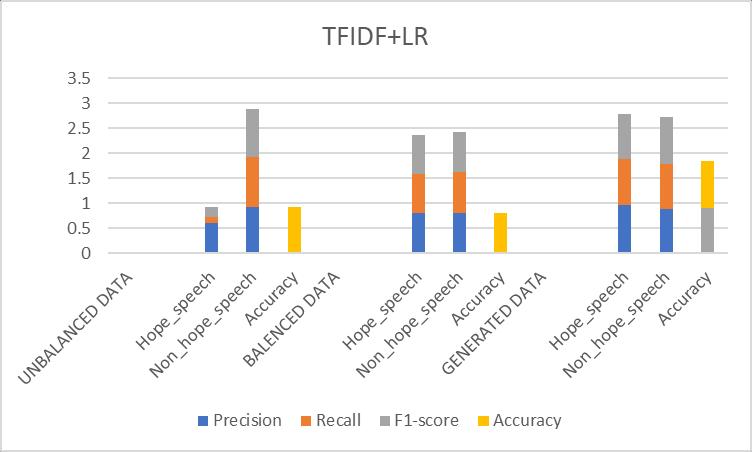
prototype
2. Logistic Regression (W2V +LR)
Table-7.2: ResultsObtainedfor(W2V+LR)Prototype
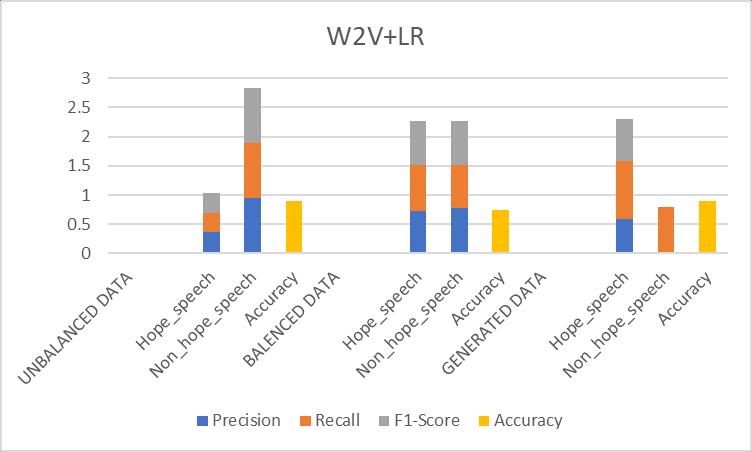
Fig 7.2: Comparisonofevaluationmetricsof(W2V+LR) prototype
3. Logistic Regression (GloVe +LR)
Table-7.3: ResultsObtainedfor(GloVe+LR)Prototype
International Research Journal of Engineering and Technology (IRJET) e-ISSN: 2395-0056
Volume: 11 Issue: 12 | Dec 2024 www.irjet.net p-ISSN: 2395-0072
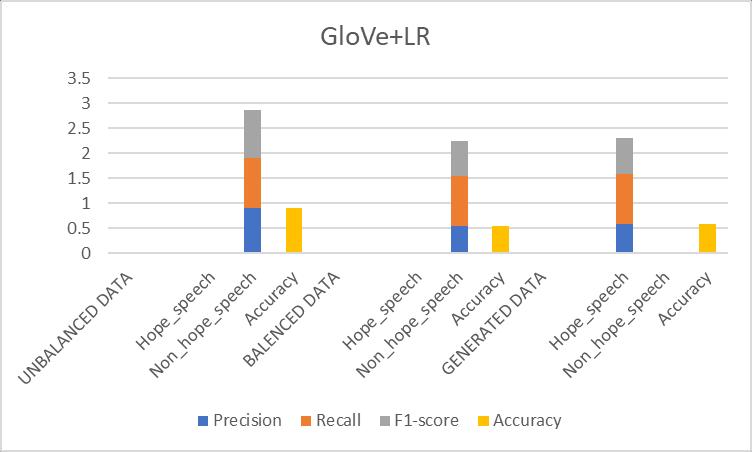
Fig 7.3: Comparisonofevaluationmetricsof(GloVe+LR) prototype
Discussion: LogisticRegression,asimpleandinterpretable prototype,performedwellonthechallenge.Theprototype generalized well, but it struggled to capture complicated patternsinthetext,whichisunderstandablegivenitslinear character.
4 Support Vector Machine (TFIDF+SVM)
Table-7.4: ResultsObtainedfor(TFIDF+SVM)Prototype
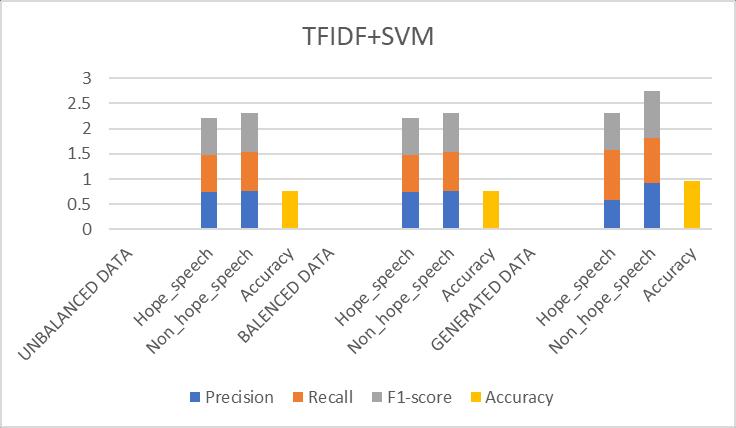
Fig 7.4: Comparisonofevaluationmetricsof(TFIDF+SVM) prototype
5. Support Vector Machine (W2V+SVM)
Table-7.5: ResultsObtainedfor(W2V+SVM)Prototype
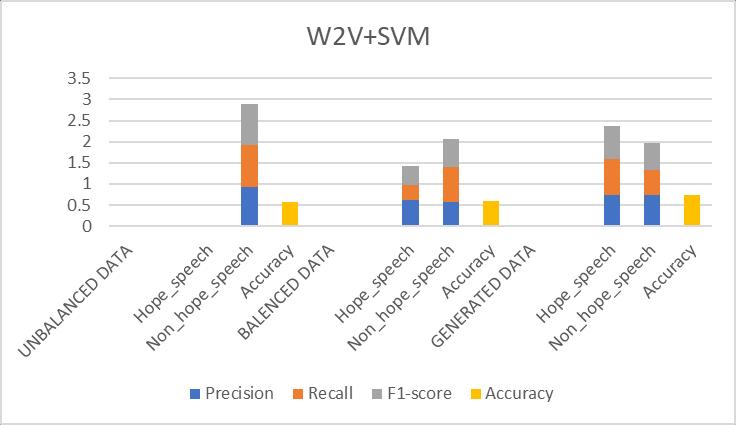
Fig 7.5: Comparisonofevaluationmetricsof(W2V+SVM) prototype
6 Support Vector Machine (GloVe+SVM)
Table-7.6: ResultsObtainedfor(GloVe+SVM)Prototype
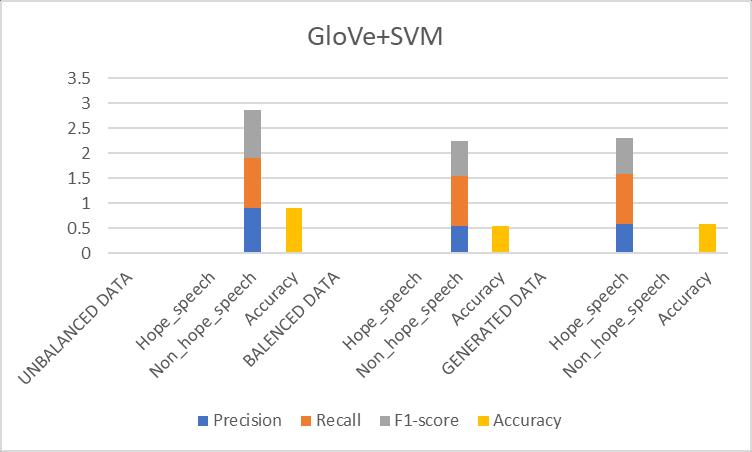
Fig 7.6: Comparisonofevaluationmetricsof(GloVe+SVM) prototype
Discussion: The SVM prototype outperformed Logistic Regression by a small margin. Its ability to handle highdimensional data made it slightly better at distinguishing betweenhopespeechandothertypesofspeech.However,it stillhadlimitationsinunderstandingthecontextualnuances ofthetext.
7. Recurrent Neural Network (RNN)
Table-7.7: ResultsObtainedforRNNPrototype
International Research Journal of Engineering and Technology (IRJET) e-ISSN: 2395-0056
Volume: 11 Issue: 12 | Dec 2024 www.irjet.net p-ISSN: 2395-0072
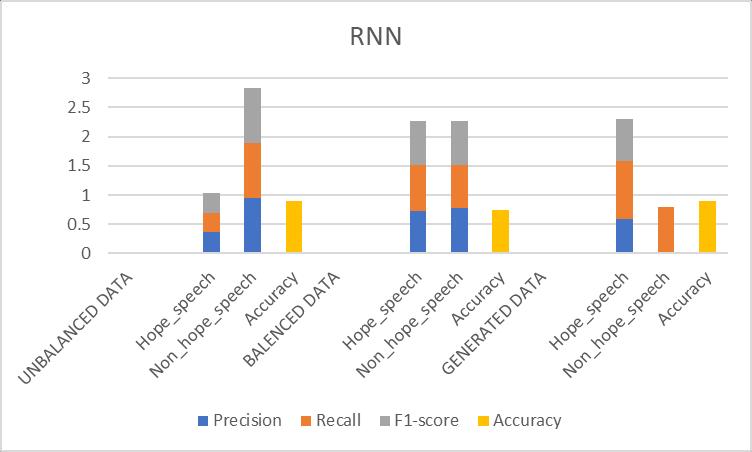
Fig 7.7: ComparisonofevaluationmetricsofRNNprototype
Discussion: The RNN prototype also showed strong performance, although it was slightly lower than BERT. RNNs are designed to capture sequential dependencies in text,whichhelpedinunderstandingtheflowofinformation. However,RNNsmaystrugglewithlong-termdependencies comparedtotransformer-basedprototypeslikeBERT.
8. BERT (Bidirectional Encoder Representations from Transformers)
Table-7.8: ResultsObtainedforBERTPrototype
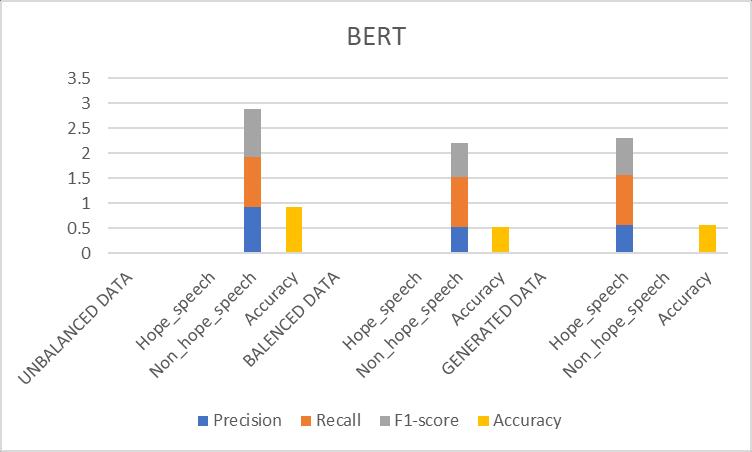
7.8: ComparisonofevaluationmetricsofBERTprototype
9. BERT+SVM
Table-7.9: ResultsObtainedfor(BERT+SVM)Prototype
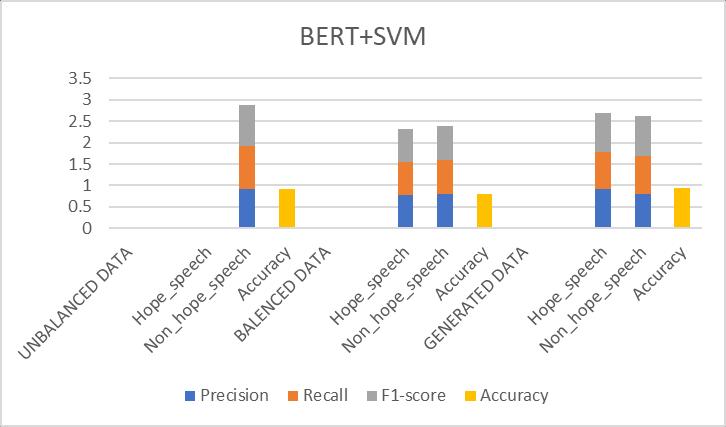
7.9: Comparisonofevaluationmetricsof(BERT+SVM) prototype
Table-7.10: ResultsObtainedfor(BERT+LSTM)Prototype
Balanceddata 79% Generateddata 99%
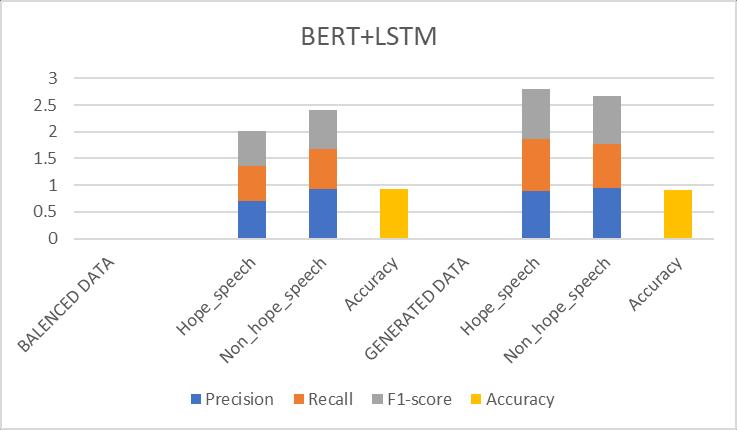
Fig 7.10: Comparisonofevaluationmetricsof (BERT+LSTM)prototype
Discussion: BERT, a transformer-based prototype, fared much better than both LR and SVM. Its deep bidirectional transformersenabledittocomprehendthecontextualand semantic meaning of words in the text. The prototype excelled in capturing the language's complicated patterns anddependencies,resultingingoodperformanceacrossall measures.
Among the four prototypes, BERT had the best accuracy,precision,recall,andF1-score.Thissuggeststhat transformer-based prototypes are more effective at detecting hope speech because they can understand contextual information and semantic complexities. Traditional machine learning prototypes, such as LR and
International Research Journal of Engineering and Technology (IRJET) e-ISSN: 2395-0056
Volume: 11 Issue: 12 | Dec 2024 www.irjet.net p-ISSN: 2395-0072
SVM,performedwell butwereconstrainedbytheirlinear characterandinabilitytograspcomplicatedcorrelationsin data. RNNs achieved a reasonable combination of performance and computational economy, but BERT outperformedthemmarginally.
BERTconsistentlyoutperformedothermethodsdue toitsdeepcontextualunderstanding.Itishighlyeffectivein grasping nuances of hope speech. RNN’s showed good performance, particularly with longer sequences where context is important. SVM and LR performed well with simpler data representations but struggled with more complex patterns. Word2Vec, GloVeand TF-IDF, provided valuable insights, but their effectiveness was limited comparedtoBERT.
Theliteraturesurveyhighlightsvariousapproaches topredictinghopefulspeechintextsentences.Traditional machine learning methods like SVMs and Logistic Regression,alongwithmoderntechniqueslikeWord2Vec, TF-IDF, RNNs, and BERT, offer diverse tools for analysing and classifying text based on emotional content. Each method brings unique strengths to the task of predicting hopefulness.Themethodologyforpredictinghopefulspeech intextsentencesencompassesacomprehensiveapproach fromdatacollectiontodeployment.By employingvarious techniquesandadvancedmachinelearningprototypes,the system aims to accurately identify and predict hopeful sentimentsintext.Continuousevaluationandupdateswill ensurethesystemremainseffectiveandrelevant.Thestudy demonstratedthatBERTisthemosteffectivetechniquefor predicting hope speech due to its deep contextual capabilities.WhiletraditionalmethodslikeSVMandLRare useful, modern NLP techniques such as BERT provide significant improvements. Future work may involve exploring hybrid prototypes and fine-tuning pre-trained prototypesonspecializeddatasets.
[1] P. Aggarwal (2022). Hope Speech Detection on Social MediaPlatforms.
[2] https://www.ncbi.nlm.nih.gov/pmc/articles/PMC77850 56/
[3] https://www.indeed.com/career-advice/careerdevelopment/types-of-speeches
[4] Sharma, N., Pandey, R., & Singh, S. (2022). Detecting hope and motivation in online forums using logistic regression and sentiment analysis. Journal of InformationScience,48(3),456-468.
[5] Jones,K.S.(2004).AStatisticalInterpretationofTerm Specificity and its Application in Retrieval. Journal of Documentation,60(5),493-502.
[6] Jurafsky,D.,&Martin,J.H.(2020).SpeechandLanguage Processing(3rded.).PrenticeHall.
[7] Ng, A. Y., & Jordan, M. I. (2002). On Discriminative vs. Generative classifiers: A comparison of logistic regression and naive Bayes. In Advances in Neural InformationProcessingSystems
[8] https://www.deeplearning.ai/resources/naturallanguage-processing/
[9] Joachims, T. (1998). Text categorization with Support VectorMachines:Learningwithmanyrelevantfeatures. InEuropeanConferenceonMachineLearning.
[10] Liuetal.(2019).Transcriptomeprofilingofperiwinkle infectedwithHuanglongbing
[11] Le, Q. V., & Mikolov, T. (2014). Distributed Representations of Sentences and Documents. In Proceedings of the 31st International Conference on MachineLearning(ICML-14).
[12] https://www.geeksforgeeks.org/ml-machine-learning/
[13] Zhang,L.,Wang,S.,&Liu,B.(2018).Deeplearningfor sentiment analysis: A survey. Wiley Interdisciplinary Reviews:DataMiningandKnowledgeDiscovery.
[14] Hochreiter, S., & Schmid Huber, J. (1997). Long shorttermmemory.NeuralComputation.
[15] Chakravarthi, B. R. (2022). HopeEDI: A Multilingual HopeSpeechDetectionDatasetforEquality,Diversity, and Inclusion. Proceedings of the 13th Language Resources and Evaluation Conference (LREC 2022), EuropeanLanguageResourcesAssociation(ELRA).
[16] https://www.analyticsvidhya.com/blog/2020/02/cnnvs-rnn-vs-mlp-analyzing-3-types-of-neural-networks-indeep-learning/
[17] Santos,C.N.d.S.,Barbosa,L.,Boghrati,R.,Braga,D.,& Carvalho,R.(2017).
[18] ConvolutionalNeuralNetworksforSentimentAnalysis ofShortTexts.
[19] https://en.wikipedia.org/wiki/BERT_(language_model)
[20] Gers, F. A., Schmid Huber, J., & Cummins, F. (2002). Learning to Forget: Continual Prediction with LSTM. NeuralComputation.
International Research Journal of Engineering and Technology (IRJET) e-ISSN: 2395-0056
Volume: 11 Issue: 12 | Dec 2024 www.irjet.net p-ISSN: 2395-0072
[21] Devlin,J.,Chang,M.-W.,Lee,K.,&Toutanova,K.(2018). BERT:Pre-trainingofdeepbidirectionaltransformers forlanguageunderstanding.
[22] Huang,B.,Li,Z.,&Zhan,J.(2020).IdentificationofHope Speechinsocialmedia:ABERT-basedApproach.Journal ofDigitalandSocialMediaMarketing.
© 2024, IRJET | Impact Factor value: 8.315 | ISO 9001:2008 Certified
| Page666