
International Research Journal of Engineering and Technology (IRJET) e-ISSN: 2395-0056
Volume:13Issue: 03|Mar 2026 www.irjet.net p-ISSN:2395-0072

International Research Journal of Engineering and Technology (IRJET) e-ISSN: 2395-0056
Volume:13Issue: 03|Mar 2026 www.irjet.net p-ISSN:2395-0072
Manvvi Cilagani1 , K. Sai Kusumitha2 , K. Srikar Reddy3 , K. Naveen4, L. Nagender Kumar5
1Frontend and Backend Developer
2Frontend Developer
3Backend Developer
4Frontend Developer
5Team Mentor, Dept. of Computer Science & Engineering, Joginpally B R Engineering College, Telangana, India.
Abstract - The increasing reliance on web applications has created a strong demand for efficient and scalable frontend deployment systems. Traditional hosting approaches often require manual configuration, resulting in delays and potential errors. Modern platforms simplify deployment but introduce limitations in terms of cost, flexibility, and infrastructure control.
This paper presents a system titled “Enhancing Frontend Deployment using AWS CloudFront – A Vercel-Inspired Platform”, which focuses on automating frontend deployment using cloud-based services. The proposed solution integrates GitHub repositories, performs automated build processes,and distributes static content through AWS CloudFront for optimized global delivery.
The system is designed to minimize deployment time, improve performance using CDN-based caching, and provide a costeffective alternativeforstudentsanddevelopers.Byleveraging AWS S3 for storage and CloudFront for content delivery, the platform ensures high availability,scalability,andlowlatency.
The results demonstratethattheproposedsystemsignificantly improves deployment efficiency while maintaining simplicity and affordability.
Key Words: Frontend Deployment, AWS CloudFront, CDN, CI/CD, GitHub Integration, Web Hosting, Automation
Therapidgrowthofmodernwebtechnologieshasincreased theneedforefficientdeploymentsystemsthatcandeliver applications quickly and reliably. Developers require platforms that not only automate the deployment process butalsoensurehighperformanceandscalability.
Traditional deployment methods involve manually uploadingfiles,configuringservers,andmanaginghosting environments. These processes are time-consuming and prone to human error. Modern solutions like automated deployment platforms have simplified this workflow, but they often come with limitations such as restricted customizationandhighercosts.
This project proposes a deployment platform inspired by modern tools, focusing on automation, performance, and affordability. The system integrates GitHub repositories, builds frontend applications automatically, and deploys them using cloud infrastructure. By utilizing AWS CloudFront, the system ensures faster content delivery throughgloballydistributededgelocations.
Recentadvancementsincloudcomputinghavesignificantly improved frontenddeployment practices.Many platforms nowofferautomateddeploymentpipelinesintegratedwith versioncontrolsystems.Thesesystemsreducemanualeffort andimprovedevelopmentefficiency.
However,existingsolutionsoftenimposelimitationssuchas pricing constraints, lack of infrastructure control, and dependency on proprietary systems. While CDN-based deliveryimprovesperformance,itisnotalwaysaccessibleto allusersduetocostbarriers.
This study identifies the need for a system that combines automation, scalability, and affordability. By analyzing existingplatformsandtheirdrawbacks,amoreflexibleand cost-efficientsolutioncanbedevelopedusingcloudservices.
The system is designed to automate and simplify the frontend deployment process by integrating multiple functionalitiesintoa unified workflow.It enablesusersto connecttheirGitHubrepositoriesseamlessly,allowingthe platformtofetchsourcecodedirectly.Oncetherepositoryis linked,thesystemautomaticallyinstallsdependenciesand buildsthefrontendapplicationwithoutmanualintervention. Thegeneratedbuildfilesarethendeployedtocloudstorage, ensuring secure and scalable hosting. Additionally, the platform generates a live deployment URL, which allows users to instantly access and share their application. Throughout the process, the system provides real-time deployment status updates, improving transparency and enhancingtheoveralluserexperience.
International Research Journal of Engineering and Technology (IRJET) e-ISSN: 2395-0056
Volume:13Issue: 03|Mar 2026 www.irjet.net p-ISSN:2395-0072
The system is designed to meet essential non-functional requirementsthatensurequalityandreliability.Itdelivers high performance with minimal latency by leveraging efficientprocessingandcontentdeliverymechanisms.The architecture supports scalability, allowing multiple users and deployments to be handled simultaneously without performance degradation.Inaddition, thesystem ensures reliableuptimeandconsistentavailability,makingdeployed applications accessible at all times. Security is also a key consideration,withappropriatemeasuresimplementedto protectuserdata andensuresafehandlingofinformation throughoutthedeploymentprocess.
The proposed system introduces an automated frontend deploymentplatformdesignedtoenhanceefficiencywhile minimizingoperationalcosts.ItintegratesGitHubtofetch projectsourcecodedirectly,enablingseamlessinteraction with modern development workflows. The system automates the build process by executing required commandswithoutmanualintervention,therebyreducing errorsandsavingtime.GeneratedfilesarestoredinAWSS3, ensuringsecureandscalablestorage,whileAWSCloudFront is utilized to deliver content globally with low latency throughCDNtechnology.Additionally,theplatformprovides real-time status tracking, allowing users to monitor deploymentprogressateachstage.Thisintegratedapproach results in faster deployment, reduced manual effort, and significantlyimprovedoverallperformance.
Thesystemfollowsadistributedarchitecturecomposedof fourkeycomponentsthatworktogethertoenableefficient andscalablefrontenddeployment.
Thefrontendlayerservesastheuserinteractioninterface.It allows users to submit GitHub repository URLs, initiate deployments,andtrackthestatusoftheirapplications.This layer is designed to be simple and user-friendly, ensuring easeofuseforbothbeginnersanddevelopers.
Thebackendserveractsasthecoreprocessingunitofthe system.Ithandlesimportantoperationssuchascloningthe repositoryfromGitHub,installingdependencies,executing thebuildprocess,andmanagingdeploymentworkflows.It alsomaintainsdeploymentstatusandcommunicateswith othersystemcomponents.
Thestoragelayerisresponsibleforstoringthestaticbuild filesgeneratedafterthedeploymentprocess.AWSS3isused due to its high reliability, scalability, and secure storage capabilities, ensuring that application files are safely maintainedandeasilyaccessible.
TheCDNlayerdistributesthestoredcontentgloballyusing AWSCloudFront. Itcaches data atmultiple edgelocations and serves users from the nearest server, which reduces latencyandsignificantlyimprovesapplicationloadtimeand performance.
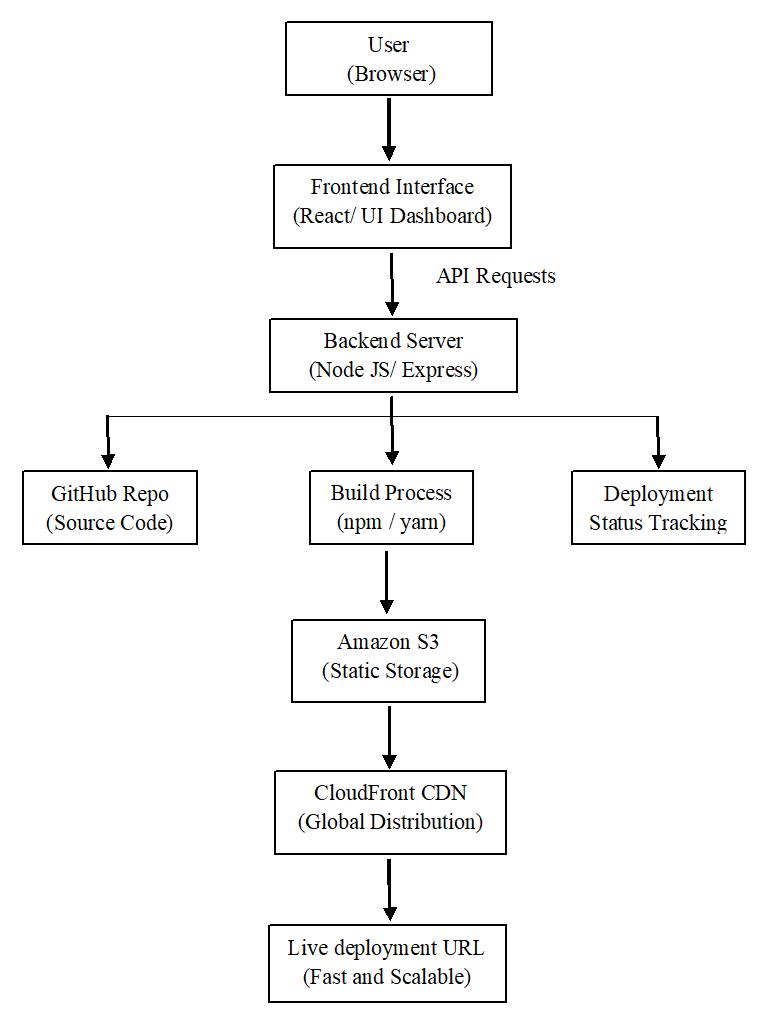
Fig1: SystemArchitecture
The system follows a well-defined and fully automated workflowdesignedtostreamlinethefrontenddeployment process and minimize manual intervention. The process begins when the user submits a GitHub repository URL throughtheplatform’sinterface.Thebackendserverthen retrieves the source code directly from the repository, ensuringseamlessintegrationwithversioncontrolsystems.
International Research Journal of Engineering and Technology (IRJET) e-ISSN: 2395-0056
Volume:13Issue: 03|Mar 2026 www.irjet.net p-ISSN:2395-0072
Oncethecodeisfetched,thesystemautomaticallyinstallsall required dependencies, preparing the environment for execution.
After setting up the environment, the build process is initiated,wheretheapplicationiscompiledintooptimized, production-readystaticfiles.Thesegeneratedfilesarethen securelyuploadedtoAWSS3,whichprovidesreliableand scalablestorage.Followingthis,AWSCloudFronttakesover the delivery process by distributing the content across multipleglobaledgelocations.Thisensuresthatuserscan accesstheapplicationfromthenearestserver,significantly reducinglatencyandimprovingloadtimes.
Finally, the system generates a unique deployment URL, whichissharedwiththeuserforinstantaccesstothelive application. Throughout this process, the system operates automaticallyandefficiently,ensuringconsistency,reducing errors, and enabling a smooth and reliable deployment pipeline.
The system is implemented using a modular approach, whereeachmoduleisresponsibleforaspecificfunctionality in the deployment pipeline. This design improves maintainability,scalability,andclarityoftheoverallsystem.
TheAuthenticationModuleisresponsibleformanaginguser access and ensuring system security. It allows users to registerandloginusingtheircredentials,therebyproviding controlledaccesstotheplatform.Themoduleusestokenbasedauthenticationmechanisms,suchasJSONWebTokens (JWT),tomaintainsecureusersessions.Onceauthenticated, userscanaccesstheirrespectiveprojectsanddeployment details without repeated login requests. This module also ensures that sensitive data is protected and unauthorized accessispreventedthroughsecurevalidationtechniques.
The Repository Integration Module enables seamless interaction with GitHub repositories. It allows users to provide a repository URL, which is then validated by the system to ensure correctness and accessibility. After validation,thebackendclonestherepositoryintotheserver environmentusingGitcommands.Thismoduleensuresthat the latest version of the source code is fetched accurately andpreparedforfurtherprocessing.Itplaysacrucialrolein connecting version control systems with the deployment pipeline,therebyenablingautomatedworkflows.
TheDeploymentEngineisthecorecomponentofthesystem that handles the build and deployment process. Once the repository is cloned, this module installs all required
dependenciesandexecutesthenecessarybuildcommands togenerateproduction-readyfiles.Thegeneratedfilesare then uploaded to AWS S3 for storage. After successful upload,themoduletriggersAWSCloudFronttodistribute thecontentgloballythroughitsCDNnetwork.Additionally, thedeploymentenginemanageserrorhandling,logsbuild outputs,andupdatesdeploymentstatus,ensuringareliable andefficientdeploymentprocess.
Theimplementedsystemsuccessfullyachievesautomated frontend deployment while providing a fast and reliable hosting solution. The integration of cloud services and automationsignificantlyenhancestheoverallefficiencyof the deployment process. The platform was tested with multiple frontend applications, and the results indicate consistent performance and reliability across different scenarios.
Oneofthemajorimprovementsobservedisthereductionin deployment time, as the automated workflow eliminates manual steps such as configuration and file uploads. Additionally, the use of CDN technology through AWS CloudFrontenablesfastercontentdeliverybyservingusers from the nearest edge locations, thereby reducing latency andimprovingloadtimes.
The system also demonstrates strong scalability, as it can handle multiple deployments simultaneously without significantperformancedegradation.Thismakesitsuitable for use by multiple users or projects at the same time. Furthermore,theoverallsolutionprovestobecost-effective, as it leverages cloud services efficiently, minimizing infrastructureandmaintenanceexpenses.
Duringtesting,theplatformmaintainedstableperformance even under multiple deployment requests, confirming its reliabilityandrobustnessasafrontenddeploymentsolution.
9.1
The proposed system presents an efficient and scalable solution for modern frontend deployment challenges. By integrating automation with cloud-based services, the platform significantly simplifies the deployment process, eliminatingtheneedformanualconfigurationandreducing the chances of human error. The use of automated workflows ensures consistency and speeds up the entire deploymentcycle,makingithighlysuitablefordevelopers andstudents.
Furthermore, the system effectively leverages cloud infrastructuretooptimizeperformancewhilemaintaining cost efficiency. The integration of AWS S3 for storage and AWS CloudFront for content delivery ensures high availability,reliability,andscalability.Inparticular,theuse
International Research Journal of Engineering and Technology (IRJET) e-ISSN: 2395-0056
Volume:13Issue: 03|Mar 2026 www.irjet.net p-ISSN:2395-0072
of AWS CloudFront plays a crucial role in enhancing application performance by distributing content across globaledgelocations,resultinginreducedlatencyandfaster load times. Overall, the system delivers a practical and affordable alternative to existing deployment platforms whilemaintainingstrongperformanceandusability.
Althoughthecurrentsystemprovidesastrongfoundation, severalenhancementscanfurtherimproveitsfunctionality and user experience. One important improvement is the integration of custom domain support, allowing users to deploy applications with personalized domain names instead of default URLs. Additionally, automating SSL certificate generation and management would enhance security by enabling HTTPS for all deployed applications withoutmanualconfiguration.
Anothervaluableenhancementistheinclusionofreal-time deployment logs, which would allow users to monitor the buildanddeploymentprocessindetailandquicklyidentify any errors. Finally, introducing multi-user collaboration featureswouldenableteamstoworktogetheronprojects, share deployments, and manage applications more efficiently. These enhancements would make the system more robust, user-friendly, and aligned with modern industrystandards.
[1]AmazonWebServicesDocumentation–CloudFrontand S3
[2]GitHubAPIDdocumentation
[3] Research on Content Delivery Networks and Web Performance
[4]StudiesonCI/CDPipelinesinWebDevelopment