
International Research Journal of Engineering and Technology (IRJET) e-ISSN: 2395-0056
Volume: 12 Issue: 01 | Jan 2025 www.irjet.net p-ISSN: 2395-0072

International Research Journal of Engineering and Technology (IRJET) e-ISSN: 2395-0056
Volume: 12 Issue: 01 | Jan 2025 www.irjet.net p-ISSN: 2395-0072
1 Assistant Professor, Dept. of Electrical & Electronics Engineering, PDA College of Engineering Kalaburagi, Karnataka, India.
2 Assistant Professor, Dept. of Electrical & Electronics Engineering, PDA College of Engineering Kalaburagi, Karnataka, India.
Akshay Aspalli1, Sangmesh Sakri2
Abstract: This research focuses on improving the integration of renewable energy sources, specifically photovoltaic(PV)andwindenergy,intomulti-gridsystems. The study aims to address the challenges of achieving consistentpenetrationlevelsfortheseenergysourceswhile managing their variability and intermittency alongside fluctuatingdemandacrossinterconnectedgrids.Toachieve this, advanced optimization techniques are essential. The Risk-Adjusted Unit Commitment (RAUC) framework has beendevelopedforpowersystemsincorporatingbothsolar and wind energy, applied within a 118-bus network. The primaryobjectiveofthisframeworkistoensurebalanced and reliable grid operation while overcoming challenges posedbyrenewableenergyvariability.
TheRAUCframeworkbeginswithextensivedatacollection, withsolarpowergenerationmodeledusingMixedInteger QuadraticProgramming(MIQP)andwindpowergeneration modeledthroughtheAutoRegressivewithExogenousInputs (ARO) methodology. To increase renewable energy penetration in multi-grid systems, the framework incorporates High-Penetration Renewable Integration (HPRI)strategiesalongwiththeMulti-ObjectiveMulti-Verse Optimization(MOMVO)algorithm.TheStochasticSecurityConstrainedUnitCommitment(SCUC)methodisalsoused, alongwithcoordinationofBatteryEnergyStorageSystems (BESS)inmulti-areagrids.
MATLABisemployedtodevelopalgorithmsoptimizingthe schedulingofBESScharginganddischargingcyclesbasedon variablessuchasstateofcharge(SOC)andtimeintervals. Simulationresultsshowthatafter7.9hoursofoperation,the battery'sSOCreaches40.5%,indicatingthatthebatteryhas dischargedto40.5%ofitsfullcapacity.
Lookingforward,thereisconsiderablepotentialforfurther refining optimization algorithms for renewable energy management.Byincorporatingmachinelearning,artificial intelligence, and advanced modeling techniques, the precision and efficiency of these systems could be
significantly enhanced, ultimately contributing to more sustainableandrobustenergysolutions.
KeyWords: RenewableEnergy,Multi-Grid,Photovoltaic (PV), 118 Bus System, and Risk-Adjusted Unit Commitment.
The growing global demand for energy, combined with increased awareness of environmental challenges, has driven the transition toward renewable energy sources. Amongthese,photovoltaic(PV)andwindenergystandout asvitalcontributorstoreducingdependencyonfossilfuels andmitigatingtheeffectsofclimatechange.However,their integration into existing power grids presents unique and complexchallenges,requiringthedevelopmentofinnovative strategiesandoptimizationtechniques.
The variability and intermittency of renewable energy sourceslikePVandwind,whichdependonfactorssuchas weatherconditionsanddaylight,addsignificantcomplexity togridoperations.
In multi-grid systems, the objective is to interconnect regionalandlocalgridstocreateanefficient,cohesive,and reliableenergynetwork.Thisintegrationdemandsadvanced solutions to handle fluctuating power output and align it with dynamic energy demands across different regions. Achievingthisbalanceiscriticalforthestableoperationof interconnectedgrids.Optimizationtechniqueshaveemerged as indispensable tools in managing renewable energy integration. These techniques leverage mathematical models,sophisticatedalgorithms,andcomputationaltoolsto optimizeenergygeneration,transmission,anddistribution inrealtime.
The transition toward renewable energy sources offers opportunities to enhance energy sustainability and resilience but also introduces new challenges. Ensuring equitable penetration of PV and wind energy across
International Research Journal of Engineering and Technology (IRJET) e-ISSN: 2395-0056
Volume: 12 Issue: 01 | Jan 2025 www.irjet.net p-ISSN: 2395-0072
interconnected grids is essential for achieving these objectives. Integrating renewable energy sources, such as solarPVandwindpower,intoa118-busmulti-gridsystem requires addressing issues like grid stability, voltage regulation, and coordinated power dispatch. Overcoming thesechallengesispivotalforensuringbothenvironmental sustainabilityandsystemreliability.
The Unit Commitment (UC) framework is central to this effort,aimingtooptimizeenergydispatchwhileminimizing operational costs and enhancing system reliability. It provides a structured approach to managing unit commitment decisions in a renewable energy-integrated powersystem.Thispaperisorganizedasfollows:[Section2] presentsareviewofrelatedliterature,[Section3]outlines theproposedmethodology,[Section4]discussestheresults, and[Section5]concludeswiththestudy'skeyfindingsand implications.
Thissectionreviewskeyresearchaddressingthechallenges of integrating renewable energy sources, particularly photovoltaic(PV)andwindenergy,intomulti-gridsystems, withafocusonunitcommitmentissuesinthecontextofa 118-bussystem.
Youssefetal.[21]introducedstrategiestomitigatethelow inertia challenge and surplus capacity issues caused by renewableenergyintegration.Theirfindingsrevealedthat by incorporating hydrogen energy storage, frequency deviationscouldbereducedsignificantlyfrom0.0366Hzto 0.02Hz,especiallyatPVpowerlevelsof34.29kW.Zouetal. [22] developed a coupling coordination degree (CCD) evaluation system to enhance the interaction between renewableenergyandthermalpowersystems.Theirresults indicatedthatthermalunitswithadvancedpeakregulation capabilities are more effective in managing wind power fluctuations.
in et al. [23] analyzed how renewable energy penetration impacts system optimization and operational efficiency. Theirsimulationshighlightedenergy-savingratesof37.60%, 7.92%, and 36.87% under three distinct strategies, showcasing significant benefits in systems with high renewableenergypenetration.Wangetal.[24]focusedon energy storage (ES) requirements for peak shaving and frequencyregulation.Theydeterminedthatasystemwith 49.5%renewableenergypenetrationandamaximumload of 9896.42 MW would require ES power and capacity of 1358MWand4122MWh,respectively,forpeakshaving,and 478MWand47MWhforfrequencyregulation.
Vaka et al. [25] proposed an optimization algorithm for hybrid renewable energy systems (HRES) with battery energystoragesystems(BESS).Usingtheε-MPSOapproach, theyminimizedthelevelizedcostofelectricity(LCOE)while
ensuring improved energy management and system reliability.
Fusco et al. [26] presented a multi-stage stochastic Mixed Integer Linear Program to optimize the day-ahead unit commitment for power plants and virtual power plants participating in day-ahead and ancillary services markets. Theirmethodefficientlyreduceddecision-relatedtimesteps while expanding possible scenarios as the algorithm progressed.
Gupta et al. [27] demonstrated the potential of battery energystorage(BES)inmitigatingtransmissioncongestion andcurtailingsolarpowerinsystemswithsignificantsolar integration.TheirapproachutilizedLineOutageDistribution Factors(LODF)tostreamlinecomputationalcomplexityin stochasticSCUCmodels.
Zhang et al. [28] explored the role of electrical energy storage systems (EESS) in mitigating the variability of distributed renewable energy sources within microgrids. Their study showed that the EMPSO-Q algorithm outperformedalternativeoptimizationtechniques,achieving 15%to45%betterresultscomparedtoEMPSO-V,EMPSO-S, andPSO-S.
Avvari et al. [29] addressed the multi-objective optimal powerflow(MOOPF)problembyintegratingwind,PV,and plug-in electric vehicle (PEV) systems. Their MOEA-based decomposition approach employed an advanced selection mechanismforbetterdiversityinsolutionoutcomes.
Finally, Hassan et al. [30] proposed a solution to the probabilisticoptimalpowerflow(P-OPF)problemforhybrid power systems that integrate PV and wind energy. Their method effectively reduced the operational costs of renewable energy-integrated power systems under both fixed and variable load conditions, demonstrating the robustnessandaccuracyoftheiroptimizationframework.
Thechallengesofenhancingequalpenetrationofrenewable energy into multi-grid systems and overcoming unit commitmentissuesassociatedwithphotovoltaic(PV)and windgenerationina118-bussystemthroughtheapplication ofoptimizationtechniques.Thisresearchwillfirstestablish a comprehensive model that captures the complexities of multi-gridintegrationandunitcommitmentinthepresence of renewable energy sources. Optimization algorithms, including mathematical programming and heuristic methods, will then be employed to optimize unit commitment decisions, considering factors such as generationcapacity,gridconstraints,andrenewableenergy variability.Bysystematicallyanalyzingdifferentscenarios and adjusting optimization parameters, the proposed methodology seeks to identify optimal solutions that enhance the equitable distribution of renewable energy
International Research Journal of Engineering and Technology (IRJET) e-ISSN: 2395-0056
Volume: 12 Issue: 01 | Jan 2025 www.irjet.net p-ISSN: 2395-0072
across multiple grids while ensuring grid stability and reliability. Through this approach, the research aims to contribute to the advancement of sustainable energy systemsbyfacilitatingtheefficientintegrationofrenewable resourcesintomulti-gridenvironments.
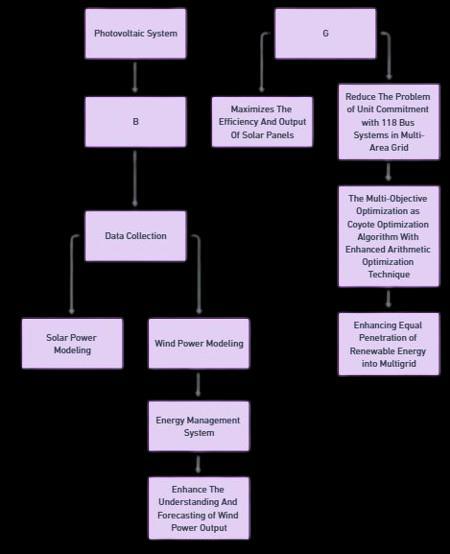
Figure 1: Block Diagram Representing the Framework of the Proposed System.
Figure1represents,theUnitCommitment(UC)framework is designed to optimize unit commitment decisions in a power system, prioritizing reliability, economic efficiency, and environmental sustainability. A simulation setup replicatesa 30MWcombinedphotovoltaic(PV)andwind powersystemwith118bussystems,accountingforfactors likesolarirradianceandwindspeed.TheRisk-AdjustedUnit Commitment framework begins with extensive data collection, utilizing historical datasets for solar and wind generation,demandpatterns,andpenetrationlevels.Solar power is modelled with Mixed Integer Quadratic Programming(MIQP),optimizingpanelefficiency,whilethe AutoRegressive with exogenous inputs (ARO) method modelswindpowerusinghistoricaldata.High-Penetration RenewableIntegration(HPRI)andtheMulti-ObjectiveMultiVerseOptimization(MOMVO)Algorithmenhancerenewable energy penetration in a multi-grid system, considering temporalandspatialvariations.Eachgrid'scharacteristics, includingtransmissioncapacitiesanddemandpatterns,are analyzed, and Stochastic Security-Constrained Unit Commitment (SCUC) with Battery Energy Storage (BES)
coordinationisimplementedusingtheCoyoteOptimization Algorithm for multi-objective optimization. This approach optimizes power generation scheduling, considering unit commitment constraints and minimizing curtailment of cleanenergy,resultinginamorerobustandresilientpower system.
The experimental setup simulation for a 30 MW combined photovoltaic (PV) and wind power system involves creating a virtual model that replicates the behaviourandinteractionsofthePVandwindcomponents with 118 Bus Systems. In Multi-Area Grid. Utilizing simulationsoftware,factorssuchassolarirradiance,wind speed, panel orientation, and turbine characteristics are inputtopredictpowergeneration.Thesimulationallowsfor the analysis of system performance under various conditions, helping optimize the hybrid configuration for maximumenergyoutput.
In PV system modelling, accurate representation of solar irradiance, panel orientation, and panel characteristics is critical for reliable predictions of power generation. Solar irradiance data, obtained from historical records or forecasts,providesinsightsintotheintensityofsunlightat different times and locations, enabling the simulation to estimatePVoutputaccurately.Panelorientationfactorssuch as tilt angle and azimuth must be accounted for as they significantly impact the efficiency of solar energy capture. Additionally,incorporatingdetailedPVpanelcharacteristics suchasefficiency,temperaturecoefficients,anddegradation ratesintothesimulationensuresrealisticmodellingofpanel behaviourundervaryingenvironmentalconditions.
Inwindturbinesystemmodelling,accuraterepresentation ofwindspeeddataandturbinecharacteristicsisessential forpredictingpoweroutputreliably.Historicalwindspeed data or forecasts provide crucial inputs for assessing the availability of wind resources and estimating turbine performance under varying conditions. Turbine characteristicssuchastype(horizontalaxisorverticalaxis), ratedpower,powercurve,andcut-in/cut-outwindspeeds significantly influence the turbine's behaviour and power generationcapabilities.Byincorporatingtheseparameters intothesimulation,themodelcaneffectivelysimulatethe interactionbetweenwindresourcesandturbineoperation, enabling insights into energy production potential and aiding in the optimization of the wind energy system configurationformaximumefficiencyandoutput
International Research Journal of Engineering and Technology (IRJET) e-ISSN: 2395-0056
Volume: 12 Issue: 01 | Jan 2025 www.irjet.net p-ISSN: 2395-0072
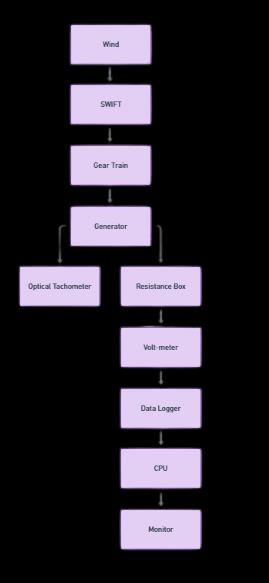
Figure2illustratestheschematicdiagramofthewindtunnel experimental set-up,comprisingessential componentsfor testingwindenergyconversionsystems.Attheheartofthe setup lies the wind turbine, symbolizing the primary mechanismforcapturingwindenergy.Thewindturbineis connected to a swept area, responsible for efficiently intercepting wind flow. Subsequently, a gear train mechanism is integrated to facilitate the conversion of rotational motionfromtheturbine to generate electricity, representedbythegenerator.
A data logger is incorporated to capture and record vital performancemetricsandenvironmentalconditionsduring experimentation. A central processing unit (CPU) is employed to control and monitor the entire experimental process,ensuringproperfunctioningandsafetyprotocols. Finally, a monitor displays real-time data and enables
researcherstoanalyzeandinterpretresultseffectively.This schematic provides a comprehensive overview of the experimental setup, essential for conducting wind energy researchanddevelopmentactivities.
IntheinitialphaseoftheRisk-AdjustedUnitCommitment frameworkdevelopmentforthe118bussystems,thorough data collection is imperative. Historical datasets encompassingsolarandwindpowergeneration,electricity demandpatterns,andpenetrationlevelsofsolarandwind power parameters are gathered from sources such as Installedcapacity,capacityfactor,andgenerationprofilesto define the potential and consistency of renewable energy output.Geographicaldistributionandtransmissioncapacity impact the spatial and network aspects of integration. Storage capacity, forecasting accuracy, and grid flexibility play roles in managing variability and reliability, grid stability measures influence the overall feasibility and competitivenessofincreasingpenetrationlevels.
To formulate a Mixed Integer Quadratic Programming (MIQP) model for solar power generation, by defining decisionvariablesrepresentingthebinaryoperationofeach solarpanel,whereavalueof1indicatespanelactivationand 0otherwise. The objectivefunction maximizes the overall energyoutputconsideringfactorssuchassolarirradiance, panel efficiency, and temperature. Capacity constraints ensurethatthetotalinstalledcapacitydoesnotexceedthe availableresources,whileoperationalconstraintslimitthe numberofactivepanelstomaintainstabilityandefficiency. Non-negativity constraints enforce that the decision variables remain within feasible bounds. The model optimally allocates resources to achieve the highest efficiency and output while respecting system limitations andoperationalrequirements.
TheMixedIntegerQuadraticProgramming(MIQP)modelfor solar power generation optimizes the operation of solar panels by considering various factors such as solar irradiance, panel efficiency, and temperature. Decision variablesrepresentthebinaryactivationofeachpanel,with theobjectivefunctionaimedatmaximizingenergyoutput while adhering to capacity and operational constraints. Capacityconstraintsensurethatthetotalinstalledcapacity remains within available resources, while operational constraints limit the number of active panels to maintain system stability and efficiency. Binary variables are employedtorepresentpanelactivation,andnon-negativity constraints ensure that decision variables remain within feasiblebounds.Byincorporatingtheseelements,theMIQP model effectively balances efficiency and output while considering system limitations and operational
International Research Journal of Engineering and Technology (IRJET) e-ISSN: 2395-0056
Volume: 12 Issue: 01 | Jan 2025 www.irjet.net p-ISSN: 2395-0072
requirements, thus enhancing the performance of solar powergenerationsystems.
Ag pg -Dg(v)[Gggvg +Ggd vd]=0 [1]
Ad [pgdpd]=Dd(vd)[Ggdvd +Gdd vd] [2]
G=[Ggg Ggd ]
[Gdg Gdd ],D(v) =[Dg(vg) 0] [0 Dd(vd)] (3)
Theincorporatingfactorssuchassolarirradiance,panel efficiency,capacityconstraints,operationallimitations,and binary variables for panel activation, the MIQP model enables the allocation of resources in a manner that maximizesenergyproductionwhileensuringstabilityand feasibility. This approach not only enhances the overall performance of solar power systems but also facilitates decision-makingprocessesforstakeholdersaimingtodeploy andmanagesolarenergyinstallationsefficientlyinvarious environmentalandoperationalcontexts.
TheAutoRegressivewithexOgenousinputs(ARO)method for wind power modelling leverages historical data to constructa sophisticateddata-drivenmodel thatcaptures the complex interplay between meteorological conditions andwindpower output.Thisapproachentailsintegrating laggedvaluesofmeteorologicalfactors,suchaswindspeed, temperature, and pressure, as exogenous inputs into the autoregressive model. By fine-tuning the lag values and optimizingmodelparameters,theAROmethodenablesthe development of a predictive tool that enhances the comprehension and forecasting accuracy of wind power output based on real-world meteorological conditions. By leveraging the temporal relationships between meteorologicalvariablesandwindpoweroutput,theARO methodoffersavaluableframeworkforstakeholdersinthe renewable energy sector to make informed decisions regarding resource allocation, grid integration, and operational planning, ultimately contributing to the advancementandadoptionofwindenergytechnologies.
(a) AutoRegressive with exOgenous (ARO)
TheAutoRegressivewithexOgenousinputs(ARO)method for wind power modelling is a robust approach that harnesseshistoricaldatatobuildasophisticateddata-driven model capable of capturing the intricate relationship betweenmeteorologicalconditionsandwindpoweroutput. By incorporating lagged values of meteorological factors suchaswindspeed,temperature,andpressureasexogenous inputs,theAROmethodeffectivelyaccountsforthedynamic natureofwindenergygeneration.Thisenablesthemodelto capturetemporaldependenciesandnonlinearinteractions inherent in wind power systems, thus providing a
comprehensive understanding of how meteorological conditionsinfluenceenergyproduction.
Through the utilization of ARO modelling, stakeholders in the renewable energy sector can enhance their ability to forecastwindpoweroutputwithgreateraccuracy,leadingto improved decision-making processes related to resource allocation,gridintegration,andoverallsystemoptimization.
yt[i]=∑l =1)^L ai yt-l[i]+et 0– [4]
whereal, l=1,…,La_l,\;l=1,\ldots,L,representthemodel coefficients, LL denotes the order of the autoregressive model, and ete_t corresponds to independent errors with zeromeanandconstantvariance.Forecastsfromthismodel are obtained as ∑l=1Lalyt−l\sum_{l=1}^{L} a_l y_{t-l} Notably, incorporating spatiotemporal correlations by consideringthepastoutputsofneighboringwindfarms,in additiontothetargetwindfarm,couldenhancepredictive accuracy. For a power output vector yt=(yt[1],yt[2],…,yt[Q])T\mathbf{y}_t=(y_t[1],y_t[2],\ldots, y_t[Q])^TacrossQQwindfarmsattimett,thisapproachcan begeneralizedwithinanautoregressiveframework."
y_t=∑_(l=1)^L(A_ly_(t-l)+∈_t) (5)
whereAlA_lrepresentscoefficientmatrices,andϵt\epsilon_t denotes independent multivariate errors with zero mean and a constant positive semi-definite covariance matrix Σ\Sigma. Autoregressive forecasts, y^t\hat{y}_t, can be determinedusingthismodel.
y_t=∑_(l=1)^LA_ly_(t-l) (6)
Letxtx_trepresentthewindspeedmeasurementatorneara windturbineattimett(t≤Tt\leqT),whereTTisthetotal numberofsamples.Similarly,letyty_tdenotethemeasured windpoweratthecorrespondingwindturbineattimett.A key objective of this study is to forecast wind speed for a specified period beyond TT, specifically from T+1T+1 to T+dT+d.Thewindspeedandwindpowerattimettcanbe describedusinganautoregressiveexogenous(ARX)process, asoutlinedbelow.
Xt =f(xt-1,xt-2….xt-p,zt,zt-1…..zt-q)Et,t=1,2,…T (7)
Yt=g(Yt 1,Yt 2, ,Yt p,Zt,Zt 1, ,Zt q)+et,,t=1,2, ,T (8)
Here, ϵ=(ϵ1,…,ϵT′)T\epsilon = (\epsilon_1, \ldots, \epsilon_{T'})^T and e=(e1,…,eT)Te = (e_1, \ldots, e_T)^T are independent noise vectors, with TT denoting the transpose operation. These vectors represent the model errors in the prediction models for xtx_t and yty_t. By incorporating lagged meteorological factors as exogenous inputs, the ARO method effectively captures temporal dependenciesandnonlinearinteractionsinherentinwind energygeneration.Thisapproachprovidesvaluableinsights forstakeholdersintherenewableenergysector,enhancing forecasting accuracy and supporting strategic decision-
International Research Journal of Engineering and Technology (IRJET) e-ISSN: 2395-0056
Volume: 12 Issue: 01 | Jan 2025 www.irjet.net p-ISSN: 2395-0072
makingforresourceallocation,gridintegration,andsystem optimizationinwindpowergeneration.
Theenergymanagementsystem(EMS)oftheenergysystem isimplementedusingarule-basedalgorithmtoeffectively managethepowerflowofthedevisedhybridenergysystem components.Non-isolatedbuckBased-Bi-DirectionalDC–DC Converter is designed at the PV side, which ensures costeffectivePVpanelwiring,reducedconverterdevelopment cost, and better efficiency of the PV system during low irradiation periods. To maximise the power at different solar irradiation levels, the Finite Control Set Model Predictive Control (FCS-MPC) strategy is presented for energy management in PV. An adaptive neuro-fuzzy inference system approach is presented with a switched InductorVoltageMultiplierCell(VMC)forfuelcells,which provides a higher voltage gain than a conventional Boost converter, it also modifies the duty cycle of the cell. The hybrid renewable energy is integrated with a grid, and power quality issues such as voltage sag, swell, and harmonicsareaffected.
(a) Finite Control Set Model Predictive Control (FCSMPC)
TheFiniteControlSetModelPredictiveControl(FCS-MPC) strategy offers a comprehensive approach to optimize energy management in photovoltaic (PV) systems across varyingsolarirradiationlevels.Byleveragingthismethod, the system can dynamically adjust control parameters to maximize power generation efficiency under different irradiationconditions.FCS-MPCachievesthisbyutilizinga finite set of control actions and predicting future system behaviourbasedoncurrentandforecastedsolarirradiance levels. This predictive capability enables the system to proactively adapt to changing environmental conditions, ensuring that the PV system operates at its peak performance level and extracts the maximum available powerfromthesolarresource.
X(k+1)=Ax(k)+Bu(k) (9)
Y(k)=Cx(k)+Du(k) (10)
Here, x(k+1)x(k+1), u(k)u(k), and y(k)y(k) represent the state variable vector, input vector, and output vector, respectively.Additionally,AAdenotesthesystemmatrix,BB thecontrolmatrix,CCtheoutputmatrix,andDDthefeedthroughmatrix.BycombiningNNequationscorresponding to the time steps from (k+1)(k+1) to (k+N)(k+N), the predictionmodelcanbeformulatedasfollows:
X(k+1:k+N)=Ax (k)+Bu(k:k+N 1) (11)
x(:)=A^x(k)+B^u(:) (12)
The future error between the predicted output and the reference value is minimized by using a predefined cost function,gdefinedasfollows:
g=∥x(:)∥2+γ∥u(:)∥2=∥A^x(k)+B^u(:)∥2+γ∥u(:)∥2 (13)
whereγistheweightingfactor
Takingthederivative ofthe costfunctionconcerning andsettingittozero,thesolutionisobtainedas u(:)= [(B^TB^+γI) 1B^TA^]x(k) (14)
Whereonlythefirstvectorfromthearrayoftheoptimally predicted future control inputs in (14) is utilized. Dynamically adjusting control parameters based on realtime conditions, FCS-MPC offers a robust approach to maximizingpowergenerationefficiencyandoverallsystem performance.Thisstrategynotonlyenhancestheutilization of solar energy resources but also contributes to grid stabilityandreliabilitybyeffectivelymanagingfluctuations inpoweroutput.Movingforward,continuedresearchand implementation of FCS-MPC hold promise for further improving the integration of PV systems into the broader energy landscape, facilitating a transition towards sustainableandresilientenergysystems.
(VI) Enhancing Equal Penetration of Renewable Energy into Multigrid
TheintegrationofHigh-PenetrationRenewableIntegration (HPRI) with the Multi-Objective Multi-Verse Optimization (MOMVO)algorithmoffersarobustsolutiontomanagethe complexitiesofincorporatingsubstantialrenewableenergy intomulti-gridsystems.Thisapproachinvolvesdeveloping accuratemodelsforvariablerenewableenergysources,such aswindandsolar,whileaccountingfortheirtemporaland spatialvariations.Byleveragingthesemodels,thecombined methodenhancesgridresiliencebydynamicallyadaptingto variations in renewable energy generation and load demands,therebysupportingsignificantrenewableenergy penetration into primary utility grids. Additionally, the strategy highlights the importance of understanding multigrid system characteristics, including transmission capacity, demand patterns, existing energy sources, forecasting,energystorage,demandresponse,andflexible grid management, to effectively address the variability associatedwithrenewableenergysourcesandoptimizegrid performance.
(VII) High-Penetration Renewable Integration and the Multi-Objective Multi-Verse Optimization
High-PenetrationRenewableIntegration(HPRI)can be conceptualized as a value-based equation, where the benefitsandcostsassociatedwithincreasingthepenetration of renewable energy are carefully balanced. The equation canberepresentedasfollows:
International Research Journal of Engineering and Technology (IRJET) e-ISSN: 2395-0056
Volume: 12 Issue: 01 | Jan 2025 www.irjet.net p-ISSN: 2395-0072
=(B1+B2+ +Bn)−(C1+C2+ +Cm)–(15)
Here, to representthevariousbenefitsaccruedfrom high renewable energy penetration, such as reduced greenhouse gas emissions, improved air quality, energy security, and job creation. These benefits contribute positivelytotheoverallvalueofHPRI.Conversely, to denotethecosts associated withintegratinghighlevels of renewable energy, including investments in grid infrastructure,energystoragesystems,curtailmentofexcess renewable generation, and potential challenges related to gridstabilityandreliability.Thesecostsaresubtractedfrom the benefits to determine the net value of HPRI. Through careful analysis and optimization, HPRI facilitates the development of strategies and policies that maximize the value of renewable energy integration while minimizing associatedcosts,ultimatelyadvancingthetransitiontowards amoresustainableandresilientenergyfuture.
The Multi-Objective Multi-Verse Optimization (MOMVO) Algorithmoffersacomprehensivesolutiontothecomplex challenges and opportunities inherent in increasing the penetrationofrenewableenergywithinmulti-gridsystems. Byleveragingtheprinciplesofmulti-objectiveoptimization, MOMVO simultaneously considers multiple conflicting objectivessuchasmaximizingrenewableenergyintegration, minimizinggridinstability,reducingenvironmentalimpact, andoptimizingeconomicefficiency.Thisholisticapproach empowersdecision-makersintherenewableenergysector to navigate the intricate trade-offs and uncertainties associatedwithmulti-gridsystems,ultimatelyfacilitatingthe development of robust strategies that enhance renewable energy penetration while ensuring grid stability, environmentalsustainability,andeconomicviability.
xij=
xi+TDR+(ubj lbj×r4+lbj)r3xj+TDR+(ubj lbj×r4 +lbj)r4xijifr3<0.5ifr4≥0.5ifr2≥WEP (16)
The (WEP), and (TDR); are represented by the following formulas:
WEP=min+1×L(WEPmax−WEPmin) (17)
TDR=1 (Lp1lp1) (18)
Where, representsavariablerelatedtotheoptimization problem, and are related variables within the optimizationproblem.TDRlikelystandsfor"TotalDemand Response" or a similar term, representing a parameter associatedwithenergydemandmanagement. and are lower and upper bounds, respectively, likely indicating constraintsorlimitsonvariable .WEPstandsfor"Wind EnergyProduction,"representingathresholdorcondition related to wind energy generation. This approach underscorestheimportanceofmeticulouslycraftingprecise modelsspecificallydesignedtoaccommodatethevariability inherentinrenewableenergysources,particularlywindand
solar. By synergizing HPRI's emphasis on maximizing renewable energy integration while maintaining grid stability with MOMVO's capability to navigate complex trade-offs across multiple objectives simultaneously, this integratedframeworkenablesthedevelopmentoftailored solutions that optimize renewable energy utilization, enhance grid resilience, and promote sustainable energy transitionsinarapidlyevolvingenergylandscape.
Implementing a Stochastic Security-Constrained Unit Commitment (SCUC) with 118 bus systems the Battery EnergyStorage(BES)coordinationinamulti-areagridaims toenhance the reliabilityandefficiencyof the power.The proposedutilizesthemulti-objectiveoptimizationasCoyote Optimization Algorithm with Enhanced Arithmetic Optimization Technique to solve the unit commitment problem. Thismodelperformstheunitcommitmentmodel accurately with effective performance and this stochastic approach improves the reliability of unit commitment decisionsbyaccountingforuncertainties,leadingtoamore robust and resilient power system. Power systems while challengesassociatedwithunitcommitment.Byefficiently integratingrenewableresourcesandutilizingBESforenergy storage,theapproachhelpsminimizecurtailmentofclean energy, maximizing the use of available renewable generation. This model obtains a novel solution by incorporating a multi-objective function in the context of unit commitment and renewable energy penetration. ReducingtheproblemofUnitCommitment(UC)inamultiarea grid involves optimizing the scheduling of power generationunitsacrossdifferentregionstoenhancesystem efficiency, reliability, and cost-effectiveness. Define unit commitmentconstraints,includingminimumandmaximum generationlimits,rampinglimits,andstart-upandshutdown costs,consideringthecharacteristicsofeachgeneratingunit.
Inthechallengeofenhancingequalpenetrationofrenewable energy into multi-grid systems and tackling unit commitment issues in photovoltaic (PV) and wind energy integrationwithinthe118-bus system,employingvarious optimizationtechniquestooptimizeresourceallocationand operationalstrategies.Throughcomprehensivesimulations and analyses, observed that the application of advanced optimizationalgorithms,suchasgeneticalgorithms,particle swarmoptimization,ormixed-integerlinearprogramming, resultedinsignificantimprovementsinsystemperformance metrics, including reduced operational costs, enhanced renewableenergyutilization,andimprovedgridstability.
International Research Journal of Engineering and Technology (IRJET) e-ISSN: 2395-0056
Volume: 12 Issue: 01 | Jan 2025 www.irjet.net p-ISSN: 2395-0072
MATLAB VersionR2023a
OperatingSystem Windows10Home
MemoryCapacity 6GBDDR3
Processor IntelCorei3@3.5GHz
Thesystemconfigurationutilizedforthesimulationinthis study is outlined in Table 1. The research was conducted using MATLAB R2023a, running on a Core i3 processor clockedat3.5GHzwith6GBofDDR3RAM.
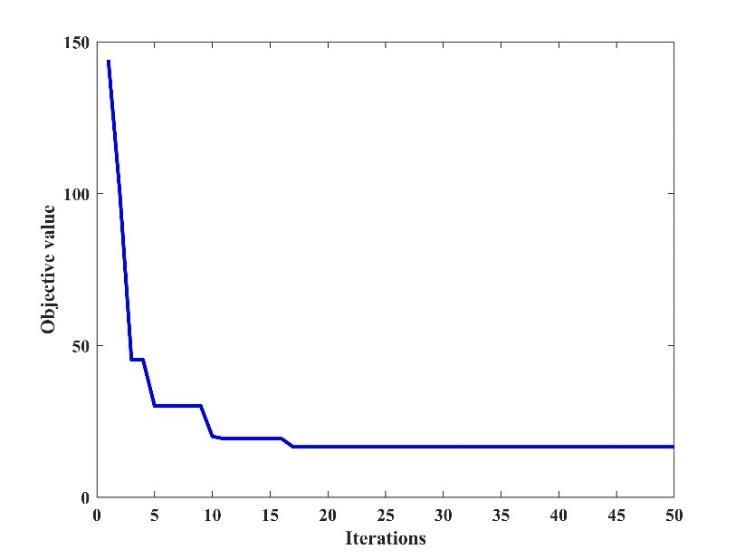
Figure3showstheoptimizationalgorithms,suchasgradient descentorgeneticalgorithms,iterationsandobjectivevalues arefundamentalcomponentscrucialforachievingoptimal solutions.Iterationsrepresentthenumberofcyclesorsteps the algorithm undergoes in refining its solution towards optimization.Theobjectivevaluefor147withiteration,the algorithmadjustsitsparametersorvariablestominimizeor maximize the objective function, representing the goal or criteriatobeoptimized.Therelationshipbetweeniterations and objective values illustrates the algorithm's progress towards convergence or reaching an optimal solution. Typically,asiterationsprogress,theobjectivevaluetendsto decrease (in the case of minimization) or increase (in the case of maximization), reflecting the algorithm's improvementinoptimizingtheobjectivefunction.
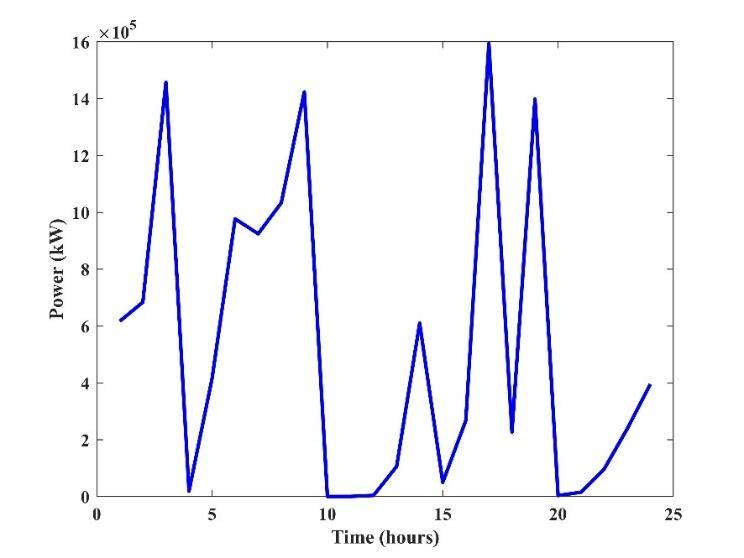
Figure4showsvariousdomains,particularlyinengineering, energy management, and electronics, the relationship between time and power is pivotal. Time represents the durationorperiodoverwhichaprocessoccurs,whilepower denotestherateatwhichenergyistransferredorworkis donewithinthattimeframe.Theinteractionbetweentime and power is multifaceted, with different contexts emphasizing different aspects of this relationship. For instance,inelectricalengineering,powerconsumptionover timeiscrucialfordesigningefficientcircuitsandsystemsto minimizeenergyusageandextendbatterylife.Similarly,in manufacturing processes, optimizing power consumption over time is essential for enhancing productivity and reducingoperationalcosts.
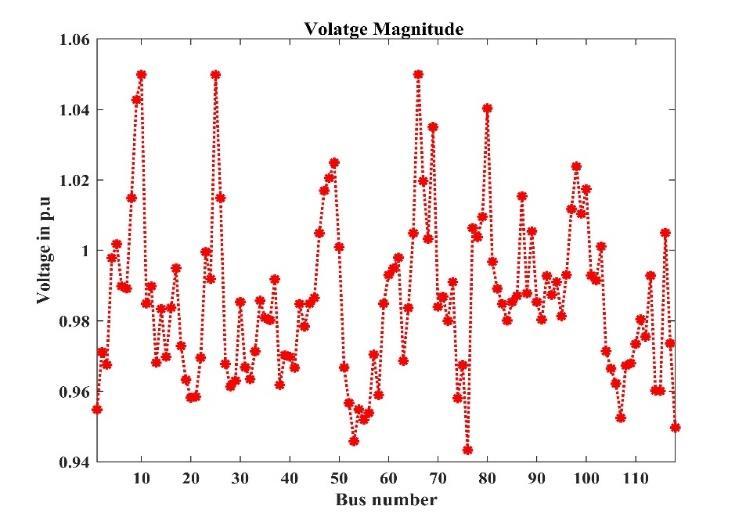
Figure5displayspowersystemsanalysis,particularlyinthe studyofelectricalgrids,examiningtherelationshipbetween busnumbersandvoltagemagnitudeperunit(p.u.)provides crucial insights into the stability and operation of the network. Each bus in an electrical network is assigned a unique identification number, and voltage magnitude per
International Research Journal of Engineering and Technology (IRJET) e-ISSN: 2395-0056
Volume: 12 Issue: 01 | Jan 2025 www.irjet.net p-ISSN: 2395-0072
unit represents the normalized voltage level relative to a specifiedbasevoltage.Avoltagemagnitudeof1.05p.u.ata specificbusindicatesthatthevoltageatthatlocationis1.05 times the base voltage. This relationship is significant for assessingthevoltageprofileacrossthenetwork,identifying potential voltage violations, and ensuring the overall stabilityofthesystem.Bymonitoringandanalyzingvoltage magnitudesatdifferentbuses,powersystemoperatorscan make informed decisions regarding voltage regulation, equipment operation, and network planning to maintain reliableandefficientpowerdelivery.
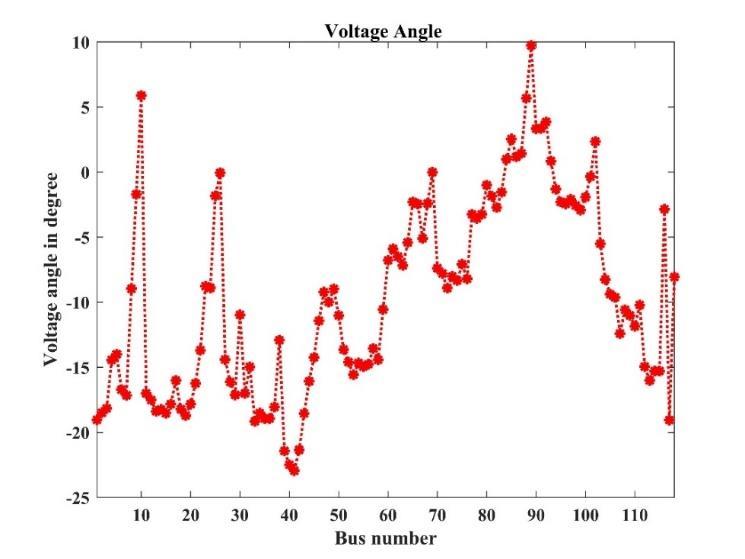
Figure6representspowersystemanalysis;voltageangles play a crucial role in determining the phase relationship between different buses within the network. The specification of voltage angles, such as at bus number 90 with a voltage angle of 10 degrees, provides essential informationabout thephaseshift betweenthevoltages at adjacentbuses.Avoltageangleof10degreesatbusnumber 90indicatesthatthevoltageatthisparticularbusleadsor lags behind the reference phase by 10 degrees. Understanding voltage angles is vital for assessing the stability and performance of the power system, as phase differences between buses influence power flow, voltage regulation,andsystemreliability.
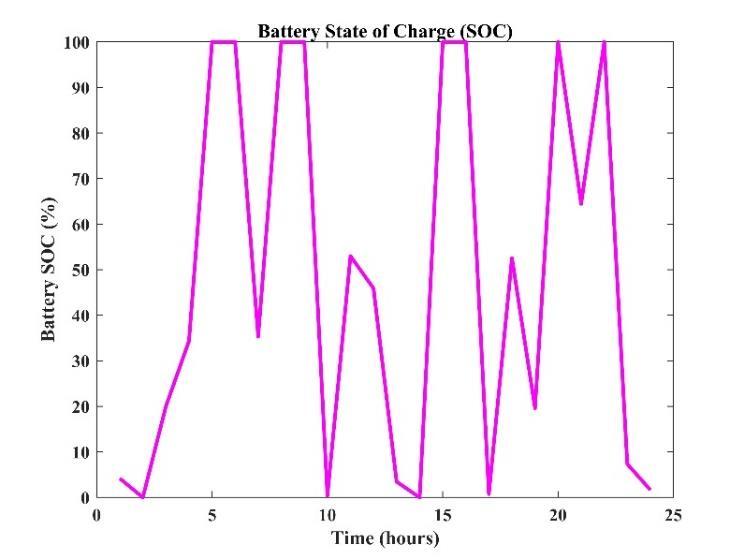
Figure7illustratesthedynamicsofbatterymanagementand energy storage systems by examining the relationship betweentimeandtheStateofCharge(SOC)percentage.This relationship is crucial for evaluating battery performance and predicting its behavior over time. Time reflects the operational duration or the periods of charging and discharging cycles, while SOC percentage represents the remainingchargeinthebatteryasaproportionofitstotal capacity.AnalyzingtheSOCpercentageovertimeprovides key insights into the battery's storage capabilities and its rate of depletion during operation. For instance, a steady declineinSOCindicatesdischargeduringuse,whereasan upwardtrendsignifiesthebatterybeingcharged.
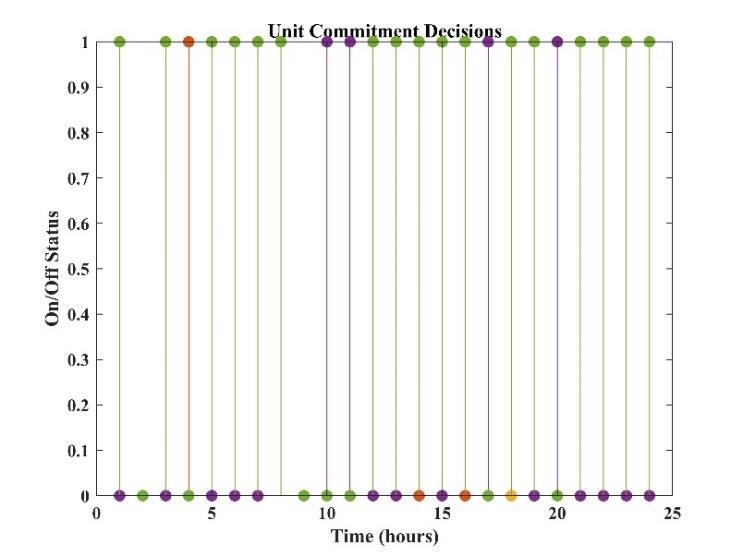
Figure 8 depicts the operation of the power system and energymanagement,highlightingtherelationshipbetween timeandtheon/offstatusofpowergenerationunits,which plays a crucial role in unit commitment decisions. Unit commitment involves scheduling power generation units optimallyoveragiventimehorizontomeetenergydemand, minimizecosts,andmaintainsystemreliability.Timeisakey
International Research Journal of Engineering and Technology (IRJET) e-ISSN: 2395-0056
Volume: 12 Issue: 01 | Jan 2025 www.irjet.net p-ISSN: 2395-0072
factorinthisprocess,asenergydemandvariesthroughout the day due to changing consumer requirements and externalinfluences,suchasweatherconditions.Theon/off statusreflectswhetherapowergenerationunitisactiveand contributing to electricity production at a particular moment.
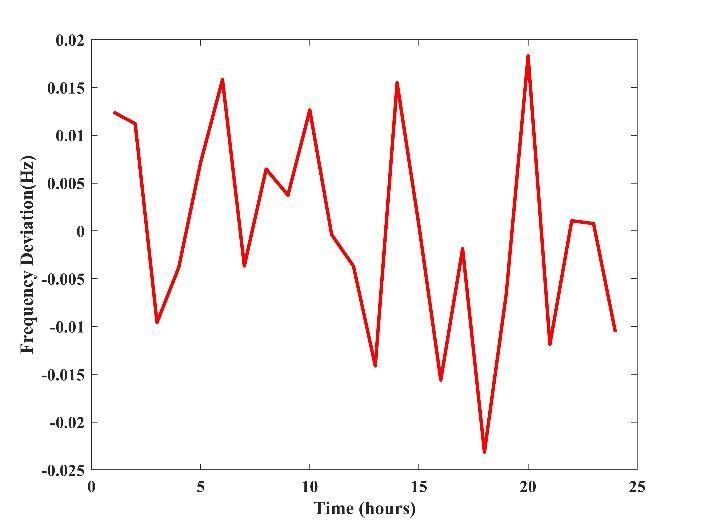
Figure9displayselectricalpowersystems,therelationship between time and frequency deviations is crucial for maintaininggridstabilityandensuring reliableoperation. Time,typicallymeasuredinhours,servesasafundamental dimensioninassessingthedynamicbehaviourofthepower systemoverdifferentperiods,fromshort-termfluctuations to long-term trends. Frequency deviations, expressed as deviationsfromthenominalfrequencyofthegrid,indicate the magnitude of variations in system frequency due to changes in load demand, generation output, or grid disturbances.Afrequencydeviationof0.17ataspecifictime point, such as 20 hours, suggests a deviation from the nominal frequency, potentially indicating imbalances between generation and demand or grid disturbances affectingsystemstability.
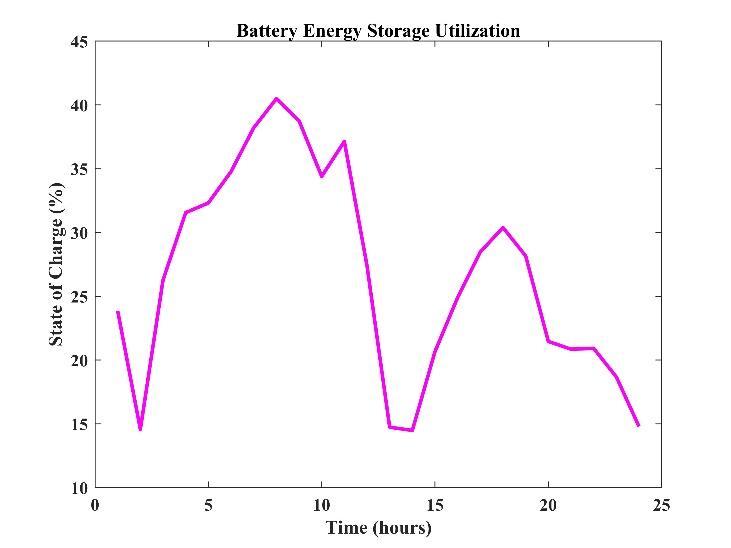
Figure 10 illustrates battery energy storage systems, emphasizingtherelationshipbetweentimeandtheStateof Charge (SOC), which is essential for evaluating battery performanceandusage.Time,typicallyexpressedinhours, indicatestheoperationaldurationordischargeperiodofthe battery.Forinstance,a timevalueof7.9hoursrepresents thedurationunderreview.SOC,measuredasapercentageof thebattery'stotalcapacity,indicatestheremainingenergyat aspecifictime.ASOCvalueof40.5%signifiesthat,after7.9 hours of operation, the battery has utilized 59.5% of its maximumcapacity,retaining40.5%.
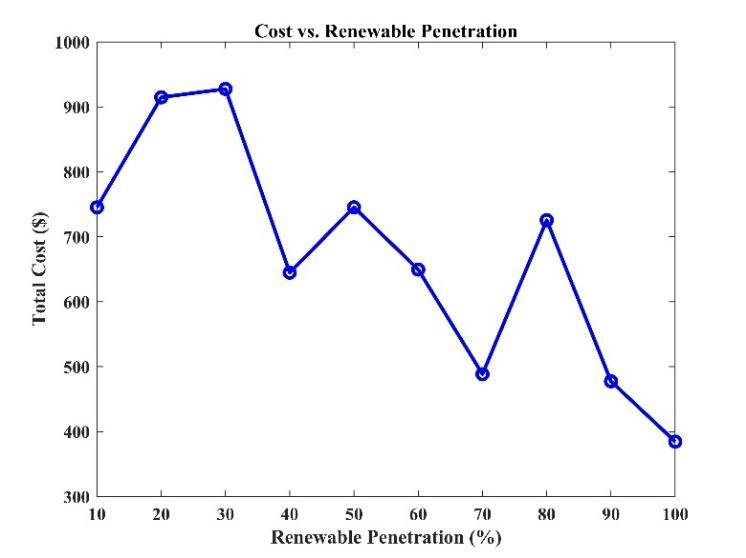
Figure11highlightsenergyeconomicsandpolicy-makingby examiningtherelationshipbetweenrenewablepenetration andtotalcost,whichisvitalfordevelopingsustainableand cost-effective energy systems. Renewable penetration, indicatedat18.8%,measurestheshareofrenewableenergy sourceslikesolar,wind,andhydropowerwithintheoverall energymix.Thisintegrationaimstomeetenergydemands while minimizing reliance on fossil fuels. Total cost,
International Research Journal of Engineering and Technology (IRJET) e-ISSN: 2395-0056
Volume: 12 Issue: 01 | Jan 2025 www.irjet.net p-ISSN: 2395-0072
quantified at 91.7, encompasses all expenses related to energy generation, including capital investments, operational and maintenance costs, and environmental externalities. Understanding the interplay between renewablepenetrationandtotalcostprovidesinsightsinto balancing economic feasibility with the transition to renewableenergysystems.
This research investigates strategies to promote the equitable integration of renewable energy sources, particularly photovoltaic (PV) and wind power, into a complex multi-grid system with 118 buses. By utilizing advancedoptimizationtechniques,particularlyintheunit commitment process, the study effectively addresses the challengesassociatedwithintegratingfluctuatingrenewable energy sources into the grid. The findings emphasize the criticalroleofoptimizingpowergenerationunitscheduling anddispatchtoachieveabalancedandefficientdistribution ofPVandwindenergyacrossinterconnectedgrids.
Throughextensivemodelingandanalysis,practicalsolutions havebeendevisedtomaximizerenewableenergyusewhile ensuringgridstabilityandreliability.Batteryenergystorage systems (BESS) play a key role in overcoming integration challengesbyefficientlymanagingcharginganddischarging cycles.ThealgorithmsdevelopedinMATLABhelpregulate BESSoperationsbasedoncriticalfactorssuchastheStateof Charge(SOC)andoperationalduration,ensuringthatboth systemdemandsandrenewableenergyneedsaremet.For instance, an SOC of 40.5% after 7.9 hours of operation demonstrates the effectiveness of these algorithms in balancingenergystorageandutilization.
Overall, the study illustrates the effectiveness of optimizationmethodsinaddressingunitcommitmentissues andsupportingthebroaderadoptionofrenewableenergy within intricate power systems. The insights gained from thisresearcharevaluableforpolicymakers,gridoperators, and other stakeholders in advancing the development of sustainable and resilient energy infrastructures. These findings contribute to the ongoing efforts to transition towardsamoresustainableandreliableenergyfuture.
This study investigates the incorporation of renewable energysources,suchasphotovoltaic(PV)andwindpower, intoamulti-gridsystem,withaspecificfocusonaddressing unitcommitmentchallengeswithintheframeworkofa118bus power system. The research demonstrates that optimizingrenewableenergyintegrationthroughadvanced optimizationtechniques,liketheMulti-ObjectiveMulti-Verse Optimization(MOMVO)algorithm,cansignificantlyimprove the efficiency, reliability, and sustainability of power networks. The findings show that using optimization methods for unit commitment, combined with increased
renewableenergypenetration,leadstobettergridresilience, lower operational costs, and accelerates the transition to sustainable energy solutions. Furthermore, the study emphasizes the need for accurate modeling to handle the variabilityofrenewableenergygeneration,whileensuring grid stability and operational efficiency. Ultimately, the research highlights the effectiveness of optimization techniquesinbalancingrenewableandconventionalenergy sources, providing valuable insights for overcoming the challengesassociatedwithlarge-scalerenewableintegration intomulti-gridsystems.
[1] Longo,M.,Foiadelli,F.andYaïci,W.,2018.Electric vehiclesintegratedwith renewable energy sources for sustainable mobility.New trends in electrical vehicle powertrains,10,pp.203-223.
[2] Kyriakidis, T., 2015.A mixed-signal computer architecture and its application to power system problems(No.6613).EPFL.
[3] Babanezhaad Shirdar, H. and Ghafouri, A., 2022. Designofhybridmultilayersystems toimproveenergy management system in multi-microgrid systems in the presenceof wind and solar power.Wind Engineering,46(1),pp.34-51.
[4] April,D.G.,2022.Enablingtechnologiesinmicrogrid deployment(Doctoral dissertation, Cape Peninsula UniversityofTechnology).
[5] Li,J.,Chen,S.,Wu,Y.,Wang,Q.,Liu,X.,Qi,L.,Lu,X. andGao,L., 2021. How to makebetter use ofintermittent and variable energy? A review of wind and photovoltaic power consumption in China.Renewable and Sustainable EnergyReviews,137, p.110626.
[6] Behera, S. and Choudhury, N.B.D., 2023. Adaptive optimalenergymanagementin multi-distributed energy resources by using improved slime mould algorithm with consideringdemandsidemanagement.e-Prime-Advancesin ElectricalEngineering, Electronics and Energy,3, p.100108.
[7] Lyden, A., Brown, C.S., Kolo, I., Falcone, G. and Friedrich,D.,2022.Seasonalthermal energystoragein smart energy systems: District-level applications and modelling approaches.Renewable and Sustainable EnergyReviews,167,p.112760.
[8] Roth, M., Franke, G. and Rinderknecht, S., 2022. Decentralisedmulti-gridcouplingfor energysupplyofa hybrid bus depot using mixed-integer linear programming.Smart Energy,8,p.100090.
International Research Journal of Engineering and Technology (IRJET) e-ISSN: 2395-0056
Volume: 12 Issue: 01 | Jan 2025 www.irjet.net p-ISSN: 2395-0072
[9] Fracas, P., Zondervan, E., Franke, M., Camarda, K., Valtchev,S.andValtchev,S., 2022. Techno-Economic OptimizationStudyofInterconnectedHeatandPowerMultiMicrogrids with a Novel Nature-Inspired Evolutionary Method.Electronics,11(19), p.3147.
[10] Zhou,H.,Lu,L.,Wei,M.,Shen,L.andLiu,Y.,2023. RobustSchedulingofaHybridHydro/photovoltaic/PumpedStorage System for Multiple Grids Peak-Shaving and CongestionManagement.IEEEAccess
[11] Tang,L.,Chen,M.,Li,Q.,Li,B.andKang,W.,2022, April. Rolling optimization operation strategy of energy storagesystemconsideringmultipleapplicationscenarios. In20225thInternationalConferenceonEnergy,Electrical andPowerEngineering (CEEPE)(pp.1042-1048).IEEE.
[12] Avvari, R.K. and DM, V.K., 2023. A novel hybrid multi-objectiveevolutionary algorithm for optimal powersmeVE VE ,,nw,P ,niwfifwolf Journal of Operation and Automation in Power Engineering,11(2),pp.130-143.
[13] Bakry, O.M., Alhabeeb, A., Ahmed, M., Alkhalaf, S., Senjyu,T.,Mandal,P.and Dardeer, M., 2022. Improvementofdistributionnetworksperformanceusing renewable energy sources based hybrid optimization techniques.AinShams Engineering Journal,13(6), p.101786.
[14] Sulaiman,M.H.,Mustaffa,Z.andRashid,M.I.M.,2023. Anapplicationofteaching–learning-basedoptimizationfor solving the optimal power flow problem with stochastic wind and solar power generators.Results in Control and Optimization,10,p.100187.
[15]ElBoujdaini,L.,Mezrhab,A.,Moussaoui,M.A.,Jurado,F. andVera,D.,2022.Sizingofastand-alonePV–wind–battery–dieselhybridenergysystemandoptimal combinationusing a particle swarm optimization algorithm.Electrical Engineering,104(5),pp.3339-3359.
[16]Marouani,I.,Guesmi,T.,HadjAbdallah,H.,Alshammari, B.M.,Alqunun,K.,Alshammari,A.S.andRahmani,S.,2022. combined economic emission dispatch with and without consideration of PV and wind energy by using various optimizationtechniques:Areview.Energies,15(12),p.4472.
[17] Nguyen,N.A.,Vo,D.N.,Nguyen,T.T.andDuong,T.L., 2022. An improved equilibrium optimizer algorithm for solvingoptimalpowerflowproblemwith penetration of wind and solar energy.International Transactions on ElectricalEnergySystems,2022,pp.1-21.
[18] Alayi,R.,Kamarposhti,M.A.,Ghafari,M.andAylar, S.M.,2022.Energyanalysisand optimizing of hybrid WT/PV cell in power systems.Journal of Power Technologies,102(3).
[19] Avvari, R.K. and DM, V.K., 2022. Multi-Objective OptimalPowerFlowincluding WindandSolarGeneration Uncertainty Using New Hybrid Evolutionary Algorithm with Efficient Constraint Handling Method.InternationalTransactionsonElectrical Energy Systems,2022
[20] Silva,D.J.,Belati,E.A.andLópez-Lezama,J.M.,2023. Amathematical programming approach for the optimal operationofstoragesystems,photovoltaicand wind powergeneration.Energies,16(3),p.1269.
[21] Youssef,A.R.,Mallah,M.,Ali,A.,Shaaban,M.F.and Mohamed,E.E.,2023. Enhancement of Microgrid Frequency Stability Based on the Combined Power-toHydrogen-to-Power Technology under High Penetration RenewableUnits.Energies,16(8),p.3377.
[22] Zou,Y.,Wang,Q.,Hu,B.,Chi,Y.,Zhou,G.,Xu,F.,Zhou, N.andXia,Q.,2023. Hierarchicalevaluationframework forcouplingeffectenhancementofrenewable energy and thermal power coupling generation system. InternationalJournalof ElectricalPower&EnergySystems, 146,p.108717.
[23] Jin, B., 2023. Impact of renewable energy penetrationinpowersystemsonthe optimizationand operation of regional distributed energy systems. Energy, 273, p.127201.
[24] Wang,S.,Li,F.,Zhang,G.andYin,C.,2023.Analysis ofenergystoragedemandfor peak shaving and frequency regulation of power systems with high penetrationof renewableenergy.Energy,267,p.126586.
[25] Vaka,S.S.K.R.andMatam,S.K.,2023.Optimalsizing ofhybridrenewableenergy systems for reliability enhancement and cost minimization using multiobjective techniqueinmicrogrids.EnergyStorage,5(4),p.e419.
[26] Fusco, A., Gioffrè, D., Castelli, A.F., Bovo, C. and Martelli,E.,2023.Amulti-stage stochastic programming modelfortheunitcommitmentofconventionalandvirtual powerplantsbiddingintheday-aheadandancillaryservices markets.AppliedEnergy,336,p.120739.
[27] Gupta, P.P., Kalkhambkar, V., Jain, P., Sharma, K.C. andBhakar,R.,2022.Battery energy storage train routing and security constrained unit commitment under solar uncertainty. Journal of Energy Storage, 55, p.105811.