
International Research Journal of Engineering and Technology (IRJET) e-ISSN: 2395-0056
Volume: 12 Issue: 03 | Mar 2025 www.irjet.net p-ISSN: 2395-0072
International Research Journal of Engineering and Technology (IRJET) e-ISSN: 2395-0056
Volume: 12 Issue: 03 | Mar 2025 www.irjet.net p-ISSN: 2395-0072
Mahesh S Markad1
1Head of Computer engineering Department Samajbhushan Eknathrao Dhakane College of Engineering Shevgaon
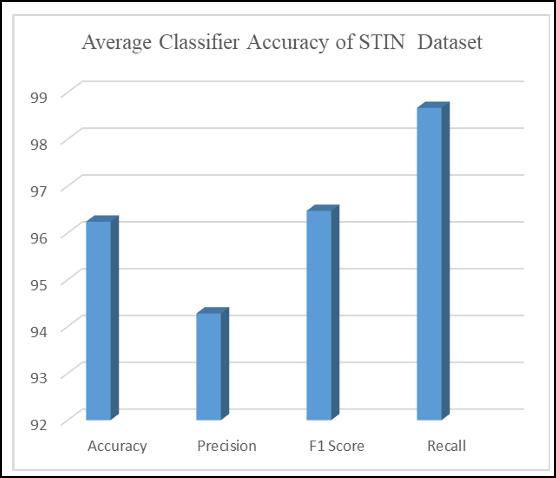
Abstract - In cybersecurity, threat detection is examining network traffic and system behavior to find and address possible cyberthreats such malware, phishing scams, and unauthorized access. Organizations may proactively reduce risks,preservesensitivedata,andguaranteetherobustnessof theirdigitalinfrastructuresthrougheffectivethreatdetection. New and changing threats, like as zero-day assaults, are difficult for traditional threat detection systems to identify. Their efficacy is diminished since they frequently generate a significant number of false positives and negatives. Furthermore, because these techniques depend on wellestablished patterns, they are sluggish to adjust to new cyberthreats. Using the ResNet101 model to improve threat detection with the STIN dataset, this work explores the possibilitiesofdeeplearning(DL)forcybersecurity.Improving threat detection accuracy, reducing false positives, and guaranteeing prompt reactions to new cybersecurity threats are the main objectives of this study. With an accuracy of 96.24%, precision of 94.28%, F1 score of 96.47, and recall of 98.67%, the ResNet101 model demonstrated outstanding performance.
Theseoutcomesdemonstratehowwellthe model detectsand reduces cybersecurity risks. Furthermore, the ResNet101 model shows its potential for real-time threat detection applications by processing the STIN dataset in about 55 seconds. This paper offers a thorough examination of model optimizationtactics,performanceassessmentmethodologies, and dataset pre-processing approaches.
The results advance our understanding of AI-driven cybersecurity and provide insightful information that practitioners and researchers may use to fortify digital infrastructure against advanced cyberthreats.
Key Words: Cyber security, deep learning, ResNet 101, threatdetection,andintrusiondetection.
Cybersecurityhasbecomeacriticaltopicinthedigitalage due to the rapid expansion of digital infrastructures and networkedsystems,whichexposesbusinessestoaneverincreasingnumberofsophisticatedcyberthreats.
Cyber attacks, which can include malware infections, phishingschemes,andadvancedpersistentthreats(APTs), pose a major risk to individuals, governments, and
businesses. Given the intricacy and scope of today's cyberthreats, traditional cybersecurity Methods such as signature-baseddetectionandheuristicanalysishavefallen behind.Thischallengeemphasizestheneedforinnovative strategiesthatcanenhancetheabilitytoidentifythreatsand providepreemptivemeasures.DL,asubsetofAI,hasbecome a powerful tool in cybersecurity, able to accurately and successfullydetectandeliminatecyberthreats.
By employing sophisticated neural network architectures, DL algorithms are able to analyze vast amounts of data, identifyintricatepatterns,andidentifyanomaliesthatmay indicateillegalactivities.Unlikeearliermethods,DLmodels can continuously train and adapt to new attack patterns, whichmakesthemincrediblyeffectiveinathreatlandscape thatisalwaysevolving.offeringacomprehensivestrategyto cybersecurityinordertoenhancethethreatdetectionDL algorithms. DL models must be optimized by modifying hyperparameters,improvingfeatureextractiontechniques, andimplementingnovelarchitecturesinordertogethigher performance. By applying optimization approaches, the proposed approach aims to strike a compromise between detectionaccuracy,computationalefficiency,andreal-time responsecapabilities.Thepaperalsolooksatthechallenges ofimplementingDL-basedcybersecuritysolutions,including adversarial attacks, data quality and availability, and the interpretabilityofmodeloutput.Theseproblemsneedtobe fixed if AI-driven security solutions are to be reliable and trustworthy. The study also examines the importance of usingarangeofdatasourcesandthreatintelligencefeedsin order to create comprehensive and full threat detection models.Thefollowingisasummaryofthisstudy:
A powerful threat detection framework that utilizes the ResNet101architectureandthepre-trainedmodel.
ExaminescontemporaryDLtechniquesincybersecurityin detail,highlightingboththeirbenefitsanddrawbacks.
Standard performance measures are used to evaluate the performance of the pre-trained model and the proposed ResNet101.Theremainingsectionsarearrangedasfollows:
Section 2 provides a review of the literature evaluating earlierstudies.Therecommendedthreatidentification
Section3providesadescriptionofmethods.Resultsanda discussion of the model's exceptional accuracy and performance metrics are provided in Section 4, and a
International Research Journal of Engineering and Technology (IRJET) e-ISSN: 2395-0056
Volume: 12 Issue: 03 | Mar 2025 www.irjet.net p-ISSN: 2395-0072
InordertoidentifyDistributedDenialofService(DDoS) assaults, Akgun et al. [2] created an intrusion detection system(IDS)builtonaDLmodel.TheCICDDoS2019dataset, which included 12 classes, was chosen by the authors. Differentmodels(DNN,CNN,andLSTM)withdifferentlayer configurationswereexaminedinordertodeterminethebest efficientarchitecture.
Theinitial88characteristicswerereducedto40essential propertiesusingfeaturereductionandselectionstrategies. For both binary and multi-class classification, the model's accuracywasimproved.Thestudywasrestrictedtoassessing candidatemodels'inferencetimesinordertocomprehend theirreal-timeperformance.Inordertoprovideanadaptable andresilientframeworkforanIDStoefficientlyidentifyand categorizenetworkassaults,Ashikuetal.[3]suggestedaDL architecture. The UNSW-NB15 dataset, which replicates actual network communication patterns and artificially manufactured attack activity, was used by the authors to verifythemodel'sefficacy.Thetotalaccuracyofthemodel was95.4%.Optimizedfeaturereductionstrategieshampered themodel'sperformancedespiteencouragingresults.
AthoroughoverviewofMLandphishingattemptswas putoutbyMughaidetal.[4],whoalsonotedthatphishing emailswerethemostcommonandsuccessfulstrategy.Three distinctdatasetswereutilizedtodevelopadetectionmodel that employed machine learning techniques. The findings demonstratedthatadditionalcharacteristicsproducedmore accurateandeffectiveresults.Onthecorrespondingdatasets, theMLalgorithm'saccuracyonboosteddecisiontreeswas 88%.Thestudyencountereddetectionlimitsasaresultof difficultiesrecognizingphishingemailsthatmimicauthentic communications.Yu et al. [5] used a bidirectional encoder representationfromtransformers(BERT)andpresenteda DL-baseddetectionstrategyforadvancedpersistentthreats (APTs) in IoT contexts. To increase the model's ability to judge lengthy sequences, the APT sequence was modified. When used on the IoT platform, the model's accuracywas limited.Toprotectnetworksfromcyberattacks,Hnamteetal. [6]createdaDL-basednetworkintrusiondetectionsystem. The study used the hybrid CNN and LSTM networks to provide an enhanced DCNNBiLSTM model for NID. The CICIDS2018datasetandreal-timenetworkdatafromEdge IoT were used to train the model. Multiclass classification wasusedtoassessthemodel'sperformance,anditachieved higheraccuracy.Nevertheless,themodelthatwasbuiltwith balanced data did not perform better, and the unbalanced datahaddrawbacksaswell.AhybridSVM-SAEmodelwas introduced by Mighan et al. [7] for efficient cybersecurity intrusion detection. detection. The system made use of an SVMmodelandanautoencoder(SAE)network.TheApache SparkML approach was used to assess the model's
effectiveness.Byapplyingdimensionalreductionto75%of the42-dimensionalISCXdataset'suniquecharacteristics,the authorsevaluatedtheSVM-SAE framework.SVMwasthen usedtoclassifythegenerateddata.TheISCX2012dataset's duplicatecharacteristicswereeliminatedtosaveprocessing time. Accuracy and speed were increased by including decision trees and SAE. Nevertheless, the model did not producethebestoutcomes.
Nasir et al. [8] introduced a DL technique for insider threatdetectionviabehavioralanalysisofcyberattacks.The methodusedabroadfeaturesetthatcomprisedlogon/logoff events,userroles,andpracticalunitstodetectinsiderswitha lowFPrateandhigheraccuracy.
Specifically, insider threats were detected using the LSTM-Autoencoder.Theaccuracyofthemodel,whichwas trained and tested using the CMUCERTv4.2 datasets, was 90.60%.Thelackofpubliclyavailablethreatscenarioswas oneofthemainchallenges.ADLtechniquewaspresentedby Al-Abassietal.[9]tohandleclassimbalanceindatasetsfrom industrial control systems(ICS). An ensemble DL model is then used to detect attacks using the balanced representations of the data that the suggested approach generated. To detect cyberattacks, the model included decisiontrees(DTs)withDNNs.Whentestedusing10-fold cross-validationontworeal-worldICSdatasets,themodel outperformed both contemporary state-of-the-art models and traditional classifiers (RF, DNN, and AdaBoost). The modelstruggledwithsmallsamplesizesbutoutperformed currentmethods.Effectivedowntimepreventionisdelayed bylimitationsindetectingattackkindsandlocations.
Maddireddy et al. [10]provided a thorough study that integratedML,DL,anddataanalyticswithAIforproactive cyberdefensetoimproveearlythreatidentificationandstop intrusions.Theapproachcomprisedgatheringandevaluating variousdatasources,usingDLmodels(CNNsandRNNs)for in-depth analysis, and using ML algorithms for anomaly identification.Betteraccuracyindetectingunusualactivity wasdemonstratedbyMLalgorithms,enablingsecurityteams to take preventative action and successfully lessen any cyberthreats. The study did, however, have a number of drawbacks, such as restrictions on sample size and data availabilityinadditiontotheinherentdifficultiesofAI-driven cybersecurityanalysis.Furthermore,biasesintheprocedures used for data collecting and analysis affected the findings' applicability.
Traditionalthreatdetectiontechniquesincybersecurity confrontanumberofseriousobstaclesfromonlineattacks. Conventionalsignature-basedthreatdetectiontechniquesare intrinsicallyfaultysincetheyareunabletodetectzero-day assaultsandfrequentlyproducelargefalsepositiveandfalse negativerates,whichreducestheirefficacy.Threatdetection rates were limited for researchers, mostly because of the Findingphishingemailsthataccuratelymimicthelanguage, branding, and structure of real emails can be challenging
International Research Journal of Engineering and Technology (IRJET) e-ISSN: 2395-0056
Volume: 12 Issue: 03 | Mar 2025 www.irjet.net p-ISSN: 2395-0072
[4].Due to the complexity and diversity of IoT devices, different communication protocols, and the enormous amountofdatacreated,themodel'saccuracywasimpairedin the IoT platform. This increased susceptibility to potential vulnerabilitiesandhigherchanceofmisseddetectionsisthe outcome [5]. A major obstacle was the lack of publicly accessiblethreatscenarios,whichmadeitdifficulttotestand certifydetectionalgorithms.Inordertohelpacademicsand practitioners better model and prepare for the dynamic spectrumofcyberthreatsinreal-worldsituations,thisgap broughtattentiontotheneedformorerealisticandvaried scenariocreation[8].
UsingaResNet101architectureandpredictivemodeling, theworkoffersathoroughapproachtothreatidentification. In order to assure consistency, quality, and quantity, the methodology which is shown in Fig. 1 involves a methodical process of attribute extraction from the STIN dataset, followed by intensive data pre-processing. When applied to threat detection, the trained model produces accurate and efficient results. By assessing the model's execution time on the STIN dataset, its computational efficiencyisevaluated,offeringimportantinformationabout howwellitperforms.
Thesuggestedmethodisavaluedimpactinthefieldof cyber security as it offers high-level network security through threat detection analysis and examination. The modelcanlearncompositedesignsandcharacteristicsfrom the data thanks to the usage of a pre-trained ResNet 101 architecture, which improves the accuracy of threat detection. This study's methodical methodology offers a strongfoundationforthreatidentificationthatmaybeused inavarietyofnetworksecuritysituations.
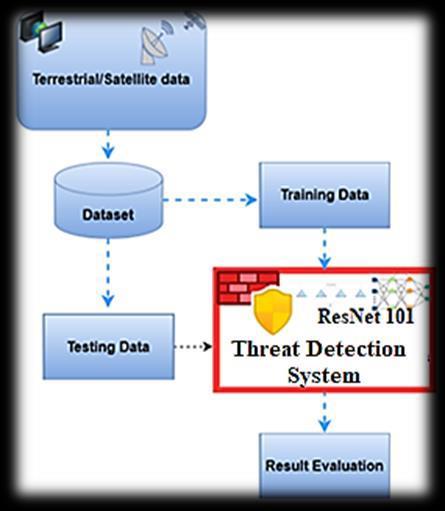
UsingtheSTINdataset,thisstudyassessestheperformance efficacy of a suggested thread detecting system. There are twosatellite-typeattacksandnineterrestrial-typeattacksin theSTINsecuritydataset,whichcoversavarietyofassaults in both satellite and terrestrial networks. Flow-based characteristics,whicharedescribedindetailinTable1,are usedtoconstructthedataset.
Table1:SKINdatasetcharacteristics Domain
Terrestrialattacks
Satelliteattacks DUPDDoS SynDDoS
Gatherlabeleddata,suchassystemlogsandnetworktraffic, whichofferinsightsintonetworkactivity(e.g.,datatraffic heat maps), in order to synthesize cybersecurity data for analysis. To ensure that features are on the same scale, preprocess the data by standardizing or normalizing it. Equation1illustratestheprocessofconvertingunprocessed network traffic or log data into CNN-friendly forms, includingtime-seriesrepresentationsor2Dheatmaps.

(1)
Where denotestherawdata,denotesthe normalized data, µ and σ denotesthemeanandstandarddeviationof thedataset.
The 101 layers of the ResNet101 design are made up of residual blocks that use skip connections to facilitate effectiveinformationflowacrosslevels,asshownin
Figure2.
ResNetbasicprincipleislearningresidualmappings, ratherthantheoriginalunreferencedmapping,enablingfor
International Research Journal of Engineering and Technology (IRJET) e-ISSN: 2395-0056
Volume: 12 Issue: 03 | Mar 2025 www.irjet.net p-ISSN: 2395-0072
effective training of deeper models without degradation concerns[11].
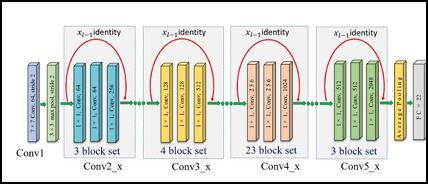
Equation 2 illustrates how the ResNet101 model uses residual blocks to extract deep features from input data, capturingintricatepatternscrucialforriskidentification.
InFigure2,theResNet101modelisdisplayed.

(2)
The feature vector that emerges from applying the ResNet101model totheinputisdenoted byF.Themodel weightsareoptimizedduringthetrainingphasetominimize alossfunctionusinggradientdescentandbackpropagation techniques, often Adam or SGD (Stochastic Gradient Descent). Equation 3 illustrates how cross-entropy loss is usedasthelossfunctioninclassificationtasks.

(3)
Where class is the actual class label, class is the predictedprobability,andclassisthetotalnumberofclasses (e.g., different types of attacks). Equation 4 presents the adjustedweights
(4)
The output of ResNet101 will be run through a softmax functiontodetermineaprobabilityforeachclass,whichis showninEquation5.

(5)
Theclass'spredictedprobabilityisshownby . wherethe outputscoreofclassIisrepresentedby and .Theclass with the highest likelihood is used to select the expected threattype.EveryresidualblockinResNet101hasaformal definitiongivenbyEquation6.


Byadding theblock'sinputtotheconvolutionallayers' output ,theoutputoftheresidualblockiscalculated.




where denotestheconvolutionallayers' weights. This makes it easier to optimize the residual functions since the network learns the residual function,whichisasimplermappingtolearnthanthedirect mapping
The proposed model was implemented and trained using PythonandKerasonGoogleColab.Theexperimentalsystem ranonWindows10,withTensorFlowasthebackend,12.75GB RAM,andGPUacceleration.ThesystemutilizedanNVIDIA GeForce GTX 1080Ti GPU, providing a significant boost in processingpower,andanIntelCorei7-6850Kprocessor.The model's architecture was optimized through hyper parametertuning,involvingsystematicexplorationofhyper parameter configurations to identify the optimal combinationyieldingthebestclassificationperformance.
The results of hyper parameter tuning are presented inTable2. The system's configuration enabled efficient processingandstorageoflargedatasets,rapidtrainingand testing of the model, and seamless execution of DL computations. Overall, the system provided a robust and efficient environment for developing and testing the proposedmodel.
Tuningthehyperparameterswasessentialtoimprovingthe model'sperformance.
Hyperparameters Values
LossFunction CategoricalCrossentropy
NumberofEpochs 25
Learningrate 0.001
Dropout 0.2
BatchSize 16
Optimizer Adam
ActivationFunction Sigmoid
(6)
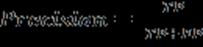
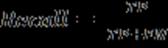
Theclassifier'sperformancewasevaluatedusingevaluation metrics. Equations (7) through (10), which reflect these indicators, offer a thorough comparison of algorithmic efficacy.Forathoroughanalysisofclassifierperformance, these metrics are evaluated using a confusion matrix that forecaststhetruepositives(TP),truenegatives(TN),false positives(FP),andfalsenegatives(FN).
Volume: 12 Issue: 03 | Mar 2025 www.irjet.net p-ISSN: 2395-0072


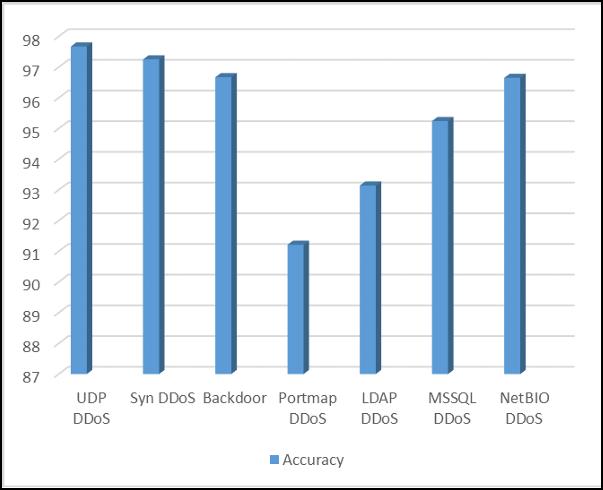
The STIN dataset is used to test the proposed Excellent securityisprovidedbyResNet101abilityforbothterrestrial and satellite networks. Using the STIN dataset, the ResNet101model'scapacitytoprovidesuperiorsecurityfor terrestrial-satellite networks was carefully assessed. This dataset was used as a thorough benchmark to determine howwellthemodelperformedindifferentiatingandaltering differentcyberthreats.Thestudyshowstheeffectivenessof the ResNet101 model in guaranteeing the security and integrity of network communications by using the STIN dataset, offering a strong defense against future cyber attacks. The findings were encouraging. The STIN dataset wasusedtoevaluatetheResNet101model'sperformance, and the findings showed that it outperformed other models.The model demonstrated its remarkable ability to recognizethisparticularthreattypewitha97.67%accuracy rate in recognizing UDP_DoS assaults. With a 97.25% accuracyrate,itperformedmarginallyworseagainstSyn_ DDoSassaults.
Theclassificationresults,whichareshownin Table 3, further demonstrate the model's outstanding performance. The model performed better overall than previous ML models, even if the accuracy scores for the "Portmap DDoS" and "LDAP DDoS" classes were lower, at 91.21% and 93.14%, respectively. The poorer accuracy ratingsfortheseparticularclassescanbeattributedtothe scarcityoftrainingdata.TheResNet101modelprovedtobe a useful tool in the field of network security despite this, since it was able to effectively detect cyber threats. Fig. 3, which displays the classifier's accuracy on the STIN terrestrialdataset,displaysthesefindings.
TheperformanceAvarietyofmeasureswere usedtoassessResNet101.Table4providesanoverviewof themodel'sperformanceanddisplaystheaverageclassifier accuracy for the STIN dataset. The average classification accuracy in Fig. 4 provides a visual representation of the model'sefficacy.Theseresultsdemonstratehoweffectively the ResNet 101 model identifies and classifies attacks, producingapracticaltoolfornetworksecurity.Thesystem's excellentoverallperformanceacrossallcriteriapointstoits potentialforpracticaluses.
International Research Journal of Engineering and Technology (IRJET) e-ISSN: 2395-0056
Volume: 12 Issue: 03 | Mar 2025 www.irjet.net p-ISSN: 2395-0072
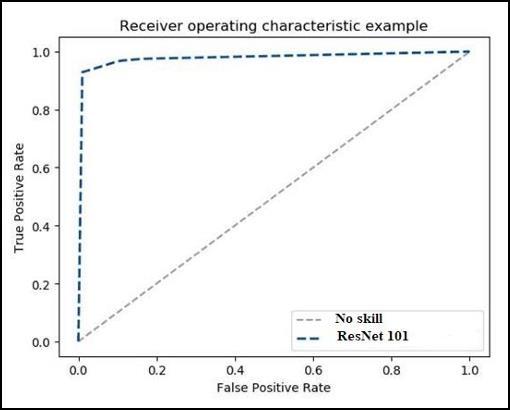
On the STIN dataset, the ResNet 101 model performed exceptionallywellandattainedaremarkableaccuracy.The model'ssuperiorityisfurtherdemonstratedbythereceiver operatingcharacteristics(ROC)curve,whichisshowninFig. 5.Interestingly,anevaluationofthemodel'scomputational complexity showed that, using the STIN dataset, its estimatedexecutiontimewas55seconds.Together,these results highlight how well the ResNet101 model detects cyberthreats,makingitausefultoolforensuringthesecurity ofbothterrestrialandsatellitenetworks.
FuturestudiescanutilizethesuggestedResNet101model as a standard. All things considered, this study has contributed significantly to the field of cyber security and offered a useful tool for identifying and categorizing cyberthreatsinsatellite-terrestrialnetworks.
5. CONCLUSION
The important contribution of the ResNet101 model to improving cybersecurity through the use of optimal DL techniquesishighlightedinthestudy'sconclusion.Witha 96.24%accuracyrate,94.28%precisionrate,96.47F1score, and98.67recall,themodelperformsexceptionallywellin dependablethreatdetection.Itsprocessingtimeofaround 55 seconds further demonstrates its efficacy for real-time applications,givingitaworkableanswertocontemporary cybersecurity issues. Using the STIN dataset, the method exhibits its exceptional capacity to quickly and precisely identify and respond to threats. The significance of DL techniquesforenhancingsecurityprotocolsandmodifying potentialrisksindynamicenvironmentsisemphasizedby this study. Future research should examine how different datasetsmaybeintegratedandhowhybridtacticsthatmix DLandconventionalsecuritytechniquescanbedeveloped.
Additionally, by using adaptive learning strategies, the model'scapacitytoadjusttochangingcyberthreatsmaybe
improved.All things considered, the study advances AIpowered cybersecurity solutions and establishes a strong basisfortheefficientdefenseofdigitalinfrastructures.
[1]Li,Y.,&Liu,Q.(2021).Acomprehensivereviewstudyofcyberattacks and cyber security; Emerging trends and recent developments.EnergyReports,7,8176-8186.
[2] Akgun,D.,Hizal,S., & Cavusoglu,U.(2022).A newDDoS attacksintrusiondetectionmodelbasedondeeplearningfor cybersecurity.Computers&Security,118,102748.
[3] Ashiku, L., & Dagli, C. (2021). Network intrusion detection system using deep learning. Procedia Computer Science,185,239-247.
[4]Mughaid,A.,AlZu’bi,S.,Hnaif,A.,Taamneh,S.,Alnajjar,A., &Elsoud,E.A.(2022).Anintelligentcybersecurityphishing detection system using deep learning techniques. Cluster Computing,25(6),3819-3828.
[5]Yu,K.,Tan,L.,Mumtaz,S.,Al-Rubaye,S.,Al-Dulaimi,A., Bashir, A. K., & Khan, F. A. (2021). Securing critical infrastructures:deep-learning-basedthreatdetectioninIIoT. IEEECommunicationsMagazine,59(10),76-82.