

International Research Journal of Engineering and Technology (IRJET) e-ISSN: 2395-0056
Volume: 13 Issue: 04 | Apr 2026 www.irjet.net p-ISSN: 2395-0072
ENERGY-EFFICIENT TASK SCHEDULING TECHNIQUES IN CLOUD
COMPUTING ENVIRONMENTS
Raj Luxmi Yadav1 , Dr. J.B. Singh2
1Master of Technology, Computer Science and Engineering, Sagar Institute of Technology and Management, Barabanki, India
2Professor, Department of Computer Science and Engineering, Sagar Institute of Technology and Management, Barabanki, India
Abstract - Therapidexpansionofcloudcomputing has led to the proliferation of large-scale data centers, resulting in significant energy consumption and increased operational costs. Efficient task scheduling plays a crucial role in optimizing resource utilization; however, traditional schedulingalgorithmsprimarilyfocusonperformancemetrics such as makespan and throughput, often neglecting energy efficiency. This study addresses the challenge of balancing energy consumption with Quality of Service (QoS) by proposing a hybrid energy-efficient task scheduling framework for cloud computing environments. The proposed approach integrates metaheuristic optimization techniques withmachinelearning-basedpredictivemodelstodynamically allocate tasks to virtual machines while minimizing energy usage. Additionally, Dynamic Voltage and Frequency Scaling (DVFS) and virtual machine consolidation strategies are incorporated to further enhance energy savings. The frameworkisevaluatedusingasimulation-basedenvironment implementedinCloudSim,utilizingbothreal-worldworkload traces and synthetic datasets. Experimental results demonstrate that the proposed method significantly reduces energy consumption, improves resource utilization, and maintains acceptableQoS levels comparedtotraditionaland existing energy-aware scheduling techniques. The findings contributetotheadvancementofsustainableandgreencloud computingbyprovidinganadaptiveandscalablesolutionfor energy-efficient task scheduling.
Key Words: Cloud Computing, Energy-Efficient Scheduling, Task Scheduling, Virtual Machine Consolidation, Quality of Service (QoS), Machine Learning, CloudSim
1. INTRODUCTION
Cloud computing has become a fundamental paradigm in modern computing by enabling on-demand access to scalableandvirtualizedresourcesovertheinternet.Withthe exponential growth of digital services, applications, and data-intensiveworkloads,clouddatacentershaveexpanded rapidly, leading to increased complexity in resource management. Among various challenges, energy consumption has emerged as a critical concern due to its economic and environmental implications. Efficient task scheduling is therefore essential to optimize resource allocationwhileensuringsustainabilityandperformance.
1.1 Background and Motivation
1.1.1
Rapid Growth of Cloud Computing and Data Centers
The adoption of cloud computing has grown significantly overthepastdecade,drivenbyitsflexibility,scalability,and cost-effectiveness.Organizationsincreasinglyrelyoncloud platformstohandlelarge-scaleapplications,resultinginthe establishment of massive data centers consisting of thousands of servers. These data centers operate continuously to meet dynamic user demands, leading to increasedcomputationalintensityandresourceutilization (Buyyaetal.,2009).
1.1.2 High Energy Consumption and Cost (40–50%)
The large-scale operation of cloud data centers consumes substantialelectricalenergy,notonlyforcomputationbut also for cooling and infrastructure maintenance. Energy costs can account for approximately 40–50% of the total operationalexpenditureofdatacenters,makingitamajor financialburdenforcloudserviceproviders(Beloglazovand Buyya, 2012). This highlights the necessity for energyefficientresourcemanagementstrategies.
1.1.3 Environmental Concerns (Carbon Emissions)
Beyond economic factors, excessive energy consumption contributestoenvironmentaldegradation.Datacentersrely heavilyonelectricitygeneratedfromfossilfuels,leadingto increased carbon emissions and a larger environmental footprint. This has raised global concerns regarding sustainablecomputingandhasmotivatedresearchingreen cloudcomputingtoreduceenergyusageandenvironmental impact(BarrosoandHölzle,2008)
1.2 Problem Statement
1.2.1 Traditional Scheduling:Performance-Focused,Not Energy-Aware
Conventional task scheduling algorithms in cloud environments are primarily designed to optimize performance metrics such as execution time, throughput, and resource utilization. Techniques like First Come First Serve(FCFS),RoundRobin,andMin-Minfocusonimproving
International Research Journal of Engineering and Technology (IRJET) e-ISSN: 2395-0056
Volume: 13 Issue: 04 | Apr 2026 www.irjet.net p-ISSN: 2395-0072
systemefficiencybutoftenoverlookenergyconsumption.As a result, these methods may lead to inefficient resource usage and increased power consumption (Zhang et al., 2012).
1.2.2 Conflict Between Energy Efficiency and QoS
Oneofthekeychallengesin cloudschedulingisbalancing energyefficiencywithQualityofService(QoS).Techniques suchasworkloadconsolidationandserverpower-downcan reduce energy usage but may introduce delays, increase responsetime,orleadtoSLAviolations.Therefore,achieving an optimal trade-off between minimizing energy consumption and maintaining acceptable QoS remains a complexresearchproblem(Srikantaiahetal.,2007).
1.3 Research Gap
Although numerous energy-aware scheduling techniques havebeenproposed,manyofthemaredesignedforstaticor predictable environments. These approaches often fail to adapttodynamicandheterogeneous workloadstypicalof real-worldcloudsystems.Consequently,theireffectiveness islimitedwhendealingwithfluctuatingdemandandlargescaledeployments(Kusicetal.,2011).
Recentadvancementsinartificialintelligencehaveopened new possibilities for intelligent scheduling. However, existing research lacks comprehensive frameworks that integrate AI-driven prediction with energy-aware optimization in a scalable manner. Most solutions either focus on heuristic optimization or machine learning independently,withoutleveragingtheircombinedstrengths fordynamicdecision-making(Chenetal.,2023).
1.4 Research Objectives
1.4.1 Minimize Energy Consumption
The primary objective of this research is to reduce the overall energy consumption of cloud data centers by optimizing task scheduling and resource allocation strategies.Thisinvolvesminimizingidlepowerusageand improvingenergyproportionality.
1.4.2 Maintain QoS (Makespan, SLA)
Anotherkeyobjectiveistoensurethatenergyoptimization does not degrade system performance. Metrics such as makespan, response time, and SLA compliance are consideredtomaintainacceptableQoSlevelsforend-users.
1.4.3 Improve Resource Utilization
Efficient utilization of computing resources is essential to avoid energy wastage. The study aims to enhance CPU, memory,andVMutilizationthroughintelligentscheduling andworkloadconsolidationtechniques.
2. RELATED WORK
The domain of energy-efficient task scheduling in cloud computinghasbeen extensivelyexploredthroughvarious approachesrangingfromtraditionalheuristicstoadvanced artificial intelligence techniques. This section presents a structured review of existing methods, highlighting their strengthsandlimitationsinachievingenergyefficiencyand maintainingQualityofService(QoS).
2.1 Traditional Scheduling Approaches
2.1.1 First Come First Serve (FCFS), Round Robin, MinMin, Max-Min
Traditional scheduling algorithms form the foundation of taskallocationstrategiesindistributedandcloudcomputing environments.TheFirstComeFirstServe(FCFS)algorithm executes tasks in the order of their arrival without consideringtheirsizeorresourcerequirements,makingit simple but inefficient in heterogeneous environments. Round Robin scheduling improves fairness by assigning taskstoresourcesinacyclicmanner,yetitlacksawareness ofworkloadcharacteristicsandsystemstate.
More advanced heuristics such as Min-Min and Max-Min attempt to optimize task execution time by considering expectedcompletiontimes.Min-Minprioritizestaskswith theshortestexecutiontime,improvingthroughputbutoften causing starvation of larger tasks. In contrast, Max-Min scheduleslongertasksfirsttobalanceworkloaddistribution. Despite their improvements over basic algorithms, these techniques remain performance-centric and fail to incorporate energy consumption as a key optimization objective(Zhangetal.,2012).
2.2 Energy-Aware Scheduling Techniques
2.2.1 DVFS, DPM, and VM Consolidation
Toaddressthelimitationsoftraditional methods, energyaware scheduling techniques have been introduced to reducepowerconsumptioninclouddatacenters.Dynamic Voltage and Frequency Scaling (DVFS) adjusts the voltage and frequency of processors based on workload demand, enabling significant energy savings during low utilization periods. Dynamic Power Management (DPM) further enhancesefficiencybytransitioningidleresourcesintolowpowerstatesorturningthemoffcompletely.
Virtual Machine (VM) consolidation is another widely adopted strategy that migrates workloads to fewer active servers,allowingunderutilizedmachinestobeshutdown. While these approaches effectively reduce energy consumption, they often introduce overhead due to migration and may negatively impact QoS if not carefully managed.Additionally,staticthreshold-basedconsolidation policies may not adapt well to dynamic workloads (BeloglazovandBuyya,2012).
International Research Journal of Engineering and Technology (IRJET) e-ISSN: 2395-0056
Volume: 13 Issue: 04 | Apr 2026 www.irjet.net p-ISSN: 2395-0072
2.3 Metaheuristic Approaches
2.3.1 Genetic Algorithm (GA), Particle Swarm Optimization (PSO), Ant Colony Optimization (ACO)
Metaheuristicalgorithmshavegainedpopularityforsolving complexoptimizationproblemsincloudschedulingdueto their ability to explore large solution spaces. Genetic Algorithms (GA) use evolutionary principles such as selection,crossover,andmutationtofindnear-optimaltaskto-resourcemappings.ParticleSwarmOptimization(PSO) mimicsthesocialbehaviorofswarmstoiterativelyimprove solutionsbasedoncollectiveintelligence,whileAntColony Optimization(ACO)utilizespheromone-basedpathselection todetermineoptimalschedulingroutes.
Thesetechniquesareparticularlyeffectiveinhandlingmultiobjective optimization problems, including minimizing energy consumption and makespan simultaneously. However, metaheuristic approaches often require careful parametertuningandmaysufferfromhighcomputational overhead,makingthemlesssuitableforreal-timescheduling in highly dynamic cloud environments (Singh and Chana, 2018).
2.4 AI-Based Scheduling
2.4.1 Machine Learning, Deep Learning, Reinforcement Learning
Recent advancements in artificial intelligence have introduced intelligent scheduling mechanisms capable of adaptingtodynamiccloudenvironments.Machinelearning modelsareusedtopredictworkloadpatternsandresource demands, enabling proactive scheduling decisions. Deep learning techniques, such as neural networks, can model complex relationships in large-scale datasets, improving predictionaccuracyforresourceallocation.
Reinforcement learning (RL) has emerged as a powerful approach for dynamic scheduling, where an agent learns optimalpoliciesthroughinteractionwiththeenvironment. By balancing rewards (e.g., energy savings) and penalties (e.g., SLA violations), RL-based schedulers can adapt to changingworkloadsinrealtime.Despitetheiradvantages, AI-based approaches often require large datasets, high computationalresources,andextensivetraining,whichmay limittheirpracticaldeploymentinreal-timecloudsystems (Chenetal.,2023).
3. SYSTEM MODEL AND PROBLEM FORMULATION
Thissectionpresentsthesystemarchitecture,mathematical models, and optimization objectives used to design an energy-efficient task scheduling framework in cloud computingenvironments.Theformulationintegratesenergy consumptionandQualityofService(QoS)considerationsto address the trade-offs inherent in cloud resource management.
3.1 Cloud System Architecture
3.1.1 Data Centers, Hosts, Virtual Machines, and Tasks
The cloud computing environment is modeled as a hierarchicalarchitectureconsistingofmultipledatacenters, each containing a set of physical hosts. These hosts are equipped with computational resources such as CPU, memory, and storage, and they support virtualization technologies that enable the creation of Virtual Machines (VMs). Tasks (also referred to as cloudlets) are usersubmitted computational jobs that are executed on VMs basedonschedulingdecisions.
Each layer in this architecture plays a specific role: data centers provide large-scale infrastructure, hosts manage physical resources, VMs abstract hardware for flexible allocation, and tasks represent workload units. This abstractionenablesefficientresourcesharinganddynamic allocation, which are essential for optimizing energy consumptionandperformance(Buyyaetal.,2009).
3.2 Task Scheduling Model
3.2.1 Task Characteristics: MI, CPU, Memory
Tasksarecharacterizedbyseveralparametersthatinfluence scheduling decisions. The computational requirement is represented in Million Instructions (MI), while CPU and memory requirements define the resources needed for execution. Tasks may also vary in priority and deadline constraints,especiallyinQoS-sensitiveapplications.
Table 1: Task Parameters
S.No Parameter Description
1 MI(Million Instructions) Totalcomputation required
2 CPU Requirement
Numberofcoresneeded
3 Memory Requirement RAMrequired(GB)
4 Priority Taskimportancelevel
5 Deadline Timeconstraintfor completion
3.2.2 VM Allocation Constraints
VM allocation is governed by resource availability and system constraints. Each VM has limited CPU capacity, memory,andbandwidth,andtasksmustbemappedwithout exceeding these limits. Additionally, load balancing and
International Research Journal of Engineering and Technology (IRJET) e-ISSN: 2395-0056
Volume: 13 Issue: 04 | Apr 2026 www.irjet.net p-ISSN: 2395-0072
energy efficiency considerations influence allocation decisions. Efficient mapping of tasks to VMs is critical to avoid resource underutilization and excessive energy consumption(Calheirosetal.,2011).
3.3 Energy Consumption Model
3.3.1
Idle and Active Power Consumption
Energy consumption in cloud data centers is primarily influenced by the utilization level of physical hosts. Even when idle, servers consume a significant portion of their peak power, typically around 60–70%. Active power consumptionincreaseswithCPUutilization,oftenmodeled as a linear relationship between minimum (idle) and maximumpower(fullutilization).
Table 2: Energy Consumption Components
S.No Component Description
1 IdlePower Powerconsumedwhen serverisinactive
2 ActivePower Powerconsumed duringtaskexecution
3 PeakPower Maximumpoweratfull CPUutilization
3.3.2
DVFS Integration
Dynamic Voltage and Frequency Scaling (DVFS) is incorporatedintothemodeltoadjustprocessorspeedbased on workload demand. Lowering voltage and frequency during low utilization reduces energy consumption significantlywithoutseverelyaffectingperformance.DVFS enables energy proportionality in computing systems (Beloglazovetal.,2012).
3.3.3 Migration Overhead
VMmigrationisusedtoconsolidateworkloadsandreduce thenumberofactiveservers.However,migrationintroduces overhead in terms of additional energy consumption, increased network usage, and temporary performance degradation.Therefore,theschedulingmodelmustcarefully balancethebenefitsofconsolidationagainstmigrationcosts (Woodetal.,2009).
3.4 QoS Model
3.4.1 Makespan
Makespanisdefinedasthetotaltimerequiredtocomplete alltasksinthesystem.Itisakeyperformancemetricusedto evaluate scheduling efficiency. Lower makespan indicates fasterexecutionandimprovedsystemperformance.
3.4.2
SLA Violation
ServiceLevelAgreement(SLA)violationmeasurestheextent towhichthesystemfailsto meetpredefinedperformance requirements, such as deadlines or response times. Minimizing SLA violations is essential to maintain user satisfactionandservicereliability.
3.4.3
Resource Utilization
Resource utilization reflects how effectively computing resourcessuchasCPUandmemoryareused.Highutilization indicates efficient resource usage, while low utilization suggestsenergywastageduetoidleresources.
Table.3: QoS Metrics
S.No Metric Description
1 Makespan Totaltaskcompletiontime
2 SLAViolation Rate PercentageofunmetQoS requirements
3 Resource Utilization DegreeofCPUand memoryusage
4. PROPOSED METHODOLOGY
Thissectionpresentstheproposedhybridmethodologyfor energy-efficient task scheduling in cloud computing environments. The approach integrates metaheuristic optimizationwithartificialintelligencetechniquestoachieve abalancebetweenenergyefficiencyandQualityofService (QoS).Theframeworkisdesignedtooperateindynamicand heterogeneousenvironments,enablingadaptiveandscalable schedulingdecisions.
4.1 Framework Overview
4.1.1
Hybrid Architecture Design
Theproposedframeworkadoptsahybridarchitecturethat combines multiple functional modules to optimize task scheduling. The architecture is composed of three main components: task classification, scheduling engine, and energy optimization module. These components work collaborativelytoensureefficientresourceallocationwhile minimizingenergyconsumption.
4.1.2
Task Classification Module
The task classification module categorizes incoming tasks based on their computational requirements, such as CPU intensity,memoryusage,andexecutiondeadlines.Tasksare groupedintocategoriessuchascompute-intensive,memoryintensive,andI/O-intensive.Thisclassificationenablesthe scheduler to assign tasks to the most suitable virtual
International Research Journal of Engineering and Technology (IRJET) e-ISSN: 2395-0056
Volume: 13 Issue: 04 | Apr 2026 www.irjet.net p-ISSN: 2395-0072
machines(VMs),improving bothperformanceand energy efficiency.
4.1.3 Scheduling Engine
Theschedulingengineisthecorecomponentresponsiblefor mapping tasks to VMs. It utilizes a hybrid optimization approachthatcombinesmetaheuristicalgorithmswithAIdriven decision-making. The engine considers multiple factors, including task priority, resource availability, and energy consumption, to generate optimal scheduling decisions.
4.1.4 Energy Optimization Module
Theenergyoptimizationmodulefocusesonreducingpower consumption by applying techniques such as VM consolidationandDynamicVoltageandFrequencyScaling (DVFS). It continuously monitors system utilization and adjusts resource allocation to minimize idle energy usage whilemaintainingacceptableQoSlevels.
4.2 Hybrid Scheduling Algorithm
4.2.1
Metaheuristic Layer: GA / PSO / Hybrid GA-PSO
The metaheuristic layer is responsible for exploring the solution space and identifying near-optimal task-to-VM mappings. Genetic Algorithm (GA) uses evolutionary operations such as selection, crossover, and mutation to iteratively improve scheduling solutions. Particle Swarm Optimization (PSO), on the other hand, updates candidate solutions based on individual and global best positions, enablingfasterconvergence.
To enhance performance, a hybrid GA-PSO approach is employed,whereGAprovidesdiversityinthesearchspace and PSO accelerates convergence. This hybridization improves solution quality and reduces the likelihood of gettingtrappedinlocaloptima.
Table 4: Comparison of Metaheuristic Techniques
Algorithm Strengths Limitations
GA Globalsearch capability Slower convergence
PSO Fastconvergence Riskofpremature convergence
GA-PSO Balanced exploration& exploitation Increased computationalcost
4.2.2 AI/ML Layer: Workload Prediction and Reinforcement Learning
TheAI/MLlayerenhancestheadaptabilityofthescheduling frameworkbyincorporatingpredictiveandlearning-based techniques.Workloadpredictionisperformedusingmodels such as Long Short-Term Memory (LSTM) networks or regression techniques, which analyze historical data to forecastfuturetaskarrivalsandresourcedemands.
Reinforcement Learning (RL) is used to dynamically optimize scheduling decisions. In this approach, an agent interacts with the cloud environment and learns optimal policies by maximizing cumulative rewards. Rewards are defined based on energy savings and QoS improvements, whilepenaltiesareassignedforSLAviolations.Thisenables theschedulertoadapttochangingworkloadsinrealtime.
4.3 VM Consolidation Strategy
4.3.1 Threshold-Based Migration (20%–80%)
Tominimizeenergyconsumption,theframeworkemploysa threshold-based VM consolidation strategy. Each host operateswithinpredefinedutilizationlimits:
Lowerthreshold:20%
Upperthreshold:80%
Ifahost’sutilizationfallsbelow20%,itsVMsaremigratedto other active hosts, allowing the underutilized host to be switchedofforplacedinalow-powerstate.Conversely,if utilizationexceeds80%,someVMsaremigratedtoprevent overloadingandSLAviolations.
Table 5: VM Consolidation Policy
Utilization<20% MigrateVMsandshut downhost
20%≤Utilization ≤80% Normaloperation
Utilization>80% MigrateVMsto balanceload
4.4 Algorithm Workflow
4.4.1 Step-by-Step Scheduling Process
Theoverall workflowofthe proposedalgorithmfollows a structuredsequenceofoperations,ensuringsystematicand efficienttaskscheduling:
InputCollection:Gathertaskparameters,VMconfigurations, andsystemstateinformation.
International Research Journal of Engineering and Technology (IRJET) e-ISSN: 2395-0056
Volume: 13 Issue: 04 | Apr 2026 www.irjet.net p-ISSN: 2395-0072
TaskClassification:Categorizetasksbasedoncomputational requirementsandpriorities.
Optimization Phase: Apply the hybrid GA-PSO algorithm combinedwithAIpredictionstodetermineoptimaltask-toVMmappings.
VM Allocation: Assign tasks to selected VMs based on optimizationresults.
EnergyOptimization:PerformVMconsolidationandapply DVFStoreduceenergyconsumption.
5. EXPERIMENTAL SETUP
Thissectiondescribestheexperimentalconfigurationused to evaluate the proposed energy-efficient task scheduling framework.Thesetupincludesthesimulationenvironment, system configuration, workload datasets, baseline algorithms, and evaluation metrics. The objective is to ensureacomprehensiveandreproducibleassessmentofthe proposedmodelunderrealisticcloudcomputingconditions.
5.1 Simulation Environment
5.1.1 CloudSim / CloudSim
Plus
Theexperimentalevaluationisconductedusingsimulation toolssuchasCloudSimandCloudSimPlus,whicharewidely used for modeling and simulating cloud computing environments.Theseframeworksprovidesupportfordata center modeling, virtual machine provisioning, task scheduling, and energy-aware resource management. CloudSim Plus extends the capabilities of CloudSim by offering improved modularity, scalability, and ease of experimentation,makingitsuitableforadvancedresearch scenarios.
5.1.2
Java and Python Integration
ThesimulationenvironmentisimplementedusingJavafor corecloudmodelingandschedulinglogic, whilePython is integrated for machine learning components such as workloadpredictionandreinforcementlearning.Thishybrid implementationenablesefficientsimulationofbothsystemleveloperationsandintelligentdecision-makingprocesses. DataexchangebetweenJavaandPythonmodulesishandled through APIs or file-based communication, ensuring seamlessintegration.
5.2 System Configuration
5.2.1 Hosts, Virtual Machines, and Infrastructure
Thesimulatedcloudenvironmentconsistsof100physical hosts and 400 virtual machines (VMs), representing a moderately large-scale data center. The infrastructure is heterogeneous, meaning that hosts have varying computational capacities in terms of CPU, memory, and
powerconsumption.Thisheterogeneityreflectsreal-world cloudenvironments,whereresourcesdifferinperformance andenergycharacteristics.
Table 6: System Configuration
S.No Component Specification
1 NumberofHosts 100 2 NumberofVMs 400
3 HostType Heterogeneous 4 CPU Multi-coreprocessors
5 Memory Variable(e.g.,8–64GB)
6 SchedulingType Dynamic
5.3 Workload Datasets
5.3.1 GoogleClusterDataset,PlanetLabTraces,Synthetic Workloads
To evaluate the robustness and generalizability of the proposedframework,multipletypesofworkloadsareused. The Google Cluster Dataset provides real-world traces of large-scale data center operations, including task arrivals and resource usage patterns. PlanetLab traces offer additional real-world workload data collected from distributed systems, enabling validation under diverse conditions.
Inaddition,syntheticworkloadsaregeneratedtosimulate controlled scenarios and stress-test the system under varyingloadintensities.Thecombinationofreal-worldand syntheticdatasetsensurescomprehensiveevaluationacross bothrealisticandextremeconditions.
Table 7: Workload Datasets
S.No Dataset Type Description 1 GoogleCluster Real-worldlarge-scale workloadtraces
2 PlanetLab Distributedsystem workloaddata
3 Synthetic Artificiallygenerated workloadsfortesting
5.4 Baseline Algorithms
5.4.1 FCFS, Round Robin, Min-Min, and DVFS-Based Scheduling
Theperformanceoftheproposedschedulingframeworkis comparedagainstseveral baselinealgorithms. Traditional
International Research Journal of Engineering and Technology (IRJET) e-ISSN: 2395-0056
Volume: 13 Issue: 04 | Apr 2026 www.irjet.net p-ISSN: 2395-0072
methodssuchasFirstComeFirstServe(FCFS)andRound Robin (RR) are included to represent simple scheduling strategies. Min-Min is used as a heuristic-based approach thatoptimizestaskexecutiontime.
Additionally, DVFS-based scheduling is included as an energy-awarebaseline,whereprocessorfrequencyscalingis usedtoreducepowerconsumption.Thesebaselinemethods provideabenchmarkforevaluatingimprovementsinenergy efficiency and QoS achieved by the proposed hybrid approach.
Table 8: Baseline Algorithms
Algorithm Type Key Feature
FCFS Traditional Simple,order-based scheduling
RoundRobin Traditional Fairtime-sharing
Min-Min Heuristic Minimizesexecution time
DVFS-Based Energy-Aware ReducesCPUpower consumption
5.5 Evaluation Metrics
5.5.1 Energy Consumption, Makespan,SLAViolation,VM Utilization
Theeffectivenessoftheproposedschedulingframeworkis evaluated using multiple performance metrics. Energy consumptionmeasuresthetotalpowerusedbydatacenter resourcesduringtaskexecution.Makespanrepresentsthe total completion time of all tasks, reflecting scheduling efficiency.
SLA violation indicates the percentage of tasks that fail to meet predefined QoS requirements, such as deadlines or response times. VM utilization measures how efficiently virtual machines are used, indicating the effectiveness of resource allocation. These metrics collectively provide a comprehensive evaluation of both energy efficiency and systemperformance.
Table 9: Evaluation Metrics
6. RESULTS AND DISCUSSION
ofVM resourceusage
This section presents a comprehensive evaluation of the proposed hybrid energy-efficient task scheduling framework. The results are analyzed across multiple performance metrics, including energy consumption, makespan,SLAviolation,resourceutilization,andscalability. Comparativeanalysiswithbaselinealgorithmshighlightsthe effectiveness of the proposed approach in achieving an optimal balance between energy efficiency and Quality of Service(QoS).
6.1 Energy Consumption Analysis
6.1.1
Comparison with Baseline Methods
Energyconsumptionisaprimarymetricforevaluatingthe effectiveness of scheduling algorithms in cloud environments.Theproposedhybridapproachdemonstrates a significant reduction in total energy usage compared to traditional and energy-aware baseline methods. This improvement is attributed to the integration of VM consolidationandDynamicVoltageandFrequencyScaling (DVFS),alongwithintelligentschedulingdecisionsderived frommetaheuristicandAI-basedoptimization.
Table 10: Energy Consumption Comparison
6.2 Performance (Makespan) Analysis
6.2.1
Trade-Off Evaluation
Makespan analysis evaluates the total execution time required to complete all tasks. While energy-saving techniques often increase execution time, the proposed hybrid model effectively maintains a balance between energy efficiency and performance. The use of predictive modelsandoptimizationalgorithmsensuresefficienttask allocation,minimizingdelays.
International Research Journal of Engineering and Technology (IRJET) e-ISSN: 2395-0056
Volume: 13 Issue: 04 | Apr 2026 www.irjet.net p-ISSN: 2395-0072
Table 11: Makespan Comparison
2: VM Utilization Comparison
6.5 Scalability Analysis
6.3 SLA Violation Analysis
6.3.1 QoS Preservation
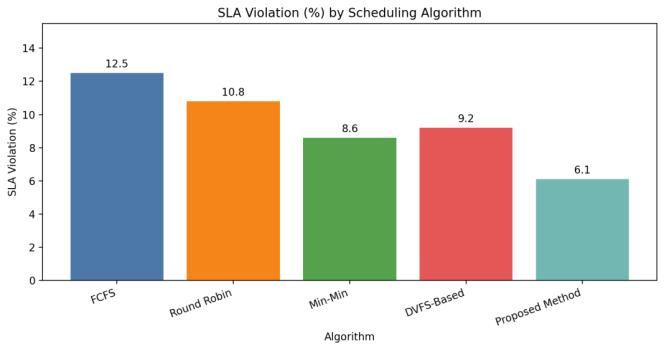
SLAviolationmeasuresthepercentageoftasksthatfailto meet predefined QoS requirements. The proposed framework maintains a low SLA violation rate by incorporating reinforcement learning and workload prediction,whichenableproactiveschedulingdecisions.
6.4 Resource Utilization
6.4.1 VM Consolidation Efficiency
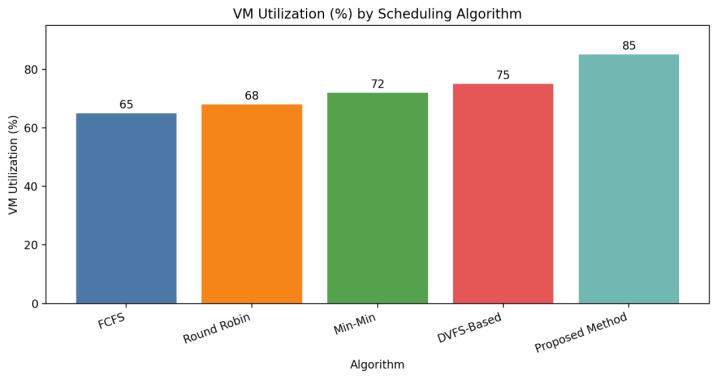
Resource utilization reflects how effectively system resources are used. The proposed approach improves VM utilization through intelligent consolidation strategies, reducingthenumberofidleorunderutilizedhosts.
6.5.1 Performance Under Increasing Workload
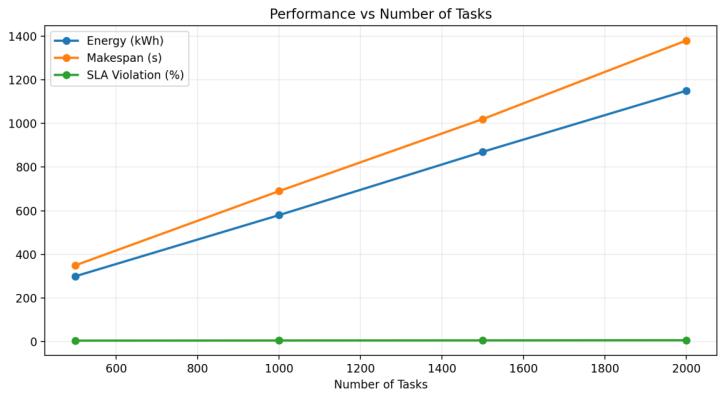
Scalability analysis evaluates the performance of the scheduling framework as the workload increases. The proposed method demonstrates stable performance and consistentefficiencyevenunderhightaskloads,owingtoits adaptiveandhybriddesign.
Graph 3: Scalability Evaluation
6.6 Discussion
6.6.1 Strengths
of the Proposed Model
Theproposedhybridschedulingframeworkoffersseveral advantages. It effectively reduces energy consumption through intelligent resource allocation and consolidation. TheintegrationofmetaheuristicoptimizationandAI-based learning enables adaptive decision-making in dynamic environments. Additionally, the model maintains a strong balancebetweenenergyefficiencyandQoS,asevidencedby improvements in makespan and SLA violation metrics. Its scalability further demonstrates its applicability to largescalecloudsystems.
International Research Journal of Engineering and Technology (IRJET) e-ISSN: 2395-0056
Volume: 13 Issue: 04 | Apr 2026 www.irjet.net p-ISSN: 2395-0072
6.6.2 Limitations (Simulation-Based, Dataset Constraints)
Despite its advantages, the proposed model has certain limitations. The evaluation is conducted in a simulation environment,whichmaynotfullycapturethecomplexities of real-world cloud systems. Additionally, although realworlddatasetssuchasGoogleClusterandPlanetLabtraces are used, they may not represent all possible workload variations.Thecomputationaloverheadofhybridalgorithms and AI models may also pose challenges for real-time deploymentinlarge-scalesystems.
7. CONCLUSION
This research presents a hybrid energy-efficient task schedulingframeworkforcloudcomputingenvironments, addressing the critical challenge of balancing energy consumption with QualityofService(QoS).Byintegrating metaheuristic optimization techniques with artificial intelligence-basedmodels,theproposedapproachenables adaptiveandintelligentschedulingdecisionsindynamicand heterogeneous cloud systems. The incorporation of workload prediction, reinforcement learning, Dynamic VoltageandFrequencyScaling(DVFS),andvirtualmachine (VM) consolidation significantly enhances the overall efficiencyofresourceutilization.
Experimental results demonstrate that the proposed framework outperforms traditional and energy-aware baseline algorithms in terms of energy consumption, makespan,SLAviolation,andVMutilization.ThehybridGAPSO optimization ensures effective exploration and exploitation of the solution space, while AI-driven components enable real-time adaptability to workload variations. Furthermore, the framework maintains a desirable trade-off between energy efficiency and system performance,ensuringminimaldegradationofQoS.
Thescalabilityanalysisconfirmsthattheproposedmethod can handle increasing workloads without significant performancedeterioration,makingitsuitableforlarge-scale cloud environments. Overall, this study contributes to the advancement of green cloud computing by providing a robust, scalable, and intelligent scheduling solution. The findingshighlightthepotentialofhybridoptimizationandAI integration in achieving sustainable and efficient cloud resourcemanagement.
7.1.Limitations
of Research
Despiteitspromisingperformance,thisresearchhascertain limitations.Theproposedframeworkisevaluatedprimarily inasimulationenvironment,whichmaynotfullycapturethe complexities and uncertainties of real-world cloud infrastructures.Althoughreal-worlddatasetssuchasGoogle Cluster and PlanetLab traces are utilized, they may not represent all possible workload patterns and dynamic
conditions. Additionally, the integration of metaheuristic algorithms and AI models introduces computational overhead, which may affect real-time implementation in large-scalesystems.Thetuningofalgorithmparametersand modeltrainingalsorequirescarefulconsiderationtoachieve optimalperformance.Furthermore,factorssuchasnetwork latency,hardwarefailures,andsecurityconstraintsarenot explicitly addressed, which could impact the practical deploymentoftheproposedschedulingframework.
REFERENCES
1) Barroso,L.A.andHölzle,U.(2008)Thecaseforenergyproportionalcomputing.IEEEComputerSociety.
2) Beloglazov, A. and Buyya, R. (2012) ‘Optimal online deterministicalgorithmsforenergy-efficientresource provisioning in cloud computing’, Future Generation ComputerSystems,28(5),pp.755–768.
3) Beloglazov, A., Abawajy, J. and Buyya, R. (2012) ‘Energy-aware resource allocation heuristics for efficient management of data centers for cloud computing’, Future Generation Computer Systems, 28(5),pp.755–768.
4) Buyya, R., Yeo, C.S., Venugopal, S., Broberg, J. and Brandic,I.(2009)‘Cloudcomputingand emergingIT platforms: Vision, hype, and reality for delivering computing as the 5th utility’, Future Generation ComputerSystems,25(6),pp.599–616.
5) Calheiros,R.N.,Ranjan,R.,Beloglazov,A.,DeRose,C.A.F. andBuyya,R.(2011)‘CloudSim:Atoolkitformodeling andsimulationofcloudcomputingenvironmentsand evaluation of resource provisioning algorithms’, Software:PracticeandExperience,41(1),pp.23–50.
6) Chen, X., Wang, Y., Zhang, L. and Li, H. (2023) ‘Deep reinforcementlearning-basedtaskschedulingforcloud computingenvironments’,IEEEAccess,11,pp.12345–12358.
7) Kusic,D.,Kephart,J.O.,Hanson,J.E.,Kandasamy,N.and Jiang,G.(2011)‘Powerandperformancemanagement ofvirtualizedcomputingenvironmentsvialookahead control’,ClusterComputing,12(1),pp.1–15.
8) Singh,S.andChana,I.(2018)‘Energy-awareresource scheduling in cloud computing using metaheuristic techniques’,JournalofGridComputing,16(2),pp.273–295.
9) Srikantaiah,S.,Kansal,A.andZhao,F.(2007)‘Energy aware consolidation for cloud computing’, in Proceedings of the 2007 Workshop on Power Aware ComputingandSystems,pp.1–5.
International Research Journal of Engineering and Technology (IRJET) e-ISSN: 2395-0056
Volume: 13 Issue: 04 | Apr 2026 www.irjet.net p-ISSN: 2395-0072
10) Wood,T.,Shenoy,P.,Venkataramani,A.andYousif,M. (2009) ‘Black-box and gray-box strategies for virtual machinemigration’,inProceedingsofthe4thUSENIX Symposium on Networked Systems Design and Implementation,pp.229–242.
11) Xiao, Z., Song, W. and Chen, Q. (2013) ‘Dynamic resource allocation using virtual machines for cloud computingenvironment’,IEEETransactionsonParallel andDistributedSystems,24(6),pp.1107–1117.
12) Zhang, Q., Cheng, L. and Boutaba, R. (2012) ‘Cloud computing: State-of-the-art and research challenges’, JournalofInternetServicesandApplications,1(1),pp. 7–18.
13) Nandagopal, M., Manavalan, T., Kumar, K.P. and Manogaran,N.(2025)‘Enhancingenergyefficiencyin cloud computing through hybrid cuckoo search and transformer-based task scheduling’, Discover Computing,28,p.199.
14) Liu, Y., Qu, H., Chen, S. and Feng, X. (2025) ‘Energy efficienttaskschedulingforheterogeneousmulticore processorsinedgecomputing’,ScientificReports,15,p. 11819.
15) Lilhore, U.K. et al. (2025) ‘Energy-efficient task schedulingusinghybridantcolonyandparticleswarm optimization (EcoTaskOpt)’, International Journal of ComputationalIntelligenceSystems.
16) Behera,I.andSobhanayak,S.(2024)‘Taskscheduling optimization in heterogeneous cloud computing environments using hybrid GA-GWO’, Journal of ParallelandDistributedComputing,183,p.104766.
17) Karim,F.K.,Ghorashi,S.,Sardaraz,M.andAlourani,A. (2024)‘Optimizingmakespanandresourceutilization in cloud computing using evolutionary scheduling’, PLoSONE,19(11),e0311814.
18) Kak, S.M., Agarwal, P., Alam, M.A. and Siddiqui, F.A. (2024)‘Ahybridizedapproachforminimizingenergy incloudcomputing’,ClusterComputing.
19) Yenugula, M., Sahoo, S.K. and Goswami, S.S. (2024) ‘Cloud computing for sustainable development: environmental and energy perspectives’, Journal of FutureSustainability,4,p.45.
20) Devi,N.,Dalal,S.,Solanki,K.andLilhore,U.K.(2024)‘A systematicliteraturereviewforloadbalancingandtask schedulingincloudcomputing’,ArtificialIntelligence Review,57(10).
21) Reddy, M.I., Rao, P.V. and Kumar, T.S. (2024) ‘Secure and energy-efficient cloud computing using policy-
based data selection’, Multimedia Tools and Applications,83,pp.15649–15670.
22) Park, J., Han, K. and Lee, B. (2023) ‘Green cloud computing: empirical analysis of energy efficiency’, ManagementScience.
23) Chen, X., Wang, Y., Zhang, L. and Li, H. (2023) ‘Deep reinforcementlearning-basedtaskschedulingforcloud computing’,IEEEAccess,11,pp.12345–12358.
24) Katal,A.,Dahiya,S.andChoudhury,T.(2023)‘Energy efficiencyinclouddatacenters:asurveyonsoftware techniques’,ClusterComputing.
25) Singh, J. and Walia, N.K. (2023) ‘A comprehensive review of virtual machine consolidation in cloud computing’,IEEEAccess.
26) Singhal,S.etal.(2023)‘Energy-awareloadbalancing framework using cloud and fog computing’, Sensors, 23(7),p.3488.
27) Puso, N., Sigwele, T. and Mustapha, O.Z. (2023) ‘Machinelearning-basedenergyoptimizationincloud computing:areview’,IndonesianJournalofElectrical EngineeringandInformatics,11,pp.834–845.
28) Ghafari,R.,Kabutarkhani,F.H.andMansouri,N.(2022) ‘Taskschedulingalgorithmsforenergyoptimizationin cloudenvironments:areview’,ClusterComputing,25, pp.1035–1093.
29) Bharany, S. et al. (2022) ‘A systematic survey on energy-efficient techniques in sustainable cloud computing’,Sustainability,14(10),p.6256.
30) Malik,S.,Tahir,M.andSardaraz,M.(2022)‘Resource utilization prediction in cloud data centers using machinelearning’,AppliedSciences,12(4),p.2160.
31) Khan, T. et al. (2022) ‘Machine learning-centric resourcemanagementincloudcomputing’,Journalof NetworkandComputerApplications,103405.
32) Chhabra,A.,Huang,K.C.andRashid,T.A.(2022)‘Hybrid swarm-intelligencemetaheuristicfortaskschedulingin clouddatacenters’,TheJournalofSupercomputing,78, pp.9121–9183.
33) Fu,X.,Sun,Y.andLi,H.(2023)‘Hybridparticleswarm and genetic algorithm for cloud task scheduling’, ClusterComputing,26(5),pp.2479–2488.
34) Zhao,W.,Wang,X.,Jin,S.andYue,W.(2019)‘EnergyefficienttaskschedulingusingMarkovchainmodelin cloudcomputing’,Electronics,8(7),p.775.
35) Wang, L. et al. (2021) ‘Energy and performanceefficienttaskschedulinginheterogeneousvirtualized
International Research Journal of Engineering and Technology (IRJET) e-ISSN: 2395-0056
cloudcomputing’,SustainableComputing:Informatics andSystems,30,p.100517.
36) Ding, D. et al. (2020) ‘Q-learning based dynamic task scheduling for energy-efficient cloud computing’, FutureGenerationComputerSystems.
37) Lis, A., Sudolska, A., Pietryka, I. and Kozakiewicz, A. (2020) ‘Cloud computing and energy efficiency: mappingresearchtrends’,Energies,13(16),p.4117.
Volume: 13 Issue: 04 | Apr 2026 www.irjet.net p-ISSN: 2395-0072 © 2026, IRJET | Impact Factor value: 8.226 | ISO 9001:2008 Certified Journal | Page1416