
International Research Journal of Engineering and Technology (IRJET) e-ISSN: 2395-0056 p-ISSN: 2395-0072

Volume: 12 Issue: 10 | Oct 2025 www.irjet.net

International Research Journal of Engineering and Technology (IRJET) e-ISSN: 2395-0056 p-ISSN: 2395-0072
Volume: 12 Issue: 10 | Oct 2025 www.irjet.net
Ms. Poonam Patil*1, Mr. Siddharth Chavanke*2 , Ms. Khushi Pardeshi*3, Mr. Prafulla Chaudhari*4
1Poonam Patil , Student , MCA , MET Institute of Management , Nashik, Maharashtra, India.
2Siddharth Chavanke , Student , MCA , MET Institute of Management , Nashik, Maharashtra, India.
3Khushi Pardeshi, Student , MCA , MET Institute of Management , Nashik, Maharashtra, India.
4Prafulla Chaudhari, Assistant Professor, Department ( MCA) MET Institute of Management , Nashik, Maharashtra, India.
Abstract
Agricultureremainstheprimarysourceoflivelihoodinrural areas, but traditional marketing systems controlled by middlemen reduce farmers earnings and raise consumer prices. This study proposes a digital platform that directly connectsfarmerswithconsumers,cuttingunnecessarycosts and increasing transparency. The platform offers secure payment options, real-time data analysis, and predictive toolsthathelpfarmersforecastpricesanddemand,enabling smarter decisions and higher profits. In addition to these core features, our research introduces innovative services such as farm visits for consumers, rental of modern agricultural equipment,and a workerhiringfacility.These added features not only enhance trust and engagement betweenfarmersandconsumersbutalsoprovidepractical support for farm operations, reducing labor and resource challenges.Surveyresultsshowthatmostfarmersareopen to using such tools for market activities and farm management. By combining advisory services, innovative features,andactual salesexecution,thesystem empowers farmers with greater independence while ensuring consumers receive fresher and more affordable products. Overall,theresearchdemonstrateshowdigitalsolutionscan boostfarmerincomes,promotefairnessinthefoodsupply chain, and create a scalable pathway toward sustainable agriculture.
Agriculture remains an essential driver of both economic growth and social progress across numerous developing nations, with India being a prominent example. In India, nearly60%ofthepopulationdependsonagricultureastheir primarylivelihood[12].Despitetheircrucialcontributionto food systems and rural economies, farmers often earn the leastfromtheirefforts.Aprimaryreasonforthisdisparityis theconventionalmarketingmodel,whichincludesmultiple intermediariessuchasmiddlemen,brokers,andwholesale agentswhotakeasubstantialshareoftheprofits[17].This resultsin low earningsforfarmerswhileretail consumers continue to pay high prices for agricultural goods. This imbalance between producers and consumers generates several socio-economic challenges. Farmers frequently

struggle to cover their basic production expenses, which leads to mounting debt, financial instability, and a diminished quality of life. In more severe instances, these pressures force farmers to leave their land or migrate to citiesinsearchofalternativesourcesofincome.Atthesame time, consumers face difficulty accessing affordable, highquality, and locally grown produce. Such inefficiencies underscoretheneedforamorebalanced,transparent,and direct agricultural marketing framework. The increasing availability of digital tools especially smartphones and internet services in rural areas has opened new doors for restructuringhowagriculturalgoodsaresold[19].Modern digital solutions, including mobile applications, websites, and e-commerce platforms, offer a means for farmers to engage directly with consumers. These platforms allow producers to set their own prices, manage orders, and receivepaymentssecurely,therebyeliminatingtheneedfor intermediaries.Consumers,inturn,benefitbygainingaccess tofresherproductsatlowercostswhilecontributingtothe sustainability of rural livelihoods. This research aims to investigatethetransformativepotentialofdigitalplatforms in connecting farmers directly with end-users, thus bypassing traditional supply chain bottlenecks. The study delves into the flaws of the existing system, highlights the tangible benefits of adopting digital approaches, and explores real-world implementations of such models. It further outlines the practical and technological challenges involvedandofferssuggestionsfordevelopinganinclusive, scalable, and sustainable digital agriculture ecosystem.
Several researchers have explored the role of digital platforms in enhancing farmer-to-consumer linkages and improving agricultural market efficiency.Dr. B. Jalendar (2023) proposed “Farmasite: A Web Application Portal DesignedforFarmers”,whichintroducedanonlineplatform that enables farmers to list and sell their produce while integrating secure payment gateways, order tracking, and location-based services. While the system offers convenience, the study highlights major concerns such as securityrisks,regulatorycomplianceissues,andscalability limitations, which may affect long-term adoption. Building onthis,NitinM.Shivale(2024)presented“Implementinga

Volume: 12 Issue: 10 | Oct 2025 www.irjet.net
New Framework to Sell Farmer Goods in Modern Era”, wherehesuggestedavendingmachine–integratedplatform toconnectfarmersdirectlywithconsumers.Thisinnovative approachaimstoenhanceaffordabilityandprofitabilityfor bothparties.However,themodelfaceschallengesincluding highinitialinvestmentcostsandresistancefromtraditional intermediaries in the agricultural supply chain. Similarly, AnuragGangane(2024)exploredthedevelopmentofan“ECommercePlatformforFarmers”,whichempowersfarmers to independently set prices, access real-time market information,andtracksales.Despitetheseadvantages,the study points out the lack of transaction security and the absence of advanced functionalities such as inventory management and expert advisory support, which limit its effectiveness. In another contribution, Pritam Ramteke (2025) proposed “Development of Web-Based System for Farmers to Consumers”, emphasizing a web solution designedtoeliminatemiddlemenandempowerfarmers.The systemintegratesreal-timedata,e-learningresources,and locallanguagesupporttoenhanceaccessibility.Nonetheless, issues related to payment security and delivery logistics remain key obstacles to implementation. Finally, Hua Lu (2025) in “The Impact and Mechanism of E-Commerce of Agricultural Products” analyzed the Chinese agricultural market,illustratinghowe-commerceplatformscanincrease profitability, improve market access, and encourage crop diversification among farmers. While the findings demonstratesignificantbenefits,thestudyishighlycontextspecific to China and lacks integration across the entire agriculturalsupplychain,limitingitsglobalapplicability.
This research followed a structured approach combining field-based data collection and prototype development[6]. SurveyswithfarmersinNashikwereconductedtoidentify challenges such as dependency on intermediaries, lack of price transparency, and limited digital literacy. Consumer feedbackwasalsogatheredtounderstandtheirexpectations foraffordability,freshness,andtransparency.Insightsfrom both groups guided the design of a conceptual framework modeled through UML diagrams, covering features like productlisting,orderplacement,paymentintegration,farm visits, equipment rental, and worker hiring, along with predictive tools for price forecasting and demand analysis. Based on this design, a prototype platform FarmConnect was developed using HTML, CSS, JavaScript, Node.js and Mongodb. The system was structured into modular components for farmers, consumers, an admin dashboard and a farm-visit map. Functional and usability testingwithapilotgroupensuredreliabilityandeaseofuse, while feedback refined navigation and security. Both quantitative and qualitative analyses were applied survey data measured adoption readiness, while interviews highlighted user perspectives. Ethical practices were followedthroughout,ensuringdatasecurityandvoluntary participation[20].
3.1 Predata analysis:
2395-0056 p-ISSN: 2395-0072
Table 1 Comparison of FarmConnect with Traditional and Other AgriTech Solution.
Feature Farm Connect Traditional Marketplaces Other AgriTech Solution
DirectFarmer Consumer Interaction Yes No
Limited
FarmVisit Yes No No
Rental Yes No No
Traceability Yes No No
Worker Yes No No
3.2 Problem statement:
Farmerstodayfaceseveralpersistentchallengesthatlimit their growth and profitability. A major issue is the lack of directmarketaccess,asmostfarmersstilldependonlocal mandisoragents,leavingthemwithlittleopportunitytosell directlytoendconsumerssuchashouseholds,restaurants, orstores.Thisproblemiscompoundedbythepresenceof multiplemiddlemeninthetraditional supplychain,which reduces farmers’ earnings and creates dependency. Additionally, farmers often struggle with limited access to modern equipment like tractors, seeders, harvesters, and drip irrigation systems that could otherwise improve efficiency and productivity. The situation is further worsened by labour shortages, particularly during peak agricultural seasons such as planting, weeding, and harvesting,whenmanpowerdemandishigh.Lastly,many farmerslackawarenessaboutagro-tourism,despitehaving farmsandruralexperiencesthatcouldattractvisitorsand generate additional income. Together, these challenges highlight the need for innovative solutions to improve marketaccess,resourceavailability,andalternativeincome opportunitiesforfarmers.
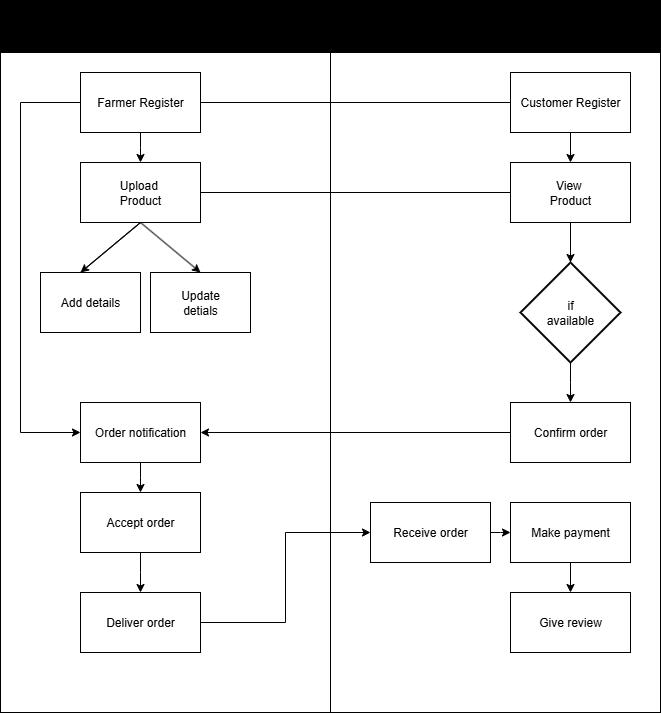
Wearedevelopingawebsitedesignedtosupportfarmersby offeringmultipleintegratedservices.Theplatformenables direct selling, allowing farmers to market and sell their crops, vegetables, fruits, and other produce directly to consumers without relying on intermediaries. It also promotesagro-tourismthroughafarmvisitbookingfeature, where people can schedule visits to farms and experience rurallife.Toaddressseasonallabourshortages,thewebsite includes a worker hiring option that lets farmers post job requestsandconnectwithnearbyworkersfortaskssuchas planting, harvesting, or irrigation. Additionally, a farm equipment rental serviceis provided,givingsmall farmers affordable access to costly machinery like tractors, tillers,
3.4
Volume: 12 Issue: 10 | Oct 2025 www.irjet.net
International Research Journal of Engineering and Technology (IRJET) e-ISSN: 2395-0056 p-ISSN: 2395-0072
andharvestersonadailyorhourlybasis.Finally,anorder tracking system ensures transparency by allowing both farmers and consumers to monitor delivery status in real time. Together, these features aim to empower farmers, reduce dependency on middlemen, and create new opportunitiesforgrowthandsustainabilityinagriculture.
4.RESULT AND DISCUSSION
TheimplementationoftheFarmConnectprototypeandits evaluation through pilot testing revealed significant potential for transforming farmer–consumer interactions. The results show that the proposed system successfully integratesmultiplefeatureslikedirectsales,ordertracking, equipment rental,workerhiring,andfarmvisitscheduling intoaunifieddigitalplatform.Thiscombinationofservices differentiates FarmConnect from earlier AgriTech models, whichlargelyfocusedonlyononlinemarketplacesorbasic e-commerce functionalities. The results demonstrate that FarmConnect not only empowers farmers by improving income opportunities and reducing dependency on middlemen but also enriches consumer access to fresh, affordable produce. The discussion highlights that the platform’strueinnovationliesincombiningmarketaccess withoperational support,agro-tourism,andlaborsolutions creating a comprehensive ecosystem for sustainable agriculture. While challenges in logistics, scalability, and inclusivityremain,thesystemprovidesastrongfoundation forfutureexpansionandpolicyintegration.
This research underscores the transformative potential of digital platforms in reshaping the relationship between farmers and consumers. By removing unnecessary intermediaries, farmers are able to secure more equitable returns for their produce, while consumers benefit from directaccesstofresh,reasonablypriced,andlocallysourced food.Suchplatformsnotonlyexpandmarketopportunities butalsofostertransparency,accountability,andtrustwithin thefoodsupplychain.Furthermore,theintegrationofdigital tools provides farmers with the ability to display their products, manage orders efficiently, and reach wider audiencesbeyondtheirimmediatelocalities.Servicessuch as online marketplaces, doorstep delivery systems, and secure digital payments create additional economic prospectsandstrengthenfarmers’participationinthedigital economy.Ultimately,adoptingdigitalsolutionsforfarmer–consumerlinkagesrepresentsmorethanjustatechnological shift it signals progress toward sustainable agriculture, improved economic resilience, and inclusive growth. By bridging the gap between producers and end-users, such platformsensurethatfarmingcontinuestothriveandadapt inanincreasinglydynamicmarketenvironment.
[1] B. Jalendar, Farmasite: A Web Application Portal Designedfor Farmers,2023.
[2]N. M. Shivale, Implementing a New Framework to Sell FarmerGoodsinModernEra,2024.
[3] A. Gangane, E-Commerce Platform for Farmers, 2024.
[4] P. Ramteke, Development of Web-Based System for FarmerstoConsumers,2025.
[5] H. Lu, The Impact and Mechanism of E-Commerceof AgriculturalProducts,2025.
[6]. Anurag Gangane; Jayesh Kavitkar; Akshay Uparikar; Himani Kale, “E-Commerce Platform for Farmers”, International Journal for Research in Applied Science & EngineeringTechnology(IJRASET)[Volno:12,2024]
[7]. Hua Lu; Guo Sun; Laiyou Zhou; Weiyun Zhang; Jinlang Zou, “The Impact and Mechanism of E-Commerce of Agricultural Products”, Science Direct Journal of EnvironmentalManagement[Volno:373,2025]
[8].Dr.B.Jalendar;K.Nagaraju;MdAbdulQadir;MdKhaja Naseeruddin Bhaba; S. Ajay, “FARMASITE: A Web Application Portal Designed for Farmers”, International Journal for Research in Applied Science & Engineering Technology(IJRASET)[Volno:11,2023]
Volume: 12 Issue: 10 | Oct 2025 www.irjet.net
International Research Journal of Engineering and Technology (IRJET) e-ISSN: 2395-0056 p-ISSN: 2395-0072
[9].NitinM.Shivale;Dr.ParikshitMahalle;SamikshaKadam; VedantBhoge;NikitaKale;PratikKoli,“ImplementingANew Framework to Sell Farmer Goods in Modern Era for Affordability&ProfitabilityofFarmers&Consumers”,IEEE MIT Art, Design and Technology School of Computing InternationalConference(MITADTSoCiCon)[2024]
[10]MengzhenZhang;SamiBerghäll,“E-CommerceinAgriFood Sector: A Systematic Literature Review Based on Service-DominantLogic”,JournalofTheoreticalandApplied Electronic Commerce Research (JTAER) [Vol.16, pp. 33563374,Dec-2021]
[11]Patil, R., & Deshmukh, S. (2020). "Contract Farming in India:AnAnalyticalStudy."AgriculturalJournal,45(2),89–97.
[12] Kumar, A., & Singh, V. (2019). "Challenges and OpportunitiesinContractFarming."InternationalJournalof RuralEconomics,38(4),102–109.
[13] Sharma, P., & Jha, S. (2021). "Digital Solutions for Agriculture."JournalofAgriculturalInnovation,12(1),55–63.
[14] Rao, K., & Mehta, R. (2018). "Risk Management in ContractFarming."AgriRiskStudies,27(3),214–226.
[15] Zhang, Y., & Wang, H. (2019). "Web Application Development for Agricultural Contract Management." JournalofInformationSystemsinAgriculture,11(2),3042.
[16] Verma, N., & Gupta, D. (2022). "Role of ICT in Agricultural Development." Technology in Farming, 29(1), 78–91.
[17] Singh, R., & Patel, M. (2020). "Comparative Study of eNAMandAgriBazaar."IndianJournalofDigitalEconomy, 7(1),15–28.
[18] Thomas, L., & Nayak, M. (2019). "Blockchain for Agriculture Supply Chains." Journal of Smart Agriculture Systems,4(4),99–112.
[19] Desai, K., & Kulkarni, S. (2021). "Improving Farmer OutreachviaDigitalPortals."InternationalJournalofICTfor Development,6(3),45–54.
[20] Rao, S., & Banerjee, A. (2023). "Leveraging Cloud TechnologiesinRuralAgriculture."JournalofEmergingTech &Agriculture,10(2),66–81.