
International Research Journal of Engineering and Technology (IRJET) e-ISSN: 2395-0056
Volume: 13 Issue: 04 | Apr 2026 www.irjet.net p-ISSN: 2395-0072

International Research Journal of Engineering and Technology (IRJET) e-ISSN: 2395-0056
Volume: 13 Issue: 04 | Apr 2026 www.irjet.net p-ISSN: 2395-0072
Brijesh Mishra1 , Prince Chauhan2 , Shivpal Yadav3 , Er. Bhupesh Kumar Pal4 , Dr. Jayati Vaish5
1Scholar, Department of Electrical Engineering, SRMCEM, Lucknow, UP
2 Scholar, Department of Electrical Engineering, SRMCEM, Lucknow, UP
3 Scholar, Department of Electrical Engineering, SRMCEM, Lucknow, UP
4 Assistant Professor, Department of Electrical Engineering, SRMCEM, Lucknow, UP
5 Assistant Professor, Department of Electrical Engineering, SRMCEM, Lucknow, UP
Abstract - The feasibility of utilizing a downpipe microhydro system in harnessing electrical energy from the rainwater flowing over the rooftop is examined in this project. With the increasing demand for sustainable and alternative sources of energy, the potential of harnessing energy from existing sources in urban areas presents an interesting area of research. The proposed project aims at harnessing the kinetic and potential energy of rainwater flowing through the gutters and downpipes of buildings using a micro-turbine generator. The proposed system includes rainwater diversion, a micro-hydro turbine located inside the downpipe, a DC generator, and an energy storage device. During rainy days, rainwater is collected and directed to turn the turbine blades, thereby producing electricity using a DC generator. A prototype model of the system was developed using light materials and a miniaturized turbine designed to function effectively in lowhead and fluctuating flow rates. The prototype was tested under artificial rainfall conditions. The findings show that the system is capable of producing adequate electrical power that can be used in low-power devices such as LED lighting and powering sensors. However, despite the fact that the power is only supplied intermittently, depending on the rain, the use of energy storage makes the system more reliable. It can, therefore, be concluded that the use of micro-hydropower in the harvesting of rainwater as an alternative source of energy is not only possible but also environmentally friendly and an efficient means of harvesting energy, which can be improved by making improvementstothesystem.
Keywords: Rooftop Rainwater Harvesting, Downpipe Micro-Hydro power, Micro-Turbine Generator, LowHead Energy Conversion, Runoff Flow Rate, DC Power Generation, Urban Renewable Energy, Energy Storage System
The last ten years have seen a sharp rise in the world's energy demand due to both rapid technological advancements and an expanding population. Global energy consumption is predicted to increase by 77% between 2000 and 2040, to 740 million terajoules [1]
Fossil fuels contributed 84% of global primary energy consumption in 2019 [2]. Environmental pollution, greenhouseeffects,andCO2emissionareonlyafewofthe alarmingeffectsofthesenon-sustainableresourcesonthe globe. The UK has set goals to generate all of its power from renewable energy by 2035 [3] Governments have understoodtheneedtoinvestingreenenergytoensurea clean environment for future generations Renewable energy sources are now among the most competitive energysourcesinmanynationsduetoquicktechnological advancements, declining costs of renewable energy supplies, and rising battery storage competitiveness [4] Energy harvesters that transform ambient energy into electrical energy have attracted a lot of research interest fromavarietyofareas.Forusageinlow-powerelectronic devices, the energy harvester gathers and stores ambient energy from outside sources like solar panels, thermal energy,andkineticenergy.Recently,scientistshavebegun touseavarietyofmethods,includingashydroelectric [5], electromagnetic [6], piezoelectric [7], solar [8], and thermoelectric [9], to harvest electrical energy from the environment. In 2020, renewable energy accounted for 43% of the 312 TWh of domestic power generated in the UK [3]. Wind and hydro only contributed 11% and 3%, respectively, whereas solar (photovoltaics) accounted for about81%of the total [10]. The UK'sflatterrainhelps to explain the modest hydro contribution given the abundance of potential and kinetic energy from heavy rains and the accessibility of ocean waves around the countryeachyear.Withanannualrainfallofroughly1154 mm,itrainsonaveragefor 156.2days oftheyear [11]. It is believed that the rainwater that enters the downspouts from the gutters is a waste of enormous potential energy. An alternative form of recycling should be developed to prevent this form of energy waste. It is more environmentallyfriendlytoharnessrainwaterasaformof energy, such as electrical energy, instead of letting it go down the drain. One way to turn rain energy into electricity is to collect it and run it via a micro-hydro turbine (MHT). Raindrops that fall are captured by a rooftop rainwater energy collection system and used to create electricity. Raindrop energy is harvested using revolving machinery like hydro turbines [12]. Conventional rainwater harvesters frequently use hydro turbines as spinning generators. Impulse turbines (Pelton
International Research Journal of Engineering and Technology (IRJET) e-ISSN: 2395-0056
Volume: 13 Issue: 04 | Apr 2026 www.irjet.net p-ISSN: 2395-0072
andTurgo)andreactionturbines(KaplanandFrancis)are two common categories for hydro turbines [12] Depending on different water-head conditions (adjusted for building height) and other real-time environmental considerations, a variety of water turbines have been developed and installed to harvest rooftop rain energy [13].Attachingpiezoelectricmaterialstoelasticstructures to capture vibration energy [14] and putting a turbine in the flow to capture its kinetic energy [15] are the two primary approaches used in the past to harvest potential energy from rain. Because it was more efficient than the piezoelectric material, the turbine design was selected to move on to the product design phase. The comparatively poor efficiency of the turbines is the primary obstacle to the wider application of hydro-kinetic power for energy production.Nomatterthetypeofturbine,AlbertBetz [16] came to the conclusion that the theoretical maximum efficiency is 59.3%. The head, flow rate, and stream characteristicsoftheflowdeterminewhichhydroturbine ismostsuitedtothedesign.Therehavebeenmanysectors thathavegeneratednotable interestinthefieldof energy harvester, which converts the surrounding energy into electrical energy. The energy harvester is used to absorb the energy that is present in the surroundings, such as solarenergy,thermalenergy,orkineticenergy,inorderto power low power electronics. Scientists have recently begun to draw electricity from the surrounding environment in several ways, one of which is hydroelectric. The water that drains from the gutters to the downspouts can be referred to as the waste of high potential energy. In this regard, there is an important alternativerecyclingprocessthatcanreducetheeffectsof this potential energy waste. It is better for the water to draininamannerthatconvertsittoelectricityratherthan flowing freely to the drains. Rainwater collection and passage through a Micro-Hydro Turbine (MHT) is one such technique of exploiting rain energy in the form of electricity.Rainwaterenergyharvestingthrougharooftop system uses rain droplets for the generation of power by utilizing rotational devices such as hydro tunnels in rain droplets The design and implementation of a downpipe micro-hydro system for electricity generation represent aninnovativeapproachtoharnessrenewableenergyfrom rooftoprainwaterrunoff.
The process of implementing the project is structured, startingfromthecollectionofrainwatertothegeneration of electrical energy and its utilization or storage. This methodology is based on the utilization of the potential and kinetic energy of the rainwater flowing through the existing downpipe of the building. This is achieved by connectingittoamicro-hydroturbinegenerator.
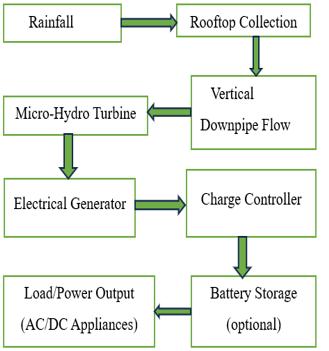
2.1Rooftop Rainwater Harvesting: The natural harvesting of the rainwater occurs on the roof of the building surface during the raining period. The roof surfaceofthebuildingbecomesthecatchmentareaforthe rainwater harvesting process. The rainwater that gets harvested on the roof surface of the building is passed to the gutter system. Afterward, the collected rainwater on the gutters is passed through vertical downpipes such as PVCormetals,whichleadtothedrainagepointatground level.
2.2 Calculation of Rainfall Runoff: Find out the rate of waterdischargeduetorainfall.
Formula:
Q = C * I * A …… (1)
Q=dischargeofrainfallrunoffinm³/s
C= Runoff coefficient, the value of C ranges between 0.75 to0.95forrooftop
I=Intensityofrain.Itsunitsareeitherinm/sormm/hr.
A=areaoftherooftop,inm²
2.3 Water Potential Energy (Head):
Formula:
P = η * ρ * g * Q * H …… (2)
P=Outputpower,inWatts
η=Efficiencyofgenerator-turbinesystem.
ρ=Densityofwater.Thedensityvalueis1000kg/m³.
g=Gravity.Itsvalueis9.81m/s².
Q=Dischargerateofrunoffwaterinm³/
International Research Journal of Engineering and Technology (IRJET) e-ISSN: 2395-0056
Volume: 13 Issue: 04 | Apr 2026 www.irjet.net p-ISSN: 2395-0072
H=Verticalheight.
2.4Downpipe System Design & Analysis: Thedownpipe is the main structural component where the energy conversion system will be integrated. It is positioned vertically; hence, the rainwater will gain kinetic energy duetotheaccelerationcausedbygravity.
2.5 Pipe Flow and Losses: Inordertodeterminethesize ofthedownpiperequiredandminimizepipelosses:
Bernoulli’sEquation(Simplified):
V^2 / 2g + H = Total Head …… (3)
Darcy-WeisbachEquationforheadloss:
hf = f * L/D * v^2 / 2g …… (4)
hf=headlossduetofriction(m)
f= Darcy friction factor (dependent on pipe roughness, Re number)
L=lengthofpipe(m)
D=diameterofpipe(m)
V=velocityofwaterinm/s
2.6 Micro-Turbine Selection and Integration: The micro-turbine is selected or designed depending on the spaceavailableinthedownpipe.Themicro-turbineisthen rotated by the power of flowing water. The mechanical rotationisthefirststageofconversion.
2.7 Generator coupling: Thegeneratorusedhereissmall and works on the principle of the DC generator. The mechanicalenergygetsconvertedintoelectricalenergyby this generator, owing to its coupling with the microturbine.
2.8 Power Conditioning Circuit: The power that comes from the generator is then processed before being used. Thecomponentsinthiscircuitare:
1.The conversion of AC into DC if an AC generator is utilized.
2.Voltageregulationtoproduceaconstantvoltagesupply.
2.9 Energy Storage or Direct Utilization: The power generated by the micro-turbinecan bestoredina battery for future use or can be used directly for the following: LED lights for indoor and outdoor usage, Environmental sensors,USBdevices,Emergencylights,etc.
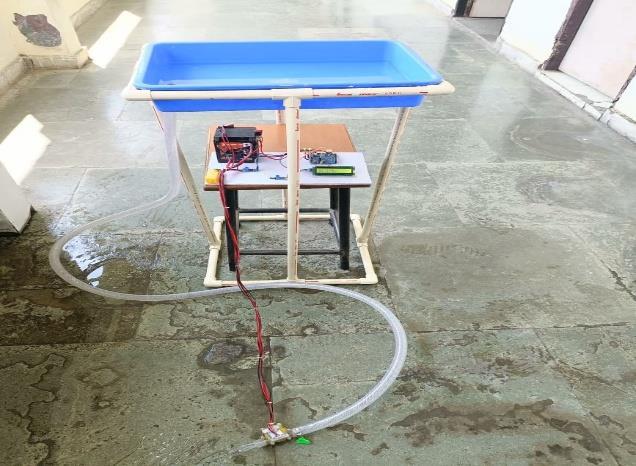
To evaluate the performance of the proposed downpipe micro-hydro system, experimental observations were recordedundervaryingheadandflowrateconditions.The performance of the proposed downpipe micro-hydro system was evaluated using fundamental hydraulic and electrical power relations. The mathematical formulation usedforanalysisisgivenbelow:
…… (5) (6)
where:
P=HydraulicPower(W)
Po=ElectricalOutputPower(W)
ρ=DensityofWater(1000kg/m3)
g=AccelerationDuetoGravity(9.81m/s2)
Q=FlowRate(m3/s)
H=Head(m)
ηt=TurbineEfficiency
The data derived from the prototype tests are shown in theTable(Figure2).Thefollowingisadetailedanalysisof thesedata.
3.1Introduction to Experimental Results: An experimental analysis was done based on variation in effective head from 2.10 ft to 14.0 ft. The parameters measured include the flow rate, speed (RPM), output voltage, hydraulic power, and electrical power generated bythesystem.
International Research Journal of Engineering and Technology (IRJET) e-ISSN: 2395-0056
Volume: 13 Issue: 04 | Apr 2026 www.irjet.net p-ISSN: 2395-0072
3.2 Relationship Between Increasing Head and Flow Rate & RPM:
Astheheadincreased:
1.The flow rate increases significantly from 7.8 L/min to 27.63L/min.
2.The rotational speed increases from 480 RPM to 1670 RPM.
Clearly, there is an indication that an increase in head leads to an increase in potential energy, leading to conversion to kinetic energy and increasing the performanceoftheturbine.
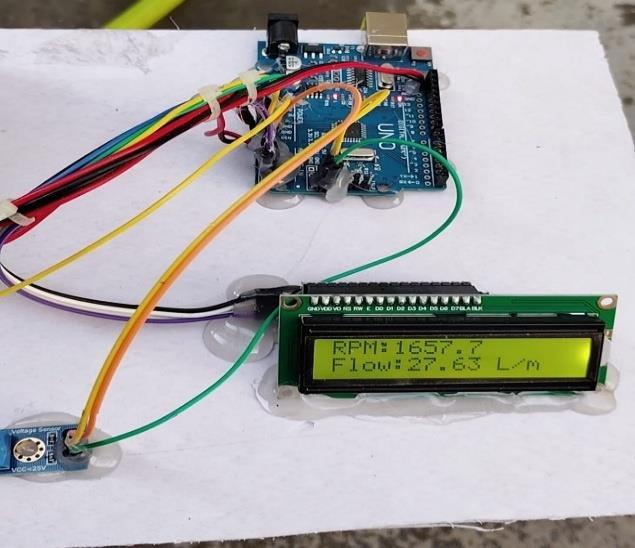
3.3 Characteristic Voltage Generation:
An increase in the generated voltage with an increase in headandflowrate:
1.Aminimumheadof2.10ftgave2.7Vofoutputvoltage.
2. A maximum head of 14.0 ft gives an output voltage of 11.8V.
This means that there exists a proportional relationship betweentheRPMandtheoutputoftheturbine.
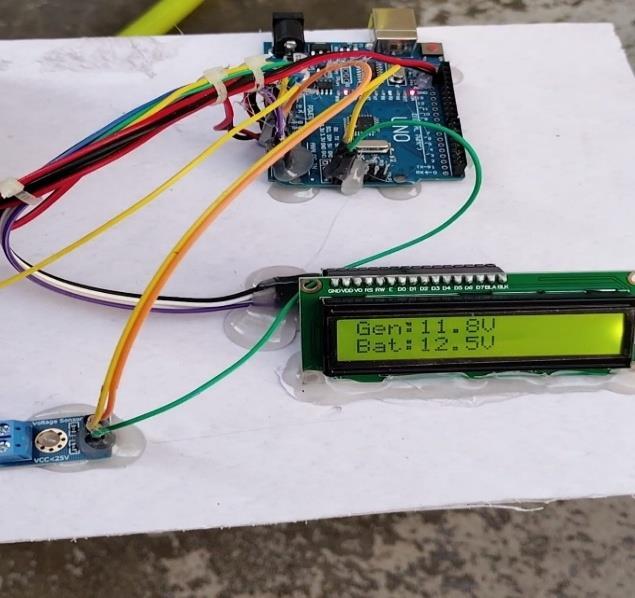
ofGeneratorandBattery voltageusingArduinoUno
3.4 Power analysis for Hydraulic and Electrical Output
Thehydraulicpowerandtheelectricaloutputpowerwere determined using the common equations in micro-hydro power.Fromtheanalysis,thefollowingisnoted:
1.Hydraulicpowerincreasedfrom0.82Wto19.26W.
2. Electrical power output was increased from 0.80W to 18.94W
Theclosenessofhydraulicandelectricalpowerindicates:
1.Highlevelofefficiencyofthesystem
2.Little or no loss of energy between the turbine and generator.
3.5 Efficiency of the system:
Fromtheresultsabove: ......(7)
Thehighefficiencyindicatesthat:
1.Turbineissuitedforlowheadhydroenergy
2.Mechanical and electrical energy loss is minimal in the system.
3.6 Practical Applications: According to the findings of theexperiment:
1.Thedeviceiscapableofgeneratingenergyforlowpower consumingdeviceslikeLEDs,sensors,etc.
International Research Journal of Engineering and Technology (IRJET) e-ISSN: 2395-0056
Volume: 13 Issue: 04 | Apr 2026 www.irjet.net p-ISSN: 2395-0072
2.At high intensity rainfall (higher water flow rate), the energy generation from the device is possible and constant.
3.The addition of energy storage devices (such as batteries/supercapacitors) could increase usability even duringdrydays.
3.7 Table and Graphs:
3.7.1Experimental Performance Analysis of Downpipe Micro-Hydro System Under Varying Head Conditions: The performance of a downpipe micro-hydro system is highly dependent on hydraulic parameters such as available head and flow rate. In rooftop rainwater harvesting systems, the vertical height of the building (head) plays a crucial role in determining the potential energy available for conversion into electrical energy. As rainwater flows through the downpipe, this potential energy is converted into kinetic energy, which drives the micro-turbine and subsequently generates electricity throughacoupledgenerator.
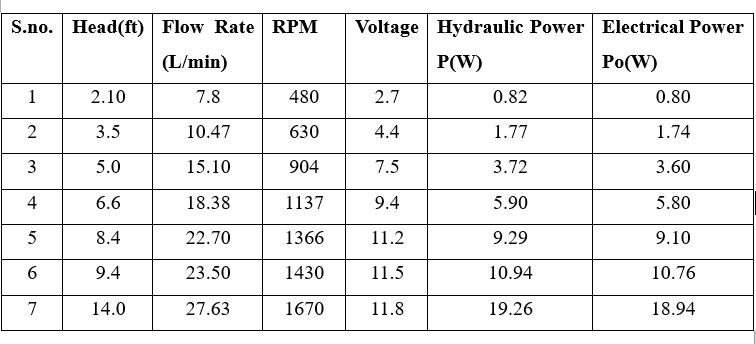
To systematically evaluate the system behaviour, experiments were conducted under varying head conditions ranging from low to high values. Key performance indicators including flow rate, turbine rotational speed (RPM), output voltage, hydraulic power, and electrical power were measured and recorded. This analysisprovidesa clearunderstandingofhowvariations in head influence the overall efficiency and output of the system. The results presented in Table 1 highlight the direct relationship between hydraulic input conditions and electrical output performance, thereby validating the effectivenessoftheproposedenergyharvestingsystem.
3.7.2 Graphical Analysis
To better understand the performance characteristics of the proposed downpipe micro-hydro system, graphical analysis is carried out using the experimental data presented in Table 1. Graphs provide a clear visual representation of the relationship between key hydraulic
inputparameters(suchasheadandflowrate)andoutput performance parameters (such as RPM, voltage, and power).
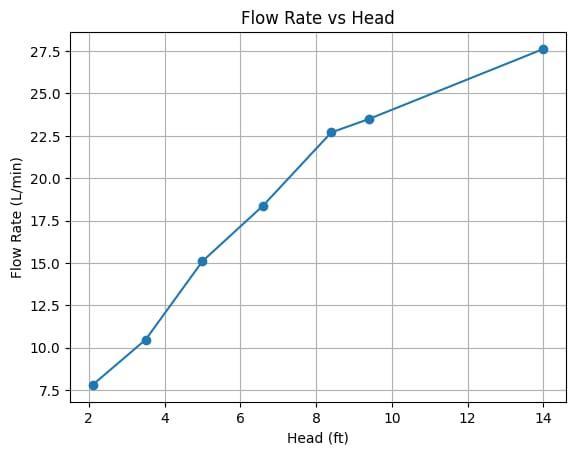
Chart -1:FlowRatevsHeadRelationship
Flow rate is directly proportional to head. Higher head results in a higher flow rate and increases the potential energyconversionefficiency.
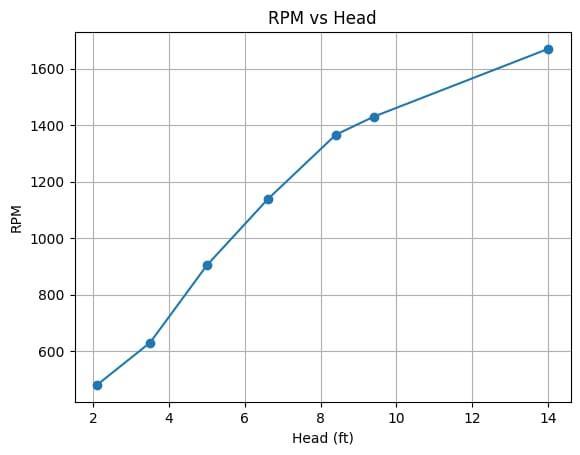
Chart -2:RPMvsHeadRelationship
The RPM of the turbine is directly proportional to the head. This means that higher pressure will result in an increasedrotationspeed.
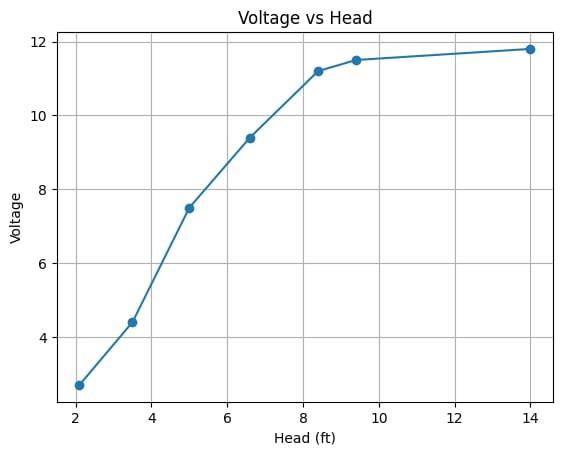
Chart -3VoltagevsHeadRelationship
International Research Journal of Engineering and Technology (IRJET) e-ISSN: 2395-0056
Volume: 13 Issue: 04 | Apr 2026 www.irjet.net p-ISSN: 2395-0072
Voltageisdirectlyproportionaltotheincreaseinhead.An increase in head means that the generator will produce morevoltageuntilitreachessaturation.
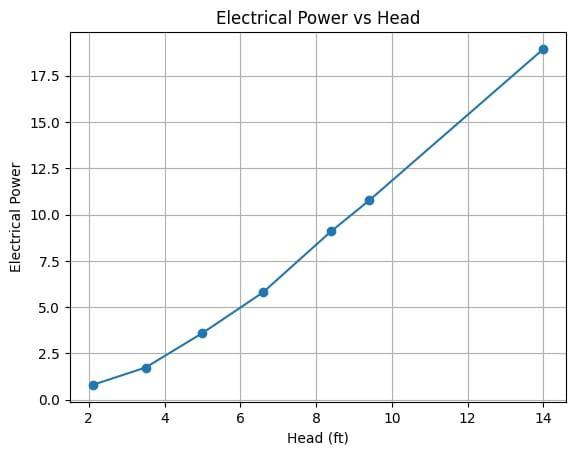
Chart -4:OutputPowervsHeadRelationship
There is a high level of increase in power when the head increases. This indicates that there is higher energy conversionduetowaterpressure.
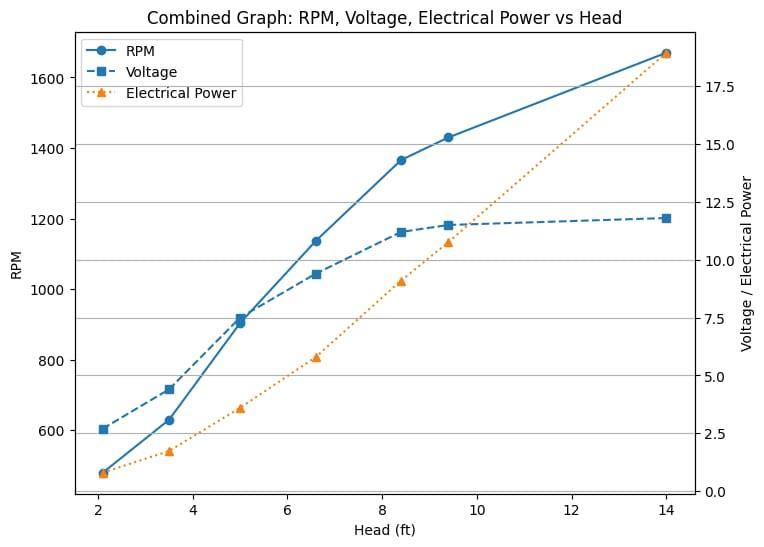
Chart -5:CombinedPerformanceAnalysisvsHead
RPM, voltage, and power are all directly proportional to the head. Increased head increases the rotational speed, generatoroutput,andelectricalperformanceefficiency.
As can be seen, the suggested downpipe micro-hydro energy production model is proven feasible for the generation of electric energy from rooftop water flow at low heads. In particular, the obtained experimental data prove the existence of the positive correlation between increased head, flow rate, turbine speed, generated voltage,andproduced power.Thisallowsus toaffirm the validityofthetheoreticalrelationsappliedthroughoutthe analysis. The highest power output of 18.94 W was observedwithabout98%efficiency.
Accordingly, it is worth noting that while the power generated may be intermittent and weather-dependent, the use of energy storage systems ensures its reliable utilization. This type of power is particularly useful in powering equipment of low consumption, for instance, LED lights and sensors. Therefore, the proposed system could be considered an effective and eco-friendly way of energyproductionformoderncities.
[1]Theworldcounts.com.GlobalEnergyConsumptiononly GoingUp.2022.(accessedon13June2022).
[2]Rapier,R.FossilFuelsStillSupply84PercentofWorld Energy And Other Eye Openers From BP’s Annual Review.Forbes.2022.(accessedon4May2022).
[3] Spglobal.com. UK Targets Power from 100% Renewable Sources by 2035. 2022.(accessed on 4 May 2022).
[4] Deloitte United States. 2022 Renewable Energy IndustryOutlook.2022.(accessedon4May2022).
[5]Bao,B.;Wang,Q.Small-scaleexperimentalstudyonthe optimisation of a rooftop rainwater energy harvester using electromagnetic generators in light rains.Int. J. EnergyRes. 2020,44,10778–10796.
[6] Khan, F.U.; Iqbal, M. Electromagnetic bridge energy harvester utilizing bridge’s vibrations and ambient wind for wireless sensor node application.J. Sens. 2018,2018, 3849683]
[7] Rajeev, S.P.; John, S.K.; Cherian, R.; Karumuthil, S.C.; Varghese, S. Next-generation rooftop tribo–piezo electric energy harvesting from rain power.Appl. Nanosci. 2020,10,679–686.
[8]Zhao,J.;Ghannam,R.;Htet,K.O.;Liu,Y.;Law,M.K.;Roy, V.A.; Michel, B.; Imran, M.A.; Heidari, H. Self-Powered implantable medical devices: Photovoltaic energy harvestingreview.Adv.Healthc.Mater. 2020,9,2000779.
[9]Nozariasbmarz,A.;Collins,H.;Dsouza,K.;Polash,M.H.; Hosseini, M.; Hyland, M.; Liu, J.; Malhotra, A.; Ortiz, F.M.; Mohaddes, F.; et al. Review of wearable thermoelectric energy harvesting: From body temperature to electronic systems.Appl.Energy 2020,258,114069
[10]Shiono,M.;Suzuki,K.;Kiho,S.AnExperimentalStudy of the Characteristics of a Darrieus Turbine for Tidal Power Generation; Electrical Engineering in Japan; Nihon University:Tokyo,Japan,2000;pp.781–787.(accessedon 4May2022).
[11] Malla, R.; Shrestha, B.; Bagtzoglou, A.; Drasdis, J.; Johnson, P.Hydropower Harvesting from a Small-Scale
International Research Journal of Engineering and Technology (IRJET) e-ISSN: 2395-0056
Volume: 13 Issue: 04 | Apr 2026 www.irjet.net p-ISSN: 2395-0072
Reciprocating System; Renewable Energy; Elsevier: Groton, MA, USA, 2011; pp. 1568–1577.(accessed on 4 May2022).
[12] David Wilson Homes. The Average House Sizes & Average Square Footage in the UK. 2018.(accessed on 26 January2018).
[13] Rettore Neto, O.; Botrel, T.; Frizzone, J.; Camargo, A.Method for Determining Friction Head Loss Along Elastic Pipes; Springer: Berlin, Germany, 2014; pp. 329–339.(accessedon4May2022).
[14] Selvakumar, P. Harvesting Energy From Rainfall. Sri Shakthi Institute of Engineering and Technology. 2017.(accessedon6May2022).
[15] Detora, C.; Griffen, K.; Luiz, N.; Soylu, B.; Worcester Polytechnic Institute.Energy Harvesting from Rainwater and Maximum Power Point Tracking Solar Charging; Worcester Polytechnic Institute: Worcester, MA, USA, 2018,(accessedon6May2022).
[16] Afework, B.; Hanania, J.; Stenhouse, K.; Donev, J. Betz Limit-EnergyEducation.