
ISSN:2395-0056
Volume: 12 Issue: 02 | Feb 2025 www.irjet.net p-ISSN:2395-0072
ISSN:2395-0056
Volume: 12 Issue: 02 | Feb 2025 www.irjet.net p-ISSN:2395-0072
Nagendra K
1
, Dr B. Mahesh Babu2
1P.G Scholar, Seshadri Rao Gudlavalleru Engineering College, 2Asso Professor, Seshadri Rao Gudlavalleru Engineering College.
Abstract - The lithium-ion battery represents the most significant expense in electric vehicles (EVs). Enhancing battery performance is crucial for advancing the EV market because it extends battery life, lowers ownership costs, and builds consumer confidence in the product. This paper explores a strategy for improving battery performance that not only prolongs its lifespan but also boosts its storage capacity. We focus on identifying the optimal charging profile for an EV battery by determining when the battery is most receptive to charging and devising a profile that minimizes the impact on its longevity. The analysis reveals that incorporating rest periods during the charging process can effectively reduce battery degradation in two key ways. Firstly, it mitigates the rate of change in the internal resistance of the battery. Secondly, it decelerates the capacity fade over time. Additionally, this approach helps maintain a lower average temperature during charging, further contributing to battery health.
Key Words: Batteryinternalresistance,Batterycharger,capacityfade,electricvehicle,lithium-ionbattery.
Technology has evolved rapidly over the past century, leading to profound changes on our planet. One of the main concerns has been the rise in pollution and climate change. Traditional vehicles rely heavily on fossil fuels, contributing significantly to environmental degradation and climate issues. As a result, there's a growing interest in transitioning to electricvehicles(EVs).However,thisshiftfaceschallenges,mainlyduetothehighercostsassociatedwithEVs,whichare largely influenced by battery technology and their overall lifespan . To address these challenges, extensive research is underway further,Lawsonfoundthatintroducingrestperiodsduringbatterydischargecouldenhancebatterylongevity. Additionally, implementing rest periods during charging could extend the cycle life of alkaline batteries by lessening platingeffects,althoughthisstrategyhasnotyetbeenappliedtolithiumbatteries.
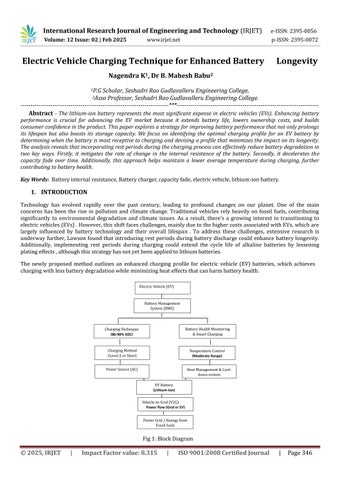
The newly proposed method outlines an enhanced charging profile for electric vehicle (EV) batteries, which achieves chargingwithlessbatterydegradationwhileminimizingheateffectsthatcanharmbatteryhealth.
Vehicle(EV) International Research Journal of Engineering and Technology (IRJET)


BatteryManagement System(BMS)

ChargingTechnique (80-90% SOC) BatteryHealthMonitoring &SmartCharging


ChargingMethod (Level2orSlow) TemperatureControl (Moderate Range)

PowerSource(AC) or (DC Fast)

Battery (Lithium-Ion)




Management&Cooldownsystem
International Research Journal of Engineering and Technology (IRJET) e-ISSN:2395-0056
Volume: 12 Issue: 02 | Feb 2025 www.irjet.net p-ISSN:2395-0072
Battery internal resistance plays a crucial role in influencing overall battery performance. It constrains how much current the battery can handle and affects the speed of charge and discharge cycles. One key contributor to increased internal resistance is the formation of the solid electrolyte interface(SEI). This phenomenon occurs through a chemical reactionbetweentheelectrolyteandanode,resultinginthedepositionofathinprotectivelayer,asillustratedinFig.2
Electrolyte



2.1 During First Charge:
Whenthebatteryisfirstcharged,someelectrolytedecomposesandformsathinSEIlayerontheanode
Thislayeractsasabarrier,preventingfurtherdecompositionoftheelectrolyte.
DuringCharging(Energystorage):
Lithiumionsmovebackfromtheanodetothecathode,generatingelectricalpower.
TheSEIremainsstable,ensuringsmoothlithium-iontransport.
3. Battery charging (chemical reaction)
The batterycell operatesthrougha seriesofchemical reactionsduringthechargingprocess,whichcan bedividedinto three key stages: charge transfer, mass transport, and the intercalation process Thethirdstageinvolvestheintercalationprocess,duringwhichlithiumionsbegintopenetratetheelectrodematerialas chargingoccurs.Thismethodalsorequiresasignificantamountoftime.
Electrode
Interecalation region
Electrolyte

Mass Transport region (Long Time) (Long Time)
Fig:3CellChemicalReaction
International Research Journal of Engineering and Technology (IRJET) e-ISSN:2395-0056
Volume: 12 Issue: 02 | Feb 2025 www.irjet.net p-ISSN:2395-0072
3.1. Charge Transfer (Electron Flow)
What happens: During charging, electrons are supplied by the charger and move through the external circuit to the anode(negativeside)ofthebattery.
Keypoint:Theanodereceiveselectronsfromtheexternalcircuit.Atthesametime,lithiumions(Li*) movethroughtheelectrolytefromthecathodetotheanode.
ReactionforchargertransferattheAnode(charging):
LixC6 + Li1C6
This represents the lithium ions (Li*) being stored in the graphite structure of the anode, as electrons flow into the anode.
3.2. Mass Transport (Lithium-ion Movement)
• What happens: Thelithiumions(Li*)movefromthecathodetotheanodethroughtheelectrolyte.
• Key point: The electrolyte allows the transport of lithium ions(Li*), and this movement is vital for charging the battery.Asionsaretransportedfromthecathodetotheanode,theycreateachemicalpotentialthatstoresenergy.
Lithium-ion Movement (Mass Transport):
LiCoO2 LixCoO2 + Li+
• Here, lithium ions (Li*) leave the cathode material (usually lithium cobalt oxide) and move towards the anode (usuallygraphite).
3..3. Intercalation (insertion of Lithium ions)
• What happens: The lithium ions (Li*) that have moved to the anode intercalate (insert) into the graphite structureoftheanode.Thisishowthebatterystoresenergyduringcharging.
• Key point: The process of intercalation is reversable. When the battery is discharging, lithium ions move back fromtheanodetothecathode,releasingenergy.
Anode Reaction During Intercalation (charging):
LixC6 Li1C6 + Li+ +
• Lithiumions(Li*)areinsertedbetweenthelayersofthegraphiteanode,storingtheenergythatwilllaterpower theEVwhenneeded.
4. METHODOLOGY
4.1 STANDARD CHARGING PROFILE:
The conventional method of charging a lithium-ion battery, commonly referred to as constant current constant voltage (CCCV)charging.
Powersource(ACorDC)
Charger&converter(ACorDC)
BatteryManagementSystem(BMS)
ConstantCurrent(CC) Phase
80%Charge
ConstantVoltage(CV)Phase
100%Charge
Chargecut-off
Fig4:BlockdiagramofStandardprofile
International Research Journal of Engineering and Technology (IRJET) e-ISSN:2395-0056
Volume: 12 Issue: 02 | Feb 2025 www.irjet.net p-ISSN:2395-0072
4.2 Explanation of this Standard profile:
1.Powersource(AC/DC)&Charger
• ConvertsACpowertoDCforbatterycharging.
• SuppliespowertotheBatteryManagementSystem(BMS)
2.BMS
• Controlsthechargingprocesstopreventoverchargingoroverheating.
3.ConstantCurrent(CC)
• Thechargersuppliesasteadycurrent,andbatteryvoltagegraduallyrises.
4.ConstantVoltage(CV)
• Chargingcurrentgraduallydecreasesasthebatteryfillsup.
5.Chargecut-off:
• Preventsoverchargingandimprovesbatterylifespan.
Existing:
There is widely accepted and defined pattern of voltage and current changes that should be followed when chargingthebattery,typicallyinvolvingaconstantcurrent(CC)phasefollowedbyaconstantvoltage(CV)phasetoensure optimalchargingefficiencyandbatterylongevity.
4.3 Modified charging profile:
Amodifiedprofilereferstoatypeofpulseprofilewithavariablepatternthatadaptstothelimitationssetbythebatterym anufacturer.
Chargingwithdesignatedrestintervals,wherecharging(ON)occursforaspecificduration,followedby(OFF)foranothers etduration,inarepeatedcyclicalmannerduringthechargingperiod
Ontheotherhand,incorporatingrestperiodsduringchargingwillextendtheoverallchargingduration.
Charger&Converter(ACorDC)
BatteryManagementSystem(BMS)
Pre-charge Constantcurrent (softstart) phase(FastCharge)
BatteryWarm-up 80%Charge
BatteryBalancing ConstantVoltage(cv) Phase(Taperingcharge)
Uniformcell 100%charge VoltageLevels
ChargeCut-off orTricklecharge
Fig4.1:BlockdiagramofModifiedProfile
International Research Journal of Engineering and Technology (IRJET) e-ISSN:2395-0056
Volume: 12 Issue: 02 | Feb 2025 www.irjet.net p-ISSN:2395-0072
4.4 Explanation of this profile:
1.Pre-Charge
• Usedfordeep-dischargedbatteries(verylowvoltage)
• Preventsuddenstressonbatterycells.
2.ConstantCurrent(CC)
• Deliversasteadyhighcurrentforquickcharging.
• Voltagegraduallyincreases.
• Chargesupto80%capacityefficicently.
3.BatteryBalancing
• Ensuresallbatterycellsinthepackhaveuniformvoltage.
• Improvesbatteryhealthandpreventsweakcellsfromovercharging.
4.ConstantVoltage(CV)
• Chargingcurrentgraduallydecreases.
• Preventsoverchargingwhileensuringfullcharge.
5.ChargeCut-off
• Chargingstopswhenthecurrentdropsbelowathreshold.
• Somesystemsusetricklechargingtomaintainfullchargewithoutoverload.
4.5 Existing:
Modified charging profiles are designed to enhance battery performance, extend lifespan, and improve energy efficiency.Theseprofilesoptimizechargingbyadjustingpowerdeliverybasedonfactorslikebatterytemperature,stateof charge(SoC),griddemand,anduserpreferences.InthisprofileEnergyefficiencyishigherthroughreal-timeadjustments.
ModifiedChargingprofilesareshapingthefutureofEVchargingbymakingitfaster,safer,andsmarter.Thesetechnologies help extend battery life, reduce energy costs, and integrate with renewable energy sources. Faster charging without overheating,Longerbatterylifebypreventingdamage.
5. RESULTS AND DISCUSSION
Theexperimentaltestswereconductedunderidenticalconditionsforbothprofiles.Thebatterytypeutilizedislithium ironphosphate(LiFePO4).Thechargingparametersarea0.8Craeandavoltageof3.65.Thedischargelimitsaredefinedby a 0.8C discharge rate voltage of 2.0. The Arbin machine functions as a programmable charger and an environmental chambermaintaininganambienttemperatureof25°C.
Itisevidentthatthetemperatureduring,chargingwasadjustedbasedonvariationsinthechargeprofile,leadingtoa reduction in battery temperature.From a capacity perspective, charging the battery with modified profileincreases its abilitytoholdmorecapaciyby0.15%,asillustratedinFig.6.Furthermore,theraeofbatterycapacitydeclinehasimproved, decreasing from 0.014% to 0.012% per cycle,representing a 1% reduction in degradation. Consequently, thebattery life willincreaseby17%(assumingtheendoflifeisreachedat80%).
6. CONCLUSIONS
Ananalysisoftwochargingprofileshasbeenconductedtodemonstratetheimpactofincorporatingarestperiodintothe chargingprocess.Thestandardchargingprocessisinitiallyintroduced,showcasingthetypicalbatterycapacitydegadation causedbycycling. Furthermore,thereductioninbatterycapacitydegradationhassignificantlyincreasedthebattery's lifespan.Effortsareunderwaytodiscovermethodsforminimizingthelossofbatterycapacity.Additionaltestsarebeing carriedoutbyalteringtherest.
References
[1] D. Lan-Ron and Y. Jieh-Hwang, "ILP-based algorithm for Lithium-ion battery charging profile," in Industrial Electronics(ISIE),2010IEEEInternationalSymposiumon,2010,pp.2286-2991
International Research Journal of Engineering and Technology (IRJET) e-ISSN:2395-0056
[2] W.Gu,Z.Sun,X.Wei,andH.Dai,"ANewMethodofAcceleratedLifeTestingBasedontheGreySystemTheoryfora Model-BasedLithium-IonBatteryLifeEvaluationSystem,"JournalofPowerSources,2014.
[3] B.Lawson,"ASoftwareConfigurableBattery,"inEVS26InternationalBattery,HybridandFuelCellElectricVehicle Symposium,LosAngeles,California,2012.
[4] D. Linden and T. Reddy, Handbook of Batteries, 3rd ed. United States of America: The McGraw-Hill Companies, 2002.
[5] (2015-04-29).BatteryLifeandHowToImproveIt.Available:
Volume: 12 Issue: 02 | Feb 2025 www.irjet.net p-ISSN:2395-0072 © 2025, IRJET | Impact Factor value: 8.315 | ISO 9001:2008