
International Research Journal of Engineering and Technology (IRJET) e-ISSN:2395-0056
Volume: 12 Issue: 06 | Jun 2025 www.irjet.net p-ISSN:2395-0072
International Research Journal of Engineering and Technology (IRJET) e-ISSN:2395-0056
Volume: 12 Issue: 06 | Jun 2025 www.irjet.net p-ISSN:2395-0072
Piyush N. Chavhan
Third Year, Department of Artificial Intelligence and Machine Learning, Progressive Education Society's Modern College of Engineering, Pune, (An Autonomous Institution Affiliated to Savitribai Phule Pune University) Shivaji Nagar, Pune-411005, Maharashtra, INDIA
Abstract - Objectrecognition,afundamentalchallengein computer vision, demands accurate feature extraction and pattern recognition to classify and analyze visual data. Traditional machine learningmethods oftenrelyon manual feature engineering, which is time-consuming and prone to inaccuracies. This study addresses these limitations by exploring the implementation of Convolutional Neural Networks (CNNs), which automate feature extraction and have significantly advanced the field. Focusing on practical applications, the research highlights techniques like data augmentation, dropout layers, and regularization to mitigate overfitting, while ReLU activation and batch normalization tackle issues like vanishing gradients. By analyzing real-world implementations in tasks such as classification, detection, and segmentation, the research underscores the transformative impact of CNNs and identifies avenues for their broader application in fields like robotics,healthcare,andautonomoussystems.
Key Words: Object recognition, computer vision, feature extraction, pattern recognition, machine learning, Convolutional Neural Networks , data augmentation, regularization.
Without proper training, AI will struggle to identify common objects. The traditional object recognition algorithms were mostly based on hand crafted features and shallow machine learning techniques. Nevertheless, the development of deep learning approaches, and especially convolutional neural networks (CNNs), has transformed the domain[4]. CNNs do the automatic hierarchical feature learning of the image pixel and thus no manual feature engineering is required. Designed to handle data, for instance, the availability of large-scale labeled datasets like ImageNet[2] and Fashion MNIST[1016] have fueled a revolution in CNNs that enable CNNs to learn rich hierarchical representations from complex objects. These deep learning models have proven so successful that the state-of-the-art in object recognition hasimproveddramaticallyleadingtosystemsthatarenot only more accurate but also become useful to a larger numberofapplications.
However, CNN architecture makes all the things, it gets features and minimizes overfitting. CNNs use convolutional layersastheirfundamental building blocks, where patterns in images (such as edges, textures, and corners) are extracted by applying filters[10]. These properties are used to recognize more advanced patterns in the deeper features of the architecture. The CNN gets something called transformation invariance to translate centricfeatures,meaningtheconvolutionoperationneeds no idea where what feature is in the picture. This invariance is important for the task of object recognition, where the same object can appear in different images at differentscales,positionsandangles.Bystackinglayersof convolution over each other the network can progressivelylearnmorestrictandcomplexfeatures[12].
Despite these impressive capabilities of deep neural networks, including CNNs, issues regarding their computation power become the potential drawback of their performance. With such a large number of trainable parameters and operations, it is computationally expensive to train. This issue is generally resolved using ReLU (Rectified Linear Unit) activation functions, which are used more often in CNNs[7]. One likely reason is that the ReLU activation function adds non-linear characteristics, allowing the network to learn more complicated shapes, plus it is computationally efficient sinceitcleansnegativevaluesbyzeroingthem.Moreover, this activation function overcomes issues like the vanishing gradient problem, which were encountered in older functions such as sigmoid and tanh[5][7][23]. Combined with pooling layers that reduce feature maps through downsampling (such as max pooling), the network reduces dimensionality so that the model has to use fewer parameters to operate on large images[1][2][17].
Another important technique that helps to enhance CNN performance, especially when you have less data in datasetsisDataaugmentation[19][12].Dataaugmentation is a technique that improves the generalization of models by applying random transformations such as rotations, scaling, and translations to the input images, creating a more diverse set of input images. This approach minimizes overfitting, due to its exposure to a variety of imageinstancesineveryepoch.Toapplyclassificationvia
International Research Journal of Engineering and Technology (IRJET) e-ISSN:2395-0056
Volume: 12 Issue: 06 | Jun 2025 www.irjet.net p-ISSN:2395-0072
fully connected layers once the convolutional and pooling processes have extracted common features, the feature map is flattened. Flattening transforms the multidimensional output into a one-dimensional vector, allowingthenetworktomakefinaldecisionsbasedonthe learntfeatures,leadingtoaccurateobjectrecognition[18].
Prior to deep learning images were mostly processed using manual feature extraction and shallow learning algorithms. In the early days of image recognition, there were approaches that used hand-crafted features like edges, textures, and shapes which were manually identifiedandextractedfromimages.Thesefeatureswere thenusedforclassificationusingmachinelearningmodels like SVM and k-NN[18][11]. But this method had constraints based on human intuition and the complexity of the manually designed features. In addition, shallow networkswouldfrequentlyfailtomodelthelevelofdetail, as well as the compositionality of visual data, resulting in worse performance on complicated tasks, such as object recognition[20].
The need for more accurate and scalable image recognition systems forces traditional methods to show their limitation[2]. They did not generalize well across largeandheterogeneousdatasets,andtheyneededalotof domainexpertisetoperformfeatureengineering.Thiswas thereasonresearchersstartedinvestigatingdeeplearning, and specifically, Convolutional Neural Networks (CNN), that learned complex features directly from raw images. Artificial Neural Networks (ANNs) were employed in vision paradigm as early as the 1980s when they were used to learn transformations in images, but it was primarily Convolutional Neural Networks (CNNs) which were introduced in 1998 and were capable of automatically discovering aspects and hierarchical features in images as we did, i.e., a process mimicking humanvisualsystem[5][3].
CNNs fundamentally changed image recognition for the better because they solved the problems traditional methods faced. Because of hierarchical learning of features, Convolutional Neural Networks were able to reach a much better accuracy in such tasks like object classification and object detection. Additionally, the availability of large labeled datasets (e.g., ImageNet) enabled CNNs to train on a wide variety of images, enhancingtheirperformanceevenmore[2].
Theyprovideeasyaccesstothekeyworksinthefieldthat have been instrumental in the development of CNNs. One pivotal moment was when AlexNet demonstrated a tremendous jump in image classification performance with a deep CNN trained on ImageNet[2]. AlexNet proved that deep learning is the way to go and kickstarted the progressinthisarea.VGGnetwork,fromVisualGeometry
Group of Oxford, proposed a concept of very deep networks with small convolutional filters, enhanced the performance as well[17]. Another milestone was introduced with ResNet where residual connections were usedtobeabletotrainmuchdeepernetworks,solvingthe vanishing gradient problem even for extremely deep networks[28]. Such seminal works have laid the foundation for contemporary CNN architectures and inspiredtheapproachadoptedhere.
Thus for this experiment we will work with Fashion MNIST dataset which is the most common benchmark to check image classifier. Fashion MNIST contains a total of 70,000 grayscale images of size 28x28 across 10 fashion categories like t-shirts, trousers, bags, and shoes, with 60,000 training images and 10,000 test images. This dataset is a more challenging version of the classical MNISTdataset,whichisbasedonhandwrittendigits.This particular dataset is a more complex picture of `clothes’ types and `classes’ compared to MNIST dataset, as it containshigherdifferencesofpatternsand`catergories’to learn. Each image is also associated with one of the 10 categories, constituting a rich source to train convolutionalneuralnetworks(CNNs).
Fashion MNIST dataset has become highly popular for easily testing and comparing deep learning algorithms. This study also provided CNN architecture patterns for improved recognition and high accuracy classification of fashionitemsbyexploitingthisdataset[10-16].
4. Understanding Convolutional Neural Networks (CNNs)
Convolutional Neural Networks (CNN) are specialized deep learning networks primarily used for image processing tasks such as object recognition. Here, we describesomekeyarchitecturalandstructuralelementsof CNNs including the flow of information through the network. CNNs are architectures with various layers such as convolutional layers that use filters to extract key features within images, and pooling layers that reduce spatialdimensionsforefficiency[1][5].Activationfunction, especially ReLU, adding non-linearity to the model, which achieves the model learning complex patterns[7]. Furthermore, we will examine the role of feature maps in representing learned features of an image and how the flatteningofthosefeaturesservestoapplyfullyconnected layersforclassificationpurpose.
4.1. Feature Extraction in Convolutional Neural Networks (CNNs)
CNN is typically a layer-by-layer model, where several layersworkinsequencetoextractinformationfrominput
International Research Journal of Engineering and Technology (IRJET) e-ISSN:2395-0056
Volume: 12 Issue: 06 | Jun 2025 www.irjet.net p-ISSN:2395-0072
data. First, the input data are fed into the network, which can be a 3D matrix of image (height, width, color channel)[4][20].
The first key component is a convolutional layer, which consistsofasetoffiltersorkernelsthatapplyconvolution operationstotheinput.Thisisdonebymovingeachfilter over the input image and performing a series of mathematical operations (for example, an element wise product) in order to identify regions of the image that possess specific characteristics (e.g. edges, textures)[1]. Each convolution produces a feature map, which highlightspatternsdetectedincertainareasoftheinput.
The output post convolution is transformed non-linearly through activation functions (usually ReLU). This adds non-linearitytothemodel,bysettinganynegativevalueto zero and maintaining positive values as is (ReLU). This allows the network to learn more complex, non-linear mapping of the data, which is critical to solve complex taskssuchasimagerecognition[7][13].
After convolution and activation, pooling layers are appliedtodownscalethespatialdimensionsofthefeature maps, which reduces the computational load and makes thenetworkmoreefficient.Poolingallowsustokeeponly the most relevant feature while removing less significant details. The most popular down-sampling method is max pooling,whichchoosesthemostpowerfulelementsfroma sectionofthefeaturemap[17].
Oncereductionofspatialdimensionsisdone,thefeatures are transferred through a flattening layer that transforms multi-dimensional feature map into a one-dimensional vector, ready to be transformed to the following processingphase[13].
After that, the flattened data is sent through one or more fully connected layers or commonly called dense layers. These layers combine the features extracted and apply high-level reasoning to generate the output from the network,suchasaclasslabelforclassificationtasks[8].
This hierarchical structure allows CNNs to learn increasinglycomplexrepresentationsoftheinput,making them particularly powerful for tasks such as image recognition, object detection and classification. This structure allows CNNs to process and analyse images effectively while capturing high-level features, making it possible for them to understand and classify visual informationaccurately.
By performing convolutions a mathematical operation onimagedata CNNslearnaspatialhierarchyoffeatures effectively. As we saw, deep convolutional layers learn to identify patterns in an image, allowing the network to recognise complex ones like types of clothes. There is a small filter (also known as kernel), which is used to perform a process called convolution with the input image.
From a mathematical point of view the convolution operationcanbedefinedasfollows:
Intheabove, �� denotestheinputimage,�� isthefilter(or kernel), and ��(��,��) indicates the position on the output feature map. The kernel itself is overlaid on the input image, performing element-wise multiplication at each position and then summing the result to produce a single output value. This is done across different areas of the inputimagetogeneratethecompletefeaturemap.This is how the CNN identifies these local patterns, edges, textures, or simple shapes, it is important to recognise theseintomorecomplexshapeslaterinthenetwork.
We have selected multiple filters to allow the model to learn different features in the convolutional layers from the input images. In the first convolutional layer, wehave 32 filters with the size of 3 x 3 which are applied to our input image. This allows the model to learn low-level features like edges and textures. Structure of layer 2 also as a convolutional layer and with 64 filters with size of 3x3,enablestodetectmorecomplexpatternsandupgrade feature maps. Hence, the output of such a convolution operation is a set of feature maps, and each feature map givesalltheresponsesofafilterasitslidesovertheinput image for a particular feature within the image like verticaledges,horizontaledges,textures,etc.
Thefunctionofmultiplefiltersallowsthenetworktoglean many features from the images. The advantage of having different filters at each level is that they can detect different kinds of features. As such, the output feature maps from each filter encode these different parts of the image, and which are important to recognise each of the types of the object or clothes of the Fashion MNIST dataset.
Convolutional layers are integral to the feature extraction inCNNs.Convolutional layersallowthenetwork to gaina better understanding of the image by applying several filters to the input image and in a way learning the relevant shapes (e.g edges and texture)[10]. Recognizing that each following layer will learn increasingly abstract features based on this understanding is essential to help
International Research Journal of Engineering and Technology (IRJET) e-ISSN:2395-0056
Volume: 12 Issue: 06 | Jun 2025 www.irjet.net
the model to classify the types of clothing in the Fashion MNISTdatasetintheend.
Feature maps at the output are important model transformation steps to make the raw input data a useful piece of high-level information for any machine learning task where patterns have to be recognised, or decisions are to be made. In a convolutional layer process filters (kernels) move over past the input data and conduct mathematical operations (usually convolutions). This operation produces a feature map, a 2D matrix that contains the convolved output. The output of each convolutional filter over the input will be known as featuremaps[1][2][3][5].
In the beginning, Feature maps created by Convolutional layers contain bottom features like edges, corners or simple textures. These low-level features serve as the essentialcomponentsthatcometogethertocreatehigherorder representations. The deeper the data flows through the subsequent convolutional layers, the more complex andhigher-levelfeaturesthenetworklearns.Forexample, the feature maps at deeper layers may sustain more comprehensive structures, such asshapes, components of items, or images that could end up being crucial in identifyingthecompleteinput.
Thehierarchicalfeaturemapsassistthemodelinmultiple ways.First,theyservetoreducethedimensionalityofthe input data, so the model can concentrate on relevant informationandignoreuninformativeaspectsofthedata.
This helps the model to focus on crucial patterns for making more precise predictions despite the input data being highly complicated or noisy[13]. Secondly, feature mapshelpthemodelgeneralizeandbuildamoreabstract representation of the data, which allows it to manage variationsinscale,rotationortranslation[9][22].
Thefeaturemapsallowthemodeltorecognizeandattend to relevant aspects of the input, like objects, textures, or other meaningful structures. As the model trains, the learned feature maps are gradually adjusted, making the network increasingly capable of discerning intricate features and ultimately improving its performance on tasks such as classification, detection, or segmentation. Convolutionallayershavetheuniquefeatureofbeingable to automate the process of determining which feature mapstouseforlearning,enablingustolearnfeaturemaps as we progress, allowing the model to hone its accuracy and improve accuracy with the data without losing versatility[20].
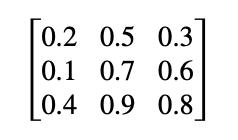
For instance a basic 3x3 matrix of a feature map could appear like below after passing an image through a convolutionallayer.
p-ISSN:2395-0072
Eachnumberinthismatrixcorrespondstotheintensityor strength of a detected feature at a particular location in theinput.Asthenetworkgoesdeeperintothelayers,this matrix would evolveto representmorecomplex patterns, helping the model to progressively learn and adapt to the featuresofthedata.
Next, after the raw data has been filtered and mapped through a sequence of convolutional layers, we must include visualization guidance so that our model can understand the non-linear structure of our data better. If we don't do this step, the network could only perform linear transformations, which means that the network won'tbeabletodetectcomplexpatternsthatarerequired in cases like image classification or object detection[6][14]. The subsequent process is crucial in combining these features in ways that mirrors the complexitiesoftruedataintheworld.
However, in the real world, data like images has nonlinear relationships, and linear transformations alone cannot capture these complexities. For example, in image classification, the edges, corners, textures, and various partsofanobjectintheimageinteractwitheachotherina non-linear manner. With only linear transformations, the network will not be able to learn these complex interactionsbetweenfeaturesandsowouldnotbeableto account for complex patterns like shapes, textures and edges. This means the network would fail to learn and structurethemorediscoverablerelationshipsonthedata.
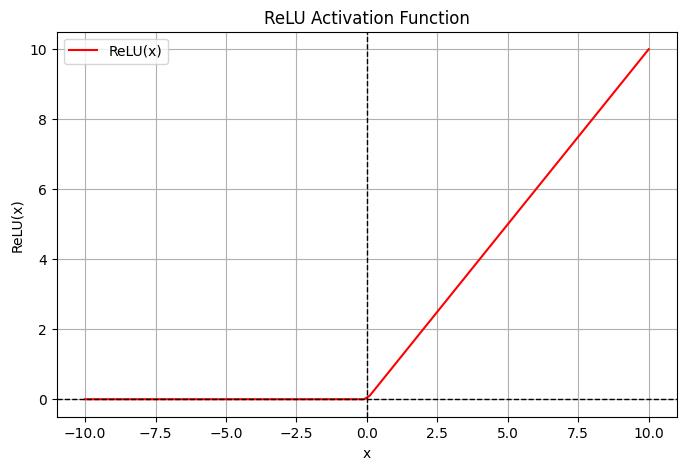
This is where the ReLU (Rectified Linear Unit) activation function comes into the picture. ReLU is important in introducing non-linearity to the model which enables the
Volume: 12 Issue: 06 | Jun 2025 www.irjet.net
network to learn more complex representations of the data.Mathematically,theReLUfunctionisgivenas:
��(��)=������(0,��)
This transformation maps any input value less than zero to zero, while leaving positive values unchanged. Specifically,
foraninput��:
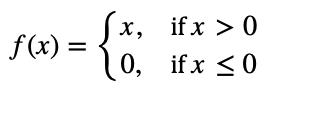
Thistransformation,asthenamesuggestsintroducesnonlinearity into the network and ReLU applies this transformation. So, it just kills the negative values and passes the positive activations to the next layer. As a consequence, the network pays attention to the most informative features within the data while disregarding irrelevant or less salient features. This ability to nonlinearly transform the input is critical for the hidden layers to find more complex relationships, particularly when working with data like images where these relationshipscanbeverynon-linear[7][28].
Without adding non-linearity, the network would be executing a series of linear transformations of the same input, irrespective of how many layers you added in the network. But mathematically, cascading several linear transformations only continues to describe a linear process, one which can only characterise linear relationships. For example, if we have a very simple 2layerneuralnetwork,theoutputwithouthavingReLU,can bewrittenas:
��=��2(��1
Here, ��1 and ��2 are weight matrices, ��1 and ��2 are bias terms, and �� is the input. Lacking any activation function, suchasReLU,thisnetworkwouldremainlimitedtolinear mappings,i.e.,itwouldbecapableofmodelingonlylinear patterns. But with the use of ReLU on each layer, the network can capture highly complex, non-linear relationships.Byintroducingthisnon-linearity,theoutput functions via a ReLU from the network is capable of learningthedatathroughmorecomplexpatterns.
As an instance our experiment, receives inputs but the arguments of the activations to a certain level decides if thelearningisfurtherinitiatedornot,ReLUinthiscase.In the initial layers, the network recognises basic elements like the edges of a shirt or the textures on a pair of trousers. These primitive features evolve into high-level representations, like the silhouette of a shirt or the contourofacoat,indeepernetworks.ReLUfiltersoutthe negative outputs, thus transmitting positive, meaningful
p-ISSN:2395-0072
activations to the next layer, thereby helping the network to focus its attention on the features that matter for correctclassification.
And,duetoReLU'scapabilitytoapplysomenon-linearity, it helps the model to learn and generalise these features together which enhances the overall accuracy of the network. Hence without ReLU, it would be impossible for the neural network to learn and describe complicated star-parts relationships, which will cause problems in its performance in tasks as diverse as image classification, textrecognition,etc.
To sum up, the introduction of non-linearity by ReLU is a crucial part of current deep learning models. This allows the network to learn complex, real-world patterns and hierarchies of features that cannot be achieved through simplelineartransformationonly.ReLUhelpsthenetwork to focus on the most important weighted images up by movingtheweightedsurfacesintheformofheight,width, and depth in the 3D plane, regardless of the efficiency in each level of activation, using the negative activation suppression process. This not only helps the network to recognise positive activations but also saves time by eliminating negative activations which leads to improved detection performance, segmentation, and classification. Hence, ReLU is an essential component of deep learning toolbox, enabling models to learn better and generalize wellonpreviouslyunseendata.
PoolingisthenextstepinCNNsaftertheReLUactivation. Thislayerisusedtodownsamplethefeaturemaps,giving it a smaller spatial dimension and therefore reducing the number of parameters in the way[1]. Convolution and ReLU are also used to extract features from the input, while pooling is used to downsample the features so that their size is smaller in width and height but retains the mostsignificantfeatures.Downsamplingsolvesafewvery importantissuesinCNNarchitectures.
Featuremapscanbelargeafterconvolutionandactivation using ReLU. The result is often “high memory use" and “computational complexity" in subsequent layers. More often,theincreaseincomputationalcomplexitycausesthe networkstotrainslowerandleadstoinefficientmodeling. Pooling reduces the spatial dimensions of feature maps, helping to manage computational load. This enhances the network’sefficiency,particularlywhenworkingwithlarge datasetsorcomplexarchitectures[20].
Forinstance,inacomputervisiontask,poolingallowsthe model to retain its predictive power while being efficient in terms of memory usage. However, as feature maps continue to grow, it incurs computational expenses leading to prolonged training time and inefficiencies, particularly in larger-scale datasets. Pooling will reduce International Research Journal of Engineering and Technology (IRJET) e-ISSN:2395-0056
International Research Journal of Engineering and Technology (IRJET) e-ISSN:2395-0056
Volume: 12 Issue: 06 | Jun 2025 www.irjet.net p-ISSN:2395-0072
thesizeofthefeaturemapslikemaxpoolingandwillhelp in optimizing speed and performance of the model. When developing real-time applications or when dealing with a significantamountofdata,thisisvital.
Moreover, while the ReLU also adds non-linearities to the feature maps, they can still carry and equally represent redundant or useless information. After ReLU activation, features like small changes in position, scale, or rotation could still be present in the feature maps. Such changes might not even be important for the task in question (for instance,predictingifanimagecontainsacertainobjector performing an image detection task). By downsampling the feature map, pooling assists in removing these excess details, permitting the network to focus on key pertinent information. Doing so, pooling allows the model to generalizetonew,unseendatamuchbetter.
Another key issue that pooling addresses is the model’s sensitivity to object position. However, for image recognition tasks, the feature location can change for various input images. Pooling helps to make the model much less sensitive to small translations of the object, enabling it to learn to classify the object correctly regardless of its position in the image. Pooling introduces spatialinvariance,whichguaranteesthatslightchangesin the position of features do not change the model’s prediction[23]. This property of spatial invariance is crucial for tasks such as object detection because the object'spositionintheimagemayvary.
Oneof thepivotal reasonstoapplypooling in experiment is to make sure that the model does not become highly sensitivewithrespecttotinyshiftsinthelocationorangle of the object. As the model learns from various pictures, minor variations in the location of elements are unpreventable. By facilitating this displacement invariance, pooling strengthens the model against variationsininputdatainpracticalscenarios[1].
Pooling helps decrease the overfitting risk of the model. Feature maps that are too big could make the model too complex in terms of the number of parameters, which couldleadinanetworkofdeeparchitecturethatcouldbe classifyingincorrectly.Thiswouldresultinlearningallthe nuancesofthetrainingsetwhileperformingworseontest data a classic case of overfitting. Pooling works by reducing the size of input by taking a summary of the features it sees, so that the model can give attention to only the most relevant features of the input which allows ittogeneralizebetteronunseendata.
Maxpoolingisacommontechnique.Itworksbytakingthe maximum value from each local receptive field (to be clear, it's a small region in the feature map). It keeps the strongest activations and reduces the size of the feature map.Let’sgoa littlemorein-depthinto the mathematical mechanicsofmaxpooling.
Let’s assume we have a feature map with dimensions ��×��, where �� is the height and �� is the width of the feature map. For example, consider a 4×4 feature map representedas:
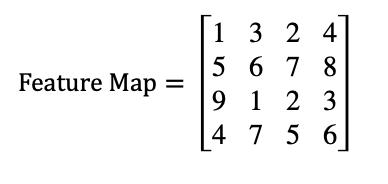
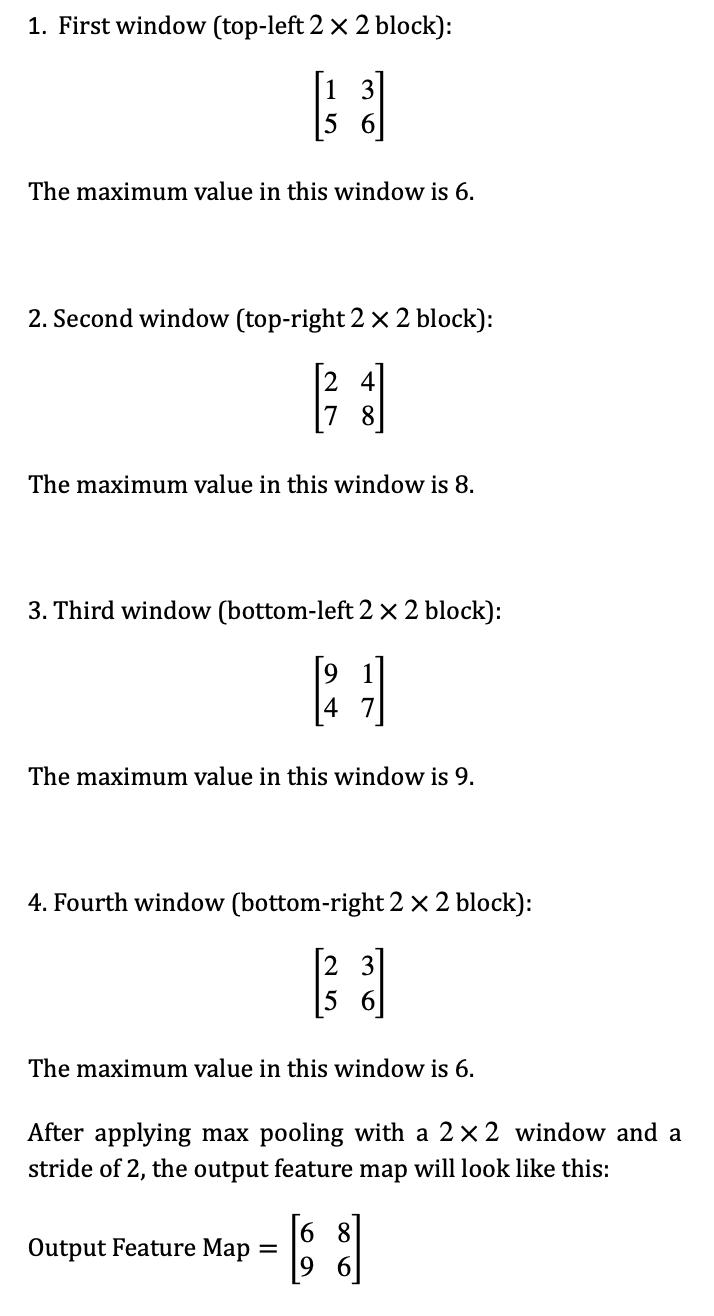
Now, assume the pooling window (receptive field) has dimensions2×2, and the stride (the step by which the window slidesacross thefeature map)is 2. To applymax pooling, we slide the 2×2window over the feature map andtakethemaximumvalueineachwindow.
Let’sillustratethis:
International Research Journal of Engineering and Technology (IRJET) e-ISSN:2395-0056
Volume: 12 Issue: 06 | Jun 2025 www.irjet.net
Thisnewfeaturemapisofsize2×2,whichishalfthesize of the original 4×4 feature map. The spatial dimensions havebeenreduced bya factorof2,leadingtoa reduction inmemoryusageandcomputationalcomplexity.
The output dimensions of the feature map after pooling depend on the input dimensions, the size of the pooling window, and the stride. If the input feature map has dimensions����,theoutputdimensions �������� and �������� can be calculated as follows:
Where �������� �������� is the size of the pooling window (e.g., 2×2)andstrideisthestride(e.g.,2).
For example, if the input feature map has dimensions 4×4,thepoolingwindowis2×2,andthestrideis2,the outputdimensionswouldbe:
So,theoutputfeaturemapwouldbe2×2
The maximum value is taken over a window size (receptive field). Higher values correlate with larger windowsandmoredownsampling.A4×4windowwould provide even more downsampling than a 2×2 window. The stride defines how much the window moves after each pooling operation. A stride of 2 means the window moves 2 steps at once. With a larger stride, the reduction inspatialdimension,becomesmorepronounced.
Max pooling allows us to reduce the spatial dimensions while also keeping the most relevant features. Using maximum value in each window better simulates these aspects, thus the edge and texture preserving, which is significative for tasks like object detection and category recognition.Thismakesthesefunctionslessresponsiveto tiny tweaks in the input, which helps the model become less sensitive to minor variations in an image, such as shifts,rotations,anddistortions.
Whileithelpswithspatialinvariancesuchthatifthereare slight translations or shifts in position, it should not drastically affect the network’s ability to recognise features of interest. This is particularly useful for tasks such as object recognition, in which the objects may appear in various locations in the input images. Max pooling helps in the generalisation of the network, which
p-ISSN:2395-0072
further helps. Thus pooling also addresses problems of overfittingsinceitreducesthefeaturemapsizeandforces the model to learn to spot the most salient features that matter instead of learning on fine details of the training data.
Thus max pooling operation is an important operation in CNN especially after ReLU activated. Max pooling enables down-sampling of the spatial dimensions of feature maps while preserving important information so as to promote efficiency, robustness, and generalisability of the model. Whether practicing image classification, object detection, or more, the max pooling operation helps keep your network computation-light while focusing only on the mostusefulfeatures.
Flattening is a crucial operation in convolutional neural networks (CNNs) that is especially used during the transition from feature extraction to decision-making. It involves converting the multidimensional feature maps generated by convolutional andpoolinglayersintoa onedimensional vector. This flattened vector functionality becomes the input feeding into the fully connected layers where the network combines and weighs features to produce predictions. This helps to retain the hierarchical and spatial information learned from the previous layers and make sure the information is prepared as per the decisionmakingthroughdenselayers[2][20][13].
Tounderstandwhyflatteningisessential,letuslookback on the architecture of CNNs. Specifically, convolutional layers of a CNN capture spatial information like edges, textures and patterns in the earlier layers, and pooling layers downsample the spatial dimensions of the data, hence the feature vectors, resulting in a more computationally tractable size. These feature maps often retain their multidimensional structure, with dimensions typically represented as ������, where �� is the height,�� isthewidth,and �� isthedepth(orthenumber ofchannels).Nowthedepthindicatesthenumberoffilters that are used during the convolution, and each filter identifies a different aspect of the input. This multidimensional representation is advantageous for feature extraction but a one-dimensional input is necessary in fully connected layers, which perform the classification or regression task. Flattening bridges this gap by changing multidimensional feature map into a singlevector.
Mathematically, flattening is straightforward. If a feature map has dimensions ������, the total number of elementscanbecalculatedas:
International Research Journal of Engineering and Technology (IRJET) e-ISSN:2395-0056
Volume: 12 Issue: 06 | Jun 2025 www.irjet.net p-ISSN:2395-0072
Flattening reshapes this feature map into a onedimensional vector of size (��⋅��⋅��)×1. For instance, consider a feature map with dimensions 2×2×3. The featuremapcouldlooklikethis:
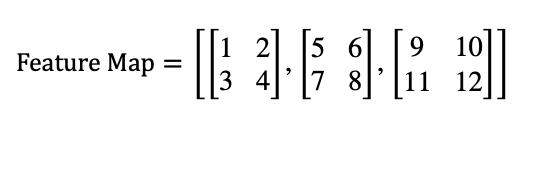
Flattening this feature map involves concatenating all elements along the depth and spatial dimensions into a singlevector:
������������������������������=[1,2,3,4,5,6,7,8,9,10,11,12]��
Flattening incorporates information from spatial and channel dimensions into a single representation, allowing dense layers to observe features uniformly. With each entry in the flattened vector corresponding to an individual feature, there is no loss of features between feature extraction and the classifications. It is quintessential to objectives such as object recognition, where obtained features should then be used to correctly predictthepresenceoridentityofanobject.
Flattening has the advantage that it is computationally simple. It has no added parameters nor does it increase the complexity of the model. Instead, it restructures that data from its multidimensional form into a linear format. Theoperationcanbeexpressedmathematicallyas:
�� =������ℎ������(��,[�� �� ��,1])
Here, �� represents the original feature map, and �� is the resulting flattened vector. This reshaping is computationally efficient and allows the model to maintain the integrity of the learned features while simplifyingtherepresentationforsubsequentlayers.
Flattening is also critical because it allows the decisionmaking layers of the network, such as fully connected layers, to work with the features optimally. Fully connected layers are thedecision-makinglayersforCNNs where the network learns to weight the importance of each feature and incorporate it to provide output predictions. Dense layers require a linear input, without flattening, they would have difficulty processing multidimensional feature maps, which have an incompatible structure. Flattening facilitates a smooth transition from the feature extraction process to the classification, as it performs a one-dimensional representation.
In addition, flattening is significant to maintain the hierarchy in nature of features acquired by the CNNs. In lower layers, features are those that capture local
characteristics, while in higher layers they capture global characteristics, or semantic information. It is so the network can have access to local and global information when making its predictions, by flattening all these featuresintoonemassivevector.
This is a layer that connects feature extraction with decision-making. It connects all input neurons to all neurons in the next layer which helps the network understand the features learned by the previous layers[18].
Thedenselayerdoesthisbycomputingtheweightedsum of each neuron in the previous layer and adding a bias term before applying an activation function (in our case ReLU). This enable the network to extract much higherlevel features like shapes or patterns that would not be directly represented in the convolutional or pooling layers.Thedenselayerwasimportantinsummarizingand understanding the learned features for the ultimate state task[21].
Often, after the dense layer, a softmax layer is used, especially in the case of multi-class classification. Finally theoutputofthedenselayerisprocessedusingasoftmax functionto getclassprobabilitiesthatallow the networks tomakepredictionsbasedonthemostprobableclass[12].
Thisprocessoffeatureextraction,followedbyabstraction via a dense layer, and then classification with softmax allows CNNs to efficiently tackle some deep learning problems, such as image recognition, that require hierarchical understanding of the data being analyzed in ordertogenerateaccuratepredictions.
The Dense Layer, acts as a bridge between the feature extractionanddecisionstages.Thisexperimentcontainsa layerwith128neuronsusingtheReLUactivationfunction. This layer uses the output of flattening step which is where our multidimensional feature maps are converted intoa one-dimensional vector.Byfirsttransforminginput data this way, since the network needs to learn exactly how arrays relate before it can be effective on more complex tasks whereby the data needs to be fully connectedtobeusedforclassification.
Let��representtheinputvectortothedenselayer,where ��isthetotalnumberoffeaturesobtainedafterflattening. Ifthepreviouslayergeneratesfeaturemapsofsize ℎ×�� with �� filters, then ��=ℎ �� ��. For example, in this architecture, if the second pooling layer outputs feature maps of size 4×4 with 64 filters, then�� =4⋅4⋅64= 1024. This vector �� serves as input to the dense layer,
International Research Journal of Engineering and Technology (IRJET) e-ISSN:2395-0056
Volume: 12 Issue: 06 | Jun 2025 www.irjet.net p-ISSN:2395-0072
whereeachneuroncalculatesaweightedsumofitsinputs, addsabiasterm,andappliesanactivationfunction.
Mathematically, the output ���� of the ��-th neuron in the denselayerisexpressedas:
�� =�� ∑��=1 �� ���� +���� ,
where:
• ������ is the weight connecting the ��-th input to the ��-th neuron,
• ���� isthe��-thinputfeature,
• ���� isthebiastermforthe��-thneuron,and
• ��()istheactivationfunction(ReLU).
The dense layer introduces a significant number of trainable parameters. For a dense layer with �� neurons, the total number of parameters, including weights and biases,isgivenby:
where �� is the number of inputs. Substituting �� = 1024and �� =128,theparametersarecalculatedas: ��������������������=1024 128+128=131,200
These parameters are learned during training, enabling thenetworktoidentifymeaningfulpatternsinthedata.
To reaffirm, the dense layer in this CNN architecture converts features that have been extracted into high-level abstractions. We have used 128 neurons with the ReLU activation function, which allows the model to learn complex relationships in the data that are critical for making accurate classifications. Its importance in the network’s learning process is reflected in the mathematical foundations, from computing weights to updating gradients. The regularising strategies make sure thatthedenselayerisefficientandgeneraliseswell,hence itisoneessentialelementindeep-learning.
The output layer is one of the last layers in the CNN, and also one of the most important layer in a CNN which performs the final steps of classification by mapping the features learned into probabilities for the target classes. This layer depends on the nature of the problem we’re dealing with, for example for tasks like multi-class classification for a dataset like Fashion MNIST, it consists oftenclassesrepresentingtendifferentclothingtypes.
The output layer has ten neurons in this architecture, representing ten potential categories. We represent each
class with one neuron, and we use softmax as the activation function for this layer. Mathematically, softmax canbegivenby:
where���� istheoutputofthe��-thneuron,and��isthetotal number of neurons in the layer (here, ��=10). This produces outputs that are probabilities such that, when summed overall probabilities,the total isequal to1.This way, the network can make a prediction, either based classification the highest probability transferred by softmaxfunction.
The input to the output layer is taken from the previous denselayer, whichcombineshigh-level featuresextracted from earlier parts of the network. Such features are patterns and abstractions with very important relevance toclassseparation.Thatmightbe,forexample,thegeneral formofashoeorthefabricofashirtintheFashionMNIST dataset. The output of the dense layer is a vector of size 128 which is fully connected to the ten neurons of the output layer. The output layer consists of neurons, where each computes a weighted sum of these inputs, adds a bias,andappliesthesoftmaxactivation.
During training, the output layer's weights and biases are learned via backpropagation. The most commonly employedlossfunctionpairedwiththesoftmaxactivation isthecategoricalcross-entropy,whichisdefinedas:
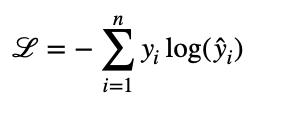
where ���� is the true label for class��, ���� is the predicted probabilityforclass��,and��isthetotalnumberofclasses. This loss function measures the dissimilarity between the predicted probability distribution and the true distribution (where the true class has a probability of 1 and all others are 0). Minimizing this loss during training ensures that the network improves its predictions over time.
The number of parameters in the output layer can be calculatedas:
Here,theinputsizeisthesizeofthevectorfromthedense layer(128), and the output sizeis the number of neurons intheoutputlayer(10).Substitutingthevalues: ��������������������=(128×10)+10=1290
International Research Journal of Engineering and Technology (IRJET) e-ISSN:2395-0056
Volume: 12 Issue: 06 | Jun 2025 www.irjet.net p-ISSN:2395-0072
These parameters consist of the weights from the dense layer to the output layer, as well as the bias for each neuron. Whilethisnumberofparametersismodestwhen comparedwithearlylayers,theoutputlayeriscrucialasit givesthefinaldecisionofthemodel.
Nowthroughoutthetraining,wecomputethegradientsof the loss with respect to the output layer weights and biases using backpropagation. The Updated parameters are using with the help of some optimization algorithm usuallyeitherSGD(StochasticGradientDescent)oroneof itsvariantAdam[19][5][18].Therolethatthederivativeof softmax activation plays in this process is crucial because it dictates how the error is propagated in the backward passthroughthenetwork.
Within the supervised machine learning framework, you canalsoassesstheoutputlayer'sgeneralizationcapability tonoveldata notusedintraining.Toassessthequalityof predictions made by the output layer, there are common metrics such as accuracy, precision, recall and F1score[10][17][23]. Again, confusion matrix provides a more elaborate illustration of how well your network is abletodiscriminatebetweenseveralclasses.
Some regularization techniques can be used to make the output layer more robust. For instance, one example of regularization is weight decay (L2 regularization), which penalizes large weights and aids the network in learning simpler and more generalizable representations. Further, techniques such as dropout could be utilized in prior layers to combat overfitting, indirectly enhancing the outputlayer'sperformance[5].
To wrap it up, the role of the output layer in CNNs is to map the learned features to high level classes to generate meaningful predictions. It is certain that this is designed for task Fashion MNIST dataset with the softmax activation function that hasten neurons. Then in the final output layer, softmax activation converges the outputs from the dense layer into probabilities enabling the network to make confident and interpretable predictions. Designing and training this layer carefully is crucial for obtaining good accuracy and generalization in image recognition, making this part of the architecture a key componentofCNNs.
Next crucial step in the convolutional neural network (CNN)developmentisModeltraining,wherethegoalisto fine-tune the model's parameters to learn to make accurate predictions. This step is after the model is compiled,wherethearchitectureisset,thelossfunctionis defined, and the optimizer and performance metrics are chosen. The training process is a repetitive cycle of refiningthenetwork'sweightsandbiasestominimizethe
disparity between the model's predictions and the target values.
We compile this CNN architecture with the Adam optimizer, sparse categorical cross-entropy loss, and accuracy as the performance metric in the model. The Adam Optimizer is an adaptive optimizer that takes advantages from both RMSProp and Stochastic Gradient Descent (SGD)[19][17]. It adjusts the learning rate for each parameter dynamically, ensuring efficient convergence even in complex architectures. Sparse categorical cross-entropy, by the way, is especially wellsuited to multi-class classification problems like Fashion MNIST, where the class labels are given as class integers, notasaone-hotencodedvector.Accuracyischosenasthe primary metric to evaluate the proportion of correctly classifiedsamplesduringtrainingandvalidation.
Themodelistrainedusingthe������function,whichtakesin the training data (������������,������������)and optionally validation data (����������,����������). In each epoch, the model goes through the training dataset, makes predictions for each input sample, and compares these predictions with the true labels using the loss function. Loss value shows how wrong the model predictions are. Next, the backpropagation algorithm is used to calculate the gradients of the loss function with respect to the model’s weights. These gradients point to the direction and scale of parameters updates required to bring down the loss. Using these gradients, the Adam optimizer adjusts the network's weights and biases to enhance performance overtime.
Validationdataisessentialtomeasuretheperformanceof themodel onunseendata overthetraining process.After the completion of every epoch, the predictions on the validation dataset are evaluated and validation loss and accuracymetricsarecalculated.Thesemetricsgiveanidea of the generalization of the model to the new data and whether overfitting or underfitting has occurred. Overfitting occurs when the model does well on the trainingdata butpoorlyonthevalidationdata,itisa sign thatthemodelsimplymemorizedcertainpatternsexisting in the training set rather than learning features that can generalize. Overfitting is mitigated either by controlling the architecture of the neural network using techniques likeearlystopping,dropout,orusingregularizationwhich addconstraintsonthenetwork’scapacity.
The training process is highly dependent on the hyperparameters selected. The learning rate defines the magnitudeofthestepsthat theoptimizer takestochange the weights. If the learning rate is too large, it can cause the training process to vary widely and it cannot reach a convergencepoint,whereastoolowalearningratewould mean the training is taking time to execute. As stated, the number of epochs is the number of times your model is
International Research Journal of Engineering and Technology (IRJET) e-ISSN:2395-0056
Volume: 12 Issue: 06 | Jun 2025 www.irjet.net
going to iterate the complete training dataset. The model trainingisfor25epochs,sothenetworkhasplentyoftime to learn very complicated patterns in the data. The number of samples that will be used to calculate the gradientandupdatethemodelweights,isknownasBatch size.Byusingasmallervalue,itcanupdatemoreoftenand helpstoenhancethegeneralization,andforahigherbatch size can help to increase the speed of training and stabilizestheupdate.
In addition, tracking the learning rate is part of the training process. One of the most popular techniques is learning rate scheduling which gradually decrease the learning rate throughout training. This method helps to encouragelargechangesatfirst,whenthelossishigh,and the changes become a lot smaller later in the training process as the parameters are fine-tuning. Methods like Adam use early applications of this theory for adaptive learning rates by basing a multiplier for the learning rate ofeachparameterinputbasedonitsrelativesignificance.
The trained model is then evaluated on a separate test dataset that was not used for training or validation. By evaluating-test set usage, we can get an unbiased approximationofthemodel'sabilitytogeneralize.Quality of predictions is evaluated by calculating metrics like accuracy, precision, recall, and F1-score[20]. This enables you to make fine-tuned adjustments to improve the model'sperformanceonspecificclasses.
Test performance is not the only aspect to take into account, we also need to think about the computational efficiency of the training process. Training deep neural networks, in particular on very large datasets, is computationally expensive. Utilizing hardware accelerators such as GPUs or TPUs greatly accelerates trainingbyparallelizingmatrixoperations.
Inthetrainingandvalidationresultofthemodel,wecould see how it has been learning to capture data and generalizeitacross25epochs.Forthetrainingaccuracy,it begins at 60% in the first epoch and rises to 99% in the last epoch, highlighting how learning continues throughout the training process. The increase in training accuracy over the epochs indicates that the model is slowly learning and optimizing its parameters to fit the trainingdatabetterandbetter.
p-ISSN:2395-0072
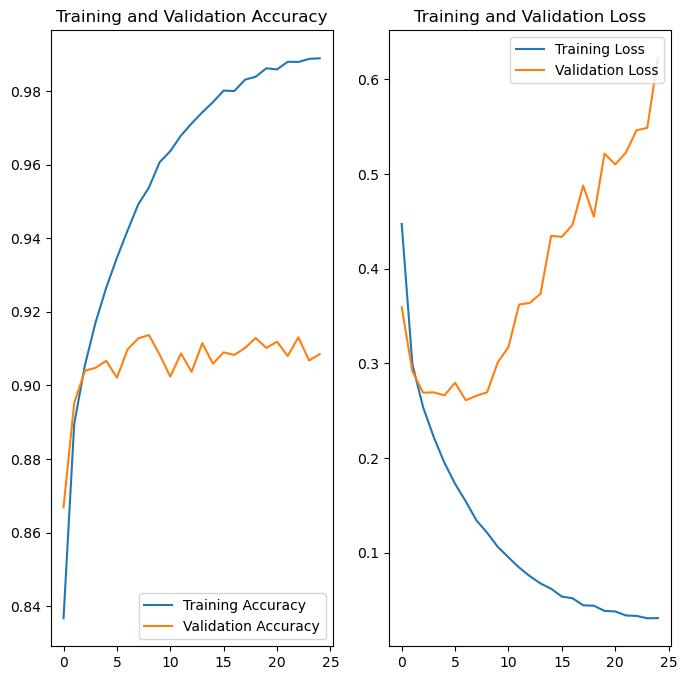
Asfortheloss,thetraininglosshasasteadydecreasefrom 0.7inthefirstepochupto0.26inthelastepoch,whichis an indication that the model is continuously fine-tuning itself to minimize the prediction errors. Looking at the validationlosswecanseeasimilartrend,wherethevalue started at 0.36 and decreased to 0.62 by the last epoch, alsosolidifyingtheideathatoverfittinghasoccured.
Although themodel performswell onthetraining,but we can see a huge gap occurring in the results of both suggesting that model has overtrained itself on the training data and now as a result of which model faces overfitting.
Data augmentation is used to execute better from a small dataset by artificially expanding the training dataset. Model retrainsusing thesamedatasetbut thistimemany differenttransformationsareperformedontheinitialdata to create new, mutated original datasets[12][23]. Small and imbalanced datasets limit the model's ability to generalize,whichiswheretheneedfordataaugmentation arises. If there is interaction between two covariates it leads to overfitting and the model starts to memorize instead of learning multiple distinct patterns of the trainingdatawhichisnottherealworld.
Data augmentation is a standard technique to combat overfitting which is a significant challenge while learning deep neural networks. Overfitting happens when the model learns the training data too well but fails in generalizingonunseendata.Thisisusuallyaresultofthe model memorizing noise or spurious correlations that do not extend into real-world situations. Data Augmentation is a technique that generates more variability in the training examplesbyapplyingtransformations(rotations, flipping, zooms, translations) on top of the existing data,
International Research Journal of Engineering and Technology (IRJET) e-ISSN:2395-0056
Volume: 12 Issue: 06 | Jun 2025 www.irjet.net p-ISSN:2395-0072
making it harder for the model to memorize the specific attributesofthedata.Thisforcesthemodeltolearnmore generic features that can be used with new, unseen examples.
Data augmentationusedas a techniquealsoimproves the robustnessofthemodel.Inthecaseofimageclassification task, for example, if the model is trained on images taken incameraanglethenitislesslikelytoperformwellonthe images taken in a different camera angle. In the image classificationdomain,consideranexamplewherewewant to recognize objects in images of different orientations. Similarly,whenthemodelistrainedwithalownumberof samples, modifying the dataset by varying with small alterations,suchaslighting,scaleorcolordistribution,can allow it to generalize better in different scenarios and environmentalconditions.
Additionally, for training models on unbalanced datasets whereoneormoreclassesmaybeunderrepresented,data augmentation is imperative. If this happens the model would get biased towards the majority class which sometimescausespoorperformanceontheminorityclass. This helps the learning algorithm to have more training data and balance in the training set leading to better performanceonminorityclass.
In tasks having limited or imbalanced data, one of the powerful techniques to improve machine learning model is data augmentation. It helps to avoid overfitting, allows for added robustness of the model, and provides generalisation by exposing the model to different examples. It can help the model learn more generalisable features, instead of it overfitting on the data, thus increasing its adaptability in the real-world application. It has been proven that the power of data augmentation relies on its ability to generate realistic and different training data that reflect real-world randomness and thereforeproducemoreeffectiveandreliablepredictions.
Dropout is a regularization method employed in deep learning networks to mitigate overfitting by randomly setting a percentage of the input units to zero at each updateduringtraining.Thisapproachpreventsthemodel from over-relying on any one neuron or feature, which ultimately leads to improved generalization and better performance on unseen data. Dropout is particularly helpfulinthecaseofcomplexneuralnetworksthathavea large number of parameters and are likely to overfit to smallandlimiteddatasets[1][21][17].
Theprimaryfunctionofdropoutistoforcethenetworkto learn redundant representations of the data. During training, each neuron has a probability �� of being “dropped out” (deactivated), typically ranging from 0.2 to 0.5.Byrandomlydroppingoutasubsetofneuronsineach
iteration, the model is encouraged to learn different combinations of features, making it more robust to variations in the input data[17]. This process also prevents the network from becoming too dependent on specificneurons,thusreducingoverfitting.
In neural networks, Dropout layers are often added after fully connected layers. Depending on the kind of model and architecture, dropout can be applied to one or more layers. The basic idea behind it is, on a training run, the dropout layer will turn off neurons in a layer at random, requiring the rest of the neurons to learn more general features[10]. However, during testing or inference, dropoutisnotused,andthefullnetworkwithallneurons is utilised for prediction. To compensate for the larger capacity of the network at inference time, the neurons outputsarescaledbythedropoutfactorattrainingtime.
Another source of over-fitting in deep models is the coadaptation of neurons, where some neurons learn to respond only in conjunction with others, rather than to complement each other by learning different useful features, dropout also helps to mitigate this in training. It appears that by allowing different weights of neurons to scale appropriately, it creates a network that generalises better to new data while preventing over-fit and retains performanceofthemodel.
Intermsofitspracticalimpact,dropouthasbeenshownto improvetheperformanceofneuralnetworks,especiallyin tasks like image classification, speech recognition, and natural language processing[6]. The simplicity and effectiveness of dropout make it one of the most widely usedtechniquesinmoderndeeplearningarchitectures.
Dropout has been demonstrated to be beneficial for the performance of neural networks, especially in matters of tasks in image classification, voice, and discourse recognition. Easy to implement, and very effective, dropout is one of the most used techniques in current deeplearningarchitectures.
In summary, dropout is a potent regularization mechanism that enhances the generalization ability of neuralnetworksbyrandomlydeactivatingneuronsduring the learning process. Dropout, as a regularization technique, improves the model's ability to generalize on unseen data by reducing overfitting and encouraging the modeltolearndiverseandstrongrepresentations.Dueto itsefficacyinregularizingdeepnetworks,ithasbecomea widely used technique in many state-of-the-art models in variousdomains.
International Research Journal of Engineering and Technology (IRJET) e-ISSN:2395-0056
Volume: 12 Issue: 06 | Jun 2025 www.irjet.net
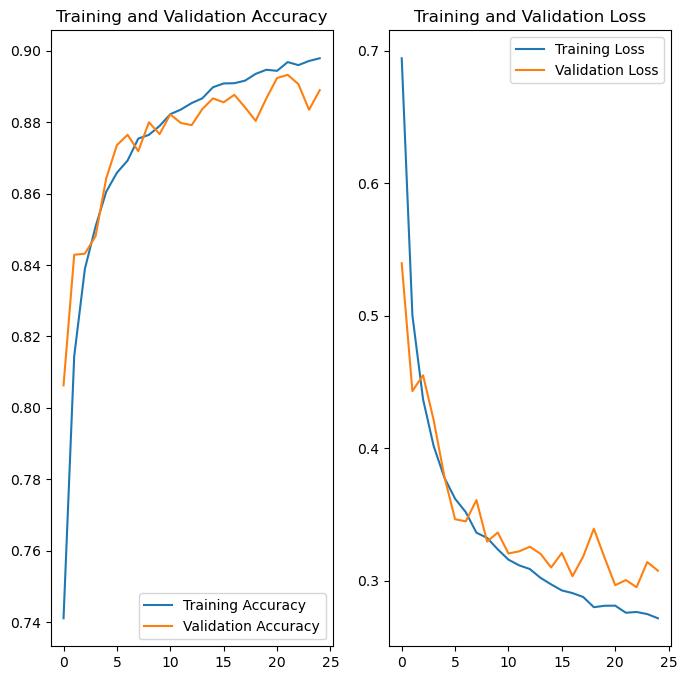
Fig -3
Itcanbeseenthatresultsfromtheperformanceofmodel withapplicationof data augmentationanddropoutlayers have some interesting trends related to the training and validation phases spanning 25 epochs. This result indicates that the model has learned very well from the training data, and it is able to generalize to new datasets as well, taking advantage of data augmentation as well as the dropout layers that served as a regularization technique.
The training accuracy gradually and consistently rises from67%inthefirstepochto90%inthelastepoch.Then with each passing epoch, the training accuracy continues to consistently increase, signifying that the model is learning, honing its existing knowledge base on the training data, and adjusting its parameters accordingly. This improvement was due to the data augmentation process which added more noise in the training data and helped the model to learn from diversified situations. In addition, the effect associated with dropout layers, which deactivate a random fraction of the neurons during each update, was probably also responsible for forcing the model to learn more generalized and robust features insteadofmemorizingthetrainingdataset.
However, the validation accuracy follows a similar increase,itstartsat80%andgoesupto89%attheendof the training. This rising trend of validation accuracy indicatesthatthemodelisnotonlyfittingthetrainingdata butisalsogeneralizingwellonunseendata.Aswecansee, since the training accuracy and validation accuracy are close to each other, we can be assured that our model is not overfitting. In this instance, there is still a small gap
p-ISSN:2395-0072
between training and validation accuracy, adding to the confidencethatthemodelisindeedgeneralizingwell.
Training loss is decreasing from 0.89 to 0.26 by the last epoch. Seeing a continual decrease in the training loss shows that the model is learning and performing better andisabletoreducetheerrororcostofthemodelduring the task over time. The validation loss also decreases consistentlyfrom0.53to0.30,indicatingthatthemodelis generalizing well on the validation data. In fact, the fact thatboththetrainingandvalidationlossarecomingdown alsoindicatesthatthemodelisnotoverfitting.
Althoughtheshownperformanceindicatesthatthemodel is performing well, we should be careful of overfitting if we would have trained longer than 25 epochs. When the trainingaccuracyincreasetonearly100%andatthesame timetraininglossdecreasetonearlyzero,itmayindicates that continued training will lead the model to start to memorize the data, which will make validation accuracy plateau or even decline. Nonetheless, these results indicate that the data augmentation and the dropout layers have helped alleviate this risk, and the model is performingwellonunseendata.
Training Convolutional Neural Networks (CNNs) requires goingthroughvariouschallenges,whichareimportantfor the model's performance, as well as achieving a certain amount of generalization. During the training of a CNN, one of the major challenges is overfitting. This can be a particular problem in tasks that involve smaller or less diverse datasets, where the model could default to remembering the specific data rather than understanding thecommonalities.
The vanishing gradient problem is popular one as well during training the CNN. The phenomenon of gradients becoming vanishing is more prevalent in deep networks where the gradients can become infinitesimally small whiletravelling backward throughthedeep papersof the network during backpropagation. This means that weight updates will lose their significance, which leads the learning process to converge or stall. This problem is common indeeparchitectures,especiallywhenactivation functions are used that squash gradients towards zero, suchassigmoidortanh.
Another critical challenge is computational complexity, especially for training CNNs with deep architectures on large datasets. And having so many parameters can be brutal in terms of computational and memory overhead, oftenrequiringalongtrainingtime,andpurchaseofheavy hardware such as GPUs for faster trainings. If not
addressed, these challenges will prevent the model from achievingitsfullaccuracyandgeneralizationpotential.
International Research Journal of Engineering and Technology (IRJET) e-ISSN:2395-0056
Volume: 12 Issue: 06 | Jun 2025 www.irjet.net
OverfittingisoneofthemajorissueswhentrainingCNN.It occurs when the model learns to memorize the training data, including its noise, peculiarities, or outliers, rather than identifying general patterns that are relevant to the task. Such overfitting causes the model to develop high accuracyonthetrainingsetyetpoorperformanceondata that has not been encountered before, which is a substantial problem in practice[10][17]. Overfitting can cause the model to perform poorly in production because it fails to generalize the underlying data structure and instead simply tailors itself to the training examples. As a result, overfitting impacts the model's ability to adapt to new data points. Therefore, the model may get high variance, i.e., it performs well on certain data but fails on others.
There are many strategies and techniques that can be utilized to prevent overfitting for Convolutional Neural Networks (CNNs), and all strategies aim to enhance the performance of the model and make it generalizes better on new data. Data Augmentation creates additional examplesthathelp with overfitting by addingdiversityto the training dataset. These transformations may involve random angles, translations, zoom, flipping, etc. which provide the model with training from possible conditions andrequiredtoworkundermultiplescenarios.Trainingit on more diverse data, in terms of providing scenarios rather than just classes, allows the model to learn more generalized features, which helps with prediction in new scenarioswithpreviouslyorunseendataintherealworld environment.
Apart from data augmentation, regularizor methods including L2 regularising are ready to use to reduce overfitting. Another type of regularisation is that of L2 (also known as Ridge regularisation), which adds a penalty term to the loss function to combat overfitting, specificallybypenalisinglargeweightsbysummingupthe squared valuesofthe weightsandadding it to theoverall cost[5]. This strategy prevents the model from relying on excessive solutions with large weights, and enables it to learn the most salient features while searching for the solution, avoiding noise by ignoring unnecessary or repetitivepatterns.
Dropout is another powerful method to prevent CNNs from overfitting. Dropout is a regularisation technique where at each iteration during training, a random subset of neurons in the network are turned off (or “dropped out”). This encourages the model to extract the most general features possible instead of overfitting on a small numberofpatternsforparticularneurons.
p-ISSN:2395-0072
Along with these techniques, early stopping is another method that can be used to prevent overfitting. Early stoppingmeanstrackingtheperformanceofamodel ona validation dataset throughout training and stopping the training process when the validation error is no longer improving.Thispreventsthemodelfromovertrainingand memorizing the training data, which can reduce overfitting. Using the patience argument in our early stopping callback is powerful still and can guide the training process to converge at just the right point where themodelhaslearnedquitealotbutnotoverfittedyet.
Vanishing gradients are another major problem in Convolutional Neural Networks(CNNs)andspecificallyin verydeepnetworks.Anissuethatcomesuphereisduring the backpropagation phase of training when we need to backpropagate the gradients of loss function through the network in order to update the model’s weights. What happens is that in very deep networks with many layers the gradients can get vanishingly small as they propagate through each layer. This leads to the updates of the weights becoming insignificantly small and no relevant adjustmentstothemodel’sparametersarechangedwhich leadstolearningprocessbeingstuckorsloweddown.This isespeciallyanissuefordeepneuralnetworkswithmany layers, since the gradients can shrink at an exponential ratecausinglearntobeineffective[3].
The disappearing gradient problem usually occurs with a specific set of activation functions like the sigmoid or hyperbolic tangent (tanh) functions, that compress their output into a tiny range, therefore making the gradients prohibitively small. Since these small gradients are multiplied layer by layer in backpropagation, they decay even more inside the backward path through the layers. Thus, there is almost no gradient signal for the first few layersofthenetworkmakingitalmostimpossibletolearn. This can also mean that training deep networks can be slow and inefficient, since the network has trouble adjustingitsweightsintheearlierlayers[21].
ReLU activation functions are one of the most successful methods of reducing the vanishing gradient problem. It is knowntogivebettergradientactionsthan functionssuch as sigmoid or tanh. Here the ReLU is a non-saturating activationfunction,whichmeansitdoesnotsquashingits output into a small range. This also helps prevent the vanishing gradient problem, as backpropagated gradients donotvanishasquicklyandthenetworkisabletoupdate parameters meaningfully and continue learning[24][26]. ReLU is simple to understand and efficient, which has contributed to its adoption as the default activation function in most CNN architectures and has improved the performanceofdeepneuralnetworksdramatically.
International Research Journal of Engineering and Technology (IRJET) e-ISSN:2395-0056
Volume: 12 Issue: 06 | Jun 2025 www.irjet.net p-ISSN:2395-0072
Also, batch normalization and methods like it can help mitigate the vanishing gradient problem. Batch normalization is when we take the activations of each layer and scale them, such that they have zero mean and variance of 1. By normalizing the activations, the process reduces the internal covariate shift, which is a phenomenon where the distribution of each layer’s input changes as the parameters of the previous layers change. Reasonis, itmakes themfastbecausegradual maintained as retain through layer and preserving input is through useof normalizationlayers. Batchnormalization alsoaids convergence byreducinginternal covariateshift,allowing the network to generalize better and perform better overall[23]. This is especially beneficial in deep CNNs becausealotoflayerscausetheactivationstochangeafter each layer, which is not ideal for a stable activation throughallthenetwork.
Training Convolutional Neural Networks (CNNs) is not without its challenges, with computational complexity beinga major oneinthedesignof deeparchitecturesand large datasets. The computational resources involved in training were particularly massive since the CNNs typically have a great number of parameters like weights and biases in multiple layers. This further leads to significant memory consumption, as well as high processing power demand. However, deep architectures thathavevariousconvolutionallayers,poolinglayers,and fullyconnectedlayers,increasethenumberofparameters, making both the train and inference very expensive in terms of computation. These challenges can be compounded in the case of big data and can lead to not just problems with the quality of the model but also lead to exponentially larger training times depending on the scaleandsizeofthedata[23][27].
The power of the CNNs comes also with its huge computational cost which is almost impossible to train withstandardCPUs dueto non-parallel processingpower neededtocomputesignificantoperations inCNNs.This is particularly important for the case of deep networks, as many layers require repeated multiplication and convolution operations. This can make training such models computationally expensive in time, especially on large datasets, if that it may even refrain from testing a morecomplexarchitecture[5].
This was precisely the reason why we use hardware accelerators (like GPUs) to train large deep learning models more efficiently in terms of time. They are meant for doing parallel computations and run lots of the operations on a lot of data points at the same time. This allowsthemtoperformmatrixandtensoroperationsin a waythatisoptimalforCNNs,enablingfastertrainingthan on CPUs. Moreover, using dedicated Tensor Processing
Units(TPUs)indeeplearningtrainingcanfurtherenhance performance, as TPUs are specifically designed for the typesofcomputationscommonlyusedindeeplearning.
Along with hardware acceleration, model optimization techniques such as pruning can reduce the computational cost of inference and training. It consists of eliminating neurons or weights that are less important to the execution of the network, decreasing the parameters without degrading the execution of the model too much. Pruning helps to create a more compact and efficient network by gradually removing those parameters that do not contribute significantly to the overall network performance. It also reduces the computational burden, helping the model to run more effectively on existing hardware[4].
Othermethodsinvolvetechniqueslikequantization,which represent model weights with lower precision and knowledge distillation, which entails training a smaller, more efficient model based on the knowledge acquired through larger models to minimize computational cost while dealing with CNNs. This is particularly useful in scenarios wheremodels needtobe deployed in resourcelimited settings, such as on mobile devices or embedded systems, where computation and memory resources are scarce.
This property enables us to reduce computational complexity, making it acceptable to train deep CNNs on hardwareacceleratorsanddeploythemonprocessors.
InourquesttoenhancetheperformanceofConvolutional Neural Networks (CNNs), several directions for future workcanbeconsidered.Perhapsthemostpromisingarea is fine-tuning. The pre-trained model can then be finetuned for specific dataset. This method can enhance the performance of the model by utilizing the knowledge obtained from a larger and diverse dataset. Classifying foodpicturesusingdeeplearningpre-trainedmodelssuch asResNetorInception,trainedonImageNet(forexample) through transfer learning, fine-tuning the model for the data nuances of the task. Especially when the dataset at handislimitedinsize,utilizingfine-tuningcandrastically reduce training time while also enhancing the model's performanceonunseendata[2].
Transfer learning represents another approach with considerable potential for future enhancements. Transfer learning is (basically) training one model, and using that knowledge and applying it to a different (but related) domain[5].Therecentprogressontransferlearningusing pre-trainedmodels,e.g.,CNN,helpsalot.Thisisespecially usefulwhendealingwithscarceannotateddatawherethe pre-trained model provides strong initialization. Transfer learning allows these models to be fine-tuned on smaller,
International Research Journal of Engineering and Technology (IRJET) e-ISSN:2395-0056
Volume: 12 Issue: 06 | Jun 2025 www.irjet.net p-ISSN:2395-0072
domain-specific datasets and can result in faster convergence, improved generalization, and ultimately, more accurate models, as collecting large amounts of labeleddatainsuchdomainsisnotalwaysfeasible.
Our CNN models yield some great results, however, more advanced techniques such as those involving fine tuning, moreadvancedarchitectureslikeResNetandInception,as wellastransferlearningoffersomesignificantpotentialto improve the performance of the model even further. In doing so, the potentialities of CNNs can be augmented across a number of applications to develop more efficient andprecisemodelsgoingforward.
12. Conclusion
This study investigated Convolutional Neural Networks (CNNs) for object recognition followed by techniques to improve the performance of models. CNNs learn hierarchies of features directly from the raw image data and often outperform traditional machine learning techniques on tasks such as classification and detection, meaningfarlessfeatureengineeringisrequiredtotraina model.Theoverviewofseveralkeytechniquesusedinthis study are data augmentation to avoid overfitting, and dropoutlayersthatleadtobettergeneralization,avoiding dependenceonspecificneurons.
However, issues such as overfitting, vanishing gradients, and computational complexity remain. Regularization techniques such as L2 regularization and batch normalization overcome this problem. Future directions that building the advanced architectures such as Resnet, Inception etc, can boost further improvements and Transfer learning with the help of pre-trained model can yieldbetterefficiency.
CNNs have demonstrated considerable progress in object recognition, and the ongoing research will allow them to continue improving and finding new applications in robotics,healthcare,etc.
1. D. Scherer, A. Müller, and S. Behnke, Evaluation of PoolingOperationsinConvolutionalArchitecturesfor Object Recognition, University of Bonn, Institute of ComputerScienceVI,AutonomousIntelligentSystems Group,2010.
2. A.Krizhevsky,I.Sutskever,andG.E.Hinton,ImageNet Classification with Deep Convolutional Neural Networks,inNeurIPS2012.
3. J.Wu,IntroductiontoConvolutionalNeuralNetworks, LAMDA Group, National Key Lab for Novel Software Technology,NanjingUniversity,China.
4. C.-C. J. Kuo, Understanding Convolutional Neural Networks with A Mathematical Model, Ming-Hsieh Department of Electrical Engineering, University of Southern California, Los Angeles, CA 90089-2564, USA.
5. K. He, X. Zhang, S. Ren, and J. Sun, Delving Deep into Rectifiers: Surpassing Human-Level Performance on ImageNetClassification,Microsoft.
6. B. C. Russell, A. Torralba, K. P. Murphy, and W. T. Freeman, LabelMe: A Database and Web-Based Tool for Image Annotation, International Journal of ComputerVision,vol.77,no.1,pp.157–173,2008.
7. V. Nair and G. E. Hinton, Rectified Linear Units Improve Restricted Boltzmann Machines, in Proc. 27th International Conference on Machine Learning, 2010.
8. D. G. Lowe, Distinctive Image Features from ScaleInvariant Keypoints, International Journal of ComputerVision,vol.60,pp.91–110,2004.
9. A. Frome, G. Cheung, A. Abdulkader, M. Zennaro, B. Wu, A. Bissacco, H. Adam, H. Neven, and L. Vincent, Large-Scale Privacy Protection in Google Street View, California,EUA,2009.
10. O.M.Khanday,S.Dadvandipour,andM.A.Lone,Effect of Filter Sizes on Image Classification in CNN: A Case Study on CIFAR-10 and Fashion-MNIST Datasets, Institute of Information Science, University of Miskolc,Miskolc,Hungary,2021.
11. O.Nocentini,J.Kim,M.Z.Bashir,andF.Cavallo,Image Classification Using Multiple Convolutional Neural NetworksontheFashion-MNISTDataset,Department ofIndustrialEngineering,UniversityofFlorence,Italy, and The BioRobotics Institute, Sant’Anna School of AdvancedStudies,Pisa,Italy,2022.
12. A.S.Henrique,A.M.daRochaFernandes,R.Lyra,V.R. Q. Leithardt, S. D. Correia, P. Crocker, and R. L. S. Dazzi, Classifying Garments from Fashion-MNIST DatasetThroughCNNs,Univali,Itajaí,Brazil,2021.
13. S.Bouzidi,G.Hcini,I.Jdey,andF.Drira,Convolutional Neural Networks and Vision Transformers for Fashion MNIST Classification: A Literature Review, ReGIM-Lab, REsearch Groups in Intelligent Machine, 2023.
14. Greeshma K. V. and Sreekumar K., Hyperparameter Optimization and Regularization on Fashion-MNIST Classification, International Journal of Recent TechnologyandEngineering(IJRTE),July2019.
International Research Journal of Engineering and Technology (IRJET) e-ISSN:2395-0056
Volume: 12 Issue: 06 | Jun 2025 www.irjet.net p-ISSN:2395-0072
15. S. Sumera, S. R. Anjum, and N. Vaidehi, ImplementationofCNNandANNforFashion-MNISTDataset using Different Optimizers, Indian Journal of Science and Technology, vol. 15, no. 47, pp. 26392645,2022.
16. S. Shen, Image Classification of Fashion-MNIST Dataset Using Long Short-Term Memory Networks, Research School of Computer Science, Australian NationalUniversity,Canberra,2022.
17. W. Rawat and Z. Wang, Deep Convolutional Neural Networks for Image Classification: A Comprehensive Review, Department of Electrical and Mining Engineering,UniversityofSouthAfrica,Florida1710, SouthAfrica,2017.
18. N. Sharma, V. Jain, and A. Mishra, An Analysis of Convolutional Neural Networks for Image Classification, Amity University Uttar Pradesh, Noida, India,2018.
19. Y.Sun, B. Xue, M.Zhang,andG.G. Yen, EvolvingDeep Convolutional Neural Networks for Image Classification,2019.
20. D.C.Cireşan,U.Meier,J.Masci,L.M.Gambardella,and J. Schmidhuber, Flexible, High Performance Convolutional Neural Networks for Image Classification, IDSIA, USI and SUPSI, Galleria 2, 6928 Manno-Lugano,Switzerland,2012.
21. A. A. M. Al-Saffar, H. Tao, and M. A. Talab, Review of Deep Convolution Neural Network in Image Classification, Faculty of Computer Systems and Software Engineering, Universiti Malaysia Pahang, Pahang,Malaysia,2022.
22. A. G. Howard, Some Improvements on Deep Convolutional Neural Network Based Image Classification, Andrew Howard Consulting, Ventura, CA93003,2021.
23. F. Sultana, A. Sufian, and P. Dutta, Advancements in Image Classification using Convolutional Neural Network, presented at the 2018 Fourth International ConferenceonResearchinComputationalIntelligence and Communication Networks, IEEE Xplore (preprint), Department of Computer Science, UniversityofGourBanga,WestBengal,India.
24. L. Kang, J. Kumar, P. Ye, Y. Li, and D. Doermann, Convolutional Neural Networks for Document Image Classification, presented at the 2014 22nd International Conference on Pattern Recognition, UniversityofMaryland,CollegePark,MD,USA,2014.
25. M. E. Paoletti, J. M. Haut, J. Plaza, and A. Plaza, A new deep convolutional neural network for fast hyperspectral image classification, ISPRS Journal of Photogrammetry and Remote Sensing, vol. 145, Part A,pp.120-147,Nov.2018.
26. P. Y. Simard, D. Steinkraus, and J. C. Platt, Best Practices for Convolutional Neural Networks Applied toVisualDocumentAnalysis,MicrosoftResearch,One MicrosoftWay,RedmondWA98052.
27. J. Bernal, K. Kushibar, D. S. Asfaw, S. Valverde, A. Oliver, R. Martí, and X. Lladó, Deep convolutional neuralnetworksforbrainimageanalysisonmagnetic resonance imaging: a review, Computer Vision and Robotics Institute, Dept. of Computer Architecture and Technology, University of Girona, Ed. P-IV, Av. LluisSantalós/n,17003Girona,Spain.
28. K. He, X. Zhang, S. Ren, and J. Sun, Deep Residual Learning for Image Recognition, presented at the 2016 IEEE Conference on Computer Vision and Pattern Recognition (CVPR), Las Vegas, NV, USA, 2016.