
International Research Journal of Engineering and Technology (IRJET) e-ISSN: 2395-0056
Volume: 12 Issue: 03 | Mar 2025 www.irjet.net p-ISSN: 2395-0072
International Research Journal of Engineering and Technology (IRJET) e-ISSN: 2395-0056
Volume: 12 Issue: 03 | Mar 2025 www.irjet.net p-ISSN: 2395-0072
Bini Geevarghese1, Swathy C L2
1PG Student, School of Architecture and Planning, Government Engineering College, Thrissur 2Assistant Professor (Adhoc), School of Architecture and Planning, Government Engineering College, Thrissur
Abstract - Urban centers worldwide face recurring issues like unbearable traffic congestion, environmental pollution, shrinking public spaces, and pedestrian safety risks, all of which undermine livability. The superblockconcept developed in Barcelona, which reshapes urban designs by giving the priority to pedestrians, public spaces, and zero-emission and low-carbon transportation, andthus offeringa viable solution. This research focuses on the careful examination of efficacy in enhancing urban livability, focusing on its adaptability to Indian Tier I cities. The study utilizes a systematic methodology and a compilation of global case study (e.g. Barcelona) to draw on the Global LivabilityIndexfor assessing key indicators - environmental quality, mobility, safety inclusivity etc. It also probes into the urban issues and planning policies of India by discerning the influence of those principles on the superblock. The data show that superblocks are a feasible solution to livability improvement because they not only bring down environmental stress factors but also encourage green practices, yet at the same time the mentioned obstacles such as governance fragmentation, vehicle choice, and socio-economic disparities prevent them. Onthe one hand, the study recommends pilot projects, communityinvolvement, and policy integration to tailor the model for India, providing strategic recommendations for adopting superblock concept for addressing rapid urbanization.
Key Words: Urban Challenges, Traffic Congestion, Superblock concept, Urban transformative model, liveability, GLI, Indian Tier I cities, environmental pollution.
The urban population of India during 2024 reached 530 millionwhichresultedin36.6%oftotalpopulationstatistics. Rapidurbanizationpatternsbetween1981to2022resulted intheurbanpopulationrisingfrom34%to43.2%(World Bank,2022).Theprimarycommitmentofcar-orientedurban developmentinIndiancitieshasresultedinworseninglevels ofpollutionandurbanheatingeffectswhilereducingurban greenareas.Physical activityalongwithsocial interaction and general health status are limited because of these environmental elements. The World Health Organization safe limit exceeds the air quality experienced by 70% of residents in Delhi and Mumbai according to WHO (2021) estimates. In 2017 poor air quality led to more than 1.2
million fatalities throughout India (The Lancet Planetary Health, 2018). The infrastructure supporting roads and parkinginfrastructureinIndiancitiesdominatesmorethan 60% of public spaces thereby decreasing available safe walking and cycling areas (Urban Mobility India, 2020). Successfulimplementationsoftheurbanplanningconcept Superblocks have occurred in Barcelona and other cities. Superblocksfunctiontoprioritizewalkingandbikingover driving which in turn develops more social places and constructs safer transportation links and adds ecological space.ThecityofAhmedabadtogetherwithPuneconducted experimentalsuperblockdemonstrationswhichshowcased these urban design elements as effective in lowering temperatures by up to 2°C and producing 30% less noise pollution(CentreforScienceandEnvironment,2019).The Ministry of Housing and Urban Affairs (2021) has set sustainability goals for India to achieve 20-30% emission reductionswhilestrengtheningclimateresilience.Asaresult Indiacanimplementsuperblockstosupportactivetransport systems and enhance community welfare that will create sustainableurbanlivingenvironments
Research investigates superblock effectiveness for urban livabilityimprovementandexaminesframeworkssuitable forIndianurbansettings.Thisanalysisconductsareviewof superblock concepts through international case studies whilereviewingGLIchangesanddiscussesbothobstacles andpossibilitiesfortheirIndianimplementation.Thestudy delivers recommendations suitable for Indian urban conditions which support sustainable and inclusive urban development.
Thestudyprovidesusefulknowledgebutfacesrestrictions from its focus on European research while lacking comprehensiveinformationonurbanmeasuredataandits inability to apply results broadly because of varied urban context. The analysis stops short of examining actual implementation practices because each site requires individualevaluations.
SalvadorRuedacreatedthesuperblockconcepttodevelop pedestrian-oriented urban solutions for Spanish cities throughanewurbandesignmodel.Superblocksoriginated
International Research Journal of Engineering and Technology (IRJET) e-ISSN: 2395-0056
Volume: 12 Issue: 03 | Mar 2025 www.irjet.net p-ISSN: 2395-0072
fromBarcelona wheretheyuniteninecityblocksina3x3 formation to create pedestrian and cycle-friendly zones along with traffic restriction areas. The superblock model focuses on public areas and supports environmentally sustainable movement solutions while cutting down car emissions.
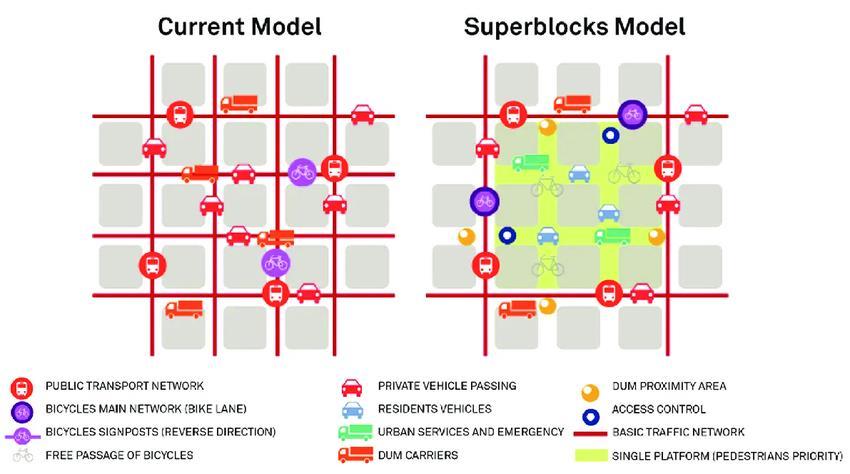
Fig -1:Superblockmodel
Source:AjuntamentdeBarcelona(CityofBarcelona).
Key Design Principles
In2014,Ruedadefinedthefollowingsevendesignprinciples for superblocks as part of the “city as a system of proportions”:
[1] Contextofurbanaction
[2] Landuseandurbanmorphology
[3] Urbanfunctionality
[4] Urbancomplexity
[5] Urbangreenandbiodiversity
[6] Metabolicefficiency
Features and Implementation
The entry of superblocks restricts traffic to only essential vehicleswithlocaldeliveryservice.Publicareasreceivenew functions because streets evolve into plazas followed by parksthenpedestrian-onlyzones.Theoutsideroadsenable cartrafficyetprotecttheinnerpedestrian-onlyzonesofthe superblocksystem.TheElPoblenouSuperblockofBarcelona successfully started operation in 2016 by decreasing pollutionwhilesupportingwalkingandcycling.
This innovative design approach led developers to create comparable projects throughout Los Angeles and Buenos Aires.BenefitsandPopularityDriversThedecreaseoftraffic emissions results in improved environmental conditions whichproducecleanerairintheenvironment.Noiseandair pollutioncontrolthroughthesechangesbringaboutbetter quality of life conditions for residents. Areas without vehiclesleadtobettercommunityrelationsthroughpublic participation along with enhanced social ties. The managementoftrafficfunctionstoreducecongestionalong withcarbonemissionamounts.
TheUrbantransformativeapproachesconsistofthecreation of frameworks which will be used for resolving the most pertinentcontemporaryurbanproblemsthroughaprocess ofurbantransformationthatestablishessustainableurban spacesresultinginlargeurbanareaswhichbringinclusion andresilience.Thetraditionalurbanplanningmethodsare excluded and are based on people-centered designs and environmental sustainability with incidents of social equality. The models join the infrastructure network with political, economic, and social activities as well as community engagement efforts to develop resilient cities responsivetotheneedsofthefuture.
Key Features
[1] ComprehensiveApproach.
[2] People-CentricDesign.
[3] CommunityEngagement.
[4] SustainabilityFocus
[5] ResilienceandAdaptability
[6] SocialEquityPromotion
Theurbantransformativemodeldemonstratesitselfthrough Superblocks by taking back public-access spaces from the urban fabric. Barcelona stands as the innovation origin of superblocks which combine traffic restrictions with pedestrian and cycling paths and city block-based green spaces.Superblocksimproveurbanlivingstandardsbecause theycutpollutionlevelswhilepromotingcommunitycontact andstrengtheningneighborhoodeconomicactivities.
The Potential of Implementing Superblocks for MultifunctionalStreet UseinCities- SvenEggimann
The research paper evaluates superblocks as a modern urban design approach which reduces automobile dependency to create sustainable walking and cycling ecosystems in communities. This paper examines Barcelona's model while it investigates urban issues connected with climate change along with pollution and healthproblems.Geospatialanalysistogetherwithnetwork methods from OpenStreetMap data allows researchers to locate suitable areas for superblocks and mini blocks through graph-based street network modeling. The evaluation uses Edmonds-Karp algorithm combined with nodedegreeandstreetlengthindicatorstoanalyzetraffic flow and urban mobility effects. Research indicates that cities with rectangular street patterns demonstrate better implementation potential since they contain between 1% and46%ofstreetssuitablefortransformation(MexicoCity and Atlanta represent the high and low ends). Irregular urbandesignscontainhigherproportionsofminiblocks.The analysispointstowardscurrentpedestrianareasassuitable locationsforincreasingcar-freespaces.Theresearchcenters onfindingtheenvironmentaladvantagesfromsuperblocks
International Research Journal of Engineering and Technology (IRJET) e-ISSN: 2395-0056
Volume: 12 Issue: 03 | Mar 2025 www.irjet.net p-ISSN: 2395-0072
together with public health benefits but also points out regulatory hurdles and community reception and traffic control issues. The authors propose that urban planning should use data to assist superblock implementation alongside ground testing of impacts in various urban environments.
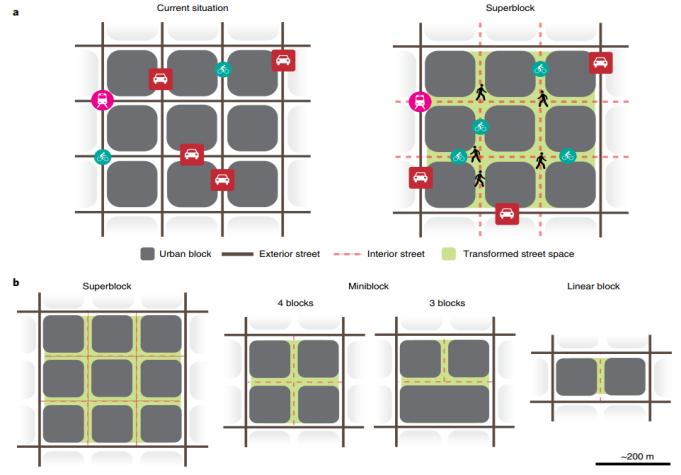
Fig -2: Schematic of superblock design. a, Barcelona superblock adopted from the urban mobility plan of Barcelona. Superblock design is characterized by exterior streetssurroundingurbanblocksandthetransformationof interior street space. b, The superblock design is further developed into similar urban configurations such as mini blocks or linear blocks Source: Natural sustainability researchpaper.
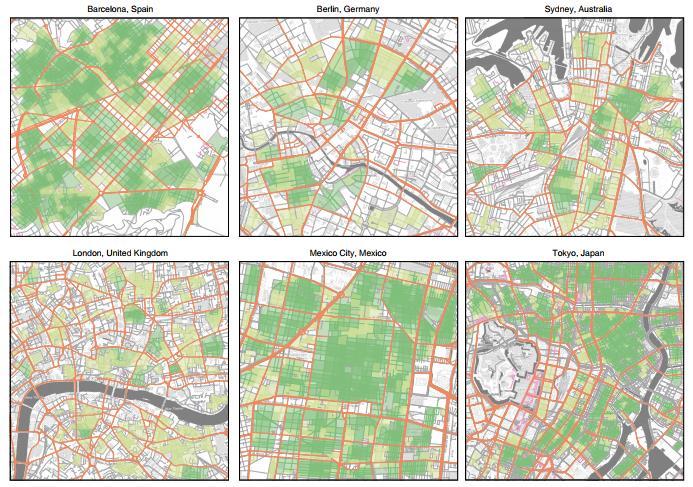
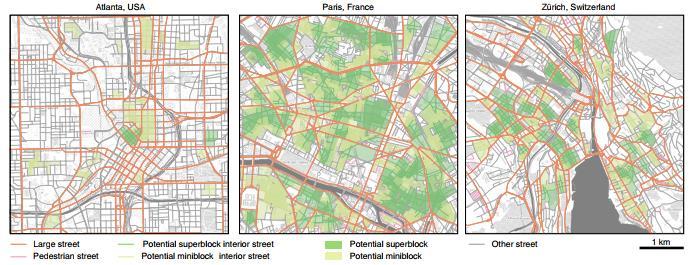
Fig -3: Modelled classification of the street network for selectedcities.source:Naturesustainabilityresearchpaper
Urban livability has become a pivotal concept in contemporary planning discourse, influencing long‐term policy goals and community initiatives across various governance levels. Academic and practical discussions recognizelivabilityasanassessmentofresidentlifequality acrossurbanenvironmentthatdemonstratesthefulfillment of residential physical, social and economic requirements. Multiple layers of sustainability assessment include open greenspaceswitheasyaccessandtop-levelpublicservice delivery and environmental protection alongside social connections and cultural environments and economic growth and efficient transportation capabilities. As local government officials and decision-makers adopt the livabilityconceptastheirdirective,thepracticeisfoundin several sub-fields such as transportation, community growth,andresilience,andtherebyconfirmstheimportance ofthisidealinsustainableandinclusiveurbanareaplanning.
Key components
[1] QualityofHousingandInfrastructure
[2] EnvironmentalQuality
[3] MobilityandTransportation
[4] SocialandCulturalAmenities
[5] EconomicOpportunities
[6] SafetyandSecurity
[7] SocialEquityandInclusion
Global Livability Index
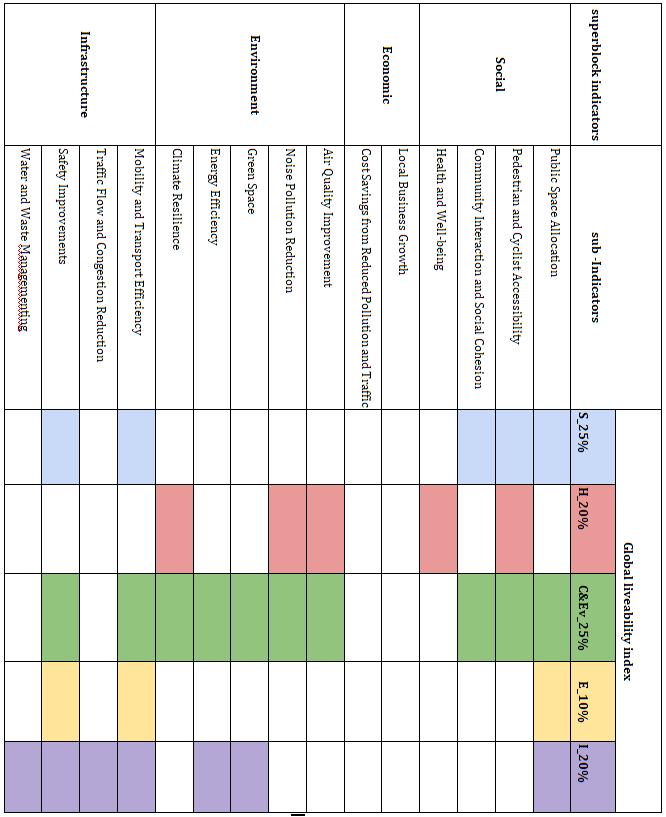
The Global Livability Index evaluates cities through evaluationoffivesubscalesincludingStability,Healthcare, CultureandEnvironment,Education,andInfrastructure.The variouscategoriesreceive weightvalueswhichdetermine the composite score measurements between 1 and 100 pointsthatreflectthequalityofliving.
[1] Stability(25%)
[2] Healthcare(20%)
[3] CultureandEnvironment(25%)
[4] Education(10%)
[5] Infrastructure(20%)
Barcelona: Evaluating the Impact of Superblocks on Urban Livability
Stability
Before the superblocks project Barcelona faced extreme traffic problems because 60% of public areas and 85% of roadsservedvehicleswhilepedestriansafetydeteriorated substantially.Thenewsuperblockdistributionpatterntook vehiclestoboundarystreetswhichcreatedfewertraveling carsby61%andalarger80%areadedicatedtopedestrians. The development of enhanced public areas created safer
International Research Journal of Engineering and Technology (IRJET) e-ISSN: 2395-0056
Volume: 12 Issue: 03 | Mar 2025 www.irjet.net p-ISSN: 2395-0072
spaces to walk and this improvement reduced accidents leadingtobettercommunityhealth.
Healthcare
The air pollution issue in Barcelona created 3,500 deaths each year Noise pollution together with small amounts of accessible green space intensified public health risks. The implementationofsuperblockssucceededinenhancingair quality levels. Residential exposure to noise pollution decreased to 73.5% despite an increase of acceptable air qualitylevelsreaching94%.Theintroductionofpedestrian and cycling networks through superblocks infrastructure helped people lead healthier lives through exercise and physicalactivity.
Urbanheatislandsincreasedcitytemperaturesbymorethan 2°C.Greenspaceswerelimitedandurbansettingsbecame lessattractivethroughouttheneighborhoods.Throughthe establishmentofSuperblockstheurbanenvironmentgained 403.7hectaresofgreenspacethusexpandingtheamountof greenspaceavailabletoeachresidentfrom2.7m²to6.3m². Public spaces which were 6.22 million m² increased both recreationalandculturalusagetopromotesocialcohesion amongresidents.Duetothewidedeploymentofpermeable surfacesalongwithnewplantingstreestheurbanheatisland effectdecreasedby35.9%.
Increased accessibility together with better school safety remained the principal outcomes of superblocks' implementation though these projects did not build new educationalfacilities.Theimplementationofwalkableroads combined with lowered transportation volume led to enhancedsafetyconditionsforstudentswhiletheywalkedto school.
The accessibility for pedestrians was severely restricted beforetheinterventionas15.8%ofstreetsweremeantfor pedestrianwalks.Thetransportation,busservicesoperated atfrequenciesrangingfrom14to15minutes.Thesuperblock implementation strategy created new pedestrian zones covering67.2%oftheareawhichboostedaccessconnectivity andactivemobility.Theimplementationofanorthogonalbus network shortened waits to2 minutes thus making public transitmoredependable.Electrictransportsystemsandtheir initiatives lowered carbon pollution in the urban environment.Boostedstormwaterinfrastructurecombined withheatreductionmeasuresstrengthenedtheurbanarea's resistancetochange.
Rapid urbanization and vehicular congestion along with deteriorating air quality create unheard-of difficulties for Indianurbancenterstoday.Scrutinizingroadstructuresand unregulatedcityexpansionledtodisruptedtransportation systemsandunsafewalkingconditionsandshrinkingpublic areasizes.TheplanningstrategyofSuperblockshasgained international momentum as a solution for the urgent combinationofissuesthatincludesimprovingwalk ability while decreasing traffic congestion and promoting sustainabletransportationsystems.Theresearchassessesif Superblocks can work in Indian cities, tier I cities (Ahmedabad,Bangalore,Pune,Kolkata,NewDelhi,Mumbai, Hyderabad, and Chennai) while identifying primary urban issues and reviewing policies that facilitate their implementation.
Theheavycongestionresultsfromexcessivedependence on private motor vehicles plus inadequate public transportationoptions.
Auto vehicle emissions play a major role in contaminatingtheairbecausepollutionlevelssurpass establishedguidelinesinnumerousurbanlocations.
International Research Journal of Engineering and Technology (IRJET) e-ISSN: 2395-0056
Volume: 12 Issue: 03 | Mar 2025 www.irjet.net p-ISSN: 2395-0072
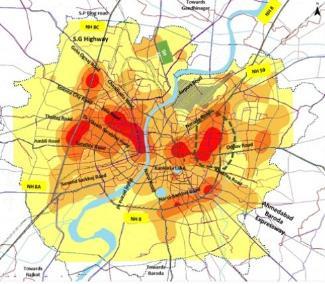
Source:ScienceDirect
2. Limited Pedestrian and Cycling Infrastructure
Unsafepedestrianareashaveoccurredfrombothahigh populationdensityaswellasmixinglandusage,leading totheinsufficientsidewalksandcyclinglanes.
Inthecaseofa roadaccident,pedestriansandcyclists arethemainvictimsduetoalackofwalkingpaths.
3. Unstructured Urban Growth and Land Use
Rapidurbanizationwithoutproperplanninghasgiven risetoinformalsettlements,thus,makingitdifficultto implementlarge-scaleurbanmobilitysolutions.
Land-use patterns frequently are conflicting with sustainable transportation solutions, which leads to ineffective transportation routes and growing dependenceoncars.
4. Lack of Green and Public Spaces
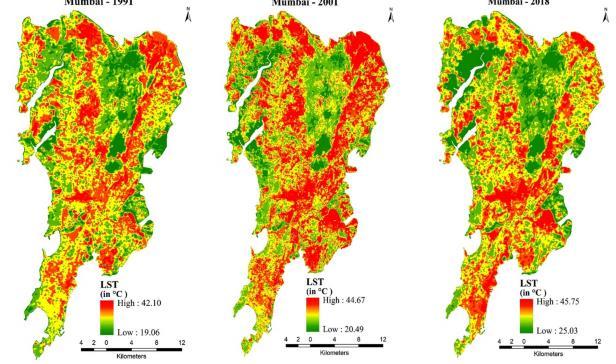
Indian cities battle with a severe shortage of green spaces,whichiscausedbytheuncontrolledconstruction andencroachmentofland.
Publichealthandcommunitywell-beingsufferfromthe lackofrecreationalspaces.
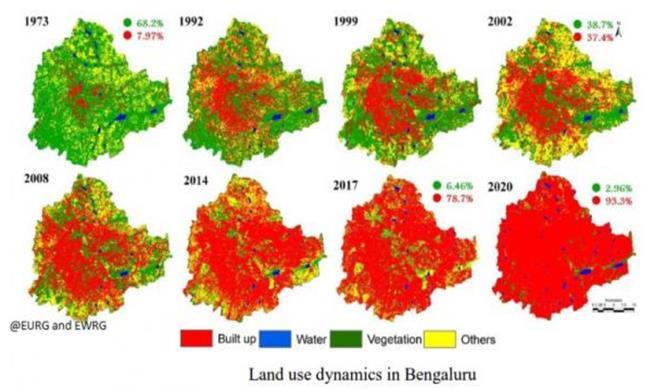
Fig -6:Decreasinggreencover-Bangalore.
Source:Researchgate
3.2 Policy support for superblock in India
Severalpoliciesandurbandevelopmentinitiativesprovidea foundationforimplementingtheSuperblockconcept:
1. National Urban Transport Policy (NUTP)
Fosteringthesustainableandintegratedurbantransport planning that has an emphasis on public transport and activetravel.
Active transportation and pedestrian-friendly infrastructural and mixed-use development are the primarysolutionstothereductionofthevehicleaddictive behavior.
2. Smart Cities Mission
Prioritizes improved urban mobility, non-motorized transport,andsustainableland-useplanning.
Encourages to integrate walkable neighborhoods and openspacesintodevelopmentplans.
3. Gati Shakti National Master Plan
Enhancemultimodalconnectivityandefficientland-use planning.
Supportstheintegrationoftransportinfrastructurewith urbandevelopmentinitiatives.
4. Streets for People Challenge
LaunchedbytheMoHUAtopromotepedestrian-friendly streetdesignandurbanmobilitysolutions.
Encouragescitiestocreatecar-freezonesandprioritize publicspaces.
5. State and City-Level Urban Mobility Plans
Adopted policies that encourage walkable neighborhoodsandreducedcardependency.
InitiativessuchasBengaluru’sTenderSUREprojectand Delhi’spedestrianizationplansalignwiththeprinciples ofSuperblocks.
Volume: 12 Issue: 03 | Mar 2025 www.irjet.net p-ISSN: 2395-0072
To implement the Superblock model in Indian cities, the various difficulties faced owing to urban density, land use patterns,theinformal economy,andlimitedinfrastructure should be resolved. The limited space further necessitates thatmicro-Superblocksbecreatedintwoormorephasesin order to ensure their feasibility. Mixed land use should be accommodatedviaflexiblezoningandpedestrian-oriented areas,whiletheinformaleconomyshouldbeaddressedby designatingvendorzonesthatdonotadverselyaffecturban inclusivity.Strategiesemployedinthehandlingofthetraffic problem should include traffic-calming measures and the provision of perimeter parking. Public transport and connectivity require the installation of multimodal integration and last-mile mobility solutions so as to be effective.Communityengagementisasignificantaspectthat entailsinformingthepublicthroughawarenesscampaigns and pilot projects involvingthe communityto gather their feedback. Open spaces that are sustainable need to be developed, e.g. parks, green corridors, and green neighbourhoods. Access and parking control mechanisms shouldincludesmartsystemstoregulateentryandensure that parking areas can be located easily. By designing business-friendly setups that also monitor vendor and deliveryaccess,economic sustainabilitybecomesthemain thing to obtain. In order to accommodate the needs of differentsocioeconomicandculturalgroups,spaceneedsto becreatedasaculturalplaceandknowledgeexchangepoint. Maintenance and monitoring efforts need to be supported through the use of digital platforms that give real-time feedbackandenablecommunity-ledactivities.
Therecommendationsfortheimplementationofsuperblock modelinIndiancities.
Developingintegratedmultimodaltransportrouteswith protected bike lanes and well-lit pedestrian walkways is recommended to improve urban mobility. Enhancing accessibility will require the expansion of public transportationsystemswithsmoothlinkagesbetweenbus, rail,andmetrohubs.Adaptivesuperblockpatterns,like2x2 blockdesigns,canbeusedtomaximizepedestrianandtraffic flow.Transitioningfromhigh-capacitypublictransportation to pedestrian-friendly areas will be easier with the establishment of entrance points that are accessible by transit.Includingmicro-mobilitysolutions,suchaselectric bicyclesandscooters,willalsoimprovelast-mileconnection. Lastly,thecreationofparkingzonesaround theperimeter willaidinreducingtrafficintheheartofthecityalongwith real-TimeInformationtechnologytoplanjourneysefficiently.
Theimplementationofadaptivezoningrestrictionsthat promotemixed-usezonesandself-sufficientneighborhoods is advised in order to improve urban planning and sustainability. Encouraging mixed-use developments will facilitate the integration of commercial, residential, and recreational areas, lowering the need for travel and promotingwalkability.Additionally,incorporatingclimateresilientdesignfeaturesandallocatingdedicatedareasfor green spaces, parks, and recreational zones will improve environmental sustainability and community well-being. Densification promotion will promote more effective infrastructuredevelopmentandfurtheroptimizelandusage.
Ensuringaccessibilityandinclusivityforallwhilecreating spaces that encourage gathering, interaction, and collaborationisessentialfordevelopingmoreengagingand inclusivepublicspaces.Topromoteasenseofownershipand community involvement, public participation should be incorporated into all phases, including decision-making, implementation,andmonitoring.Additionally,effortsshould focus on developing vibrant communities by promoting cultural activities and social programs within superblock zones,enhancingcommunityengagementandstrengthening socialconnections.
Specialized spaces for street vendors and small-scale businessesshouldbecreated,placedtodrawfoottraffic,in order to boost economic opportunities and support local businesses. Public areas will be further activated by the installationofstreetfurniturethatisflexibleandadaptable, as well as kiosks for food vendors and pop-up markets. Additionally, ensuring equitable access for street vendors throughstructuredlicensing,designatedvendingzones,and essentialamenitiessuchasstorageandwastedisposalwill createamoreinclusiveandsustainableurbanenvironment.
Low-Impact Development strategies, such permeable pavementsandraingardensinsidesuperblocks,areadvised toimprovesustainabilityandurbanresiliencebyefficiently managingrainwaterandreducingrunoff Integratinggreen rooftopsandverticalgardensonbuildingswillhelpabsorb CO₂ and reduce overall energy consumption. Climateresponsive design should be prioritized by incorporating native vegetation and shade-providing structures in open spacestomitigateheat.Additionally,theuseoflandscaping and sound barriers along perimeters can minimize noise pollutionfrombusyroads,fosteringaquieterandhealthier environment. By using high-albedo materials on building exteriors and pavements, urban heat island effects can be
International Research Journal of Engineering and Technology (IRJET) e-ISSN: 2395-0056
Volume: 12 Issue: 03 | Mar 2025 www.irjet.net p-ISSN: 2395-0072
minimizedandheatabsorptioncanbefurtherdecreased.The enhancement of urban greenery should involve the conversion of certain streets and parking lots into parks, green corridors, and community gardens. Lastly, incorporatingfitnesszones,joggingtracks,andopengyms willencourageactivelivingandpromoteoverallwell-being.
Utilize Using GIS and urban data analytics for spatial optimization and ongoing monitoring is recommended to improveurbanplanningandmanagement.Thedevelopment ofdigitalplatformsandapplicationscanimproveaccessibility and efficiency by offering real-time information about amenities, services, and transportation. Integrating IoT sensors within superblocks will enable the monitoring of traffic patterns, pollution levels, and energy consumption, contributing to data-driven decision-making. Additionally, implementingsmartcitytechnologieswilloptimizeresource management and facilitate performance evaluation. To guarantee that stakeholder and resident input is actively integrated into urban development strategies, interactive feedbacksystemsshouldbeestablished.
This research highlights the superblock concept's transformative potential in improving urban liveability, especially in Indian cities. Superblocks provide a feasible solutiontocriticalurbanissuesliketrafficcongestion,noise and air pollution, a lack of green spaces, and declining pedestriansafetybyrearrangingurbanlayoutstoprioritize pedestrians, public spaces, and sustainable modes of transportation.
Based on international case studies, findings demonstrate how superblocks can greatly enhance important urban livabilitymetrics,suchassocialintegration,mobility,safety, andenvironmentalquality.Implementingthisapproachin Indiancities,however,willinvolveaddressinganumberof real-world obstacles, including an extensive reliance on motor vehicles, fragmented urban government, socioeconomicinequality,andinadequateinfrastructure. Anstrongfoundationforintegratingsuperblocksisprovided by current regulations in Indian cities, such as those pertaining to transit-oriented developments, pedestrianfriendlystreetinitiatives,andurbangreeninginitiatives.But forthemtobesuccessful,theseregulationsmustbealigned with an integrated framework for urban planning that prioritizes sustainability, equity, and community engagement.
Accordingtothestudy'sfindings,superblockshavealotof potentialforIndiancities,buttheirdeploymentrequiresa flexible and phased strategy. If the superblock model is carefully modified, it might completely transform Indian cities,makingthemmorelivable,sustainable,andresilientto futurechallenges.
[1] SvenEggimann,(2022),Thepotentialofimplementing superblocks for multifunctional street use in cities, nature sustainability | VOL 5 | May 2022 | 406–414. https://doi.org/10.1038/s41893-022-00855-2.
[2] Ajuntament de Barcelona. Superblocks.https://ajuntament.barcelona.cat/superille s/en/ Accessed 28 January 2024 Lopez, ´ I., Ortega, J., Pardo, M., 2020. Mobility infrastructures in cities and climate change:ananalysisthroughthesuperblocksin Barcelona.Atmosphere11(4),410
[3] MarkNieuwenhuijsena,b,c,*,AudreydeNazelle,(2024), TheSuperblockmodel:Areviewofaninnovativeurban model for sustainability, liveability, health and wellbeing. Environmental Research 251 (2024) 118550. https://doi.org/10.1016/j.envres.2024.118550
[4] Superblocks: the strategy that will change cities foreverhttps://www.urbanteo.com/urbantoolkit/superblocks
[5] https://www.researchgate.net/publication/345363211 _Understanding_liveability_related_concepts_and_definit ions#full-text
[6] Rueda,S.(1995).EcologiaUrbana:Barcelonailaseva RegióMetropolitanacomareferents.Ed.
[7] Beta Editorial.Rueda, S., et al. (2012). Ecosystemic UrbanismCertification.Ed.BCNecologia.
[8] Palencia,KatherinePerez,Gloria,2021.Reportofresults of the environmental andhealth effects of the Superblocks model in Barcelona. In: Salut Als Carrers (SAC) Project. Ag`encia de Salut Pública de Barcelona, Barcelona.
[9] BiaaniLeon-G´omez,´B.,Pal`encia,L.,P´erez,C.,2020. Methodological guide for theevaluation of the environmental and health effects of the Superblocks model inBarcelona. In: Salut as Carrers (Health in the Streets)Project.Ag`enciadeSalutPúblicadeBarcelona, Barcelona.
[10] Barcelona meeting (2023). Accessed Feb 2, 2024. https://www.barcelona.cat/en/noticia/barcelonasuperblock-international-meeting-22-to-25march_1265393.
[11] BCNEcologia202320yearsofurbanecologyagency in Barcelona https://bcnroc.ajuntament.barcelona.cat/jspui/bitstrea m/11703/122999/3/BCNecologia_20%20years_ENG.pd fAccessed5October2023.