
International Research Journal of Engineering and Technology (IRJET) e-ISSN: 2395-0056
Volume: 13 Issue: 03 | Mar 2026 www.irjet.net p-ISSN: 2395-0072

International Research Journal of Engineering and Technology (IRJET) e-ISSN: 2395-0056
Volume: 13 Issue: 03 | Mar 2026 www.irjet.net p-ISSN: 2395-0072
Baskaran T1, Suresh B2, Mohan S K3, Ganesh B4
1Research Scholar, Department of Chemical Engineering, Annamalai University, Tamilnadu, India
2Professor, Department of Chemical Engineering, Annamalai University, Tamilnadu, India
3Professor, Department of Chemical Engineering, The Kavery Engineering College, TN, India
4Asst.Professor, Department of Chemical Engineering, Adhiparasakthi Engineering College, TN, India
Abstract - Manufacturing industries involve complex production processes characterized by high-risk operations, heavy machinery, and hazardous materials. These environmentsexposeworkerstosignificantoccupationalrisks that may result in injuries, equipment damage, and operationaldisruptions.Thisstudyevaluatestheeffectiveness of Safety Management Systems (SMS) in manufacturing industries using statistical analysis and a case study of a medium-scale manufacturing plant. Accident data from 2017–2023wereanalyzedtoexaminetheimpactofstructured safety management practices. The results indicate a significant reduction in workplace incidents following SMS implementation.Thestudyalsoproposesanintegratedsafety managementframeworkanddemonstrates 62.7%reduction in workplace incidents after SMS implementation, and improvements insafetyperformance indicators
Key Words: Safety Management System, Manufacturing Safety, ISO 45001, Occupational Safety, Industrial Accidents, Risk Management
Manufacturingindustriesrepresentoneofthemostcritical sectors of economic development. However, industrial environments present numerous safety hazards including mechanicalfailures,electricalrisks,chemicalexposure,and human-machineinteractionrisks.Workplaceaccidentsnot only endanger employees but also lead to productivity losses,financialliabilities,andreputationaldamage.
Traditional safety management approaches focused primarilyonreactivemeasures,addressingaccidentsonly after they occurred. Modern safety practices emphasize proactivehazardidentificationandsystematicriskcontrol. StructuredSafetyManagementSystemssuchasISO45001 provide systematic approach to managing occupational hazards.
Dyreborg(2024)[1]reportedthatcompaniesimplementing formalsafetymanagementsystemsexperiencedsubstantial improvementsinworkplacesafetyperformance.
Joo(2023)[2]foundthatorganizationsadoptingISO-based safety systems reported improved safety awareness and reducedworkplaceincidents.
Yoon(2013)[3]indicatesthatsafetymanagementsystems significantly influence accident prevention by promoting continuous monitoring and improvement of safety processes.ThesefindingssuggestthatSMSimplementation canbeacriticalfactorinimprovingsafetyperformancein manufacturingindustries.
Chatzoglou (2022) [4] emphasized the importance of leadership commitment and worker participation in achieving effective safety management outcomes. Organizations that actively involve employees in safety activities tend to experience improved safety culture and higherincidentreportingrates.
However,theeffectivenessofsafetymanagementsystems depends on factors such as management commitment, worker participation, safety training programs, and continuoussafetymonitoring.
Although previous research supports the effectiveness of safety management systems, empirical case studies evaluating their real-world impact in manufacturing environmentsremainlimited.Thisstudyaddressesthisgap by analyzing accident data before and after SMS implementation.
This study uses a quantitative research design combined withacasestudyapproachtoevaluatetheeffectivenessof safetymanagementsystems.Accidentrecords,safetyaudits, trainingreports,incidentinvestigationreports,andworker safety surveys were analyzed to evaluate safety performance. Key indicators included Lost Time Injury FrequencyRate(LTIFR),totalincidents,andsafetytraining participation.
Pant Profile:
Industry:AutomotiveComponentManufacturing
Employees:450
ProductionUnits:Machining,Assembly,Finishing
SafetyStandard:ISO45001-basedSMS
International Research Journal of Engineering and Technology (IRJET) e-ISSN: 2395-0056
Volume: 13 Issue: 03 | Mar 2026 www.irjet.net p-ISSN: 2395-0072
Pre-Implementation Challenges:
PriortoSMSimplementation,theplantfacedseveralissues:
Inadequatehazardidentification
Limitedsafetytraining
Poorincidentreporting
Lackofsafetyaudits
SMS Implementation Strategy:
Keymeasuresimplementedincluded:
Safetypolicyformulation
Hazardidentificationandriskassessmentprogram
Monthlysafetyaudits
Workersafetytrainingprograms
Incidentreportingsystem
Safetyperformancemonitoringdashboard
Accident Trend Analysis:
Table -1: AccidentDatafrom2017-2023
This figure demonstrates a clear reduction in workplace accidents after the safety management system was implementedintheyear2000.
Statistical Analysis: Incident Reduction Percentage: Incidentreductioniscalculatedusing:
InitialIncidents−FinalIncidents×100 InitialIncidents Reduction=67-25x100=67.25%
67
The analysis indicates that accident rates decreased by 62.7%afterSMSimplementation.
Lost Time Injury Frequency Rate Analysis (LTIFR):
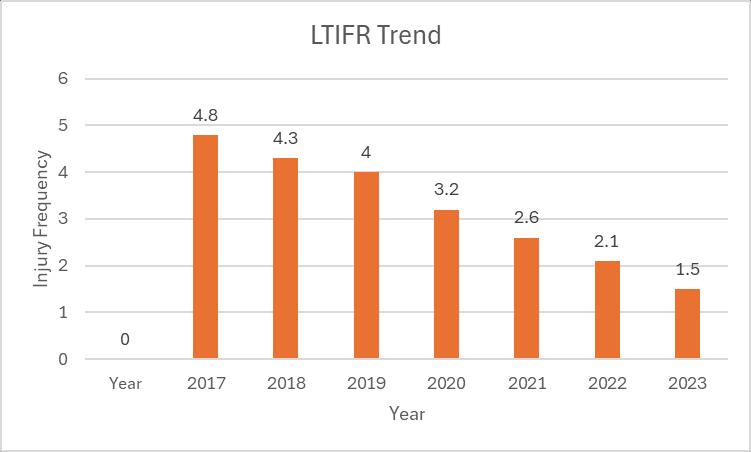
This chart shows a consistent decline in accident frequencyafterSMSimplementation.
Safety Training Participation:

The data indicates that increased safety training participationcontributedtoimprovedsafetyawarenessand reducedaccidentrates.
Safety Culture Improvement:
Workersurveysrevealedimprovementsinsafetyculture.
Table -2: Safety Culture
SafetyCultureSurvey
Indicator BeforeSMS AfterSMS Managementcommitment 52% 86%
Volume: 13 Issue: 03 | Mar 2026 www.irjet.net p-ISSN: 2395-0072
Theevaluationofsafetyperformanceindicatorsbeforeand aftertheimplementationoftheSafetyManagementSystem (SMS) demonstrates substantial improvements in occupational safety outcomes within the manufacturing facility.Accidentrecordscoveringtheperiodfrom2017to 2023revealacleardownwardtrendinworkplaceincidents, losttimeinjuries,andaccidentfrequencyrates.
Prior to the implementation of the structured safety managementsystem,theorganizationexperiencedrelatively high accident frequencies due to inadequate hazard identificationprocedures,limitedworkersafetytraining,and reactiveincidentmanagementpractices.Theintroductionof asystematicsafetyframeworksignificantlyimprovedrisk identification,safetyawareness,andoperationaldiscipline.
The analysis of safety performance data reveals several importantfindings:
1. Workplace incidents decreased by approximately 62.7%afterSMSimplementation.
2. LostTimeInjuryFrequencyRatedecreasedbynearly 68%duringthestudyperiod.
3. Safety training participation increased from 33% to 93%,improvingworkerawareness.
4. Hazard identification procedures significantly improvedworkplaceriskcontrol.
5. Safetycultureindicatorsshowedstrongimprovement inworkerengagementandmanagementcommitment.
Thesefindingsprovidestrongempiricalevidencesupporting the effectiveness of safety management systems in improvingoccupationalsafetyoutcomesinmanufacturing environments.
ThedecliningtrendreductioninLTIFRvaluesreinforcesthe conclusionthatthesafetyinterventionsimplementedwithin theorganizationwereeffectiveinreducingtheseverity of workplaceinjuries. Inaddition,safetyinspectionsandaudits conductedatregularintervalsenabledtheidentificationof unsafeconditionsbeforeaccidentscouldoccur.
Another contributing factor was the introduction of standardizedworkproceduresandjobsafetyanalysis(JSA) for critical operations. These procedures ensured that workers were aware of potential hazards associated with their tasks and were trained to follow safe operating practices.
The study demonstrates that Safety Management Systems play a crucial role in improving occupational safety performance in manufacturing industries. The case study confirmsthatsystematicimplementationofsafetypolicies, risk assessment procedures, employee training, and continuousmonitoringcansignificantlyreduceworkplace incidents.
Keyfindingsinclude:
1. SMS implementation resulted in a 62% reduction in accidents.
2. Losttimeinjuryfrequencyratedecreasedsignificantly overfiveyears.
3. Workerparticipationandleadershipcommitmentwere keyfactorsinfluencingsafetyperformance.
Manufacturing industries should adopt comprehensive safety management frameworks such as ISO 45001 and Future research should focus on integrating artificial intelligenceandpredictiveanalyticsintosafetymanagement systemstofurtherenhanceaccidentpreventionstrategies.
[1] Dyreborg, J. et.al., Effectiveness of OHSAS 18001 in reducing accidents at work, Safety Science, vol. 177, 2024,106573, https://doi.org/10.1016/j.ssci.2024.106573
[2] Ikhyun Joo, Kyungmin Baek, The consequences of ISO 45001, Journal of Occupational Health, vol.66, No.1,2024,https://doi.org/10.1093/joccuh/uiad007
[3] Yoon, S.J., Lin, H.K., Chen, G., Yi, S., Choi, J. and Rui, Z, Effect of Occupational Health and Safety Management System on Work-Related Accident Rate. Safety and HealthatWork,vol.4,2013,pp.201-209.
[4] Prodromos D. Chatzoglou, Athanasios E. Kotzakolios, and Panagiotis K. Marhavilas, Health and Safety Management System (HSMS) and Its Impact on EmployeeSatisfactionandPerformance-ANewHSMS Model,Safety,vol.11,No.2,2025,pp.52 https://doi.org/10.3390/safety11020052
[5] InternationalLabourOrganizationWorldDayforSafety and Health at Work 2025, ISBN 9789220417706 DOI:https://doi.org/10.54394/KNZE0733
[6] Bandar Saad Alshreef, The ISO 45001: A systematic review of global adoption trends, outcomes, and barriers, International Journal of Innovative Research andScientificStudies,vol.8,no.5,2025,pp.1127-1136
International Research Journal of Engineering and Technology (IRJET) e-ISSN: 2395-0056
Volume: 13 Issue: 03 | Mar 2026 www.irjet.net p-ISSN: 2395-0072
[7]Musungwa,T.,&Kowe,P,Effectsofoccupationalhealth and safety management systems implementation in accident prevention, Cogent Engineering, vol.9, no.1, 2022. https://doi.org/10.1080/23311916.2022.2124638
[8] Lee J, Jung J, Yoon SJ, Byeon SH. Implementation of ISO45001, Safe Health Work., vol.11.no.4. 2020, pp. 418-424.
© 2026, IRJET | Impact Factor value: 8.315 | ISO 9001:2008 Certified Journal | Page2082