
International Research Journal of Engineering and Technology (IRJET) e-ISSN: 2395-0056
Volume: 13 Issue: 04 | Apr 2026 www.irjet.net p-ISSN: 2395-0072
International Research Journal of Engineering and Technology (IRJET) e-ISSN: 2395-0056
Volume: 13 Issue: 04 | Apr 2026 www.irjet.net p-ISSN: 2395-0072
Nihal1 and Hemant Sood1*
1Department of Civil Engineering, National Institute of Technical Teachers Training (NITTTR), Sector 26, Chandigarh, India-160019
Abstract - This study investigates the influence of TiO₂ nanoparticles and TiO₂/gCN nanocomposite on the mechanical properties of M30 grade concrete. TiO₂ nanoparticles were synthesized using the sol–gel method, while graphitic carbon nitride (gCN) was prepared via thermal polycondensation. The TiO₂/gCN nanocomposite was fabricated through physical mixing and ultrasonication. Concrete specimens were prepared by replacing 1% of cement with nanomaterials. Mechanical properties including compressive strength, split tensile strength, and flexural strength were evaluated at 7 and 28 days. Results indicate that nanomaterial incorporation significantly enhances the strength characteristics of concrete. The TiO₂/gCN-modified concrete exhibited the highest improvement with compressive strength increases of about 13.22% at 7 days and 13.53% at 28 days. Similarly, split tensile strength improved by approximately 14.37% at 7 days and 6.94% at 28 days, while flexural strength increased by about 13.92% at 7 days and 11.07% at 28 days. The enhancement is attributed to improved particle packing, pore refinement, and accelerated hydration due to the nano-filler effect.
Keywords- Nanoconcrete, TiO₂, gCN, Mechanical strength, Compressive strength, Split tensile strength, Flexural strength
Concrete is the most widely used construction material in the world due to its versatility, availability of raw materials, and relatively low cost [1]. However, despite its widespread application, conventional concrete exhibits certain inherent limitations,particularlyintermsoftensilestrength,brittleness,anddurability [2].Thepresenceofmicrocracks,pores,anda weak interfacial transitionzone (ITZ) between cement pasteandaggregates often leadsto reduced mechanical performance and premature structural deterioration [3]. Therefore, enhancing the mechanical properties of concrete has remained a key areaofresearchincivilengineeringmaterials.
In recent years, nanotechnology has emerged as a promising approach to overcome these limitations by modifying the microstructure of cementitious materials at the nanoscale [4]. Nanomaterials possess extremely small particle size and high specific surface area, which enables them to act as effective fillers and nucleation sites within the cement matrix [5]. Among various nanomaterials, titanium dioxide (TiO₂) has gained significant attention due to its chemical stability, high reactivity, and ability to enhance hydration processes [6]. When incorporated into concrete, TiO₂ nanoparticles can accelerate the formation of hydration products such as calcium silicate hydrate (C–S–H), resulting in improved density and strength of the matrix[7].
Furthermore,theincorporationofhybridnanocompositeshasshownevengreaterpotentialinimprovingconcreteproperties. Graphitic carbon nitride (gCN), a two-dimensional layered material, when combined with TiO₂, forms a TiO₂/gCN nanocompositethatofferssynergisticeffects.ThelayeredstructureofgCNprovidesalargesurfaceareaand facilitatesbetter dispersionofTiO₂ nanoparticles,thereby enhancingtheoverallinteraction withinthecement matrix [8].This hybridsystem notonlyimprovesparticlepackingbutalsostrengthenstheinterfacialbondingbetweencementpasteandaggregates,leading toimprovedmechanicalperformance.
The improvement in concrete strength due to nanomaterials can be attributed to multiple mechanisms, including the nanofillereffect,porerefinement,andacceleratedhydrationkinetics.Thenano-fillereffecthelpsinfillingmicrovoidsandreducing porosity,whilethenucleationeffectpromotestheformationofadditionalhydrationproducts.Thesecombinedeffectsleadto
International Research Journal of Engineering and Technology (IRJET) e-ISSN: 2395-0056
Volume: 13 Issue: 04 | Apr 2026 www.irjet.net p-ISSN: 2395-0072
adensermicrostructure,improvedloadtransfer,andenhancedresistancetocrackinitiationandpropagation [9].Asaresult, bothcompressiveandtensile-relatedpropertiessuchassplittensileandflexuralstrengtharesignificantlyimproved.
In this context, the present study aims to investigate the effect of TiO₂ nanoparticles and TiO₂/gCN nanocomposite on the mechanical properties of M30 grade concrete. The study focuses on evaluating compressive strength, split tensile strength, and flexural strength at different curing ages (7 and 28 days). By comparing the performance of plain and nanomodified concrete,theresearchseekstoestablishtheeffectivenessofnanomaterialincorporationasaviablestrategyforenhancing the structuralperformanceofconcrete.
2.1.
Thenanomaterialsusedinthisstudy,namelyTiO₂nanoparticlesandTiO₂/gCNnanocomposite,weresynthesizedusingwellestablished chemical routes to ensure high purity and uniformity. TiO₂ nanoparticles were prepared via the sol–gel method usingtitaniumisopropoxideastheprecursor.Initially,ahomogeneoussolutionofdeionizedwater,ethanol,andglacialacetic acid was prepared and stirred to ensure proper mixing. Titanium isopropoxide was then added dropwise under continuous stirring,allowinghydrolysisandpolycondensationreactionstooccur,leadingtotheformationofastablesol.Themixturewas further stirred for an extended duration to promote particle growth and stabilization. The resulting precipitate was filtered, washed with deionized water and ethanol to remove impurities, and subsequently dried at moderate temperature to obtain fineTiO₂ nanoparticles.Graphiticcarbon nitride(gCN) wassynthesized separately bythermal polycondensationof urea in a mufflefurnaceatelevatedtemperature(around550°C)forseveralhours,resultinginalayeredyellowpowderstructure.The TiO₂/gCN nanocomposite was then prepared by physically mixing equal proportions of TiO₂ and gCN in deionized water followed by probe ultrasonication to ensure uniform dispersion and intimate interfacial contact. The mixture was filtered, dried,andfinelygroundtoobtainahomogeneousnanocompositepowder,whichwasusedforfurtherconcretepreparation.
The concrete specimens were prepared using M30 grade mix designed as per IS 456:2000 and IS 10262:2019 guidelines. OrdinaryPortlandCement(OPC43grade),fineaggregates(ZoneIIsand),andcoarseaggregates(20mmnominalsize)were used along with a superplasticizer (Conplast 430-G8) to achieve the desired workability. The water–cement ratio was maintained at 0.40. For nanomodified mixes, 1% of cement (by weight) wasreplaced with TiO₂ nanoparticles and TiO₂/gCN nanocomposite, respectively. The nanomaterials were first dispersed in mixing water using ultrasonication to minimize agglomerationandensureuniformdistributionwithinthecementmatrix.Themixingprocessinvolveddrymixingofcement andaggregatesfollowedby gradualadditionofthe nanomaterial-containingwaterandadmixturetoachievea homogeneous mix. The fresh concrete was then poured into standard moulds of cubes, cylinders, and beams for compressive, split tensile, and flexural strength tests, respectively. Proper compaction was ensured using vibration to eliminate entrapped air. After casting,thespecimenswerecoveredtopreventmoisturelossanddemouldedafter24hours.Thedemouldedspecimenswere cured in water under controlled conditions for 7 and 28 days. This systematic preparation ensured uniform dispersion of nanomaterialsandconsistentdevelopmentofmechanicalpropertiesinthehardenedconcrete.
3.1. Compressive strength Analysis
Thevaluesofcompressivestrengthforplainandnanomaterial modifiedconcrete were testedafter7 days andafter 28days (Figure1and2).Inthecase ofplainM30concrete,the recordedindividual 7-daystrengths were24.82MPa,26.17MPaand 25.49MPagivinganaverageof25.49MPawhereasthe28daysstrengthswere37.18MPa,38.63MPaand39.07MPagivingan averageof38.29MPa.Thecomparativelylowdifferencebetweenthethreespecimensshowsthattherewereaconsistentmix, casting,curing,andtestingofthespecimens.For1%TiO₂/M30concrete,the7daysstrengthsof26.47MPa,27.83MPa,27.12 MPayieldedanaverageof27.14MPa,whilethe28daysstrengthswere40.23MPa,41.47MPaand40.82MPawithanaverage of40.84MPa,whichisclearlyhigherthanthecontrolmix(plainM30concrete).Similarly,1%TiO₂/gCN/M30concretegave7daystrengthsof28.23MPa,29.48MPaand28.86MPawiththemeanof28.86MPaand28-daystrengthsof42.83MPa,44.12
International Research Journal of Engineering and Technology (IRJET) e-ISSN: 2395-0056
Volume: 13 Issue: 04 | Apr 2026 www.irjet.net p-ISSN: 2395-0072
MPa and 43.47 MPa, respectively (with average value 43.47 MPa). The increase in compressive strength due to nanomodificationstothemixesmaybeattributedtothemicro-fillereffectandsubsequentdensificationofthematrix,whichhelp inensuringimprovedtransferofloadsandinternalreductionoftheinternalvoids,whichincreasesthecompressivecapacity oftheconcrete[10].
Theincreaseincompressivestrengthnoticedinnanomaterialmodifiedconcreteinthecurrentstudyagreeswiththeavailable literature. The study by He et al. [11] has shown that the addition of TiO2 nanoparticle initially increases the strength of concrete through micro- fill ability which amounts to dense microstructure inside the concrete. They found that when 3% percent TiO2 were added, their data showed an approximate 5% in strength and this was mainly due to the fact that the nanoparticles had been found to fill the micro-voids and enhance the packing of particles. Further improvement in strength duetotheincorporationofnanomaterialshavebeenattributedtotheeffectofnucleationinthehydrationofcement.Visaliet al. [12] found that addition of ZnO nanoparticles raised the density of concrete to a peak of 31.2 per cent of compressive strength of M25 cement after 28 days of curing. They credited this enhancement to the fact that ZnO nanoparticles acted as nucleationsitesofhydrationproducts,hence,enhancingspeedintheformationofcalciumsilicatehydrate(C-S-H).Similarly, Heikal et al. [13] demonstrated that 1% nano-Fe2O3 reacts with calcium hydroxide (C-H) to produce nano-reinforced hydration products which increase the density of the microstructure and significantly enhance compressive strength. In addition, unreacted nanoparticles serve as extra nuclei of C-S-H in the formation of hydration in the pore structure. Mechanistic findings made by Sarkar et al. [14] also support the contribution of nanomaterials to the modification of microstructure of cementitious systems. In their effort, they found that the V2O5 addition was favorable in facilitating the formation of needle-shaped nano- scale mullite structures, which enhanced the concrete by increasing the level of microstructuralbondingandphasetransformation.Thenanomaterialusedinthecurrentresearchisdifferenthowever,thenature oftheconceptofdensifyingthemicro-structureandenhancingbondingwithinthematrixisalsosimilar.
International Research Journal of Engineering and Technology (IRJET) e-ISSN: 2395-0056
Volume: 13 Issue: 04 | Apr 2026 www.irjet.net p-ISSN: 2395-0072
Figure1:ComparativecompressivestrengthresultsofplainM30,TiO₂/M30,andTiO₂/gCN/M30concrete cubeshowing(a)7-daycuringstrength,(b)28-daycuringstrength,and(c)correspondingaverage compressivestrengthvalues.
International Research Journal of Engineering and Technology (IRJET) e-ISSN: 2395-0056
Volume: 13 Issue: 04 | Apr 2026 www.irjet.net p-ISSN: 2395-0072 © 2026, IRJET | Impact
Table1: Comparative7daysand28dayscompressivestrengthresultsofplainM30,TiO₂/M30,andTiO₂/gCN/M30concrete cube. Sr.No.
1.
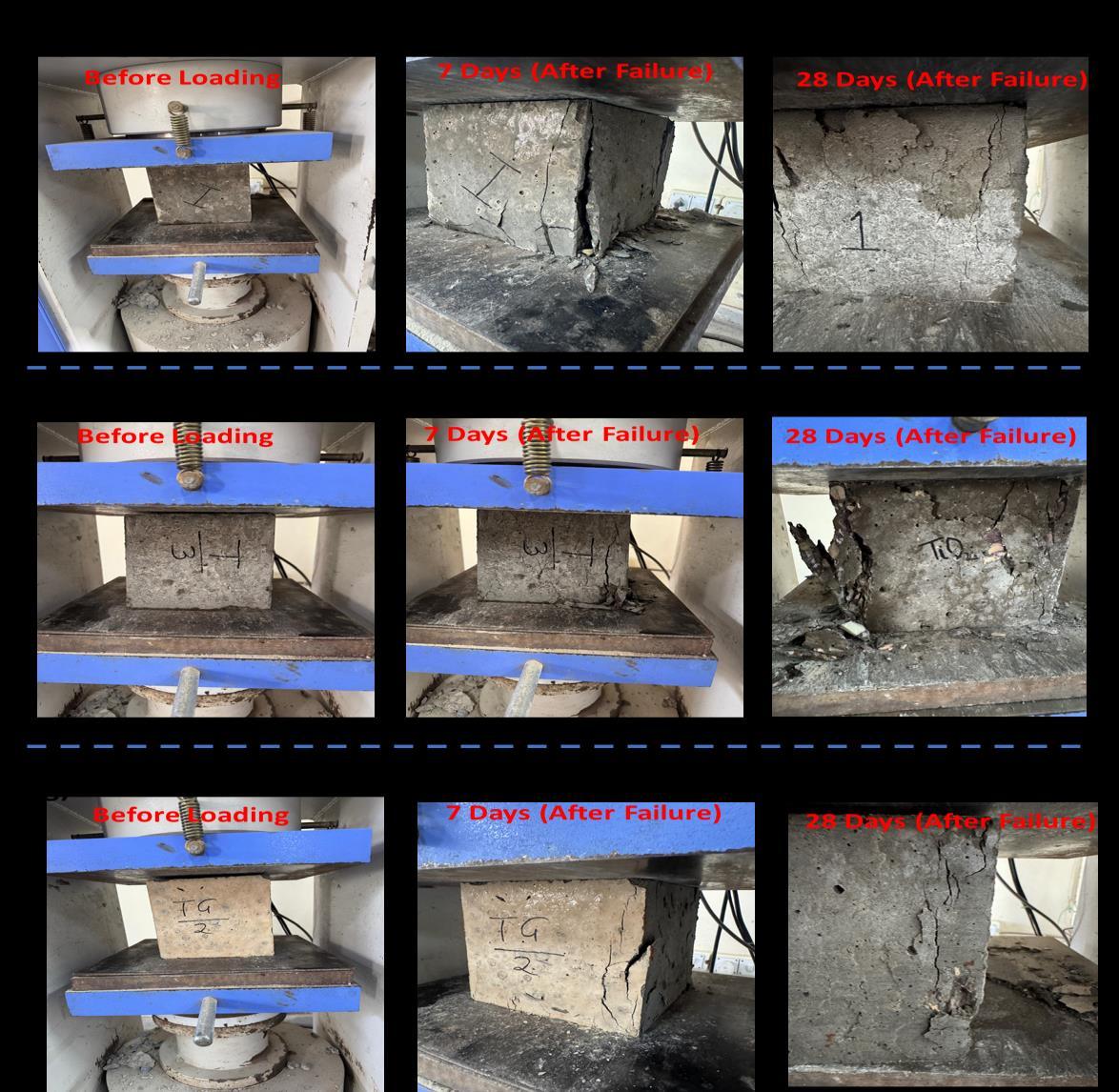
Figure2: Photographsofconcretecubespecimens(plainM30,1TiO₂/M30,andTiO₂/gCN/M30)before loadingandaftercompressivestrengthtestingfor7-dayand28-daycuredspecimensshowingfailure patternsafterloading.
International Research Journal of Engineering and Technology (IRJET) e-ISSN: 2395-0056
Volume: 13 Issue: 04 | Apr 2026 www.irjet.net p-ISSN: 2395-0072
Theobservedresultsofthesplittensilestrengthshowa systematicenhancementwhennano-modifiedcementsystemswere incorporated,withthetrendbeingfairlysimilartothatofcompressivestrengthdescribedabove(Figure3and4).Theaverage splittensilestrengthofthecontrolM30concretewas3.48MPaaftersevendaysand4.32MPaafter28days.Thesevaluesare consistent with the typical behavior of M30 grade concrete, where tensile strength generally lies in the range of 8 to 12 percentofthecompressive strength.Inthepresentstudy,thecompressivestrengthofplainM30concreteafter28days was 38.29 MPa, and the corresponding split tensile strength of 4.32 MPa is approximately 11.28 percent of the compressive strength,confirmingtheinternalconsistencyandreliabilityoftheexperimentalresults.
Withtheincorporationof1%TiO₂nanoparticlesinM30concrete,theaveragesplittensilestrengthincreasedto3.72MPaat sevendaysand4.47MPaat28days,showinganimprovementofapproximately6.90%and3.47%,respectively,comparedto thecontrolmix.Thisenhancementisinagreementwiththecorrespondingincreaseincompressivestrength(from38.29MPa to 40.84 MPa at 28 days), indicating that TiO₂ nanoparticles not only improve the load-bearing capacity but also enhance resistancetocrackinitiationandpropagationundertensilestress.Thisbehaviorcanbeattributedto thenucleation effectof nanoparticles,whichaccelerateshydration,refinesthemicrostructure,andimprovesstresstransferwithinthecementmatrix.
For TiO₂/gCN/M30 concrete, the split tensile strength was found to be 3.98 MPa at seven days and 4.62 MPa at 28 days, representing an increase of approximately 14.37% and 6.94%, respectively, compared to plain concrete. The proportional improvement in both compressive and tensile strengths suggests a synergistic effect of the hybrid nanocomposite, which enhancesmatrixcontinuity andresistancetomicrocrackformation.Sincetensilefailureinconcreteisprimarilygovernedby crack initiation and propagation, the observed improvement indicates that the TiO₂/gCN nanocomposite significantly enhances crack-bridging capability and interfacial bonding within the matrix, resulting in superior mechanical performance comparedtoconventionalconcrete.
7Days
International Research Journal of Engineering and Technology (IRJET) e-ISSN: 2395-0056
Volume: 13 Issue: 04 | Apr 2026 www.irjet.net p-ISSN: 2395-0072
:ComparativesplittensilestrengthresultsofplainM30,TiO₂/M30,andTiO₂/gCN/M30concrete cylindershowing(a)7-daycuringstrength,(b)28-daycuringstrength,and(c)correspondingaveragesplit
International Research Journal of Engineering and Technology (IRJET) e-ISSN: 2395-0056
Volume: 13 Issue: 04 | Apr 2026 www.irjet.net p-ISSN: 2395-0072
Table2: Comparative7daysand28dayssplittensilestrengthresultsofplainM30,TiO₂/M30,andTiO₂/gCN/M30concrete cube. Sr.No.
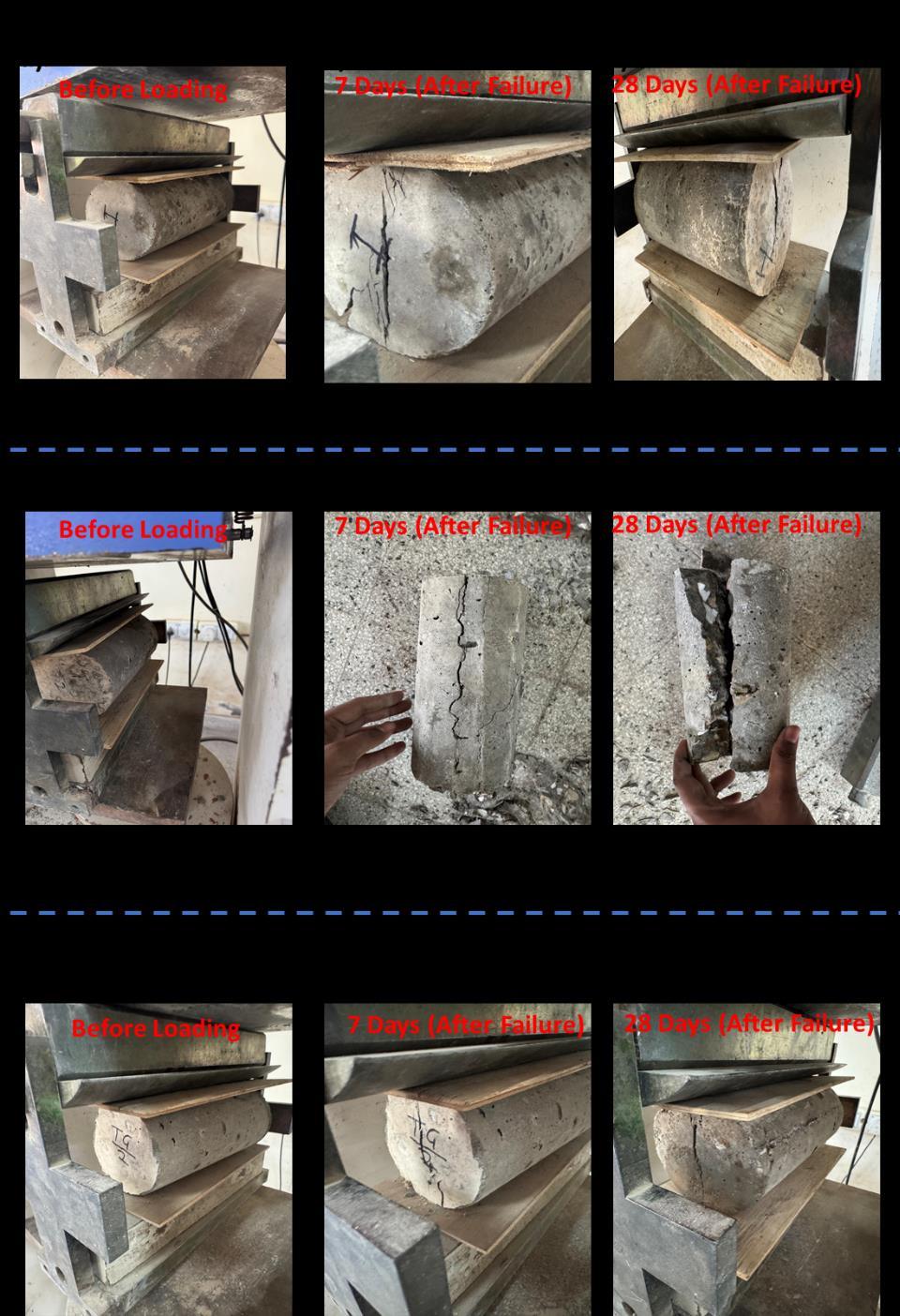
Photographsofconcretecylinderspecimens(plainM30,TiO₂/M30,andTiO₂/gCN/M30)before loadingandaftersplittensilestrengthtestingfor7-dayand28-daycuredspecimensshowingfailure patternsafterloading.
International Research Journal of Engineering and Technology (IRJET) e-ISSN: 2395-0056
Volume: 13 Issue: 04 | Apr 2026 www.irjet.net p-ISSN: 2395-0072
The flexural strength results for plain M30 concrete, TiO₂/M30 concrete, and TiO₂/gCN/M30 concrete are represented in Figure5.
ForplainM30concrete,the7-dayflexuralstrengthsofthethreespecimenswere3.80MPa,3.95MPa,and3.90MPa,givingan averageof3.88MPa.At28days,thecorrespondingvaluesincreasedto4.80MPa,5.00MPa,and5.10MPa,withanaverageof 4.97 MPa. The 28-day flexural strength shows an improvement of approximately 28% compared to the 7-day strength, indicatingnormalstrengthgainwithhydration.
Forthe1%TiO₂/M30concrete,the7-dayflexuralstrengthswere4.05MPa,4.20MPa,and4.12MPa,resultinginanaverageof 4.12MPa.At28days,theflexuralstrengthswere5.10MPa,5.30MPa,and5.25MPawithanaverageof5.22MPa.Comparedto plain M30, this represents an improvement of approximately 6.19% at 7 days and 5.03% at 28 days. The enhancement in flexural strength suggests improved matrix densification and better resistance to tensile stresses developed at the extreme fibreduringbending.
The TiO₂/gCN/M30 concrete exhibited the highest flexural performance. At 7 days, the three specimens showed flexural strengths of 4.35 MPa, 4.50 MPa, and 4.42 MPa, yielding an average of 4.42 MPa. At 28 days, the values further increased to 5.40MPa,5.60MPa,and5.55MPa,withanaverageof5.52MPa.TheimprovementoverplainM30at7daysisapproximately 13.92%andat28daysisapproximately11.07%.Sinceflexuralstrengthisgovernedprimarilybytensilecrackinitiationand propagation,thehighervaluesindicateenhancedcrackresistanceandimprovedstresstransferwithinthecementmatrixdue tothehybridnano-modification.
Theseresultsareinagreementwithotherstudiesthathadbeenconductedaboutnano-modifiedcementitiousmaterials.Janus et al. [15] have demonstrated that the incorporation of 1 % nano-TiO2 produces the highest flexural strength of the compositionsconsidered(1%,3%,and 5%),thusjustifyingtheassumptionthat lowconcentrationsof nanoparticlespresent beneficialrefinementstocementcompositesmicrostructure.However,afurtherincreaseinTiO2 doseafterthislevelgivesrise to nanoparticle agglomeration, which causes an unevenly distributed microstructure and subsequent reduction in flexural strength. In another study, Francoso et al. [16] investigated the effect curing temperature on flexural strength of 1% TiO2 incorporated concrete, it was found that, at higher curing temperatures of 45oC, flexural strength exhibited a significantly declineby12%,whereas,atlowercuringtemperaturesof5oCtheflexuralstrengthincreasescrease.ThepositiveeffectofTiO2 on flexural strength was further enhanced at the ambient curing temperature of 20oC. Further in a research conducted by Visalietal.[12]theyreportedthattheadditionofZnOnanoparticlesincreasedflexuralstrengthoftheconcreteby2.8MPato about 5.0 MPa after 28 days cure depending on the increment in the ZnO content (3 0.5) to 7 0.5). All these observations support the positive contribution of nano-scale additives to cementitious matrices in strengthening the crack resistance and theoverallstrengthofcementitiousmatrices.
For a span length of 400 mm under third-point loading, the middle third region extends from 133 mm to 267 mm from the support. After 7 days curing the TiO₂-M30 concrete shows type A failure with crack distance of 170 mm from nearest point. Whereas,bothplainM30concreteaswellas TiO₂/gCNM30concreteshowstypeBfailurewiththecrackdistanceof130-140 mmfromthenearest point.After28dayscuring,allthespecimeni.e.pureM30concrete,TiO₂/M30concrete,andTiO₂/gCN M30concreteshowsfailurewithinthismiddlethirdata distanceofapprox.170mm,indicatingTypeAfailureasper IS516: 2021 (Figure 6).This shift toward a more central fracture location suggests improved stress distribution, enhanced tensile resistance, and better crack-bridging behavior due to the synergistic effect of TiO₂ and graphitic carbon nitride. The nanocompositelikelycontributedtomatrix densificationand stronger interfacial bonding, resulting ina more homogeneous structureandamoreidealflexuralcrackpatternunderbending[17].
The resultsofflexural strength,directlycorrelates with compressiveandsplittensilestrengthresultsdiscussed above.Inall thesamples,plainM30concreteexhibitedthepoormechanicalperformance,TiO2/M30concreteshowedanaverageincrease, andTiO2/gCN/M30concreteshowedthehigheststrength.Thustheoverallresultssuggeststhattheadditionofnanomaterials not only increases tensile-based traits and crack resilience, but also compressive load-bearing capacity. The similar
International Research Journal of Engineering and Technology (IRJET) e-ISSN: 2395-0056
7Days
Volume: 13 Issue: 04 | Apr 2026 www.irjet.net p-ISSN: 2395-0072 © 2026, IRJET | Impact Factor value: 8.315 |
improvementofthethreemechanicalparametersindicatesthatthereisatotalimprovementofmatrixintegrity andinternal bondinginthenano-modifiedconcretes.
28Days
International Research Journal of Engineering and Technology (IRJET) e-ISSN: 2395-0056
Volume: 13 Issue: 04 | Apr 2026 www.irjet.net p-ISSN: 2395-0072
Figure5:ComparativeflexuralstrengthresultsofplainM30,TiO₂/M30,and TiO₂/gCN/M30concrete beamsshowing(a)7-daycuringstrength,(b)28-daycuringstrength,and(c)correspondingaverage flexuralstrengthvalues.
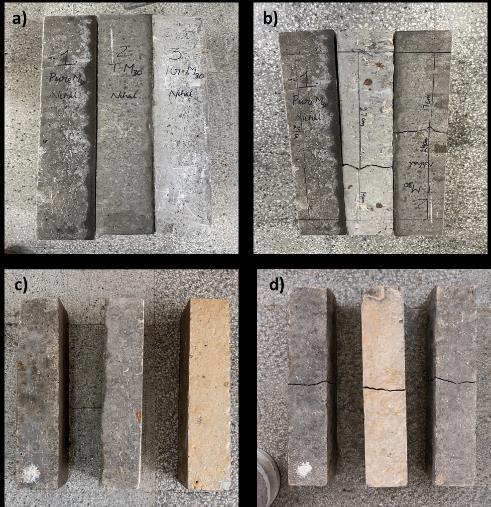
Figure6: Photographsofconcretebeamspecimens(plainM30,TiO₂/M30,andTiO₂/gCN/M30)before loadingandafterflexuralstrengthtestingfor7-dayand28-daycuredspecimensshowingfailurepatterns afterloading.
© 2026, IRJET | Impact Factor value: 8.315 | ISO 9001:2008 Certified Journal | Page1173
International Research Journal of Engineering and Technology (IRJET) e-ISSN: 2395-0056
Volume: 13 Issue: 04 | Apr 2026 www.irjet.net p-ISSN: 2395-0072
Table3: Comparative7daysand28daysflexuralstrengthresultsofplainM30,TiO₂/M30,andTiO₂/gCN/M30concretecube.
Sr. No.
1.
2.
3.
4. Conclusion
TypeA
TypeA
TypeA
This study involved evaluating mechanical properties, including compressive strength, split tensile strength, and flexural strength. The results demonstrated consistent improvement with the incorporation of nanomaterials. The TiO₂/gCN/M30 concreteshowedanincreaseofapproximately13.22%at7daysand13.53%at28daysincompressivestrengthcomparedto plainM30concrete.Similarly,splittensilestrengthimprovedbyabout14.37%at7daysand6.94%at28days,whileflexural strength increased by approximately 13.92% at 7 days and 11.07% at 28 days. These enhancements are attributed to improved particle packing, pore refinement, accelerated hydration, and strengthening of the interfacial transition zone. Additionally, improved flexural failure behavior indicated enhanced crack resistance and better stress distribution in nanomodifiedconcrete.Overall,theresultshighlightthatTheincorporationofTiO₂andTiO₂/gCNnanomaterialssignificantly enhances mechanical properties of M30 concrete. TiO₂/gCN showed maximum improvement in compressive, tensile, and flexuralstrength,makingitsuitableforadvancedconstructionapplications.
References
1. Cardarelli, F. (2018). Cements, Concrete, Building Stones, and Construction Materials. In Materials Handbook (pp. 1421–1439).SpringerInternationalPublishing.https://doi.org/10.1007/978-3-319-38925-7_15
2. Shahandashti, M. L., & Fallah, N. (2025). Mechanical Properties, Fracture Energy, and Brittleness of Concrete Containing Sodium Acetate at Different Water-to-Cement Ratios and Curing Ages. Iranian Journal of Science and Technology, TransactionsofCivilEngineering https://doi.org/10.1007/s40996-025-02012-z
3. Kishore, K., & Tomar, R. (2023). Understanding the role of interfacial transition zone in cement paste and concrete. MaterialsToday:Proceedings,80,877–881.https://doi.org/10.1016/j.matpr.2022.11.322
4. Singh, N. B., Kumar, B., Usman, U. L., & Susan, Md. A. B. H. (2024). Nano revolution: Exploring the frontiers of nanomaterials in science, technology, and society. Nano-Structures & Nano-Objects, 39, 101299. https://doi.org/10.1016/j.nanoso.2024.101299
5. Wang, Y., Zhang, S., Chen, Y., Zhao, S., & Zhu, X. (2026). Nanotechnology in cement-based materials: A state-of-the-art review on performance enhancement, sustainability challenges, and future prospects. Green Technologies and Sustainability,100389.https://doi.org/10.1016/j.grets.2026.100389
6. Ghareeb,A.,Fouda,A.,Kishk,R.M.,&elKazzaz,W.M.(2024).Unlockingthepotentialoftitaniumdioxidenanoparticles:an insight into green synthesis, optimizations, characterizations, and multifunctional applications. Microbial Cell Factories, 23(1),341.https://doi.org/10.1186/s12934-024-02609-5
7. Jenima, J., Priya Dharshini, M., Ajin, M. L., Jebeen Moses, J., Retnam, K. P., Arunachalam, K. P., Avudaiappan, S., & Arrue Munoz, R. F. (2024). A comprehensive review of titanium dioxide nanoparticles in cementitious composites. Heliyon, 10(20),e39238.https://doi.org/10.1016/j.heliyon.2024.e39238
8. Suganthi,S.,Sivakumar,T.,Nethaji,P.,Vignesh,S.,&Oh,T.H.(2023).ConstructionofgraphiticcarbonnitridecoupledTiO2 heterostructured composite for enhanced photocatalytic performance towards organic pollutant degradation. Inorganic ChemistryCommunications,158,111658.https://doi.org/10.1016/j.inoche.2023.111658
9. Al-saffar, F. Y., Wong, L. S., & Paul, S. C. (2023). An Elucidative Review of the Nanomaterial Effect on the Durability and Calcium-Silicate-Hydrate(C-S-H)GelDevelopmentofConcrete.Gels,9(8),613.https://doi.org/10.3390/gels9080613
10. Jothi Prakash, C. G., & Prasanth, R. (2021). Approaches to design a surface with tunable wettability: a review on surface properties.JournalofMaterialsScience,56(1),108–135.https://doi.org/10.1007/s10853-020-05116-1
International Research Journal of Engineering and Technology (IRJET) e-ISSN: 2395-0056
Volume: 13 Issue: 04 | Apr 2026 www.irjet.net p-ISSN: 2395-0072
11. He, R., Huang, X., Zhang, J., Geng, Y., & Guo, H. (2019). Preparation and evaluation of exhaust-purifying cement concrete employingtitaniumdioxide.Materials,12(13),2182.https://doi.org/10.3390/ma12132182
12. Visali, C., Priya, A. K., & Dharmaraj, R. (2021). Utilization of ecofriendly self-cleaning concrete using zinc oxide and polypropylenefibre.MaterialsToday:Proceedings,37,1083–1086.https://doi.org/10.1016/j.matpr.2020.06.309
13. Heikal,M.,Zaki,M.E.A.,&Ibrahim,S.M.(2021).Characterization,hydration,durabilityofnano-Fe2O3-compositecements subjected to sulphates and chlorides media. Construction and Building Materials, 269, 121310. https://doi.org/10.1016/j.conbuildmat.2020.121310
14. Sarkar, M., Maiti, M., Malik, M. A., Xu, S., Li, Q., & Mandal, S. (2018). Influence of metal oxide (V2O5) in recycled waste materials for advanced durable construction technology. Construction and Building Materials, 171, 770–778. https://doi.org/10.1016/j.conbuildmat.2018.03.231
15. Janus,M.,Mądraszewski,S.,Zając,K.,Kusiak-Nejman,E.,Morawski,A.W.,&Stephan,D.(2019).PhotocatalyticActivityand MechanicalPropertiesofCementsModifiedwithTiO2/N.Materials,12(22),3756.https://doi.org/10.3390/ma12223756
16. Francioso,V.,Moro,C., Martinez-Lage, I., &Velay-Lizancos,M.(2019). Curing temperature:Akeyfactorthatchanges the effectofTiO2 nanoparticlesonmechanicalproperties,calciumhydroxideformationandporestructureofcementmortars. CementandConcreteComposites,104,103374.https://doi.org/10.1016/j.cemconcomp.2019.103374
2026, IRJET | Impact Factor value: 8.315 | ISO 9001:2008 Certified Journal | Page1175