
International Research Journal of Engineering and Technology (IRJET) e-ISSN: 2395-0056
Volume: 13 Issue: 04 | Apr 2026 www.irjet.net p-ISSN: 2395-0072

International Research Journal of Engineering and Technology (IRJET) e-ISSN: 2395-0056
Volume: 13 Issue: 04 | Apr 2026 www.irjet.net p-ISSN: 2395-0072
Amit Kumar1
1 Department of Physics, St. John’s College, Agra, Dr. Bhimrao Ambedkar University, Agra-282002 (UP) India
Abstract-Two-Dimensional ElectronGas(2DEG)formation between LaAlO3/SrTiO3 (LAO/STO) can be induced by UV light. Here we show the effect of temperature-induced resistancemeasurements with variationoftemperature with incidentUVlight(250 -400nm)ontheelectricaltransportof LAO/STO heterostructures fabricated by pulsed laser deposition at a thickness of 20-unit cells. Our data shows a drop of sheet resistance from 6.90 kOhm at room temperature to 1.25 k Ohm at 13.33K indicating that this transition occurs with distinctly observed saturation as a function of temperature when measured electrically as a metallic material. Furthermore, under monochromatic UV radiation (250-400nm), the resistance of LAO/STO decreases as a function of time which can be represented as (R(t) - RD)/RD x100% over time. The onset of the photoconductivity occurs at approximately 896.66 seconds astheresistivitycontinuestodecreaseuntilitreachesanearsaturation condition. These large increases in conductivity can be attributed to the excitation of electrons from both oxygen vacancy-associated surface states and shallow trap states into conduction band states derived from the Ti 3d states through photon excitation. This will provide support for the concept of optical tunability of the LaAlO3/SrTiO3 interface and establishes a firm basis for understanding how defects in the oxide heterostructure contribute to photoconductivity.
Keywords: Photoconductivity,2DEG,LAO/STO,thinfilm.
Many researchers have investigated the oxide heterostructures of LaAlO3 (LAO) and SrTiO3 (STO) interfacesformanyyearsbecauseoftheunanticipatedfact thatatwo-dimensionalelectrongas(2DEG)developsatthe interface of LAO and STO (Ohtomo & Hwang 2004). The presenceofa2DEGattheinterfaceoftwooxideinsulators provides evidence that two oxide insulators have the potential to develop conductivity at their interfaces. Interest has continued to increase in studying the properties of LAO-STO systems as more work is being conductedonthemtoinvestigatethepossibledevelopment of superconducting, magnetic, or tunable electronic propertiesusinganexternalgatevoltage[1-3].Researchers have produced multiple models that explain how conductivitydevelopsatoxideinsulatorinterfaces,including latticedistortion orphysical restructuringoftheinterface and/orchargecarrierdefectmediation.LAO/STOInterface: AnExtremelyUltraviolet(UV)SensitiveInterfaceWhilethe transportpropertiesofinterfacesareimportant,usingUV
light sources will greatly affect the conductivity of the interfaceatLAO-STOcompoundinterfaces.Theapplication of UV light results in a significant decrease in resistance principallybygeneratingadditionalcarriers[4-5]viaphotoionization,suchasthecreationofoxygenvacancy(defects). Infact,theeffectoflightonamaterialcanremainforalong timesincetherateatwhichelectronsrecombinewiththeir localized states (i.e., metastable) associated with these defects is much lower after it is illuminated by a photon than when it is not. Consequently, photon conduction can remain a useful tool/model to characterize the defect structure of 0D, 1D, and 2D interfaces of SrTiO3-based materials[6].This workwillinvestigatetherelationshipof the temperature dependence of resistance and the time dependence of the resistance change caused by UV light exposed to the two-dimensional (20 LaO/SrO) LAO/STO heterostructures.Themotiveof thisworkistounderstand how UV light influences conductivity at the LAO/STO interface and also to activate the surface defect structure (defectsatthesurfaceoftheLAO/STOheterostructure).
Usingapulsedlaserdepositionmethod,afilmcomposedof 20unitcellsoflanthanumaluminatewascreateduponTiO2 terminated(001)StrontiumTitanatesubstrates.Reflection High-EnergyElectronDiffractionwasusedasawaytoverify andmonitortheunit-cellgrowthviaoscillations.Thisthin film was then cooled under controlled O2 gas pressure to minimize the amount of O vacancies created during this process, thus helping to ensure that the lanthanum aluminate film's resistance, as a function of temperature (i.e.,usingthefour-probemethod)wouldshowlittleorno effectfromOvacanciesbeingintroducedtothelanthanum aluminatecrystal fromcooling thefilmunderoxygen(O2) atvaryingtemperaturesof13.33Kto297.04K.Tomeasure the photo-responsive nature of the sample using UV monochromatic light sources at 250nm, 300nm, 325nm, 350nm, 400nm, changes in law and light resistance were made during a 2500-second period. The normalized variationofelectricresistanceduringthisperiodusingthe relation(R(t)-RD)/RD×100%,whereRDrepresentstheinitial resistance(R,nolight).
As the temperature decreases, the resistance of the heterostructures also decreases. Fig. 1 shows that R decreasesfrom6.90kΩatT=297Kto1.25kΩatT=13.33
International Research Journal of Engineering and Technology (IRJET) e-ISSN: 2395-0056
Volume: 13 Issue: 04 | Apr 2026 www.irjet.net p-ISSN: 2395-0072
K. The decrease in R is consistent with the metallic conduction model, since the scattering of phonons is greaterathightemperatures,thusreducingtheamountof scattering suppression at low temperatures [2], therefore allowingasteadystatewith2DEGconductionoverawide rangeoftemperature(T)changes(i.e.,largevariationinR with small change in T).The R of the LaAlO3/SrTiO3 (LAO/STO)interfacesbeginstosaturate below ~25K as canbeseen in[7].Theprimaryoriginofthesaturationis due to the impurity and interface scattering that establishes aminimumresistance value(minimumRvalue) due to the decrease in the contribution from phonons to totalR.Notably,thereisnoinsulatingupturnoranysignof localizing behavior, indicating an unbroken conducting 2DEGexistsovertheentireTrangestudied.Thecontinuous R-T dependence indicates that the interface is of good quality and therefore provides an excellent reference for examiningfurtherchangescausedbyillumination.
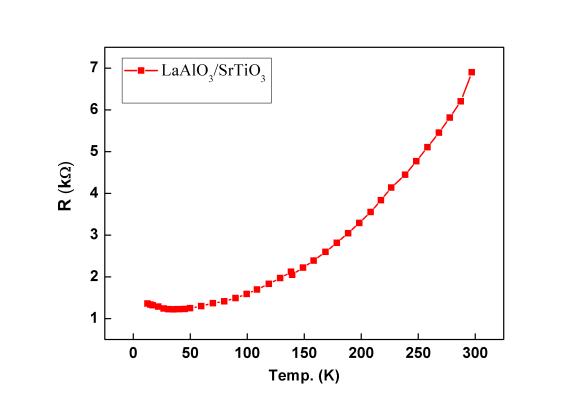
Figure 1: Thetemperaturecharacteristics and resistance of LaAlO3/SrTiO3heterostructuresareinvestigatedwiththe focusonitsphotoconductivereactiontoopticalradiation.
Theratio(R(t)−RD)toRD multipliedby100%representsan identifiable photo response to a U.V. light because the performance at which this occurs has changed with time since there was an original controlled U.V. light exposure. Thereisnosignificantdeviationduringtheinitialportionof the response, however, at approximately 896.66 seconds after the initial U.V. light exposure you can observe a deviationfromtheinitialresponseduetotheactivationof photocarriers.Withtheactivationofphotocarriers,thereis generationofnewandincreasedmobilityofchargecarriers, which leads to a continual decrease in the material resistance through continued illumination. Therefore, the response from U.V. light exposure at shorter wavelengths (250–325nm)ismuchhigherthanfromlongerwavelengths, as the shorter wavelengths cause excitation of electrons from both deep level defects as well as donor levels from oxygen vacancies [4-5]. On the other hand, there are less dramatic responses to longer wavelengths (350-400 nm), although these are still measurable, and can likely be
attributedtotheexcitationofdeep-leveldefectstateswith subbandgapenergies[6].Thefactthatthereisapersistent decreasein resistanceshowsthatU.V.Light isinfluencing theinterfacial2Delectrongaspotentialwithrespecttothe levelofdefectionizationandphotocarrierproduction.
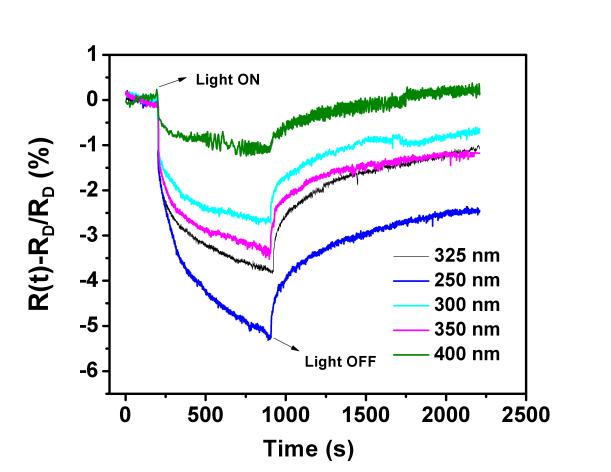
Figure 2: The20-unitcellLaAlO3/SrTiO3 sampleshowsa time-dependentchangeintherelativeresistance,whichis evidenceofthephotoconductiveresponseofthesampleat illumination.
The LAO/STO heterojunction's electrical characteristics are altered by UV radiation. In particular, the resistance betweenthetwomaterials is decreased whenanelectron is promoted to a higher conduction band by a photon duringthisprocess.Ingeneral,fewerconductionelectrons willexistinthelocalizeddefectstates ascompared tothe conduction bands[5-6].Theconductionbandholdsmore conductionelectronsthanlocalizeddefectstates;therefore, a greaternumberofconductionelectrondensitieswillexist inconductionbandsthaninlocalizeddefects.Consequently, the conductivity of the surface of the heterojunction increases. Additionally,UVradiation,fromshort-wavelength (250-300nm)light,willfacilitateothertypesoftransitions (e.g.,band-to-bandtransitions)whichwill alsocontribute to increased carrier densities. When the LAO/STO heterojunction is illuminated by UV radiation, the measured resistancedecreasesuntil it reachesasteadystate (saturated) value. This indicates that there is an equilibriumbeing established betweenthelight produced photo-carriergenerationand their redistributionand/or partial trapping within theheterojunction interfaceregion [4].Thisdescribesthenatureofphotoconductivityfoundat LAO/STOheterojunctioninterfaces.
4. Conclusion
Authors conducted an extensive study that examines how temperature affects both the electrical transport characteristics and the photocurrent produced by
International Research Journal of Engineering and Technology (IRJET) e-ISSN: 2395-0056
Volume: 13 Issue: 04 | Apr 2026 www.irjet.net p-ISSN: 2395-0072
ultraviolet (uv) light in a LaAlO₃/SrTiO₃ heterostructure that consists of twenty unit cells. The presence of twodimensionalelectrongas(2DEG)isevidencedby observing metallic behavior and a plateau in conductivity at low temperatures for this heterostructure. During uv irradiation typical of those used for this work, the resistance of this heterostructure exhibited a large decreasein absolute resistanceand spectral dependence ascomparedtowhatwouldbeexpectedsimplybecauseof thermalheating.Thiscanbeexplainedduetothefactthat electrical charge carriers are excited by uv light from defect and oxygen vacancy states into the conduction bandand thepresenceof thetwo-dimensional character required by2DEGat LaAlO₃/SrTiO₃ interfaces.The time at which a photoconductive response was generated (∼896.66 seconds after light exposure) and the time for this response to stabilize provides insights into the dynamics of charge generation and stabilization at oxide interfaces. Overall, results of this study demonstrate that when illuminated with light, the electrical properties of LAO/STOheterostructurescanbemodulated andprovide informationondefectsandenhancedphotoconductivity in theheterostructure.
[1] Ohtomo,A.,&Hwang,H.Y.(2004).Ahigh-mobility electrongasattheLaAlO₃/SrTiO₃heterointerface. Nature,427(6973),423–426.
[2] Reyren, N., Thiel, S., Caviglia, A. D., Fitting Kourkoutis,L.,Hammerl,G.,Richter,C.,Schneider,C. W.,Kopp,T.,Rüetschi,A.-S.,Jaccard,D.,Gabay,M., Muller,D.A.,Triscone,J.-M.,&Mannhart,J.(2007). Superconducting interfaces between insulating oxides.Science,317(5842),1196–1199.
[3] Caviglia, A. D., Gariglio, S., Reyren, N., Jaccard, D., Schneider, T., Gabay, M., Thiel, S., Hammerl, G., Mannhart,J.,&Triscone,J.-M.(2008).Electric field control of the LaAlO₃/SrTiO₃ interface ground state.Nature,456(7222),624–627.
[4] Rastogi, A., & Budhani, R. C. (2012). Wavelengthdependent photoconductivity in LaAlO₃/SrTiO₃ interfaces.OpticsLetters,37(3),317–319.
[5] Tarun,M.C.,Selim,F.A.,&McCluskey,M.D.(2013). Persistent photoconductivity in strontium titanate.Physical ReviewLetters,111(18),187403.
[6] Tebano,A.,Fabbri,E.,Pergolesi,D.,Balestrino,G.,& Traversa, E. (2012). Near ultraviolet and visible photoconductivity in LaAlO₃/SrTiO₃ interfaces. ACSNano,6(2),1278–1283.
[7] Rastogi,A.,Kushwaha,A.K.,Shiyani,T.,Gangawar, A., & Budhani, R. C. (2010). Persistent photoconductivity in LaAlO₃/SrTiO₃ heterostructures. Advanced Materials, 22(38), 4448–4452.