
International Research Journal of Engineering and Technology (IRJET) e-ISSN:2395-0056
Volume: 12 Issue: 04 | Apr 2025 www.irjet.net p-ISSN:2395-0072
International Research Journal of Engineering and Technology (IRJET) e-ISSN:2395-0056
Volume: 12 Issue: 04 | Apr 2025 www.irjet.net p-ISSN:2395-0072
1B. Aditya Chandrashekar , 2Abhishek Pratap Singh Bhadauria
1Final Year BTech Student, Mechanical Engineering , K. J. Somaiya School of Engineering, Mumbai - 400077, Maharashtra, India
2Assistant Professor, Mechanical Engineering Department , K. J. Somaiya School of Engineering, Mumbai - 400077, Maharashtra, India ***
Abstract - Brakes play a crucial role in vehicle safety by enabling controlled deceleration. Improper geometry and material selection can lead to disc rotor damage or failure, compromising braking efficiency and vehicle control This research work centers on analyzing both structural and thermal behavior of braking parts (e.g., rotor, caliper) using various materials under differing conditions. Finite Element Analysis (FEA) is used to assess von Mises stress, overall deformation, and strain in structural tests, while thermal simulations evaluate temperature distribution and heat dissipation during abrupt braking.
The selected materials for this investigation include Grey Cast Iron, Stainless Steel, Magnesium Alloy, 1060 Aluminum Alloy, and Vanadium Alloy. The modeling and simulations are conducted using SolidWorks 2023 and Solid Edge. The results indicate that no single material excels in all conditions, with each material demonstrating strengths and limitations based on specific performance criteria. This study provides valuable insights into material selection strategies for optimizing disc brake efficiency and durability.
Key Words: Mechanical properties, CAD Modelling, Finite Element Analysis, Heat dissipation, Braking efficiency
Braking systems are essential for vehicle safety, ensuring controlled deceleration and stability.. Among braking components, the disc brake rotor significantly influences braking efficiency, thermal performance, and structural integrity. During braking, friction between the brake pad and rotor converts kinetic energy into heat, which, if not dissipated effectively, can cause thermal stress, material degradation,andreducedperformance.
Traditionally, Grey Cast Iron has long been favored for brake rotors owing to its wear resistance, thermal conductivity, and affordability.. However, the demand for lightweight, high-performance braking systems has led to the exploration of alternative materials such as Stainless Steel, Magnesium, and Aluminum alloys. While cast iron offers superior heat dissipation, its high weight increases un-sprung mass and affects fuel efficiency. Lightweight
alloys reduce weight but may exhibit lower thermal resistance and durability under extreme braking conditions.
This study employs Finite Element Analysis (FEA) to evaluatetheeffectofmaterialselectionondiscbrakerotor performance. Structural and thermal simulations determine von Mises stress, deformation, strain, heat dissipation, and temperature distribution under sudden braking conditions. The modeling is conducted using SolidWorks 2023 and Solid Edge to ensure accurate representationofreal-worldscenarios.
The findings provide a comparative analysis of different materials, highlighting trade-offs between structural integrity, thermal efficiency, and weight reduction. By identifyingtheoptimal material fordisc brakerotors,this studyaimstocontributetoadvancedbrakingsystemsthat enhancevehiclesafety,performance,andenergyefficiency inconventionalandelectricvehicles.
Thisresearchworkfocusesonassessingthestructuraland thermalperformanceofselecteddiscbrakematerials.The mainobjectivesarelistedbelow:
1). To analyze the impact of different materials on the structuralintegrityofadiscbrakerotor byevaluatingvon Mises stress, total deformation, and strain elongation underbrakingconditions.
2).Toexaminethethermalcharacteristicsofeachmaterial by measuring heat dissipation ability and temperature variationduringemergencybrakingsituations.
3). To compare and evaluate the suitability of different materials Grey Cast Iron, Stainless Steel, Magnesium Alloy, 1060 Aluminum Alloy, and Vanadium Alloy based ontheirmechanicalandthermalproperties.
4).Toidentify an optimal material that balancesstrength, thermal efficiency, durability, and weight reduction for improvedbrakingperformanceandvehicleefficiency.
International Research Journal of Engineering and Technology (IRJET) e-ISSN:2395-0056
Volume: 12 Issue: 04 | Apr 2025 www.irjet.net p-ISSN:2395-0072
5).ToutilizeFiniteElementAnalysis(FEA)forsimulating real-world braking scenarios using SolidWorks 2023 for modeling and Solid Edge for structural and thermal analysis..
1) Ali Belhocine and Oday Ibrahim Abdullah et. al. (2021) - This investigation utilized numerical modelingtostudytheperformanceofthreedifferent disc brake materials. A three-dimensional thermal analysis was applied to understand how heat is distributed across the disc, and a comparative evaluation was conducted to determine the most effective material for braking. Results were illustrated through a thermomechanical modeling approach.[1]
2) Srushti Newase, Pradnya Kosbe et. al. (2021) - The research is centered on thermal analysis of vented brake rotors specifically for the Mahindra Bolero. It aimed to determine appropriate rotor and pad materials that can efficiently manage heat while maintainingmechanicalstrength.[2]
3) Adarsh Bhat et. al. (2021) - This study presents a comparisonbetweendiscanddrumbrakes,assessing stopping distances, heat management, and overall braking performance. While drum brakes are more economical, the focus was on enhancing disc brake systems to reduce deformation and improve heat handling.[3]
4) Aakash Jawla, Rahul Anand, Shobhit Agarwal et. al. (2020 ) - Thermal simulation techniques were appliedinthisstudytoinvestigatehowstainlesssteel performs in disc brake applications, particularly under conditions of heat buildup and thermal stress. SolidWorks and ANSYS Workbench tools were used to conduct the analysis, offering guidance for better materialchoices.[4]
5) Sanket Darekar, Ajinkya Dhage et. al. (2020) - In this design-based project, a disc brake for the Bajaj Pulsar 220F was developed using CATIA. The team analyzed how temperature changes during braking, employingANSYSWorkbenchforsimulation.Various rotordesignswerecomparedtoachieveanoptimized configuration.[5]
6) S.A.M Da Silva, DVV Kallon et. al. (2019) - This research contrasts the structural performance of grooved and drilled-grooved disc rotors under several linear load conditions. Using Brembo rotor designsforaRenaultvehicle,theteamanalyzedload paths, stress zones, and displacements through simulation.[6]
Thisstudyexaminestheinfluenceofmaterialselectionon the structural and thermal performance of a disc brake rotor using Finite Element Analysis (FEA). The selected materials Grey Cast Iron, Stainless Steel, Magnesium Alloy, 1060 Aluminum Alloy, and Vanadium Alloy were chosen for their distinct mechanical and thermal properties. Grey Cast Iron is widely used for its high thermal conductivity and wear resistance, while Stainless Steelofferssuperiorcorrosionresistance.Magnesiumand Aluminum alloys are considered for their lightweight characteristics,reducingoverallvehiclemass.
Structural analysis determined von Mises stress, deformation, and strain elongation under braking forces, while thermal analysis assessed heat dissipation and temperature distribution during sudden braking. By comparing material performance, this study identifies an optimal rotor material that balances structural strength, thermal efficiency, and weight reduction, contributing to high-performance braking systems for conventional and electricvehicles.
Choosing the right material for a component involves evaluating several critical factors, which can be grouped intothefollowingkeycategories:
Material attributes – Mechanical, thermal, and chemicalcharacteristicsthatinfluenceperformance.
Material Cost and Availability – Economic feasibilityandaccessibilityofthematerial.
Manufacturing Process – Suitability of the material forfabricationandmachining.
Environmental Factors – Impact of the material on sustainability,recyclability,andresistancetoexternal conditions.
This study analyzes the structural, thermal and fatigue performance of a disc rotor using Finite Element Analysis (FEA).TherotorismodeledinSolidWorks2023software Structural analysis determines von Mises stress and deformation, while thermal analysis evaluates heat dissipationandtemperaturedistributionunderbraking.
Fivematerials GreyCastIron,StainlessSteel,Magnesium Alloy, 1060 Aluminum Alloy, and Vanadium Alloy are selected for their mechanical strength, thermal conductivity, and weight efficiency. Realistic boundary conditions, including rotational velocity, braking force, and convective heat transfer, replicate actual braking conditions.
International Research Journal of Engineering and Technology (IRJET) e-ISSN:2395-0056
Volume: 12 Issue: 04 | Apr 2025 www.irjet.net p-ISSN:2395-0072
The analysis highlights trade-offs between strength, heat resistance, and weight reduction, aiding in material selection for high-performance disc brake rotors in modernandelectricvehicles.
6. CAD MODEL
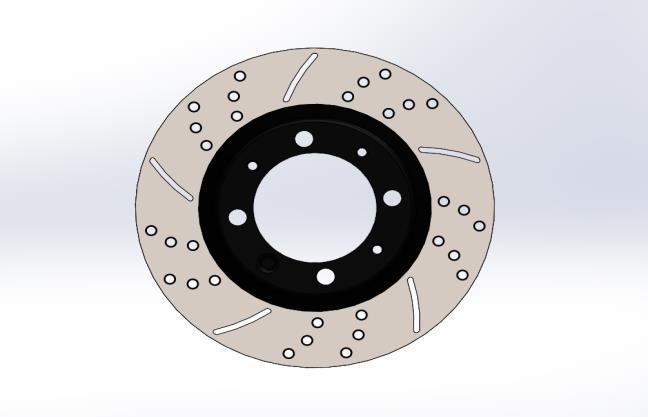
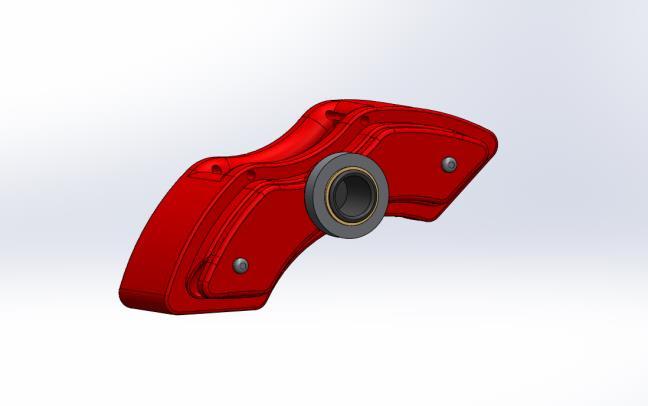
Fig01:3DCADModelofDiscBrakeRotor
Fig02:3DCADModelofDiscBrake Calliper
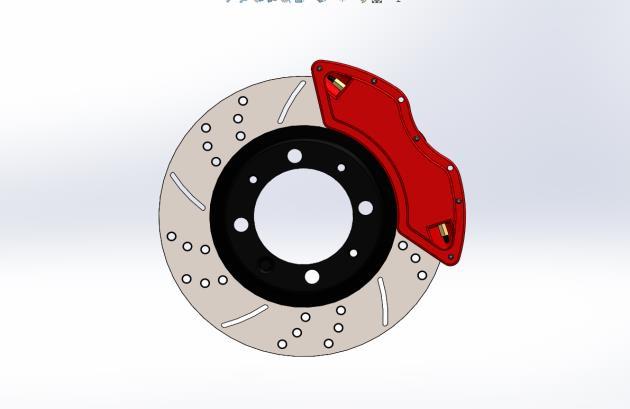
Fig03:3DCADModelofDiscBrake
7.
Table01:Representspropertiesofdifferent materials
Grey Cast Iron has a higher COF due to its surface roughness, making it an excellent material for brake rotors.
Stainless Steel has a moderate COF, but its corrosion resistance makes it ideal for high-performance applications.1060
Aluminum Alloy & Magnesium Alloy have a lower COF, reducing frictional braking performance, but theirlightweightpropertiesareadvantageous
Titanium (Annealed) provides moderate friction whilemaintaininghighstrengthandheatresistance.
8. RESULTS
Structural Analysis :Grey Cast Iron
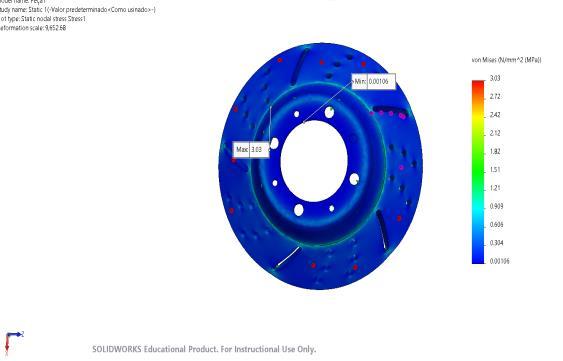
Fig04:ResultofEquivalentStress
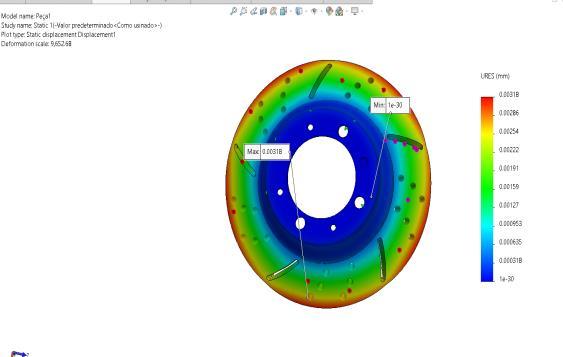
Fig05:ResultofTotalDeformation
International Research Journal of Engineering and Technology (IRJET) e-ISSN:2395-0056
Volume: 12 Issue: 04 | Apr 2025 www.irjet.net p-ISSN:2395-0072
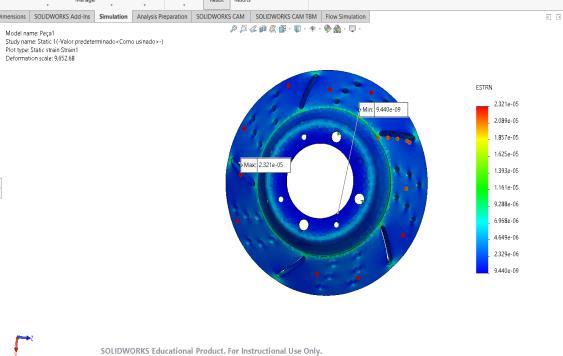
:ResultofMaximumPrincipalStrain
GreyCastIron:
Thestructuralanalysisofthediscbrakemadeofgrey cast iron shows good performance in terms of strengthanddurability.
The material’s excellent damping properties help in reducing vibrations, while its high wear resistance ensureslongevity.
Stress distribution is even, with localized high stressesneartherotor’scenter.
Stainless Steel
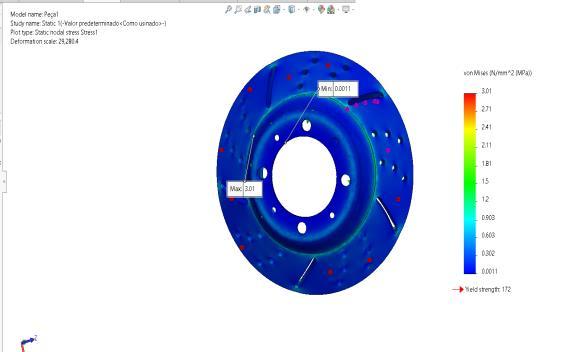
Fig07:ResultofEquivalentStress
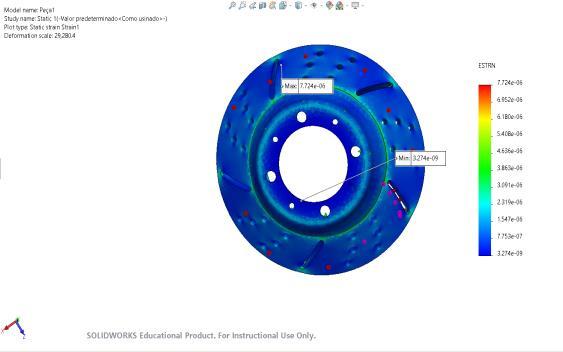
Fig08:ResultofTotalDeformation
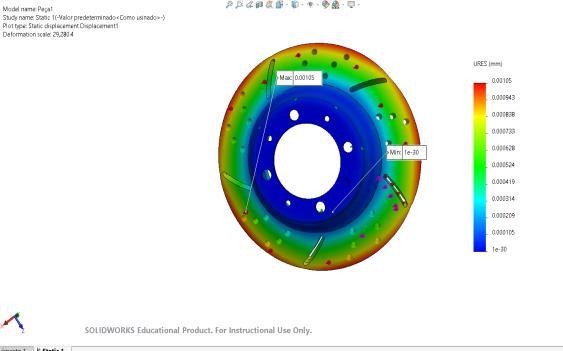
Fig09:ResultofMaximumPrincipalStrain
StainlessSteel:
In the structural analysis of a disc brake made from stainlesssteel,thematerial'sstrength,stiffness.
The analysis highlighted the brake's ability to withstand high mechanical stresses and thermal expansionduringbraking.
Stainless steel's durability provides effective heat dissipation, reducing wear and ensuring longevity, while maintaining structural integrity during cyclic loadingconditionstypicalinautomotiveapplications.
1060 Aluminium Alloy
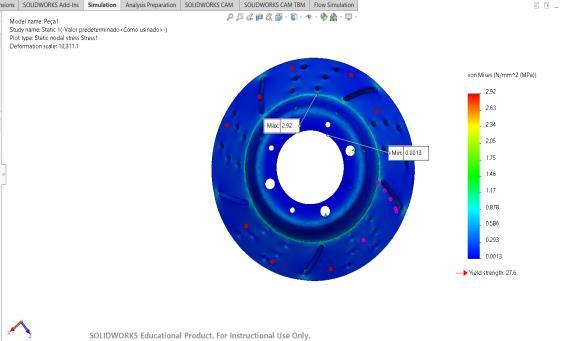
Fig10:ResultofEquivalentStress
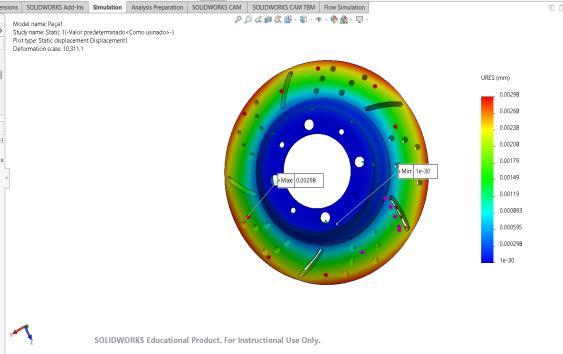
Fig11:ResultofTotalDeformation
International Research Journal of Engineering and Technology (IRJET) e-ISSN:2395-0056
Volume: 12 Issue: 04 | Apr 2025 www.irjet.net p-ISSN:2395-0072
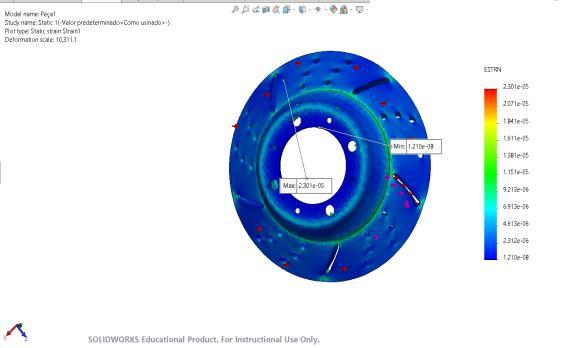
Fig12:ResultofMaximumPrincipalStrain
1060AluminiumAlloy:
In the structural analysis of a disc brake made from 1060Aluminumalloy,thematerial'slowstrengthand highductilitywereconsidered.
Resultsindicatedthatwhilethebrakedisccanhandle moderate thermal stresses, it may not perform well under extreme conditions due to the material’s relativelylowtensilestrength.
The analysis highlights the importance of optimizing design parameters and considering alternative materialsforhigh-performancebrakingsystems.
Titanium (Annealed)
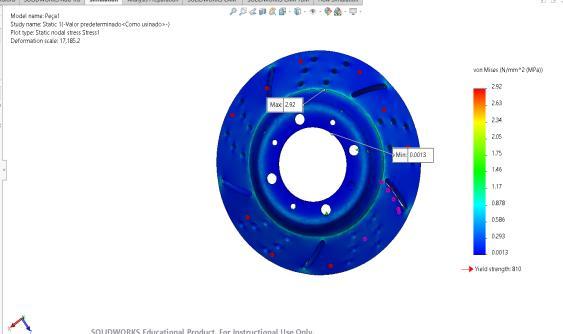
Fig13:ResultofEquivalent Stress
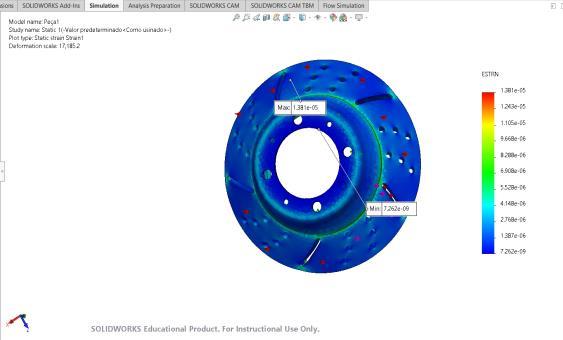
Fig14:ResultofTotalDeformation
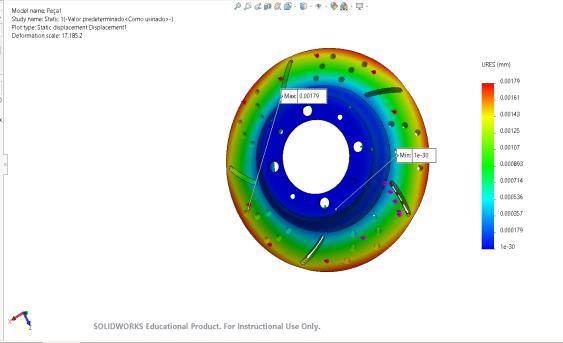
Fig 15 : Result of Maximum Principal Strain
Titanium(Annealed):
The Structural evaluation of an annealed titanium disc brake shows a high strength-to-weight ratio alongwithsuperiorfatigueandcorrosionresistance.
Thetitanium'sabilitytoithstandthermalcyclingand extreme temperatures is beneficial for brake performance.
The analysis shows that the material maintains structural integrity under stress, offering improved durability and lightweight characteristics compared to traditional materials like cast iron, enhancing overallbrakingefficiencyandvehicleperformance.
Alloy
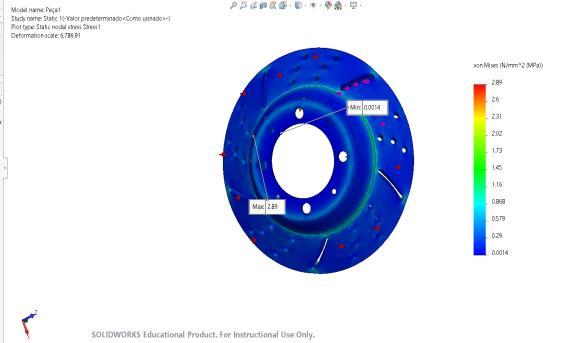
Fig16:ResultofEquivalentStress
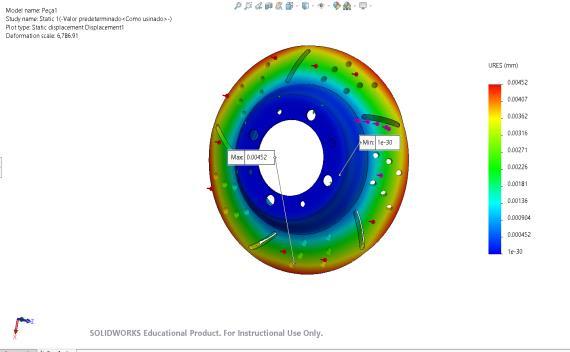
Fig17:ResultofTotalDeformation
International Research Journal of Engineering and Technology (IRJET) e-ISSN:2395-0056
Volume: 12 Issue: 04 | Apr 2025 www.irjet.net p-ISSN:2395-0072
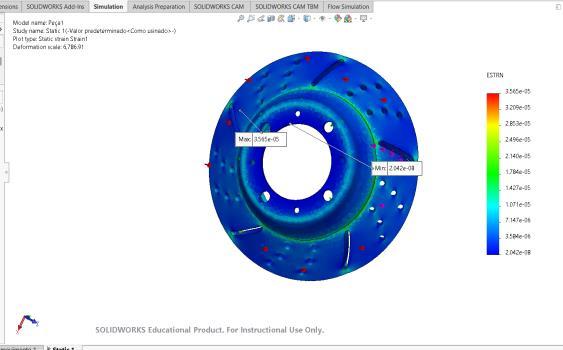
Fig18:ResultofMaximumPrincipalStrain
MagnesiumAlloy:
The Structural evaluation of a magnesium alloy disc brake shows a favorable strength-to-weight ratio, makingitsuitableforloweringvehiclemass.
Stress distribution analysis shows that the magnesium alloy handles braking forces effectively, though it exhibits higher deformation compared to steel.
The material's lower density contributes to better performance in high-speed applications, but it requires careful consideration for durability and thermal management due to its lower thermal conductivity.
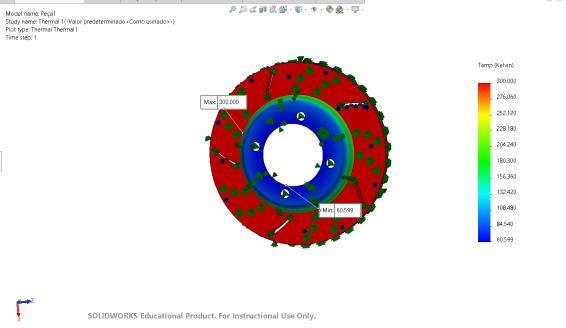
Fig19:ResultofTemperature Dispersion
Thermal Analysis :Grey Cast Iron Stainless Steel 1060 Aluminium Alloy
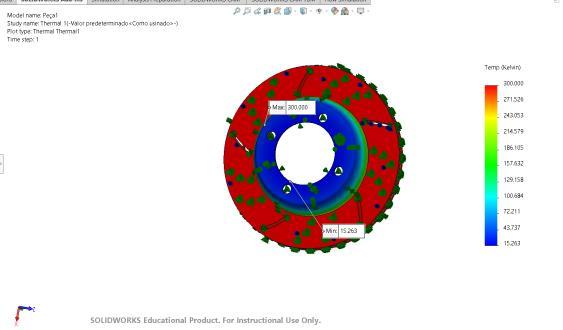
Fig20:ResultofTemperatureDispersion
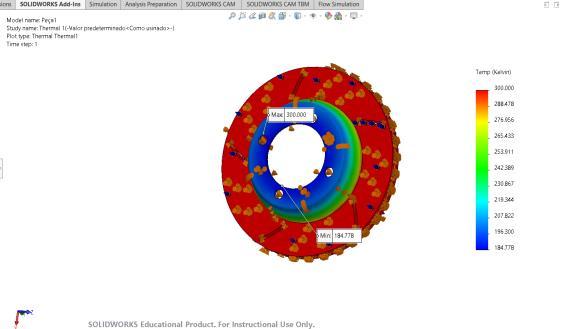
Fig21:ResultofTemperatureDispersion
(Annealed)
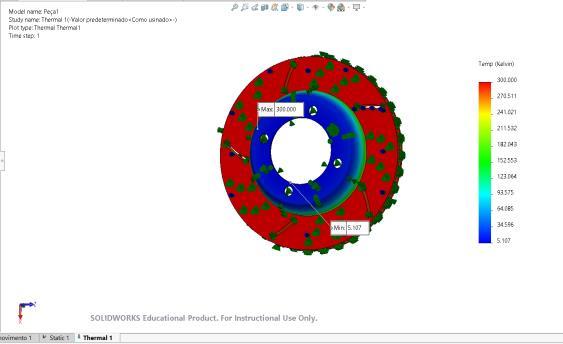
Fig22:ResultofTemperatureDispersion
Magnesium Alloy
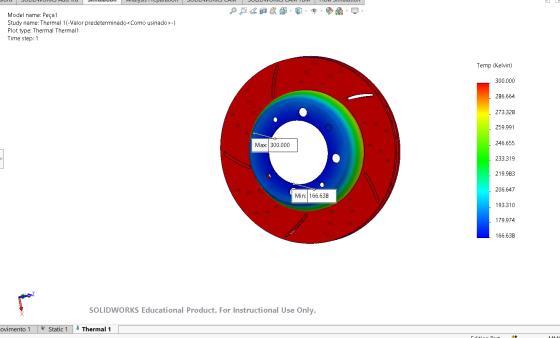
Fig23:ResultofTemperatureDispersion
MagnesiumAlloy:
In the thermal analysis of a disc brake made from magnesiumalloy,resultsshowthatthematerial'slow thermal conductivity limits heat dissipation, leading tohighertemperaturesduringbraking.
This can cause thermal stresses, reducing performanceandlifespan.
However, magnesium's lightweight nature offers benefitsinreducingoverallvehicleweight.
Proper cooling mechanisms and heat-resistant coatings are crucial to managing thermal loads and improvingthebrakesystem'sefficiency.
International Research Journal of Engineering and Technology (IRJET) e-ISSN:2395-0056
Volume: 12 Issue: 04 | Apr 2025 www.irjet.net p-ISSN:2395-0072
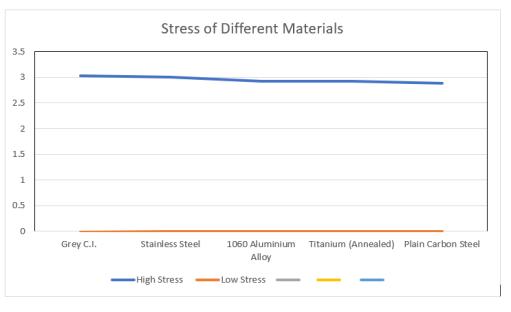
Fig24:GraphicalRepresentationofStressDistribution
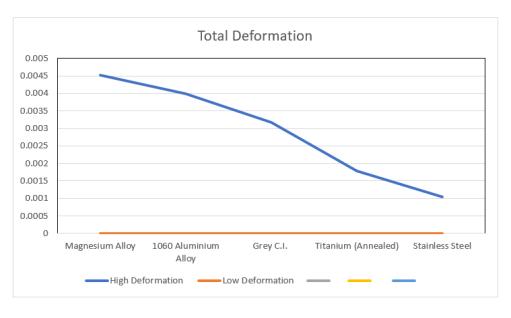
Fig25:GraphicalRepresentationofDeformation
10. Discussion
The structural analysis of the disc brake revealed key insights into material performance under braking loads. Von Mises stress distribution highlighted high-stress concentrationsatthebrakepad-rotorinterface,especially at the outer edges. Grey Cast Iron showed superior structural integrity, withstanding high stress without exceeding yield strength. Stainless Steel exhibited moderate deformation but maintained strength due to higher elasticity. 1060 Aluminum and Magnesium Alloys displayed increased deformation, suggesting potential failureunderextremebraking.
Titanium Alloy provided a balanced response with moderate deformation and superior fatigue resistance. Total deformation analysis showed that lighter materials experienced greater elongation, making them unsuitable forhigh-loadapplications. Thermalanalysisindicatedthat 1060 Aluminum and Magnesium Alloys had excellent thermalconductivity,leadingtorapidheatdissipationbut higher temperature gradients and potential thermal fatigue.
The analysis highlights the importance of material selection for optimal braking efficiency and durability. Grey Cast Iron showed superior structural integrity and moderate thermal resistance, making it ideal for disc
brakes. Titanium Alloy offered an excellent strength-toweight ratio and fatigue resistance, suitable for highperformance applications. 1060 Aluminum and Magnesium Alloys provided efficient heat dissipation but sufferedfromexcessivedeformation.StainlessSteel,while corrosion-resistant, had higher thermal stress concentrations. The study confirms that the best material choicedependsonbalancingmechanicalstrength,thermal performance, and fatigue resistance for specific braking requirements.
Future researchonthe effectofmaterial selectionondisc brakeperformancemayfocusonadvancedmaterialssuch as ceramic matrix composites, carbon-carbon composites, and nano-reinforced alloys to enhance thermal and structural properties. Exploration of hybrid and functionally graded materials tailored for electric and high-performancevehiclesisalsopromising.Multi-physics simulations combined with experimental validation using embeddedsensorscanofferdeeperinsightsintoreal-time performance.
[1]R.TalatiandS.Jalalifar,"Thermalconductionmodeling indisc brakingsystems," J. Appl. Sci.,vol.8,no.5,pp.846–850,2008.DOI:10.3923/jas.2008.846.850
[2] B. S. Poddar, S. K. Suman, and A. K. Sinha, "FEA-based thermalandstructuralevaluationofadiscbrake,"in Proc. Int. Conf. Adv. Res. Mech. Eng. (ICARME), Bangalore, India, 2015.
[3] Y. C. Lim, M. M. Rahman, and C. H. Lee, "Thermal dissipation analysis of ventilated brake discs using FEA," Int. J. Automot. Mech. Eng., vol. 12, pp. 2906–2917, 2015. DOI:10.15282/ijame.12.2015.4.0241.
[4]M.Bijwe,N.Chand,andU.Mahajan,"Frictionandwear characteristicsofnewlydevelopedbrakepadcomposites," Wear, vol. 259, no. 7–12, pp. 1068–1076, 2005. DOI: 10.1016/j.wear.2005.01.038.
[5] D. T. Pham, S. S. Kim, and J. H. Yoon, "Effect of rotor materialsonbrakingperformancecharacteristics," J. Mech. Sci. Technol., vol. 34, no. 3, pp. 1247–1256, 2020. DOI: 10.1007/s12206-020-0225-9.
[6] R. S. Khurmi and J. K. Gupta, Machine Design Textbook, 14thed.,NewDelhi,India:S.ChandPublishing,2005.
[7]S.D.BelegunduandT.R.Chandrupatla, Introduction to Finite Element Methods in Engineering, 4th ed., Upper SaddleRiver,NJ,USA:Pearson,2011.
International Research Journal of Engineering and Technology (IRJET) e-ISSN:2395-0056
[8] N. Öztürk, "Thermal-mechanical comparative study of brake disc materials," J. Eng. Sci. Technol. Rev., vol. 13, no. 4,pp.53–59,2020.DOI:10.25103/jestr.134.06.
BIOGRAPHIES


Volume: 12 Issue: 04 | Apr 2025 www.irjet.net p-ISSN:2395-0072 © 2025, IRJET | Impact Factor value: 8.315 | ISO 9001:2008
1. B. Aditya Chandrashekar, Final Year BTech Student, Department of Mechanical Engineering, K. J. Somaiya School of Engineering, Vidyavihar(E), Mumbai-400077,Maharashtra,India
2.AbhishekPratapSinghBhadauria, AssistantProfessor,Departmentof MechanicalEngineering,K.J.Somaiya SchoolofEngineering,Vidyavihar(E), Mumbai-400077,Maharashtra,India