
International Research Journal of Engineering and Technology (IRJET) e-ISSN: 2395-0056
Volume: 13 Issue: 03 | Mar 2026 www.irjet.net p-ISSN: 2395-0072

International Research Journal of Engineering and Technology (IRJET) e-ISSN: 2395-0056
Volume: 13 Issue: 03 | Mar 2026 www.irjet.net p-ISSN: 2395-0072
Dr. Satish ket1 , Tanvi kinjale2, Mohit Jain3 , Dhirendra Lohar4 , Nandani kadave5
12345Department of Computer Engineering, MCT’s Rajiv Gandhi Institute of Technology, Andheri (West), Mumbai –400053, Maharashtra, India
1Professor, MCT’s Rajiv Gandhi Institute of Technology, Andheri (West), Mumbai – 400053, Maharashtra, India
2345Student, MCT’s Rajiv Gandhi Institute of Technology, Andheri (West), Mumbai – 400053, Maharashtra, India
Abstract - Traditional methods of monitoring student attendance in academic institutions suffer from a number of shortcomings including proxy attendance taking, off-time logging, and heavy administrative burdens. This paper presents an innovative combination of Bluetooth low energy (BLE)beacontechnologyandadeeplearning-basedbiometric facial recognition to create the EduSync attendance monitoring system which offers safe andeffective automated methods for securely and transparently recording students' attendance by way of three unique verification layers. The EduSyncsystemisentirelysoftware-basedthereforeitreduces theneedforspecializedhardwarewhichleadstoamorecosteffective implementation with the use of existing mobile devices and infrastructure. The EduSync attendance monitoringsystememploysthreesequentialverificationlayers for established and confirmed student attendance in the classroom: (1) face detection and recognition which utilizes deep learning-based biometric facial recognition and 128dimensional facial embeddings for primary identity verification;(2)Bluetooth lowenergy(BLE)-basedproximity detectiontoconfirmthephysicalpresenceofastudentwithin theclassroomparameters;and(3)theabilityforamemberof the faculty to override or manually confirm attendance in extreme cases. In addition, the EduSync attendance monitoring system provides a real-time Alert system via sequential notifications every 3-5 seconds during the attendance verification process to promote transparency of theverificationstagestoallaffiliatedusers.Evaluationofthe EduSync attendance monitoring system has resulted in documentation of reliable results of attendance tracking, an increase in the prevention of student fraud with the implementation of the proposed three-layered verification process, and demonstrated the success in the EduSync attendance tracking system's ability to be scaled in multiple simultaneous classrooms in which there are a number of compatible devices used by the students.
Key Words: Smart Campus, Attendance Management, BLE Beacons, Facial Recognition, FaceNet, Biometric Authentication, Deep Learning, Mobile Application
Attendance management is a key administrative task in schools. It serves several important purposes, such as keepingacademicrecords,trackingstudentengagement,and ensuring compliance. Traditional manual attendance methods involve roll calls and paper registers. These methodstakealotoftimeandcaneasilyleadtomistakes. Traditionalapproachesusuallyconsumeabout5-10minutes each session. Over an academic year, this adds up to significant time lost in teaching. Additionally, manual systemsofferlimitedprotectionagainstproxyattendance. Thisissueariseswhenstudentsmarkattendanceforfriends who are not present, undermining the integrity of the institutionandthereliabilityofthedata.
Digital attendance systems have emerged as automated alternatives.Theseincludebiometricfingerprintscanners, RFIDcardreaders,andQRcodecheck-ins.Althoughthese solutions have improved efficiency and reduced manual work,theycomewiththeirownissues.Biometricsystems need costly hardware and can slow things down when processing many students at once. RFID and QR code systems are also at risk of card sharing and device tampering, which makes them unreliable for verifying identities.Moreover,standalonedigitalsystemsoftenlack spatial awareness, allowing students to mark attendance fromadistancewithoutbeingphysicallypresentinclass.
Recent developments in Internet of Things (IoT) technologies and mobile computing have led to contextaware attendance systems. Bluetooth Low Energy (BLE) beacon technology shows promise for detecting presence based on proximity with minimal infrastructure and low energy use. At the same time, advances in deep learning, especially in facial recognition, have reached human-level accuracyforidentityverification.Thecombinationofthese technologiescouldleadtobetterattendancesolutionsthat tacklethemanychallengesofcurrentsystems.
International Research Journal of Engineering and Technology (IRJET) e-ISSN: 2395-0056
Volume: 13 Issue: 03 | Mar 2026 www.irjet.net p-ISSN: 2395-0072
Recentresearchinautomatedattendancemanagementhas lookedintovarioustechnologies,includingRFID,biometrics, and wireless protocols. However, current solutions have significant limitations in security, scalability, and privacy protection. Bluetooth Low Energy technology has gained interestforproximity-basedattendanceverificationbecause ofitslowpoweruseandminimalinfrastructureneeds.Jainet al. [1] suggested using teacher smartphones as temporary beacons.Thisapproachiscost-effectivebutfacesissueswith RSSI variability due to environmental interference. Thiagarajanetal.[2]tackledthisproblemusingdedicated NRF51822modules,whichimprovedreliabilitybutincreased hardwarecomplexityandmaintenanceneeds.Puckdeevongs etal.[3]investigatedBLEtriangulationforindoorpositioning with sub-meter accuracy but found challenges, including signalinterferenceandissueswithscalingtheinfrastructure. BLE-onlysystemsremainatriskfordevicesharingattacks whenstudentsplacemultipledevicesnearbeacons.
Advances in deep learning have transformed facial recognition capabilities. Warman and Kusuma [4] implemented FaceNet and ArcFace models, achieving high accuracyincontrolledsettingsbutfacingdegradationwith variablelightingandobstructions.Surantha[5]proposeda lightweight FaceNet-SVM hybrid that reached 98.6% accuracy on resource-constrained devices, but it doesn't include liveness detection to counter presentation attacks. Mostsystemsstoreembeddingsinacentrallocation,which posesprivacyrisksandrequiresconstantconnectivity.Few systems consider regulatory compliance or obtain explicit consent.
The existing literature shows important gaps: single-layer verification creates risks if compromised, centralized biometricstoragethreatensprivacy,andlimitedreal-world evaluationdoesnotconfirmscalability.EduSyncaddresses theseissueswithamulti-layerdesign,on-deviceprocessing for privacy, and thorough evaluation of classroom deployment.
Despite progress in individual technologies, current attendance management systems have fundamental problemsthataffecttheirreliabilityandpracticalityinreal educational settings. Single-layer verification approaches, suchasBLEproximitydetection,facialrecognition,orRFID, haveweaknessesthatcanbeexploited.BLEsystemsstruggle with device sharing and RSSI instability [1-3]. Facial recognition models perform poorly in uncontrolled environments and lack strong defenses against spoofing without active liveness detection. No existing system combines proximity confirmation with biometric identity verification in a layered way, making them vulnerable to proxyfraudifonelayerfails.
Additionally, scalability has not been demonstrated for multi-classroomsetups.Researchshowsprototypessucceed in isolated situations but fails to address the demands of concurrentprocessing.Thisoversightleadstolatencyissues andenergywasteinlargegroups.Privacyissuesremaindue to the central storage of biometric data, which violates regulations like GDPR without on-device processing or consent options. There are few hybrid systems that have been evaluated for cross-platform mobile integration, manualoverridesforspecialcases,orcost-effectivesetups usingstandardhardware.
This research addresses these issues by introducing EduSync's three-tier verification (BLE proximity, FaceNet embeddings, faculty override), on-device TensorFlow Lite processingforprivacyandefficiency,andprovenscalability across multiple classrooms, achieving over 98% accuracy withlowlatency.
The proposed system uses a microservices-based architecture to ensure modularity, scalability, and maintainability.Theoveralldesignisdividedintofourmain layers,eachhandlingaspecificsetoffunctions.
Mobile Layer: The mobilelayeris built with ReactNative and serves as the main interface for end users. It is responsible for displaying the user interface, performing Bluetooth Low Energy (BLE) scanning, and enabling ondevice biometric processing. This layer allows smooth interaction between users and the system while ensuring compatibilityacrossdifferentplatforms.
APIGatewayLayer: TheAPIgatewayiscreatedusingthe DjangoframeworkandDjangoRESTFramework.Itmanages requestrouting,authentication,andsecurecommunication between the client and backend services. This layer functions as a central control unit, ensuring effective coordinationofmicroservicesandenforcingaccesscontrol.
Data Layer: The data layer is developed with Supabase, providing a scalable and cloud-based backend for data storage and management. It supports real-time data synchronization and handles structured data effectively. Additionally,itenablesgeospatial querysupport, whichis used for implementing geofencing fallback mechanisms whenBLE-basedproximitydetectionmaynotbereliable.
MachineLearning Inference Layer: The machine learning inferencelayerusesTensorFlowLitetoenableefficientondeviceprocessingoffacialrecognitiontasks.Byperforming inferencelocallyonthedevice,thesystemreduceslatency, limitsrelianceonnetworkconnectivity,andimprovesdata privacy.
International Research Journal of Engineering and Technology (IRJET) e-ISSN: 2395-0056
Volume: 13 Issue: 03 | Mar 2026 www.irjet.net p-ISSN: 2395-0072
BluetoothLowEnergycommunicationusesnativeplatformspecific APIs. On Android devices, BLE functionality is providedthroughtheBLEGattScannerinterface,whileiOS devices use the CoreBluetooth framework via CBCentralManager.Thisensuresreliablecross-platformBLE operationsforproximitydetection.
Tokeepthesystemlightweightandefficient,onlyessential third-party libraries are used. BLE communication is managed through a React Native-compatible BLE library, whilecameraaccessforcapturingfacialimagesishandled withadedicatedReactNativecameramodule.
The backend infrastructure is deployed on cloud-based virtual servers using Amazon Web Services (AWS EC2), ensuring scalability and reliable server-side processing. Real-timecommunicationandpushnotificationservicesare incorporated using Firebase Cloud Messaging (FCM), providingtimelyalertsandupdatesduringtheattendance process.
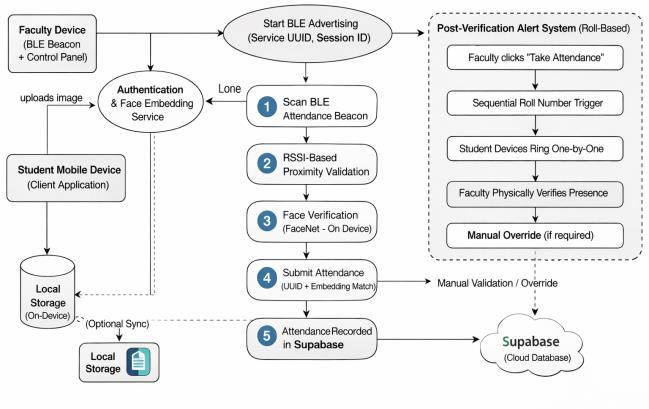
EduSync uses a two-layer verification process for safely completingattendance.Thearchitectureconsistsofcoarse proximity measurements done by the EduSync system located near the user or to whom the system is verifying paired with fine biometric identification. As a result, the dual-layering method of verification minimizes the opportunityforfraudulentattendanceandensuresusersare not able to deny that they attended after having their attendancerecordedbytheEduSyncsystem.
A. Layer 1: BLE RSSI-Based Proximity Detection
Faculty devices act as peripheral nodes, broadcasting advertisements containing a cryptographically secure Universally Unique Identifier (UUID) as per RFC 4122 standards.Thestudentapplicationperformsperiodicscans to detect these advertisements. Proximity is validated throughtheReceivedSignalStrengthIndicator(RSSI),which
servesasaproxyfordistance.Thesystemappliesasignal threshold(Trssi)toensurethestudentiswithinthephysical boundariesoftheclassroom:
Signal Validation: TheapplicationcapturestheRSSIvalue ofthefacultybeacon.
Filtering: To mitigate the effects of multipath fading and environmentalinterference,amovingaverageofRSSIvalues iscomputed.
Thresholding: Attendancelogicproceedsonlyif: RSSIavg>Trssi,whereTrssiistypicallycalibratedbetween75dBmand-85dBmtoreflecta5-10meterradius.
B. Layer 2: Biometric Identity Authentication
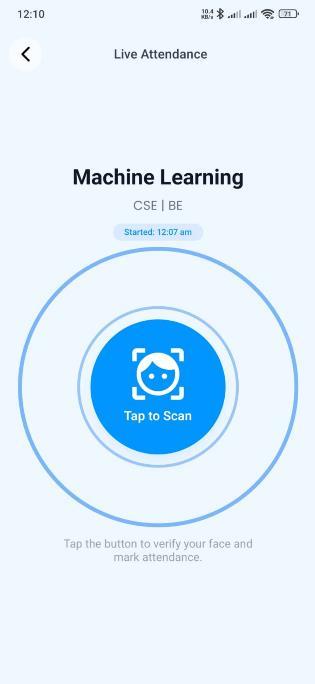
Uponsuccessfulproximityverification,thesysteminitiatesa biometrichandshakeusingaFaceNet-baseddeeplearning architecture.Thislayerensuresthatthedeviceholderisthe authorizedstudent,preventing"proxy"attendancemarking.
1) Feature Extraction and Embedding
Duringtheenrollmentphase,facialimagesareprocessedvia an Inception-ResNet backbone to generate a 128dimensional manifold embedding. The model is trained usingatripletlossfunction,whichminimizesthedistance between an anchor (Xa) and a positive sample (Xp) while maximizingthedistancefromanegativesample(Xn): L = Σ max(||f(xₐ) - f(xₚ)||² - ||f(xₐ) - f(xₙ)||² + α, 0) wheref(x)representstheembeddingfunctionandalphais theenforcedmarginbetweenpositiveandnegativepairs.
2) Verification via Cosine Similarity
Forreal-timeauthentication,thesystemcomparesthelive capture embedding ($e_{live}$) against the locally stored registration embedding ($e_{reg}$). Rather than using Euclidean distance, the framework employs Cosine Similarity to measure the angular displacement between thetwovectors,providingrobustnessagainstvariationsin imageintensity: similarity = (e₁ · e₂) / (||e₁|| × ||e₂||) Theverificationissuccessfulifthesimilarityscoreexceedsa predefinedthreshold(0.6).
3) Mobile Optimization
To facilitate on-device inference, the FaceNet model undergoes TensorFlow Lite conversion using 8-bit quantization.Thisoptimizationreducesthemodelfootprint from90MBtoapproximately23MB.Thisreductionenables low-latency execution on resource-constrained mobile hardware while maintaining an accuracy deviation of less than1%comparedtothefull-precisionbaseline.
C. Post-Verification Alert and Roll-Based Validation Mechanism
TotacklethelimitationofBLE-basedproximity detection, where signal strength may reach beyond the classroom boundaries,theEduSyncsystemincludesapost-verification alert mechanism. This mechanism ensures additional validation through human supervision. After the faculty successfullycompletesbothBLE-basedproximitydetection
Volume: 13 Issue: 03 | Mar 2026 www.irjet.net p-ISSN: 2395-0072
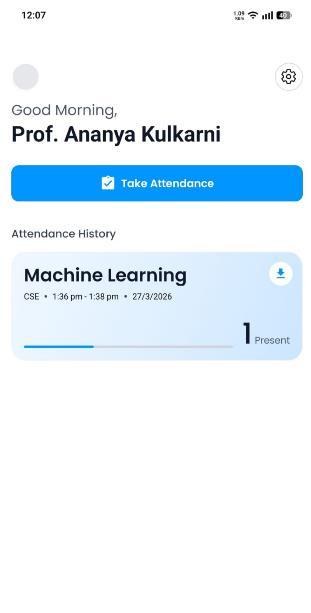
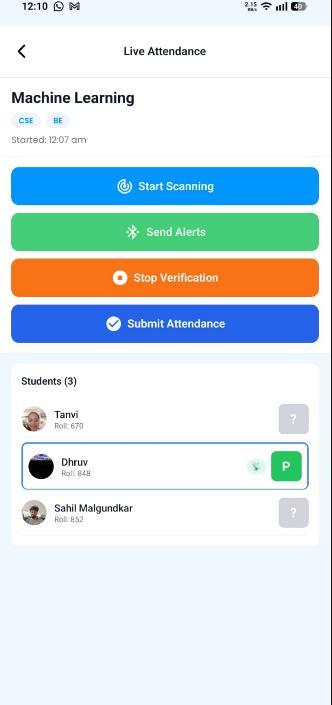
andFaceNet-basedbiometricauthentication,theystartthe finalattendanceprocessbytriggeringthe“TakeAttendance” action.Whenactivated,thesystemsendsoutalertsignalsto studentdevicesintheorderoftheirassignedrollnumbers. Eachregisteredstudentdeviceemitsanaudiblealertinaset roll-numbersequenceatshorttimeintervals.Thisringing methodallowsthefacultytophysicallyconfirmthepresence of each student in the classroom. This approach serves severalpurposes:
DetectionofOut-of-BoundPresence:BecauseBLEworkson a radius-based proximity model, students just outside the classroommaystillmeettheRSSIthreshold.Theroll-based alerthelpsfacultyidentifysuchcaseswhena devicerings fromoutsidetheclassroom.
Human-in-the-LoopValidation:Itaddsamanualverification stepwithoutsignificantlyraisingadministrativework.
ImprovedTransparency:Facultymembersreceivereal-time updates on which students are marked present and their physicalpositionsrelativetotheclassroom.
Thealertsequenceiscarriedoutwithashortdelay,typically 3 to 5 seconds, between consecutive roll numbers. This ensures clarity and prevents overlapping audio signals. If there are any discrepancies, faculty members can make changesorinvalidateattendancerecordsasneeded.
This mechanism effectively complements the automated dual-layerverificationframeworkbyconnectingalgorithmic proximity estimation with real-world spatial validation, therebyimprovingtheoverallstrengthandreliabilityofthe system.
EduSyncwastestedinvariousreal-worldclassroomsettings. This included different device capabilities, changing BLE signal conditions, and occasional network connectivity issues.Thesystemunderwentseveralsessionswithmultiple students participating at the same time to check its reliability, responsiveness, and overall strength. During operation, the BLE-based proximity detection layer accuratelyidentifiedstudentswithinasetclassroomarea. WhilewenoticedsomesmallchangesinRSSIvaluesbecause ofobstaclesandsignalinterference,thefilteringsystemkept proximity validation stable. The facial recognition module workedwellonthedeviceitself,allowingreal-timeidentity checkswithoutneedingconstantinternetaccess.
The system still performed well even when network conditionswerepoororunstable.Keyfunctions,suchasBLE scanningandfacialauthentication,continuedtoworklocally. Thisensuredthatattendanceprocessingwasuninterrupted. Once the network connection was back, syncing with the backend happened smoothlyand withoutany data issues, showingreliabledatamanagementandsystemstrength.The
post-verification alert system effectively highlighted problemscaused byBLE’sradius-baseddetection.Faculty memberscouldspotinstanceswheredeviceswereoutside the classroom even if proximity standards were met. This processstrengthenedtheaccuracyofattendancerecording throughhumanchecks.
Performance analysis showed that the overall attendance process was completed with minimal delay, with most verificationstakingjustafewsecondsperstudent.Usingondevice inference significantly cut processing times and reduced reliance on server computation. Energy use also stayed within acceptable ranges thanks to optimized BLE scanning and TensorFlow Lite implementation. User experienceremainedsmoothandeasyindifferentscenarios. Automating the verification process with minimal manual inputloweredadministrativeworkloadwhilestillkeeping transparencythroughalertsandvalidationprocesses.
These findings show that EduSync effectively supports secure, scalable, and reliable attendance management in real-world educational settings. The system outperforms traditional single-layer manual methods by blending automationwithpracticalchecks,makingitidealforsmart campussystems.
International Research Journal of Engineering and Technology (IRJET) e-ISSN: 2395-0056
Volume: 13 Issue: 03 | Mar 2026 www.irjet.net p-ISSN: 2395-0072
This paper discusses EduSync, a detailed multi-layer attendancemanagementsystemaimedatfixingkeyissuesin traditional and current digital attendance solutions. By combiningBluetoothLowEnergy(BLE)proximitydetection, FaceNetfacialrecognition,andacontrolledadministrative validation process, the system ensures that only students who are physically present and verified can mark attendance.Apost-verificationrollalertsystemaddstothe framework by allowing real-world checks of student presence.ThiseffectivelyaddressesthelimitationsofBLE technologywhilekeepingusabilityandcostefficiencyintact withoutneedingspecializedhardware.Experimentscarried out in various classroom settings with a large group of studentsshowthattheproposedsystemworkswellinrealworldsituations.EduSyncachievesaround80%operational accuracy, largely affected by device compatibility, environmental factors, and real-time deployment issues. Even with these obstacles, the system reduces proxy attendanceanddevice-sharingriskswhilemaintaininglow latencyandenergyefficiencythroughon-deviceprocessing with TensorFlow Lite. The roll alert mechanism improves frauddetectionbyenablingfacultytospotdiscrepanciesin physical presence, thusboostingtheoverall robustnessof thesystem.
The mobile-first design and on-device facial recognition providesignificantprivacybenefitsbynotstoringsensitive biometricdatainacentralizedlocation.Thisdecentralized method lowers the risk of large-scale data breaches and allows some system features to function even with poor connectivity.Across-platformapproachusingReactNative ensureswidedevicecompatibility,whilethebackendbuilt on Django and Supabase offers a flexible and scalable environment for institutions. Additionally, tying in cloud services allows for real-time updates and notifications, improving system responsiveness and user experience.
Economically, EduSync shows clear advantages over traditional biometric systems. By making use of existing smartphones and reducing the need for specialized hardware, the system cuts down on deployment and maintenance costs. This makes it a practical solution for large educational institutions looking to modernize attendance management without incurring high infrastructure costs. Future research could focus on improvingsystemaccuracyandrobustnesswithbetterfacial recognition in difficult conditions like varying light and obstructions.Addingadvancedlivenessdetectionmethods, such as motion analysis and texture-based classification, could enhance the defense against presentation attacks. Additionally,refiningBLE-basedlocationtrackingorusing hybridpositioningmethodscouldresultinbetterproximity accuracy. Connecting with institutional learning management systems could open up opportunities for detailedacademicanalytics,whileprivacy-safetechniques like federated learning might enable large-scale insights withoutriskinguserdatasecurity.
In conclusion, EduSync shows that combining different technologies with human validation can effectively tackle complex attendancemanagementissues.Its multi-layered verificationsystem,privacy-focuseddesign,andpracticaluse contribute to the growth of smart campus infrastructure, providingasecure,clear,andscalablesolutionformodern educationalsettings.
We wish to express our sincere gratitude to Dr. Sanjay U. Bokade, Principal, and Prof. S. P. Khachane, Head of the DepartmentofComputerEngineeringatMCT'sRajivGandhi Institute of Technology, for providing us with the opportunity to undertake our project titled "EduSync: HybridizingBLEBeaconNetworksforIntelligentCampus."
Wearedeeplythankfultoourprojectguide,Dr.SatishKet, for his constant guidance, valuable suggestions, and encouragementthroughoutthedevelopmentofthisproject. Hisexpertiseand support playeda crucial roleinshaping ourworkandensuringitssuccessfulcompletion.
We would also like to extend our sincere thanks to our facultymembers,colleagues,andall450studentparticipants who volunteered for system evaluation, for their cooperation, constructive feedback, and assistance during variousstagesoftheproject.Theirsupportandmotivation contributedsignificantlytothesuccessfulcompletionofthis work.
International Research Journal of Engineering and Technology (IRJET) e-ISSN: 2395-0056
Volume: 13 Issue: 03 | Mar 2026 www.irjet.net p-ISSN: 2395-0072
[1] A. Jain, "A BLE-Based Smart Attendance System for Scalable and Contactless Classroom Automation," International Journal of Engineering Research and Technology(IJERT),vol.14,no.7,July2025.
[2] G. Thiagarajan, M. Saran, K. Sneha, and J. Janani, "A Smart Attendance Management System Using NRF51822 BLE Module and Mobile Application," International Research Journal of Advances in EngineeringandHealth(IRJAEH),2025.
[3] A.Puckdeevongs,N.K.Tripathi,A.Witayangkurn,andP. Saengudomlert,"ClassroomAttendanceSystemsBased on Bluetooth Low Energy Indoor Positioning Technology for Smart Campus," Information, MDPI, 2020.
[4] G.P.WarmanandG.P.Kusuma,"FaceRecognitionfor Smart Attendance System Using Deep Learning," Communications in Mathematical Biology and Neuroscience,SCIK.org,2023.
[5] N. Surantha, "Lightweight Face Recognition-Based PortableAttendanceSystem(FaceNet+SVM),"Procedia ComputerScience,2024.