

International Research Journal of Engineering and Technology (IRJET) e-ISSN: 2395-0056
Volume: 13 Issue: 04 | Apr 2026 www.irjet.net p-ISSN: 2395-0072
EDULOAN: SECURE LOAN PROCESSING AND MANAGEMENT SYSTEM WITH PERMISSIONED BLOCKCHAIN AND SMART CONTRACTS
Dr. S. Annie Joice1, M. Selva Rubavathy2, J. Dhivyazhini3, C. Jananai 4
1Assistant Professor, Department of CSE, Government College of Engineering, Srirangam, Tamilnadu, India 2,3,4UG student, Department of CSE, Government College of Engineering, Srirangam, Tamilnadu, India
Abstract- Traditional education loan systems suffer from centralized control, lack of transparency, and vulnerability to fraud. This paper proposes EduLoan, a blockchain-based framework for end-to-end education loan lifecycle management built on Hyperledger Fabric. The system employs a permissioned distributed ledger and smart contracts to automate loan application submission, multi-level stakeholder verification, weighted eligibility assessment, conditional approval, and sequential year-wise fee disbursement. An intelligent multi-factor evaluation model incorporating CIBIL score analysis, debt-to-income ratio, employment classification, and institution tier ensures unbiased credit decision-making. An automated repayment scheduling engine and auto-debit EMI simulation engine process repayments with real-time blockchain recording across multiple organizations, culminating in automatic loan closure upon full repayment. All transactions are immutably recorded, ensuring data integrity, non-repudiation, and complete auditability. By integrating SHA-256 cryptographic security, MSPbased role access control, and multi-party endorsement consensus, EduLoan establishes a secure, transparent, and automated ecosystem for education finance in India.
Key Words: Blockchain, Hyperledger Fabric, Education Loan, Smart Contracts, Chaincode, Role-based Access Control, EMI Automation, Loan Lifecycle Management
1. INTRODUCTION
Theacceleratingevolutionofdigitalfinancialecosystems has underscored the critical need for secure, transparent, and resilient infrastructures to support education financing [1]. Existing loan processing frameworks are deeply entrenchedincentralized,legacy-drivenarchitecturesthat are inherently inefficient, opaque, and vulnerable to systemic risks [2]. These systems rely on manual workflows, fragmented data repositories, and intermediarydependent validation mechanisms, resulting in prolonged processingcyclesandlimitedauditability[3].
The multi-stakeholder nature of education loan systems introduces data asymmetry, lack of interoperability, and inconsistencies in decision-making [4], while the absence ofatamper-resistantinfrastructureexposesthesystemto identity fraud, document falsification, and unauthorized fund diversion [5]. These limitations highlight a pressing needfordecentralized,trust-enforcingarchitectures[6].
Blockchaintechnologyhasemergedasadisruptiveinnovation offering decentralization, immutability, cryptographic security, and consensus-driven validation [7]. Permissioned frameworks such as Hyperledger Fabric provide fine-grained access control and identity management via Membership Service Providers, making them highly suitable for regulated multi-party financial governance[8][9].
This paper introduces EduLoan, a blockchain-enabled frameworkbuiltonHyperledgerFabricthatautomatesthe complete education loan lifecycle from application and credit evaluation to disbursement, EMI repayment, and loan closure ensuring security, transparency, and auditabilitythroughMSP-basedroleaccesscontrolandmulti-partyendorsementconsensus[7][8][9].
The key contributions of this paper are: (1) a fully permissionedthree-organizationHyperledgerFabricnetwork with MSP-based role enforcement across all loan lifecycle phases; (2) a deterministic weighted scoring model for bias-free credit evaluation; (3) sequential year-wise disbursement governance with automated email notifications;and(4)anintegratedauto-debitEMIsimulationengine with real-time blockchain recording and automated loanclosure.
2. RELATED WORK
Researchers have extensively investigated blockchainbased frameworks and smart contract architectures to address inefficiencies, fraud vulnerabilities, and transparencylimitationsindigitalfinancialsystems.Sonawaneand Motwani [10] proposed a blockchain-powered financial services platform facilitating peer-to-peer payments, crowdfunding, and loan services within a unified decentralizedecosystem.However,thesystemisbuiltonapublic blockchain, introducing limitations in access control granularity, participant identity management, and data confidentiality factors critical in regulated education loanenvironments.Gazalietal.[11]proposedaprototype system for managing education loan repayment using blockchain and smart contracts, motivated by persistent defaultpaymentissuesfacedbyMalaysia'sNational Higher Education Fund Corporation. However, the prototype addresses only the repayment phase and lacks multiorganizationalarchitecture,role-basedaccesscontrol,and
International Research Journal of Engineering and Technology (IRJET) e-ISSN: 2395-0056
Volume: 13 Issue: 04 | Apr 2026 www.irjet.net p-ISSN: 2395-0072
end-to-endlifecyclecoverage.Abbasetal.[12]proposeda blockchain-basedframework tosecure financial technology loan processing through smart contract integration. While the system reduces fraudulent transactions and processing delays, it does not encompass multi-party enrollment verification, institution-specific sequential disbursement, or automated EMI processing. Legowo et al. [13] proposed a smart contract-based blockchain frameworktogovernpeer-to-peerlendingoperations,eliminating dependency on traditional financial intermediaries. However, the platform lacks structured credit evaluation, institution-tier-based eligibility scoring, sequential disbursement enforcement, and role-based access control through distinct organizational identities. Saleem et al. [14] proposed a blockchain-powered loan management system integrating smart contracts to automate end-toend loan processing. While the system reduces manual processing overhead, it does not address educationdomain-specific requirements such as CIBIL-based weighted credit scoring, sequential year-wise disbursement,orautomatedEMIrepaymentscheduling. TheproposedEduLoanframeworkaddressesallidentified limitations through a fully permissioned threeorganization Hyperledger Fabric network with deterministic chaincode-driven lifecycle automation, intelligent weightedcreditscoring,andanintegratedauto-debitEMI simulationengine.
3. PROPOSED SYSTEM
3.1 System Architecture
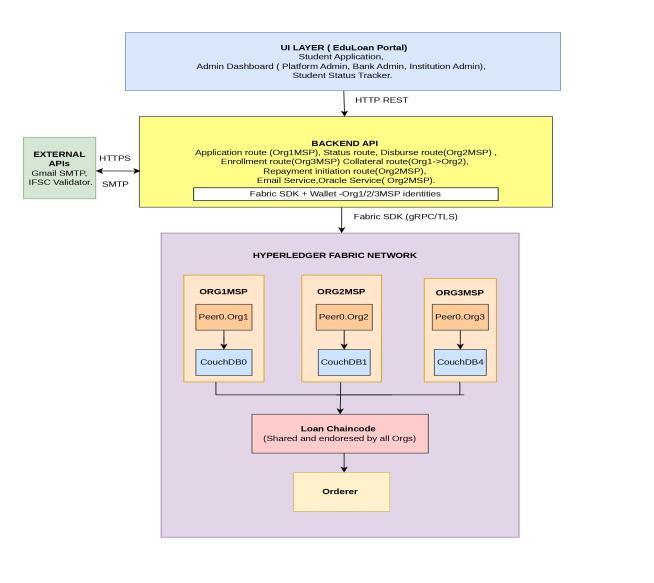
The EduLoan framework is architected on a threeorganizationHyperledgerFabricpermissionedblockchain network, comprising Org1MSP (Platform applicantfacing operations), Org2MSP (Bank disbursement and repayment governance), and Org3MSP (Institution enrollmentverificationandconfirmation).Eachorganization operatesanindependentpeernodebackedbyadedicated CouchDB instance, enabling rich JSON-based state queries andindexedledgeraccessacrossallloanlifecyclerecords.
All participating peers communicate through a single Raft-basedorderingservicedeployedonasharedorderer node, ensuring deterministic transaction sequencing and fault-tolerant consensus across organizations [8]. A unifiedchannel named"loan"servesasthesharedcommunicationfabric,throughwhich all endorsedtransactionsare committed to the distributed ledger [7].Smart contracts (chaincode)writteninJavaScriptanddeployedontheloan channel encapsulate the complete business logic of the loan lifecycle, organized into five functional modules: application and eligibility, collateral and enrollment, yearwisedisbursement,repaymentandEMImanagement,and auditandtransparency.Accesstoeachchaincodefunction is strictly governed by MSP-based role authorization, en-
suring that only authorized organizations can invoke sensitiveoperations[8][9].
The backend layer comprises a Node.js Express API serverthatinterfaceswiththeFabricnetworkthroughthe Fabric Gateway SDK, while the frontend is a React-based studentandadminportal.Anintegratedemailnotification servicetriggersautomatedcommunicationsat everycritical lifecycle event, ensuring complete stakeholder awarenessthroughouttheloanprocess.
3.2 Methodology
The EduLoan framework adopts a structured, phasedrivenmethodologythatmapseachstageoftheeducation loanlifecycletoacorrespondingsmartcontract
moduledeployedontheHyperledgerFabricpermissioned blockchain.Themethodologyensuresend-to-endautomation, auditability, and multi-party governance across all participatingorganizations[8].
3.2.1 Loan Application and KYC Submission
The loan lifecycle initiates when a student submits an application through the React-based EduLoan portal. The applicationcapturespersonal identityinformationincludingPAN,Aadhaar,dateofbirth,mobilenumber,andemail address, alongside academic details such as institution, course, duration, and total course fees, and financial details including the requested loan amount, repayment period, bank account number, IFSC code, and co-applicant information. Upon submission, the backend API invokes the submitApplication chaincode function authorized exclusively to Org1MSP. All sensitive identifiers are cryptographicallyhashedbeforebeingrecordedonthedistribut-
International Research Journal of Engineering and Technology (IRJET) e-ISSN: 2395-0056
Volume: 13 Issue: 04 | Apr 2026 www.irjet.net p-ISSN: 2395-0072
ed ledger, ensuring data integrity and privacy [7]. The transactionisendorsedbypeersacrossallthreeorganizations before being committed to the loan channel, establishinganimmutableapplicationrecord[8].
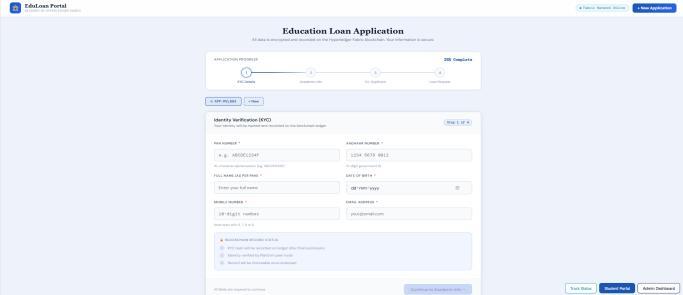
Fig -2:StudentApplication
3.2.2
CIBIL-Based Credit Evaluation
Following successful application submission, an automated CIBIL evaluation is triggered through the recordCIBILResult chaincode function, also authorized to Org1MSP. The system queries an external credit scoring oracleviatheRazorpayIFSCvalidationAPItoretrievethe co-applicant's credit profile based on their PAN number. The retrieved CIBIL score is classified into predefined bands Excellent(750andabove),Good(700–749),Fair (650–699),andPoor(below650) andrecordedimmutablyontheledger.Thisscoresubsequentlyfeedsintothe weightedeligibilityassessmentmodel,ensuringthatcredithistoryisadeterministicfactorinloandecision-making.
3.2.3
sion
Weighted Eligibility Assessment and Loan Deci-
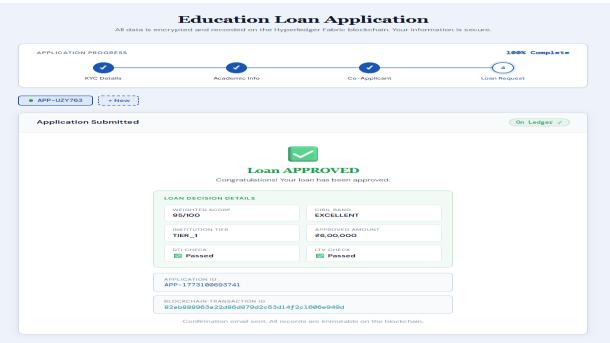
The evaluateLoanApplication chaincode function implements an intelligent multi-factor weighted scoring model that evaluates each application across four dimensions: CIBIL score band (40% weight), debt-to-income ratio (30% weight), employment classification of the coapplicant(20%weight),andinstitutiontier(10%weight). Each parameter is assigned a normalized score, and the composite weighted score is computed deterministically on-chain, eliminating subjectivity and human bias from the credit decision process [12]. Applications scoring above the approval threshold are marked APPROVED, thosemeetingconditional criteria aremarkedAPPROVED WITH CONDITIONS requiring collateral submission, and those falling below the minimum threshold are marked REJECTEDwithenumeratedrejectionreasonsrecordedon theledger[9].
3.2.4
tion
Collateral Submission and Enrollment Verifica-
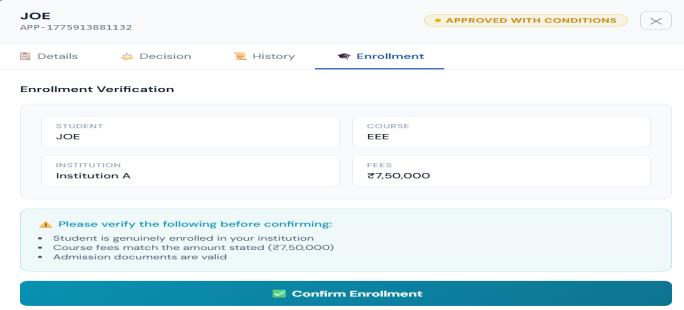
For conditionally approved applications, the student is required to submit collateral details including type, estimated value, and document reference through the portal. The submitCollateral chaincode function records these detailsontheledger,afterwhichOrg2MSPperformsphysical verification and invokes approveCollateral to confirm acceptance. Subsequently, Org3MSP confirms student enrollment by invoking the confirmEnrollment function, which transitions the application to an active disbursement-ready state.This three-phase verification ensures that loan funds are released only upon complete institutionalandfinancialvalidation[13].
3.2.5 Sequential Year-Wise Fee Disbursement
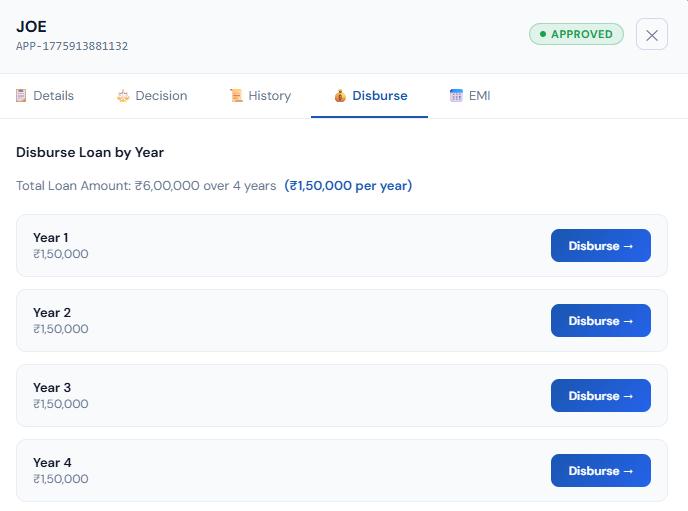
The disbursement methodology enforces strict sequential governance Year N fees cannot be disbursed until Year N-1 disbursement is confirmed on-chain. The recordDisbursement chaincode function, authorized to Org2MSP,acceptsthe applicationidentifier,a uniqueUTR number, and the academic year as parameters. Upon successful on-chain commitment, the backend triggers automated email notifications to the student, institution, and bank, maintaining complete transactional transparency. This sequential enforcement prevents premature fund release and ensures alignment with actual academic progression[10][13]
International Research Journal of Engineering and Technology (IRJET) e-ISSN: 2395-0056
Volume: 13 Issue: 04 | Apr 2026 www.irjet.net p-ISSN: 2395-0072
3.2.6 Repayment Initialization and EMI Scheduling
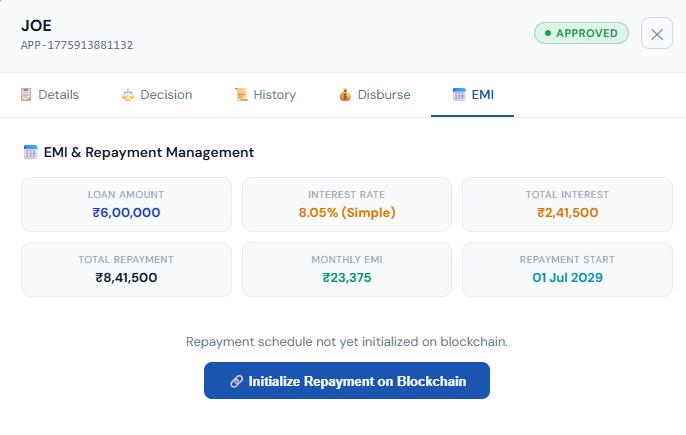
Upon completion of all four disbursement years, Org2MSPinvokestheinitializeRepaymentchaincodefunction,whichcomputesthecompleteEMIschedulebasedon the sanctioned loan amount, applicable interest rate, interest type (simple for public sector banks, compound for privatesectorbanks),andrepaymenttenure.Themoratorium period of one year post-course-completion is factored into the repayment start date in compliance with RBI guidelines. The generated schedule, comprising monthlyEMIamounts,duedates,andstatuses,isrecorded immutablyontheledger[11][14]andanautomatedemail notification is dispatched to the student containing the completeloansummary,EMIschedulewithduedatesand amounts, and designated bank account details for autodebitprocessing
3.2.7 Automated EMI Processing and Loan Closure
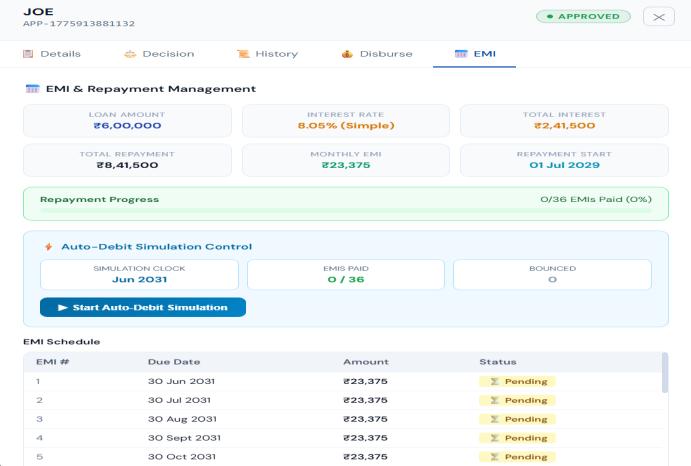
The auto-debit EMI simulation engine, integrated into the backend, periodically processes EMI payments by invoking recordEMIPayment on Org2MSP. In the event of insufficient balance, recordEMIBounce is invoked, apply-
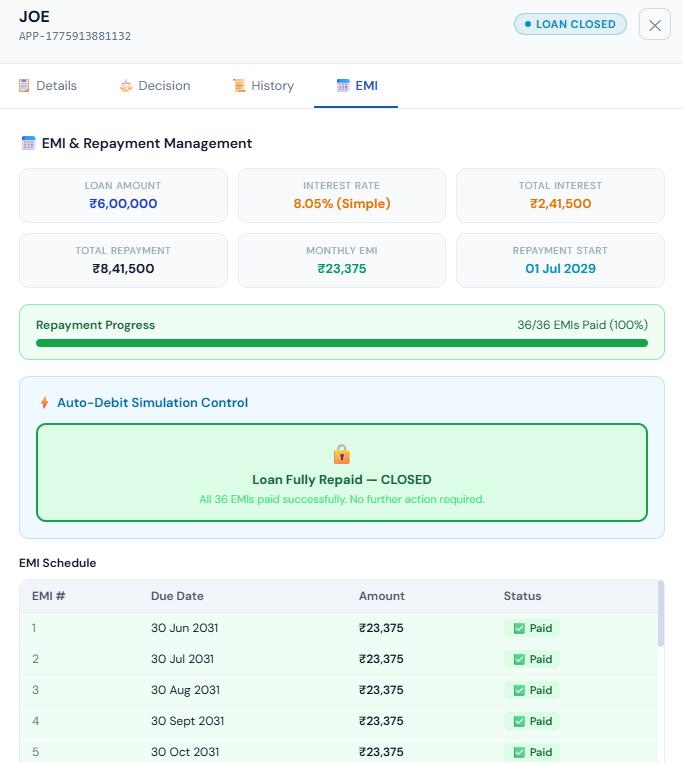
ing a 2% penalty on the outstanding EMI amount and recording the bounce event on the ledger [14]. Email notificationsaredispatchedtothestudentuponeverypayment andbounceevent.Uponsuccessfulcompletionofall EMIs, the system automatically transitions the loan status to LOAN CLOSED,recordingtheclosuretransactionimmutablyonthedistributedledgeranddispatchinganautomated email notification to the student confirming full repaymentandblockchain-recordedclosure.
4. EXPERIMENTAL EVALUATION
4.1
Experimental Setup
TheEduLoan blockchainsystem wasdeployedandevaluated on a local development environment running Ubuntu 22.04.5 LTS on Windows Subsystem for Linux 2 (WSL2). The host machine is equipped with a 13th Gen Intel Corei3-1315Uprocessorand8GBofRAM.The con-
Volume: 13 Issue: 04 | Apr 2026 www.irjet.net p-ISSN: 2395-0072
tainerized Hyperledger Fabric network was managed usingDockerDesktopv4.68.0 on Windows,managing Docker Engine v29.2.1 inside WSL2. The backend API was implemented using Node.js v22.22.0 and the React-based frontendwasservedonport3000,withthebackendREST APIrunningonport3001.
The Hyperledger Fabric network consisted of three organizations Org1MSP (representing the loan application authority), Org2MSP (representing the bank), and Org3MSP (representing the educational institution) each running a peer node backed by a CouchDB instance for rich querysupport.The orderingserviceuseda single orderernode.Thesmartcontract(chaincode)waswritten in JavaScript and deployed on a channel named loan. All three organizations endorsed and committed the chaincodewithanendorsementpolicyrequiringapproval fromallthreepeers.
The system was tested end-to-end covering the complete loan lifecycle: application submission, CIBIL evaluation, collateralmanagement,year-wisedisbursement,andEMIbased repayment tracking. For performance benchmarking, a dedicated benchmark script was developed using the Fabric Node.js SDK to invoke chaincode functions directly and measure transaction latency and throughput undercontrolledconditions.
4.2 Performance Evaluation
Twocategoriesoftransactionswerebenchmarkedusing the Fabric Node.js SDK. Query transactions invoke evaluateTransaction, reading state directly from the peer's CouchDB ledger without passing through the ordering service. Submit transactions invoke submitTransaction, triggeringthefullHyperledgerFabriclifecycle proposal endorsement across all peer organizations, ordering, and blockcommitmenttotheledger.
Table 1:QueryTransactionLatency(getAllApplications–10runs)
that bypass the consensus pipeline. The elevated first-run latency of 218 ms is attributable to gateway initialization overhead,withsubsequentrunsstabilizingbetween96ms and130ms.Submittransactionsaveraged2242msatapproximately 0.45 TPS, a result of the multi-phase Fabric transaction lifecycle involving cross-peer endorsement,orderer batching, and ledger commit across three organizations on a resource-constrained WSL2 environment. Across 10 runs, the spread between minimum and maximum latency was 188 ms, confirming the stability and determinism of the consensus pipeline under test conditions.
4.3 Security and Access Control
The system enforces organization-level access control via Hyperledger Fabric's MSP framework. Each chaincode function validates the invoking MSPID submitApplication and recordCIBILResult are restricted to Org1MSP, recordDisbursementandinitializeRepaymenttoOrg2MSP, andconfirmEnrollmenttoOrg3MSP.Unauthorizedinvocations are rejected at chaincode level. Sensitive fields student PAN, Aadhaar, and co-applicant PAN are hashed using SHA-256 before ledger storage, ensuring no personally identifiable information is persisted in plaintext.TheimmutabilityoftheFabricledgerguarantees allrecordsarepermanentlytamper-evidentandauditable.
5. CONCLUSION
Table 2: SubmitTransactionLatency(SubmitApplication –10runs)
This paper presented EduLoan, a decentralized educationloanmanagementsystembuiltonHyperledgerFabric, designed to address the transparency, security, and accountability deficiencies prevalent in traditional loan processing frameworks. By mapping each phase of the loan lifecycle application, credit evaluation, collateral verification, disbursement, and repayment to dedicated smart contract modules enforced across three distinct organizations, the system achieves tamper-evident recordkeeping, role-based access control, and automated multistakeholder coordination without reliance on a central authority. Sensitive student data is protected through SHA-256hashingpriortoledgerstorage,ensuringcompliancewithdataprivacyprinciples.Experimentalevaluation on a three-organization Hyperledger Fabric network demonstrated query latencies averaging 123 ms at 8 TPS andsubmitlatencies averaging2242ms at0.45 TPS,consistentwithpermissionedblockchainconsensusoverhead. The results validate that blockchain technology can serve asarobust,auditable,andsecurefoundationforeducation loangovernanceinIndia.
REFERENCES
Query transactions averaged 123 ms at approximately 8 TPS,reflectingtheefficiencyofdirectCouchDBpeerreads
[1] R. Yang, "Development and Supervision of Financial Technology Based on Blockchain," Computa-
International Research Journal of Engineering and Technology (IRJET) e-ISSN: 2395-0056
Volume: 13 Issue: 04 | Apr 2026 www.irjet.net p-ISSN: 2395-0072
tional Intelligence and Neuroscience, vol. 2022, pp.1–12,Jun.2022.
[2] S.M.Idrees,M.Nowostawski,R.Jameel,andA.K. Mourya, "Security Aspects of Blockchain Technology Intended for Industrial Applications," Electronics,vol.10,no.8,p.951,2021.
[3] D.Malhotra,P.Saini,andA.K.Singh,"HowBlockchain Can Automate KYC: Systematic Review," Wireless Personal Communications, vol. 122, pp. 1987–2021,2022.
[4] M. Zachariadis, G. Hileman, and S. V. Scott, "Governance and Control in Distributed Ledgers: Understanding the Challenges Facing Blockchain Technology in Financial Services," Information and Organization, vol. 29, no. 2, pp. 105–117, 2019.
[5] X.Zheng,Z.Zheng,H.Dai,J.Chen,andX.Wang,"A Survey on Blockchain Technology and its Security," Blockchain:ResearchandApplications,vol.3, no.2,p.100067,Jun.2022.
[6] M.Xu, X.Chen, andG. Kou, "ASystematic Review of Blockchain," Financial Innovation, vol. 5, no. 1, pp.1–14,2019.
[7] M. N. M. Bhutta, A. A. Khwaja, A. Nadeem, H. F. Ahmad, M. K. Khan, M. A. Hanif, H. Song, M. Alshamari, and Y. Cao, "A Survey on Blockchain Technology: Evolution, Architecture and Security,"IEEEAccess,vol.9,pp.61048–61073,2021.
[8] E.Androulaki,A.Barger,V.Bortnikov,C.Cachin,K. Christidis,A.DeCaro,D.Enyeart,C.Ferris,G.Laventman, Y. Manevich, S. Muralidharan, C. Murthy, B.Nguyen,M.Sethi,G.Singh,K.Smith,A.Sorniotti, C. Stathakopoulou, M. Vukolic, S. W. Cocco, and J. Yellick, "Hyperledger Fabric: A Distributed Operating System for Permissioned Blockchains," in Proc. 13th EuroSys Conf., Porto, Portugal, Apr. 2018,pp.1–15.
[9] S. Casino, T. K. Dasaklis, and C. Patsakis, "A Systematic Literature Review of Blockchain-Based Applications: Current Status, Classification and Open Issues," Telematics and Informatics, vol. 36, pp.55–81,Mar.2019.
[10]S. S. Sonawane and D. Motwani, "BlockchainPoweredFinancialServicePlatform:EnablingP2P Payments,CrowdfundingandLoans,"IEEE,2024.
[12] S. Abbas, M. A. Khan, A. Qayyum, and J. Lloret, "A Blockchain-BasedFramework for SecuringFinancial Technology Loan Processing Systems," IEEE Access,vol.9,pp.99212–99226,2021.
[13] N. B. Legowo, D. Subanidja, and M. S. Rosmansyah, "The Integration of Blockchain, Smart Contract, and Internet of Things for the P2P Lending Platform,"in Proc.2020Int. Conf.onSmartTechnology and Applications (ICoSTA), Surabaya, Indonesia,Feb.2020,pp.1–6.
[14]Q. Saleem, A. Iqbal, F. Saleem, M. Y. Javed, and M. A. Khan, "A Blockchain-Based Loan Management System Using Smart Contracts," in Proc. 2020 Int. Conf. on Information Science and Communication Technology (ICISCT), Karachi, Pakistan, Mar. 2020,pp.1–6.
[11] H. M. Gazali, R. Hassan, C. M. Nor, and H. Li, "ReInventingPTPTNStudyLoanwithBlockchainand SmartContract,"inProc.2018IEEEConf.onOpen Systems (ICOS), Langkawi, Malaysia, Nov. 2018, pp.66–70.