
International Research Journal of Engineering and Technology (IRJET) e-ISSN: 2395-0056
Volume: 13 Issue: 04 | Apr 2026 www.irjet.net p-ISSN: 2395-0072

International Research Journal of Engineering and Technology (IRJET) e-ISSN: 2395-0056
Volume: 13 Issue: 04 | Apr 2026 www.irjet.net p-ISSN: 2395-0072
M
1Dept. of Electronics and Communication Engineering, MVSR Engineering College, Hyderabad, India & Address
2Dept. of Electronics and Communication Engineering, MVSR Engineering College, Hyderabad, India & Address
3Dept. of Electronics and Communication Engineering, MVSR Engineering College, Hyderabad, India & Address
4Dept. of Electronics and Communication Engineering, MVSR Engineering College, Hyderabad, India & Address
Abstract -This project presents a hybrid Edge–Fog computingframeworkforautonomousvehiclecommunication withinanintelligenttransportationenvironment.Thesystem focuses on minimizing decision latency and enhancing road safety by distributing computational tasks across edge nodes and fog infrastructure instead of relying solely on centralized cloud systems. A simulated multi-lane highway scenario is developed where vehicles dynamically interact using Vehicleto-Vehicle (V2V) and Vehicle-to-Infrastructure(V2I) communication.Pythonisusedtomodeltrafficbehaviourand visualization, while MATLAB handles real-time decisionmaking, including lane selection, speed control, and collision avoidance. The system incorporates adaptive offloading strategies based on network conditions, vehicle state, and infrastructure load. Experimental results demonstrate improvedresponsiveness,reducedlatency,andefficienttraffic coordination, indicating the effectiveness of integrating edge and fog computing in future autonomous transportation systems.
Key Words: Edge computing, Fog computing, Task Offloading, Traffic Simulation, Collision Avoidance, Lane ChangeOptimization,RoadSideUnits
Autonomousdrivingsystemsdependheavilyoncontinuous dataexchangeandfastdecisionmaking.Vehiclesmustreact instantlytosurroundingconditionssuchastrafficdensity, obstacles,andspeedvariations.Anydelayinprocessingcan leadtounsafesituations.
Traditional centralized computing models rely on remote servers,whichintroducecommunicationdelaysduetolong transmission distances. These delays become critical in applications where decisions must be made within milliseconds.
To address this limitation, distributed computing approacheshavebeenintroduced.Edgecomputingenables data processing near the source, while fog computing provides an intermediate layer that aggregates regional information.
Together, these technologies create a hierarchical processingstructure thatbalancesspeedandcomputational capability.Thisprojectfocusesondesigningasystemwhere vehicles operate collaboratively using decentralized
communication and intelligent decision mechanisms, ensuringsafeandefficienttrafficflow.
Existing research in autonomous transportation primarily explores cloud-based framework for vehicle coordination. While these systems offer high computational power, they sufferfromsignificantcommunicationdelays,makingthem unsuitableforreal-timedecision-makingscenarios.Studies havehighlightedthatlatencybeyondafewmillisecondscan leadtounsafedrivingconditions.
Recent advancements have shifted focus toward edge computing,whereprocessingisperformedneardatasources. Researchdemonstratesthatedge-basedarchitecturesreduce responsetimeandimprovesystemreliability.However,edge nodesalonemaylacksufficientcomputationalresourcesfor complexanalytics,leadingtotheintegrationoffogcomputing asasupplementarylayer.
IoVbasedcommunicationmodelshavealsogainedattention for enabling cooperative driving. V2V communication facilitates direct interaction between vehicles, improving awareness of nearby traffic conditions, while V2I communication connects vehicles to infrastructure for broaderenvironmentalinsights.Despitetheseadvancements, challengesremaininefficientlydistributingcomputational tasks and maintaining network stability under dynamic conditions.
Thisprojectbuildsupontheseconceptsbycombiningedge and fog computing with IoV communication into a unified framework, addressing both latency and scalability challenges.
Theproposedsystemfollowsastructuredsimulation based methodologydesignedtoemulatereal-worldautonomous vehiclecoordinationunderdynamictrafficconditions.The approach integrates vehicle behaviour modelling, communication mechanisms, and distributed computing decisionsintoacontinuousexecutioncycle.
Theprocessbeginswithenvironmentinitialization,wherea multi-lanehighwayisdefinedwithfixedspatialdimensions anddirectionalconstraints.Vehiclesareintroducedintothis environmentwithrandomizedattributessuchasposition, velocity, and lane assignment. This randomness is not
International Research Journal of Engineering and Technology (IRJET) e-ISSN: 2395-0056
Volume: 13 Issue: 04 | Apr 2026 www.irjet.net p-ISSN: 2395-0072
arbitrary itisessentialtopreventpredictablepatternsand toreplicateheterogeneoustrafficconditionsobservedinreal scenarios
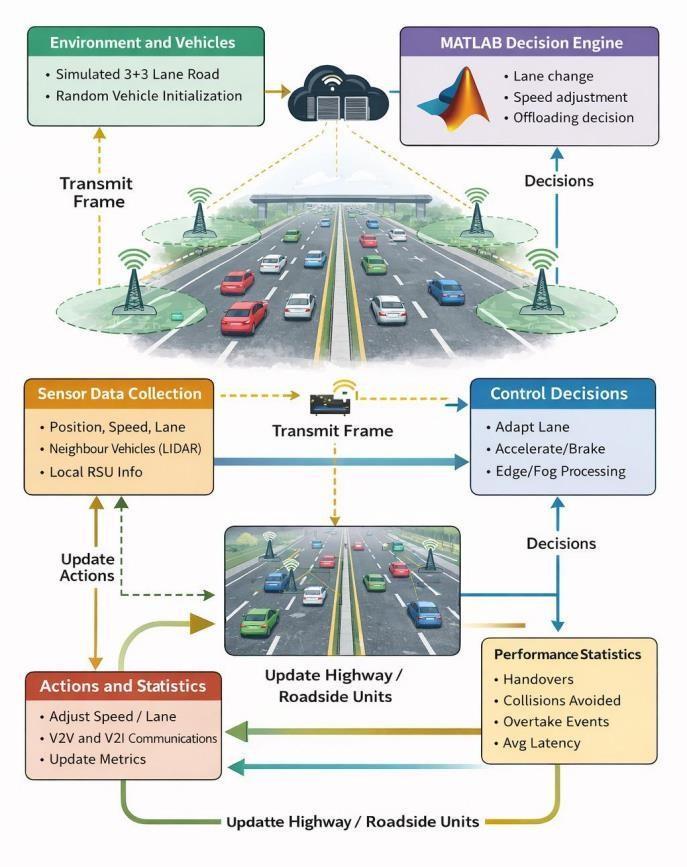
Ateachsimulationinterval,vehiclestatesareupdated using discrete-time motion equations. Instead of continuousmodelling,astep-basedupdate(withfixed time intervals) is used to balance computational efficiency and simulation accuracy. This allows the systemtoscalewhilestillmaintainingrealisticmotion behavior. Boundary conditions are handled using a wrap-aroundlogic,ensuringuninterruptedvehicleflow andeliminatingartificialstoppingpoints.Akeypartof the methodology lies in situational awareness generation. Each vehicle continuously scans its surroundings to identify nearby entities within a predefinedcommunicationradius.Thislocalperception is constructed using relative position, lane alignment, and speed differences. Rather than relying on global knowledge,thesystemintentionallylimitsawarenessto nearby vehicles, mimicking real-world sensor constraintsanddecentralizedintelligence.Thecollected environmental data is then transformed into a structured representation known as a sensor frame. Thisstepiscriticalbecauserawsimulationdataisnot directly usable for decision-making. The frame consolidates spatial, dynamic, and network-related parameters into a unified format, enabling efficient
processing by the decision engine. Care is taken to includebothphysicalmetrics(likespeedandposition) and network indicators (such as signal strength and infrastructure load), ensuring that decisions consider bothtrafficandcommunicationconditions.
Once the data is prepared, it is transmitted to the decision-making module, where computational intelligence is applied. Instead of embedding logic directly into the simulation, the system separates decision processing into an external controller. This separationisintentionalitimprovesmodularity,allows independent tuning of algorithms, and reflects realworld deployment where vehicles rely on external computationalsupport.Thedecisionengineevaluates multiplefactorssimultaneously.Itprioritizessafetyby analyzing inter-vehicle distances and predicting potential conflicts. Lane selection is treated as a constrainedoptimizationproblem,whereonlyfeasible neighboringlanesareconsideredbasedondirectionand available space. Speed adjustments are derived from proximity conditions rather than fixed rules, allowing adaptiveresponsestotrafficdensity.
Another critical component is the computation offloadingstrategy.Themethodologydoesnotassume that all decisions should be processed locally or remotely. Instead, it dynamically determines the executionlocationbasedonsystemconditions.Factors such as vehicle speed, surrounding traffic density, communication quality, and infrastructure load are evaluated before making an offloading decision. This ensures that the system avoids unnecessary communication delays while still leveraging external computational resources when beneficial. After decisionsaregenerated,theyarereintegratedintothe simulation environment. Vehicles update their states accordingly, modifying their trajectory, velocity, and processingmode.Thisclosed-loopinteractionbetween simulation and decision engine creates a feedback systemwhereeachcycleinfluencesthenext,enabling emergentbehaviorratherthanscriptedmotion.
Finally, the methodology incorporates continuous monitoring of system performance. Metrics such as latency, safety events, and communication transitions are recorded during execution. This is not just for reporting it allows validation of whether the design choices (likeedgeoffloadingorcommunicationranges) actually improve system behavior under varying conditions.
The system follows a hierarchical distributed architecture designed to minimize delay while maintaining coordinated decision-making across multiple vehicles. Instead of relying on a single centralizedunit,computationisdividedacrossdifferent
International Research Journal of Engineering and Technology (IRJET) e-ISSN: 2395-0056
Volume: 13 Issue: 04 | Apr 2026 www.irjet.net p-ISSN: 2395-0072
layersbasedonurgencyandcomplexity.Atthelowest level,vehiclesactasintelligentagentsthatcontinuously sensetheirsurroundingsandexchangeinformationwith nearby entities. They do not operate blindly each vehiclebuildsalocalizedunderstandingoftrafficusing short-rangecommunicationandonboardsensing.This ensures immediate awareness without waiting for externalprocessing.
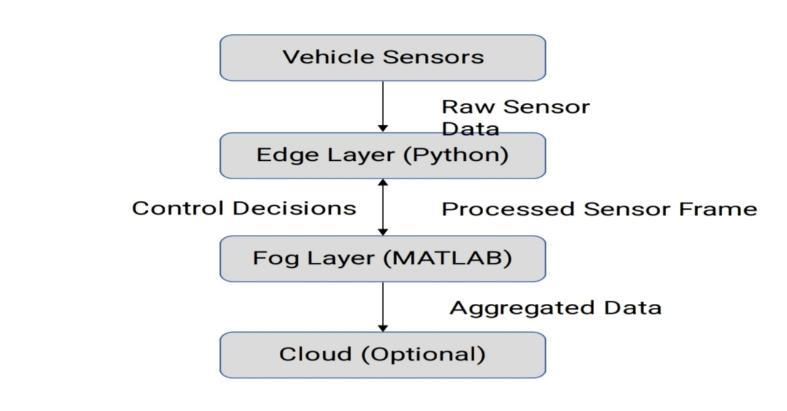
The intermediate layer consists of Road Side Units, whichfunctionasedgenodes.Theseunitshandletimesensitive computational tasks that are too heavy for individual vehicles but still require low latency. Their placement along the road ensures that vehicles can quickly connect to the nearest unit, reducing communicationdelayandenablingfasterresponse.
Above this, the fog layer serves as a regional coordinator. It does not deal with individual vehicle actionsdirectlybutinsteadprocessesaggregateddatato support broader traffic-level insights. This separation prevents overload at lower layers and improves scalabilitywhenvehicledensityincreases.
Thedecision-makinglayerisimplementedthroughan external controller that evaluates incoming data and generatesoptimizedactions.Byisolatingdecisionlogic fromsimulation,thesystemachievesflexibility,allowing algorithmimprovementswithoutmodifyingtheentire structure.
Overall,thearchitectureisdesignedaroundproximitybased processing: immediate decisions occur close to thevehicle,whilecomplexanalysisishandledathigher layers. This distribution is what reduces latency and avoidsbottlenecks
The system is implemented as a co-simulation framework combining Python for environment modellingandMATLABfordecisioncomputation.The core idea is to separate simulation logic from control
intelligence while maintaining real-time interaction between them. On the Python side, the road environment and vehicles are modelled using objectorienteddesign.Eachvehicleinstancemaintainsitsown dynamicstateand updatesitatevery simulation step based on motion equations. A scheduler controls the execution loop, ensuring consistent time progression andsynchronizedupdatesacrossallentities.Toenable interactionbetweenvehicles,aproximity-basedsearch mechanismisimplemented.Insteadofcheckingevery possiblepairinefficiently,distancefilteringisappliedto identify only relevant neighboring vehicles within a defined range. This reduces computational overhead and keeps the simulation scalable as the number of vehicles increases. A structured data interface is then created to bridge Python and MATLAB. Instead of passing raw variables, all relevant parameters are packaged into a standardized data structure. This ensures compatibility between the two environments and avoids data inconsistency during transmission. MATLAB component is responsible for executing the decision-making algorithms that govern vehicle behavior. Upon receiving structured data from the Pythonsimulation,MATLABprocessestheinputsusing control logic that may include rule-based systems or optimization techniques to determine appropriate actions such as speed adjustment, lane changes, or collision avoidance. The computed decisions are then transmitted back to the Python environment, where they are applied to update each vehicle’s state in the nextsimulationcycle
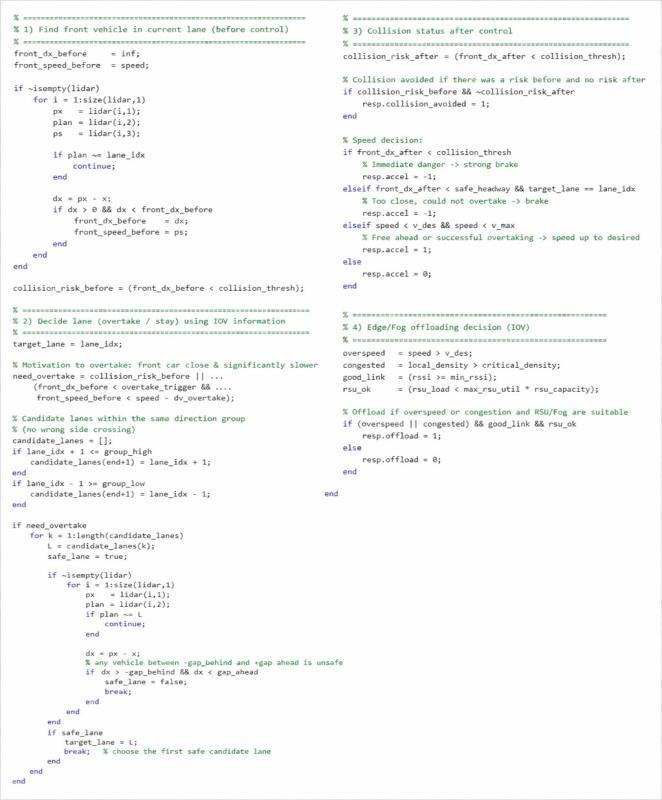
Fig-3 ProgramforOverSpeedoftheVehicle
International Research Journal of Engineering and Technology (IRJET) e-ISSN: 2395-0056
Volume: 13 Issue: 04 | Apr 2026 www.irjet.net p-ISSN: 2395-0072
CommunicationbetweenPythonandMATLABisachieved usingtheMATLABEngineAPI.PythoninvokestheMATLAB function, transfers the structured data, and waits for the response. This synchronous interaction guarantees that each simulation step uses updated decisions before proceeding further. Within MATLAB, the control logic is implementedasamodularfunction.Thefunctionevaluates incomingdatausingconditionalrulesandgeneratesoutputs that directly influence vehicle behavior. The logic is designed to be lightweight sothatitcan processmultiple vehiclesefficientlywithoutintroducingdelays.Onreceiving the controller output, Python applies the decisions immediately by updating vehicle attributes such as lane position,velocity,andprocessingmode.Insteadofabrupt changes, constraints are applied to ensure transitions remainrealisticandstable.
Theimplementationalsoincludesaresourcemanagement mechanismforRSUs.Eachunittracksitscurrentprocessing load, and updates are applied dynamically as vehicles offloadtasks.Thispreventsunrealisticunlimitedprocessing and introduces practical system limitations. To maintain continuity in communication, a handover mechanism is implemented.Whenavehiclemovesbeyondthecoverageof one unit, it automatically switches to another based on proximity. This transition is handled seamlessly without interruptingthesimulationflow.
Finally,avisualizationmodulerenderstheentiresystemin real time. It reflects vehicle movement, communication links,andprocessingstates,allowingdirectobservationof system behaviour. Alongside this, performance data is continuouslyloggedforevaluation.
The simulation demonstrates that the integration of edge and fog computing significantly enhances system performance compared to traditional centralized approaches.Vehiclesexhibitimprovedresponsivenessdue to reduced processing delays, enabling timely decisionmakingincriticalscenarios
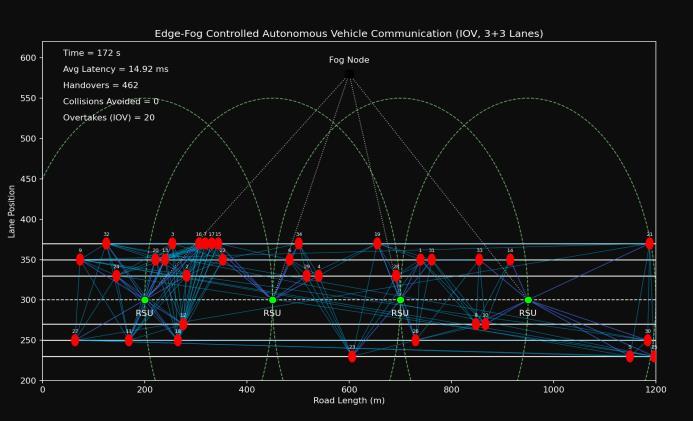
Collision avoidance mechanisms effectively maintain safe distances between vehicles, reducing the likelihood of accidents. The implementation of intelligent overtaking strategies contributes to smoother traffic flow and minimizescongestion
Task offloading to edge nodes is observed to balance computational loadefficiently,preventingoverloadinany single component. Additionally, the system adapts dynamically to varying network conditions, ensuring consistentperformance.Latencymeasurementsindicatea notable reduction when edge processing is utilized, validating the effectiveness of the proposed architecture. Overall,theresultshighlighttheimportanceofdistributed computing in achieving reliable and efficient autonomous vehiclesystems.
This work presents a comprehensive approach to autonomous vehicle communication using a hybrid Edge–Fog architecture. By combining decentralized computing withIoVcommunicationmodels,thesystemaddresseskey challenges related to latency, scalability, and safety. The integrationofMATLAB-baseddecision-makingwithPython simulation enables a flexible and powerful framework for analyzing traffic behavior. The results confirm that distributing computational tasks across multiple layers improves system efficiency and enhances real-time responsiveness.
While the current implementation provides a strong foundation, further enhancements such as machine learning-based decision models and advanced network simulationscanextenditscapabilities.Theproposedsystem represents a significant step toward the realization of intelligent and adaptive transportation systems for future smartcities.
[1] A. Thakur, R. Malekian, Fog computing for detecting vehicular congestion, an internet of vehicles based approach:areview.IEEEIntell.Transp.Syst.Mag.11(2), 8–16(2019)
[2] R. Naqvi, S. Salman, S. Wang, M. Ahmed, M. Anwar, A survey on vehicular edge computing: architecture, applications, technical issues, and future directions. Wirel. Commun. Mob. Comput. 2019, 1–19 (2019). https://doi.org/10.1155/2019/3159762
[3] R.Mahmud,A.N.Toosi,K.Rao,R.Buyya,Context-aware placementofIndustry4.0applicationsinfogcomputing environments.IEEETrans.Ind.Inf.16(11),7004–7013 (2020)
[4] R.S. Sandhya Devi, V.R. Vijaykumar, P. Sivakumar, Neeraja Lakshmi A, Vinoth Kumar B, in Edge ArchitectureIntegrationofTechnologies:CasesonEdge ComputingandAnalytics(2020)
[5] R.Mahmud,K.RamamohanaRaoR.Buyya,Application Management in Fog Computing Environments: A
International Research Journal of Engineering and Technology (IRJET) e-ISSN: 2395-0056
Volume: 13 Issue: 04 | Apr 2026 www.irjet.net p-ISSN: 2395-0072
Taxonomy,ReviewandFutureDirections(Universityof Melbourne,Melbourne,2020)
[6] R.Mahmud,K.RamamohanaRaoR.Buyya,Application Management in Fog Computing Environments: A Taxonomy,ReviewandFutureDirections(Universityof Melbourne,Melbourne,2020)
[7] H.A. El Zouka, A secure interactive architecture for vehicular cloud environment, in proceedings of IEEE ConferenceonSmartCloud(2016),pp.254–261
[8] M.Anwar,S.Wang,M.Zia,A.Jadoon,U.Akram,R.Naqvi, S.Salman,Fogcomputing:anoverviewofbigIoTdata analytics.Wireless.Commun.Mob.Compute.2018,1–22 (2018).https://doi.org/10.1155/2018/7157192
[9] M.Anwar,S.Wang,M.Zia,A.Jadoon,U.Akram,R.Naqvi, J. Sun, Q. Gu, T. Zheng, P. Dong, Y. Qin, Joint Communication and computing resource allocation in vehicularedgecomputing.Int.J.Distrib.Sens.Netw.15, 155014771983785 (2019).