
International Research Journal of Engineering and Technology (IRJET) e-ISSN: 2395-0056
Volume: 13 Issue: 04 | Apr 2026 www.irjet.net p-ISSN: 2395-0072

International Research Journal of Engineering and Technology (IRJET) e-ISSN: 2395-0056
Volume: 13 Issue: 04 | Apr 2026 www.irjet.net p-ISSN: 2395-0072
1 M.Tech Student, Rno: 24A31D5811, Dept. of Computer Science Engineering
2Assistant Professor, Dept. of Computer Science Engineering
`Pragati Engineering College1,2 , A.P, India ***
Abstract - Traditional methods associated with resources like water utilization and waste management, struggles to handle the challenges leading to inefficiencies, resource depletion,andenvironmentaldegradation[14] Toaddressthese limitations,weproposeacomprehensive techniqueECO-ML,a data-driven intelligent framework for sustainable urban resource management. It mainly focuses on three main core objectives such as Forecasting Urban Water Demand[9][10][11] , Predicting Municipal Solid Waste Generation[1][8], and Optimizing Waste Collection Routes[6][13]. The real-time and historical data related to population growth, climatic conditions, consumption patterns, and urban infrastructure are utilized to train predictive models Machine learning algorithms[2][14] such as regression and decision tree models such as gradient booster, Random Tree Forest, Logistic RegressionandXGBoostareemployedtoenhanceforecasting accuracy and efficiency. Additionally, Route optimization mechanisms are integrated to minimize fuel consumption, operational costs, and carbon emissions in waste collection processes. This ECOML model excels the conventional approaches by means of prediction accuracy, scalability, and adaptability. The framework provides actionable insights for municipalauthoritiesenablingproactivedecision-makingand efficientresourceallocationtowardthe developmentofsmart and sustainable cities.
Key Words: ECO-ML, Prediction, Water Demand, Solid waste generation, Route optimization, Sustainable.
Rapid urbanization makes the resource management[14] a challenging issue i.e., mostly in the domain of water management and solid waste management in the cities. According to the United Nations SDG 12, cities must have impact on responsible consumption and production Traditionalmodels[5] suchasPopulation-basedEstimation Models, Per Capita Waste Generation Method, Manual MonitoringofWasteBins,FixedScheduleWasteCollection System,StatisticalForecastingTechniques,ManualPlanning and Rule-based Estimation, etc., are not sufficient to overcomethesechallengesmadebyrapidurbanization. So, we need a most efficient models to overcome these challenges for that we propose a Machine Learning based Sustainable Urban Resource Management framework[2] called“ECOML:SMARTRESOURCEMANAGEMENT”.Inthis we experimentally demonstrate the three main core modules i.e., forecasting urban water demand, predicting
municipal solid waste generation, and optimizing waste collectionroutesinthecities.
The objectivesof thisproposedframework consists- i) To forecastingtheWaterDemandinthecities.ii)Topredictthe Municipal Solid Waste generations. iii) To optimize the WasteCollectionRoute.
Inthisstudy,thedataset[15] whichiscollectedfromvarious sourcessuchassmartwatermetersforthecollectionofflow rate,Governmentssourceslikemunicipalcorporationdata fordailywastecollectionandward-wisewastegeneration.In India online portals are available for data collection like SwachhBharathmissionportal.Forwastecollectionroute optimization, the data sources are road and map data, IoT smart bins, google maps platform, municipal GPS vehicle trackingsystems.
Data preprocessing[2] plays a critical role in improving the performance and reliability of machine learning models. Several preprocessing steps were implemented to ensure data qualityandconsistency.Missingvalueswerehandled usingmeanandmedian imputation techniques.Numerical featureswerenormalizedtomaintainuniformscaleacross variables.Categoricalattributeswereencodedintonumerical formats to enable model compatibility. Outliers were detected and removed to prevent skewed predictions. Additionally, feature selection techniques were applied to retainonlythemostrelevantattributes,therebyenhancing modelefficiency.
Thisstudyinvolvesthemodulestodesignandutilizationof waterresourcesandsolid-wastemanagementinthecities. ThemodulesofExigent,CleanovateandOpti-routearethe models to predict water demand forecasting, solid-waste generationandoptimumwastecollectionrouterespectively by using the ML techniques such as Gradient booster, RandomForestandXGBoost[2]forbetterefficient.
The ECO-ML system follows a structured machine learning workflow[2][14] for urban resource prediction and optimization.
TheECO-MLsystemisdesignedtomanageurbanwater resources and solid waste through three key modules: Exigent (water demand forecasting), Cleanovate(waste generation prediction), and Opti-route (waste collection
International Research Journal of Engineering and Technology (IRJET) e-ISSN: 2395-0056
Volume: 13 Issue: 04 | Apr 2026 www.irjet.net p-ISSN: 2395-0072
optimization). It uses machine learning models such as Logistic Regression, Random Forest, and XGBoost[2] to improve prediction accuracy and efficiency. Logistic Regressionusedforlinearlyseparabledata.RandomForest builds multiple decision trees based on classification algorithm and reduces overfitting. XGBoost works for reducingerrorsandproducessequentialtree.
TheworkflowbeginswithCSVdatasetswhicharecollected from,municipalwatersystems,roadandmapdata,municipal GPSvehicletrackingsystems,municipalcorporationdataand ward-wise waste generation. The collected data is preprocessedwheremissingvaluesarehandled,dataisscaled, and categorical variables are encoded using an integrated pipeline. Feature Engineering then selects and transforms relevantvariablesformodelreadiness.Multiplemodelsare trainedandevaluatedusingRMSEandR²metrics[4] Thebestperformingmodelisselectedusingthevaluesobtained.For predictions,thechosenmodelgeneratesreal-timeoutputs, whicharedisplayedasgraphs.TheOptimalWasteCollection routes are determined using a combination of the Greedy algorithm and the Haversine formula[13] for the shortest distance between the source and transfer station on the earth’ssurface.
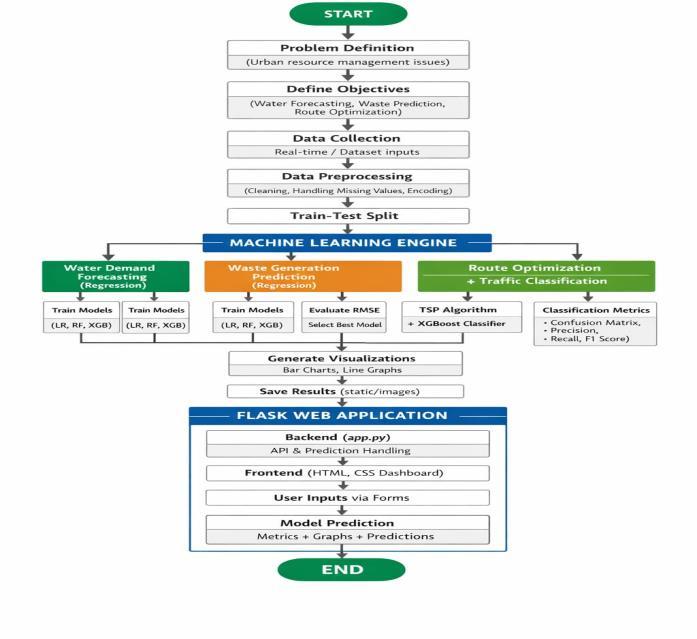
TheaboveworkflowillustratestheworkingoftheECO-ML SmartUrbanResourceManagementSystem.Itbeginswith problem definition andobjectivesetting,followed bydata collection and preprocessing. The process then moves to train-testsplittingandentersthemachinelearningengine[2] , where three modules operate: water demand forecasting, waste generation prediction, and route optimization with traffic classification[6][12]. Each module trains models and evaluates performance using appropriate metrics. After
selecting the best models, the system generates visualizations and saves results. These outputs are integratedintoaFlaskwebapplication,whereusersprovide inputs, receive predictions, and view results through an interactivedashboardinterface.
The project “ECO-ML: Smart Resource Management” successfully demonstrates how machine learning can transform[14] traditional urban resource management systems into intelligent, predictive, and sustainable frameworks.
The integration of three critical modules water demand forecasting, waste generation prediction, and route optimization providesacomprehensivesolutiontosomeof themostpressingchallengesfacedbymoderncities.Unlike conventional systems that operate on static rules and historical averages, ECO-ML leverages real-time and historicaldatatoenabledata-drivendecision-making[2]
The E-EXIGENT module ensures accurate water demand forecasting, helping authorities prevent shortages, reduce wastage, and improve distribution efficiency. The CCLEANOVATE module provides reliable waste generation predictions, enabling better planning of waste collection, processing, and disposal. Meanwhile, the O-OPTIRoute module enhances operational efficiency by optimizing collection routes, reducing fuel consumption, and minimizingenvironmentalimpact.
A key strength of ECO-ML lies in its ability to capture complex, non-linear relationships between multiple variablessuchaspopulationgrowth,climaticconditions,and consumption patterns. The use of advanced machine learning models like XGBoost ensures high prediction accuracy,whileoptimizationalgorithmsimprovereal-world applicability.
From a sustainability perspective, the framework contributes significantly by-reducing resource wastage, lowering operational costs, minimizing carbon emissions, supportingeco-friendlyurbanplanning
Furthermore,thesystemisscalableandadaptable,makingit suitable for deployment in smart cities and urban management systems. It can be extended with IoT integration, real-time dashboards, and advanced deep learningtechniquesforevengreaterefficiency.
Inconclusion,ECO-MLrepresentsanext-generationurban resourcemanagementsolutionthatshiftstheparadigmfrom reactivetoproactivemanagement.Bycombiningpredictive analyticswithoptimization,thesystemnotonlyimproves operational efficiency but also promotes sustainable developmentandenvironmentalresponsibility.Thismakes ECO-ML a valuable contribution toward building smart, resilient,andsustainablecitiesofthefuture.
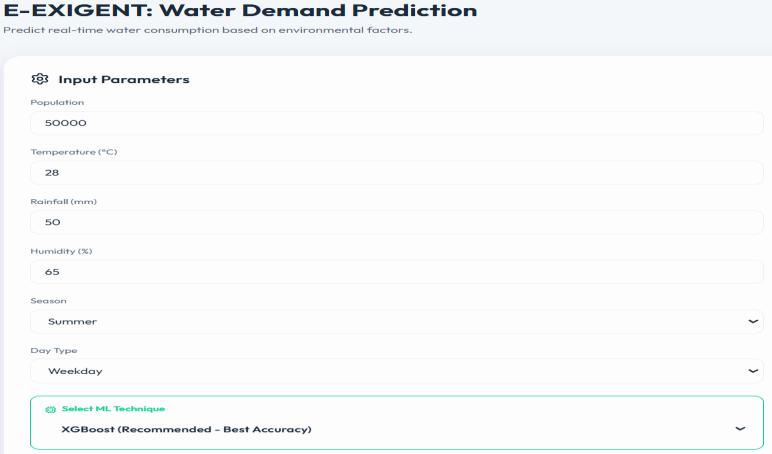
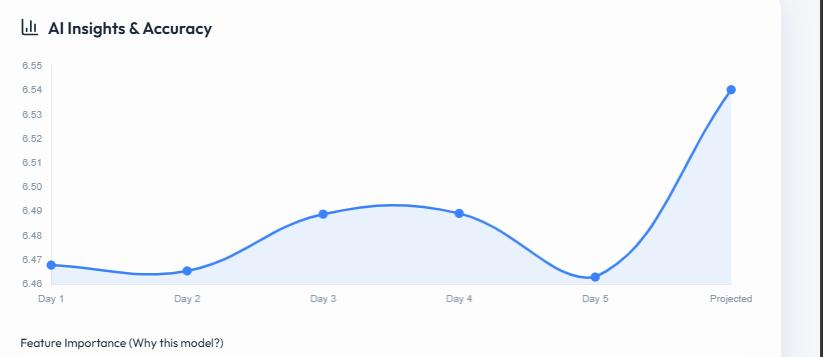
Thewaterdemandprediction[9][10][11] modulegeneratedan output of 6540.41 liters/day with a high confidence level
International Research Journal of Engineering and Technology (IRJET) e-ISSN: 2395-0056
(~98%). The temporal analysis showed relatively stable demandintheinitialdaysfollowedbyanoticeableincrease in projected demand. This indicates the model’s ability to capturebothshort-termstabilityandfuturedemandsurges.
TheuseofXGBoostenabledaccuratemodeling[4][11]ofnonlinear relationships between population, temperature, rainfall,andseasonalvariations.
KeyInsight:
Thesystemsuccessfullypredictswaterdemandwithhigh accuracyandcanproactivelyalertauthoritiesaboutfuture increases, helping prevent shortages and optimize distribution.

Generation Prediction)
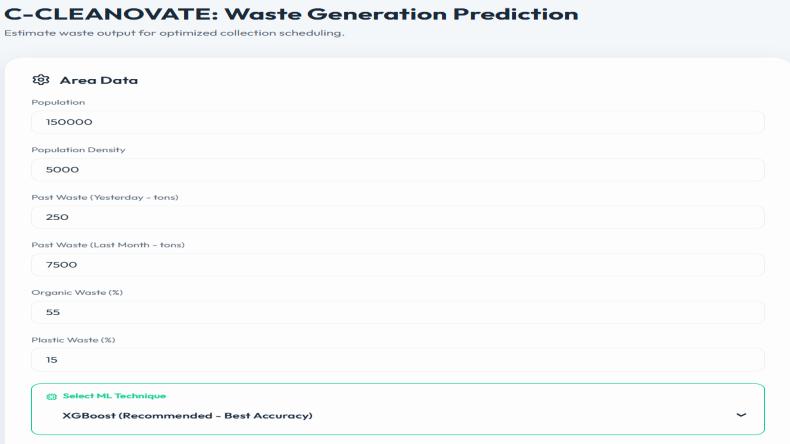
The waste generation prediction[1][8] module estimated ~299.9 tons/day, showing high stability with minimal fluctuations across time. The trend graph indicated slight variationsinfluencedbyfactorssuchaspopulationdensity, organic waste percentage, and historical waste data. No
extreme spikes were observed, demonstrating that the modelproducesconsistentandreliableforecasts.
KeyInsight:
Waste generation is strongly influenced by historical patterns and population density[1] The model ensures accurateandstableprediction,whichiscriticalforefficient wastemanagementplanning.
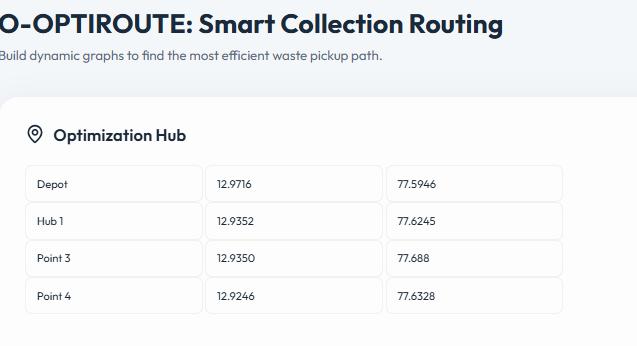
Module 3: O-OPTIRoute (Route Optimization)
The route optimization module generated an efficient path[6][13]connectingallwastecollectionpoints,minimizing travel distance and avoiding redundancy. The system utilizedK-Meansclustering[13]togroupnearbylocationsand shortestpathalgorithmstodetermineoptimalroutes.
KeyInsight:
Themodulesignificantlyimprovesoperationalefficiencyby reducingfuelconsumption,traveltime,androuteoverlap, makingwastecollectionmoresustainable[14]
Volume: 13 Issue: 04 | Apr 2026 www.irjet.net p-ISSN: 2395-0072 © 2026, IRJET | Impact Factor value: 8.315 | ISO 9001:2008
International Research Journal of Engineering and Technology (IRJET) e-ISSN: 2395-0056
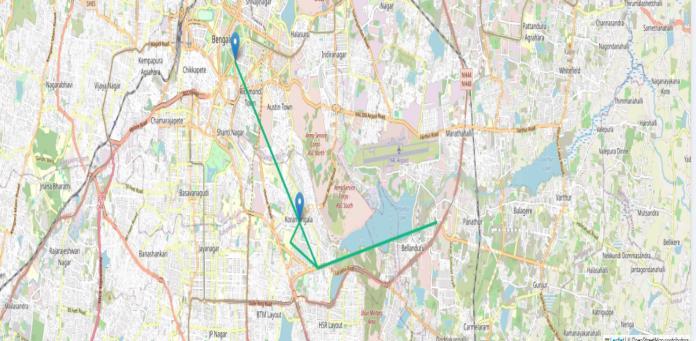
Fig -7:OptimalDistancePredictedforWasteCollection
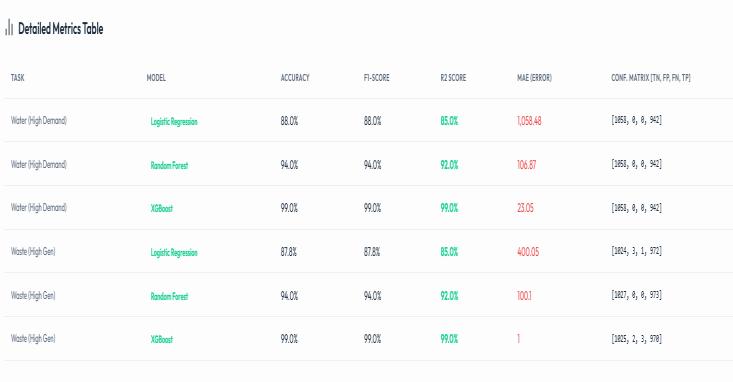
Fig -8:DetailedMetricsforvariousMLmodels
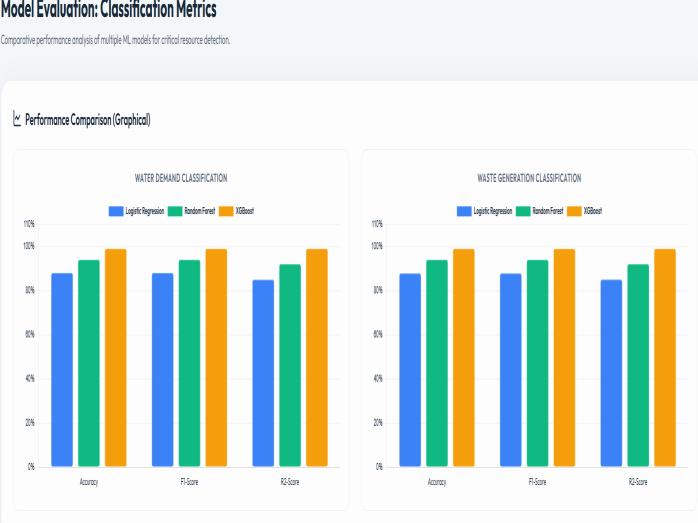
Fig -9:BarRepresentationofECOMLMODULES
REFERENCES
[1] M. Abbasi, M. A. Parvizimosaed, and M. Khosravi, “Forecasting municipal solid waste generation using artificial intelligence modelling approaches,” Waste Management,vol.56,pp.13–22,2016.
[3] S.Longhi,D.Marzioni,E.Alidori,G.DiBuò,M.Prist,and M. Grisostomi, “Solid waste management architecture using wireless sensor network technology,” IEEE Int. Conf.onNewTechnologies,MobilityandSecurity,pp.1–5,2012.
[4] K.Malialis,N.Mavri,D.G.Eliades,andM.M.Polycarpou, “Urban water consumption forecasting using deep learning,”arXivpreprintarXiv:2501.00158,2024.
[5] A.K.Kolekar,P.J.Kshirsagar,andS.A.Jadhav,“Machine learning-based smart waste management system for smart cities,” International Journal of Computer Applications,vol.182,no.30,pp.1–6,2018.
[6] J.Q.Li,Z.H.Han,andY.Wang,“Smartwastecollection route optimization based on machine learning,” IEEE Access,vol.9,pp.123456–123467,2021.
[7] S. K. Gupta and R. Kumar, “IoT-enabled smart waste management using machine learning techniques,” Journal of Cleaner Production, vol. 310, pp. 127–140, 2021.
[8] P.S.Rana,A.Jain,andV.Kumar,“Predictionofmunicipal solid waste generation using regression and neural networks,” Sustainable Cities and Society, vol. 62, pp. 102–115,2020.
[9] A.M.Ghalehkhondabi,E.Ardjmand,W.A.Young,andD. K.Weckman,“Waterdemandforecasting:Reviewofsoft computing methods,” Environmental Modelling & Software,vol.123,pp.104–117,2019.
[10]R.Kumar,S.Singh,andV.K.Singh,“Smartwaterdemand forecasting using machine learning techniques,” IEEE Int.Conf.onSmartCities,pp.210–215,2020.
[11]M.F.G.Ribeiro,R.P.Rocha,andJ.P.Carvalho,“Shorttermwaterdemandforecastingusingensemblemachine learningmodels,”AppliedSoftComputing,vol.106,pp. 107–119,2021.
[12]S. M. S. Islam, M. A. Hannan, A. Hussain, and H. Basri, “The application of machine learning techniques for smartwastebinleveldetectionandrouteoptimization,” Sensors,vol.20,no.23,pp.1–18,2020.
[13]H. Zhang, J. Li, and X. Chen, “Optimization of waste collection routes using clustering and shortest path algorithms,” IEEE Transactions on Intelligent TransportationSystems,vol.22,no.5,pp.2985–2995, 2021.
Volume: 13 Issue: 04 | Apr 2026 www.irjet.net p-ISSN: 2395-0072 © 2026, IRJET | Impact Factor value: 8.315 | ISO 9001:2008 Certified Journal | Page819
[2] A. S. Al-Mamun, M. S. Hossain, and M. M. Hasan, “Machine learning approaches in smart solid waste management systems: A review,” Journal of Environmental Management, vol. 330, pp. 117–129, 2023.
International Research Journal of Engineering and Technology (IRJET) e-ISSN: 2395-0056
Volume: 13 Issue: 04 | Apr 2026 www.irjet.net p-ISSN: 2395-0072
[14]A.Sharifi,“Smartcitiesandsustainability:Areviewof theapplicationsofmachinelearning,”Sustainability,vol. 11,no.2,pp.1–25,2019.
[15]https://docs.google.com/spreadsheets/d/1mUC_0sc1hg lMD1QeXx2eCFdcbzEmtdbbeG_jCvpvL_s/edit?usp=shari ng


Mr. Devisetti Venkata Durga Prasad is working as Assistant Professor in Department of Civil Engineering, Pragati Engineering College(A), Surampalem. He has published 2 papers and 1 book chapter in reputed National and International Journals and done NPTEL certifications in PYTHON andMLcourses.
Mrs PamulapatiLakshmiSatyais workingasAssistantProfessor,in Department of Computer Science Engineering, Pragati Engineering College(A),Surampalem.Previously, she worked at Tech Mahindra as Software Developer, Hyderabad, Telangana.Shehas3plusyearsof Teaching Experience after her M.Tech.Herresearchareaincludes NLP,AIMLandInternetofThings. Shepublished2papersinreputed National&InternationalJournals. She has NPTEL Certifications in ANLP, DBMS and POM. She has membershipinIAENG
2026, IRJET | Impact Factor value: 8.315 |