
International Research Journal of Engineering and Technology (IRJET) e-ISSN: 2395-0056
Volume: 13 Issue: 04 | Apr 2026 www.irjet.net p-ISSN: 2395-0072

International Research Journal of Engineering and Technology (IRJET) e-ISSN: 2395-0056
Volume: 13 Issue: 04 | Apr 2026 www.irjet.net p-ISSN: 2395-0072
Mr. Abhishek B M , Aishwarya Setty C, Bhavana S G , C M Sireesha , Diya Jannu
1 Assistant Professor Acharya Institute of Technology Bangalore, India,
2 BE (Computer Science and Engineering) Acharya Institute of Technology Bangalore, India
3BE (Computer Science and Engineering) Acharya Institute of Technology Bangalore, India
4BE (Computer Science and Engineering) Acharya Institute of Technology Bangalore, India
5BE (Computer Science and Engineering) Acharya Institute of Technology Bangalore, India ***
Abstract - Alzheimer’s disease gradually affects memory, thinking, and daily functioning, making supportive smart technologies increasingly important. ECHO is a voice-assisted system powered by machine learning that provides personalized help for people in the early stages of Alzheimer’s through spoken reminders, safety monitoring, and cognitive tracking. The system integrates four main modules: a medication reminder, an appointment and daily task scheduler, a geofencing feature that alerts caregivers when users move outside safe zones, and a cognitive assessment tool that delivers brief mental quizzes to monitor changes over time. By focusing on simple voice interactions and user-friendly design, ECHO supports independence, reduces caregiver burden, and improves safety and quality of life. Initial evaluations suggest that ECHO enhances adherence to daily routines, reduces wandering incidents, and assists in the early detection of cognitive decline, while its scalable architecture allows future integration with advanced healthcare platforms and IoT-enabled devices.
Key Words: - Alzheimer’scare,voiceassistant,machinelearning,cognitiveassessment,geofencing,medicationreminders, assistivetechnology,healthcareAI
Alzheimer’sdiseaseaffectsmillionsofpeoplearoundtheworld,leadingtomemoryproblems,confusion,wandering,and difficultykeepingupwithdailymedications[1],whichoftenplacesaheavyemotionalandpracticalloadonfamilycaregivers andlimitstheperson’sindependence[4].ECHOisintroducedasasingle,easy-to-useassistivesystemcreatedtodirectlytackle thesechallengesbybringingtogetherfeaturesthatmanycurrentdigitaltoolshandleonlyinisolation.Itoffersgeofence-based safety monitoring [2] with automatic SMS and voice-call alerts to caregivers if the person moves outside a safe area, multilingualvoiceremindersformedicationsandappointments,simplevoice-basedconfirmationsusing“yes”or“no,”anSOS optionforemergencies,andshortcognitiveteststokeeptrackofmemoryovertime[3].Bycombiningthesecapabilitiesinone voice-driven,patientfriendlyplatform,ECHOaimstomakedailylifesaferandBangalore,Indiamoremanageableforpeople withAlzheimer’swhileeasingthepressureoncaregivers.Thesystemisdesignedwithusabilityforolderadultsinmind:voice prompts are short and clear, confirmation flows require minimal interaction, and multilingual support enables wider accessibility.Privacyanddatasecurityaretreatedascorerequirements sensitivedataisstoredandtransmittedfollowing bestpracticesandaccesscontrolsareprovidedforcaregiversandclinicians.Earlypilotdeploymentswithsmallusergroups indicated increased adherence to medication schedules and positive caregiver feedback on timely alerts and simplified monitoring.Finally,ECHO’smodulararchitectureallowseasyfutureintegrationwithwearables,homeIoTdevices[6],and electronichealthrecordsystems,enablingrichercontext-awareassistanceandlongitudinalclinicalmonitoring.
PeoplelivingwithAlzheimer’scaneasilybecomedisoriented,eveninfamiliarplaces,whichmeansasimplestepoutsidecan turnintogettinglostandfrightened[2].Thisisalsodeeplystressfulforfamilies,whoworryconstantlyabouttheirlovedone’s safetyandfeeltheymustwatchthematalltimes[4].Wanderingisnotjustabehavioralissue[2];itisaserioussafetyriskthat affectseveryoneinvolved.Missingappointmentsisanotherquietbutharmfulproblem.Whencheckupsorfollow-upsare forgotten, important changes in health or behavior may be missed, delaying treatment and leaving both the patient and caregiveruncertainaboutwhatishappening.Overtime,thiscanleadtoavoidablecomplicationsandasensethatthediseaseis progressingfasterthanthecarebeingprovided.Similarly,forgettingmedicationsortakingthemtwiceisverycommon[1]and canquicklyworsensymptomsorcausesideeffects.Withoutsimple,regularcognitivechecks,smalldeclinesinmemoryand thinkingmayalsogounnoticeduntiltheybecomemuchhardertomanage.Together,theseissuesshowwhygentlereminders, safetymonitoring,andongoingcognitiveassessmentareessentialtosupportboththepersonwithAlzheimer’sandthepeople whocareforthem.
International Research Journal of Engineering and Technology (IRJET) e-ISSN: 2395-0056
Volume: 13 Issue: 04 | Apr 2026 www.irjet.net p-ISSN: 2395-0072
TheobjectivesoftheECHOsystemareasfollows:
• ProvideAlzheimer’spatientswithpersonalized,multilingualremindersformedicationsandappointments.
• Ensurealertsarereliableandcustomizableforchangingschedules.
• Introducereal-timeGPStrackingforimmediatelocation-basedalerts.
• Offerasecure,user-friendlyinterfaceformanagingpatientprofiles.
• Includeengaging,game-basedcognitivetestsforearlydeclinedetection.
• Centralizepatientdataforimprovedcoordinationamongcaregiversandprofessionals.
ResearchonAlzheimer’sassistivetechnologiesshowshowimportantitistosupportpatientswithtimelyreminders,safety tools,andsimplewaystochecktheircognitivehealth.Kamimuraandcolleaguesstudiedtheuseofautomatedmedication reminderdevicesforolderadultswithmemorydifficulties[1].Theyfoundthatsuchdevicesgreatlyimprovehowregularly patientstaketheirmedicinesandreducethenumberofmisseddoses.Theirworkhighlightsthevalueofremindersystemsthat areclear,reliable,andeasytouse[1],whichdirectlysupportsECHO’sapproachtodeliveringvoice-basedmedicationalerts. SafetyisanothermajorthemeinAlzheimer’sresearch.Linandhisteamproposedapersonalizedgeofencingmethodthat createssafezonesbasedon a person’s actual GPS movement patterns instead of usingfixed distances[2]. Their findings showedthatpersonalizedgeofencesreducefalsealarmsanddetectwanderingmoreaccurately.Sincewanderingisoneofthe biggestrisksforAlzheimer’spatients,thisstudyreinforcestheimportanceofincludingreal-timelocationtrackingandsafety alertsinsystemslikeECHO.Cognitivetestinghasalsobecomemoreaccessiblethankstodigitaltools.Teeandcollaborators developedtheDigitalProcessingSpeedTest(DPST),amobile-basedcognitiveassessmentavailableinmultiplelanguages[3]. Theirresearchshowedthatthetestperformssimilarlytowell-knownclinicaltoolssuchastheMMSEandMoCA.Thissupports the idea that simple, app-based tests can effectively identify early signs of cognitive decline and makes a strong case for includingregular,lightweightcognitiveassessmentswithinECHO.Studiesoncaregiverexperiencealsopointtosignificant emotionalandpracticalchallenges.Researchoncaregiverstressshowsthatfamiliesoftenmanagemedications,appointments, safety concerns, and behavior changes using separate tools, which makes daily care exhausting and inefficient [4]. Many existingsolutionsfocusonjustoneareaofsupport suchasremindersortracking leavingcaregiverstojugglemultiple systemsontheirown.Thesefindingshighlighttheneedforanintegratedplatformthatbringstogetherdifferentcaregiving functions in one place. Overall, previous studies show that while existing technologies are helpful, they usually work in isolation.Thiscreatesgapsinsupportandincreasestheworkloadforcaregivers.Theselimitationsmotivatethedevelopment of ECHO, which unifies medication reminders, appointment alerts, geofencing with emergency responses, and cognitive assessmentsintoasingle,easy-to-usesystemdesignedtobettersupportbothpatientsandcaregivers.
Theproposedsystem,ECHO,isaweb-basedAlzheimer’scareplatformdesignedtoassistpatientsandcaregiversthroughfour majorfeatures:medicationreminders,appointmentalerts,locationsafetymonitoring,andcognitivetesting.Thesemodules operatethroughasharedFlaskbackendandaSQLitedatabase,ensuringsmoothintegrationandseamlessoperationacrossall components.
ECHOisbuiltusingasimpleclient–serverstructure.Thefrontendmanagesuserinputsanddisplaysalerts,whilethe backendisresponsibleforhandlingscheduling,GPSprocessing,voicegeneration,anddatastorage.ASQLitedatabase maintains user information, reminders, appointments, cognitive test results, and location logs. Together, these componentsformacontinuousandreliablesupportsystemforAlzheimer’scare.
B. Medication Reminder Module
Thismoduleensurestimelymedicationintakethroughmultilingualvoicealerts. Process:
• Theuserselectsthemedicationtime,custommessage,andpreferredlanguage.
• TheinformationissavedintotheSQLitedatabase.
• APSchedulerschedulesbackgroundremindertasks.
International Research Journal of Engineering and Technology (IRJET) e-ISSN: 2395-0056
Volume: 13 Issue: 04 | Apr 2026 www.irjet.net p-ISSN: 2395-0072
• Atthescheduledtime,avoicealertisgeneratedusingGoogleText-to-Speech(gTTS).
• Thesystemlistensforthepatient’s“Yes/No”responseusingSpeechRecognition
•Responsesarestored,andifunclear,thereminderisrepeated.
C. Appointment Reminder Module
Thismodulehelpspreventmisseddoctorappointments.
Process:
• Usersenterdetailssuchasdoctorname,hospital,date,time,andpreferredlanguage.
• Thebackendvalidatesandstoresthedata.
• Avoicealertistriggeredatthescheduledappointmenttime.
• Apopupaskswhetherthepatientwillattendtheappointment.
• Responsesaresaved,andallappointmentsaredisplayedinacalendarinterface.
D. Geofencing and Location Tracking Module
Thismoduleimprovespatientsafetybymonitoringrealtimemovementandvalidatingwhetherthepatientremainswithin adefinedsafezone.
Process:
• Thesystemreadsthepatient’sliveGPSlocationusingthedevice’sGeolocationAPI.
• Thecaregiverdrawsasafezone(circleorpolygon)onthemap.
• EverynewGPSupdateiscomparedwiththesafezoneboundary.
• Ifthepatientexitsthezone,thesystemplaysanalertsound[5],changesthescreenstatusto“OutsideSafeZone”, sendsanSOSmessagewithlivelocationtothecaregiver,andautomaticallycallsthecaregiver.
• Thepatient’sentirepathisdisplayedonthemapforcontinuoustracking.
Thismoduleevaluatesmemoryandthinkingabilitiesthroughinteractivegame-liketests[3].
Process:
• Usersselectatesttypesuchasmemoryrecall,picturerecognition,coloridentification,orsequencerecall.
• Questionsortasksaredisplayedinaguided,step-by-stepformat.
• Responsesarecollectedandscoredautomatically.
• Resultsareshownimmediatelyandstoredforcomparisonovertime.
F. Data Handling and Security
Allreminderdetails,appointmentrecords,testscores,andgeofenceupdatesaresecurelystoredinSQLite.Flask-Login managesuserauthenticationandaccesscontrol.Sensitiveinformation,includinglivelocationandemergencycontacts, isprocessedwithstrictprivacymeasurestoensureconfidentialityandsafety.
G. Overall Workflow
• TheuserlogsintotheECHOplatform.
• Theyselecttherequiredmodulefromthedashboard.
• Thebackendprocessesallinputsandstoresnecessarydata.
• Dependingontheselectedmodule,thesystemtriggersreminders,voicealerts,GPSchecks,SOSnotifications,or cognitivescoring.
• Caregiversreceivealerts,viewlogs,andarenotifiedinstantlyduringemergencies
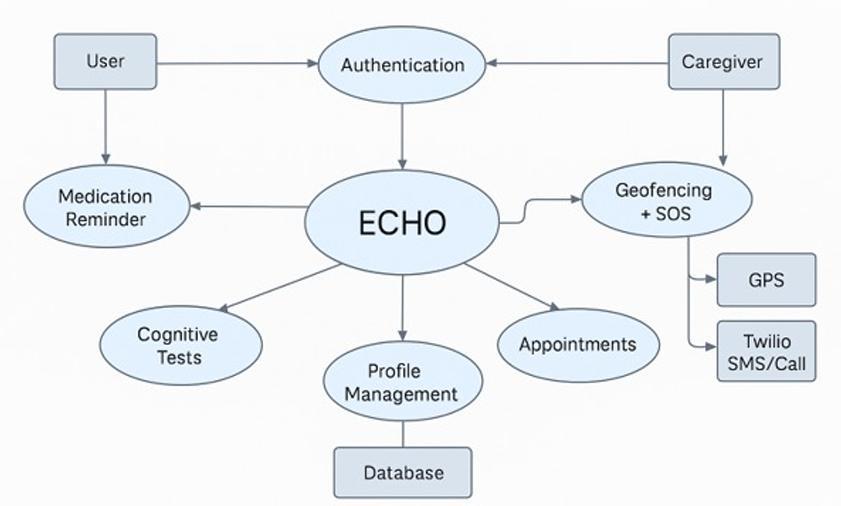
6. SYSTEM ARCHITECTURE
The ECHO platform is built as a modular, web-based system that brings together key Alzheimer’s care features like reminders,safetytracking,cognitivechecks,andcaregivertools intooneeasy-to-useinterface.ItsFlaskbackendandSQLite databasekeepallmodulesconnectedsoinformationflowssmoothlyandalertsaredeliveredreliably.
International Research Journal of Engineering and Technology (IRJET) e-ISSN: 2395-0056
Volume: 13 Issue: 04 | Apr 2026 www.irjet.net p-ISSN: 2395-0072
A. System Architecture Overview
• TheECHOplatformisamodular,web-basedsystemdesignedtocombinemultipleAlzheimer’scare featuresintoa singleinterface.
• ItusesaFlaskbackendandSQLitedatabasetokeepeachmoduleconnectedandensuresmoothdataflow.
• Thesystemfollowsaclient–servermodelwherethebrowsermanagesuserinteractionsandthebackendhandles logic,scheduling,GPSchecks,anddatastorage.
• Thisstructuresupportsscalabilityandallowscontinuousmonitoringforpatientsoverlongperiods.
B. Core Features
• Themaindashboardprovidesquickaccesstotheplatform’sprimarymodules.
• CoremodulesincludeGeofencingwithSOSalerts–Medicationreminder–Appointmentscheduler
• Thesemodulesformtheessentialday-to-daytoolsforpatientsandcaregivers.
C. Geofencing Flow
• Continuouslymonitorsthepatient’sliveGPSlocationinthebackground.
• Detectswhenthepatientmovesoutsidethecaregiverdefinedsafezone.
• Triggersimmediatesafetyactions:–Sendsalertnotifications–DeliversSOSmessages–Automatically callsthe caregiverusingserviceslikeTwilio.
• Tracksanddisplaysmovementhistoryandalertsonthecaregiverdashboard.
D. Medication Reminder Flow
• SchedulesandplaysspokenTTSpromptsatsettimes.
• Listensforasimple“Yes”or“No”responsefromthepatient.
• Savestheresponseandrepeatsthereminderifnoclearreplyisheard.
• Aimstominimizeconfusionandsupporttimelymedicationintake.
E. Appointment Reminder Flow
• Sendsvoicealertspriortoscheduledappointments.
• Asksthepatienttoconfirmattendance.
• Displaysallupcomingvisitsinacalendarviewforeasyplanning.
International Research Journal of Engineering and Technology (IRJET) e-ISSN: 2395-0056
Volume: 13 Issue: 04 | Apr 2026 www.irjet.net p-ISSN: 2395-0072
• Actsasacontrolcentershowing:–SOSalerts–Locationupdates–Medicationconfirmations–Appointment responses
G.
• Enablescaregiverstoreactquicklywheninterventionisneeded.
• Offersshort,simpleassessmentstomonitormemoryandrecognition.
• Storeseachtestresultforlongitudinalcomparison.
• Allowscaregiverstoreviewresultsanddiscussconcernswithhealthcareprofessionalswhenneeded.
TheECHOplatformwasimplementedasalightweightwebsystemsothatAlzheimer’spatientsandcaregiverscouldaccessit easilyfromanysmartphoneorcomputerwithoutneedingtoinstallspecialsoftware.Throughoutthedevelopment,themain focuswastokeepeveryinteractionsimple,especiallyforolderuserswhomayhavelimitedfamiliaritywithtechnology.
ThebackendofECHOwasdevelopedusingFlask(Python)becauseitallowedmodularroutingforreminders, appointments, geofencing, and cognitive tests. A single Flask server manages all requests, stores user data, and triggersvoicealertsattheappropriatetime.Forschedulingfunctionality,APSchedulerwasusedtorunbackground jobsthatcheckthedatabaseeveryminute.Wheneveramedicationorappointmenttimeisreached,thescheduler activatesavoicealert.Thisensuredreliabilityevenwhenmultiplereminderswerescheduledonthesameday.Voice interactionformedakeycomponentofthesystem.GoogleText-to-Speech(gTTS)wasintegratedtoconvertreminder messagesintoclearaudio.MultilingualsupportinKannada,English,andHindiwasaddedbecausemanyelderlyusers respondbettertoremindersinfamiliarlanguages.Eachreminderissavedwithachosenlanguage,andthebackend dynamicallygeneratestheaudiofileaccordingly.Toverifywhetherpatientsheardandrespondedtoreminders,the SpeechRecognitionlibrarywasincorporated.Itlistensforsimpleresponsessuchas“yes”or“no,”keepinginteractions minimal and manageable for Alzheimer’s users. The backend interprets the reply and updates the database indicatingwhetheramedicationwastakenorwhetheranappointmentwillbeattended.Ifnoclearanswerisdetected, thesystemrepeatsthereminder.Twilio’sAPIwasusedtoautomatecallingandSOSalertsduringgeofenceviolations. Thisguaranteesthatcaregiversreceiveimmediatenotificationsevenwhentheyareoffline.
Thefrontendwasdesignedwithacleanandhigh-contrastlayouttohelpelderlyusersnavigatewithoutconfusion. HTML,CSS,andJavaScriptwereusedfortheinterface,whileLeaflet.jsprovidedallmap-basedinteractions.Caregivers candrawcircularorpolygonalsafezonesdirectlyonthemap.Theseshapesaresavedinthebackendandcompared withlivelocationupdates.Thebrowser’sGeolocationAPIcontinuouslycapturesthepatient’scoordinatesandsends them to the server every few seconds. A real-time indicator displays either “Safe Zone” or “Outside Safe Zone,” allowingcaregiverstoseeimmediatelywhenthepatientcrossestheboundary.Duringtesting,thisvisualfeedback proved helpful for quick responses to wandering risks. The cognitive test module was also implemented on the frontend.Testssuchasmemoryrecall,coloridentification,picturematching,andsequencerecallappearonestepata timetoavoidoverwhelmingtheuser.Questionsarerandomlygenerated,andresponsesaresenttothebackendfor scoring.
Allpatientinformation,reminderschedules,appointmentrecords,testscores,andgeofencesettingsarestoredina SQLitedatabase.SQLitewasselectedforitslightweightstructureandcompatibilitywithsmalltomediumdatasets.
Tableswerecreatedfor:
• medicationschedules,
• appointmentdetails,
• confirmationresponses,
• geofencecoordinatesandalerthistory,
International Research Journal of Engineering and Technology (IRJET) e-ISSN: 2395-0056
Volume: 13 Issue: 04 | Apr 2026 www.irjet.net p-ISSN: 2395-0072
•cognitivetestscores.Thismodularschemamadeitsimpletoupdateindividualcomponentswithoutdisruptingthe restofthesystem.
Security in ECHO focuses on maintaining authorized access without complicating the login process. Instead of a passwordsystemwhichelderlyusersmayforget theplatformutilizesTwilio-basedOTPauthentication.Caregivers entertheirphone4numberandreceiveaone-timeverificationcodeviaSMS.Afterenteringthecorrectcode,accessto thedashboardisgranted.Alldatasenttothebackend,includingremindersandgeofencecoordinates,isvalidated beforestorage.SensitiveAPIkeysusedforOTPverificationandvoicegenerationaresecurelystoredontheserver. Thesystemmaintainsusersafetythroughsimplebuteffectiveauthenticationanddata-handlingpractices.
Allmoduleswereintegratedthroughaunifiedcaregiverdashboard.Fromasingleinterface,caregiverscan
• checkwhethermedicinesweretaken,
• viewupcomingappointments,
• monitorthepatient’sreal-timelocation,
• viewcognitivetestprogress,
• receiveSOSnotificationsinstantly.
Thisintegrationensuresthatallessentialpatientinformationisaccessibleinoneplace,improvingcoordination andreducingcaregiverworkload.
TheECHOplatformwastestedacrossallmajorfeaturestoevaluatehowwellitsupportsAlzheimer’spatientsandcaregiversin real-worlduse.Duringtesting,thesystemconsistentlydeliveredmedicationandappointmentremindersatthecorrecttimes, withclearandunderstandablemultilingualvoiceprompts.Thespeech-basedconfirmationprocessworkedreliably,allowing patientstorespondwithsimple“yes”or“no”answers,andthesystemhandledunclearormissedresponsesbyrepeatingthe reminderasintended.Appointmentnotificationsalsofunctionedsmoothly,withscheduledalertsappearingontimeandall upcomingvisitsproperlydisplayedintheintegratedcalendarinterface.Thegeofencingandsafety-monitoringmoduleshowed stableandaccuratebehaviorthroughouttesting.ThesystemcontinuouslyreceivedliveGPScoordinatesfromtheuser’sdevice anddisplayedthemovementonthedashboardmapwithminimaldelay.Wheneverthepatientsteppedoutsidethedefinedsafe zone,ECHOimmediatelyproducedanon-screenalert,sentanSOSmessagecontainingthelivecoordinates,andautomatically triggeredaphonecalltothecaregiver.Thisconsistentperformancedemonstratedthatthesystemcouldreliablyassistin preventing wandering incidents, one of the most significant safety concerns in Alzheimer’s care. The cognitive tests also performedwell,loadingquicklyandguidingusersthrougheachquestionstep-by-steptoreduceconfusion.Responseswere accurately recorded and scored, and results were stored for monitoring changes in cognitive performance over time. Performancetestingfurthershowedthattheplatformremainedresponsiveevenwhenmultipleremindersandbackground tasks were running simultaneously. Voice files were generated in a short amount of time, backend processing operated efficiently,andtheSQLitedatabaseretrievedrecordsquicklyduetoitslightweightstructure.GPSupdatesweregenerally smooth,withdelaysoccurringonlyinareaswithweaksignalcoverage.Overall,thesystemdemonstratedstableperformance undervaryingconditions.Userexperiencetestingprovidedpositivefeedbackfrombothpatientsandcaregivers.Elderlyusers foundtheinterfacesimple,readable,andeasytonavigate,whilecaregiversappreciatedhavingallessentialinformation medicationconfirmations,appointments,real-timelocation,andcognitivetestresults availableinasingleunifieddashboard. TheOTPbasedloginmethodwasespeciallyappreciatedforeliminatingtheneedtorememberpasswords.Thevoice-driven interactionmodel,particularlytheshortyes/noresponses,madetheplatformaccessibleandlesscognitivelydemandingfor userswithmemorydifficulties.Overall,theresultsshowthatECHOisbothpracticalandreliableforeverydayAlzheimer’scare. The system success fully improved medication adherence, strengthened patient safety through precise geofence alerts, simplifiedappointmentmanagement,andenabledeffortlesscognitiveassessments.Itsstability,easeofuse,andcaregiverfriendlydesigndemonstratethatECHOeffectivelymeetsitsintendedgoalsandprovidesmeaningfulsupportinmanagingdaily dementiacare.
International Research Journal of Engineering and Technology (IRJET) e-ISSN: 2395-0056
Volume: 13 Issue: 04 | Apr 2026 www.irjet.net p-ISSN: 2395-0072
TheresultsshowthatECHOsuccessfullydeliverstimelyreminders,accurategeofencealerts,andsimplevoice-based interactions,makingitapracticaltoolforeverydayAlzheimer’scare.Itsmainstrengthliesinintegratingmultipleessential functions medicationreminders,appointmentalerts,locationtracking,andcognitiveassessments intoasingle,easy-to-use system.Thevoice-drivendesign,yes/noconfirmations,andsimplifieddashboardwereespeciallyeffectiveforolderuserswho maystrugglewithcomplexinterfaces.Despitethesestrengths,thesystemalsohaslimitations.GPSaccuracycandecrease indoors,affectinggeofencereliability[2];speechrecognitionperformancemayvarywithbackgroundnoiseorunclearpatient responses;andthesystem’sdependenceoninternetconnectivitymaydelayremindersinlownetworkconditions.Additionally, thecognitiveassessmentsprovidedarebasicandintendedonlyforscreeningratherthanclinicaldiagnosis[3].Overall,ECHO demonstrates strong potential as a supportive, home-based Alzheimer’s care platform while also high lighting areas for improvementinsensingaccuracy,stability,andlong-termscalability.
The ECHO platform was developed to address key challenges faced by individuals with Alzheimer’s disease and their caregivers, including missed medications, forgotten appointments, wandering risks, and the need for simple cognitive monitoring.Byintegratingvoice-basedreminders,real-timegeofencingalerts,multilingualsupport,andeasy-to-usecognitive assessmentsintoasingleweb-basedsystem,ECHOprovidesaunifiedsolutionthatreducescaregiverburdenwhilehelping patientsmaintaindailyroutinesmoreindependently.Testingresultsshowedthattheplatform’slightweightarchitecture builtusingFlask,SQLite,andbrowser-basedGPS performedreliably,deliveringtimelyalerts,accuratelocationtracking,and smooth interaction for elderly users. Features such as voice prompts, yes/no confirmations, and a simplified dashboard contributedtoimprovedusability,evenforuserswithlimitedtechnicalfamiliarity.TheseoutcomesdemonstratethatECHO canfunctionasapracticalhome-caretoolthatenhancessafety,supportsdailyhealthtasks,andhelpstrackcognitivechanges overtime.AlthoughlimitationsexistinareassuchasGPSprecisionandspeech-recognitionconsistency,thesystemestablishes astrongfoundationforfutureimprovements.Overall,ECHOrepresentsaneffectivesteptowardaccessible,technologyassisted Alzheimer’scarethatsupportsbothpatientwell-beingandcaregiverpeaceofmind.
WhileECHOalreadyprovidesessentialsupportforAlzheimer’scare,severalimportantenhancementscanfurtherstrengthen itsusefulness,intelligence,andlong-termclinicalvalue.Futureversionsoftheplatformcanintegratewearabledevicessuchas smartwatches,fall-detectionsensors,andheart-rateoractivitymonitors.Theseadditionswouldallowcontinuousbackground monitoringofthepatient’sphysicalcondition,enablingautomaticdetectionofemergencieswithoutrequiringcaregiverinput. ThesystemcanalsobenefitfrommoreadvancedAImodelscapableofanalyzingbehaviorpatterns,detectinganomalies,and predicting early signs of cognitive decline. By learning from daily routines such as walking patterns, speech behavior, reminderresponsetimes,andinteractionfrequency thesystemcouldgeneratepersonalizedinsightsandnotifycaregivers when unusual changes occur. This would transform ECHO from a reactive tool into a proactive early-warning system. Geofencingcanbefurtherimprovedwithmachine-learningbasedlocationpredictionandhybridindoor-outdoorpositioning. SinceGPSsignalsareofteninaccurateinsidehomesorcrowdedareas,combiningWi-Fimapping,Bluetoothbeacons,and motion-sensordatacouldgreatlyreducefalsealertsandoffersmootherreal-timetracking.Thecognitivetestmodulecanalso beexpandedtoincludeadaptivedifficultylevels,multi-stagetasks,andclinicallyvalidatedscreeningmodels.Integratingthe platformwithelectronichealthrecords(EHR)wouldallowneurologistsandhealthcareprofessionalstoreviewtesttrends, accesslocationlogs,andcoordinatetreatmentmoreeffectively.Fromanengineeringperspective,futureversionsofECHOcan transitionfromSQLitetoasecurecloud-baseddatabase,enablingmulti-useraccess,centralizedbackups,anddeployment acrossclinicsorsenior-carecenters.Acloudarchitecturewouldalsosupportlarge-scaleanalytics,allowingresearchersto studybehavioraltrendsinAlzheimer’spatientsoverlongperiods.Finally,incorporatingchatbot-basedassistance,video-call supportforcaregivers,IoT-basedhomesafetydevices[6],andemotional-well-beingmonitoringwouldmakeECHOamore complete,intelligent,andholisticAlzheimer’s-careplatform.ACKNOWLEDGMENTTheauthorsacknowledgeAcharyaInstitute ofTechnologyforprovidingthenecessarycomputationalresources,facilities,andsupportthatcontributedtothesuccessful completionofthisresearchwork.
International Research Journal of Engineering and Technology (IRJET) e-ISSN: 2395-0056
Volume: 13 Issue: 04 | Apr 2026 www.irjet.net p-ISSN: 2395-0072
[1] T.Kamimura,D.S.Nelson,andJ.A.Dunn,“MedicationReminderDeviceforOlderAdultswithMildCognitiveImpairment,” AmericanJournalofAlzheimer’sDisease&OtherDementias,vol.27,no.4,pp.255–262,2012.
[2] Y.Lin,H.Chen,andC.Tsai,“GPSTrajectories-BasedPersonalizedSafeGeofenceforElderswithDementia,”International JournalofGerontechnology,vol.19,no.3,pp.176–187,2020.
[3] T.Tee,S.Hisham,andL.Y.Lee,“DigitalProcessingSpeedTest(DPST):AMultilingualMobileCognitiveAssessmentTool,” JournalofAlzheimer’sDisease,vol.89,no.2,pp.563–574,2023.
[4] L.O.P.Smith,R.J.Wesson,andM.Thompson,“CaregiverStressandBurdeninDementiaCare:ASystematicReview,” PatientPreferenceandAdherence,vol.10,pp.479–489,2016.
[5] A. Gupta and S. Rao, “Real-Time Tracking and Geo-Fencing for Patient Safety Using GPS and Web Technologies,” InternationalJournalofComputerApplications,vol.180,no.27,pp.1–6,2018.
[6] M.Al-Fuqaha,“SmartMedicationReminderSystemUsingIoT,”InternationalJournalofAdvancedComputerScienceand Applications,vol.10,no.6,pp.112–119,2019