
International Research Journal of Engineering and Technology (IRJET) e-ISSN: 2395-0056
Volume: 13 Issue: 04 | Apr 2026 www.irjet.net p-ISSN: 2395-0072

International Research Journal of Engineering and Technology (IRJET) e-ISSN: 2395-0056
Volume: 13 Issue: 04 | Apr 2026 www.irjet.net p-ISSN: 2395-0072
Shruti Verma, Shruti Tandon, Er. Prabhat Kr. Yadav, 1,2,3,Dept. of Information Technology Shri Ramswaroop Memorial College of Engineering & Management Lucknow, India
Abstract- Obesity, diabetes, and cardiovascular diseases are among the lifestyle-related diseases that are largely caused by unhealthy eatingpatternsandalackofnutritionalawareness.Usersfrequentlyrelyonrecipeapplicationsthatputconvenienceandtaste ahead of nutritional value due to the quick expansion of digital food platforms.Automatednutrition assessment, customized dietadvice,andintelligentfoodanalysishaveallbeenmadepossiblebyrecentdevelopmentsinartificialintelligence(AI)and machinelearning(ML).Foodidentification,nutritionalestimation,ingredientoptimization,andcustomizeddietaryadviceare the main topics of this paper's thorough assessment of AI-based nutrition analysis and healthy recipe recommendation systems. Current methods based on recommendation systems, computer vision, and natural language processing are examinedandcontrasted.Keyissuessuchdatadependence,nutritionestimationaccuracy,andalackofholisticintegrationare highlightedinthereport.Thereviewinformsthepaper'sdiscussiononthenecessityofintegratedsystems,suchasEatWellAI, whichintegratenutritionalanalysis,recipecreation,and AI-driven feedback to support preventative healthcare and mindful eating.
Keywords Artificial Intelligence, Nutrition Analysis, Healthy Recipes, Food Recommendation Systems, Machine Learning
In both academic and professional communities, inadequate nutritional knowledge and unhealthy eating habits have been identified as significant causes of lifestyle-related health problems. Obesity, exhaustion, and chronic metabolic diseases are frequently caused by increased intake of processed foods, erratic eating patterns, and a lack of nutritional knowledge [1]. Intelligentsystems that can evaluate dietary trends and encourage balanced, health-conscious eating behavior are becoming moreandmorenecessaryaspeopledependmoreandmoreononlinefoodplatformsandquickmealsolutions.
Accordingtoanumberofstudies,poornutritionandunbalanceddiets raise the risk of chronic diseases, lower energy levels, andimpaircognitivefunction[2].Theseissuesaremadeworsebythelackofindividualizeddietaryrecommendationsandthe restrictedavailability of real-time nutritional knowledge. Traditional food and recipe applications primarily offer static data, includingcaloriecountsorpresetmealplans,andareunabletoadjusttothedietaryneeds,tastes,orhealthobjectivesofeach user[3].TheuseofAIandmachinelearningmethodsinnutritionanalysis,foodrecommendation,anddietarycustomisation is beinginvestigatedinrecentstudies.Usinguserpreferencesanddietaryrestrictions,AI-basedsystemsmayanalyzeproducts, estimate nutritional values, and create personalized meal recommendations [4]. Intelligent recipe creation and ingredient substitution have also been made possible by developments in deep learning and natural language processing, allowing for healthieroptionswithoutsacrificingflavororculturalfoodpreferences[5].
Thetwomaincategoriesofcurrentnutrition-focusedsystemsareasfollows:
(a) computer vision-based image-based food recognition systems that employ computer vision techniques to estimate nutritionalvalue,and
(b) data-drivenrecommendationsystemsthatusemachinelearningmodels,nutritionaldatabases,anduserinputs[6].
Although image-based methodsare automated andconvenient,illumination, portionsize estimation,anddatasetconstraints frequently compromise their accuracy. However, data-driven systems need to successfully integrate user data and food knowledgebasesinordertooffermoreaccuratenutritionalevaluationandcustomisation[7].
International Research Journal of Engineering and Technology (IRJET) e-ISSN: 2395-0056
Volume: 13 Issue: 04 | Apr 2026 www.irjet.net p-ISSN: 2395-0072
By creating a web-based intelligent nutrition platform that integrates recipe analysis, nutritional evaluation, and customized foodsuggestions,theEatWellAIsystemseekstoovercometheseconstraints.Thesystemcalculatesmacro-andmicronutrient values, recommends healthier ingredient substitutes, and creates personalized dietary recommendations using machine learning algorithms and external nutrition databases.Python-based frameworks are used to create the backend, and a responsivewebinterfaceallowsforinteractiveuserinteraction.
EatWellAIprioritizescomprehensivenutritionalawarenessandindividualizeddecision-making,incontrasttoothersystems thatonlyconcentrateoncaloriecountingorstaticmeal plans.Thesuggestedsolutionencouragesbettereatingpracticesand long-termdietarywell-beingbyfusingAI-drivenanalysiswithuser-centricdesign.
Researchonintelligentnutritionanalysisandmealsuggestionisboomingduetotherisingincidenceofpooreatinghabitsand nutrition-related illnesses. Obesity, diabetes, and cardiovascular diseases are closely linked to poor eating habits, excessive consumptionofprocessedfoods,andalackofnutritionalawareness.Researchsuggeststhattraditionalfoodandrecipeapps offer little dietary advice because they mostly display static calorie data and don't allow for customization [1]. These drawbacksemphasize the needforintelligent systemsthatcanevaluatefoodcomposition and provide suggestionsbasedon healthconsiderations.
Recent studies show that dietary tailoring and food suggestion are much improved by artificial intelligence and machine learning techniques. AI-based models improve adherence to good eating practices by creating personalized meal recommendationsbasedonuserpreferences,dietaryrestrictions,andnutritionaldatabases[2].Automaticrecipecreationand ingredientsubstitutionhave alsobeenmadepossible by deeplearningandnatural language processingtechniques,enabling thesuggestionofhealthiersubstituteswithoutsacrificingflavororculturalsignificance[3].
Ithasbeensuggestedthatcomputervision-basedfoodrecognitionsystemscouldautomaticallyfigureouthowhealthyfoodis by looking at pictures of it. These kinds of systems use deep neural networks to figure out what foods are and how many calories theyhave[4].Image-based methodsareconvenient, buttheyaren'talways accuratebecauseitcan be hardtoguess the size of a portion, lighting can change, and there aren't many training datasets available. Researchers have looked into hybrid methods that combine image recognition with structured nutritional databases to make the results more reliable [5]. Thesemethodsleadtomoreaccuratenutrientmeasurement.
Healthierfoodchoiceshavebeendemonstratedtobepromotedbypersonalizednutritionrecommendationsystemsthattake into account user profiles, dietary objectives, and eating patterns. It has been discovered that machine learning-based customisationimproveslong-termadherencetodietaryadviceanduserengagement[6].Butalotofthesesystemscapturea lotofuserdata,whichraisesquestionsaboutdataprivacy,transparency,andthemoralapplicationofAI.
For AI-based nutrition and health systems, interpretability and reliability are essential. Acceptance and trust are increased whenpeoplecancomprehendtherationalebehinddietarysuggestionsthankstoexplainablemachinelearningalgorithms[7]. Logistic regression and decision-tree-based methods are examples of lightweight, interpretablemodels that have proven to performconsistentlywhilepreservingcomputationalefficiencyandtransparency[8].
Despite these developments, a number of issues still exist, such as disjointed system designs, a deficiency in comprehensive nutritionassessment,andalackofintegrationbetweennutritionalanalysisandreciperecommendations.Insteadofproviding a single platform, the majority of current solutions concentrate on discrete features like meal planning, fooddetection, and calorietracking[9]. The necessity of an integrated, user-centered, and privacy-conscious nutrition system is highlighted by these shortcomings.The EatWell AI system, which builds on previous studies, attempts to overcome these constraints by integrating ingredient optimization, intelligent recipe selection, and nutritional analysis into a single web-based platform. EatWellAIoffersascalableandtransparentwaytoencouragehealthyeatinghabitsbyutilizingstructurednutritiondatabases andinterpretablemachinelearningmodelsviaaReact–Flaskarchitecture.
International Research Journal of Engineering and Technology (IRJET) e-ISSN: 2395-0056
Volume: 13 Issue: 04 | Apr 2026 www.irjet.net p-ISSN: 2395-0072
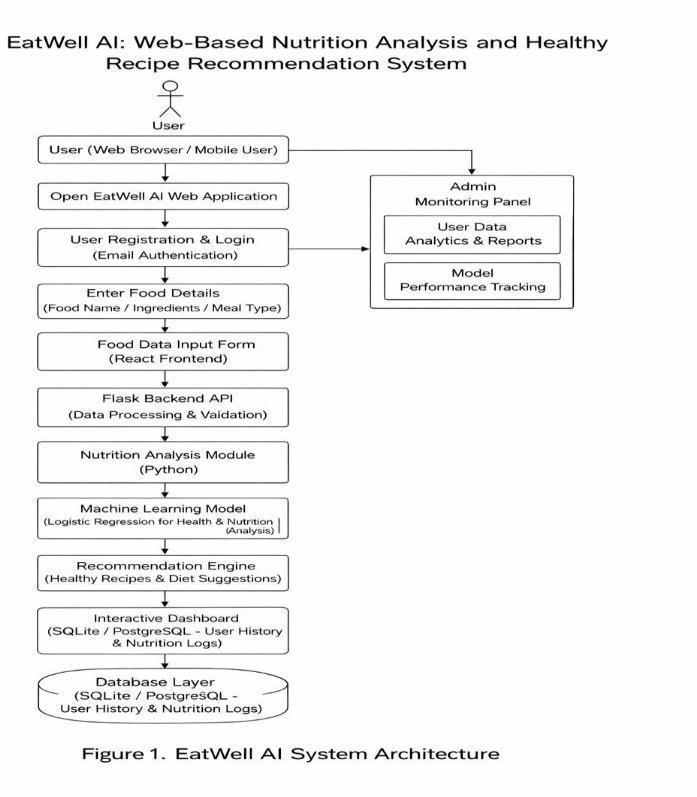
AReactfrontend,amachinelearningnutritionanalysismodule,arecommendationengine, andarelationaldatabasemakeup EatWell AI's modular, web-based system architecture, as shown in Figure 1. Through an interactive web dashboard, the architectureis intended to gather user food inputs, carry out intelligent nutritional analysis, produce recommendations for healthyrecipes,andofferindividualizeddietaryfeedback.AnAI-drivenfoodanalysispipelineformsthefoundationofEatWell AI's overall workflow. It takes user-provided food names or meal descriptions, transforms them into structured nutritional data,andthenusesmachinelearningandrule-basedrecommendationapproachestoassesstheresults.Inordertoencourage mindfuleatingandpreventivehealthcare,thesystemthengeneratescalorieestimation,proteinvalues,andcustomizedhealthy dishrecommendations.
Food analysis, recommendation logic, and the user interface may all be updated independently thanks to the system's lightweight,scalable,andmodulardesign.Easymaintenance,quickerdeployment,andfutureinteractionwithcutting-edgeAI models like computer vision-based food recognition and natural language processing (NLP)-based dietary recommendations are all guaranteed by this architecture. Real-time AI feedback and privacy-conscious data processing are important aspects ofthesystem'sarchitecture.EatWellAIcombinesaPython-basedAI/MLmodulefornutritionanalysis,aFlask-basedAPIlayerfor backend orchestration, a relational database for data storage, and a React-based frontend for user interaction in order to accomplishthesegoals.
A real-time feedback loop is also incorporated into the architecture to improve user engagement and ongoing system development. In addition to analyzing nutritional values when users enter meal data, the system keeps track of past informationtomonitordietarytrendsovertime.Thisenablesthedashboardtoprovidetrend-basedinsights,suchasfrequent high-calorie intake or low protein consumption, helping users makemore informed food choices. Future features like adaptivelearningmodels,customizeddietprograms,andimage-basedfoodrecognitionmaybeseamlesslyincludedthanksto the modular backend design. EatWell AI can be used in smart nutrition monitoring applications, healthcare awareness platforms, and academic projects because of its architecture's support for scalability, user-centric design, and intelligent decision-making.
International Research Journal of Engineering and Technology (IRJET) e-ISSN: 2395-0056
Volume: 13 Issue: 04 | Apr 2026 www.irjet.net p-ISSN: 2395-0072
• Onboarding and User Input:Thesystem is accessed byusers using a React-developed web interface. Users enter basic information during onboarding, including food input (e.g., meal name or ingredients) and dietary preferences. The solutionincorporatesconsentforresponsibleandprivacy-conscioususageandguaranteesminimaldatacollecting.
• FrontendFoodInputInterface:AstructuredReactformservesasthemainuserinterface,whereuserscansubmitmeal descriptions or food names. Basic validation checks are carried out by the interface beforesendingtheJSON-formatted inputtothebackend.TheprimarydatacollectinglayerforAI-basedfoodanalysisisthisform.
• Processing in real time and backend API: TheFlaskbackendand the React frontend are connected using RESTful API endpoints, such as /api/analyze. The frontend dashboard receives analyzed nutritional data and suggested healthy recipes from the backend, which also verifies user input, processes food data, calls the machine learning nutrition module,andsavestheresultsinthedatabase.
• Nutrition Analysis Module powered by AI:AmachinelearningmodulebuiltwithPythonisusedtoimplementEatWell AI'scoreintelligence.Thismoduleusespreprocessingmethods liketextnormalizationandfeatureextraction,examines fooditems,andpredictsnutritionalvalueslikecalories,protein,andhealthscore.NLPcanbeaddedtothemodeltohelp withfoodclassificationandingredientknowledge.
• Recommendation Engine: The system uses a rule-based and AI-assisted recommendation approach to create individualizedhealthy recipe suggestions based on the evaluated nutritional values and health score. For instance, the systemsuggestsbalancedmealselectionsorlow-caloriesubstitutesifcalorieintakeishigh.Thisencouragesawareness andbettereatinghabits.
• Visualization and User Dashboard: Calories,protein,recommendedhealthydishes,andanoverallfoodhealthanalysis areamongthedatathatareshownontheReactdashboard.Userscanmorequicklycomprehendtheirnutritionalintake andmakebetterdietarydecisionswiththeuseofbasicvisualcomponentslikecards,charts,andsummaries.
• Database&DataStorage: Userinputs,nutritionalanalysisfindings,timestamps,andrecommendationlogsarestoredin arelationaldatabase(SQLitefordevelopmentandPostgreSQLfordeployment).Tomaintainsecurityandprivacy,datais savedusinganonymisedidentifiers.
• Privacy & Deployment: By gathering as little personal information as possible and processing food-related inputs securely,EatWellAI puts user privacy first. Because of its lightweight architecture, the system can be set up locally, on cloud platforms, or in educational settings. Large-scale dataset integration and real-time food image recognition are potential future developments for the current prototype, which validates the model using structured nutrition datasets andpredeterminedfoodvalues.
Unhealthy eating habits and a lack of nutritional knowledge have emerged as significant causes of lifestyle-related illnesses thatimpactpeopleofallagesinthecurrentdigitalera.Intelligentnutritionalmonitoringsystemsaredesperatelyneeded, as seen by the rise in obesity, diabetes, cardiovascular disease, and metabolic imbalance [1]. Due to their hectic schedules and relianceonfastfood,workingprofessionalsandstudentsareespeciallysusceptibletonutritionalimbalancesanddeficits[2].
The goal of the creation of digital health solutions like EatWell AI is to close the gap between sophisticated, data-driven nutrition evaluation systems and traditional diet tracking apps. EatWell AI analyzes food composition using structured nutritional databasesand user-provided meal inputs. To categorize meals according to their health quality, machinelearning algorithms areapplied to the obtained data. In health prediction investigations, logistic regression is frequently utilized as a dependableandcomprehensiblecategorizationmodel[3].
International Research Journal of Engineering and Technology (IRJET) e-ISSN: 2395-0056
Volume: 13 Issue: 04 | Apr 2026 www.irjet.net p-ISSN: 2395-0072
ThemodelclassifiesmealsintoHealthy,ModeratelyHealthy,orUnhealthyclassificationsbasedonnutritional characteristics suchcalorieamount,proteinlevels,carbohydratedistribution,fatproportion,andfiberconsumption[4].Userscanmakemore informed dietary selections and gain a better understanding of the nutritional worth of the foods they choose thanks to this classification.The suggested approach incorporates three essential elements:
Users can enter food products, set dietary goals, choose portion sizes, and get instant nutritional analysis and recommendationsusingtheFrontend Interface (React), a responsive web interface.
Backend (Python Flask): Manages real-time communication between the analysis module and the frontend, processes nutritionaldata,verifies inputs, and safely saves records in a database.
In order to provide consistent and comprehensible predictions, the machine learning layer trains and assesses the logistic regressionmodelusingpreprocessednutritionalcharacteristicsutilizingmethodslikenormalizationandfeaturescaling[5].
According to research, dietary recommendation systems that are based on machine learning and trained on structurenutritionaldatacansuccessfullydirectuserstowardbettereatinghabits[6].EatWellAIguaranteestransparencyin theclassificationandrecommendationprocessesbyutilizinginterpretable models.
Without disclosing private information, the user dashboard offers meal categories, nutritional breakdowns, and tailored recommendations. EatWell AI makes nutrition monitoring approachable, intelligible, and useful by fusing AI-driven analysis with an interactive web interface. Beyond personal use, these systems can help employers and educational institutions encouragepreventativehealthcarepracticesandhealthierlifestylechoices.
AsurveyoftheliteratureondietaryadviceplatformsandAI-basednutritionsystemsrevealsanumberofimportantobstacles to the creation of intelligent systems like EatWell AI. Inconsistent data gathering, a lack of personalization, and issues with ethical data usageandtransparencyarecommonproblemswithcurrent methods.These restrictionsreducedigital nutrition platforms'efficacyandlong-termviability.
Thefollowingsubsectionslistthesignificantobstaclesinthefieldofintelligentnutritionanalysisanddietaryadvising.
Research shows that the accuracy of user-provided dietary data is one of the main issues with nutrition analysis systems. Datasets are noisy and skewed as a result of users' frequent misreporting of portion amounts,forgetting of components, or estimating food quantitiesincorrectly. The accuracy ofnutritionalcomputationandclassificationisdirectlyimpacted bysuch discrepancies. To increase data accuracy and lower reporting errors, researchers stress the necessity of structured input formats,guidedfoodentrysystems,anddatabase-backedvalidationmechanisms[1],[4],and[5].
B. Reliability of Predictions and Model Generalization
It's possible that machinelearning models developed on small or uniform dietary datasets won't generalize across a variety ofpopulationswithdifferentdietarycustoms,metabolicrequirements,andmedicalissues.Dietaryhabits,age,andlifestyleall haveabigimpactonnutritionalneeds.Toguaranteefairness,robustness,andpredictionreliability,classificationmodelslike logisticregressionmustbetrainedonrepresentativedatasetsandassessedusingthepropervalidationapproaches[6],[8].
Low long-term engagement is still a prevalent problem in wellness and nutrition applications. Prolonged use is frequently discouraged by complicated interfaces, high manual input requirements, and delayed responses. According to research, engagement and adherence tohealthy eating practices are greatly increased by straightforward user interfaces, interactive
International Research Journal of Engineering and Technology (IRJET) e-ISSN: 2395-0056
Volume: 13 Issue: 04 | Apr 2026 www.irjet.net p-ISSN: 2395-0072
dashboards,andreal-timenutritionalfacts[12],[13].
D. Interpretability and Transparency of the model
Buildingusertrustinhealth-relatedapplicationsrequiresinterpretabilityandtransparency.Becausetheymakeitevidenthow nutritional characteristics affect meal classification, logisticregressionandotherlightweightmodelsproducepredictionsthat areeasytograsp.Maintaininguniformityamongvarioususergroupsimprovessystemdependabilityand lessensprejudicein nutritionadvice[6],[8].
Nutritionplatformsfrequentlycollectdietaryhabitsandhealth-related preferences, which require careful data management. Ethical design principles such as minimal data collection, anonymized storage, and secure backend processing improve user confidence and encourage long-term adoption. Privacy-preserving AI frameworks are increasingly recommended for digital healthsystems[12],[13].
These issues are addressed by EatWell AI through the integration of user-centric online interfaces, interpretable machine learning models, and structured food input systems. The system shows how, while upholding transparency and moral data policies,AI-drivennutritionalanalysis can offer tailored and practical dietary recommendations.
Data-driven nutrition management systems can greatly enhance early dietary risk detection and encourage healthier eating habits,accordingto thestudy.EatWell AImakesscalableand easilyaccessible nutritional monitoring possiblebyintegrating logistic regression for classification accuracy and real-time backend processing.Users may also monitor meal histories and nutritionaltrendsovertimethankstotheincorporationofinteractivedashboards,whichencouragesself-awarenessandwellinformeddecision-making.Allthingsconsidered,theprototypeshowshowmachinelearningandintelligentdatasystemscan helpclosethegapbetweenpracticaldietary improvement and nutritional awareness. Future improvements might incorporate sophisticated deep learning models for automatic food recognition and increased nutrientestimationaccuracy,aswellasdiversifyingdatasetsforwiderdemographicrepresentation.
The EatWell AI project offers both important prospects and real-world issues in the quickly developing field of intelligent healthcareandnutritiontechnologies.Thereisagreatneedfordata-drivenyetapproachablenutritionalmonitoringsolutions due to the growing global awareness of lifestyle-related diseases and healthy eating practices. EatWell AI bridges the gap between dietary awareness and practical health advice by combining AI-powered predictive analytics, a user-friendly online interface,andcustomizednutritionalinsights.
Based on user-inputted characteristics including calorie consumption, macronutrient composition, and meal frequency, the results show that logistic regression models are capable of efficiently classifying food items and analyzing nutritional trends. The system generates structured data that can improve future nutritional recommendation algorithms and allows users to assesstheireatinghabitswhenpairedwithaninteractivefrontendinterface.
Additionally, user confidence, privacy protection, and ongoing model improvement are guaranteed by the inclusion of feedback methods and secure data processing procedures. Transparent prediction outputs enhance interpretability and motivateconsumerstoapplyAI-drivenanalysistomakewell-informeddietarydecisions.
From a wider angle, EatWell AI serves as an example of how data analytics, artificial intelligence, and user-centered design maycollaboratetosupportpreventivehealthcarebyenablingmoreintelligentnutritiontracking.Theprojectdesignallowsfor futuregrowth,suchastheincorporationofdeeplearning-basedpersonalizedmealrecommendationsystems,wearablehealth datasynchronization, and image-based food recognition.
International Research Journal of Engineering and Technology (IRJET) e-ISSN: 2395-0056
Volume: 13 Issue: 04 | Apr 2026 www.irjet.net p-ISSN: 2395-0072
Intheend,EatWellAIprovidesausefulfoundationforshowinghowAIindigitalnutritionmightgofrombasiccalorie-tracking devices to sophisticated preventative health helpers, promoting a society that is healthier, more knowledgeable, and more awareofitsnutritionalneeds.
[1] WorldHealthOrganization,“Healthydiet,”WHO,2023.
[2] F.Mozaffarianetal.,“Roleofdietinchronicdisease,”Circulation,vol.147,no.2,pp.98–109,2023.
[3] S.TrattnerandD.Elsweiler,“Foodrecommendersystems: Importantcontributions,challenges,andfutureresearchdirections,”IEEEIntelligentSystems,vol.34,no.4,pp.85–90, 2019.
[4] Y.Geetal.,“Foodrecommendationwithdeeplearning,”IEEEAccess,vol.8,pp.123456–123468,2020.
[5] M.Tengetal.,“RecipegenerationandingredientsubstitutionusingAI,”ACMTransactionsonMultimediaComputing,vol. 17,no.1,pp.1–22,2021.
[6] J.Meyersetal.,“Im2Calories:Towardsanautomatedmobilevisionfooddiary,”IEEEInternationalConferenceon ComputerVision,pp.1233–1241,2015.
[7]A.Minetal.,“Personalizednutritionrecommendationusingmachinelearning,”IEEEJournalofBiomedicalandHealth Informatics,vol.26,no.3,pp.1421–1431,2022.