
International Research Journal of Engineering and Technology (IRJET) e-ISSN: 2395-0056
Volume: 12 Issue: 04 | Apr 2025 www.irjet.net p-ISSN: 2395-0072
International Research Journal of Engineering and Technology (IRJET) e-ISSN: 2395-0056
Volume: 12 Issue: 04 | Apr 2025 www.irjet.net p-ISSN: 2395-0072
Yashika, Suman Pattnaik, Suresh D, Surya koundinya C
1Yashika, Student, Jain University, Karnataka, India
2Suman Pattnaik, Student, Jain University, Karnataka, India
2Suresh D, Student, Jain University, Karnataka, India
2Surya Koundinya C, Student, Jain University, Karnataka, India
Abstract - The emergence of intelligent travel solutions has increased the demand for comprehensive and real-time trip planning systems. TripPlanner, a production-ready, modular system driven by Multi-AI Agents utilizing the Taskflow AI framework, is presented in this paper. Web Research, Travel, and Reporter Agents are specialist agents that use external technologies such as SerperSearch, Wikipedia APIs, Amadeus Flights API, and Weather.com to collect and aggregate data in order to process a single question. GPT-3.5 Turbo balances memory and API limitations while enabling reasoning. The system employs Retrieval-Augmented Generation (RAG) to boost accuracy and real-time awareness. Analysis reveals that TripPlanner provides incredibly pertinent and eye-catching trip information. It opens the door for more extensive uses outside of travel by showcasing the usefulness and scalabilityofagentcoordination.
Key Words: Multi-Agent Systems, Trip Planning, Retrieval-Augmented Generation, Taskflow AI, GPT-3.5, Real-TimeInsights,ModularAI,TravelItinerary
Artificial intelligence (AI) has changed how people use digital platforms in recent years, particularly in areas like research, travel, and tailored suggestions. Conventional travel planning is looking through numerous websites, evaluating flight alternatives, examining weather predictions, and reading a tonne of blogs or articles. In addition to being time-consuming, this procedure lacks a cohesive, intelligent interface that can accommodate a widerangeofchanginguserpreferences.
In order to overcome these constraints, this paper presents TripPlanner, an intelligent itinerary creation system that uses several independent AI agents and is based on the Taskflow AI framework. The TripPlanner system uses a modular and multi-agent strategy that breaks down user enquiries into smaller tasks that are performedbyspecialisedagents,incontrasttomonolithic AI models that try to answer general questions in isolation. Every agent is made to concentrate on a particular task, such gathering travel data, assessing the weather,orsummarisingcontent.
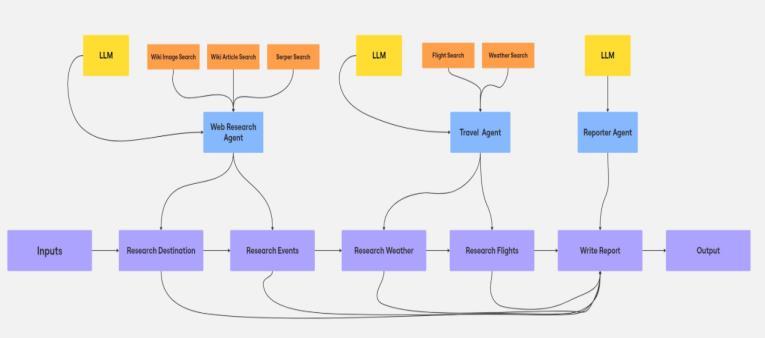
The coordination amongst agents each driven by languageandsupplementedbyexternaltoolsandAPIs is the fundamental breakthrough. For instance, the Travel Agent retrieves real-time flight information from the Amadeus API, while the Web Research Agent uses Wikipedia and SerperSearch to collect contextual data. After that, a Reporter Agent compiles the results into an approachable format. Additionally, the architecture adheres to the concepts of Retrieval-Augmented Generation(RAG),whichenablesagentstomakeinformed judgements beyond the static knowledge of the model by referencingreal-timedata.
Thefollowingarethecontributionsmadebythiswork:
• A scalable and modular architecture that uses AI agents togenerateitineraries.
• The incorporation of external tools and APIs for pertinent,real-timedata.
• The Taskflow framework facilitates effective task decompositionandagentcollaboration.
• An economical implementation that takes memory and APIlimitationsintoaccount.
This paper's remaining sections are arranged as follows: Related work is discussed in Section II. The system architecture is shown in Section III, and the roles and toolchains of each agent are explained in Section IV. Use cases and implementation are described in Section V. EvaluationandresultsarepresentedinSectionVI,andthe paper'sconclusionwithrecommendationsforthefutureis coveredinSectionVII.
Intelligent trip planning research has progressed from early rule-based systems to contemporary designs that integrate multi-agent coordination and retrievalaugmented generation (RAG). The main goal of early travel recommender systems was to tailor suggestions based on static databases and past user information. Recent studies on recommender systems for sustainable tourism have pointed out that these systems frequently
International Research Journal of Engineering and Technology (IRJET) e-ISSN: 2395-0056
Volume: 12 Issue: 04 | Apr 2025 www.irjet.net p-ISSN: 2395-0072
failed to incorporate broader sustainability measures and providecurrentinformation[1].
Large language model creation can now incorporate external, real-time data thanks to developments in RAG. The accuracy and contextual relevance of the outputs are much enhanced by this integration, which also lessens modelhallucinations[2].Applicationsliketravelplanning, where details like operating hours, current affairs, and seasonal patterns are vital, particularly require these features.
Simultaneously, studies on multi-agent systems have shownthatbreakingdown difficulttasks(suchcomposite travel planning) into smaller, more manageable jobs can resultin more reliableand effectivesolutions. When used to learn dialogue policies for complicated tasks, hierarchical deep reinforcement learning techniques have demonstrated significant gains in handling multi-step planning difficulties [3]. In order to tackle real-world trip sharing issues, other research has investigated strategic multiagent planning, highlighting the efficiency and environmentaladvantagesofgroupdecision-making[4].
These scholarly findings are further supported by recent corporate initiatives. For instance, Aimpoint Digital has created an AI agent system that creates detailed travel routes almost instantly by utilising vector and RAG databases [5]. In addition to streamlining the planning process, these tools make it easier to include real-time data,allowingformoresustainableandcustomisedtravel suggestions.
In order to dynamically create customised travel plans based on user preferences, real-time data, and contextual information, the suggested system uses a modular, agentbasedarchitecture.Ourmethodologyisbasedonretrievalaugmented generation (RAG), multi-agent collaboration, andTaskflowAI-enabledorchestratedtaskexecution.
The core of our approach is a collection of specialised agentscreatedtocarryoutdistinctsubtasksthataddupto the final itinerary. Among the primary agents are: Travel agents are responsible for creating suggested itineraries based on consumer preferences, such as place categories,budget,andduration.
• Reporter Agent: Arranges information gathered from multiple sources and creates summaries that are readable byhumans.
• Web Research Agent: Conducts contextual research, including finding popular travel locations, regional happenings,ortravelwarnings.
Withaccesstopertinenttoolsandknowledgesources,each agentworksautonomouslywhilereportingitsfindingstoa centralised workflow orchestrator. By adhering to parallelism and separation of concerns, this architecture producesoutputsmorequicklyandaccurately.
Our solutionaddscurrent external knowledge toagent outputs via a lightweightRAG pipeline. The web research agent, for example, searches the internet for the most recent articles and updates when a user chooses a destination. These are then condensed and contextualised before being shown to the user. This system guarantees thattheplannerstaysuptodateonthelatestevents,travel circumstances,andlogisticaldetails.
Three steps make up the RAG flow:
1. Querying: Agents create dynamic queries according to thejobaimanduserinput.
2. Retrieval: Web scraping and custom search APIs are usedtoretrievepertinentresults.
3. Generation: To improve readability and relevance, retrieved data is subjected to summarisation and categorisationprocesses.
We use Taskflow AI, which enables the execution of intricate, multi-step workflows using a declarative taskbased design, to coordinate the aforementioned agents. Inputs,outputs,anddependenciesareusedtodefinetasks, allowingforconditionalexecutionandmodulardebugging. When itcomes tovacation planning,thiscoordinated flow replicates human decision-making processes, such as confirming visa requirements before advising overseas travel or checking the weather before offering outdoor activities.
Users can set preferences via the front-end system, including budget, number of days, preferred climate, and destination kinds (such as beaches, temples, and hill stations).Theorchestratorusesthisinformationtoinitiate the proper agents, gather their answers, and create a logical multi-day plan. An interactive and customised experience is made possible by the planner's dynamic updating of its recommendations in response to user feedback(e.g.,addingmoreadventureplacesorremovinga destination).
The system incorporates capabilities for flight and hotel searches, weather forecasting, and image-based destinationpreviews.
International Research Journal of Engineering and Technology (IRJET) e-ISSN: 2395-0056
Volume: 12 Issue: 04 | Apr 2025 www.irjet.net p-ISSN: 2395-0072
To ensure security and adaptability across various deployment scenarios, environment variables are used to safely load all API keys and sensitive information. The planner's testing, deployment, and upgrades are streamlinedviaautomationscriptsandCI/CDpipelines.
TripPlannerprovesthatmodularmulti-agentsystemscan simplify complex tasks like travel planning. Our implementation, using Python and Taskflow AI, generates interactive,context-awareitineraries.Futureplansinclude expanding to international locations, real-time booking, enhanced agent interactions, and reinforcement learning foradaptationtouserfeedback.
ACKNOWLEDGEMENT:
Theauthorswouldliketothankallthosewhocontributed tothisresearchandsupporteditsdevelopment.
[1] A. Banerjee et al., "Enhancing Tourism Recommender Systems for Sustainable City Trips Using RAG", arXiv:2409.18003,2024.
[2] O. Shone, "5 Key Features and Benefits of RAG", MicrosoftCloudBlog,Feb2025.
[3] B. Peng et al., "Dialogue Policy Learning via HierarchicalDeepRL",AAAI,2017.
[4] J. Hrnčíř, M. Rovatsos, "Strategic Multiagent Planning forTravel",arXiv:1301.0216,2013.
[5] E. Khan et al., "Aimpoint Digital: AI Agent Systems for Travel",DatabricksBlog,Dec2024.