
International Research Journal of Engineering and Technology (IRJET) e-ISSN: 2395-0056
Volume: 12 Issue: 10 | Oct 2025 www.irjet.net p-ISSN: 2395-0072
International Research Journal of Engineering and Technology (IRJET) e-ISSN: 2395-0056
Volume: 12 Issue: 10 | Oct 2025 www.irjet.net p-ISSN: 2395-0072
Niven Ahmad Alibraheem¹, Mohamad Shady Alrahhal²
¹*Faculty of Technical Engineering, Department of Food Engineering Technologies, Aleppo University, Syria 2AIMD Lab, College of Computing, Department of Computer Science, Fahad Bin Sultan University, Saudi Arabia
Abstract - Detecting Salmonella contamination in chicken breast meat is a critical priority for the food industry, especially when it comes to talking about unseen infected regions of chicken breast meat. A novel intelligent system leveragingdeeplearning(ResNet)isintroduced, incorporating Histogram Equalization (HE) to enhance training image quality. This preprocessing step improves feature extraction, enabling the model to identify previouslyundetectableregions of contamination. The system achieves 97% accuracy (with generalization) and 95% without, outperformingcomparable methods by 1%. By integrating deep learning into food safety technologies, this approach can protect public health, boost consumer confidence, and enhance sustainability, particularly in developing nations like Syria, as well as in industrialized countries.
Key Words: Salmonella contamination, Artificial Intelligence, Deep Learning, Accuracy, Histogram Equalization.
Ononehand,healthychickenisahigh-qualityprotein source,providingallessentialaminoacidsneededformuscle growth,tissuerepair,andimmunefunction.Itisalsorichin Bvitamins(B6,B12,niacin),whichboostenergymetabolism andsupportbrainhealth.Additionally,chickencontainsiron andzinc,enhancingoxygentransportandstrengtheningthe body’sdefencesystem,makingitapowerfulfoodforoverall vitality [1] On the other hand, contamination with Salmonella bacteria poses serious health risks, including severe food poisoning with symptoms like vomiting, diarrhea,fever,andabdominalcramps.Invulnerablegroups (children,elderly,immunocompromisedindividuals),itcan lead to life-threatening complications such as sepsis or meningitis[2].Additionally,antibiotic-resistantSalmonella strainsareemerging,makinginfectionshardertotreatand increasing public health concerns. Early detection of contaminationwithSalmonellaisthebestwaytoavoidsuch serioushealthrisks.
Artificial Intelligence (AI), particularly Convolutional Neural Networks (CNNs), has significantly advanced the detection of Salmonella contamination in food, offering faster, more accurate, and scalable solutions compared to traditional methods [3, 4] However, poor accuracy of
predictionrelatedtoexistingofSalmonellacontamination leadstoprovidingdangerousfoodtoindividuals.
Developingintelligentsystemsfordetectionofexisting ofSalmonellacontaminationmanlydependontrainingthe system on high-quality images. Therefore, good preprocessingstepiscriticaltoincreaseaccuracyofprediction. Figure1illustratestheproblem.
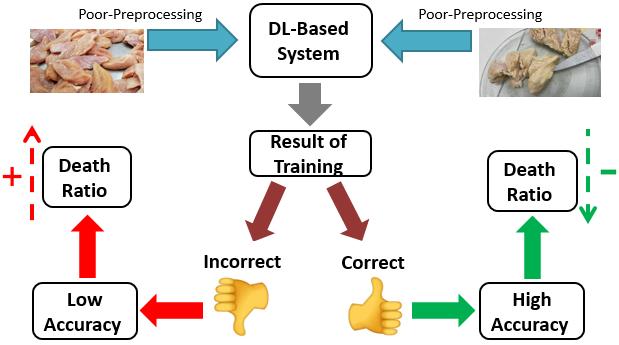
Fig -1:Problemintermsoflowaccuracy.
As shown in Figure 1, the correct prediction leads to highaccuracyofprediction,whichinturnleadstodecrease the death ratio. On opposite, poor prediction leads to increasethedeathratio.
Thecorrespondingresearchquestionthatislinkedto the problem stated above is: how to increase detection of Salmonella contamination through providing effective technique of pre-processing linked with intelligent DL system. This research question can be solved by using histogramequalizationtechniquetoenhancethequalityof images (Chicken Breast Contamination with Salmonella Bacteria),evenifthereisunseenamountofcontamination bynakedeyes,beforetrainingtheintelligentsystem.
This section presents an overview of some related works that used artificial intelligence for detection of Salmonellacontamination,asdescribedbelow.
International Research Journal of Engineering and Technology (IRJET) e-ISSN: 2395-0056
Volume: 12 Issue: 10 | Oct 2025 www.irjet.net p-ISSN: 2395-0072
First study: Authors of work [5] used Hyperspectral imaging(HSI)withCNN(ResNet)toenhancetheaccuracyof detection. The system is feed and trained on spectral signatures of Salmonella colonies. One of the key contributionofthisworkistoreducethedetectiontimeto bewithintherangeof24hours.
Second study: Authors of work [6] used transfer learningtotraintheintelligentsystembasedonmicroscopic images.Thekeyideabehindthisworkistoemploycolony morphologytoextractsignaturesofSalmonellagrowthover time.Thisleadstorealtimedetection.
Third study: Authors of work [7] used YOLOv5 CNN basedmethodologytodetectexistingofSalmonella,where detection based on analysing the colours affected by the amountofconcentrationof Salmonella Thecolouranalysing methodusedisrelatedtoanalysingtheRGBcoloursystem andgenerationofothercoloursfrombasicones.
Forthstudy: Authorsofwork[8]providedanintelligent alarming system based on pH\temperature indicators to provideproperrecommendationrelatedtoclassifychicken meat as healthy or not, They used CNN technique, where dataiscapturedusingInternetofThings(IoT)sensors.
Table 1 summarizes the reviewed works in terms of achievedaccuracy,usedtechniqueanddrawbacks.
Table -1: Summarizationofreviewedworks.
Work UsedTechnique Accuracy Drawback
[5] (HSI)+CNN 90% Requiresexpensive HSIequipment
[6] ResNet+Transfer Learning 94% Needshigh-resolution microscopy
[7] YOLOv5+CNN 91% Sensitivityaffectedby lighting
[8] pH/temperature +CNN+IoT 88% Requiresfarm-wide sensordeployment
AsnoticedinTable1,alldrawbacksarerelatedtopoor pre-processing stage, which forms the research gap addressedinthiswork.
3. Methodology
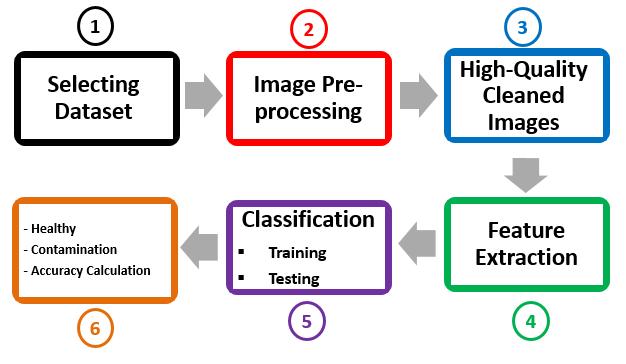
The methodology consists of six stages, as shown in Figure2.
The data set used to develop the intelligent system (classifier) is called Chicken Salmonella, which available online [9] for usage by researchers. The data set contains 2391imagesofbreastchicken.Allimagesarecolouredones withasizeof640x640resolution.Figure3showssamples takenfromthedataset.
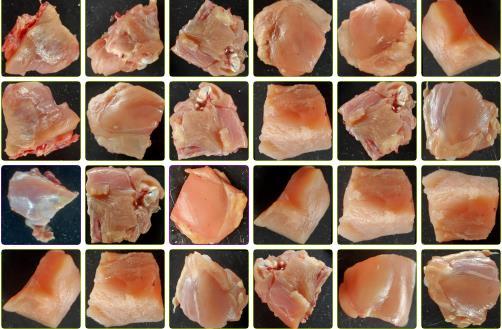




-3:Samplestakenfromthedataset.
International Research Journal of Engineering and Technology (IRJET) e-ISSN: 2395-0056
Volume: 12 Issue: 10 | Oct 2025 www.irjet.net p-ISSN: 2395-0072
As the images are colored, they firstly converted into grayimagestofacilitatefurtherprocessing.Thenhistogram equalizationtechnique[10]isappliedtoenhancethequality. This in turn will enable extracting good features for the purpose of training. The following steps summarizes the imagepre-processingstage:
1- Defineregionofinterestbycroppingmethod.
2- Convertingcoloredregionintograyimages.
3- Applyinghistogramequalizationtechnique.
However, applying histogram equalization leads to some blurring, which negatively affect the process of extractinggoodfeatures.Toenableextractinggoodfeatures thatmaybeunseen bynakedeyes,CLAHEmethod [11] is appliedfollowedbyintensityinversion.Figure4showsthe resultofimagepre-processing.
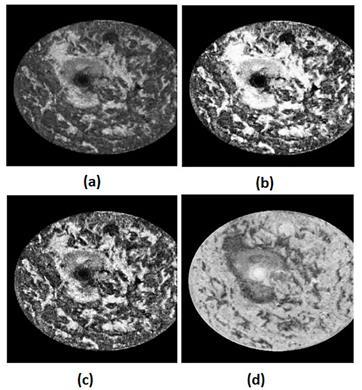
AsshowninFigure4,(a)representstheoriginalregion of interest that contain Salmonella contamination. (b) representstheregionafterapplyinghistogramequalization. (c) represents region after applying CLAHE method. (d) representstheregionafterintensityinversion.Itisclearthat the parts affected by Salmonella contamination are highlightedeveniftheyarenotseenbynakedeyes.Now,the imagesarereadytoenterfeatureextractionstage.
This work employs Convolutional Neural Network (CNN),whichisacommonDeepLearningtechniqueusedto deal with images effectively. With the help of the Scale-
InvariantFeatureTransform(SIFT)method[12]toextract goodfeatures.ThegoodpropertyofSIFTisthatitfiltersthe pixels that affect negatively of features, while saving the good ones based on the pre-processed images. Figure 5, illustrates the operation of the CNN while features extraction, where the filter scans the image in a convolutionalmannerandapoolingprocessisperformedto collectthefinalfeatures.
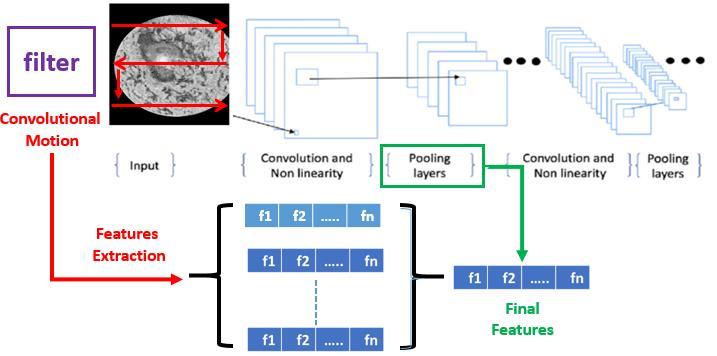
Fig -5:FeaturesextractionusingCNNwithSIIFT techniques.
This stage requires dividing the cleaned \ enhanced dataset into training and testing parts. In this context, the Holdoutmethodisusedtodividetheenhanceddatasetinto training(with2000images)andtesting(with391images). Figure 6 illustrates the division process in terms of percentages.
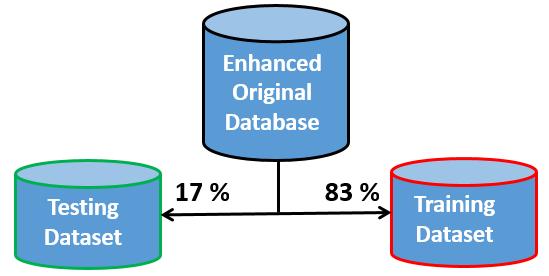
Fig -6:Holdoutdivisionprocess.
Fortraining,theCNNisused.Practically,ResNetversion isusedtoperformconvolutionalandpoolingprocesswith standard parameters. ResNet is combined with the SIFT method to extract features as explained in features extractionstage.ThearchitectureoftheResNetconsistsof 5-based convolutional layers with 4-based pooling layers, where max-pooling function is employed to group the advanced features from abstract ones. The classification layer uses the Softmax function to generate outputs (i.e., predictions if the food is healthy or Salmonella contamination). Figure 7 illustrates the operation of the Softmax function from mathematical point of view to generatepredictions.
International Research Journal of Engineering and Technology (IRJET) e-ISSN: 2395-0056
Volume: 12 Issue: 10 | Oct 2025 www.irjet.net p-ISSN: 2395-0072
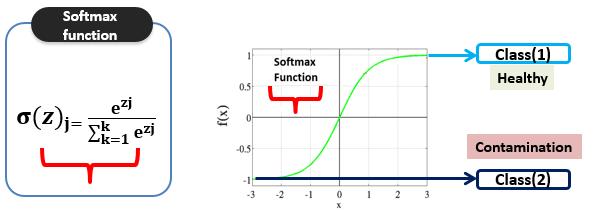
Fig -7:Softmaxfunctionusedforpredictionoutputs.
As shown in Figure 7, there are two classes of prediction.Class1referstohealthyfoodrepresentedby+1 valueofSoftmaxfunction,whileclass2referstoSalmonella contaminationrepresentedby-1valueofSoftmaxfunction.
As for testing, it is related to calculate the accuracy degree based ontheconducted experiments,asdescribed below.
Theexperimentsrelatedtodividingthecleaneddataset, training,testing,andmeasuringaccuracyareconductedin AIMLLab[13]atcollegeofcomputinginFahadBinSultan University (FBSU). The reason behind conducting experiments in such Lab is that handling images requires GPUs tofacilitatescanningimages,applyingenhancement methods, and training and testing stages. Matlab programminglanguageisemployedtoimplementthecode oftheclassifier.
Two main DL-based metrics are used to evaluate the proposed classifier. They are inferred from the confusion matrix [14]shownbelow.
Table -2: Confusionmatrix.
Positives (FP)
Negatives (TN)
Truepositives(TP):positiveimagesthatarecorrectly labelledbytheclassifier.
True negatives (TN): negative images that are correctlylabelledbytheclassifier.
False positives (FP): negative images that are incorrectlylabelledaspositive.
False negatives (FN): positive images that are mislabeledasnegative.
Accuracyisthepercentageofthechickenbreastimages includedinthetestingdatasetthatarecorrectlyclassified (ashealthyorSalmonella contamination). The accuracyis definedas:

Sensitivityreferstothetruepositiverecognitionrate.It isgivenby:

The proposed classifier \ system (ResNet-HE) is compared to the results of second study (ResNet-TR) presented in the literature review section as it offers the highestaccuracyamongthereviewedworks.
Frist Experiment: In this experiment, the proposed systemisevaluatedundertheoriginaldivisionofthecleaned dataset (83% for training and 17% for testing). Table 3 summarizes the values of used metrics achieved by the proposedsystem.
Table -3: Accuracyandsensitivityofproposedsystem (ResNet-HE).
Work Trainingto TestingRatio
Proposed classifier (ResNet-HE)
Discussion of Frist Experiment: The results that is achieved is 97% and 96% for accuracy and sensitivity, respectively.Thevaluesarecomparableastheclassifieris trainedonalargenumberofimages.Actually,increasingthe size of the training dataset leads to enhance the accuracy becausethesystemistrainedfrommorefeaturesextracted fromtheimagesduringtrainingstage.
SecondExperiment(GeneralizationConcept): Taking intoaccountthegeneralizationconcept,whichreferstothe robustnessoftheclassifieragainstchangingthepercentage of the training dataset with a step equals to 10% (i.e, decreasingthepercentageofthetrainingdatasetwith10%), Table4summarizestheachievedresults.
Volume: 12 Issue: 10 | Oct 2025 www.irjet.net
Table -3: Accuracyandsensitivityofproposedsystem (ResNet-HE)undergeneralizationconcept.
Discussion of Second Experiment: Theresultsthatis achieved in average is 95% and 95.3% for accuracy and sensitivity,respectively.Thereasonbehindrecordinglower resultscomparedtofirstexperimentisthatthenumberand qualityofextractedfeaturesislessthanthefirstexperiment. However, the proposed system is still comparable and showedsteadylevelofpredictionastheaccuracydecreased only by 2% and sensitivity by 0.7%. This means that the systemshowedgoodrobustnessintermsofgeneralization, wherethestandardvalueusedtoassessagivensystemis 3%decreasing.
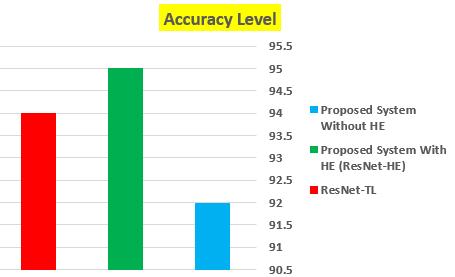
Third Experiment: In this experiment, the proposed systemisevaluatedcomparedtothesecondstudy(ResnetTR)intermsofaccuracy.Theproposedsystemisevaluated with and without applying Histogram Equalization (HE) techniquetoshowitsimpact.Theachievedaccuracyofthe proposedsystem(ResNet-HE)istakenintoconsiderationin thisexperiment.TheResNet-TLisimplemented(i.e.,trained andtested)underthesamedatasettoofferfaircomparison. Figure8belowshowsthecomparison
DiscussionofThirdExperiment: AsshowninFigure8, theproposedsystem(ResNet-HE)outperformthe(ResNetTL)systemasitusesanenhancedmethodtoimprovethe qualityoftherawimages,whilethe(ResNet-TL) doesnot employanyenhancementtechniqueinthepre-processing stage. The proposed system showed less level of accuracy when ignoring the HE technique. This means that the HE techniquehaspositiveimpactontheaccuracyasitenables observing unseen regions that affected by Salmonella contamination. This in turn means that the extracted featuresafterapplyingHEtechniquearebetterfortraining. ThetransferlearningisstrongerthanResNetasitpresents further processing of images in terms of knowledge transferringtoformagoodbackgroundforlearning.Forthis reason,theResNet-TLprovidesbetteraccuracylevelwhen compared to the proposed system without applying HE technique.Tosumup,theResNet-HEsystemoutperformthe ResNet-TLby1%accuracyenhancement,whiletheResNetTLoutperformtheproposedsystem(withoutusingHE)by2 %accuracyenhancement.
DetectionofSalmonellacontaminationinchickenbreast meat is avital domain in food industry. Intelligent system thatuseddeeplearningtechnique(ResNet)isproposed.The proposedsystemisequippedwithanenhancementmethod for increasing the quality of the training images, which is HistogramEqualization(HE)technique. TheHEtechnique contributes to offer more advanced extracted features for training,whereunseenregionofSalmonellacontamination becomeavailabletobetrainedonbytheproposedsystem. Theproposedsystemshowedbetteraccuracyof97%and 95% with and without taking into account generalization concept, respectively. The proposed system provides enhancement of accuracylevel by 1% when compared to similar work. Employing deep learning in food science technologiescancontributetosavelifeofpeople,increasing the trust of clients in food companies, and optimizing the sustainabilityqualityattributeofdevelopingcounties,such asSyria,aswellasotheradvancedcountries.
[1] Sheffield,Sydney,MartaL.Fiorotto,andTeresaA.Davis. "Nutritional importance of animal-sourced foods in a healthy diet." Frontiers in Nutrition 11 (2024): 1424912.
[2] Sharif, Mian K., Komal Javed, and Ayesha Nasir. "Foodborne illness: threats and control." Foodborne diseases.AcademicPress,2018.501-523.
[3] Alrahhal, Mohamad Shady, et al. "An AugmentationBased System for Diagnosing COVID-19 Using Deep Learning."InternationalJournalofAdvancedComputer Science&Applications16.8(2025).
[4] Alrahhal,MohamadShady,andEftkharAlqhtani."Deep learning-basedsystemfordetectionoflungcancerusing fusion of features." International Journal of Computer Science&MobileComputing10.2(2021):57-67.
International Research Journal of Engineering and Technology (IRJET) e-ISSN: 2395-0056
Volume: 12 Issue: 10 | Oct 2025 www.irjet.net p-ISSN: 2395-0072
[5] Papa, MeiLi. Pathogen Classification Using AI-Enabled Hyperspectral Microscopy to Detect Biological Variations.MSthesis.MichiganStateUniversity,2025.
[6] Chin,ShuangYee,etal."Bacterialimageanalysisusing multi-task deep learning approaches for clinical microscopy."PeerJComputerScience10(2024):e2180.
[7] Xiao, Yan, and Dongming Yao. "Deep Learning Based Peach Quality and Disease Detection Methods for Research in Intelligent Food Safety Detection." J. COMBIN.MATH.COMBIN.COMPUT127(2025):80038025.
[8] Tang, Ning, et al. "Wearable sensors and systems for woundhealing-relatedpHandtemperaturedetection." Micromachines12.4(2021):430.
[9] Universe Website. Online [Avaliable]: https://universe.roboflow.com/object-detection2irn9/chicken-salmonella/dataset/2 (Accessed 1-92025)
[10] Mustafa, Wan Azani, and Mohamed Mydin M. Abdul Kader."Areviewofhistogramequalizationtechniques inimageenhancementapplication."JournalofPhysics: ConferenceSeries.Vol.1019.IOPPublishing,2018.
[11] Setiawan, Agung W., et al. "Color retinal image enhancement using CLAHE." International conference onICTforsmartsociety.IEEE,2013.
[12] Wang,Yuyao,etal."AScaleInvariantFeatureTransform BasedMethod."J.Inf.HidingMultim.SignalProcess.4.2 (2013):73-89.
[13] FBSU Website. Online [Available]: https://fbsu.edu.sa/All/sections/Artificial-Intelligence,Machine-Learning-and-Data-Security-Lab (Accessed59-2025)
[14] MonaAlfifi,MohamadShadyAlrahhal,SamirBataineh and Mohammad Mezher. “Enhanced Artificial Intelligence System for Diagnosing and Predicting Breast Cancer using Deep Learning”. International JournalofAdvancedComputerScienceandApplications (IJACSA) 11.7 (2020). http://dx.doi.org/10.14569/IJACSA.2020.0110763