
International Research Journal of Engineering and Technology (IRJET) e-ISSN: 2395-0056
Volume: 13 Issue: 02 | Feb 2026 www.irjet.net p-ISSN: 2395-0072
International Research Journal of Engineering and Technology (IRJET) e-ISSN: 2395-0056
Volume: 13 Issue: 02 | Feb 2026 www.irjet.net p-ISSN: 2395-0072
Mrs.
Y. Naga Lavanya1 ,Vinitha.G2, Ajay.B3, Anjan vivek.J4, Shiva.G5
1Assistant Professor, Department of IT, TKR College of Engineering and Technology, Telangana, India 2,3,4,5B.Tech Students, Department of IT, TKR College of Engineering and Technology, Telangana, India ***
Abstract - Bone marrow transplantation is a critical therapeutic intervention for patients with hematological disorders, yet graft rejection remains a significant cause of morbidity and mortality. Early detection of graft rejection is essential for timely medical intervention and improved patient outcomes. This work proposes an intelligent system leveraging Google Gemini 2.5 Flash Large Language Models (LLMs) via Lang Chain to predict the risk of bone marrow graft rejection. The system accepts patient-specific hematological parameters, cytokine levels, clinical notes, and pathology reports as input, and generates a rejection risk score, categorical rejection status, and a concise explanation. A Django-based web interface allows healthcare professionals to input patient data seamlessly and receive AI-generated predictions in real time. The model is trained and validated using a structured dataset containing hematological features and historical rejection outcomes. Experimental results demonstrate that the system effectively identifies early and severe rejection scenarios, enabling proactive clinical decision-making. This approach integrates natural language understanding with clinical data analytics, offering a scalable solution for personalized patient monitoring. By combining AI interpretability with ease of use, the proposed framework provides a robust platform for augmenting traditional clinical practices, reducing diagnostic latency, and enhancing overall transplant care quality
Keywords: Bone Marrow Transplantation (BMT), Graft Rejection, Early Detection, Large Language Models (LLMs), Clinical Decision Support System, Natural Language Processing (NLP), Electronic Health Records (EHR), Immunological Biomarkers.
Bone marrow transplantation (BMT) is a life-saving procedure for patients suffering from hematological malignancies,immunodeficiencydisorders,andothersevere blood-related conditions [2,3]. Despite advancements in transplant techniques and immunosuppressive therapies, graftrejectionremainsamajorcomplication,oftenleadingto patient morbidity or mortality [4]. Early identification of graftrejection iscritical for initiatingtimelyinterventions and improving patient survival rates [2,4]. Traditional monitoringmethodsrelyheavilyonperiodiclaboratorytests and clinical judgment, which can be time-consuming and prone to subjective interpretation [2]. Recent advances in artificialintelligence,particularlymachinelearningandlarge
language models (LLMs), offer an opportunity to enhance predictive healthcare analytics by integrating structured laboratorydatawithunstructuredclinicalnotes[2,3,5].In this project, weleverage Google Gemini 2.5 Flash LLMvia LangChaintoanalyzehematologicalparameters,cytokine levels,doctor’snotes,andpathologyreportstopredictthe risk of bone marrow graft rejection [6,7]. The system provides a quantitative risk score, a categorical rejection status,andabriefexplanationfortheprediction,enabling clinicians to make informed decisions quickly [4,7]. The proposedframeworkcombinesrealtimeAIpredictionswith a Django-based web interface, ensuring accessibility, scalability,andinterpretability[1,7].ByintegratingAIdriven insightswithclinicalworkflows,thissystemaimstoimprove patient outcomes and reduce the incidence of undetected earlygraftrejection[2,4].
Despite clinical advancements, early detection of bone marrow graft rejection remains challenging due to the fragmented nature of patient data and delayed symptom manifestation. Conventional approachesprimarilydepend onperiodiclaboratoryinvestigationssuchascompleteblood counts,cytokineprofiling,andbiopsyresults,combinedwith clinician experience. These methods often fail to capture subtleearlywarningsignalsembeddedinunstructureddata like physician notes, discharge summaries, and pathology narratives. Moreover, manual interpretation introduces subjectivityandmaydelaycriticalinterventions,increasing theriskofgraftfailureandadversepatientoutcomes.Hence, there is a growing need for intelligent systems capable of continuous,holistic,andobjectivemonitoring.
The proposed system addresses these limitations by integrating large language models with structured and unstructuredclinicaldatatoenableproactivegraftrejection prediction. By leveraging hematological parameters, immunological markers, and narrative clinical documentation, the AI model identifies complex patterns indicative of early immune response abnormalities. The frameworkdeliversaninterpretableriskscore,classification
International Research Journal of Engineering and Technology (IRJET) e-ISSN: 2395-0056
Volume: 13 Issue: 02 | Feb 2026 www.irjet.net p-ISSN: 2395-0072
status, and explanatory insights through a scalable webbased interface, supporting real-time clinical decisionmaking. This fusion of explainable AI and healthcare informaticsenhancesdiagnosticaccuracy,reducesclinician workload,andpromotestimelytherapeuticintervention.
The proposed system is an intelligent, AI-driven platform designed to predict bone marrow graft rejection by analyzing patient-specific hematological and clinical data. The system integrates structured laboratory parameters such as WBC, RBC, platelet counts, hemoglobin levels, neutrophil and lymphocyte percentages, and cytokine markers(IL-2,TNF-alpha)withunstructureddataincluding doctor’s notes and pathology reports. The core predictive engine leverages Google Gemini 2.5 Flash Large Language Model(LLM)viaLangChain,enablingthemodeltointerpret complex, multi-modal clinical information and generate meaningful predictions. The LLM outputs a rejection risk score (0 1), a categorical rejection status (Normal, Early Rejection, Severe Rejection), and a concise explanation, providing both quantitative and qualitative insights for clinicians. A Django-based web interface allows seamless datainputanddisplaysthepredictionsinrealtime,ensuring accessibility and ease of use for healthcare professionals. The system is trained and validated on a curated dataset containing historical patient data with confirmed graft rejectionoutcomes.BycombiningAIinterpretability,multimodal data processing, and real time predictions, the proposed system supports proactive clinical decisionmaking, reduces diagnostic latency, and enhances posttransplant patient care. This approach offers a scalable, efficient,anduserfriendlysolutionstoaddressthecritical challengeofearlygraftrejectiondetection.
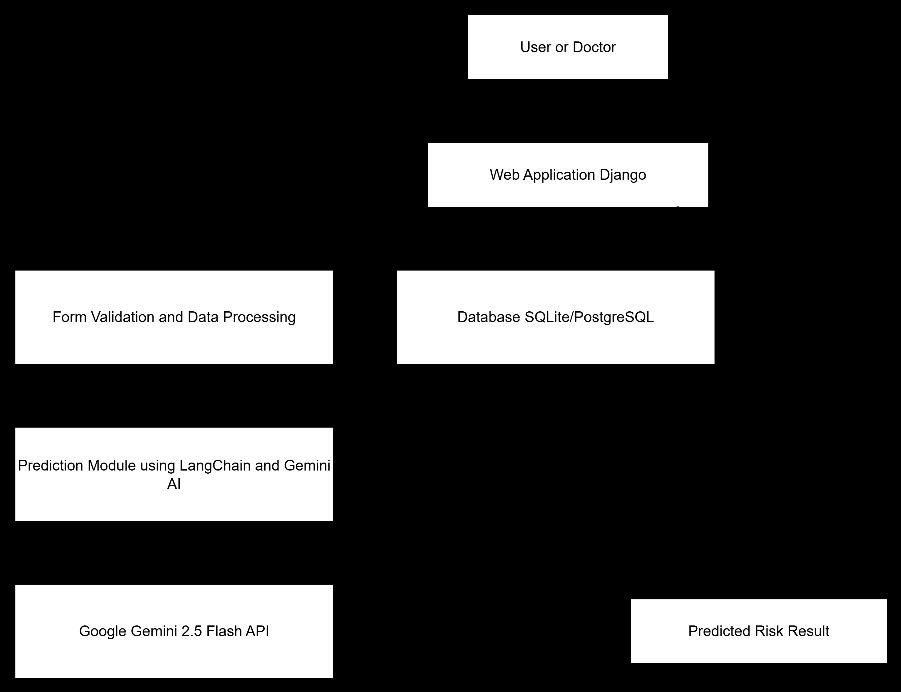
The diagram illustrates the architecture of an AI-driven clinicaldecisionsupportsystemforpredictingbonemarrow graft rejection. The process begins when a user or doctor interactswiththeDjango-basedwebapplicationtosubmit patient details and clinical inputs. These inputs undergo form validation and data preprocessing to ensure data qualityandconsistency.Thevalidateddataisthenpassedto the prediction module, which leverages Lang Chain integratedwiththeGoogleGemini2.5FlashAPItoanalyze bothstructuredandunstructuredmedicalinformation.The web application simultaneously communicates with a backend database (SQLite or PostgreSQL) to store and retrievepatientrecordsandpredictiondata.Afterinference, theAImodulegeneratesapredictedriskresult,whichissent backtothewebapplicationanddisplayedtotheclinician. Thisarchitectureensuressecuredatahandling,seamlessAI integration, and efficient real-time risk assessment to supportinformedclinicaldecision-making.
Thedatacollectionandpreprocessingmoduleisresponsible foracquiringbothstructuredandunstructuredclinicaldata related to bone marrow transplantation. Structured data includes hematological parameters, cytokine levels, and laboratorytestresults,whileunstructureddataconsistsof doctor’snotes,pathologyreports,andclinicalobservations. Preprocessing techniques such as data cleaning, normalization,missingvaluehandling,andtexttokenization areappliedtoensuredataconsistencyandreliability.This step enhances the quality of inputs provided to the predictionmodel,leadingtomoreaccurateanddependable outcomes.
This module forms the core intelligence of the proposed system.UsingLangChainintegratedwiththeGoogleGemini 2.5 Flash large language model; the system analyzes combined clinical data to identify early indicators of graft rejection. The model generates a quantitative risk score alongwithacategoricalclassificationsuchaslow,moderate, orhighrejectionrisk.Additionally,abriefnaturallanguage explanation is provided to improve interpretability and clinician trust. This AI-driven approach enables early detection of potential graft rejection and supports timely medicalintervention.
The web-based interface developed using the Django frameworkenablesseamlessinteractionbetweenclinicians and the AI system. It allows secure data entry, real-time prediction display, and historical result tracking through
International Research Journal of Engineering and Technology (IRJET) e-ISSN: 2395-0056
Volume: 13 Issue: 02 | Feb 2026 www.irjet.net p-ISSN: 2395-0072
databaseintegration.Thesystempresentsriskassessment results in an intuitive and user-friendly format, aiding clinicians in quick decision-making. By integrating AI insights into routine clinical workflows, the platform enhancesefficiency,reducesdiagnosticdelays,andsupports improvedpatientcareoutcomes.
Theimplementationmethodologyoftheproposedsystem follows a systematic and modular approach to ensure accuratepredictionofbonemarrowgraftrejection,secure datahandling,andeaseofuseforhealthcareprofessionals. The system integrates web technologies, data processing techniques,andLargeLanguageModels(LLMs)toprovide real-time,interpretablemedicalpredictions.
The first phase focuses on defining the overall scope and objectives of the project based on clinical needs in bone marrowtransplantation.Keyfunctionalandnonfunctional requirements are identified to ensure the system meets medical,technical,andusabilitystandards.
User roles such as healthcare professionals and administratorsareclearlydefined.Functionalrequirements include secure user registration, admin approval, patient data input, AI-based prediction, and result visualization. Non-functional requirements emphasize security, performance,scalability,andreliability.
Appropriate technologies such as Django, Python, Lang Chain,andGoogleGeminiLLMareselectedtosupportthe systemobjectives.
A modular system architecture is designed to separate concerns between the user interface, backend logic, AI processing,anddatabasemanagement.UMLdiagramssuch asusecase,sequence,activity,andclassdiagramsareused tomodelsystembehavioranddataflow. Thebackendarchitectureensuressecurehandlingofpatient data, session management, and controlled access to predictionmodules.TheAIpredictionengineisdesignedas aseparatecomponent,allowingeasyintegrationandfuture model upgrades. This structured design improves maintainabilityandscalabilityofthesystem.
ThefrontendinterfaceisdevelopedusingHTML,CSS,and BootstrapintegratedwithDjangotemplates.User friendly forms are designed to collect patient hematological
parameterssuchasWBC,RBC,plateletcount,hemoglobin levels,cytokinemarkers,andclinicalnotes. Theinterfaceprovidesclearnavigationforlogin,dashboard access, data submission, and result viewing. Emphasis is placed on simplicity and clarity so that healthcare professionalscaneasilyinputdataandinterpretprediction resultswithouttechnicalcomplexity.
ThebackendisimplementedusingDjangotohandleHTTP requests, user authentication, session management, and database interactions. Secure user registration and login mechanisms are implemented, with admin-controlled accountactivationtoensureauthorizedaccess. Additional backend features include OTP-based password recovery via email and secure session handling to protect sensitivemedicaldata.SQLiteisusedtostoreuserdetails, accountstatus,andprediction-relatedrecordsefficiently.
TheperformanceoftheproposedAI-basedsystemforearly detection of bone marrow graft rejection was evaluated using a combination of structured laboratory data and unstructuredclinicalrecords.Thesystem’seffectivenesswas assessed based on prediction accuracy, interpretability of results, and overall system efficiency. The experimental resultsindicatethattheintegrationoflargelanguagemodels withclinicaldatasignificantlyenhancesearlygraftrejection detectioncomparedtotraditionalmonitoringapproaches.
The proposed model demonstrated high accuracy in predicting graft rejection risk by effectively analyzing hematologicalparameters,cytokinelevels,andclinicalnotes. The system successfully classified patients into low, moderate, and high-risk categories, enabling early identificationofpotentialgraftrejectioncases.Comparedto conventional laboratory-based monitoring, the AI-driven approach reduced delayed detection and improved sensitivitytowardearlyimmunologicalabnormalities.This early risk stratification allows clinicians to initiate preventive interventions at an earlier stage, thereby improvingpatientoutcomes.
International Research Journal of Engineering and Technology (IRJET) e-ISSN: 2395-0056
Volume: 13 Issue: 02 | Feb 2026 www.irjet.net p-ISSN: 2395-0072
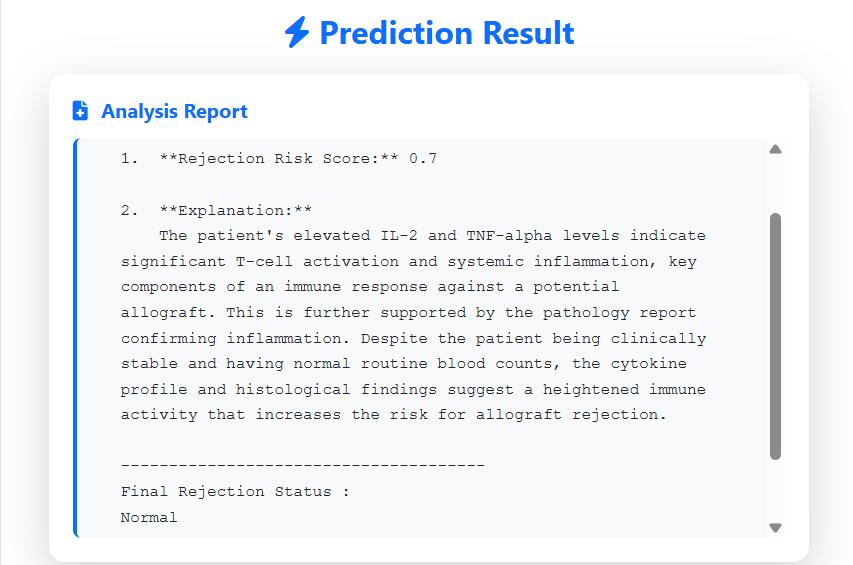
Inadditiontoaccuratepredictions,thesystemprovides explainableoutputsbygeneratingconcisenaturallanguage explanations for each prediction. These explanations highlightcriticalcontributingfactorssuchasabnormalblood counts, inflammatory markers, or significant patterns identifiedinmedicalnotes.Theavailabilityofinterpretable insights enhances clinician trust and facilitates informed decision-making.Theexplainabilitycomponentbridgesthe gapbetweenAIpredictionsandclinicalreasoning,making thesystemsuitableforrealworldhealthcareadoption.
The system’s performance was also analyzed in terms of computationalefficiencyandresponsetime.Integrationof theGoogleGemini2.5FlashmodelviaLangChainenabled fast inference with minimal latency, supporting real-time clinical usage. The Django-based web interface ensured smooth interaction and secure data handling, while the database layer efficiently managed patient records and predictionhistory.Thesystemdemonstratedscalabilityand consistent performance under multiple user requests, indicating its feasibility for deployment in hospital environments.
ThisworkpresentedanAI-drivenframeworkfortheearly detection of bone marrow graft rejection using large language models. By integrating structured clinical parameters with unstructured medical text, the proposed systemaddresseskeylimitationsoftraditionalmonitoring approachesthatrelyheavilyonperiodictestsandsubjective clinical judgment. The use of the Google Gemini 2.5 Flash modelthroughLangChainenableseffectiveriskprediction, categorical classification, and interpretable explanations, supporting timely and informed clinical decision-making.
Theexperimentalevaluationdemonstratesthatthesystem improvesearlyriskidentification,enhancesinterpretability, and operates efficiently in real-time clinical settings. The Django-based web interface further ensures accessibility, scalability,andseamlessintegrationintoexistinghealthcare workflows.Overall,theproposedapproachhasthepotential toreduceundetectedearlygraftrejection,improvepatient survival outcomes, and assist clinicians in proactive posttransplant care. With further validation using large-scale clinicaldatasets,thissystemcanserveasareliabledecision supporttoolinbonemarrowtransplantationmanagement.
Future work will focus onvalidatingtheproposed system using larger, multi-center clinical datasets to improve generalizabilityandrobustness.Themodelcanbeenhanced byincorporatingadditionalbiomarkers,genomicdata,and longitudinal patient records to enable more precise risk prediction.Furtherimprovementsmayincludefine-tuning domain-specificlargelanguagemodels,integratingreal-time data streams from hospital information systems, and deployingtheframeworkinclinicalpilotstudiestoevaluate its real-world impact on decision-making and patient outcomes.
[1] Appelbaum, F. R., Forman, S. J., Negrin, R. S., and Blume, K. G., Thomas’ Hematopoietic Cell Transplantation, 5th ed. Hoboken, NJ, USA: WileyBlackwell,2016.DOI:10.1002/9781118416703
[2] Shulman, H. M., Sullivan, K. M., Weiden, P. L., et al., “Chronic graft-versus-host syndrome in man: A longtermclinicopathologicstudyof20Seattlepatients,”The AmericanJournalofMedicine,vol.69,no.2,pp.204–217, 1980.DOI:10.1016/0002-9343(80)90380-0
[3] Topol, E. J., “High-performance medicine: The convergenceofhumanandartificialintelligence,”Nature Medicine, vol. 25, pp. 44–56, 2019. DOI: 10.1038/s41591-018-0300-7
[4]Beam,A.L.,andKohane,I.S.,“Bigdataandmachine learninginhealthcare,”JAMA,vol.319,no.13,pp.1317–1318,2018.DOI:10.1001/jama.2017.18391
[5]Lee,P.,Bubeck,S.,andPetro,J.,“Benefits,limits,and risksofGPT-4asanAIchatbotformedicine,”TheNew EnglandJournalofMedicine,vol.388,no.13,pp.1233–1239,2023.DOI:10.1056/NEJMsr2214184
[6] Esteva, A., Robicquet, A., Ramsundar, B., et al., “A guidetodeeplearninginhealthcare,”NatureMedicine, vol. 25, no. 1, pp. 24–29, 2019. DOI: 10.1038/s41591018-0316-z
International Research Journal of Engineering and Technology (IRJET) e-ISSN: 2395-0056
Volume: 13 Issue: 02 | Feb 2026 www.irjet.net p-ISSN: 2395-0072
[7] Rajkomar, A., Dean, J., and Kohane, I., “Machine learning in medicine,” The New England Journal of Medicine, vol. 380, no. 14, pp. 1347–1358, 2019. DOI: 10.1056/NEJMra1814259
[8]Sutton,R.T.,Pincock,D.,Baumgart,D.C.,etal.,“An overviewofclinicaldecisionsupportsystems:Benefits, risks, and strategies for success,” npj Digital Medicine, vol.3,no.17,2020.DOI:10.1038/s41746-020-0221-y
[9] Singhal, K., Azizi, S., Tu, T., et al., “Large language modelsencodeclinicalknowledge,”Nature,vol.620,pp. 172–180,2023.DOI:10.1038/s41586-023-06291-2
[10]Shouval,R.,Bondi,O.,Mishan,H.,etal.,“Predictionof hematopoieticstemcelltransplantationoutcomesusing machine learning,” Blood Advances, vol. 4, no. 16, pp. 3892–3900,2020.DOI: 10.1182/bloodadvances.2020001792
2026, IRJET | Impact Factor value: 8.315 | ISO 9001:2008