
International Research Journal of Engineering and Technology (IRJET) e-ISSN: 2395-0056
Volume: 13 Issue: 03 | Mar 2026 www.irjet.net p-ISSN: 2395-0072
International Research Journal of Engineering and Technology (IRJET) e-ISSN: 2395-0056
Volume: 13 Issue: 03 | Mar 2026 www.irjet.net p-ISSN: 2395-0072
Dnyaneshwar Pawar1 , Narendra panchal2 , Sudarshan Umbre3 , Ritesh sonet4 , PROF. K.M.kahandal5 , PROF. A.C.NAIK6
1,2,3,4 (Students, Department Of Computer Engineering), S.Y.P SHREEYASH COLLEGE OF ENGINEERINGAND TECHNOLOGY (POLYTECHNIC), CHH.SAMBHAJINAGAR , India. 5 (Project Guid, Dept Of Computer Engineering), 6(HOD, Dept Of Computer Engineering), S Y P SHREEYASH COLLEGE OF ENGINEERINGAND TECHNOLOGY (POLYTECHNIC), CHH.SAMBHAJINAGAR , India
Abstract - The rapid growth of digital technology has transformed traditional education into online learning systems. However, most existing e-learning platforms provide the same content to all learners without considering individual learning needs, abilities, and interests. This reduces engagement and learning efficiency. To solve this problem, this project proposes an ELearning Platform with an AI Recommendation Engine that delivers personalized learning experiences to students. The system collects user data such as course history, quiz performance, time spent on topics, and learning preferences. Using Artificial Intelligence and Machine Learning algorithms, the platform analyses student behaviour and identifies strengths and weaknesses. Based on this analysis, the recommendation engine suggests suitable courses, practice materials, revision content, and advanced topics tailored to each learner. The platform includes features such as user registration, course management, video lectures, quizzes, performance tracking, and an interactive dashboard. The AI-based recommendation system improves learning efficiency by guiding students toward relevant study materials and helping them focus on weak areas.
This system enhances student engagement, supports self- paced learning, and increases overall academic performance. The proposed model can be applied in schools, colleges, competitive exam preparation, and corporate training environments. By integrating AI into e-learning, the platform creates a smarter and more adaptive educational ecosystem for modern learners.
Key Words:- E-Learning Platform, Artificial Intelligence (AI), Recommendation Engine, Machine Learning, Personalized Learning, Collaborative Filtering, Content-Based Filtering, Learning Analytic
The advancement of internet technology and digital devices has significantly changed the education system. Traditional classroom learning is gradually being supported and replaced by online learning platforms. E-learning platforms allow students to access educational content anytime and anywhere, making learning moreflexibleandconvenient. However, most existingplatformsprovidethesamelearningmaterials to all students, without considering their individual abilities, interests,andlearningspeed.
Every student has a different learning style. Some students understand concepts quickly, while others requireadditional practice and explanation. Providing the same content to all learners may reduce engagement and affect performance. Therefore, there is a need for a smart system that can understand student behavior and recommend suitable learning materialsaccordingly.
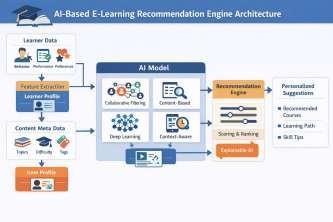
Fig-1: AI-Based E-Learning Recommendation Engine Architecture
International Research Journal of Engineering and Technology (IRJET) e-ISSN: 2395-0056
Volume: 13 Issue: 03 | Mar 2026 www.irjet.net p-ISSN: 2395-0072
Toaddressthisissue,theproposedsystemintroducesan E-Learning Platform with an AI Recommendation Engine.The systemusesArtificial
IntelligenceandMachineLearningtechniquestoAnalyzestudentactivitiessuchasquizscores,course history,timespent ontopics,andlearningpreferences.Basedonthisanalysis,theplatformprovidespersonalizedrecommendationsincluding courses, practice questions, revision materials, and advanced topics. The main goal of this system is to improve learning efficiency,increasestudentengagement,and providea customizedlearning experience.By integratingAI into e-learning, the platform becomes more adaptive and intelligent, helping students focus on their weak areas and achieve better academicperformance.
Predictingstudentacademicperformancehasbecomeaprominentresearchareaineducationaldatamining(EDM)dueto theincreasingavailabilityofstudent-relateddatageneratedbylearningmanagementsystems(LMS),onlineplatforms,and traditionalclassrooms.Theobjectiveofthesesystemsistoleveragehistoricalandreal-timedatatoidentifyat-riskstudents, enhanceinstructionalstrategies,andimproveoveralleducationaloutcomes.Earlystudiesfocusedprimarilyontheuseof traditional statistical techniques to explore relationships between student demographicattributesandacademicsuccess. Romeroand Ventura (2007) pioneered the use of educational data mining to extract patterns from educational datasets, demonstrating that student behavior, when analyzed correctly, can forecast future outcomes. Their work laid the foundationforlinkingacademicdatawithpredictivemodelsthatassisteducatorsindecision-makingprocesses.
In the last decade, researchers have transitioned from simple statistical methods such as linear regression and correlation analysis to more sophisticated machine learning approaches. For example, Kotsianti set al. (2004) compared classification algorithms such as Decision Trees, Naive Bayes, and Support Vector Machines in predicting student grades, finding that ensemble methods often outperform traditional classifiers. These studies highlight the benefit of machine learning in handling complex and non-linear relationships within educational datasets. Recent literature reflects a noticeable shift towarddeeplearninganddata-drivenapproaches.Deepneural networks,suchasLongShort-TermMemory(LSTM)and Convolutional Neural Networks (CNN), have been applied to sequential and behavioral data to capture temporal engagement patterns that traditional techniques cannot extract. Al-Balawi et al. (2018) successfully utilized recurrent neuralnetworkstomodelstudentactivitylogsinonlinecourses,showingsignificantimprovementinprediction accuracy comparedtobaselinemodels.
Several researchers have also emphasized feature engineering as a critical step in performance prediction. Student interactionlogs,resourceaccesspatterns,time-on-taskmeasurements,andforumparticipationmetricshavebeenshown to contribute strongly to predictive accuracy. For example, Yang and Liu (2019) demonstrated that combining academic
International Research Journal of Engineering and Technology (IRJET) e-ISSN: 2395-0056
Volume: 13 Issue: 03 | Mar 2026 www.irjet.net p-ISSN: 2395-0072
scores withinteractiondata fromLMS platformssignificantlyenhancesthemodel’sabilitytodetect early signs of student disengagement. The rapid development of digital education has led to the growth of various e-learning platforms. Traditional online learning systemsmainlyfocusondeliveringcontentthroughvideos, notes,andquizzes.However,these systems provide uniform content to all learners without considering individual differences. Researchers have identified thatlackofpersonalizationreducesstudentengagementandlearningeffectiveness.Severalstudieshaveexploredtheuse of Artificial Intelligence (AI) in education to improve personalization. AI-based learning systems analyze user behavior suchastimespentonlessons,quizperformance,andcoursecompletion ratestounderstandlearning patterns.Basedon thisanalysis,recommendationsystemssuggestsuitablelearningmaterialstostudents.Research
Different recommendation techniques such as content-based filtering, collaborative filtering, and hybrid models have been widely studied. Content-based filtering recommends materials similar to those previously accessed by the learner. Collaborativefilteringsuggestscontentbasedonthebehavior of similar users. Hybrid models combine both approaches to improve accuracy and effectiveness. Existing platforms like Coursera and Khan Academy use data-driven methods to enhance user experience, but many systems still lack fully adaptive and intelligent learning paths. Therefore, there is a need to design an advanced e-learning platform integrated with an AI recommendation engine that provides dynamic, real-time personalized suggestions. The proposed system aims to address these limitations by combining machine learning techniques with a structured e-learning environment to create a smarter and more adaptive digital educationplatform.
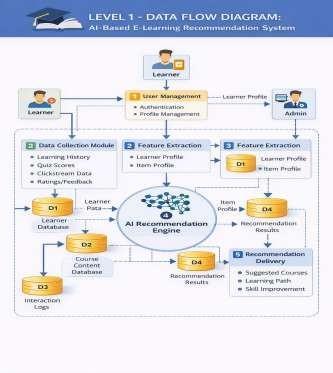
TheproposedsystemisanintelligentE-LearningPlatformintegratedwithanAI-basedRecommendationEnginedesignedto provide personalized learning experiences to students. The main objective of this system is to analyze student behavior, performance,andintereststorecommendsuitablecoursesandlearningmaterials.Whenauserregistersontheplatform, they provide details such as educational background, preferredsubjects,skill level,andlearning goals. This information is storedinacentralizeddatabaseandformstheinitialuserprofile.Asthestudentinteractswiththeplatformbyenrollingin courses, attempting quizzes, watching video lectures, and completing assignments, the system continuously collects learningactivitydatasuchastimespent,scoresobtained,coursecompletionrate,andtopicpreferences.Thecollecteddata isprocessedthroughafeatureextractionmodulewhereimportantattributeslikeaverageperformance,weaksubjects,and learning pace are identified. The AI recommendation engine then applies machine learning techniques such as ContentBased Filtering and Collaborative Filtering to generate personalized suggestions. Content-based filtering recommends coursessimilartothosepreviouslystudiedbythelearner,whilecollaborativefilteringsuggestscoursespreferredbyother students with similar learning patterns. A hybrid approach combining both techniques ensures higher accuracy and relevanceofrecommendations.
The system architecture consists of a user interface layer,applicationlayer,AIengine,andclouddatabase, which canbe implemented using technologies such as Flutter or Android Studio for frontend development and Firebase for backend services. This proposed method enhances learning efficiency, improves course completion rates, reduces dropoutchances, andcreatesanadaptiveandscalabledigitallearningenvironmentsuitableformoderneducationsystems.
The proposed E-Learning Platform with an AI Recommendation Engine provides an intelligent and personalized approachtodigitaleducation.Unliketraditionale-learningsystemsthatofferthesamecontenttoalllearners,theproposed systemadaptstoindividual studentneedsbyanalyzinglearningbehavior,performancedata,andinteractionpatterns.By integrating Artificial Intelligence and Machine Learning techniques, the platform can identify strengths and weaknesses, recommendsuitable study materials, and generate adaptive learning paths. This improvesstudent engagement, enhances learning efficiency, and supports self-paced education. The system also provides real-time feedback and detailed performanceanalysis,helpingstudentstracktheirprogressandimprovecontinuously.
Additionally, the platform assists faculty and administrators by providing analytical reports and monitoring tools that support better academic decision-making. The centralized dashboardensuressmoothcommunicationandeasyaccess to important information. Overall, the implementation of an AI-based recommendation engine in an e-learning platform createsasmarter,adaptive,anduser-centriceducationalenvironment.Theproposedsystemhasthepotentialtoimprove academic performance, increase learner satisfaction, and contribute to the advancement of modern digital education systems.
International Research Journal of Engineering and Technology (IRJET) e-ISSN: 2395-0056
Volume: 13 Issue: 03 | Mar 2026 www.irjet.net p-ISSN: 2395-0072
[1]C.RomeroandS.Ventura,“EducationalDataMining:A Reviewof the StateoftheArt,”IEEE Transactionson Systems, Man,andCybernetics,PartC(ApplicationsandReviews),vol.40,no.6,pp.601–618,2010.
[2]F. Ricci, L. Rokach, and B. Shapira, “Introduction to Recommender Systems Handbook,” in Recommender Systems Handbook,Springer,2011,pp.1–35.
[3]G.AdomaviciusandA.Tuzhilin,“TowardtheNextGenerationofRecommenderSystems:ASurveyof theState-of-theArtandPossibleExtensions,”IEEETransactionsonKnowledgeandDataEngineering,vol.17,no.6,pp.734–749,2005.
[4]X.SuandT.M.Khoshgoftaar,“ASurveyof CollaborativeFilteringTechniques,”AdvancesinArtificialIntelligence,vol.2009,pp.1–19,2009.
[5]R.S.J.d. Bakerand K.Yacef, “TheStateofEducational Data Mining in2009:AReviewand Future Visions,” Journal of EducationalDataMining,vol.1,no.1,pp.3–17,2009.
MR.DNYANESHWAR PAWAR
PursuingPoly(Co)S.Y.PShreeyashCollege OfEngineeringandTechnology(Polytechnic)
MR.NARENDRA PANCHAL
PursuingPoly(Co)S.Y.PShreeyashCollege OfEngineeringandTechnology(Polytechnic)
MR.SUDARSHAN UMBRE
PursuingPoly(Co)S.Y.PShreeyashCollege OfEngineeringandTechnology(Polytechnic)
MR.RITESH SONET
PursuingPoly(Co)S.Y.PShreeyashCollege OfEngineeringAndTechnology(Polytechnic)
PROF. K.M.KAHANDAL
Guide,Dept.ofComputerEngineering
S.Y.PShreeyashCollege OfEngineeringAndTechnology(Polytechnic).
PROF.ANIL NAIK HOD
HOD,Dept.ofComputerEngineering
S.Y.PShreeyashCollegeofEngineeringand Technology(Polytechnic)