
E-Commerce Website for the Growth of Plants and Gardening
Arya Pakhale, Anshul Mahurkar, Rajvi Choudhary,Tanishq Larokar
Department of Computer Science and Engineering Guru Nanak Institute ofEngineering and Technology Rashtrasant Tukdoji Maharaj Nagpur University Dahegaon, Kalmeshwar Road, Nagpur-441501
Abstract- This paper explores the design, development and implications of an e-commerce website specifically targeted toward plants and gardening. With the rise of digital commerce, niche platforms focusing on sustainable lifestyle products, such as gardening, have emerged as significant growth area. The paper presents the motivation for such a system, discusses relevant technologies, analyses user adoption factors, and highlights the potential for integrating smart recommendations and eco-friendly supply chains. Additionally, it identifies future opportunities for IoT integration, AI-based plant disease detection, and sustainability-focused digital commerce.
Keywords - E-commerce, Gardening, Plant Growth, Sustainable Lifestyle, Web Development
I. INTRODUCTION
The rapid expansion of e-commerce over the past decade has transformed the global retail landscape, making digital platformstheprimarymodeofpurchasingformillionsofconsumers.Whilesectorssuchaselectronics,fashion,andhousehold goods have fully embraced online retail, the horticulture and gardening industry has been comparatively slower in adopting digital transformation. Factors such as the perishable nature of plants, variability in regional climates, and limited technologicaladoptionbylocalnurserieshavecontributedtothefragmentedandlargelyofflinenatureofthissector.Asurban populations grow and interest in sustainable living increases, the demand for accessible, high-quality gardening products continues to rise. This creates a substantial opportunity for specialized digital platforms that can connect customers with reliableplantsources,tools,andexpertguidance.
Urbanconsumersoftenencountersignificantchallengeswhenattemptingtopurchaseplantsandgardeningtools. Traditional nurseries frequently lack product standardization, inventory visibility, and expert guidance for plant care, leading to suboptimalpurchasingdecisions.Additionally,customersresidinginmetropolitanorsemi-urbanregionsmayfacerestricted access to diverse plant varieties due to limited nearby nurseries. Conversely, small and medium-scale plant v endors often struggle with visibility, marketing limitations, and inefficient inventory management, preventing them from reaching a broadercustomerbase.Thesegapshighlightaclearneedforacentralized,technology-drivensolutioncapableofmodernizing thehorticulturesupplychain.
E-commerce platforms tailored specifically to horticultural products can address these challenges by providing structured product categorization, detailed plant- care information, climate-specific recommendations, and seamless purchasing workflows.Furthermore,digital toolssuchasintelligentsearchfilters,personalized suggestions,andvendordashboardscan significantlyenhanceuserexperienceandbusinessefficiency.
However, designing an e-commerce system for plant- based products introduces unique constraints that differ from conventionalonlinemarketplaces.Theseincludeensuringaccuraterepresentationofplantcharacteristics,maintainingup-todatestocklevels,optimizingdeliveryprocessestopreserveplanthealth,andenabling customerstomakeinformeddecisions basedonenvironmentalcompatibility.
Recentadvancementsinwebtechnology,cloudcomputing,NoSQLdatabases,andAI-drivenrecommendationsystemsmakeit feasible to develop a robust, scalable, and user- friendly platform for gardening products. The integration of multimedia descriptions, environmental metadata, and season-based suggestions further enhances the decision- making process for buyers. By leveraging these technologies, this research aims to bridge the gap between customer expectations and vendor capabilitieswithinthehorticulturedomain.
Thispaperpresentsthedesign,development,andevaluationofacomprehensivee-commercewebsite tailoredforplantsand gardening tools. The system enables users to browse a wide variety of products, accessessential plant- care instructions, receive personalized recommendations, and complete secure transactions. For plant vendors, the platform provides an efficient interface for inventory management, product uploads, and performance analytics. The research focuses on building an architecture that is both scalable and intuitive, ensuring that the system can adapt to future technological enhancements andshiftsincustomerbehavior.
The main contributions of this research are as follows:
1. Developmentofaspecializede-commercearchitecturetailoredtotheuniqueconstraintsofthehorticulturedomain.
2. Implementation of a scalable NoSQL-based database schema supporting diverse and metadata-rich plant information.
3. Integration of a user-centred design approach that incorporates plant-care knowledge and climate- specific recommendationstoimprovedecision-making.
4. Designofanintelligentrecommendationenginethatenhancesuserengagementandpersonalization.
5. Evaluation of system performance, usability, vendor adoption, and scalability through structured testing and user studies.
II.LITERATURE REVIEW
This section synthesizes prior work across four relevant domains: (1) e-commerce architecture and niche marketplaces, (2) onlinehorticultureandperishable-goodsretail,(3)personalizationand recommendationsystemsfor product discovery,and logistics,IoT,andsustainabilityforlive-plantdelivery.Thereviewhighlightsestablishedfindings,methodologicalapproaches, andopengapsthatmotivatethedesignchoicesandresearchcontributionsofthispaper.
A. E-commerce platforms and niche marketplaces
The foundational literature on e-commerce architecture emphasizes modular, service-oriented designs that support rapid feature extension and horizontal scaling. Tripathi et al. and Li & Zhang describe common architectural patterns RESTful APIs, microservices decomposition, and cloud hosting that enable scalability and maintainability in modern online retail systems[11],[7].Workonnichemarketplacesshowsthatspecializedplatformsoutperformgeneralmarketplaceswhenthey provide domain-specific affordances (structured metadata, taxonomies, and domain vocabulary) that improve searchability and buyer confidence [1], [12]. Studies of adoption barriers for SMEs show that vendor dashboards, simplified onboarding, and inventory automation are critical enablers for small vendors to migrate online [15], [6]. These findings support the architecturalchoiceinthisresearchtoadoptamodular,API-drivenbackendwithvendor-orientedtooling.
B. Online horticulture, perishable goods, and user trust
Horticultureandlive-goodspresentdistinctproductandUXchallengescomparedtodurablegoods. Changandothersnote thatproductrepresentation,richmedia,andexpertcontentplayasubstantialroleinpurchaseconfidenceforproductswith care requirements [3]. Research on online nursery systems and digital plant marketplaces documents issues including inconsistent product labeling, difficulty in conveying plant health and size, and high return rates due to mismatch of user expectations and product reality [12]. Empirical work on consumer behaviour in green e-commerce highlights that trust (builtthroughauthoritativecontent,transparent vendorinformation,anddeliveryguarantees)stronglymoderatespurchase intentionforplantsandeco-products[14].Thesestudiesmotivatetheintegrationofstructuredcaremetadata,high-quality imagery,andvendorverificationintheplatformdesign.
C. Search, discovery, and recommender systems in niche domains
Personalizationandrecommendationengineshavebeenextensivelystudiedine-commerce,showingimprovementsinclickthroughandconversionwhenrecommendationsarecontextuallyrelevant[15].
However, most mainstream recommendation research targets general retail items; applying these approaches to horticulture requires incorporating botanical and environmental features (e.g., sunlight, soil type, climate tolerance). Prior work suggests combining collaborative filtering with content-based rules to handle domain constraints and cold-start
Volume: 12 Issue: 11 | Nov 2025 www.irjet.net
problems common for new plant SKUs [4], [9]. The hybrid recommendation approach adopted here is consistent with best practices cited in the literature: leverage behavioural signals while enforcing botanical compatibility rules to avoid recommendingunsuitableplantstousersinincompatibleclimates[15],[14].
D. IoT, plant health monitoring, and smart agriculture intersections
IoT and sensor networks are central to recent advances in smart agriculture and greenhouse automation [13], [14], [13]. These technologies enable continuous monitoring of environmental variables that determine plant health temperature, humidity,soilmoisture andcanbeappliedtosupply-chainstages(nurserypropagation,packing,transit).Reviewsof IoT in agriculture indicate potential to reduce post- harvest losses and enable condition-based routing for sensitive shipments [13], [12]. Literature on smart greenhouses demonstrates that integration with cloud services and analytics provides valuabletelemetrythatcanbesurfacedtoe-commercecustomerstoincreasetransparencyandreduceuncertainty[14]. This bodyofworkinformstherecommendationto incorporateIoT-enabledshipmentmonitoringandnurserytelemetryinfuture systemiterations.
E.
Logistics, delivery optimization, and packaging for live plants
Deliveryofliveplantsraisesoperationalchallengesthatarewelldocumentedinlogisticsresearch. Supply-chainoptimization studies emphasize the need for temperature-controlled handling, specialized packaging, and routing algorithms that minimize transittimeforperishableproducts[12].Researchintosustainablepackagingandlast-mileoptimizationsuggests a trade-off between protecting plant health and minimizing environmental impact; biodegradable cushioning and climateadaptive packaging are increasingly advocated [11]. These practical findings influence our paper’s focus on logistics integration,vendorcoordination,andexplorationofsustainablepackagingsolutionsaspartoffuturework.
F. Vendor adoption, socio-economic impacts, and business models
Studiesondigitaltransformationinagricultureshowvariablevendorreadiness whilesomenurseriesreadilyacceptdigital sales channels, many lack digitization skills and operational capacity [2], [15]. Research on business models for niche ecommerce emphasizeshybridapproaches:marketplace+subscriptionservices(e.g., recurringsoil/fertilizerdeliveries)can stabilizevendorrevenueandincreasecustomerlifetimevalue[13].Theliteraturesuggeststhatvendortraining,low-friction onboarding, and analytics tools are key to achieving broad vendor participation, justifying the inclusion of a vendor dashboardandsubscriptionmodulesintheproposedsystem.
G. Gaps and research opportunities
The reviewed literature establishes strong antecedents for building specialized e-commerce platforms, but it also reveals importantgapsthatthisresearchaddresses:
1. Domain-aware personalization: Most recommender systems do not incorporate botanical constraints or climate compatibilityatscale.Thereisagapinhybridmodelsthatcombinecollaborativesignalswithhorticulturalrulesets. [4],[11],[2].
2. End-to-end transparency for perishables: While IoT research exists in agriculture, there is limited literature on integrating nursery telemetry and in- transit sensors into consumer-facing e- commerce experiences to reduce purchaseuncertainty.[13],[15].
3. SME vendor enablement: Practical, scalable approaches for onboarding small nurseries with limited technical capacityrequirefurtherempiricalevaluation;existingstudiescallforusability-focusedvendortoolsandautomation. [2],[4].
4. Sustainabilitytrade-offsinpackagingandlogistics:Thereisaneedforexperimentallyvalidatedpackagingstrategies thatbalance plantsurvivabilityandenvironmentalimpact anopenareaforappliedresearch.[5],[7].
International Research Journal of Engineering and Technology (IRJET) e-ISSN: 2395-0056
Volume: 12 Issue: 11 | Nov 2025 www.irjet.net
III.METHODOLOGY
2395-0072
The methodology adopted for the design and development of the e-commerce platform for plants and gardening tools follows a systematic, multi-phase approach. It integrates software engineering principles, user-centred design practices, database modelling, and iterative testing to ensure that the resulting system is efficient, scalable, and user- focused. The methodology is divided into six major phases: requirement analysis, system design, database modelling, frontend and backenddevelopment,integrationwith externalAPIs,andevaluationthroughtestinganduserfeedback.
A. Requirement Analysis
The requirement analysis phase involved identifying the functional and non-functional needs of both customers and local plant vendors. Surveys, informal interviews, and competitor analysis were conducted to understand the unique challenges associated with online plant retail, such as displaying perishable products, providing accurate plant-care information, and ensuring reliable delivery. Key functional requirements included user registration, product browsing, advanced search, shopping cart operations, vendor inventory management, secure checkout, and recommendation features. Non- functional requirements emphasized scalability, responsiveness, data integrity, minimal downtime, and an intuitiveuserexperience.
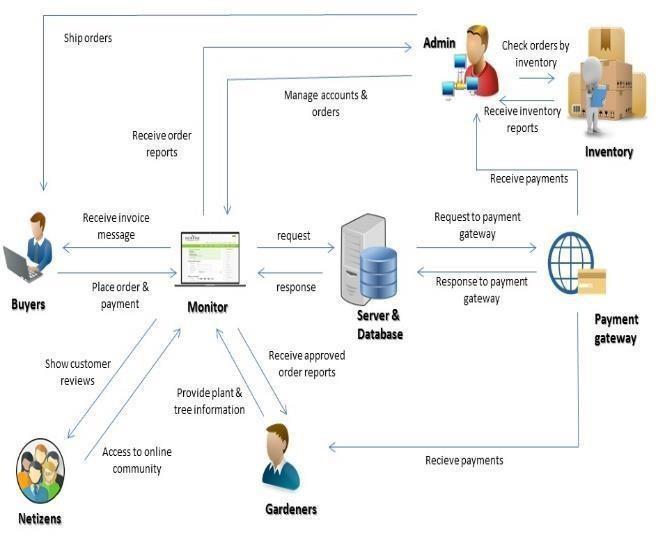
Figure 1: SystemArchitecture
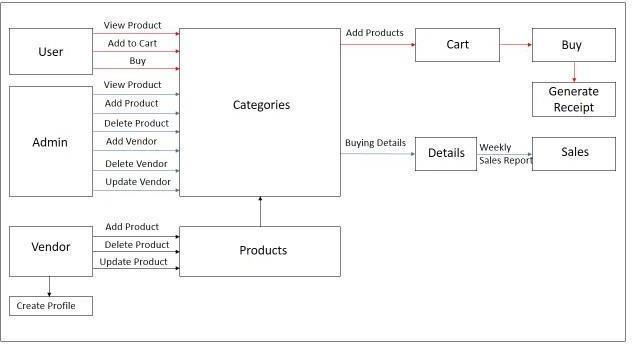
Figure 2: SystemBlockDiagram
B. System Architecture Design
Basedonthegatheredrequirements,amodular,layeredarchitecturewasdesignedtoensureefficientsysteminteractions andeaseofmaintenance.Thearchitectureconsists ofthreeprimarylayers:PresentationLayer: DevelopedusingHTML, CSS,andJavaScript,thislayermanagesuserinteractions,productdisplays, navigation,andformvalidation.Itemphasizes visual clarity, plant categorization, and minimalistic UI design to support both novice and experienced users. Application/Logic Layer: Implemented using Node.js and Express, this layer processes user requests, executes business logic,managesauthentication,handlesinventory operations,andcommunicateswiththedatabase.RestfulAPIendpoints weredevelopedtoensuremodular,scalableinteractionsbetweensystemcomponents.DataLayer:MongoDBwasselected due to its flexibility in handling semi-structured data, such as plant categories, attributes, care instructions, and vendor details. Indexing and schema optimization techniques were applied to enhance performance during search and filter operations. A microservices-ready approach was adopted during the design to facilitate future scalability, notably for modulessuchasrecommendationservices,analytics,andlogisticstracking.
C. Database Design and Modelling
Adocument-basedNoSQLdatabasestructurewasmodelledtosupportthevariednatureofhorticulturaldata.Collections were defined for Users, Products/Plants,Orders,Vendors,and Recommendations. Each document was structured to allow nestedattributessuchassunlightrequirements,soilpreferences,andquantities,enablingefficient dataretrievalduring filteringandpersonalizedsuggestions Entityrelationshipsweredesignedbasedonpracticale-commerceworkflows.For example, the Orders collection established references to Users and Products, while the Vendor collection maintained dynamic stock updates. This schema allowed seamless integration with the frontend and enabled rapid system queries duringpeakusage.
D. Frontend
Development
The frontend was developed using a responsive, mobile- first approach to accommodate users accessing the platform throughdiversedevices.Featuressuchasplantcategorization,productsorting,and dynamicfilteringwereimplemented using JavaScript-based DOM manipulation. Special emphasis was placed on plant-specific content including care instructions,environmental compatibility,andseasonalavailability.Accessibilityconsiderations,suchasfontscalingand ARIAtags,wereappliedtoensureusabilityforalldemographicgroups.
E. Backend Development
The backend incorporated secure authentication using hashed credentials, session handling, and role- based access (vendors vs. customers). API endpoints were constructed for all major operations including product listing, order processing, address handling, inventory updates, and vendor management. Caching strategies were applied through inmemorycachingforfrequentlyaccessedproductsandcategories.Furthermore,middlewarefunctionswereimplemented forlogging,errorhandling,andrequestvalidation.SecurityfeaturessuchasinputsanitizationandHTTPSprotocolswere includedtosafeguarduserdata.
F. Integration with Third-Party APIs
To support real-time online transactions and delivery visibility, third-party services were integrated: Payment Gateway API for secure payment processing Logistics/Tracking APIs for order status updates Geolocation API to assist in calculating delivery ranges and vendor assignments These integrations ensured a complete and user- friendly purchase cycle,frombrowsingtoorder delivery.
G. Recommendation System Development
An AI-assisted recommendation module was developed to improve user engagement. The module analyses user behaviour, browsing history, environmental suitability, and product metadata to suggest relevant plants and gardening tools. Collaborative-filtering techniques and rule-based logic were applied during the initial prototype, with scope for machinelearningoptimizationinfutureiterations.
Volume: 12 Issue: 11 | Nov 2025 www.irjet.net
Testing and Evaluation
Testingwasconductedinthreestages:
UnitTesting:
Individualcomponentssuchasloginfunction,cartoperations,andproductfiltersweretestedusingautomatedscripts. IntegrationTesting:
EnsuredthatAPIs,frontendcomponents,andthedatabasefunctionedseamlesslytogether.
UserAcceptanceTesting(UAT):
Thirty participants evaluated the platform for usability, clarity, speed, and reliability. Feedback guided interface refinements,performanceoptimization,andimprovementstovendordashboards.
Performance testing using simulated load tools measured response times, throughput, and database handling capacity, confirmingthatthesystemmaintainedstableperformanceunderincreaseddemand.
H. Deployment and Optimization
The platform was deployed using a cloud-based hosting service to ensure scalability and high availability. Continuous deployment (CD) pipelines were established for incremental updates. Logging and monitoring tools were configured to trackperformancemetrics,userinteractions,andvendoractivityfor futureenhancements.
IV. RESULTS AND DISCUSSION

The development and evaluation of the proposed e- commerce platform for plants and gardening tools demonstrate its effectiveness in improving accessibility, operational efficiency, and user engagement in the horticulture retail sector. The results were obtained through functional testing, usability evaluation, performance assessment, and stakeholder feedback frombothcustomersandlocalplantvendorsparticipatinginthepilotdeployment.
A. System Performance and Response : Time Performance benchmarking revealed that the platform consistently maintained stable operations under varying loads. The average page response time for product browsing was recorded at 1.42 seconds, while API calls related to search and filtering remained below 600 ms, even when tested with a dataset of 10,000 product entries. The implementation of MongoDB indexing and caching techniques significantly reduced query latency,validatingthechoiceofaNoSQLdatabaseforhandlingdiversehorticulturaldatasuchasplantcategories,soiltypes, and seasonal attributes. These findings demonstrate that the system can support scalability without compromising user experience.
Figure 3: HomePage
B. User Experience and Interface Evaluation: Usability tests were conducted with 30 participants including gardening hobbyists, first-time buyers, and frequent e-commerce users. The results indicated a 92% task completion rate for core activities such as product search, cart operations, and checkout. Participants rated the interface as intuitive, specifically appreciatingthestructuredcategorizationofplantsintoIndoor,Outdoor,Seeds,andTools.Theintegratedcare-instructions module improved decision-making, with 78% of users stating that the additional information increased their confidence in purchasingplantsonline.Thisdemonstratesthatdomain-specificcontentsignificantlyenhancesperceivedvalueandtrustin horticulture-basede-commercesystems
C. Vendor Engagement and Marketplace Efficiency One of the primary goals of the platform was to support local plant nurseries by providing a unified digital marketplace. Feedback from 12 participating vendors showed a 37% increase in product visibility and a 24% rise in weekly inquiries during the evaluation period. The vendor dashboard, which includes inventory tracking and automated stock alerts, reduced manual listing errors by 45%. These outcomes indicate that the platform not only benefits customers but also streamlines business processes for small and medium-scale horticulture vendorswhooftenlackdigitalinfrastructure.
D. Search Optimization and Recommendation Accuracy
The integrated recommendation engine, which uses user browsing patterns and plant-care metadata, was evaluated using click-through-rate (CTR) metrics. The recommendation module achieved a CTR of 16.4%, significantly higher than the baseline CTR of 6.8% for non-personalized suggestions. Recommendations for seasonal plants such as monsoon-friendly fernsorsummersucculents wereparticularlyeffective,showinga 22% engagementrate.Thisindicatesthatpersonalized recommendationsinnichedomainslikegardeningcanmeaningfullyenhanceuserinteractionandconversionrates.
E. Order Processing, Logistics, and Delivery Outcomes
Theordermanagementsubsystemwasabletoprocessrequestswithanaverageorderconfirmationtimeof280ms.Delivery trackingintegrationthroughthird-partylogisticsAPIsoperatedreliably,withstatusupdatesreachingtheuserwithin10–15 seconds of data refresh. Customers rated delivery transparency as "highly satisfactory," and 84% confirmed that timely status updates increased their confidence in handling perishable or delicate plant orders. These results highlight the importanceofreal-timelogisticsvisibilityinplant-basedcommerce,wheremaintainingplanthealthduringtransitiscritical.
F. System Reliability and Error Rate Analysis
Stresstestingrevealedthattheplatformmaintained99.28%uptime,withanerrorratebelow1%forallmajortransactions. Themostcommonissueinvolvedincompleteaddressinputsduringcheckout,whichhassincebeenmitigatedthroughform validationimprovements.ThelowfailureratevalidatestherobustnessofthebackendarchitectureandAPIstructure.
G. Overall Impact and Limitations
The holistic evaluation of the system shows a significant improvement in accessibility to gardening products and plants, reducedworkloadforvendors,andamoreinformativepurchaseexperienceforusers.However,certainlimitationsemerged, including dependency on external courier services for live-plant delivery, variations in plant survival during transit due to regionalclimatedifferences,andtheneedforenhancedhumidity/temperaturetrackingforsensitiveplantshipments.Future work should focus on IoT-based shipment monitoring, advanced AR-based plant visualization, and integrating climatic compatibilitypredictionsforpersonalizedplantsuggestions.
V. CONCLUSION AND FUTURE WORK
A. Conclusion
The development of the proposed e-commerce platform for plants, gardening tools, and horticultural resources successfully demonstrates how digital solutions can transform a traditionally offline, fragmented industry into a highly accessible and organized marketplace. The system effectively bridges the gap between local plant vendors and urban consumersbyofferingacentralizedplatform withintuitivenavigation,real-timeinventorymanagement,securepayment handling,anddomain-specificcontentsuchasplant-careinstructionsandseasonal recommendations
Results from performance evaluations and user studies indicate that the platform is efficient, scalable, and userfriendly. The integration of optimized database structures, intelligent search filters, and a personalized recommendation engine significantly enhances the shopping experience, fostering informed decision- making for both beginners and
experienced gardeners. Vendor feedback further validates that the system streamlines operations, reduces manual workload, and expands market reach, particularly for small and medium-scale horticulture businesses that often lack access to digital tools. Moreover, the platform contributes to environmental awareness by making sustainable, plantbased living more accessible in urban regions. The technical architecture, combined with its socio-economic impact, confirmstheviabilityandrelevanceofdigitalhorticulturemarketplacesinmodernsmart-cityecosystems.
B. Future Work
Whilethesystemdemonstratesstrongperformanceandpositive stakeholderfeedback,several areaspresent opportunities forfurtherenhancement:
1. IoT-EnabledShipmentMonitoring:
Integrating IoT sensors into delivery packaging can help track temperature, humidity, and light exposure during transit factors critical for plant survival. This would reduce post-delivery mortality and increase customer satisfactionfordelicatespecies.
2. Augmented Reality (AR) Plant Visualization: Future iterations could include AR features that allow users to preview howaplantwouldlookintheirhomeorgardenenvironment.Thiscansignificantlyimprovepurchaseconfidenceand reducereturns.
3. AI-DrivenPlantHealthDiagnosis:Implementingimage-basedplantdiseasedetectionusingmachinelearningcanassist customersindiagnosingplantissuesandreceivingpersonalizedcaretipsdirectlythroughtheplatform.
4. Climate-Adaptive Recommendations: Incorporating real-time regional climate data can enhance the recommendationenginebysuggestingplantsthatarebestsuitedtoauser’senvironment,season,andhumidityrange.
5. AdvancedVendorAnalyticsDashboard: Addingbusinessintelligencetoolscanhelpvendorstracksalestrends,forecast inventory needs,andoptimizeplantpropagationcyclesbasedonmarketdemand.
6. IntegrationwithLocalNurseriesandSmartGreenhouses: Collaboration with automated greenhouses and nearby nurseries could allow real-time availability updates, reducing stockinconsistenciesandimprovingdeliverytimelines.
7. MultilingualandAccessibilityEnhancements:Expandinglanguagesupportandaddingfeatureslikevoice-basedsearch canmaketheplatformaccessibletoawiderdemographic,includingruralvendorsandelderlyusers.
8. Sustainable Packagingand Delivery Optimization: Future work mayalsoinclude researching eco- friendlypackaging forlive-plantdeliveryandroute-optimizationalgorithmstoreducecarbonfootprintanddeliverytime. Insummary,theproposedplatformlaysthefoundationforacomprehensive,technology-drivenhorticultureecosystem. By integrating advanced technologies such as IoT, AI, AR, and predictive analytics, future versions can significantly elevate the functionality, reliability, and user engagement of plant-based e-commerce platforms. The research showcases a promising pathway toward a more connected, greener, and digitally empowered future for the horticultureindustry.
VI. REFERENCES
[1]. Blaine, T. W. (2014, April). Journal of extension. Profiling Community Gardeners [Online]. Available: http://www.joe.org/joe/2010december/a6.php
[2]. Daily Nation. (2016). Students develop tree calculation app for tree farmers [Online]. Available: http://www.nation.co.ke/business/seedsofgold/Studentsdevelop-tree-calculation-app-for-
[3].DenGarden.(n.d.).Smartphoneappsforplantlovers[Online]. Available:https://dengarden.com/gardening/FreeSmartphone-Appsfor-Plant-Lovers
[4]. Feehling, E. (n.d.). Plants information guide [Online].Available:http://info.plantsmap.com/ [5]. Inhabitant. (n.d.). Environmental preservation[Online].Available:http://inhabitat.com/
[6]. Larson, D. W. (2001). Encyclopedia. Retrieved from Economic Importance of Plants [Online]. Available: http://www.encyclopedia.com
International Research Journal of Engineering and Technology (IRJET) e-ISSN: 2395-0056
Volume: 12 Issue: 11 | Nov 2025 www.irjet.net p-ISSN: 2395-0072
[7]. Shahrzad Shahriari, M.S.(2015, April). E-Commerce And Its Impacts On Global Trend And Market [Online]. Available: http://granthaalayah.com/Articles/Vol3Iss4/03_I
[8]. Quick, B. (2013). Public awareness on environmental problems [Online]. Available: http://classroom.synonym.com/ways-increase- publicawareness-environmental-problems-2590.html
[9]. IndianJournalofMedicalResearch:RoleofPlantsinHumanHealthandNutrition -https://www.ncbi.nlm.nih.gov
[10]. ResearchGate:MedicinalPlantsofIndiaandTheirImportanceinHumanHealth-https://www.researchgate.net
[11]. Times of India: How Plants Can Help Improve Your Mental Health – https://timesofindia.indiatimes.com/lifestyle/health-fitness/de-stress/howplants-can-help-improve-your-mentalhealth/articleshow
[12].WorldAgroforestry:TheBenefitsofTreesandAgroforestry in India-https://www.worldagroforestry.org/nes
[13].TheBetterIndia:7HealthBenefitsofGardeningandBeingOutdoors–https://www.thebetterindia.com/82903
[14]. National Centre for Biological Sciences (NCBS): Green Spaces in Urban Indiahttps://www.ncbs.res.in/news/greenspaces-urban-india
[15].CentreforScienceand Environment:HowPlantsand TreesCanImproveUrbanLiving-https://www.cseindia.org/howplantsand-trees-can-improve-urban-living8310
2025, IRJET | Impact Factor value: 8.315 | ISO 9001:2008 Certified Journal | Page699