
International Research Journal of Engineering and Technology (IRJET) e-ISSN: 2395-0056

International Research Journal of Engineering and Technology (IRJET) e-ISSN: 2395-0056
Prof.R.R.Dhaygude¹, Ankita Bansod², Pruthiviraj Suryavanshi³, Disha More´, Nikita Gadekarµ ²,³,´,µ Students, Department of Computer Engineering, SVPM’s College of Engineering, Malegaon (Bk), Maharashtra, India.
¹ Assistant Professor, Department of Computer Engineering, SVPM’s College of Engineering, Malegaon (Bk), Baramati, Maharashtra, India.
Abstract-The E-Gram Panchayat System is a web-based digital governance platform developed using MERN Stack technology to improve village administration and citizen services. The system digitizes important Panchayat operations such as house management, resident records, water bill management, certificate generation, complaint handling, project monitoring, announcement publishing, and online payment processing. The proposed system provides separate admin and citizen portals with secure JWT authentication and real-time database management using MongoDB. The application improves transparency, efficiency, accessibility, and communication between village authorities and citizens. The system also integrates QR code verification for secure access to house and certificate information. The implementation demonstrates how modern web technologies can support smart village initiatives and digitalgovernance.
Keywords: E-Gram Panchayat, MERN Stack, MongoDB, React.js, Node.js, Express.js, Digital Governance, Smart Village, Online Certificate System, QR Verification
In recent years, digital transformation has become an essential part of modern governance systems. Government organizations are increasingly adopting information technology solutions to improve administrative efficiency,transparency,andaccessibility of public services. However, many rural village administrations still rely on traditional paper-based systems for maintaining records, managing citizen services, collecting taxes, generating certificates, and handling complaints. These manual processes are timeconsuming, inefficient, and prone to errors, data loss, andcorruption.
Village Panchayats play an important role in rural developmentandlocalgovernance.Theyareresponsible for maintaining resident records, managing village infrastructure projects, handling public complaints, collecting utility payments, issuing certificates, and communicatingimportantannouncementstocitizens.In traditional systems, all these activities are managed manually, making administration difficult and reducing servicequalityforcitizens.
The proposed E-Gram Panchayat System is a web-based digital governance platform developed using MERN StacktechnologytomodernizePanchayatadministration and improve citizen services. The system provides an integrated online platform where administrators can efficiently manage village operations while citizens can accessessentialservicesdigitallyfromanywhere.
Theprojectisimplementedusing:
1. MongoDB fordatabasemanagement
2. Express.js forbackendAPIdevelopment
3. React.js forfrontenduserinterface
4. Node.js forserver-sideexecution
Thesystemfollowsa completeMERN Stackarchitecture with REST API communication and JWT-based authenticationforsecureaccesscontrol.
The E-Gram Panchayat System includes multiple functionalmodulessuchas:
1. HouseManagement
2. ResidentManagement
3. WaterBillManagement
4. OnlinePaymentSystem
5. CertificateGeneration
6. ComplaintManagement
7. VillageProjectMonitoring
8. AnnouncementSystem
9. QRCodeVerification
The admin panel allows Panchayat officers to manage village data, approve certificate requests, monitor complaints, publish announcements, and maintain development project information. The citizen portal enables users to register, apply for certificates, pay bills online,track complaintstatus,andaccessvillage-related informationdigitally.
One of the important features of the system is QR code verification, which provides secure and quick access to house and certificate information. The system also supports centralized MongoDB data storage for efficient datamanagementandreal-timeupdates.
The main goal of the project is to reduce paperwork, minimize manual effort, improve transparency, and providefasterpublicservicesinruralareas.Bydigitizing
Volume: 13 Issue: 05 | May 2026 www.irjet.net p-ISSN: 2395-0072 © 2026, IRJET | Impact Factor value: 8.315 | ISO 9001:2008 Certified Journal | Page1946
International Research Journal of Engineering and Technology (IRJET) e-ISSN: 2395-0056
Volume: 13 Issue: 05 | May 2026 www.irjet.net p-ISSN: 2395-0072
Panchayat operations, the system helps bridge the gap betweenruralgovernanceandmoderntechnology.
The E-Gram Panchayat System contributes to the conceptofSmartVillagesandDigitalIndiabypromoting e-governance at the village level. The implementation demonstrates how modern full-stack web technologies can be effectively used to improve rural administration andcitizenengagement.
The system architecture consists of a React frontend connected to a Node.js and Express backend through Axios API communication, with MongoDB used as the centralizeddatabase.
Overall,theproposedsystemprovidesascalable,secure, and user-friendly digital governance solution that enhances administrative efficiency and improves the qualityofpublicservicesforvillagecitizens.
The traditional Panchayat administration system mainly depends on manual and paper-based processes for managing village records, citizen services, water bills, certificates, complaints, and development projects. This manual approach creates several challenges such as excessive paperwork, slow processing, difficulty in maintaining records, lack of transparency, data redundancy, and increased chances of human errors. Citizens are often required to visit Panchayat offices multiple times for services like certificate applications, bill payments, and complaint submissions, which consumes significant time and effort. Existing systems alsolackcentralizedmanagement,secureauthentication, online payment facilities, and real-time tracking of services. Due to the absence of integrated digital solutions, communication between citizens and Panchayat authorities becomes inefficient. Therefore, there is a need for a secure, centralized, and userfriendly digital governance platform that can automate Panchayat operations and provide efficient online services to citizens. The proposed E-Gram Panchayat SystemdevelopedusingMERN Stacktechnologyaimsto solvetheseproblemsbydigitizingvillageadministration through modules such as house management, resident management, complaint tracking, certificate generation, online payment processing, announcement publishing, and QR-based verification, thereby improving efficiency, transparency, accessibility, and overall governance quality.
Digital governance and smart village management systems have become an important area of research in recent years. Many researchers have focused on developing web-based and e-governance solutions to improveadministrativeefficiencyandcitizenservicesin rural areas. Existing studies mainly concentrate on
digital record management, online public service delivery, complaint management systems, and smart governanceplatforms.Severale-governanceapplications have been developed to reduce paperwork and improve transparency in government operations. Research on smart village systems highlights the importance of integrating information technology with rural administration to provide better communication, accessibility, and service delivery for citizens. Previous systems developed for Panchayat management mainly provide limited functionalities such as online certificate generation, resident data storage, or complaint registration. Some systems use basic database management but lack secure authentication, real-time data synchronization, centralized administration, and integrated online payment facilities. Many traditional applications are not scalable and fail to provide a userfriendlyinterfaceforbothadministratorsandcitizens.In addition, most existing systems do not include QR code verification, project tracking, or complete digital managementofvillageservices.
Recent advancements in full-stack web development technologies such as MongoDB, Express.js, React.js, and Node.js have enabled the development of scalable and efficient web applications. MERN Stack technology provides fast frontend rendering, secure backend processing, REST API communication, and flexible database management. Several modern governance systems now use these technologies to improve performance,responsiveness,anduserexperience.
TheproposedE-GramPanchayatSystemimprovesupon existing solutions by integrating multiple village administration services into a single centralized platform. The system provides secure JWT authentication, online payment processing, complaint tracking, certificate generation, announcement management, QR-based verification, and real-time data handling using MongoDB. By using MERN Stack architecture, the proposed system offers better scalability, efficiency, transparency, and accessibility compared to traditional Panchayat management systems.
ThemotivationbehinddevelopingtheE-GramPanchayat System is to improve the efficiency, transparency, and accessibility of village administration services through digital technology. In many rural areas, Panchayat operations are still managed manually using paperbased records, which leads to delays, data mismanagement, lack of transparency, and increased administrative workload. Citizens often face difficulties in accessing essential services such as certificate applications, complaint registration, bill payments, and project information due to time-consuming traditional procedures.Withtherapidgrowthofdigitalgovernance initiatives and smart village concepts, there is a strong
International Research Journal of Engineering and Technology (IRJET) e-ISSN: 2395-0056
Volume: 13 Issue: 05 | May 2026 www.irjet.net p-ISSN: 2395-0072
need for a modern web-based system that can simplify Panchayatoperationsandprovidebettercommunication between village authorities and citizens. The development of this system is motivated by the goal of reducing paperwork, minimizing human errors, improving record management, and providing online accesstoimportantvillageservices.
The availability of modern technologies such as MongoDB, Express.js, React.js, and Node.js makes it possible to build scalable, secure, and user-friendly web applications for rural governance. The proposed system aimstosupportdigitaltransformationatthevillagelevel by integrating multiple services such as resident management, online certificate generation, complaint tracking, water bill payment, project monitoring, announcements, and QR code verification into a single centralized platform. The project also contributes to the Digital India initiative by promoting smart governance and improving the quality of public services in rural communities.
The proposed E-Gram Panchayat System is designed using MERN Stack architecture to provide a secure, scalable, and efficient digital governance platform for village administration. The system integrates multiple village management services into a centralized webbased application that enables smooth interaction between citizens, Panchayat administrators, and the databasesystem.Thearchitecturefollowsaclient-server model where the frontend communicates with the backendusingRESTAPIs,andthebackendmanagesdata storageandbusinesslogicusingMongoDB.
The architecture is divided into four major layers: Presentation Layer, Communication Layer, Application Layer, and Database Layer. Each layer performs specific functions to ensure proper execution, security, and data managementwithinthesystem.
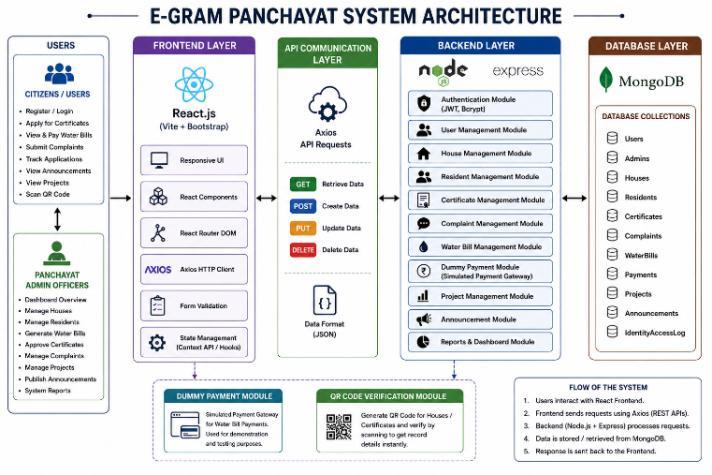
The Presentation Layer represents the frontend user interface of the system. It is developed using React.js with Vite and Bootstrap technologies. This layer is responsible for handling all user interactions and displaying information in a user-friendly manner. Both administrators and citizens access the system through webbrowsers.
Thefrontendprovidesseparateinterfacesfor:
1. AdminPanel
2. UserPortal
The admin panel enables Panchayat officers to manage villagerecords,approvecertificates,generatewaterbills, monitorprojects,andhandlecomplaints.Theuserportal allowscitizenstoregister,applyforcertificates,paybills, submitcomplaints,andviewannouncements.
React.js uses component-based architecture, which improves code reusability, scalability, and maintainability. Bootstrap is used to create responsive layouts that support multiple devices such as desktops, tablets,andsmartphones.
Features of Presentation Layer
1. Responsiveuserinterface
2. Dashboardvisualization
3. Formvalidation
4. Dynamicpagerendering
5. Userauthenticationpages
6. Real-timedatadisplay
7. Navigationandrouting
8. The frontend communicates with backend APIs throughAxiosHTTPrequests.
The Communication Layer acts as the bridge between thefrontendandbackendsystems.AxiosisusedforAPI communicationbetweenReact.js andtheNode.jsserver. ThecommunicationisbasedonRESTAPIarchitecture.
ThesystemusesstandardHTTPmethodssuchas:
1. GETforretrievingdata
2. POSTforinsertingdata
3. PUTforupdatingrecords
4. DELETEforremovingrecords
Whenever a user performs an action such as login, certificate application, complaint submission, or bill payment,thefrontendsendsAPIrequeststothebackend server. The backend processes the request and sends a responsebacktothefrontend.
International Research Journal of Engineering and Technology (IRJET) e-ISSN: 2395-0056
Volume: 13 Issue: 05 | May 2026 www.irjet.net p-ISSN: 2395-0072
Example API Flow
1. Userenterslogincredentials.
2. FrontendsendsPOSTrequestto/api/auth/login.
3. Backendvalidatesuserinformation.
4. JWTtokenisgenerated.
5. Authenticationresponseisreturnedtofrontend.
6. Userdashboardisdisplayed.
The communication layer ensures secure and efficientdatatransferthroughouttheapplication.
C. Application Layer
The Application Layer represents the backend of the system. It is developed using Node.js and Express.js technologies. This layer handles all server-side processing, business logic, authentication, and API management.
Express.js is used to create RESTful APIs and route management for different modules of the application. The backend performs CRUD operations on the MongoDBdatabaseandprocessesalluserrequests.
Major Backend Modules
1) Authentication Module
Thismodulemanages:
1. Userregistration
2. Loginverification
3. Passwordvalidation
4. JWTtokengeneration
5. Authorizationcontrol
JWT authentication is implemented to secure protected routesandpreventunauthorizedaccess.
2) House Management Module
Thismoduleallowsadministratorsto:
1. Addhouserecords
2. Edithouseinformation
3. Deletehousedetails
4. Managetaxandaddressdata
3) Resident Management Module
Thismodulestoresresidentdetailssuchas:
1. Residentname
2. Age
3. Gender
4. Aadhaarnumber
5. Mobilenumber
6. HouseID
4) Water Bill Management Module
Thismoduleperforms:
1. Waterbillgeneration
2. Usagecalculation
3. Paymenttracking
4. Billstatusmonitoring
5) Certificate Management Module
Citizenscanapplyfor:
1. IncomeCertificate
2. ResidenceCertificate
3. BirthCertificate
The admin verifies requests and approves or rejects applications.
6) Complaint Management Module
Citizenscanreportissuessuchas:
1. Waterproblems
2. Garbageissues
3. Streetlightfailures
Theadmincan:
1. Assignworkers
2. Updatecomplaintstatus
3. Monitorcomplaintresolution
7) Project Management Module
Thismodulemanagesvillagedevelopmentprojectssuch as:
1. Roadconstruction
2. Watertankinstallation
3. Schoolbuildingprojects
8) Announcement Module
Thismoduleenablesadministratorstopublish:
1. Governmentschemes
2. Watersupplynotices
3. Publicmeetinginformation
4. Emergencyalerts
Thebackendlayerprocessesalltheseservicesefficiently andsecurely.
International Research Journal of Engineering and Technology (IRJET) e-ISSN: 2395-0056
Volume: 13 Issue: 05 | May 2026 www.irjet.net p-ISSN: 2395-0072
D. Database Layer
The Database Layer is implemented using MongoDB, which is a NoSQL document-oriented database. MongoDB stores all application data in JSON-like documents, providing flexibility and scalability for large datasets.
Thesystemcontainsmultiplecollectionsincluding:
1. Users
2. Admins
3. Houses
4. Residents
5. WaterBills
6. Payments
7. Certificates
8. Complaints
9. Projects
10. Announcements
11. IdentityAccessLog
12. MongoDBprovidesseveraladvantagessuchas:
13. Fastdataretrieval
14. Flexibleschemadesign
15. Real-timeupdates
16. Scalability
17. EasyintegrationwithNode.js
The centralized database architecture ensures proper storageandmanagementofvillagerecords.
E. JWT Authentication Architecture
The system implements JWT-based authentication to secureusersessionsandprotectsensitivedata.
Authentication Process
1. Userenterslogincredentials
2. BackendverifiescredentialsusingMongoDB.
3. JWTtokenisgenerated.
4. Tokenisstoredonclientside.
5. Protected APIs validate token before granting access.
Benefits
1. Secureauthentication
2. Statelesssessionhandling
3. Role-basedauthorization
4. Preventionofunauthorizedaccess
JWTimprovesoverallsystemsecurityandperformance.
F. QR Code Verification Architecture
The proposed system integrates QR code verification functionalityforhousesandcertificates.
Working Process
1. AdmingeneratesQRcode.
2. QRcodeisattachedtohouseorcertificate.
3. UserscansQRcodeusingmobiledevice.
4. System retrieves and displays verified information.
Advantages
1. Fastverificationprocess
2. Improvedtransparency
3. Reducedfraud
4. Secureinformationaccess
This functionality modernizes document verification withinPanchayatadministration.
The implementation of the proposed E-Gram Panchayat System is carried out using MERN Stack technology, which includes MongoDB, Express.js, React.js, and Node.js. The system is designed as a web-based digital governance platform that automates Panchayat administrative operations and provides online citizen services. The implementation focuses on secure authentication, centralized database management, responsive user interfaces, REST API communication, andreal-timedataprocessing.
The project is divided into frontend implementation, backend implementation, database implementation, authentication implementation, payment system implementation, and QR code verification implementation.
The frontend of the system is developed using React.js with Vite and Bootstrap. React.js is used to create dynamic and reusable user interface components, while Bootstrap provides responsive design and styling support.Viteisusedasthefrontendbuildtoolforfaster developmentandoptimizedperformance.
The frontend provides separate interfaces for administrators and citizens. React Router is used for page navigation and Axios is used for communication withbackendAPIs.
Frontend Features
1. Responsivedashboardinterface
2. Userregistrationandloginforms
International Research Journal of Engineering and Technology (IRJET) e-ISSN: 2395-0056
Volume: 13 Issue: 05 | May 2026 www.irjet.net p-ISSN: 2395-0072
3. Dynamicdatarendering
4. Formvalidation
5. Certificateapplicationforms
6. Complaintsubmissionpages
7. Billpaymentinterface
8. Projectandannouncementdisplay
9. QRcodescanningpages
Frontend Modules
1. AdminDashboard
2. UserDashboard
3. HouseManagementInterface
4. ResidentManagementInterface
5. ComplaintManagementInterface
6. WaterBillInterface
7. CertificateApplicationInterface
8. AnnouncementInterface
9. ProjectMonitoringInterface
Frontend Technologies Used
1. React.js
2. Vite
3. Bootstrap
4. Axios
5. ReactRouterDOM
The frontend interacts with the backend through REST APIs and displays real-time information retrieved from MongoDB.
B. Backend Implementation
The backend is implemented using Node.js and Express.js. Node.js provides the runtime environment, while Express.js is used to develop RESTful APIs and manageserver-sideoperations.
Thebackendprocessesallbusinesslogic,authentication, data validation, API routing, and CRUD operations. Express middleware functions are used for request handling,tokenverification,anderrormanagement.
Backend Features
1. RESTAPIdevelopment
2. JWTauthentication
3. CRUDoperations
4. Routeprotection
5. Middlewarehandling
6. Errorhandling
7. Databaseconnectivity
8. QRcodegeneration
Main Backend Modules
1) Authentication Module
Thismodulehandles:
1. Userregistration
2. Loginverification
3. Passwordencryption
4. JWTtokengeneration
5. Authorizationcontrol
2) House Management Module
Thismoduleperforms:
1. Addhouserecords
2. Updatehouseinformation
3. Deletehouserecords
4. Fetchhousedetails
3) Resident Management Module
Thismodulestores:
1. Residentdetails
2. Aadhaarinformation
3. Contactdetails
4. Houseallocationrecords
4) Certificate Management Module
Thismodulemanages:
1. Certificateapplications
2. Applicationverification
3. Approvalandrejectionprocess
4. PDFcertificategeneration
5) Complaint Management Module
Thismodulehandles:
1. Complaintregistration
2. Complainttracking
3. Statusupdates
4. Workerassignment
6) Water Bill Module
Thismoduleperforms:
1. Billgeneration
2. Usagemanagement
International Research Journal of Engineering and Technology (IRJET) e-ISSN: 2395-0056
Volume: 13 Issue: 05 | May 2026 www.irjet.net p-ISSN: 2395-0072
3. Billcalculations
4. Paymenttracking
7) Announcement Module
Thismoduleallowsadministratorsto:
1. Publishannouncements
2. Updatenotices
3. Displaypublicinformation
8) Project Management Module
Thismodulemanages:
1. Villageprojectdetails
2. Budgettracking
3. Projectprogressmonitoring
Backend Technologies Used
1. Node.js
2. Express.js
3. JWT
4. bcrypt.js
5. Mongoose
6. QRCodepackage
C. Database Implementation
MongoDBisusedasthedatabasemanagementsystem.It isa NoSQL document-orienteddatabasethatstoresdata in JSON-like documents. Mongoose is used as the Object Data Modeling (ODM) library for MongoDB integration withNode.js.
Main Collections
1. Users
2. Admins
3. Houses
4. Residents
5. Certificates
6. Complaints
7. WaterBills
8. Payments
9. Projects
10. Announcements
11. IdentityAccessLog
Database Features
1. Centralizeddatastorage
2. Flexibleschemadesign
3. Real-timedataretrieval
4. Scalablearchitecture
5. Fastqueryprocessing
D. Authentication Implementation
JWT (JSON Web Token) authentication is implemented for secure access control. During login, the backend verifiesuser credentialsandgeneratesa JWT tokenthat isstoredontheclientside.
Authentication Workflow
1. Userenterslogincredentials.
2. Backendvalidatescredentials.
3. JWTtokenisgenerated.
4. Tokenisreturnedtofrontend.
5. Protectedroutesverifytokenbeforeaccess.
Security Features
1. Passwordhashingusingbcrypt.js
2. Securetokengeneration
3. ProtectedAPIroutes
4. Role-basedaccesscontrol
JWT improves system security and prevents unauthorizedaccess.
E. API Implementation
REST APIs are implemented using Express.js to enable communicationbetweenfrontendandbackendsystems.
Common API Methods
1. GET→Retrieverecords
2. POST→Insertrecords
3. PUT→Updaterecords
4. DELETE→Removerecords
Sample APIs
1. /api/auth/login
2. /api/houses
3. /api/residents
4. /api/complaints
5. /api/certificates
6. /api/projects
7. /api/bills
The APIs ensure smooth data exchange and real-time processing.
International Research Journal of Engineering and Technology (IRJET) e-ISSN: 2395-0056
Volume: 13 Issue: 05 | May 2026 www.irjet.net p-ISSN: 2395-0072
F. Payment System Implementation
The system includes an online payment module for water bill payments. Users can view pending bills and complete online payments through the payment interface.
Payment Workflow
G. QR Code Verification Implementation
QR code functionality is implemented for secure verification of houses and certificates. The QRCode libraryisusedtogenerateuniqueQRcodes.
QR Verification Process
1. AdmingeneratesQRcode.
2. QR code is attached to certificate or house record.
3. UserscansQRcode.
4. Systemretrievesverifieddetails.
Benefits
1. Fastverification
2. Securedataaccess
3. Reducedfraud
4. Improvedtransparency
H. Local System Deployment
TheprojectisdeployedlocallyusingNode.jsserversand Reactdevelopmentservers.
Backend Execution
cdBackend
npminstall
npmrundev
BackendServer:
http://localhost:5000
Frontend Execution
cdFrontend/vite-project
npminstallnpmrundev
FrontendServer:
http://localhost:5173
I. Testing and Validation
Systemtestingisperformedtoverify:
1. Loginfunctionality
2. APIcommunication
3. CRUDoperations
4. Paymentprocessing
5. Complainthandling
6. Certificategeneration
7. QRverification
Bothfrontendandbackendmodulesaretestedtoensure properfunctionalityanderrorhandling.
The development of the proposed E-Gram Panchayat System follows a structured MERN Stack-based methodology to ensure efficient implementation, secure data management, and reliable digital governance services. The methodology includes requirement analysis, system design, frontend development, backend development, database integration, authentication implementation, testing, and deployment. The system is developed using modern web technologies such as MongoDB, Express.js, React.js, and Node.js to provide a scalable and user-friendly solution for village administration.
Initially, the requirements of the Panchayat administration system were analyzed by identifying the major challenges in traditional manual governance systems.Importantservicessuchashousemanagement, resident record management, water bill generation, complaint handling, certificate generation, announcement publishing, and project monitoring were studied in detail. Based on these requirements, the functional and non-functional specifications of the systemweredefined.
After requirement analysis, the system architecture and database structure were designed. MongoDB collections were created for storing information related to users, houses, residents, complaints, certificates, payments, announcements, and village projects. The system architecture was planned using the MERN Stack clientserver model where the React frontend communicates with the Node.js and Express backend through REST APIs.
The frontend development phase was implemented using React.js with Vite and Bootstrap technologies. React components were created for various modules such as login pages, dashboards, complaint forms, certificate application forms, bill payment pages, and project monitoring interfaces. Bootstrap was used to create responsive and user-friendly interfaces for both administratorsandcitizens.AxioswasintegratedforAPI communicationbetweenfrontendandbackendservices.
Thebackenddevelopmentphasewasimplementedusing Node.jsandExpress.js.RESTfulAPIsweredevelopedfor handling CRUD operations, authentication, data validation, complaint management, certificate approval, and payment processing. Express middleware was used for request handling, route protection, and error management. The backend server manages all business logicandprocessesrequestsreceivedfromthefrontend.
International
Volume: 13 Issue: 05 | May 2026 www.irjet.net
MongoDB was integrated with the backend using Mongoose for schema modeling and database connectivity. The database stores all Panchayat-related records in a centralized manner and supports real-time dataretrievalandupdates.MongoDB’sflexibledocument structure provides scalability and efficient handling of villageadministrationdata.
JWT(JSONWebToken)authenticationwasimplemented to provide secure login access and role-based authorization.Passwordswereencryptedusingbcrypt.js before storing them in the database. During login, JWT tokens are generated and validated for accessing protected routes within the system. This improves overall security and prevents unauthorized access to sensitivedata.
The system also integrates QR code generation and verification functionality for houses and certificates. Unique QR codes are generated using QR libraries and linked to database records for secure and quick verificationofinformation.
Thepaymentmodule wasimplementedtoenableonline waterbillpayments.Thepaymentworkflowincludesbill generation,paymentprocessing,transactionverification, and database updates. Payment records are stored securely in the MongoDB database for future tracking andreporting.
After implementation, the system was tested using module testing, API testing, and integration testing methods.Eachmodulesuchaslogin,complainthandling, certificate processing, payment management, and QR verification was verified individually to ensure proper functionality.Errorhandlingandvalidationtestingwere also performed to improve system reliability and user experience.
Finally, the application was deployed locally using Node.js and React development servers. The backend server runs on localhost:5000, while the frontend application runs on localhost:5173. The complete workflow of the system enables efficient interaction between administrators, citizens, backend services, and thecentralizedMongoDBdatabase.
The proposed methodology ensures efficient development, secure operation, centralized data management, and scalable digital governance services formodernsmartvillageadministration
The proposed E-Gram Panchayat System was successfully implemented using MERN Stack technology and tested for various Panchayat administration activities. The system effectively digitizes village governance services such as house management, resident management, certificate generation, complaint handling, water bill payment, project monitoring, announcementpublishing,andQRcodeverification.The
implementation demonstrates improved efficiency, centralized data management, and secure online access forbothadministratorsandcitizens.
The frontend developed using React.js provides a responsive and user-friendly interface that allows smooth navigation between different modules. The backend developed using Node.js and Express.js successfully handles API requests, authentication, and database operations. MongoDB efficiently stores and retrievesallPanchayat-relateddatainrealtime.
The login and authentication module was tested successfully using JWT authentication. The system securely validates user credentials and restricts unauthorized access to protected routes. Password encryption using bcrypt.js improves overall application security.
The house and resident management modules successfully store and update village records through CRUD operations. Administrators can efficiently manage house details, resident information, tax records, and relateddatausingtheadmindashboard.
The certificate management module allows citizens to apply for various certificates such as residence certificates, income certificates, and birth certificates through the user portal. The system successfully stores certificate requests, enables admin verification, and generatesdownloadablecertificatesafterapproval.
The complaint management module enables users to submit complaints related to water supply, garbage collection, street lights, and other village issues. Administrators can monitor complaint status, assign workers, and update complaint progress. The module improves transparency and communication between citizensandPanchayatauthorities.
The water bill management system successfully generates bills, stores payment information, and supportsonlinepaymentfunctionality.Citizenscanview pending bills and complete payment processes digitally, reducingmanualcollectionefforts.
The QR code verification module was implemented successfully for houses and certificates. The generated QR codes provide secure and fast verification of information, reducing the possibility of fraud and improvingaccessibility.
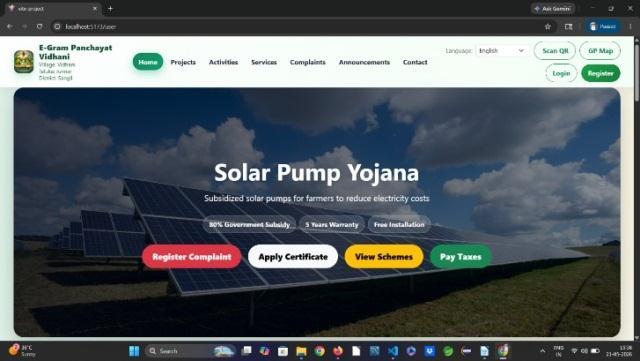
International Research Journal of Engineering and Technology (IRJET) e-ISSN: 2395-0056
Volume: 13 Issue: 05 | May 2026 www.irjet.net p-ISSN: 2395-0072
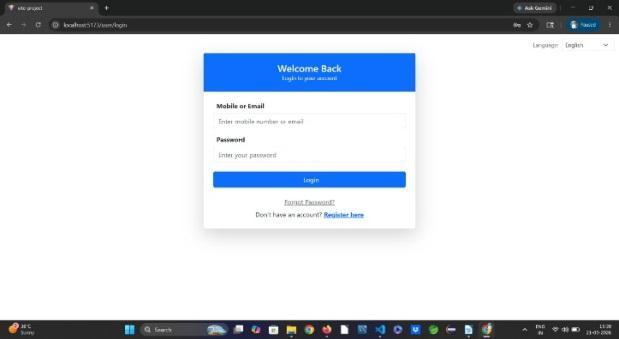
Result 4 :loginpage
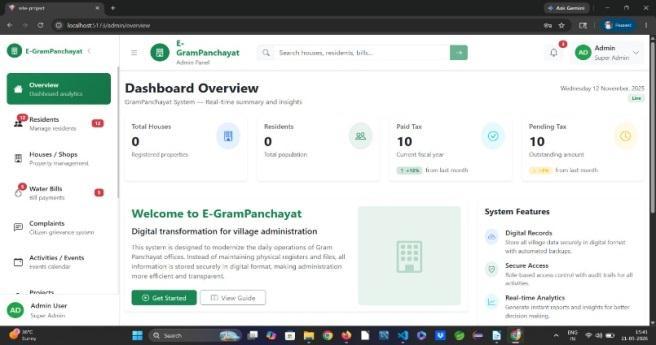
Result 5 :AdminPage
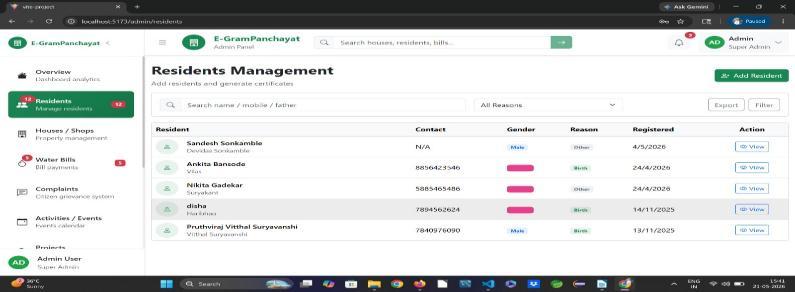
Result6 :AdminActivity
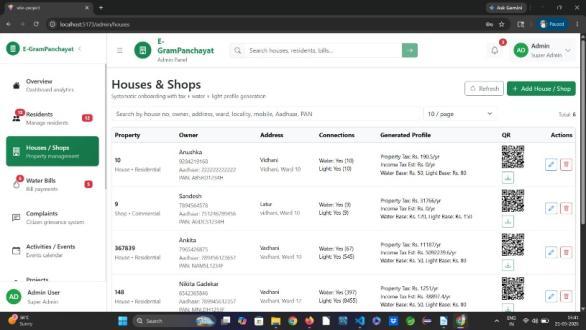
Result 7: AdminActivity
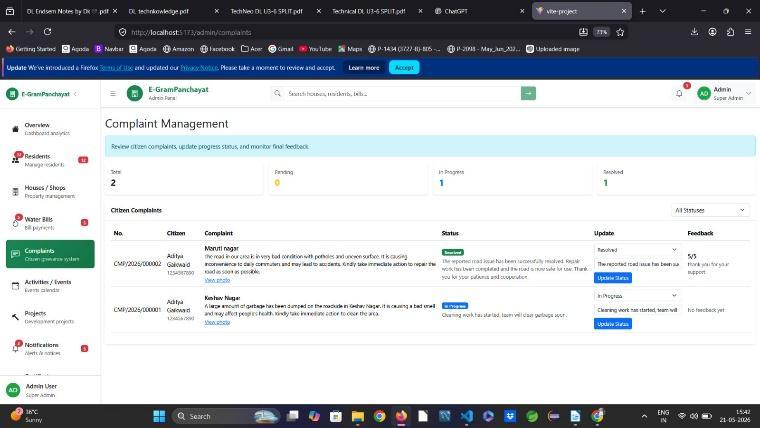
Result8:Adminactivity
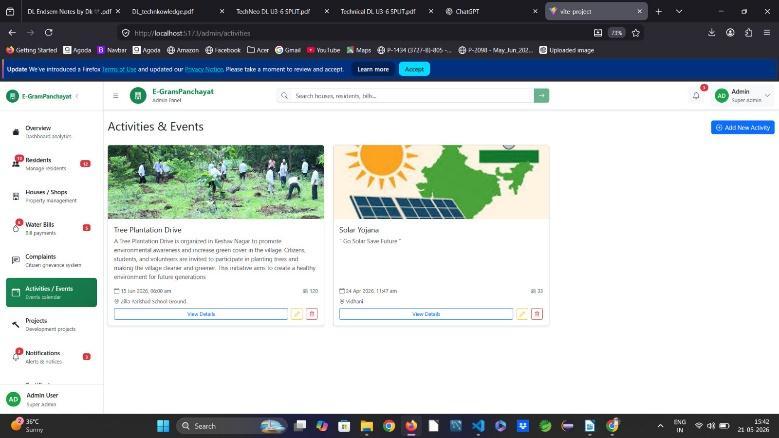
Result 9 :Useractivity
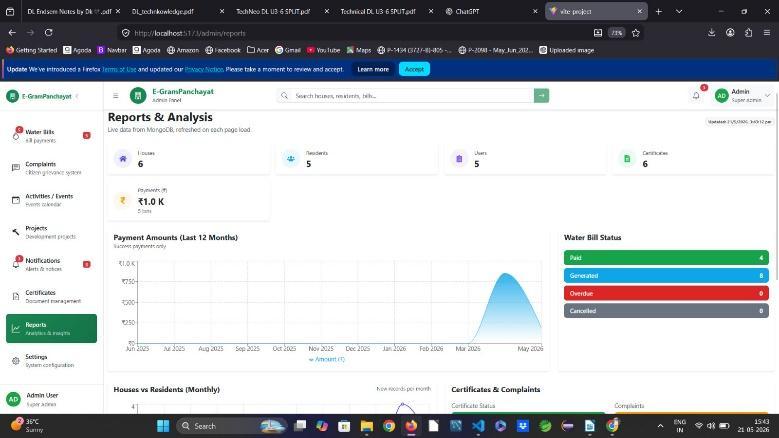
Result10 : Analyticsofwork
The system was tested for various functionalities such as:
1. UserRegistrationandLogin
2. CertificateApplicationProcessing
3. ComplaintTracking
4. TaxPayment
5. NotificationServices
6. DatabaseOperations
All modules performed successfully and produced accurateoutputsduringtesting.
The implementation results show that the proposed system provides a reliable, scalable, and efficient solution for smart rural governance and supports the objectivesofDigitalIndiaandSmartVillageinitiatives.
The E-Gram Panchayat System can be further enhanced by integrating advanced technologies and additional smart governance features to improve rural administrationandcitizenservices.
Futureimprovementsofthesysteminclude:
1. Development of a Mobile Application for Android and iOS platforms to provide easier access for ruralcitizens.
2. Integration of Aadhaar-based OTP authentication forsecureuserverificationandfraudprevention.
International Research Journal of Engineering and Technology (IRJET) e-ISSN: 2395-0056
Volume: 13 Issue: 05 | May 2026 www.irjet.net p-ISSN: 2395-0072
3. Implementation of AI-based chatbots to provide instantsupportandguidancetocitizensregarding
4. Addition of Voice Assistant support in regional languages such as Marathi for better accessibility amongruralusers.
5. Integration of Blockchain technology for secure andtamper-proofcertificateverification.
6. Implementation of AI-based complaint analysis and priority management for faster resolution of importantissues.
7. Integration of IoT-based smart village monitoring systems for water supply, street lights, and waste management.
8. Addition of real-time analytics and data visualization dashboards for better decisionmakingbyPanchayatauthorities.
9. Integrationwithgovernmentportalsforautomatic synchronization of welfare schemes and citizen records.
10. Enhancement of security features using advanced encryptionandcloud-basedbackupsystems.
Thesefuture enhancements cantransform theproposed system into a complete smart village governance platform supporting efficient, transparent, and technology-drivenruraladministration.
The E-Gram Panchayat System successfully provides a digital platform for managing rural administrative services efficiently and transparently. The system automates important Gram Panchayat operations such as certificate management, complaint handling, tax payment, government scheme information, and public announcements through a centralized web-based application.
The implementation of the system reduces manual paperwork,minimizesprocessingtime,improvesrecord management, and enhances communication between citizensandPanchayatauthorities.FeaturessuchasSMS notifications, email alerts, GIS village mapping, and online service access improve the overall user experienceandsupportsmartvillagedevelopment.
Theprojectdemonstrateshowmodernwebtechnologies anddatabasesystemscanbeeffectivelyusedtoimprove rural governance and public service delivery. The proposed system supports the Digital India initiative by promoting transparency, accessibility, and efficient administrationinruralareas.
Overall, the e-Grampanchayat Management System provides a reliable, scalable, and user-friendly solution fordigitalvillagegovernanceandcontributestowardthe development of smart and digitally empowered rural communities.
1. Raj Kamal, Internet and Web Technologies, McGrawHillEducation,2019.
2. Ian Sommerville, Software Engineering, 10th Edition,PearsonEducation,2017.
3. Pressman R. S., Software Engineering: A Practitioner’sApproach,McGrawHill,2014.
4. Elmasri R. and Navathe S. B., Fundamentals of DatabaseSystems,PearsonEducation,2016.
5. Government of India, Digital India Programme, Ministry of Electronics and Information Technology,2021.
6. Google Developers, Google Maps API Documentation, Available: https://developers.google.com/maps
7. Twilio Inc., Twilio SMS API Documentation, Available:https://www.twilio.com/docs
8. BootstrapTeam,BootstrapOfficialDocumentation, Available:https://getbootstrap.com
9. Mozilla Developer Network (MDN), Web Development Documentation, Available: https://developer.mozilla.org
10. Oracle Corporation, MySQL Documentation, Available:https://dev.mysql.com/doc
11. W3Schools,WebDevelopmentTutorials,Available: https://www.w3schools.com
12. S. Kumar and R. Singh, “Web-Based E-Governance System for Rural Administration,” International Journal of Computer Applications, vol. 176, no. 12, pp.25–30,2021.
13. A. Sharma et al., “Digital Panchayat Management System Using Web Technologies,” International Research Journal of Engineering and Technology (IRJET),vol.7,no.5,pp.1450–1455,2020.
14. M. Patil and S. Jadhav, “Smart Village Governance UsingInformationTechnology,”IEEEInternational ConferenceonSmartSystems,2022.
15. N. Deshmukh et al., “Online Complaint and Service Management System for Rural Areas,” Journal of Emerging Technologies and Innovative Research (JETIR),vol.8,no.6,pp.1120–1125,2021.