
International Research Journal of Engineering and Technology (IRJET) e-ISSN: 2395-0056
Volume: 13 Issue: 03 | Mar 2026 www.irjet.net p-ISSN: 2395-0072
International Research Journal of Engineering and Technology (IRJET) e-ISSN: 2395-0056
Volume: 13 Issue: 03 | Mar 2026 www.irjet.net p-ISSN: 2395-0072
Amit S. Gawande 1 , Pradnya M. Waghmare 2
1,2 Civil Engineering Department, College of Engineering and Technology, Akola, Maharashtra, India
Abstract - The rapid growth of urban areas has led to increasedconstructionofhigh-risebuildings.Thesestructures are highly sensitive to seismic forces due to their height and flexibility. Dynamic analysis is therefore essential to evaluate the structural response during earthquakes. In this study, a G+14 reinforced concrete building is analyzed using the response spectrum method. The structural model was developed usingSTAAD.Prosoftwareandanalyzedaccording to IS 1893 (Part 1): 2016 and IS 456:2000 provisions. Important parameters such as storey displacement, storey drift,baseshear, andnaturaltimeperiodwereevaluated. The results show that response spectrum analysis provides accurate prediction of seismic response and helps ensure safe design of high-rise RC structures.
Key Words: High Rise Building, Dynamic Analysis, Response Spectrum Method, Seismic Analysis, STAAD.Pro, Storey Drift.
High-rise reinforced concrete buildings are increasingly constructedinurbanregionsduetolimitedlandavailability. However, these structures are more vulnerable to lateral loadssuchasearthquakes.Seismicforcescausevibrationsin structures which may lead to excessive displacement or structuralfailure.
Dynamicanalysisisanimportanttoolusedtounderstand theresponseofstructuresduringearthquakes.Theresponse spectrummethodconsidersthedynamiccharacteristicsof thestructuresuchasnaturalfrequencyandmodeshapes. The objective of this research is to analyze the seismic performanceofaG+14reinforcedconcretebuildingusing responsespectrumanalysis
1.1
a) ToperformdynamicanalysisofaG+14RCbuilding.
b) Todeterminestoreydisplacementandstoreydrift.
c) To evaluate base shear generated during seismic loading.
d) To study structural behavior using response spectrumanalysis.
Anil K. Chopra (2012), statedthatdynamicanalysisplaysa crucial role in understanding the behavior of structures subjectedtoearthquakeexcitation.Hisworkonstructural dynamics explains that the response spectrum method provides an efficient approach for estimating maximum structural response without performing detailed time historyanalysis.Themethodconsidersnaturalfrequencies andmodeshapesofstructures,whichsignificantlyinfluence seismicbehavior.
S. K. Duggal (2013), emphasizedthatearthquake-resistant designmustconsiderlateralforces,structuralstiffness,and energy dissipation capacity of buildings. His research explainsthatreinforcedconcretemoment-resistingframes arecommonlyusedinseismicregionsduetotheirabilityto resistlateralloadseffectively.
C. S. Agarwal and B. K. Agarwal (2015), investigated earthquake-resistantdesignofbuildingsandhighlightedthe importance of considering dynamic characteristics of structuresduringanalysis.Theirresearchdemonstratedthat buildings with greater height tend to exhibit larger displacementsandrequirecarefuldesigntoensurestability andserviceability.
Clotaire Michel et al. (2007), conductedfull-scaledynamic testingofreinforcedconcretebuildingsunderweakseismic motionsandambientvibrations.Theirresearchshowedthat modal parameters obtained from field measurements can help validate analytical models and improve accuracy of seismicanalysis.
Hassan Moniri (2017), studiedtheseismicperformanceof reinforced concrete buildings subjected to near-field earthquakes and found that dynamic analysis methods providebetterpredictionofstructuralresponsecomparedto simplifiedstaticapproaches.Thestudyalsohighlightedthat high-risebuildingsaremoresensitivetoearthquake-induced vibrationsduetotheirflexibility.
V. D. Pawar and R. S. Patil (2019), comparedequivalent static analysis with response spectrum analysis for multistorey buildings. They performed response spectrum analysis of reinforced concrete structures and found that dynamicanalysismethodsprovidemoreaccurateestimation ofstoreydriftanddisplacement.
International Research Journal of Engineering and Technology (IRJET) e-ISSN: 2395-0056
Volume: 13 Issue: 03 | Mar 2026 www.irjet.net p-ISSN: 2395-0072
Kislay Kashyap and M. P. Verma (2019), studieddynamic analysis of high-rise buildings using response spectrum method and concluded that displacement increases with height while drift values remain within permissible limits whenstructuresareproperlydesignedaccordingtoseismic codes.
A. Surwase et al. (2018), performed seismic analysis of multi-storeybuildingsusingstructuralanalysissoftware.His study confirmed that dynamic analysis methods such as response spectrum analysis provide reliable results for evaluatingseismicbehaviorofstructures.
R. Ghosh and R. Debbarma (2017), evaluatedtheseismic performanceofsetbackbuildingswithopengroundstorey and observed that irregularities in building configuration significantly influence seismic response. Their study highlightedtheimportanceofproperstructuralmodelingin earthquakeanalysis.
From the literature review, it is evident that dynamicanalysisplaysacrucialroleinthedesignofhighrise reinforced concrete buildings located in earthquakeproneregions.Mostresearchersrecommendusingresponse spectrumanalysisforbuildingswithmorethantenstoreys to accurately evaluate structural response under seismic loading.
Therefore,thepresentstudyfocusesonperformingseismic analysisofaG+14reinforcedconcreteresidentialbuilding usingtheresponsespectrummethod.Thebuildingmodelis developed using STAAD.Pro and analyzed according to IndianseismicdesignprovisionsspecifiedinIS1893(Part 1):2016.
The objective of this research is to evaluate key seismic parameterssuchasstoreydisplacement,storeydrift,base shear, and natural time period in order to assess the structural performance of the building under earthquake loading.
The objective of this research is to evaluate the seismic performance of a G+14 reinforced concrete residential building subjected to earthquake forces. The structural model was developed and analyzed using STAAD.Pro structural analysis software. The analysis was carried out accordingtoIndianStandardcodesincludingIS1893(Part 1):2016forearthquakeresistantdesignandIS456:2000for reinforcedconcretedesign.
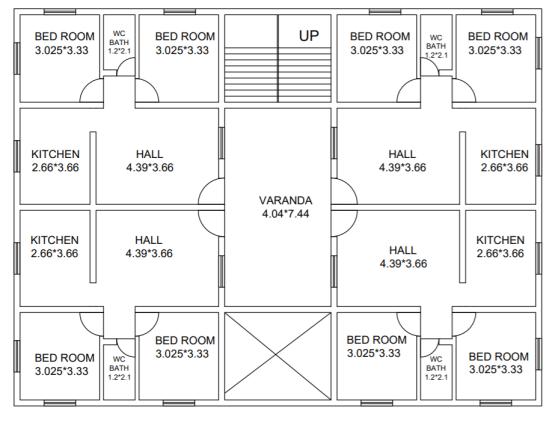
The building considered in this study is a multi-storey reinforced concrete residential structure consisting of groundfloorplusfourteenupperstoreys(G+14).Theplanof the building is symmetrical, which helps in reducing torsionalirregularitiesduringseismicloading.
Table 1. BuildingDescription
BuildingType
StoreyHeight 3m TotalHeight
ColumnSize
BeamSize
SlabThickness
ConcreteGrade M30
mm×600mm
mm×500mm
mm
SteelGrade Fe500
SeismicZone ZoneV
SoilType Medium
ThebuildingwasmodeledandanalyzedusingSTAAD.Pro.
Theloadsappliedtothebuildingweredeterminedaccording toIndianStandardcodes.Deadloadswerecalculatedbased ontheself-weightofstructuralelementsandfloorfinishes
International Research Journal of Engineering and Technology (IRJET)
Volume: 13 Issue: 03 | Mar 2026 www.irjet.net
accordingtoIS875(Part1):1987.Liveloadswereapplied accordingtoIS875(Part2):1987.
Typicalloadsconsideredintheanalysisinclude:
Table 2. LoadConsiderations Parameter
3.3 Seismic Parameters :-
Table 3. SeismicParameters
Theseparameterswereusedtogeneratetheresponse spectrumcurveusedindynamicanalysis.
3.4 Structural Modeling :-
The structural model of the building was created in STAAD.Prousingthefollowingsteps:
a) Creation of three-dimensional geometry of the building.
b) Assignmentofbeamandcolumnproperties.
c) Definitionofmaterial properties for concreteand steel.
d) Applicationofdeadloadandliveload.
e) Definitionofseismicloadcases.
f) Generationofloadcombinations.
g) Executionofstructuralanalysis.
3.5 Analysis Methods:-
Twoseismicanalysismethodswereusedinthisstudy.
Equivalent Static Analysis - In this method, earthquakeforcesarecalculatedbasedonthetotal seismicweightofthebuildinganddistributedalong theheightaccordingtocodeprovisions.
ResponseSpectrumAnalysis- Responsespectrum analysis is a dynamic analysis technique that considersmultiplevibrationmodesofthestructure. Themaximumresponseofeachmodeiscombined todeterminetheoverallstructuralresponse.
The results obtained from the analysis include storey displacement, storey drift, base shear, and natural time periodofthestructure.
4.1 Story Displacement:-
Storeydisplacementreferstothelateralmovementofeach floor due to earthquake forces. The results show that displacementincreaseswithbuildingheight.
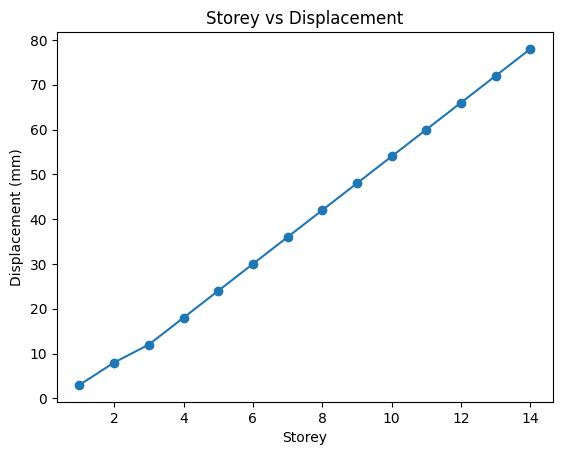
Chart 1. StoreyvsDisplacement
Table 4. StoreyvsDisplacement
Volume: 13 Issue: 03 | Mar 2026 www.irjet.net p-ISSN: 2395-0072
Themaximumdisplacementoccursatthetopstorey,which isexpectedbecausethecumulativeflexibilityincreaseswith height.
4.2 Storey Drift :-
Storey drift represents the relative displacement between twoconsecutivestoreys.
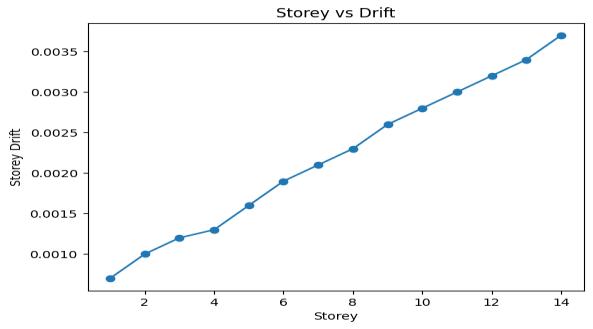
Chart 2 StoreyvsDrift
Table 5. StoreyvsDrift Storey Drift
0.0032
0.0028
0.0023
2 0.0007
ThepermissibledriftlimitaccordingtoIS1893(Part1): 2016is:0.004×storeyheight
The obtained drift values are within allowable limits, indicatingsatisfactoryseismicperformance.
4.3 Base Shear :-
Base shear represents the total lateral force acting at the baseofthestructureduringanearthquake.
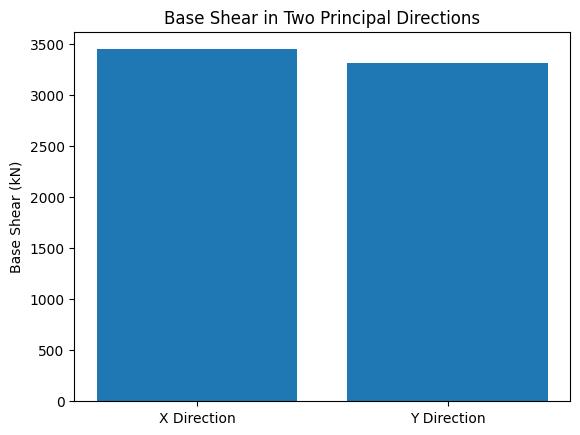
Chart 3. BaseShear
Table 6. BaseShear
Direction Base Shear (kN) XDirection 3450 YDirection 3320
The base shear values obtained from response spectrum analysisaredistributedalongthebuildingheightaccording tomassparticipation.
4.4 Natural Time Period:-
The fundamental natural time period of the building was obtainedfrommodalanalysis.
FundamentalTimePeriod=1.45seconds
Thisvalueindicatesthatthebuildingbehavesasaflexible structure,whichistypicalforhigh-risereinforcedconcrete buildings.
The present study investigated the seismic behavior of a G+14reinforcedconcreteresidentialbuildingusingdynamic analysismethods.
Thefollowingconclusionscanbedrawnfromthestudy:
1. Storey displacement increases gradually with building height, with maximum displacement occurringatthetopstorey.
2. Storey drift values obtained from analysis are within the permissible limits specified in IS 1893 (Part1):2016.
3. The base shear values indicate the magnitude of seismic forces acting on the structure in different directions.
4. The response spectrum method provides a more realistic estimationofseismicforcescomparedto equivalentstaticanalysis.
5. The structural model developed in STAAD.Pro effectively simulates the dynamic behavior of the building.
Therefore,dynamicanalysistechniquesshouldbeadopted forthedesignofhigh-risebuildingslocatedinearthquakeproneregions.
[1]. Anil K.Chopra (2012).DynamicsofStructures:Theory and Applications to Earthquake Engineering. Prentice Hall.
[2]. S. K. Duggal (2013). Earthquake Resistant Design of Structures.OxfordUniversityPress.
[3]. C. S. Agarwal and B. K. Agarwal (2015). Earthquake ResistantDesignofStructures.PHILearning.
International Research Journal of Engineering and Technology (IRJET) e-ISSN: 2395-0056
Volume: 13 Issue: 03 | Mar 2026 www.irjet.net p-ISSN: 2395-0072
[4]. ClotaireMicheletal.(2007).Full-scaledynamicresponse of an RC building under weak seismic motions using ambient vibration analysis. Journal of Earthquake Engineering.
[5]. HassanMoniri(2017).Evaluationofseismicperformance of reinforced concrete buildings under near-field earthquakes. International Journal of Advanced StructuralEngineering.
[6]. V. D. Pawar and R. S. Patil (2019). Response spectrum analysis and comparison of seismic parameters of RC structures. Journal of Structural Engineering and Management.
[7]. Kislay Kashyap and M. P. Verma (2019). Dynamic analysisofhigh-risebuildingsusingresponsespectrum method. International Journal of Scientific Research in CivilEngineering.
[8]. Surwaseetal.(2018).Seismicanalysisofmulti-storeyed buildingconsideringdifferentdesigncodes.International JournalofInnovativeResearchinScienceEngineering& Technology.
[9]. R. Ghosh and R. Debbarma (2017). Performance evaluationofsetbackbuildingswithopengroundstorey. ProcediaEngineering.