
International Research Journal of Engineering and Technology (IRJET) e-ISSN: 2395-0056
Volume: 13 Issue: 03 | Mar 2026 www.irjet.net p-ISSN: 2395-0072
International Research Journal of Engineering and Technology (IRJET) e-ISSN: 2395-0056
Volume: 13 Issue: 03 | Mar 2026 www.irjet.net p-ISSN: 2395-0072
Arjun Tilak C R1 , Dr Chethan K2
1P.G. Student, department of Civil Engg. , Major: Earthquake Engineering, University of Visvesvaraya College of engineering, Karnataka, India, 2Associate professor, department of Civil Engg. , University of Visvesvaraya College of engineering, Karnataka, India
Abstract- This study evaluates the seismic performance of a 15-storey (G+15) reinforced concrete building using finite element analysis (FEA) in accordance with IS 1893:2016 provisions. The structure was analysed through Modal analysis and Response Spectrum analysis to assess parameters such as natural period, storey displacement, and drift. Results show that the hybrid slab system incorporating core walls and drop panels exhibits superior seismic performance, achieving lower displacement and greater stiffness compared to the conventional flat slab system. The inclusion of core walls and drop panels provides an effective balance between flexibility, stability, and economy, making the hybrid slab configuration suitable for mid-rise buildings in seismic-prone regions.
Keywords: Seismic performance, flat slab, hybrid slab, dynamic analysis, storey drift, base shear, core wall, drop panel
1. INTRODUCTION
Thisprojectinvolvesthedesignandanalysisofa15-storey (G+15)reinforcedconcretebuildingwithdifferentstructural systems, including RC beam–slab, flat slab, and hybrid configurations.Themodelsincorporatecorewallsanddrop panelsandarecomparedintermsofstructuralperformance, cost-effectiveness, and constructability to assess the influence of various slab systems on overall building behavior
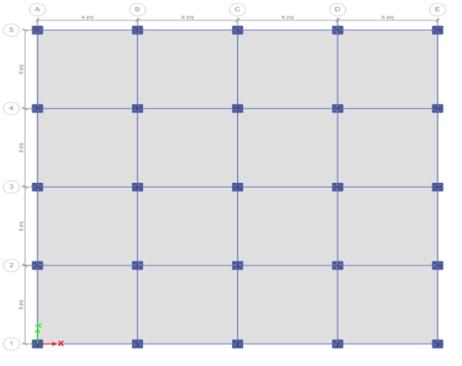
Three structural systems were considered to evaluate the seismic performance of a 15-storey (G+15) reinforced concrete building designed as per IS 1893:2016. Type 1 representstheconventionalRCbeam–slabsystem,offering highstiffnessandmomentresistancebutwithgreaterweight andlongerconstructiontime.Type2isahybridsystemwith RCbeam–slabconstructioninthelowerfloorsandflatslabs above,aimingtoreduceself-weightandimproveefficiency. Type3adoptsflatslabsinthelowerfloorsandRCbeam–slab construction above to study the effect of flexible lower storeysonseismicresponse.Allmodelshavea32m×32m baseplanwith4×4baysandareanalyzedunderidentical loadingandseismicconditions.
Thestudyevaluatestheseismicperformanceofflatslaband hybrid slab systems under dynamic loading using finite elementanalysis(FEA).ConventionalRCbeam–slabandflat slabsystems,withandwithoutdroppanelsandcorewalls, arecomparedtoassesstheireffectiveness.Theinfluenceof structuralconfigurationandbuildingheightonkeyseismic parameters such as time period, displacement, and storey drift is examined. The effect of drop panels on enhancing stiffnessandreducingseismicvulnerabilityisalsoanalyzed to identify the most efficient slab system with improved seismicresistanceandoverallstability
Sixreinforcedconcretebuildingmodelsweredevelopedfor the15-storey(G+15)structure,incorporatingconventional RCbeam–slab,flatslab,andhybridslabsystemswithand without core walls and drop panels to assess seismic performance.:
Table -1: 6 STRUCTURAL SYSTEMS NOMENCLATURE
Structural System Nomenclat-ure
Firsthalfportionofbuilding floorwithRCbeamslaband abovehalffloorswithFlatslabs 8B8F
Firsthalfportionofbuilding floorwithRCbeamslaband abovehalffloorswithFlatslabs withCore,Drop 8B8FWCD
International Research Journal of Engineering and Technology (IRJET) e-ISSN: 2395-0056
Volume: 13 Issue: 03 | Mar 2026 www.irjet.net p-ISSN: 2395-0072
5 Firsthalfportionofbuilding floorwithFlatslabandabove floorwithRCBeamslab 8F8B
6 Firsthalfportionofbuilding floorwithFlatslabandabove floorwithRCBeamslabwith Core,Drop 8F8BWCD
Building Dimensions:
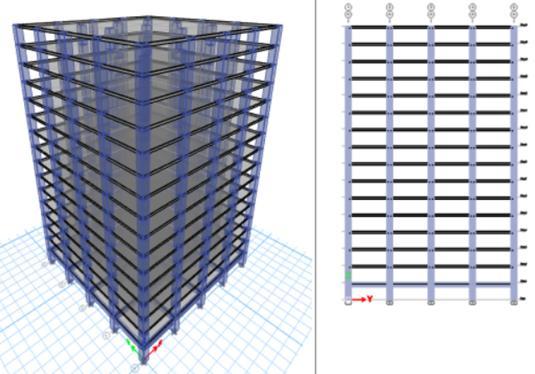
•TotalHeight:45m(15storeys)
•StoreyHeight:3m
•PlanDimension:32m×32m(square)
•BayWidth:8m
Material Properties and Sections
ConcreteandSteelProperties:
•GradeofConcrete:M30
•CompressiveStrengthofConcrete:30N/mm²
•ModulusofElasticity(Concrete):27,32N/mm²
•GradeofSteel(Reinforcement):Fe550
•RebarStrength:550N/mm²
SectionDimensions(Commonforallsystems):
•Beam:600mm×600mm(RectangularRCCsection)
•Column:1000mm×1000mm(RectangularRCCsection)
•Slab:220mmthickness,FlatSlab:400mmthickness
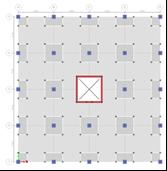
•Core(Centralshearwall):300mmthickness,thickness ofdrop100mmand4mx4m(square)
SpecialElements:
•Diagrid(DG):CHS1000×40mm
•Outrigger(OT):600mmthicknesswall
•BeltTrussSystem(BTS):RHS600×1000×30mm
Loading Conditions
GravityLoads(asperIS875-1987PartI&II):
•SuperImposedDeadLoad:1.5kN/m²
•LiveLoad:4.0kN/m²
•MassSource:100%deadload+25%liveload
SeismicLoadParameters(asperIS1893-2016):
•SeismicZone:ZoneV
•ZoneFactor(Z):0.36
•SoilType:mediumSoil
•ImportanceFactor(I):1.2
•ResponseReductionFactor(R):5
•DampingRatio:5%
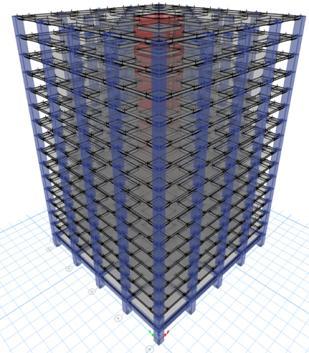
International Research Journal of Engineering and Technology (IRJET) e-ISSN: 2395-0056
Volume: 13 Issue: 03 | Mar 2026 www.irjet.net p-ISSN: 2395-0072
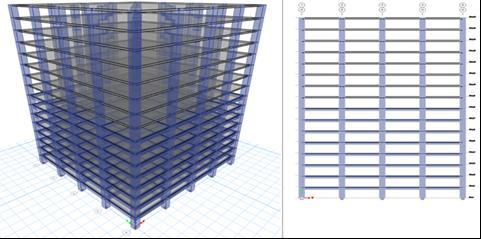
3DViewandElevationG+15[8B8F]
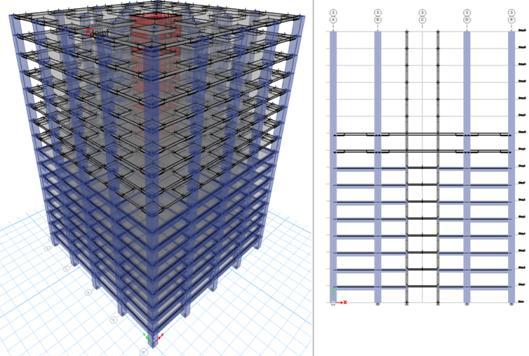
3DViewandElevationG+15[8B8FWDC]
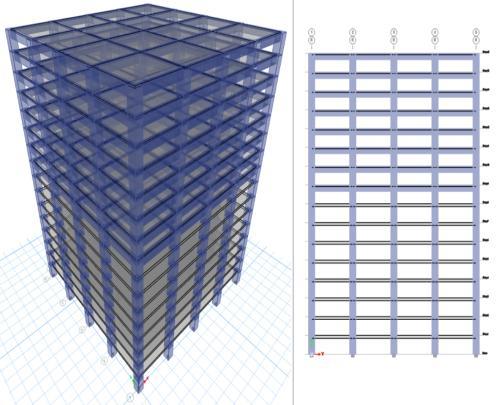
3DViewandElevationG+15[8F8B]
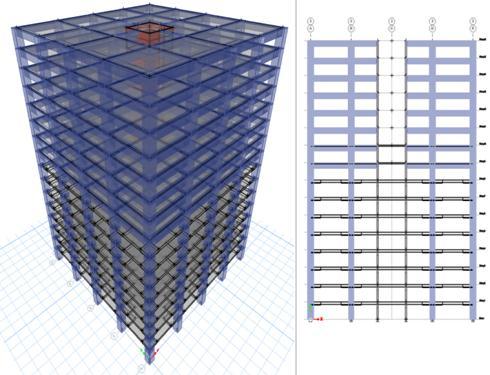
3DViewandElevationG+15[8F8BWDC]
3. RESULTS AND DISCUSSION
3.1 Modal Analysis
Table-2: MODE 1 TIME PERIOD OF ALL STRUCTURES
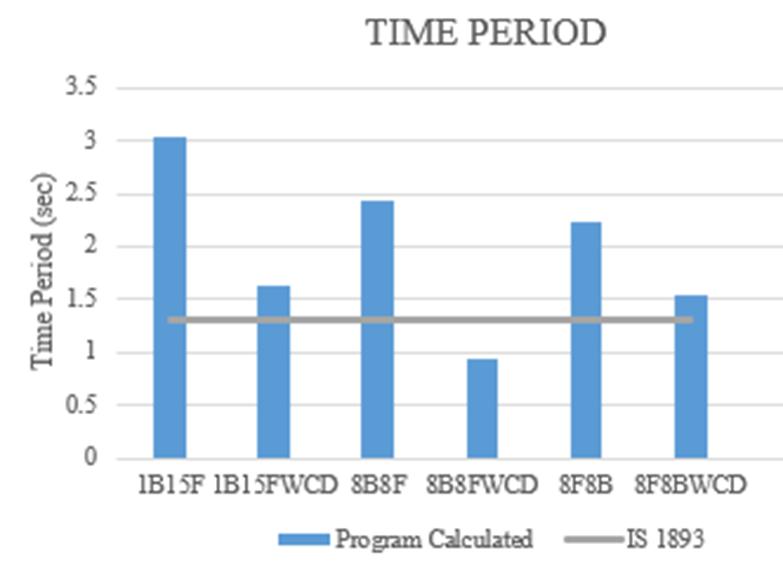
Chart -1:Modaltimeperiodofallstructure
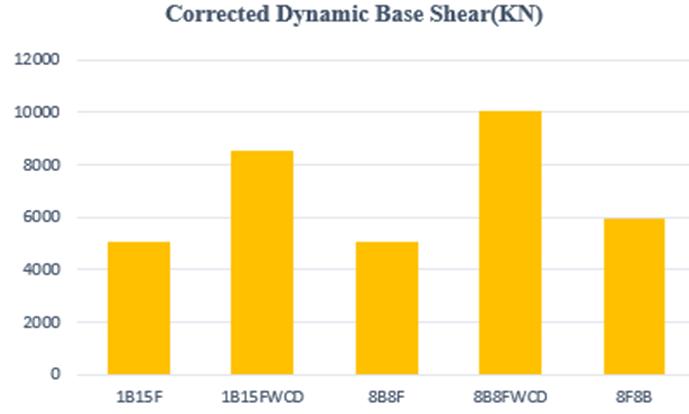
3.2 Base Shear from Time History Analysis
Table-3: Corrected Dynamic Base shear for all models (106) IN kN
International Research Journal of Engineering and Technology (IRJET) e-ISSN: 2395-0056
Volume: 13 Issue: 03 | Mar 2026 www.irjet.net p-ISSN: 2395-0072
3.4 Inter Storey Drift Ratio
Table-5: MAX INTER STOREY DRIFT RATIO (10-3)
3.3 Storey Displacement
Table-4: MAX STOREY DISPLACEMENT IN (mm)
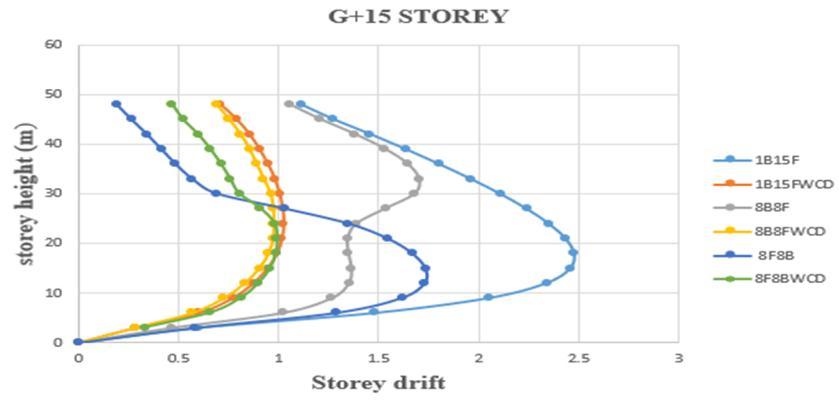
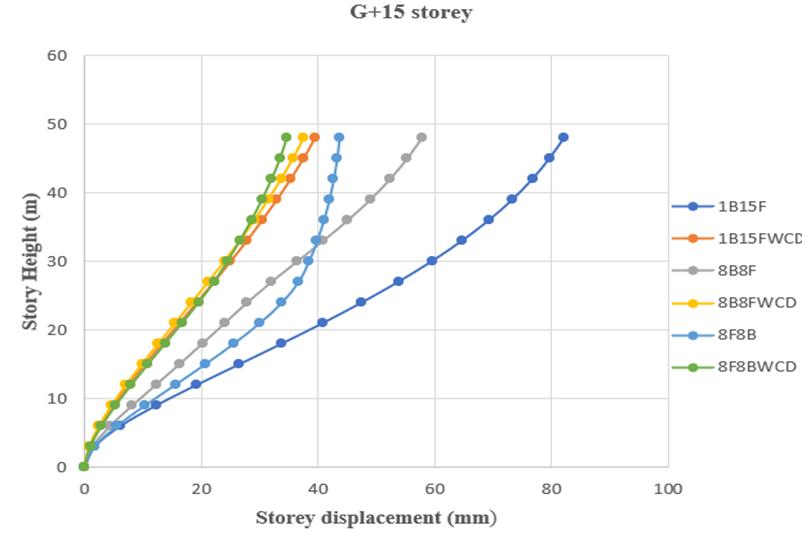
Chart -3: MaxDisplacementofAllStructure
4. CONCLUSIONS
Modal Analysis
Modelswithcorewallsanddroppanelsshowbetterseismic performance, with 1B15FWCD, 8B8FWCD, and 8F8BWCD increasing base shear by 68.4%, 98.5%, and 54.9%, respectively. Among base systems, 8F8B performs best, offeringbalancedstiffnessandimprovedseismicresistance.
Base Shear Response
The introduction of core walls and drop panels greatly enhances the lateral load resistance of all models. The 1B15FWCD,8B8FWCD,and8F8BWCDsystemsexhibitbase shear improvements of 68.4%, 98.5%, and 54.9%, respectively, compared to their non-core counterparts. Among the original configurations, the 8F8B model demonstrates the highest base shear, indicating superior performanceinresistingseismicforces
International Research Journal of Engineering and Technology (IRJET) e-ISSN: 2395-0056
Volume: 13 Issue: 03 | Mar 2026 www.irjet.net p-ISSN: 2395-0072
Incorporatingcorewallsanddroppanelsleadstoamarked reduction in lateral displacement. The 1B15FWCD, 8B8FWCD, and 8F8BWCD models show displacement reductions of 51.9%, 35.1%, and 20.5%, respectively, compared to their non-core versions. Among the basic configurations, the 8F8B model exhibits the least displacement,indicatinggreaterstiffnessandbetterseismic control.
The integration of core walls and drop panels effectively minimizesinter-storeydrift,enhancingoverallrigidity.The 1B15FWCD, 8B8FWCD, and 8F8BWCD models show drift reductions of 54.2%, 30.8%, and 40%, respectively, compared to their non-core systems. Among the base configurations,8B8Frecordsthelowestdrift,demonstrating bettercontroloflateraldeformation.
Models with core walls and drop panels perform much betterinearthquakesbyincreasingstrengthandreducing movement. The 1B15FWCD, 8B8FWCD, and 8F8BWCD modelsshowhigherbaseshearby68.4%,98.5%,and54.9%, alongwithreduceddisplacementanddriftcomparedtotheir normal versions. Among the three main configurations (1B15F,8B8F,and8F8B),the8F8Bsystemperformsbest,as itshowshigherbaseshear,lowerdisplacement,andbetter overallstability.Overall,the8B8FWCDmodelgivesthebest seismic performance, proving that core walls and drop panels greatly improve stiffness and safety during earthquakes.
[1] AdityaP.Gaikwad,R.M.Desai(2021).SeismicAnalysis of Flat Slab Structure with Shear Wall at Different Locations.InternationalJournalofAdvanceEngineering andResearchDevelopment(IJAERD),Volume8,Issue1, January2021.
[2] AdityaP.Gaikwad,R.M.Desai(2021).SeismicAnalysis of Flat Slab Structure with Shear Wall at Different Locations.InternationalJournalforScientificResearch& Development(IJSRD),Vol.09,Issue03,pp.232–238.
[3] Anghan Jaimis, Mitan Kathrotiya et al (2016). ComparativeStudy ofFlatSlab andConventional Slab UsingSoftwareAid.GRDJournals(GlobalResearchand DevelopmentJournalforEngineering),RecentAdvances inCivilEngineeringforGlobalSustainability.
[4] AshwiniGhorpade,Dr.B.ShivakumaraSwamy(2018). StudyonthePerformanceofFlatSlabStructureUsing Pushover Analysis With and Without Shear Wall.
International Research Journal of Engineering and Technology(IRJET),Volume05,Issue07,July2018.
[5] AthiraM.V.,SruthiK.Chandran(2017).SeismicAnalysis of Flat Slab Building with Shear Wall. International Journal of Engineering and Technology (IJERT), ISSN: 2278-0181,ETCEA-2017ConferenceProceedings.
[6] Chandan Kumar Chandravanshi, Ramanuj Jaldhari (2022). Comparative Seismic Study of Flat Slab and ConventionalSlabBuildingsUsingETABS.International JournalofInnovativeResearchinScience,Engineering and Technology (IJIRSET), Volume 11, Issue 4, April 2022.
[7] Chandan Kumar Chandravanshi, Ramanuj Jaldhari (2022). Comparative Study on Seismic Behaviour of G+10 and G+20 Buildings with Flat and Conventional Slabs. International Journal for Research in Applied Science & Engineering Technology (IJRASET), Vol. 10, Issue5,pp.455–463.
[8] D.S. Vijayan, S. Arvindan, Naveen Kumar, S. Mohamed Javed(2019).Seismic PerformanceofFlatSlabinTall Buildings with and without Shear Wall. International Journal of Engineering and Advanced Technology (IJEAT),Volume09,Issue1,October2019.
[9] K. Veera Babu, S. Siva Rama Krishna (2023). Seismic BehaviourofMulti-StoreyBuildingsonSlopingandFlat Terrains Using ETABS. International Journal of EngineeringandTechnology(IJET),Vol.11,Issue2,pp. 120–129.
[10] Khadid, A. Boumrkik (2008). Pushover Analysis of ReinforcedConcreteFrameStructure.AsianJournalof CivilEngineering(BuildingandHousing),Vol.9,No.9, pp.75–83.
[11] Khwaja Moinuddin Khan, M. Jeelani (2018). Seismic Analysis of Flat Slab Building with and without Shear Wall Using ETABS. International Journal of Civil EngineeringandTechnology(IJCIET),Volume9,Issue 10,October2018.
[12] MaheshB.,PandurangaRao(2021).SeismicAnalysisof Multi-storeyRCBuildingswithPlanIrregularitiesUsing Response Spectrum Method. International Journal of EngineeringResearch&Technology(IJERT),Volume10, Issue6,June2021.
[13] Mahesh B., Panduranga Rao (2021). Evaluation of Seismic Performance of RC Buildings with Different StructuralConfigurations.InternationalJournalofCivil and Structural Engineering Research (IJCSER), Vol. 8, Issue2,pp.90–99.
[14] Manish Agrawal, Dinesh Sen (2020). Comparative Study of Flat Slab and Conventional RC Framed
International Research Journal of Engineering and Technology (IRJET) e-ISSN: 2395-0056
Volume: 13 Issue: 03 | Mar 2026 www.irjet.net p-ISSN: 2395-0072
Structure under Seismic Load. International Research JournalofEngineeringandTechnology(IRJET),Volume 7,Issue9,September2020.
© 2026, IRJET | Impact Factor value: 8.315 | ISO 9001:2008 Certified Journal | Page268