
International Research Journal of Engineering and Technology (IRJET) e-ISSN: 2395-0056
Volume: 13 Issue: 01 | Jan 2026 www.irjet.net p-ISSN: 2395-0072
International Research Journal of Engineering and Technology (IRJET) e-ISSN: 2395-0056
Volume: 13 Issue: 01 | Jan 2026 www.irjet.net p-ISSN: 2395-0072
Rohan C. Jagtap 1 , Vaibhav R. Shirodkar2 ,
1 PG student, Department of civil engineering, Dattakala Shikshan Sanstha’s Dattakala group of Institutions Faculty of Engineering, Swami-Chincholi, Dound,413130.
2 Professor, Department of civil engineering Dattakala Shikshan Sanstha’s Dattakala group of Institutions Faculty of Engineering, Swami-Chincholi, Dound,413130.
Abstract - This study presents a refined nonlinear timehistory analysis of three-cell reinforced concrete (RC) box girder bridges modelled in CSI Bridge. Rectangular, circular and trapezoidal cross-sectional configurations are compared under IRC Class AA and Class 70R wheeled loading for a uniform span. Moving vehicular loads, prestress effects and axial forces were simulated to obtain vertical, transverse and longitudinal displacements at critical locations. Results indicate that the trapezoidal sectionprovides the best control of vertical deflection, while the circular section records the largest vertical andlongitudinal deformations. Thesefindings support practical recommendationsforcross-sectionselection to optimize serviceability in medium-span multicellular box girder bridges.
Key Words: Multicellular box girder, nonlinear timehistory, IRC loading, dynamic response, selected span.
Assessingthedynamicinteractionbetweenvehicularloads and bridge structures remains an important theme in contemporary bridge engineering. The dynamic impact imparted by vehicles depends on several parameters associated with both the superstructure and the vehicle itself,suchasnaturalfrequency,stiffness,vehiclespeedand otherinfluencingfactorsthatareoftendifficulttoaccount foraccurately(A.R.Khalim,2014).
Box-girderbridgeshavebecomeincreasinglypopulardueto their excellent serviceability performance, structural stability and overall efficiency (Monu Kumar, 2021; P. Agarwaletal.,2022).Theiranalysisanddesign,however,are relatively complex because of their inherently threedimensionalbehavior,whichinvolvestorsion,distortionand combined longitudinal–transverse bending (Monu Kumar, 2021).
Abridgeisessentiallyastructuralsystemintendedtocarry vehicular or moving loads across physical obstacles. Boxgirderbridgesarenowextensivelyadoptedformediumand longspansowingtotheirstructuraladvantages(P.Agarwal et al., 2022). Based on construction method, functional purpose and cross-sectional shape, box girders may be
classifiedassingle-cell,double-cellormulticellularsystems. They may be constructed monolithically with the deck (closedsection)orcastseparately(opensection),and are commonlyavailableinrectangular,trapezoidalorcircular shapes.
For curved alignments, box girders are particularly beneficial because of their superior torsional rigidity. For bridgeswithmildcurvature,theinfluenceofcurvatureon bending, shear and torsional stresses may be considered negligiblewithinpermissiblelimits.Undersuchconditions, curved bridges maybeanalyzedusingsimplifiedstraightbridgeassumptions(P.Agarwaletal.,2022).
The present study performs a dynamic analysis of a multicellularRCbox-girderbridgeusingCSIBridgesoftware. Three geometric configurations, rectangular, circular and trapezoidal,areevaluatedunderloadingconditionsspecified by the Indian Roads Congress (IRC). The investigation focusesonstructuralresponsesincludingsupportreactions, shearforcesanddisplacementbehaviorusingthenonlinear time-history method under IRC Class AA and Class 70R wheeledvehicleloading.
Thenonlineartime-historymethodevaluatesthedynamic response of a structure by applying loads as a function of timeinaccordancewithestablishedprinciplesofstructural dynamics. This approach calculates the time-dependent behavior of the structure as it undergoes ground-motiontypeexcitationorvaryingvehicularloads.Unlikesimplified staticmethodsthatassumeinstantaneousandconstantload Application,thetime-historymethodcapturestherealistic variation of forces over time, thereby providing a more accuraterepresentationofthestructuralresponse.
TheprimarycodeforloadsisIRC:6(StandardSpecifications and Code of Practice for Road Bridges). For dynamic analysis,thefollowingloadingclassesareconsidered:
IRCClassA: Standardliveloadformostpermanent bridges;usedtocheckfornormaltrafficconditions.
International Research Journal of Engineering and Technology (IRJET) e-ISSN: 2395-0056
Volume: 13 Issue: 01 | Jan 2026 www.irjet.net p-ISSN: 2395-0072
IRC Class 70R: Represents heavy specialized vehicles(wheeledortracked).Itisthemostcritical forcheckingthestrengthofthebridge.
IRC Class AA: Another heavy loading class, often usedinindustrialormunicipalareas.
Impact Factor (Dynamic Allowance): IRC:6 specifies that live loads must be increased by an impactfactor to account for the dynamiceffectof movingvehicles.
ForRCbridges(ClassA/B),theimpactfactorfractionisoften calculatedas:
I=4.5/(6+L)
(whereListhespanlengthinmeters). ForClass70RandAA,thefactoristypicallyfixedat 25% for spansupto9mandvariesforlongerspans.
Wheeled,Class70R
Gradeofsteel Fe500
Gradeofconcrete 35mpa
A. Geometrical details of multicellure R.C box girder
Table-1:GeometricaldetailsofmulticellureR.Cboxgirder. Thisworkinvolverthedynamicanalysisofamulti-cellbox girder bridge model with different geometries using non linear time history method in CSI Bridge software. The analysis aims to identify the optimum geometry by calculating the behavior of rectangular, circular, and trapezoidal multicell models under class AA wheeled and Class70RIRCloading.
Thisdissertationworkisaboutthedynamicanalysisofthe multi cellure box girder bridge model with different geometry using non- linear method using CSI bridge software.ModelingandDynamicanalysisadoptingnonlinear time history method by using CSI bridge software for the variousmulticelluremodelslikerectangular,circularand trapezoidalgeometry arecalculatedforoptimumgeometry considering Class AA wheeled and Class 70R IRC loading according to IRC: 6. Analysis Results obtained from this models was enhanced according to their behaviour for bending moment, shear force and displacement are extractedconsideringdifferentmovingloadcasealongwith stressvariationsalongdifferentsection.Total6modelsof multicellureboxgirderbridgeweredevelopedconsidering Class AA wheeled and Class 70R wheeled IRC loading for rectangularboxgirder(fig.1,a),circularboxgirder(fig.1, b),andtrapezoidalboxgirder(fig.1,c).
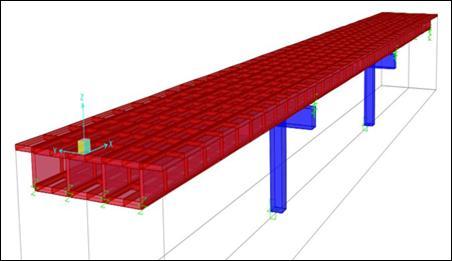
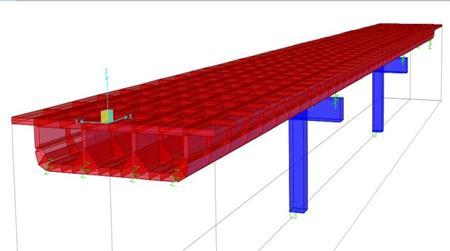
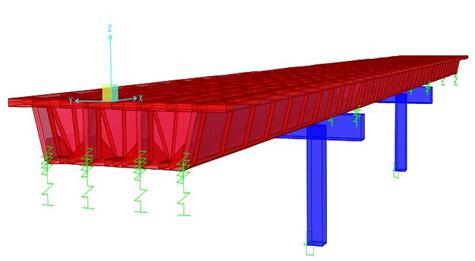
Fig. 1.Typesofmulticelluremodelsa)Rectangularbox girder,b)Circularboxgirder,c)Trapezoidalboxgirder.
International Research Journal of Engineering and Technology (IRJET) e-ISSN: 2395-0056
Volume: 13 Issue: 01 | Jan 2026 www.irjet.net p-ISSN: 2395-0072
The preliminary results regarding the displacement are within the acceptable limits for the evaluated models of multi-cellboxgirderbridges.Thisstudyseekstoperforma dynamicanalysisoftheboxgirderbridgethroughanonlinear timehistorymethodincorporatingmovingloadscenariosfor IRCclassAAwheeledvehiclesandIRCclass70R wheeled vehicles. The variations in displacement values among the differentmodelsgeneratedunderIRC classAAloadingare depictedvisuallyintheaccompanyinggraphs1
Table 2: Displacementobtainedfromanalysisofmulti cellureboxGirderBridgefordifferentIRCloading
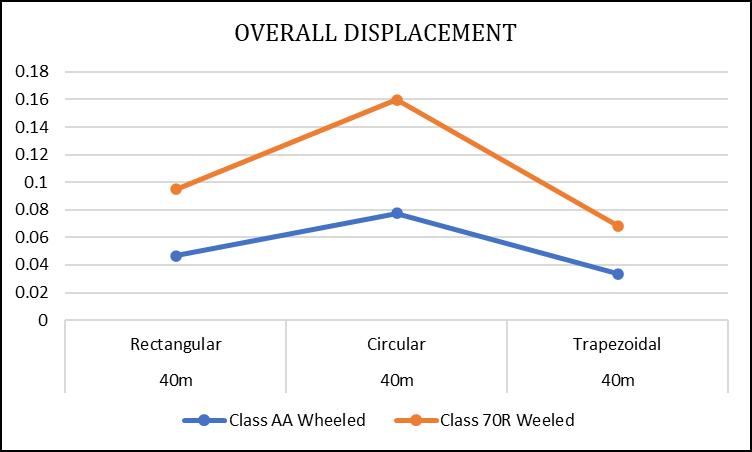
Graph 1:OerallDisplacement
Analysis of Geometrical Performance
Trapezoidal Cell Performance: Thetrapezoidalcrosssection demonstrates the lowest overall displacement. Forinstance,itsverticaldisplacementisestimatedtobe 32.25%lessthantherectangularsectionunderClassAA wheeled loading. This superior behaviour is due to its efficient geometry in resisting torsional and shears forces,resultinginhigherstiffness.
CircularCellPerformance: Thecircularsectionexhibits thehighestdisplacement,showinganestimated53.06% moreverticaldisplacementthantherectangularsection for the Class AA wheeled load. This indicates a comparativedisadvantageinmaintainingrigidityunder thedynamicloadingofthisspan.
Location of Maximum Deflection: The maximum vertical deflection is consistently observed near the midpointofthecentrallaneacrossallgeometries,which aligns with expected structural behaviour for simply supportedbridges.
Effect of IRC Loading
As anticipated, the heavier IRC Class 70R wheeled loading induces greater displacement values across all cell geometriescomparedtotheIRCClassAAwheeled loading. This difference in displacement highlights the criticalneedtodesignforthespecific,mostseveretraffic loadsanticipated.
Thefollowingconclusionshavebeendrawnbasedonthe resultsobtainedfromtheanalysisofthreecellsBox GirderBridgefordifferentIRCloading:-
Optimal Geometry (Least Displacement): The trapezoidal cell exhibits the greatest reduction in displacementcomparedtotherectangularcell,indicating itresultsinthelowestdisplacementoverall.
HighestDisplacement: Thecircularcellexperiencesthe greatestdisplacementcomparedtotherectangularcell.
Compliance: All displacements under various loading and service conditions remain within acceptable IRC limits.
Loading Effect: IRCClassAAwheeledloadinggenerally results in lower displacement values compared to IRC Class70Rwheeledloading.
I wish to express my sincere gratitude to my supervisor, Prof. Vaibhav R. Shirodkar, for his expert guidance and technical mentorship throughout this research. I am also thankfultotheauthoritiesofDattakalaGroupofInstitutions, Faculty of Engineering, and the Department of Civil Engineering for providing the necessary facilities and academicresourcestocompletethisstudy.
[1] DipikaA.Khirade,Prof.S.SZambani,(2024)“optimizing box girder design across the variable spans through software analysis”, International Journal of Creative Research Thoughts (IJCRT), 12(1),pp.2320-2882.
[2] BrinissatMarame,RajmundKuti,RichardPRay,(2024) “Truck Load Positions Effect on Dynamic Behavior of FracturedSteelBoxGirderBridge” Researchgate,pp.6774,Doi:10.3233/ATDE240528, https://www.researchgate.net/publication/385036270
[3] P. Agarwal, P. Pal, and P. K. Mehta, (2023) “Finite element analysis of reinforced concrete curved boxgirder bridges,” Adv. Bridg. Eng., 4(1), pp.12-18, Doi: 10.1186/s43251-023-00080-7.
[4] P.AgarwalandD.K.Singh,(2023)“Parametricstudyon prestressed skewed box-girder bridge,” Adv. Bridge. Eng.,4(1),p.12,Doi:10.1186/s43251-023-00090-5.
International Research Journal of Engineering and Technology (IRJET) e-ISSN: 2395-0056
Volume: 13 Issue: 01 | Jan 2026 www.irjet.net p-ISSN: 2395-0072
[5] P.Agarwal,P.Pal,andP.K.Mehta,(2022)“Box-Girder Bridges-ModelingandAnalysis,” International Journal. Eng. Model, 35(1), pp.19–42, Doi: 10.31534/engmod.2022.1.ri.02.
[6] S. Ereiz, I. Duvnjak, and J. Fernando Jiménez-Alonso, (2022) “Review of finite element model updating methodsforstructuralapplications,”Structures,41(2), pp.684–72,Doi:10.1016/j.istruc.2022.05.041.
[7] Raisa Tabassum Ira, (2022) “Analysis and Design of Prestressed Concrete Box Girder Bridge,” Technical report- Research gate,Doi:10.5281/zenodo.10804832, https://www.researchgate.net/publication/378866710
[8] PreetiAgarwal,PriyaranjanPal,PradeepKumarMehta, (2022) “A study on factors influencing dynamic response of thin-walled box-girder Railway Bridge subjectedtohigh-speedtrainloadthroughregression modeling”, Engineering Modeling, 10(1) pp.19-42,Doi: 10.31534/engmod.2022.1.ri.02m
[9] Monu Kumar, Gaurav Tanwar, (2021) “Comparative Analysis between Curved Shaped and Straight Multi Cellular Box Girder with Variations in Radius of Curvature–AReview”, International Journal of Science, Technology and Management (IJSTM), 8(2),pp.15-22.
[10] Nishi Gupta, Pradeep Kumar Mehta, Rakesh Kumar,(2021)“EffectofDepthonBoxGirderBridges”, International Research Journal of Engineering and Technology (IRJET), 8(6),pp.4635-4641.