
International Research Journal of Engineering and Technology (IRJET) e-ISSN: 2395-0056
Volume: 12 Issue: 06 | Jun 2025 www.irjet.net p-ISSN: 2395-0072
International Research Journal of Engineering and Technology (IRJET) e-ISSN: 2395-0056
Volume: 12 Issue: 06 | Jun 2025 www.irjet.net p-ISSN: 2395-0072
Zhen-Yi Chen1 , Guan-Chen Yu1 , Guan-Hao Chen1 , Jui-Pin Hung 1*
1Dept.ofMechanicalEngineering,NationalChin-YiUniversityofTechnology, Taichung411030,Taiwan(R.O.C.)
Abstract - This study investigates the influence of bearing specifications on the dynamic characteristics of a milling spindlethrough bothexperimental measurementsandfinite element modeling. Bearing configurations were defined by the number and diameter of rolling elements, contact geometry of the raceways, and preload conditions. Frequency response functions (FRFs) were experimentally obtained via impact tests on spindle units with varying bearing setups. Modal parameters such as natural frequency, damping ratio, and compliance were extracted from the FRFs andanalyzed in relationto bearing design. A finite element model incorporating Hertzian contact theory was developed to simulate spindle dynamics and predict bearing stiffness. The results show that changes in bearing rigidity, particularly when switching from larger to smaller bearings, significantly affect the spindle’s dynamic response. The simulated FRFs exhibit good agreement with experimental data, with discrepancies limited to approximately 5%. These findings demonstrate the importance of bearing selection in tuning spindle performance and validate the proposed modeling approach as a tool for the design and integration of machine tool structures.
Key Words: Dynamiccompliance,Dynamiccharacteristics, Frequencyresponsefunctions,Highspeedspindle
1. INTRODUCTION
The spindle system is one of the most critical components in machine tools, as its performance directly influences both the machining capability and precision. According to the research conducted by Choi and Lee [1], morethan50%ofthestructuraldeformationatthecutting point during machining originates from the spindle–bearing system. As such, enhancing the rigidity of the spindlesystemisconsideredoneofthemosteffectiveways to improve the overall stiffness of machine tools. Several studies[2-6]havedemonstratedthatthedynamicbehavior of a spindle–tool system is largely governed by the characteristics of the supporting bearings. Among various options, angular contact ball bearings are the most commonlyusedinspindlesystemsduetotheirlowfriction andtheircapacitytosupportbothaxialandradialloads.
The key factors influencing spindle rigidity include bearing size and specification, arrangement, span, and
preload [7-11]. For instance, Kim et al. [7] reported that a higherbearingpreloadcanenhancespindleaccuracy,butit may also lead to a significant temperature rise. Therefore, preload levels must be carefully adjusted according to the specific cutting conditions. In a related study, Li and Shin confirmed that increases in bearing temperature can alter the preload, thereby affecting the vibration characteristics ofthespindlesystem[12]
In bearing dynamics, parameters such as ball diameter,numberofballs,andoverall bearingdimensions (including inner and outer ring diameters) play a critical role in determining bearing performance particularly in terms of stiffness, vibration characteristics, and loadcarryingcapacity[13].Thesefactorsaffecthowthebearing interactswithappliedloads,influencingstressdistribution, noiseandvibrationgeneration,andoverallservicelife.Bai et al.[14] demonstrated that variations in ball diameter significantly affect the sound radiation characteristics of full ceramic bearings, with the impact becoming more pronounced at higher rotational speeds. In a separate study,Deng etal.[15]identified ball diameter as the most sensitive structural parameter influencing the dynamic stability and vibration behavior of ball bearings, followed bygroovecurvatureradiusandracewaydiameter.Arecent investigation by Deng et al. [16] further examined the effects of raceway diameters and guiding clearances on dynamicbearingstiffness.Theirfindingsindicatethatboth balldiameterandthenumberofballs,incombinationwith different raceway diameters, influence contact loads, contact angles, contact deformations, and offset distances, thereby altering bearing stiffness. They concluded that a balanced combination of inner and outer raceway diameters is essential to achieve both favorable stiffness magnitudeandminimalstiffnessfluctuation.
In general, bearings with smaller contact angles offer improved resistance to radial loads and higher radial stiffness. Larger balls provide increased contact area, reducing elastic deformation at the ball–raceway interface and enhancing both contact stiffness and overall bearing rigidity. Additionally, a higher number of balls contribute to increased stiffness and load-carrying capacity. Tighter groovecurvature(i.e.,smallerclearance)resultsingreater contact stiffness, and an optimized curvature ratio is beneficial for improving rigidity and minimizing deformation.
International Research Journal of Engineering and Technology (IRJET) e-ISSN: 2395-0056
Volume: 12 Issue: 06 | Jun 2025 www.irjet.net p-ISSN: 2395-0072
Thisstudyinvestigatedthedynamiccharacteristicsof a spindle–toolsystemusingbothexperimental testingand finite element modeling (FEM). As is well established, the machiningstabilityofamachinetoolisstronglyinfluenced by the dynamic frequency response function (FRF) of the spindle–tool assembly. Therefore, a thorough understanding of spindle dynamics is essential for evaluating and enhancing machining performance. To this end, a three-dimensional finite element model of the spindle unit was developed to simulate its dynamic behavior. The model was validated through experimental FRF measurements obtained via impact (tapping) tests on a physical spindle unit. A critical aspect of the FEM model developmentwastheaccuraterepresentationoftherolling interfacewithintheangularcontactballbearings.Thiswas achieved by introducing a series of spring elements betweentheinner andouterraceways tosimulatecontact stiffness. The contact stiffness at the rolling interface was modeled as a function of bearing specifications, including contactgeometry,balldiameter,contactangle,andpreload, andwascalculatedbasedonHertziancontacttheory.
Theresultsofthisstudyprovideausefulreferencefor tuning spindle dynamics through appropriate selection of bearing specifications. The proposed modeling approach can be further extended for the integrated design and analysis of complete machine tool systems, including the spindleassemblyandmachineframestructure.
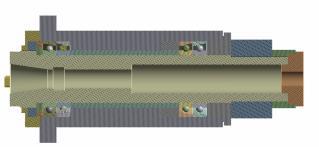
The high-speed spindle used in this study is shown in Fig-1(a). The front and rear bearing pairs were designed with different specifications such ball number, ball diameter and contact angle, but with the same basic dimensions.Thespecificationsofthebearingsarelistedin Table-1. The bearing pairs were mounted in DT arrangement and preloaded by using the spacers with different clearance, which isdetermined by the difference of axial length between the outer and inner spacers, irrespectivetotheclearanceinradialdirection.
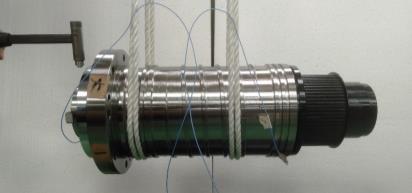

Fig-1: (a)Highspeedspindlefortest,(b)Schematicofthe tappingtestofspindle.
Table-1: Mainspecificationsofbearing.
Fig-1(b) illustrates the experimental configuration of the spindle unit without tool holder. The spindle was suspendedbytwowireropesfortest.Theaccelerometers were mounted on the spindle nose and spindle housing, respectively to measure the vibration signals excited by theimpacthammerattheoppositesideofspindlenoseor spindle tail. The dynamic responses were then extracted from the recorded FFT spectrum. The modal parameters such as damping ratio and dynamic stiffness associated with the dominant vibration modes were extracted from themeasuredFRFs.
3.1 Contact stiffness of ball bearing
Therollinginterfacesbetweenrollingballsandraceways ofthebearingareconsideredastheprimarysitesaffecting thedynamiccharacteristicsofspindletool.Therefore, itis necessarytocorrectlymodelingtherollinginterfaceatthe bearings in spindle unit by finite element method Fig-2 shows the contact status of a typical angular contact ball bearing.Thecontactforcebetweentherollingballandthe racewaycanberelatedtothelocaldeformationofcontact pointbytheHertzianexpression[21]asfollows:
International Research Journal of Engineering and Technology (IRJET) e-ISSN: 2395-0056
Volume: 12 Issue: 06 | Jun 2025 www.irjet.net p-ISSN: 2395-0072
where Q denotes the contact force and is the elastic deformation at the contact point. Kh represents the Hertz constant, which is determined by the contact geometry of the ball groove or raceway and the material properties of the contacting components. Details are available in the literature [22]. The normal stiffness at a specific preload canthenbeobtainedas
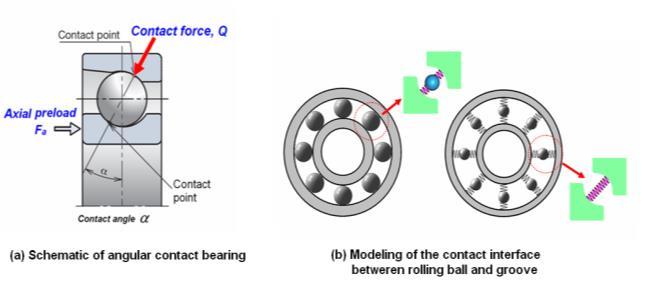
A solid model of the spindle bearing system was shown in Fig-3, including the rotating shaft and the spindle housing. The finite element model was meshed with hexahedron elements. To reduce the complexity in model creation and mesh generation of the motion components, such as the ball bearing, the contact configuration between rolling ball and the raceway was modeledas surfacecontact model usinga series ofspring element between the inner and outer rings by neglecting theeffectofrollingballs.Forfiniteelementanalysis,allthe metal components have the following material properties of carbon steel: elastic modulus E = 208GPa, Poisson’s ratio =0.3,anddensity =7850Kg/m3 .
Forsubsequent analysis,the finite element model was validated by comparing the results of the harmonic analysiswiththeexperimentalmeasurements.Inthefinite element model of the tested spindle, the overall contact stiffness of each bearing was calculated as 591N/m accordingtotheequation(2).Thestiffnessofeachbearing is distributed on the spring elements circumferentially surroundingthespindleshaftcreatedinthefiniteelement model.
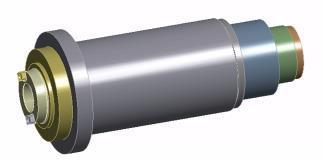
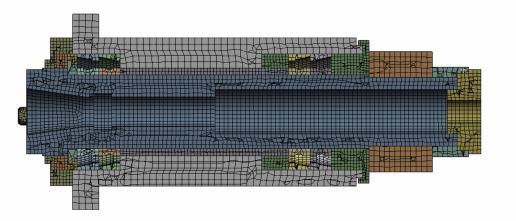
thespindlewith 453881nodesand108229elements.
4.1
Themeasuredvibrationresponsesofthespindleunits with different bearings pairs are illustrated in Fig-4 for comparison, which are expressed in terms of the compliance varying with frequency. The curve H11 and H22representthedirectfrequencyresponsemeasuredat spindlenose(point1)andtail(point2)excitedatopposite sideofpoint1andpoint2respectively,byimpacthammer. For spindle with L-sized bearing it shows three fundamentalmodesatabout1443,2937and4376Hz.For spindles with small balls, the natural frequencies are foundtoshiftslightlytoa higherorlowervalue. Itcan be foundfrom Fig-4 thattheresponseH11andH22havethe same resonant mode at frequency of 1443 Hz, but with differentamplitude,whichcanberegardedasthebending vibration mainly associated with of spindle nose and spindletail.
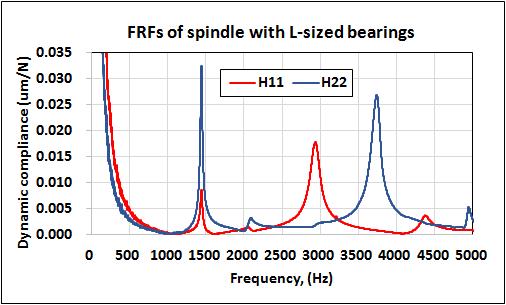
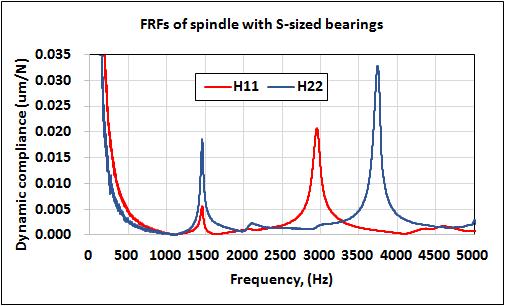
Fig-4: Frequencyresponsefunctionsmeasuredatthe spindlenoseandhousing.
International Research Journal of Engineering and Technology (IRJET) e-ISSN: 2395-0056
Volume: 12 Issue: 06 | Jun 2025 www.irjet.net p-ISSN: 2395-0072
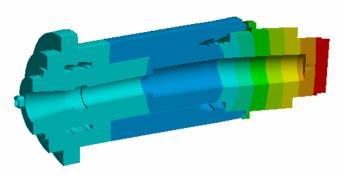
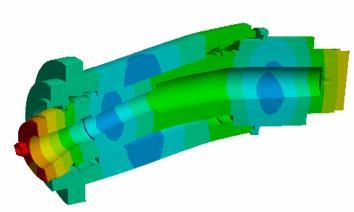
Fig-5 Compares the frequency response functions measured spindle with different bearings. The modal parameters extracted from frequency response functions are listed in Table-2 It is clearly demonstrated in Fig-5 that the natural frequency and vibration amplitude were affected to change for bearing pairs from large to small sizes. According to the finite element modeling, the vibrations modes were mainly caused by the bending deformationofthespindleshaft,asshownin Fig-6,which wasgreatlydeterminedbytherigidityofthebearings.
bending vibration of the spindle nose at higher frequency around 1447 Hz and the second mode is the vibration of the spindle nose at higher frequency around 2906 Hz. In addition, the second bending vibration induces a maximumdisplacementatthespindlenose,whichislikely to affect the machining accuracy. The natural frequencies corresponding to the first two vibration modes are 1447 and 2906Hz, respectively, agreeing well with the experimentalmeasurements(1444and2938Hz)
S-sized 1461 5.65 0.94 L-sized 1444 8.57 0.75
VibrationMode (II)
S-sized 2954 2076 125
L-sized 2938 1779 168
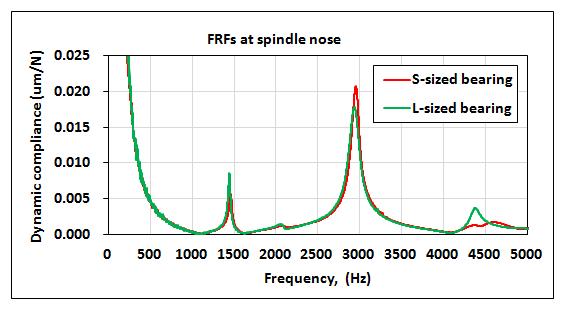
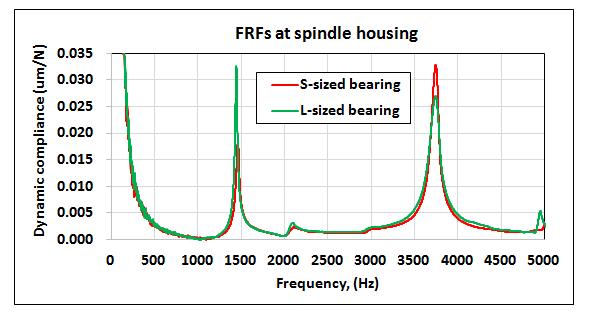
Fig-5: Comparisonsoffrequencyresponsefunctions measuredspindlewithdifferentbearings.
4.2 Vibration modal behavior
The fundamental vibration modes of the spindle unit wereassessedfrommodalanalysis,asdepictedin Fig-6 It isfoundthatthefirstmodeisassociatedwiththebending vibrations of the spindle tail and the second mode is the
The harmonic analysis was performed to assess the dynamic response of the spindle with large-sized bearing under unit force at the tool holder. The frequency response functions predicted at spindle nose and housing were alsoillustrated in Fig-7 for thecomparison with the measurement, which clearly verifies that the spindle model behaves a dynamic behavior comparable to those measuredinphysicalspindle.
Again, the spindle unit was found to become more compliantwhenthefirstandsecondbendingmodes were excited. For spindle with larger bearing, the predicted dynamiccomplianceatsecondmodewas 18.61 m/kN at frequencyof2906Hz,whilethemeasuredvaluewas17.79 m/kN at 2938 Hz. It is noticed that the differences between the predicted results and experimental measurements are approximately around 5%. This addressesthattheproposedanalysismodelofthespindle can appropriately predict the dynamic behavior of the spindletoolsystem.
International Research Journal of Engineering and Technology (IRJET) e-ISSN: 2395-0056
Volume: 12 Issue: 06 | Jun 2025 www.irjet.net p-ISSN: 2395-0072
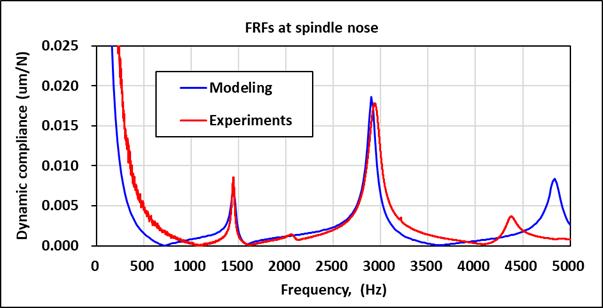
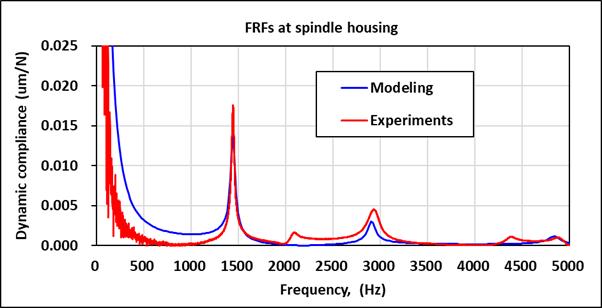
Fig-7: Comparisonsofthefrequencyresponsefunctions predictedbyFEMmodelandmeasuredbytappingtest.
Basically, the influence of the bearing rigidity also can be accurately analyzed with the modeling of the rolling interface into the solid finite element model. Essential, bearing rigidity can be affected by the design details of different specification such as ball diameter, contact geometry and preload set in the spindle. As shown in Table 1, the bearing with large balls has different loading capacityandtherigidityas comparedwithonewithsmall balls. This actually make the bearing having different rigidity, it follows that the spindle behaves different dynamicbehaviorsasshowninFig-5.
Thisstudyhasinvestigatedtheinfluenceof bearing specifications on the dynamic characteristics of a milling spindle through a combination of experimental measurements and finite element modeling. The bearing specifications were defined by the number and diameter ofrolling elements,thecontactgeometryofthe raceways, and the preload amount. Experimentally, frequency response functions (FRFs) were obtained by performing impact tests on spindle units equipped with different bearing configurations. Modal parameters including natural frequency, damping ratio, and compliance were extracted from the measured FRFs and analyzed in relationtothecorrespondingbearingspecifications.
A finite element model of the spindle was also developed to predict its dynamic behavior. The results demonstrate that changes in bearing rigidity, particularly when replacing large-sized bearings with smaller ones, significantly affect the spindle’s modal parameters. Moreover, the predicted FRFs showed good agreement
with the experimental results, with discrepancies within approximately5%.Theaccuracyofthemodeldependson the representation of the rolling interface, where bearing contact stiffness is estimated using Hertzian contact theory. Overall, the findings highlight the importance of bearing design in determining spindle dynamics. The proposed modeling approach serves as a useful tool for optimizing spindle performance and can be extended to support the integrated development of machine tools, including both the spindle assembly and the supporting structuralcomponents.
[1] J.K.Choi,D.G.Lee,“Characteristicsofspindlebearing system with a gear located on the Bearing span,” InternationalJournalofMachineToolsManufacturing, Vol.37(2),1994,pp.171-181.
[2] S. P. Harsha, L. Sandeep, R. E. Prakash. “Effects of preload and number of balls on nonlinear dynamic behaviors of ball bearing system,”International Journal of Nonlinear Science and Numerical Simulation.Vol.4(3),2003, pp.265-278
[3] Y. Cao, Y. Altintas, “Modeling of spindle-bearing and machinetoolsystems for virtual simulation of milling operations,” International Journal of Machine Tools andManufacturing.Vol.47(9),2007,pp.1342-1350
[4] M. A. Alfares, A. A. Elsharkawy. “Effects of axial preloading of angular contact ball bearings on the dynamics of a grinding machine spindle system,” Journal of Materials Processing Technology. Vol. 136(3),2003,pp.48-59
[5] S. A. Spiewak, T. Nickel. "Vibration based preload estimation in machine tool spindles," International Journal of Machine Tools & Manufacture. Vol. 41(4), 2001,pp. 567-588
[6] A. Gunduz, J. T. Dreyer, R. Singh, “Effect of bearing preloads on the modal characteristics of a shaftbearingassembly:experimentsondoublerowangular contact ball bearings,” Mechanical Systems and Signal Processing.Vol.31,2012,pp.176-195
[7] K. Kim, S. S. Kim, “Effect of preload on running accuracyofspindle,” International Journal ofMachine ToolsandManufacturing,Vol.29(1),1989,pp.99-105.
[8] V.R. Reddy, A.M. Sharan, “Design of machine tool spindlesbasedontransientanalysis,”ASMEJournalof Mechanisms,TransmissionsandAutomationinDesign, Vol.107,1985,pp.346-352.
[9] V.R. Reddy, A.M. Sharan, “The finite element modeled design of lathe spindles: the static and dynamic
International Research Journal of Engineering and Technology (IRJET) e-ISSN: 2395-0056
Volume: 12 Issue: 06 | Jun 2025 www.irjet.net p-ISSN: 2395-0072
analysis,”ASMEJournalofVibrations,AcousticsStress andReliabilityinDesign,Vol.109,1987,pp.407-415.
[10] H. Li, Y.C. Shin, "Analysis of Bearing configuration effects on high speed spindles using an integrated dynamic thermo-mechanical spindle model,” International Journal of Machine Tools and Manufacture,Vol.44,2004,pp.347-364.
[11] T.Yamamoto, “Oncritical speedsofa shaftsupported by a ball bearing,” Journal of Applied Mechanics, Vol. 26(2),1959,pp.199-204.
[12] HQ Li, Y.C. Shin, "Analysis of bearing configuration effects on high speed spindles using an integrated dynamic thermo-mechanical spindle model", International Journal of Machine Tools and Manufacturing,Vol.44,2004,pp.347–364
[13] R. K. Purohit, K Purohit, "Dynamic analysis of ball bearings with effect of preload and number of balls", Internationaljournalofappliedmechanicsand engineering,Vol.11(1),2006, pp.77-91
[14] X. T. Bai, Y. H. Wu, I. C. Rosca, K. Zhang, H. T. Shi, "Investigation on the effects of the ball diameter difference in the sound radiation of full ceramic bearings," Journal of Sound and Vibration,Vol. 450, 2019,pp.231-250.
[15] S. Deng, H. Chang, X. Zhu, D. Qian, L. Hua, S. Jiang, "Sensitivity of different types of structural size combinations to dynamic stability and vibration of angular contact ball bearings based on nonlinear dynamic model," Tribology International,Vol.181, 2023,108309.
[16] S. Deng, J. Shen, C. Yang, "A nonlinear dynamic approach for analyzing dynamic stiffness of ball bearings at different raceway diameters and guiding clearances", International Journal of Non-Linear Mechanics,Vol.160,2024,104632.