
International Research Journal of Engineering and Technology (IRJET) e-ISSN: 2395-0056
Volume: 13 Issue: 04 | Apr 2026 www.irjet.net p-ISSN: 2395-0072

International Research Journal of Engineering and Technology (IRJET) e-ISSN: 2395-0056
Volume: 13 Issue: 04 | Apr 2026 www.irjet.net p-ISSN: 2395-0072
Mr. Md. Chan Basha1, Dandotikar Ayush2, Goda Harshitha3, Godugu Koushik4, Buyya Gowthami5
1AssistantProfessor,Dept. ofComputerScienceandEngineering,JoginpallyBREngineeringCollege,RangaReddy, Telangana,India.
2DeptofComputerScienceandEngineering,JoginpallyBREngineeringCollege,RangaReddy,Telangana,India.
3DeptofComputerScienceandEngineering,JoginpallyBREngineeringCollege,RangaReddy,Telangana,India.
4DeptofComputerScienceandEngineering,JoginpallyBREngineeringCollege,RangaReddy,Telangana,India.
5DeptofComputerScienceandEngineering,JoginpallyBREngineeringCollege,RangaReddy,Telangana,India.
Abstract – In recent times, timely and accurate drug recommendation has become critically important in medical emergencies to improve patient health outcomes. Healthcare professionals often face significant challenges in making rapid and precise decisions under high-pressure conditions, highlighting the need for advanced decision-support tools. This work proposes a drug recommendation system that leverages machine learning (ML) techniques to assist healthcare providers during emergency medical situations. The system integrates patient-specific data including vital signs, medical history, and symptoms with a comprehensive pharmaceutical database to recommend the most appropriate medications. The recommendation process considers multiple factors such as potential drug interactions, possible side effects, and individual patient conditions to ensure that the suggested drugs are both effective and safe. Furthermore, the system is designed to continuously improve its performance by adapting to newly available medical research and updated patient data over time. By reducing the likelihood of human error and accelerating the clinical decision-making process, the proposed drug recommendation system aims to enhance treatment accuracy, support healthcare professionals, and ultimately improve survivalratesincriticalmedicalemergencies.
Keywords: Machine Learning, Healthcare AI, Drug Recommendation, Emergency Systems
Inemergencyhealthcaresettings,rapidandaccurate decision-making is essential to ensure patient survival and effective treatment. Healthcare professionals often operate under intense pressure and limited time, making it difficult to evaluate all possible treatment options while considering patient-specific factors such as medical history,
allergies, and ongoing medications. Selecting the correct drugin such critical situations is challenging due to the complexity of drug interactions, contraindications,andvaryingpatientconditions.
Traditional drug recommendation methods rely heavily on the experience and judgment of medical practitioners, which, while valuable, may not always account for all relevant variables in real time. This can lead to delays or errors in medication selection, potentially compromising patient safety. As the volume ofmedical datacontinues to grow, thereis a need for intelligentsystemsthatcanassistclinicians in making faster and more accurate treatment decisions.
Machine learning provides an effective solution by analyzing large volumes of healthcare data to generate personalized and evidence-based drug recommendations.Byprocessingpatientinformation such as symptoms, vital signs, and clinical history, machine learning models can suggest appropriate medications while also identifying potential drug interactions and side effects. This improves treatment accuracy and supports clinicians in highstakesemergencysituations.
Overall, a machine learning–based drug recommendation system aims to enhance the efficiency, reliability, and safety of emergency medical care. By assisting healthcare providers with real-time, data-driven insights, such systems can reducemedicationerrors,improvepatientoutcomes, andcontributetotheadvancementofintelligentand personalizedhealthcaresolutions.
The primary objective of a machine learning–based drug recommendation system in medical emergencies is to assist healthcare professionals in
International Research Journal of Engineering and Technology (IRJET) e-ISSN: 2395-0056
Volume: 13 Issue: 04 | Apr 2026 www.irjet.net p-ISSN: 2395-0072
makingquick,accurate,andsafetreatmentdecisions. Inemergencysituations,cliniciansoftenworkunder severe time constraints and must make critical decisions with limited patient information. The proposed system analyzes patient symptoms, medical history, allergies, and other clinical parameters to recommend appropriate medications inrealtime.
The system aims to provide personalized treatment by considering individual patientcharacteristics and medical conditions. Byusingdata-drivenalgorithms, it helps reduce human errors, prevent incorrect prescriptions, and identify potential drug interactions or contraindications. Ultimately, the objective is to improve patient safety, enhance treatment efficiency, and support healthcare professionals in delivering high-quality emergency care.
The scope of machine learning–based drug recommendationsystemsinemergencyhealthcareis extensive. These systems can be deployed in hospitals, emergency departments, telemedicine platforms, and remote healthcare centers where access to medical specialists may be limited. By analyzing large volumes of medical data, electronic health records, and clinical guidelines, the system can provide evidence-based drug recommendations andassistinpatienttriageandprioritization.
However, several challenges affect the implementationofsuchsystems.Emergencymedical dataisoftenincomplete,inconsistent,orunavailable inrealtime,whichcanreducepredictionaccuracy.In addition, integrating the recommendation system with existing hospital infrastructure and electronic health record systems can be technically complex. Ensuring system reliability, fast response time, and user-friendly interfaces is critical for successful adoptioninemergencyenvironments.
Despite the advantages of machine learning in healthcare, the development of drug recommendation systems for emergency use presents multiple challenges. One major issue is the availabilityandqualityofpatientdata,asemergency situations frequently involve missing or outdated medicalrecords.Thiscanleadtoincorrectorunsafe
drug recommendations if not properly handled by themodel.
Another key problem is the lack of transparency in advanced machine learning algorithms, which often function as black-box models. Medical professionals may hesitate to rely on recommendations if the reasoning behind them is not clearly explained. Additionally, ethical and legal concerns related to patient privacy, data security, and regulatory compliance must be addressed. Therefore, careful system design, reliable data handling, and explainableAItechniquesareessentialtoensuresafe and trustworthy deployment in real-world medical settings.
Drug recommendation systems have emerged as an important application of artificial intelligence in healthcare, aimed at supporting clinicians in selecting appropriate medications based on patientspecific information. These systems analyze various parameters such as symptoms, medical history, allergies,laboratoryresults,anddemographicdatato generate personalized treatment suggestions. The increasing availability of electronic health records andmedicaldatasetshasenabledthedevelopmentof moreaccurateandreliablerecommendationmodels.
Machine learning techniques have been widely adopted in healthcare for tasks such as disease prediction, medical image analysis, clinical decision support,anddrugrecommendation.Algorithmssuch as Decision Trees, Random Forest, Support Vector Machines, and Neural Networks are capable of identifying patterns within complex medical datasets. By learning from historical patient records and treatment outcomes, these models can assist healthcare professionals in making evidence-based decisions and improving diagnostic and treatment accuracy.
Several existing systems use rule-based methods or statistical models to recommend medications. Rulebased systems rely on predefined clinical guidelines and expert knowledge to suggest drugs. While these systems are transparent and easy to interpret, they
International Research Journal of Engineering and Technology (IRJET) e-ISSN: 2395-0056
Volume: 13 Issue: 04 | Apr 2026 www.irjet.net p-ISSN: 2395-0072
often lack flexibility and may not adapt well to new medical data or evolving treatment practices. In contrast, machine learning–based systems can automatically learn from data and update their recommendations as more information becomes available,makingthemmoreadaptiveandscalable.
Despite significant progress, existing drug recommendation systems face several limitations. Many models struggle with incomplete or inconsistent patient data, which is common in realworld healthcare settings. Additionally, some advancedmachinelearningmodelsfunctionasblack boxes,makingitdifficultforclinicianstounderstand thereasoningbehindspecificrecommendations.This lack of interpretability can reduce trust and hinder adoption in critical medical environments such as emergencycare.
2.5
Given the limitations of traditional and rule-based systems, there is a growing need for intelligent drug recommendation systems that combine data-driven learning with clinical knowledge. Such systems should provide accurate, explainable, and real-time recommendations while ensuring patient safety and compliance with medical standards. The integration of machine learning with clinical decision support tools has the potential to significantly enhance the qualityandefficiencyofhealthcaredelivery.
3.1
The methodology of the proposed drug recommendation system outlines the step-by-step processfollowedtodesign,develop,andevaluatethe machine learning–based solution. The system is developed to analyze patient-specific data, predict relevant medical conditions, and recommend safe and effective medications in emergency situations. The methodology includes data collection, preprocessing, model development, drug recommendation,andsafetyvalidation.
3.2 Data Collection
The firststepinthe methodologyinvolves collecting patient-related data from various medical sources. The dataset includes information such as patient demographics, symptoms, medical history, allergies,
laboratory test results, and prescribed medications. Data is obtained from publicly available healthcare datasets,hospitalrecords,andsimulatedclinicaldata to ensure a diverse and representative dataset for trainingthemachinelearningmodels.
3.3 Data Preprocessing
Raw healthcare data often contains missing values, inconsistencies, and irrelevant attributes that can negatively affect model performance. Therefore, preprocessing techniques are applied to clean and prepare the data for analysis. Missing values are handled using imputation methods, categorical variables such as symptoms and diseases are encoded into numerical format, and numerical featuresarenormalizedtoensureconsistentscaling. The dataset is then divided into training and testing subsetstoevaluatemodelperformanceobjectively.
3.4 Feature Selection and Engineering
Feature selection is performed to identify the most relevant attributes that contribute to accurate drug recommendations. Unnecessary or redundant features are removed to reduce model complexity and improve computational efficiency. Feature engineering techniques are also applied to create newmeaningfulattributesfromexistingdata,suchas combining symptom severity scores or grouping relatedclinicalindicators.
3.5 Model Development
Machine learning models are developed using supervised learning techniques to predict suitable drugs based on patient conditions. Algorithms such as Random Forest, Extreme Gradient Boosting (XGBoost), and Light Gradient Boosting Machine (LightGBM) are trained on the prepared dataset. Thesemodelslearntherelationshipbetweenpatient symptoms, diagnoses, and prescribed medications. Hyperparameter tuning and cross-validation techniques are applied to optimize model performanceandpreventoverfitting.
3.6 Model Evaluation
To assess the effectiveness of the trained models, performance evaluationis conducted usingstandard classification metrics such as accuracy, precision, recall, and F1-score. The model that demonstrates the highest performance and generalization capability on the testing dataset is selected for deployment.Thisevaluationensuresthatthesystem
International Research Journal of Engineering and Technology (IRJET) e-ISSN: 2395-0056
Volume: 13 Issue: 04 | Apr 2026 www.irjet.net p-ISSN: 2395-0072
provides reliable and consistent drug recommendationsinreal-worldscenarios.
Once the optimal model is selected, it is integrated into the system to generate real-time drug recommendations. When a healthcare provider enters patientsymptomsandclinicaldetailsintothe system,thetrainedmodelprocessesthisinformation and predicts the most appropriate medication. The system retrieves drug details, including dosage and usage instructions, from the database and presents themtotheuserinaneasy-to-understandformat.
Before presenting the final recommendation, the system performs safety validation by checking for potential drug interactions, contraindications, and allergy conflicts. This step ensures that the recommended medications do not pose any risks to the patient and comply with established medical safety guidelines. If any conflicts are detected, the system alerts the userand suggestssafer alternative drugs.
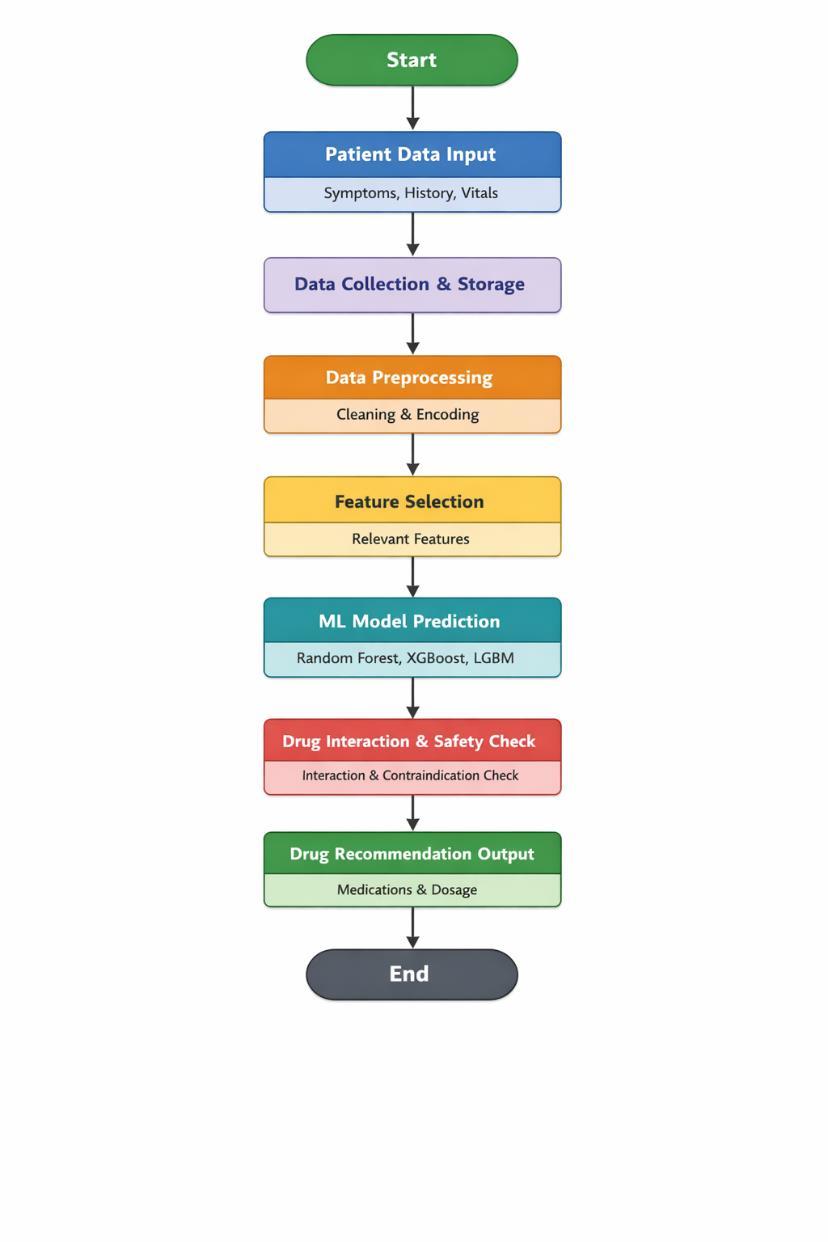
The overall workflow of the methodology can be summarizedasfollows:
1. Collection of patient data from multiple sources
2. Data cleaning, preprocessing, and feature selection
3. Training and evaluation of machine learning models
4. Selectionofthebest-performingmodel
5. Generation of drug recommendations based onpatientinput
6. Validation of drug safety and interaction checks
7. Displayoffinalrecommendationstotheuser
This structured methodology ensures that the proposed system operates efficiently, provides accurate predictions, and maintains high safety standards, making it suitable for deployment in emergencyhealthcareenvironments.
4. MODULES
• Data Collection Module:
This module gathers patient information from various sources like Electronic Health Records (EHR), wearable devices, and real-time monitoring
systems, including demographics, medical history, symptoms,andvitalsigns,toprovidecomprehensive inputsforthesystem.
• Data Preprocessing Module:
In this module, the collected raw data is cleaned, encoded,andtransformedtoensureconsistencyand usability by handling missing values, scaling, and splittingthedatasetintotrainingandtestingsetsfor furtheranalysis.
• Model Development Module:
This module applies advanced machine learning algorithms such as Random Forest,XG Boost. LGBM, and others to train models that predict the most appropriate drugs based on patient-specific conditionsandemergencyrequirements.
• Drug Interaction and Safety Cheeks:
A critical module where the system cross-verifies recommended drugs against a database of potential interactions, contraindications, and known side effects to ensure that the suggested medications are safeandsuitableforindividualpatients.
International Research Journal of Engineering and Technology (IRJET) e-ISSN: 2395-0056
Volume: 13 Issue: 04 | Apr 2026 www.irjet.net p-ISSN: 2395-0072
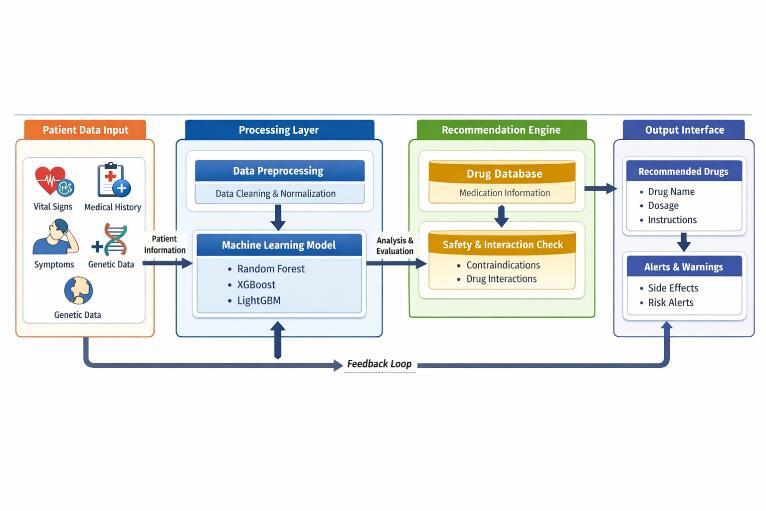
Thesystem follows a layered architecture consisting ofthefollowingmaincomponents:
UserInterfaceLayer
DataProcessingLayer
MachineLearningLayer
DrugRecommendationLayer
DatabaseLayer
This modular design ensures flexibility, scalability, andeaseofmaintenance.
[5.1]UserInterfaceModule
The user interface serves as the interaction point between healthcare providers and the system. It allows users to enter patient details such as symptoms, age, gender, medical history, and current medications. The interface is designed to be simple, intuitive,andresponsivetosupportquickdataentry duringemergencysituations.
[5.2]DataPreprocessingModule
The data preprocessing module is responsible for cleaning and transforming raw patient data into a suitable format for machine learning models. This includes handling missing values, encoding categorical variables, normalizing numerical data, and validating user inputs. Proper preprocessing ensuresthatthemodelreceivesconsistentandhighquality data, which is essential for accurate predictions.
[5.3]MachineLearningModule
Themachinelearningmoduleisthecorecomponent of the system. It uses trained algorithms to analyze patient symptoms and predict possible diseases or medical conditions. Based on these predictions, the systemidentifiesthemostappropriatedrugs.Models such as Decision Trees, Random Forest, or other classificationalgorithmscanbeemployeddepending onthedatasetandperformancerequirements.
[5.4]DrugRecommendationModule
Once the disease or condition is predicted, the drug recommendation module retrieves relevant medications from the drug database. This module also checks for drug interactions, contraindications, and dosage guidelines to ensure that the recommended treatment is safe and suitable for the patient.
[5.5]DatabaseDesign
The system uses a structured database to store patientrecords,druginformation,treatmenthistory, and model training data. The database ensures efficient storage, quick retrieval, and secure managementofmedicalinformation.Tablestypically includepatientdetails,symptoms,diseasecategories, drug names, dosage information, and interaction warnings.
[5.6]WorkflowoftheSystem
The overall workflow of the system can be summarizedasfollows:
1. The user enters patient information through the interface.
2. Thedataispre-processedandvalidated.
3. Themachinelearningmodelpredictsthedisease orcondition.
4. The system retrieves suitable drugs from the database.
5. Recommended medications and dosage informationaredisplayedtotheuser.
This architecture ensures that the system provides fast, accurate, and safe drug recommendations, making it suitable for use in time-critical medical environments.
International Research Journal of Engineering and Technology (IRJET) e-ISSN: 2395-0056
Volume: 13 Issue: 04 | Apr 2026 www.irjet.net p-ISSN: 2395-0072
6.1 Overview of Machine Learning Algorithms
Machinelearningalgorithmsplayacrucialroleinthe proposed drug recommendation system by enabling automated prediction of suitable medications based on patient-specific data. These algorithms learn patternsfromhistoricalmedicalrecordsandusethis knowledge to generate accurate and personalized drugrecommendationsduringemergencysituations. The system employs ensemble and boosting techniques to improve prediction accuracy, robustness,andgeneralization.
6.2 Random Forest Algorithm
The Random Forest algorithm is an ensemble learning technique that constructs multiple decision trees during training and combines their outputs to improve classification accuracy. Each tree is trained on a random subset of the data and features, which helps reduce overfitting and increases model stability.
In the proposed system, Random Forest is used to analyzepatientsymptoms,demographicinformation, and medical history to predict the most probable disease and recommend suitable medications. Its ability to handle high-dimensional data and missing values makes it particularly suitable for healthcare datasets.
6.3 Extreme
ExtremeGradientBoosting(XGBoost)isanadvanced boosting algorithm designed to optimize model performance through gradient descent and regularization techniques. It builds decision trees sequentially, where each new tree focuses on correcting the errors made by previous trees. This iterative learning process results in highly accurate andefficientmodels.
Inthedrugrecommendationsystem,XGBoostisused toenhancepredictionaccuracybycapturingcomplex nonlinear relationships between patient symptoms and drug responses. Its ability to handle large datasets and prevent overfitting through regularization makes it effective in medical decision supportsystems.
LightGradientBoostingMachine(LightGBM)isafast and efficient gradient boosting framework that uses a leaf-wise tree growth strategy. Compared to
traditional boostingmethods, LightGBMoffers faster training speed, lower memory usage, and improved performanceonlarge-scaledatasets.
The system utilizes LightGBM to process large volumes of patient data and generate real-time drug recommendations with minimal computational delay. Its efficiency makes it suitable for emergency medical applications where quick predictions are essential.
6.5 Comparison
Different machine learning algorithms were evaluated to determine the most suitable model for drug recommendation. Random Forest provides strong baseline performance and robustness, while XGBoost and LightGBM offer higher accuracy and fastertrainingdue to their boostingmechanisms. By comparingthesealgorithmsbasedonmetricssuchas accuracy, precision, recall, and F1-score, the system selects the model that delivers the best overall performanceforclinicaldecision-making.
6.6 Model Selection and Deployment
After evaluating the performance of all trained models, the best-performing algorithm is selected and deployed within the system for real-time predictions.Theselectedmodelisintegratedintothe backend of the application, where it processes incoming patient data and generates drug recommendations instantly. Periodic retraining is performed to ensure that the model remains up-todate with new medical data and evolving treatment practices.
1. Healthcare Professionals
Doctors,nurses,andemergencymedicalstaffarethe primary beneficiaries of the proposed drug recommendationsystem.Thesystemassiststhemin making faster and more accurate medication decisions by analyzing patient data and suggesting suitable drugs. In emergency situations, where time is critical, this support helps reduce the chances of humanerrorandimprovesclinicalefficiency.
2. Patients
Patients benefit directly from the system through improved treatment accuracy and safety. By recommending drugs based on patient-specific factors such as allergies, medical history, and symptoms, the system reduces the risk of adverse
International Research Journal of Engineering and Technology (IRJET) e-ISSN: 2395-0056
Volume: 13 Issue: 04 | Apr 2026 www.irjet.net p-ISSN: 2395-0072
drugreactionsandincorrectprescriptions.Thisleads tobetterhealthoutcomesandfasterrecovery.
3. Hospitals and Healthcare Institutions
Hospitals and clinics can use this system to enhance theirclinicaldecisionsupportinfrastructure.Ithelps in standardizing treatment procedures, reducing medication errors, and improving overall patient care quality. Additionally, it assists hospitals in managing large volumes of patient data efficiently andsupportsdigitalhealthcaretransformation.
4. Pharmacists
Pharmacistscanusethesystemasaverificationtool to cross-check prescriptions and identify potential drug interactions or contraindications. This additionallayerofsafetyhelpsensurethatdispensed medicationsareappropriateandsafeforpatients.
5. Medical Researchers
The system collects and processes large amounts of medical data, which can be valuable for researchers studying drug effectiveness, treatment patterns, and disease trends. The insights generated from the system can support future medical research and the developmentofimprovedtreatmentguidelines.
6. Healthcare Management and Policy Makers
Healthcareadministratorsandpolicymakerscanuse the system’s analytics and reports to understand drug usage patterns, monitor treatment outcomes, and make informed decisions regarding resource allocation and healthcare policies. This helps in improving the overall efficiency of healthcare deliverysystems.
7. Medical Students and Trainees
The system can also serve as an educational tool for medical students and trainee doctors. By observing how the system recommends drugs based on symptoms and patient history, learners can gain a betterunderstandingofclinicaldecision-makingand pharmacologicalpractices.
1.Overview of Experimental Results
The proposed drug recommendation system was tested using a dataset containing patient symptoms, medical history, and prescribed medications. The machinelearningmodelsweretrainedandevaluated to determine their ability to accurately predict
appropriate drugs for given patient conditions. The results demonstrate that the system can effectively assist in recommending medications with high accuracyandreliability.
Multiplemachinelearningalgorithms,including RandomForest,XGBoost,andLightGBM,were trainedandtestedontheprepareddataset.The performanceofeachmodelwasevaluatedusing standardevaluationmetricssuchas: Accuracy Precision
Recall
F1-Score
Thesemetricshelpinassessinghowwellthemodel predictscorrectdrugsandavoidsincorrect recommendations.
SamplePerformanceComparison
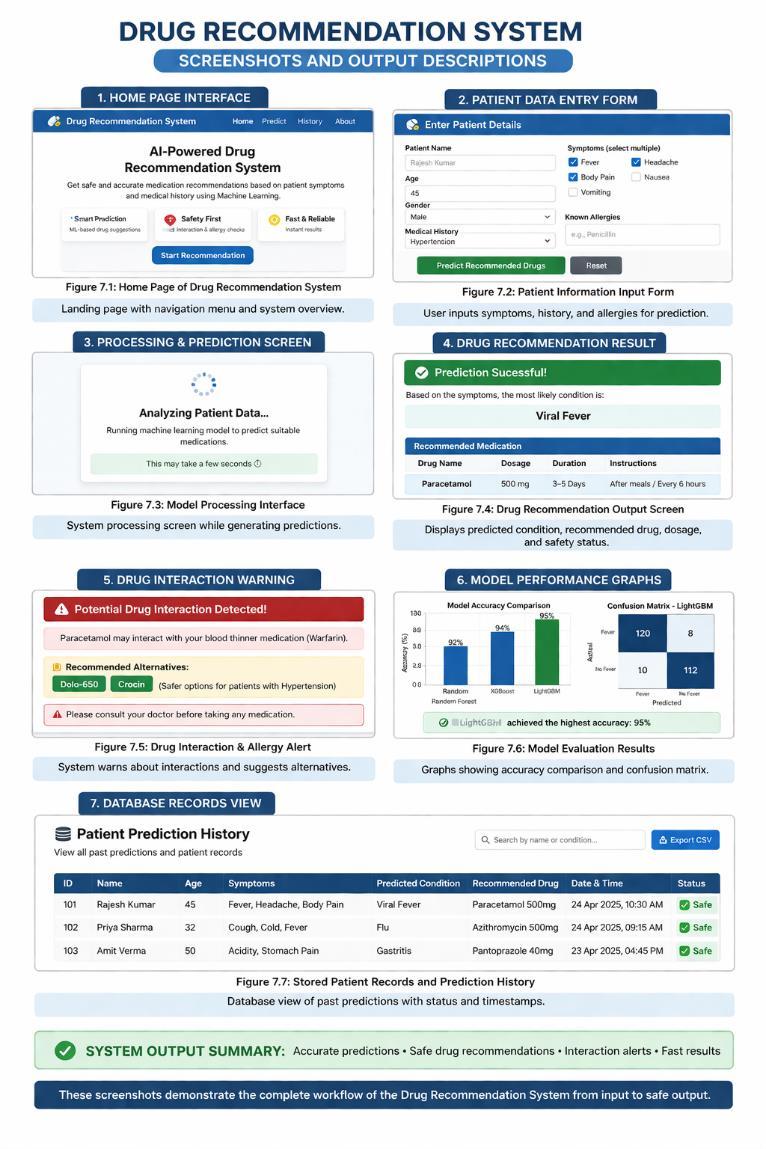
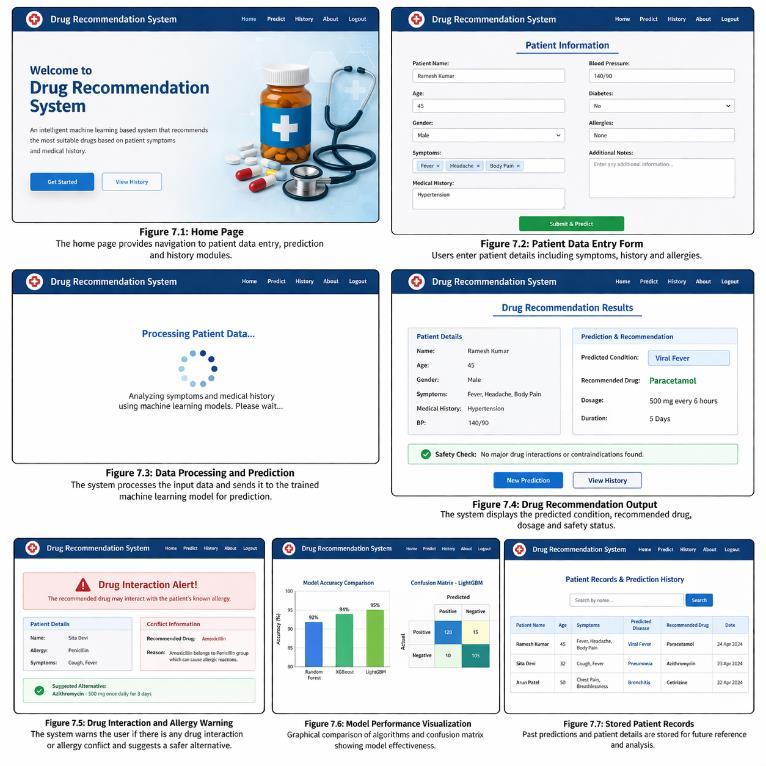
From the comparison, LightGBM achieved the highest accuracy and overall performance, makingit thepreferredmodelfordeploymentinthesystem. �
The developed system provides a user-friendly interface where healthcare professionals can input patient details such as symptoms, age, gender, and medical history. After processing the input, the systemdisplays:
Predicteddisease(ifapplicable)
Recommendeddrug(s)
International Research Journal of Engineering and Technology (IRJET) e-ISSN: 2395-0056
Volume: 13 Issue: 04 | Apr 2026 www.irjet.net p-ISSN: 2395-0072
Suggesteddosage
Safetywarningsorinteractionalerts
This output is presented in a clear and structured format to support quick decision-making during emergencysituations.
4. Example Output Scenario
InputProvidedtoSystem
Age:45
Gender:Male
Symptoms:Fever,headache,bodypain
MedicalHistory:Hypertension
SystemOutput
PredictedCondition:ViralFever
RecommendedDrug:Paracetamol
Dosage:500mgevery6hours
SafetyCheck:Nomajordruginteractiondetected
This example demonstrates how the system processespatientdataandgeneratesmeaningfuland safedrugrecommendations.
5. Drug Interaction and Safety Results
Thesystemwastestedforitsabilitytodetectunsafe drug combinations and allergy conflicts. When a recommended drug matched with a known patient allergy or harmful interaction, the system successfully generated warnings and suggested alternativemedications.Thisconfirmsthatthesafety module functions effectively and enhances patient protection.
6. Visualization of Results
During model evaluation, confusion matrices and accuracy graphs were generated to analyze prediction performance. These visualizations helped in identifying misclassification patterns and improving model tuning. The graphical results indicated that boosting algorithms performed better in handling complex symptom–drug relationships comparedtotraditionalclassifiers.
7. Discussion of Results
The experimental results indicate that machine learning techniques can significantly improve the accuracy and speed of drug recommendation systems. The integration of safety checks further ensures that the recommendations are not only accurate but also clinically safe. The system demonstrates strong potential for real-world healthcare applications, especially in emergency decisionsupport.
International Research Journal of Engineering and Technology (IRJET) e-ISSN: 2395-0056
Volume: 13 Issue: 04 | Apr 2026 www.irjet.net p-ISSN: 2395-0072
1. Integration with Real-Time Hospital Systems
In the current implementation, the drug recommendationsystemoperatesusingastandalone dataset. In the future, the system can be integrated with real-time hospital databases such as Electronic Health Records (EHR) and laboratory information systems. This integration would allow the system to automaticallyretrievepatientdata, reducingmanual data entry and improving accuracy and efficiency in clinicalenvironments.
2. Expansion of Drug and Disease Database
The present system is trained on a limited dataset containing a predefined set of symptoms, diseases, andmedications.Futureversionscanincludeamore extensive and regularly updated medical database covering a wider range of diseases, drug classes, dosagevariations,andtreatmentprotocols.Thiswill improve the system’s capability to handle complex andraremedicalcases.
3. Incorporation of Deep Learning Techniques
While the current system uses traditional machine learningalgorithmssuchasRandomForest,XGBoost, and LightGBM, future enhancements may include deep learning models such as Artificial Neural Networks (ANN) and Recurrent Neural Networks (RNN). These models can capture more complex
patterns in large-scale medical datasets and further improvepredictionaccuracy.
4. Personalized Medicine and Genomic Data Integration
Future versions of the system can incorporate genomic and genetic data to support personalized medicine. By analyzing patient-specific genetic information,thesystemcouldrecommenddrugsthat are more effective and less likely to cause adverse reactions, leading to highly individualized treatment plans.
To increase accessibility, the system can be developed as a mobile application or cloud-based web platform. This would allow healthcare professionals to access the drug recommendation system from smartphones, tablets, and remote healthcare facilities,improvingusabilityinrural and emergencysettings.
6. Continuous Learning and Model Updating
The system can be enhanced to support continuous learning by automatically retraining models using newlycollected patientdata. This would ensure that the recommendations remain up-to-date with evolvingmedicalknowledgeandtreatmentpractices, therebyimprovinglong-termreliability.
7. Multilingual and Voice Input Support
Futureversionscanincludemultilingualsupportand voice-based patientdataentry. Thiswould make the system easier to use in diverse healthcare environments and reduce the time required for data entryduringemergencysituations.
1. Summary of the Work
TheDrugRecommendationSystemdevelopedinthis project demonstrates the effective use of machine learning techniques to assist healthcare professionals in selecting appropriate medications based on patient symptoms, medical history, and other clinical parameters. By leveraging algorithms such as Random Forest, XGBoost, and LightGBM, the systemiscapableof analyzingcomplexmedical data and generating reliable drug recommendations in realtime.
International Research Journal of Engineering and Technology (IRJET) e-ISSN: 2395-0056
Volume: 13 Issue: 04 | Apr 2026 www.irjet.net p-ISSN: 2395-0072
2. Achievements of the Proposed System
The system successfully achieves its primary objectives,including:
Automatedanalysisofpatientdata
Accuratepredictionofsuitablemedications
Detection of potential drug interactions and contraindications
Presentation of recommendations through a user-friendlyinterface
These features collectively help in reducing prescription errors, improving treatment accuracy, and supporting clinical decision-making in emergencyscenarios.
3. Impact on Healthcare Decision Support
The implementation of this system highlights the growing importance of artificial intelligence in healthcare. By providing quick and data-driven recommendations, the system enhances the efficiencyofmedicalprofessionalsandcontributesto safer patient care. It demonstrates how intelligent decision support tools can complement human expertiseratherthanreplaceit.
4. Limitations
Despite its advantages, the system has certain limitations,suchasrelianceonthequalityandsizeof the training dataset, limited coverage of rare diseases, and the need for continuous validation in real clinical environments. Addressing these limitations will be essential for large-scale deploymentinhealthcareinstitutions.
5. Final Remarks
In conclusion, the proposed drug recommendation systemservesasapromisingsteptowardintelligent and automated healthcare support systems. With further improvements, integration with real-world medical infrastructure, and expansion of datasets, the system has the potential to become a valuable tool in modern healthcare environments, assisting clinicians in delivering faster, safer, and more personalizedtreatmenttopatients.
1. L. Venkateshwara Reddy, C. Sindhuja, M. Vandana,K.Vamshi,N.Naveen,“Predicting Drugs in Medical Emergencies using Machine Learning Algorithm” International Conference-Communicated.
2. Wittich CM, Burkle CM, Lanier WL. Medication errors: an overview for clinicians. Mayo Clin Proc;89(8):1116- 25, 2014Aug.
3. Bartlett JG, Dowell SF, Mandell LA, File TM Jr, Musher DM, Fine MJ. Practice guidelines forthemanagementofcommunity-acquired pneumonia in adults. Infectious Diseases Society of America. Clin Infect Dis.;31(2):347-82,2000Aug.
4. T. N. Tekade and M. Emmanuel, “Probabilistic aspect mining approach for interpretation and evaluation of drug reviews,”InternationalConferenceonSignal Processing, Communication, Power and Embedded System (SCOPES), Paralakhemundi.2016
5. Doulaverakis, C., Nikolaidis, G., Kleontas, A. et al. GalenOWL: Ontology-based drug recommendations discovery. J Biomed Semant3,14,2012.
6. Gao, Xiaoyan, Fuli Feng, Heyan Huang, XianLing Mao, Tian Lan, and Zewen Chi. “Food recommendation with graph convolutional network.” Information Sciences584:170183,2022.
7. Chen, Yu-Xiu, Li-Chih Wang, and Pei-Chun Chu. “A medical dataset parameter recommendation system for an autoclave process and an empirical study.” Procedia Manufacturing51:1046-1053,2020.
8. Fox, Susannah and Duggan, Maeve. Implementing a Machine Learning Model to Realize an Effective IOMT Assisted Client Nutrition Recommender System. Pew ResearchInternetProjectReport,2012.
9. J. Ramos et al., “Using tf-idf to determine word relevance in document queries,” in Proceedings of the first instructional conference on machine learning, vol. 242, pp.133142,Piscataway,NJ,2013.
10. N.V.Chawla,K.W.Bowyer,L.O.HallandW. P. Kegelmeyer. SMOTE: Synthetic Minority Oversampling Technique, Journal of Artificial Intelligence Research, Volume 16, 2020,2011.
International Research Journal of Engineering and Technology (IRJET) e-ISSN: 2395-0056
Volume: 13 Issue: 04 | Apr 2026 www.irjet.net p-ISSN: 2395-0072 © 2026, IRJET | Impact Factor value: 8.315 | ISO 9001:2008
11. Leilei Sun, Chuanren Liu, ChonghuiGuo, Hui Xiong, and YanmingXie. Data-driven Automatic Treatment Regimen Development and Recommendation. In Proceedings of the 22nd ACM SIGKDD International Conference on Knowledge Discovery and Data Mining (KDD ’16). Association for Computing Machinery, New York,NY,USA,18651874,2016.
|