
International Research Journal of Engineering and Technology (IRJET) e-ISSN: 2395-0056
Volume: 13 Issue: 04 | Apr 2026 www.irjet.net p-ISSN: 2395-0072

International Research Journal of Engineering and Technology (IRJET) e-ISSN: 2395-0056
Volume: 13 Issue: 04 | Apr 2026 www.irjet.net p-ISSN: 2395-0072
Mr. K . Mallikarjuna Rao1 , Devulapally Sai Bhavani2 , Yedulapuram Praharsha3 , Chukkala
Tejendra Deep4, Mohammed Riyaz Ahmed5
12345Department of Information Technology, Vidya Jyothi Institute of Technology, Telangana, India
Abstract - DrowsyShield is a computer vision-based driver drowsinessdetectionsystemthataimstoimproveroadsafety byidentifyingsigns of fatigue inreal time. It uses a camera to monitor the driver’s facial features and applies Eye Aspect Ratio (EAR) and Mouth Aspect Ratio (MAR) to detect behaviors such as eye closure and yawning. The system continuously analyzes these features to classify the driver’s state and generate alerts when drowsiness is detected. By avoiding wearable sensors, it provides a non-intrusive and practical solution for everyday use. Combining real-time monitoring with facial feature analysis, DrowsyShield enhances driving safety and helps in reducing accidents.
Key Words: Driver Drowsiness Detection, Computer Vision, Machine Learning, Facial Landmark Detection, Eye Aspect Ratio (EAR), Mouth Aspect Ratio (MAR), RealTime Monitoring, Fatigue Detection.
Theincreasinguseofmoderntechnologyintransportation systemshasbroughtattentiontosafety-relatedchallenges, particularly those caused by driver fatigue. Despite improvementsinvehicledesignandroadinfrastructure,a large number of accidents still occur due to drowsiness. Driversoftenfailtorecognizeearlysignsoffatigue,which affectstheiralertness, reaction time, and decision-making ability. This creates a serious need for systems that can monitor driver behavior and provide timely warnings to preventaccidents.
RecentadvancementsinArtificialIntelligence(AI),Machine Learning (ML), and Computer Vision have enabled the development of intelligent monitoring systems. These technologiesallowreal-timeanalysisofvisualdata,making itpossibletodetectbehavioralpatternssuchaseyeclosure and yawning. Computer vision techniques, in particular, provide a non-intrusive way to monitor drivers without requiringadditionalhardwareorphysicalcontact.
DrowsyShield is a real-time driver drowsiness detection systemthatutilizescomputervisiontechniquestoidentify signs of fatigue. The system captures video input and analyzesfacialfeaturestodetectchangesineyeandmouth
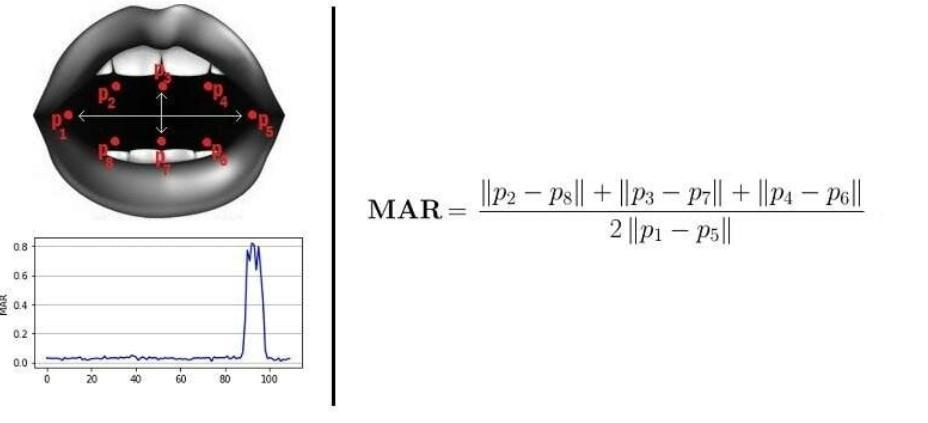
behavior. By applying Eye Aspect Ratio (EAR) and Mouth AspectRatio(MAR),thesystemisabletorecognizepatterns associatedwithdrowsinessandprovidealertsaccordingly. Thesystemfollowsastructuredprocessingapproachwhere facial landmarks are detected and analyzed continuously. Thishelpsinextractingmeaningfulinformationfromeach frame and reduces ambiguity in detection. By observing thesefeaturesoverasequenceofframes,thesystemensures that temporary actions such as blinking do not lead to incorrectalerts.
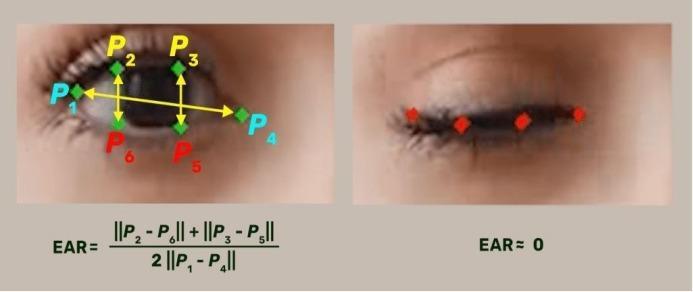
A key aspect of the system is its ability to perform continuous monitoring with minimal computational requirements.Theuseoflightweightalgorithmsallowsthe systemtooperateefficientlyinrealtimewhilemaintaining reliable performance. This makes it suitable for practical implementationineverydaydrivingscenarios.
The proposed DrowsyShield system follows a structured methodologythatintegratescomputervisiontechniquesto providereliablereal-timedriverdrowsinessdetection.The processbeginswithvideocapture,wherethedriver’sfacial dataiscontinuouslyrecordedusingacamera.Eachframeis processed and prepared for further analysis, ensuring
International Research Journal of Engineering and Technology (IRJET) e-ISSN: 2395-0056
Volume: 13 Issue: 04 | Apr 2026 www.irjet.net p-ISSN: 2395-0072
consistency and enabling effective interpretation of visual input.
Theprocessstartswithframeacquisition,wherevideoinput is captured and converted into individual frames. These frames are then preprocessed to improve clarity and consistency using techniques such as resizing, grayscale conversion,andnoisereduction.Thisstephelpsinenhancing feature visibility and ensures accurate detection of facial componentsunderdifferentconditions.
Next,thefacedetectionmoduleidentifiesthepresenceofthe driver’sfaceineachframeusingcomputervisionalgorithms. Oncethefaceisdetected,faciallandmarkdetectionisapplied toextractkeypointsaroundimportantregionssuchasthe eyes and mouth. These landmarks provide a structured representationoffacialfeaturesrequiredforfurtheranalysis.
2.1 Methodology Summary
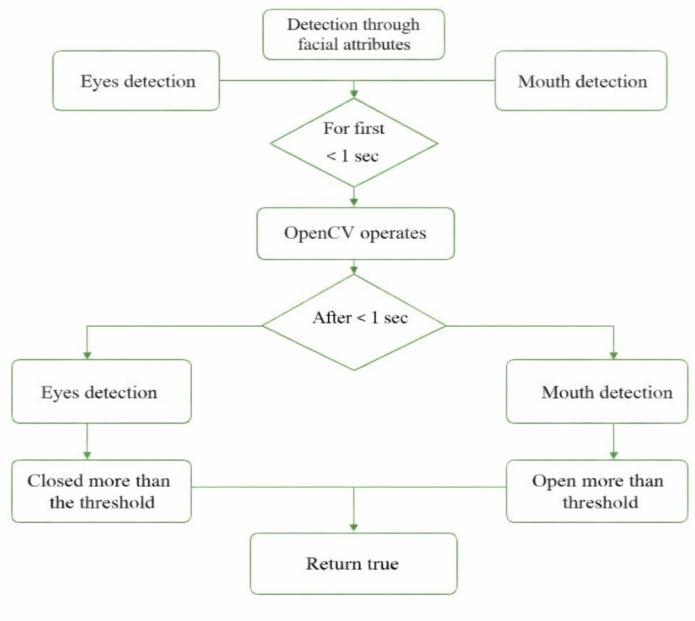
Overall,DrowsyShieldfollowsasystematicpipelineinwhich video frames are captured,processed,analyzed using EAR andMAR,andevaluatedovertimetodetectdrowsiness.This approachimprovesdetectionreliability,maintainsreal-time performance, and provides an effective solution for continuousdrivermonitoring.
The DrowsyShield system was evaluated using real-time videoinputsandsimulateddrivingconditionstomeasureits effectivenessindetectingdriverdrowsiness.Theevaluation focused on how accurately the system can identify fatigue indicatorssuchaseyeclosureandyawning,andhowquickly itcangeneratealertsinreal-timescenarios.
To improve accuracy, the system evaluates EAR and MAR values over a sequence of consecutive frames instead of relyingonasingleframe.IfEARremainsbelowapredefined thresholdorMARexceedsathresholdforacertainduration, the system classifies the driver as drowsy. This approach reducesfalse detectioncaused by normal blinking or brief facialmovements.
Oncedrowsinessisdetected,thealertmoduleisactivatedto notifythedriver.Thealertcanbeintheformofasoundor visualindication,ensuringimmediateawareness.Thisstepis crucialinpreventingpotentialaccidentsbyprovidingtimely warningstothedriver.
International Research Journal of Engineering and Technology (IRJET) e-ISSN: 2395-0056
Volume: 13 Issue: 04 | Apr 2026 www.irjet.net p-ISSN: 2395-0072
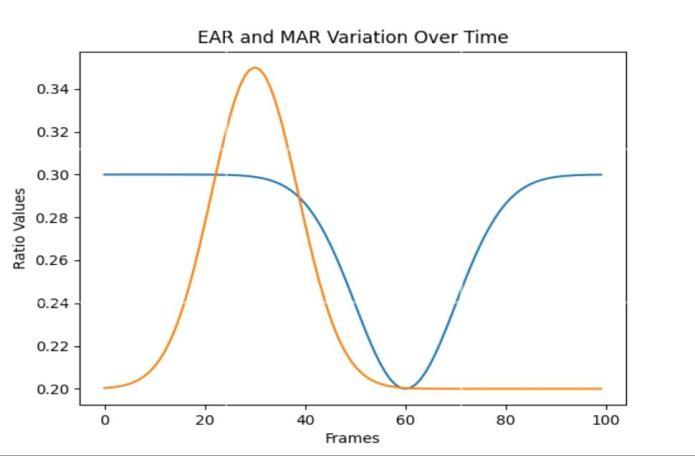
Fig.2 Illustratestheperformanceofthesystembyanalyzing variationsinEyeAspectRatio(EAR)andMouthAspectRatio (MAR) over consecutive frames. The results show that the systemeffectivelydistinguishesbetweennormalanddrowsy statesbasedontheseparameters.
The system performs well when facial features are clearly visibleandlightingconditionsarestable.Itaccuratelydetects prolonged eye closure and frequent yawning, which are strongindicatorsoffatigue.Minordeviationsmayoccurin cases of extreme lighting changes or significant head movement,butoveralldetectionremainsconsistentdueto continuous frame analysis. the system shows stable performance during normal driving conditions where the drivermaintainsarelativelysteadyposture.Theuseofboth EAR and MAR helps in improving detection reliability by consideringmultipleindicatorsoffatigueinsteadofrelying on a single feature. The system is also able to handle commonvariationssuchasblinking,slightfacialmovements, andthepresenceofspectacleswithoutsignificantlyaffecting accuracy.
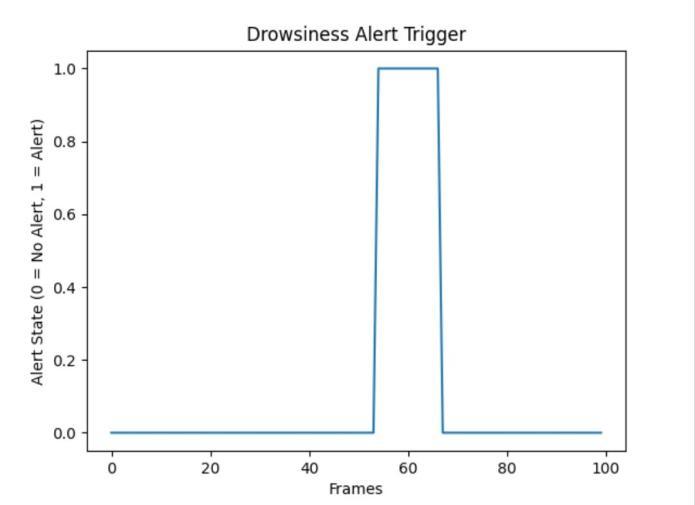
Fig -5:Alertgenerationperformancebasedondetected drowsinessevents
Fig. 5 presentsthesystem’sabilitytogeneratealertsbased ondetecteddrowsinessconditions.Theresultsindicatethat alerts are triggered correctly when EAR and MAR cross predefinedthresholdsforaspecificduration.
The alert mechanism works effectively in real-time and provides immediate feedback to the driver. In most cases, alerts fall within accurate detection scenarios, while occasional delaysmayoccurdue torapidchangesinfacial expressions. However, the use of continuous monitoring
helpsinreducingfalsealertscausedbynormalblinkingor short-termmovements.
The overall performance of the DrowsyShield system is summarized using standard evaluation metrics, as shown below:
The detectionaccuracy of93.2%indicates thatthe system correctlyidentifiesmostdrowsinessevents.Precisionreflects thesystem’sabilitytoavoidfalsealerts,ensuringwarnings are meaningful and not excessive. Recall shows how effectively the system detects actual fatigue conditions, minimizingmissedcases.TheF1scoreprovidesabalanced measurebycombiningprecisionandrecall,indicatingstable andreliableoverallperformanceofthesystem.Overall,these metrics demonstrate that the system maintains a good balancebetweenaccuracyandresponsiveness.Thismakesit suitableforreal-timeapplicationswheretimelyandcorrect detectionisimportant.
The evaluation results confirm that DrowsyShield can provide accurate and real-time drowsiness detection. The combinationofEARandMARimprovesreliabilitycompared tosingle-parametersystems,whilecontinuousframeanalysis enhancesstability.
Although minor limitations exist under challenging conditions such as low lighting or occlusions, the system maintains consistent performance in most practical scenarios. These results highlight the effectiveness of DrowsyShieldasasimple,efficient,andscalablesolutionfor improvingdriversafety.
DrowsyShieldpresentsaneffectiveandtechnology-driven approach to improving road safety by detecting driver drowsinessusingcomputervisiontechniques.Thesystem continuously monitors the driver’s facial features in real time, eliminating the need for any wearable devices, and
International Research Journal of Engineering and Technology (IRJET) e-ISSN: 2395-0056
Volume: 13 Issue: 04 | Apr 2026 www.irjet.net p-ISSN: 2395-0072
convertsvisualinputsintomeaningfulindicatorsoffatigue. ByutilizingEyeAspectRatio(EAR)andMouthAspectRatio (MAR), the system accurately identifies signs such as eye closureandyawning,therebyreducingtheriskassociated withdelayedhumanreactionduringdriving.
Theuseofastructuredprocessingpipelineensuresthatraw video input is systematically converted into actionable insights. Facial landmark detection enables precise extraction of eye and mouth regions, which improves the consistencyofdetection.Thisapproachnotonlyenhances system performance but also ensures reliable monitoring under normal driving conditions, ultimately supporting timelyalertgenerationandreducingaccidentrisks.
A key strength of DrowsyShield lies in its non-intrusive design and real-time capability. The system operates efficientlywithoutrequiringadditionalhardwareorcomplex setup, making it suitable for practical deployment. Continuousframeanalysisandthreshold-basedevaluation contribute to stable performance, even in the presence of minorvariationssuchasblinkingorslightheadmovement.
Despite its effectiveness, the system may face limitations underextremeconditionssuchaspoorlighting,occlusions, orsignificantheadrotations.However,thesechallengescan be addressed through further improvements such as advancedimageprocessingtechniquesandtheintegrationof morerobustdetectionmodels.
In conclusion, DrowsyShield demonstrates the practical potential of using computer vision for real-time driver monitoring.Thesystemoffersasimple,reliable,andscalable solutionfordetectingdrowsinessandenhancingroadsafety. By combining efficiency with ease of implementation, it contributestowardsreducingaccidentsandpromotingsafer drivingpractices.
The DrowsyShield system can be further enhanced by improving its performance under challenging conditions suchaslowlightingandvaryingcameraangles.Integration ofadvancedimageprocessingtechniquescanhelpinbetter detection of facial features even in dim environments. Additionally,incorporatingadaptivethresholdingcanmake the system more flexible to different users and driving conditions.
Future developmentmayalsoinclude integration with invehiclesystemstoenableautomaticsafetyactionssuchas reducing vehicle speed or activating warning signals. Deployment as a mobile or embedded application, along withcloud-basedsupport,canimprovescalabilityandallow thesystemtobeusedacrossdifferentplatforms.Additional featuressuchasheadposedetection,gazetracking,andrealtime driver behavior analysis can further strengthen the system’s capabilities. The inclusion of data logging and analyticscanhelpinmonitoringdriverpatternsovertime, therebyimprovingsystemperformanceandmakingitmore effectiveforlong-termusage.
[1]O. F. Hassan et al., “Real-Time Driver Drowsiness DetectionUsing TransformerArchitectures:ANovel Deep LearningApproach,”ScientificReports,vol.15,2025.
[2]Z.AlArnaoutetal.,“ExploitingHeartRateVariabilityfor DriverDrowsinessDetectionUsing Wearable Sensors and MachineLearning,”ScientificReports,vol.15,2025.
[3]T. Fonseca and S. Ferreira, “Drowsiness Detection in Drivers: A Systematic Review of Deep Learning-Based Models,”AppliedSciences,vol.15,no.16,2025.
[4]S. Essahraoui et al., “Real-Time Driver Drowsiness DetectionUsingFacialAnalysis andMachineLearningTechniques,”Sensors,vol.25,no.3, 2025.
[5]P.S.Lambaetal.,“DetectionofDriverDrowsinessUsing AdaptiveEyeCharacteristicRatioforEnhancedRoadSafety,” IEEEAccess,2024.
[6]S.Díaz-Santosetal.,“DriverIdentificationandDetection ofDrowsinesswhileDriving,”AppliedSciences,vol.14,no.6, 2024.
[7]M. E. Shaik, “A Systematic Review on Detection and PredictionofDriverDrowsiness,”TransportationResearch InterdisciplinaryPerspectives,vol.21,2023.
[8]A.Kumaretal.,“DriverDrowsinessDetectionandSmart AlertingUsingDeepLearningandIoT,”InternetofThings, vol.22,2023.