
International Research Journal of Engineering and Technology (IRJET) e-ISSN: 2395-0056
Volume: 13 Issue: 03 | Mar 2026 www.irjet.net p-ISSN: 2395-0072

International Research Journal of Engineering and Technology (IRJET) e-ISSN: 2395-0056
Volume: 13 Issue: 03 | Mar 2026 www.irjet.net p-ISSN: 2395-0072
1 Dr. Sri Hari Nallamala, 2 Mathi Darshini Sai, 3Miriyala Nandu Vasanthi, 4 Mudavath Yamuna Bai , 5 Narnepati Dieckman Sandeep
Professor, Department of CSE, Vasireddy Venkatadri Institute of Technology, Nambur, Guntur Dt., Andhra Pradesh UG Students, Department of CSE, Vasireddy Venkatadri Institute of Technology, Nambur, Guntur Dt., Andhra Pradesh
Abstract - Cotton (Gossypium hirsutum) is one of the most important commercial crops, and its productivity is severely affected by leaf diseases and pest infestations. Early and accurate identification of these diseases is essential to minimize crop loss and improve agricultural yield. This work presents an intelligent system for automated cotton leaf disease detection using deep learning techniques. An EfficientNetV2-based convolutional neural network was developed to classify cotton leaf images into eight categories, including healthy and diseased classes. The dataset was preprocessed using resizing, normalization, and data augmentationtoimprovemodelgeneralizationandaccuracy.
The proposed model was trained using transfer learning to achieve high performance with reduced computational complexity. After training, the model was integrated into a real-time web application named CottonCare AI using the Streamlit framework. The system allows farmers to upload cotton leaf images and receive instant predictions with confidencescores.Inaddition,aLargeLanguageModel(LLM)based agricultural chatbot powered by Google Gemini 2.5 Flashwasincorporatedtoprovideguidanceondiseasecauses, symptoms, treatment, and prevention through natural languageinteraction.
Experimental results demonstrated that the EfficientNetV2 model achieved high classification accuracy and reliable performance across multiple cotton disease categories. The developed system provides a fast, low-cost, and user-friendly solution for early cotton disease detection and intelligent decision support, thereby promoting sustainable smart agriculture
Keywords Cotton, Gossypium hirsutum, Leaf Disease Detection, Deep Learning, EfficientNetV2
Cotton, often referred to as “white gold” due to its high economic value, plays a vital role in both the agricultural economy and the global textile industry. Millions of farmers rely on cotton cultivation for their livelihood, making it a cornerstone of rural economies in many regions. However, cotton crops are highly susceptible to a wide variety of
diseases and pest infestations, such as bacterial blight, powderymildew,aphidinfestations,andarmywormattacks, whichcanseverelyreducebothyieldandfiberqualityif not detectedandmanagedpromptly[1],[2].
Traditional methods of cotton disease detection primarily involve manual field inspections conducted by agricultural experts.Whileeffectivetosomeextent,thisapproachisoften time-consuming, subjective, and not always accessible, particularly in remote or rural farming areas [3]. Furthermore, many cotton diseases exhibit visually similar symptoms, which makes accurate identification challenging even for experienced farmers. Delays in identifying and treating these diseases can lead to substantial crop damage, reduced market value, and significant financial losses for farmers[3].
Recent advancements in artificial intelligence (AI) and computer vision have enabled automated and precise diseasedetectionusing deeplearningmodels.Convolutional neural networks (CNNs), in particular, have shown remarkable success in image classification tasks, including plantdiseaserecognition[1]–[4].Thesetechniquesprovidea faster, more accurate, and scalable alternative to traditional manualinspectionmethods,allowingforreal-timedetection andtimelyintervention.
Inthisresearch,weproposeanautomatedsystemforcotton leaf disease detection utilizing EfficientNetV2, a lightweight yet highly accurate CNN architecture [2]. The system is designed to classify cotton leaf images into multiple categories, including healthy and diseased classes, thereby providing immediate and reliable diagnostic information. To enhancepracticalusability,thesystemisdeployedthrougha user-friendly web application, which enables farmers to receivepredictionsinrealtime.
Additionally, a Large Language Model (LLM)-based conversational assistant, powered by Google Gemini 2.5 Flash, has been integrated into the system to provide interactive guidance regarding disease causes, symptoms, treatment strategies, and preventive measures [5]. By combining computer vision with generative AI, this hybrid approachoffersanend-to-endsolutionforsmartagriculture,
International Research Journal of Engineering and Technology (IRJET) e-ISSN: 2395-0056
Volume: 13 Issue: 03 | Mar 2026 www.irjet.net p-ISSN: 2395-0072
enabling early disease detection and informed decisionmakingbyfarmers.
The remainder of this paper is organized asfollows: Section II presents a literature survey highlighting prior work in plant disease detection; Section III details the methodology including data preprocessing, model training, system deployment, and user interaction; Section IV discusses the experimental results and model performance; and Section V concludes the paper with key findings and directions for futurework.
Several researchers have explored the use of deep learning techniques for plant disease detection, demonstrating the potentialofartificialintelligenceinagriculture.Earlystudies primarily employed convolutional neural network (CNN) architecturessuchasAlexNet,VGG16,andResNettoclassify plant leaf images into different disease categories. These modelsachievedgoodaccuracyinidentifyingplantdiseases, indicating the feasibility of automated detection [1], [3]. However, these traditional CNN architectures often required substantialcomputationalresourcesandlongtrainingtimes, which posed challenges for deployment in real-world agriculturalenvironmentswhereresourcesmaybelimited.
To address these computational limitations, recent research has introduced lightweight architectures, including MobileNet and EfficientNet, which aim to balance accuracy with efficiency. EfficientNet, in particular, utilizes a compound scaling method to simultaneously scale network depth, width, and input resolution, thereby achieving superior accuracy while maintaining a relatively small number of parameters [2]. These lightweight architectures have shown promising results across various plant species, includingcotton,maize,andtomato,demonstratingthathigh accuracycanbeachievedwithoutthecomputationalburden oflargerCNNmodels.
Despite these advancements, most existing systems focus primarily on classification accuracy and often lack real-time deploymentcapabilitiesorinteractivesupportforendusers, such as farmers [4]. Many studies report high accuracy on benchmark datasets, but they do not address practical challenges, including variability in field conditions, image quality, and the need for actionable guidance after disease detection.Additionally,veryfewstudiesintegrateautomated disease detection with advisory systems that provide information on treatment, prevention, or management strategies.
This research addresses these gaps by combining an EfficientNetV2-based classification model with a Large
Language Model (LLM)-powered agricultural assistant. The approach ensures not only accurate automated detection of cottonleafdiseasesbutalsointeractiveguidanceforfarmers regarding disease causes, symptoms, treatment methods, and preventive measures. By integrating a real-time, userfriendly system, this work extends beyond traditional classificationmodelstoprovideacomprehensivesolutionfor smartagriculture.
The proposed system for automated cotton leaf disease detection consists of four main stages: data preprocessing, model training, system deployment, and intelligent user interaction.
In this study, cotton leaf images belonging to eight distinct categories, including healthy and various diseased classes, were collected and organized into training datasets.
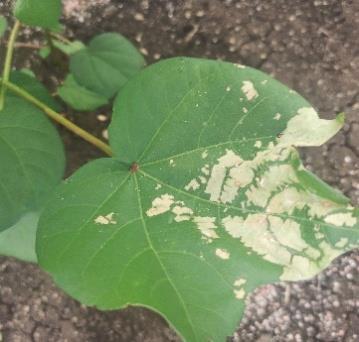
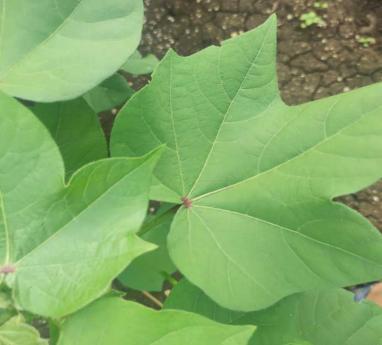
In this study, cotton leaf images belonging to eight distinct categories, including healthy and various diseased classes, were collected and organized into training and validation datasets. The dataset was carefully curated to ensure that each class contained a sufficient number of representative images, which is essential for effective model training and reliable evaluation. Tomaximizethediversityofthetraining dataandreducepotential bias,thedataset wasdivided such that the majority of images were used for training, while a smaller portion was reserved for validation to assess the model’sperformanceonunseensamples.
Before feeding the images into the model, several preprocessing steps were applied to standardize and enhance the data. Initially, all images were resized to a consistent resolution to ensure compatibility with the input requirementsoftheEfficientNetV2model.Thisresizingstep also helps in reducing computational complexity during training. Subsequently, image normalization was performed to scale pixel intensity values to a uniform range, which
International Research Journal of Engineering and Technology (IRJET) e-ISSN: 2395-0056
Volume: 13 Issue: 03 | Mar 2026 www.irjet.net p-ISSN: 2395-0072
stabilizes the learning process and improves convergence duringoptimization.
To further enhance the model’s ability to generalize across different scenarios, various data augmentation techniques were applied. These included random rotations, horizontal flipping, zooming, and shifting. Random rotations allow the model to recognize leaves in different orientations, horizontal flipping simulates variations in leaf positioning, zooming enables the model to handle different scales, and shifting addresses positional variability within the images. Byapplyingtheseaugmentationtechniques,thedataset was effectively expanded, reducing the risk of overfitting and improving the robustness of the model across diverse input conditions.
These preprocessing steps ensured that the input data fed into the EfficientNetV2 model was both standardized and diverse, which is critical for achieving high classification accuracy across all eight classes of cotton leaf conditions. Overall, careful attention to data preprocessing lays the foundation for effective model training and reliable performanceinreal-worldapplications.
For the task of cotton leaf disease classification, EfficientNetV2B0 was selected as the base model due to its combination of high accuracy and low computational complexity [2]. EfficientNetV2 is a modern convolutional neuralnetworkarchitecturethatemployscompoundscaling, simultaneously balancing network depth, width, and input resolution to optimize both performance and efficiency. The B0 variant, being the smallest and most lightweight version of the EfficientNetV2 family, was chosen to ensure faster training times while maintaining robust feature extraction capabilities, making it particularly suitable for real-time agricultural applications with limited computational resources.
To leverage prior knowledge and accelerate model convergence, transfer learning was applied using pretrainedweightsfromtheImageNetdataset[3].Byinitializing the network with these pre-trained weights, the model can utilize previously learned features, such as edge detection and texture patterns, which are transferable to the task of cotton leaf disease classification. This approach reduces the amount of training data required and enhances the model’s abilitytogeneralizeeffectivelytounseensamples.
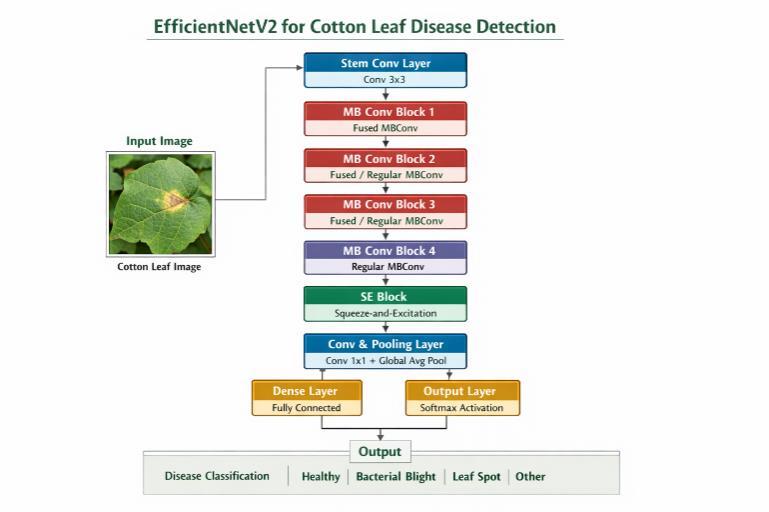
The EfficientNetV2B0 model was trained using transfer learning with pre-trained ImageNet weights to leverage existing feature representations. Only the top layers were fine-tuned for cotton leaf disease classification, allowing the model to adapt to the specific dataset while retaining generalized feature extraction. The network was trained using the Adam optimizer with categorical cross-entropy loss, and data augmentation techniques such as rotation, flipping, zooming, and shifting were applied to improve robustness. This approach enabled efficient training with high accuracy while keeping computational requirements low,makingitsuitableforreal-timeagriculturalapplications.
ThetrainedEfficientNetV2B0modelwasdeployedthrougha web application named CottonCare AI using the Streamlit framework, providing an accessible platform for farmers to utilizethediseasedetectionsystem.Userscansimplyupload images of cotton leaves, and the system delivers real-time predictions along with confidence scores for each disease category.Theinterfaceisdesignedto beintuitive, with clear instructionsandvisual feedback,making itsuitable evenfor users with limited technical expertise. To ensure practical usability in agricultural environments, the application was optimized for fast inference, leveraging the lightweight nature of EfficientNetV2B0 to deliver accurate results without requiring high-end hardware. In addition to imagebased disease detection, the system is structured to seamlessly integrate with the Large Language Model-based agricultural assistant, enabling users to receive detailed guidance on disease symptoms, causes, treatment, and preventive measures. By combining automated diagnosis with interactive advisory support, the deployed system provides a comprehensive, low-cost, and real-time solution
International Research Journal of Engineering and Technology (IRJET) e-ISSN: 2395-0056
Volume: 13 Issue: 03 | Mar 2026 www.irjet.net p-ISSN: 2395-0072
forearlycottondiseasemanagement,promotingsustainable farmingpracticesandinformeddecision-making..
To enhance the utility of the CottonCare AI system beyond automated disease detection, a Large Language Model (LLM)-powered agricultural assistant, based on Google Gemini 2.5 Flash,wasintegrated.Thisassistantservesasan interactive virtual advisor, providing farmers with detailed, real-time guidance related to cotton leaf diseases. When a farmer uploads an image, the EfficientNetV2B0 model first predictsthediseasetypeandassignsaconfidencescore.The detected disease name, along with any additional queries fromtheuser,isthenprocessedbytheLLMchatbot.Usinga hybrid retrieval–generation approach, the system accesses a local knowledge base containing verified agricultural data andsupplementsit withgenerativeresponsesfromthe LLM toanswermorecomplexorunforeseenquestions.
Theassistantprovidescomprehensiveinformationincluding disease symptoms, possible causes, treatment recommendations, and preventive measures, enabling farmers to make informed decisions for crop management. The conversational interface is designed to be user-friendly, supportingnaturallanguageinteractionsothatuserscanask questions in their own words without needing technical expertise. Furthermore, the system prioritizes accuracy and reliability by cross-verifying the information generated by theLLMwiththecuratedknowledge base,reducingtherisk ofmisinformation.
By integrating the image-based detection module with an intelligent advisory assistant, the CottonCare AI platform offers an end-to-end smart agriculture solution. Farmers not only receive instant disease diagnoses but also gain actionable guidance for treatment and prevention, promoting early intervention, reducing crop loss, and supporting sustainable agricultural practices. This combination of deep learning for classification and generative AI for advisory support represents a significant advancement over conventional plant disease detection systems, which typically provide only class labels without practical recommendations. The LLM-based assistant also allows farmers to ask follow-up questions after receiving an initial prediction, creating an interactive and adaptive advisory experience. making, such as suggesting targeted pesticideapplicationorcultural practicestopreventdisease spread.
The EfficientNetV2B0 model demonstrated robust performance in classifying cotton leaf diseases across all
eight categories, including healthy and various diseased classes. During training, the model achieved rapid convergence due to the application of transfer learning with ImageNetpre-trainedweights,alongwithdataaugmentation techniquesthatenhancedgeneralization[2],[3].Asshownin Figure 3, the training and validation accuracy steadily increasedovertheepochs,withminimaldivergencebetween the two curves, indicating effective learning and reduced overfitting.Thefinalvalidationaccuracyreachedahighlevel, demonstratingthemodel’sabilitytogeneralizeeffectivelyto unseenleafimages.
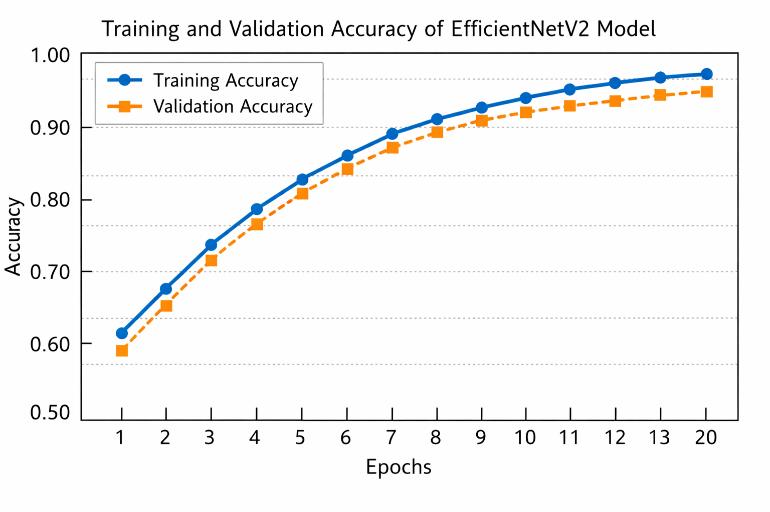
Fig .3 .TrainingandValidationAccuracyofEfficientNetV2 Model
A detailed analysis using the confusion matrix (Figure 4) revealed that most misclassifications occurred between visuallysimilardiseasecategories,suchasdifferenttypesof leaf spot infections. However, the overall misclassification rate was minimal, reflecting the model’s precise feature extractionanddiscriminativecapability.Precision,recall,and F1-score values were consistently high across all classes, highlighting balanced performance and reliable detection without bias toward any particular category. These results suggest that EfficientNetV2B0 is well-suited for multi-class cottondisease
When compared to traditional CNN architectures such as AlexNet[1],VGG16[1],andResNet[1],theEfficientNetV2B0 modelachievedsuperioraccuracywhilemaintainingalower parameter count, resulting in faster inference and reduced computational requirements. This efficiency is crucial for deploymentinreal-timeapplications,particularlyinruralor resource-limitedsettings wherehigh-performancehardware may not be available. Additionally, the combination of a lightweight architecture with data augmentation and transfer learning enabled the model to perform effectively
International Research Journal of Engineering and Technology (IRJET) e-ISSN: 2395-0056
Volume: 13 Issue: 03 | Mar 2026 www.irjet.net p-ISSN: 2395-0072
even with a relatively small dataset, reducing the need for extensivedatacollection[2],[3].
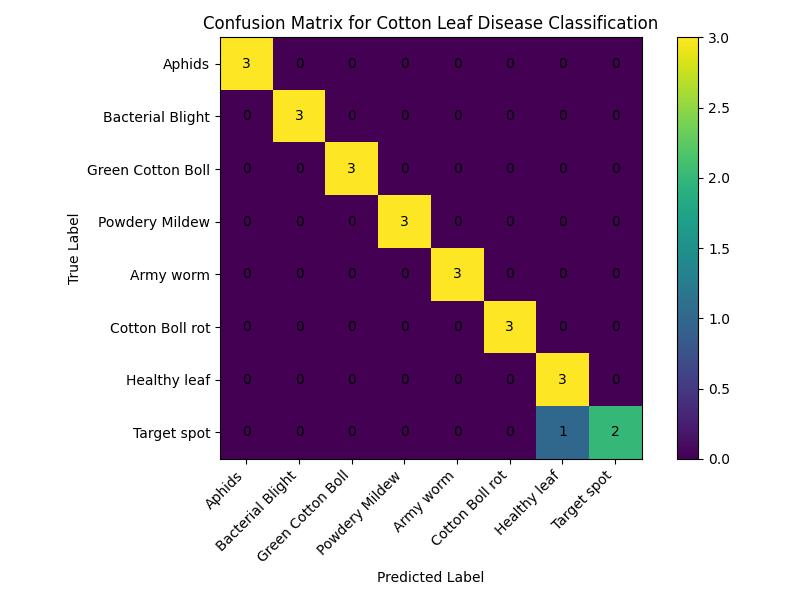
Fig . 4 .ConfusionMatrixofEfficientNetV2forCottonLeaf DiseaseClassification
Beyond image classification, the integration of the LLMbased chatbot powered by Google Gemini 2.5 Flash significantly enhanced the practical utility of the system [5]. Unlike conventional disease detection systems that output only a class label, the Cotton Care AI platform provides farmers with actionable insights, including disease symptoms, causes, treatment options, and preventive strategies.Thishybridapproachofcombining deep learning fordetectionandgenerativeAIforadvisorysupportensures that users can make informed decisions promptly, thereby reducing crop losses and supporting sustainable farming practices.
Overall, the experimental results validate that the proposed system offers a comprehensive, accurate, and user-friendly solution for early cotton leaf disease detection. The combination of EfficientNetV2B0’s high classification performancewithanintelligentLLM-basedadvisorymodule representsasignificantadvancementoverexistingmethods, bridgingthegapbetweenautomateddetectionandpractical agricultural guidance. These findings underscore the potential of AI-powered systems to transform traditional agricultural practices into smart, data-driven, and sustainableoperations.
This research presented an intelligent cotton leaf disease detectionsystemusingEfficientNetV2integratedwitharealtime web application. The system accurately classifies eight
cotton leaf conditions and provides interactive agricultural guidancethroughanLLM-basedchatbot.
A key novelty of this work is the integration of a Large Language Model-based agricultural assistant powered by Google Gemini 2.5 Flash with deep learning-based image classification. This hybrid architecture enables both automated disease detection and intelligent advisory support.
The proposed system reduces dependence on manual inspection and enables early disease diagnosis, thereby minimizing crop losses. Future work may include mobile application development and expansion to additional crop species.
[1] A. Krizhevsky, I. Sutskever, and G. Hinton, “ImageNet classification with deep convolutional neural networks,” AdvancesinNeuralInformationProcessingSystems,2012.
[2]M.TanandQ.Le,“EfficientNet:Rethinkingmodelscaling for convolutional neural networks,” Proceedings of the InternationalConferenceonMachineLearning,2019.
[3] P. Mohanty, D. Hughes, and M. Salathe, “Using deep learning for image-based plant disease detection,” Frontiers inPlantScience,2016.
[4] S. Sladojevic et al., “Deep neural networks for plant disease recognition,” Computational Intelligence and Neuroscience,2016.
[5]T.Brownetal.,“Languagemodelsarefew-shotlearners,” AdvancesinNeuralInformationProcessingSystems,2020.
© 2026, IRJET | Impact Factor value: 8.315 | ISO 9001:2008 Certified Journal | Page2137