
International Research Journal of Engineering and Technology (IRJET) e-ISSN: 2395-0056
Volume: 12 Issue: 12 | Dec 2025 www.irjet.net p-ISSN: 2395-0072
International Research Journal of Engineering and Technology (IRJET) e-ISSN: 2395-0056
Volume: 12 Issue: 12 | Dec 2025 www.irjet.net p-ISSN: 2395-0072
Rajsi Sinha1, Priya Chauhan2, Ritika Kumari3
1Student, KCC Institute of Technology, Greater Noida, Uttar Pradesh, India
2Student, KCC Institute of Technology, Greater Noida, Uttar Pradesh, India
3Student, KCC Institute of Technology, Greater Noida, Uttar Pradesh, India
Abstract - Natural disasters have been a significant concern to the affected communities. This is because they interfere with the lives of the people and restrict the channels to which they have access for relief. The available systemsondisastermanagementfunctioninsilos,leadingto disjointed communication and delayed reporting [1] [2] [6], thereby causing a situation of mis-coordination among victims, NGOs, and authorities. This paper presents ResQHub, a web-based disaster relief and resource management system designed to connect citizens, volunteers,NGOs,andauthoritiesona unifiedplatform.The system enables users to report incidents with location details, after which automated notifications are sent to concerned authorities. Administrators can assign rescue teams, while NGOs update the status of resource distribution, such as food, medicine, and shelter. Built using the MERN stack (MongoDB, Express.js, React, Node.js) [20], ResQHub implements a novel four-stage validation pipeline called SCSDA-DM (Semantic Crisis Similarity & Disaster Assessment -Disaster Module) toensure report authenticity and prioritization [5][18]. A context-aware information retrieval system [15] enhances decision-making by providing relevant historical and environmental data. It provides real-time insights to victims through specific dashboards, enabling them to monitor their requests’ status through customized interfaces. Moreover, it ensures smooth flow of communication, thus curtailing delays associated with manual intervention, to make ResQHub disaster responseeffortsevenmoreeffectiveandwell-organized.
Index Terms: Disaster Response, Incident Reporting, Resource Allocation, Coordination of Emergencies, Real-time Dashboard, Rescue Team Allocation, Cooperation between NGOs, Crisis Response, SCSDADM Validation Pipeline
Naturalandman-madedisastersstillposeathreatintheir effectsnotonlyinthecommunitybutinregardtothelives of humans as well. The rising occurrence of floods, earthquakes, landslides, industrial disasters, and fire disasters has made one realize the susceptibility of the human population in the world. Many disasters can be attributed to population growth, unplanned development, rapidurbanization,andclimatechange[1].
Millions of people are impacted annually by delayed communication, a lack of preparation, and ineffective coordination[1][3]amongreliefauthorities,according to reportsfrominternationaldisasteragencies[2][8]. These findings highlight the necessity of a more structured and successfulapproachtodisastermanagement.
Traditional disaster response strategies are largely dependent on offline reporting systems or the use of telephonic communication or physical meetings with the authorities. In actuality, victims face a challenge while getting the most basic communication from the relevant entityconcerningthedisasterspecifics,suchasthelevelof severityoftheincidentortheir exactposition.Itbecomes difficult for governments and non-governmental institutions to immediately provide assistance since they receiveinformationinbits[6][8].
Current systems have a number of serious drawbacks:
1. Fragmented Communication: Itbecomesdifficultto achieve unified situational awareness because of reports coming from scattered sources (Helplines, SocialMedia,andOfflineGrievances)[6][7].
2. Manual Verification Delays: In fast-disaster situations, the decision-making process gets delayed bypaper-basedmethods[6][13].
3. Uncoordinated Activities: There are gaps in rescue efforts, owing to the fact that different agencies employdifferentdataplatforms[8].
4. Lack of Resource Visibility: The authorities cannot track the availability of the resources and the help beingprovidedtotheaffectedareas[9][16].
5. Victim Information Gap: Due to a lack of information,victimsareuninformedaboutthestatus of their rescue, and this leads to anxiety, with repeatedreporting[7][10].
Realevents,likethecollapseoftheUttarkashi Tunnel in 2025 [2] [13], draw to a unified digital platform [20] that will help speed up the process and integrate relief
International Research Journal of Engineering and Technology (IRJET) e-ISSN: 2395-0056
efforts. The absence of such an integrated mechanism is further causing delay, fragmented communication, and hurdlesinintegratingreliefefforts.
This paper presents ResQHub, a holistic web-based disaster management platform that addresses these limitationsthrough:
1. Asinglereportinginterfaceforthestakeholders.
2. A new four-stage validation pipeline, called SCSDA-DM, for report verification and prioritization.
3. Context-aware information retrieval to aid better Decision-making.
4. Real-time Dashboards for victims, NGOs, responders, andadministrators.
5. Structuring the work processes for assigning the teamsandcoordinatingresources.
6. Complete case tracking with automated status updates.
The rest of the paper is organized as follows: Section II discusses the related work available for the area of disaster management system design, Section III discusses the system architecture and design, Section IV covers the methodology and the proposed SCSDA-DM pipeline, Section V discusses the implementation, and finally Section VI offers a result discussion and future improvements.
Disaster management systems have witnessed a remarkable evolution throughout the last ten years, and different techniques are applied to different aspects of coordinationduringemergencies.
Several solutions have been created to facilitate the operations involved in disaster response. The Disaster Response Reporting Platform created by the National Disaster Management Authority (NDMA) has a central reporting system along with guidelines issued by the government, although it is plagued by manual reporting andupdateissues[2].Google’sCrisisMaphasanexcellent mapping facility, but it is devoid of case reporting functionality[4].
Sahana Disaster Management System: It is an integrated system with resource management as well as volunteer management. However, it does not have effective coordination processes, and it even lacks processes to update victim status [5]. The Global Disaster Alert and Coordination System (GDACS) have world-wide alert and natural hazard alerts. However, it lacks processes to reportincidentsinvolvingcasesinparticularareas,which enableuserstotrackcases[1].
Unverified reports by citizens, as well as the issue of disseminated communication channels, were raised by Palen et al. [6]. This paper mainly focuses on the importance of report verification procedures for noise removal and the filtration of actual reports. Inaccurate reportingbythevictims,whichcausesconfusion,hasbeen discussedbyKauretal.[7].
In a related development, coordination failure studies carried out by Mehta & Zhao in [8] established that there areconsiderabledelaysindisasterreliefeffortsduetothis typeoffailureintheinvolvedagencies.Theycitedthefact that the absence of a shared dashboard inhibits simultaneous activities between the police, hospitals, firefightingunits,andNGOs.
Alonsoetal.[9]addressedtheissuesofdelaysinresource distributioninhumanitarianlogistics.Thisstudyindicates thatifthereisresourcevisibilityinrealtimeandresource allocation based on location can provide beneficial assistance to the affected population. World Health Organization [10] focused on social vulnerabilities whereby the aged and distressed persons struggle with complexreportingsystems.
There has been recent progress in the area of web technology and real-time systems that have made it possibletohaveresponsivesystemsformanagingdisaster situations. Roy and Fernandes [11] worked on implementing deep learning concepts in communication systems during emergency situations, whereas Hassan [12] focused on the concept of real-time images for the detectionofdisasterseverity.
Results of our analysis show some major weaknesses of currentsolutions:
● Lackofavailableorganizedandnormalizedreport templates
● Not real-time status is available regarding the victims
● Lackofabilitytocoordinateamongstakeholders
● Limited resource visibility and resource managementcapabilities
● Accessibility problems faced by the vulnerable groups
● Novalidationprocessesregardingtheauthenticity oftheintegratedreport[6][8][9][10]
Volume: 12 Issue: 12 | Dec 2025 www.irjet.net p-ISSN: 2395-0072 © 2025, IRJET | Impact Factor value: 8.315 | ISO 9001:2008 Certified Journal | Page 1053
International Research Journal of Engineering and Technology (IRJET) e-ISSN: 2395-0056
Volume: 12 Issue: 12 | Dec 2025 www.irjet.net p-ISSN: 2395-0072
We propose Validated AI Learning Theory (VALT), synthesizing four established learning theories for AIenhancededucation[2,18].
ResQHubisbasedonalayeredarchitecture,whichbreaks downthesystemintodistinctcomponentsoftheplatform. This allows the platform to be stable, secure, and have efficient interaction between the front-end, back-end, and databaselayers.Thesystemusesamodularityapproachin designphilosophy.
TheResQHubarchitectureconsistsofsixprimarylayers:
1. Frontend Layer: The front-end presentation layer is built with React.js and powered by TailwindCSS,assisting increatinga responsive& intuitive interface. The primary functionalities are:
● role-based dashboards for victims, nongovernmental organizations, response teams
● GPS-enabledincidentreportingforms
● Real-timetrackingstatusinterfaces
● InteractiveMapVisualization
● Mobile-responsive design for field accessibility
2. API Layer: The API layer is an interface bridge that enables communication between frontend components and backend services. The API layer contains:
● RESTfullAPIendpointsforalloperations
● JWT-basedauthenticationmiddleware
● Requestvalidationandsanitization
● Ratelimitingandsecuritycontrols
● Errorhandling
3. Backend Logic Layer: Developed using Node.js withtheExpress.jsframework,theBackendLayer handlesthefundamentallogicofthebusiness:
● Reportvalidationofincidents
● Rescueteamassignmentalgorithms
● ResourceAllocationWorkflows
● Statusupdatepropagation
● Role-basedaccesscontrol(RBAC)
● Notificationgenerationanddispatch
4. Data Persistence Layer: Mongo DB with Mongoose ODM is providing the infrastructure for:
● Adaptable schema design for incident reports
● Effectiveindexingforlocationqueries
● User information & authentication informationstorage
● Resourceinventorymanagement
● Casehistoryandaudittrails
5. Infrastructure Layer: This is responsible for ensuringtheavailabilityandperformance:
● FrontenddeploymentusingNetlify
● BackendhostingonRender
● CloudStorageforMediaFiles
● Contentdeliveryoptimization
● Basichorizontalscalingsupport
6. Security Layer: Security systems ensure the safetyoftheplatformandtheusers’information:
● SecuredthroughJWT
● Bcryptpasswordhashing
● Role-basedpermissionenforcement
● Inputvalidationandsanitization
● Sessionsecuritymanagement
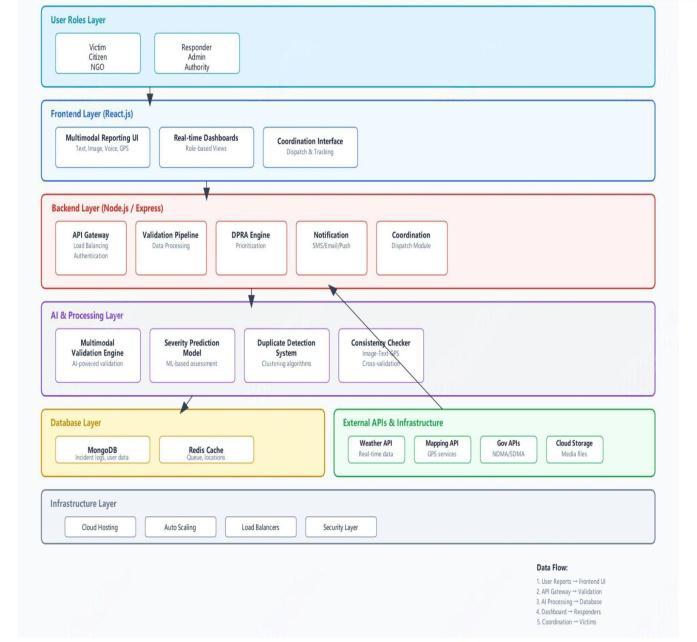
The diagram shows interaction between users, the React Frontend, Node.js/Express backend, MongoDB database, Authenticationmodule,andDashboardsforvictims,NGOs, andAuthorities.
It also uses a structured data flow process from incident notificationtoclose:
1. Incident Reporting: Incidents can be submitted via the web interface through text descriptions, images,andGPSlocationdetails.
2. Validation Pipeline: The reports are submitted tothefour-stepvalidationpipelineinSCSDA-DM.
International Research Journal of Engineering and Technology (IRJET) e-ISSN: 2395-0056
Volume: 12 Issue: 12 | Dec 2025 www.irjet.net p-ISSN: 2395-0072
3. Case Assignment: Validatedcasesareassignedto the relevant authorities through the admin dashboards.
4. Team Dispatch: The dispatch of available team membersaccordingtotheirlocation.
5. Status Updates: Case statuses (accepted, on the way,finished)areupdatedinrealtime.
6. Resource Coordination: NGOs update resource availabilityanddistributionstatus.
7. Victim Tracking: Victims can track the progress of the case through their own personalized dashboards.
ResQHub uses the latest in web technologies that can be quiteappropriateforemergencyresponse:
Table – 1: TechnologyStackofResQHub
Category Technology Purpose
Frontend
React.js, React Router, TailwindCSS
Userinterface development; buildingrole-based dashboards; providingforeasy andsmooth navigation, responsivedesign.
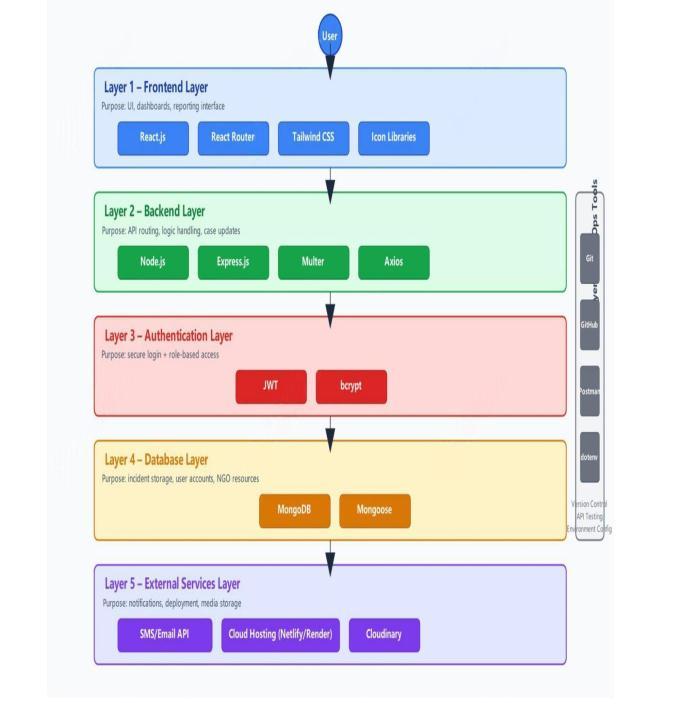
This describes the multi-layer composition of the ResQHub system architecture, detailing how the request from the user navigates through the set of the system's frontend, backend, and database layers. The layered architectural model delineates the system's secure authenticationmechanism,well-organizeddatapath,rolebaseddashboards,andthesecurestorageofdataforrealtimedisasterreporting.
Backend Node.js,Express.js, Multer
Database MongoDB, Mongoose
RESTAPIcreation, routing,report handling
Storingincident reports,userdata, NGOresources,and caseupdates
Authentication JWT(JSONWeb Tokens),bcrypt Secureloginand role-basedaccess.
ExternalServices Cloud Hosting (Netlify,Render) Deployment
DevOps&Tools Git,GitHub, Postman,dotenv
Versioncontrol,API testing,environmental configuration
4.1
The Semantic Crisis Similarity & Disaster Assessment DisasterModule(SCSDA-DM)proposesacompletelynovel validation mechanism for testing and prioritizing the influxofdisasternotificationsforvalidationandarranging theirpriorityfortherescueteamstodealwith.
Validation
All disaster reports submitted for rescue action validation are first passed through a primary check for basic authenticity and completeness concerningthefollowing:
● Verification of GPS coordinates and/or locationinformation
● Assessment of description clarity and completeness
● Imagequalityandrelevancevalidation
● Determinationofmissingcriticalfields
● Preliminaryduplicatedetection Reportswithmissinginformationareidentifiedas
International Research Journal of Engineering and Technology (IRJET) e-ISSN: 2395-0056
Volume: 12 Issue: 12 | Dec 2025 www.irjet.net p-ISSN: 2395-0072
Requiring correction by the user through automated messages. This stage helps eliminate noiseandenabletherespondentstohaverelevant informationonly[6].
2. Stage 2: Contextual & Environmental Consistency Review
Validated reports are compared against such contextualfactorsthat:
● Historical incident patterns in the reportedlocation Locationclosetoknownattractionsand Infrastructure
● Compatibility with the prevailing environmentalconditions
● Cross-refertorecentparallelcases
● Geographicfeasibilitystudy
Reports with discrepancies that are contextdependent proceed to the revivification cycle, where potentially further inputs from the user or fieldvalidationcouldberequired[1][13].
3. Stage 3: Severity Assessment & Risk Identification
systemanalyzestheseverityofanincidentby basedonavarietyoffactors,including:
● Description analysis for urgency indicators
● Location Risk Assessment-flood areas, hightrafficareas
● Analysis of visual evidence from uploadedimages
● Reportedvictimconditionsandinjuries
● Timesensitivityassessment
Each case is identified with a severity level initially,thatis,low,moderate,andhigh.
The Severity Score is S = w1·D + w2·L + w3·T + w4·I
Where:
D =Descriptionurgencyindicator
L =Locationriskfactor
T =Timesensitivity
I =Imageorevidenceavailability w1…w4 =predefinedweights
4.
Validatedandcategorizedincidentsareconverted intostructuredcaseentries:
● Generation of standardized incident cards
● Severity Level Highlighting for Dashboard
Visualization
● Creatingmapmarkerswithlocationview
● Role-specificinformationformatting
● Assigning to appropriate responder queues
Theslidesaredynamic,adjustingaccordingtothe user role (NGO, Responder, or Authority) to ensurethatimportantinformationreachesthem.
Reports that don't pass a validation stage aren't deletedbutgointoafeedbackloop:
● Automated prompting to the user for moreinformation
● Manualreviewqueueforedgecases
● Field verification assignment when necessary
● Refine by iteration until validation requirementsaremet
This will reduce the chances of any important informationbeinglost,thusincreasingthequality ofdatacollection.
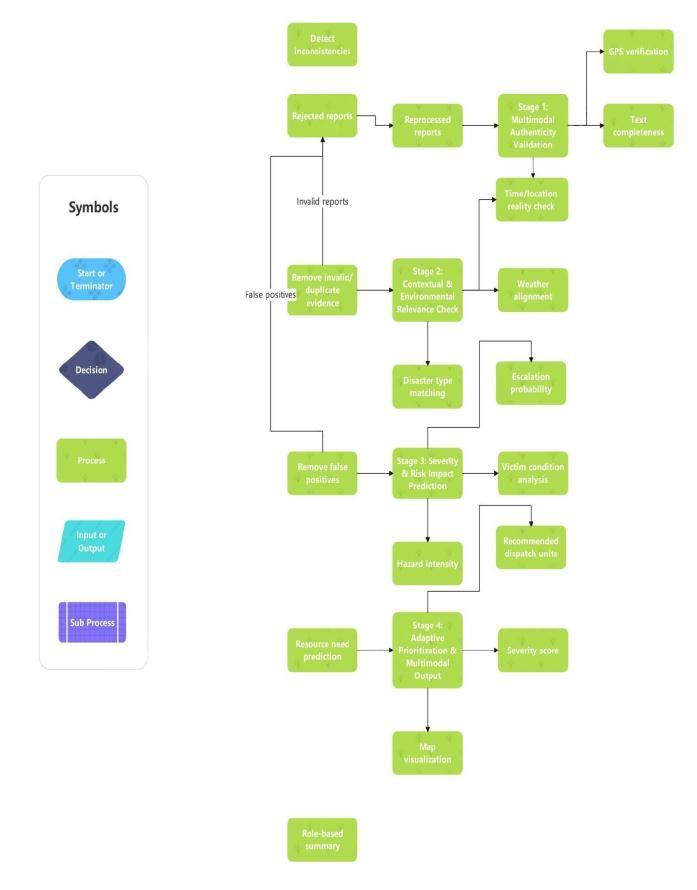
This pipeline includes authenticity, contextual validation, severity assessment, and prioritized output generation. Reportsfailingatanyoftheabovestageswillberoutedto
International Research Journal of Engineering and Technology (IRJET) e-ISSN: 2395-0056
Volume: 12 Issue: 12 | Dec 2025 www.irjet.net p-ISSN: 2395-0072
a re-validation feedback loop for improving the accuracy andreliability.
ResQHub uses a six-level context-aware system for enhancing the quality of the decision-making process by using a structured approach for information retrieval and validation[11][15][18].
1. Stage 1: Input Understanding and Processing
Thissystemrecognizesthenecessarydetailsfrom reportedreports:
● Text descriptions natural language processing
● Coordinateextractionandnormalization
● Imagemetadataanalysis
● Incidentcategoryclassification
● Timestamp and urgency indicator detection
2. Stage 2: Context Retrieval from Internal Databases
Relevantinformationisdrawnupon:
● Historicalincidentrecordsinproximity
● Available NGO resources near the location
● Current roles and responders' accessibility
● Localinfrastructureandlandmarkdata
● Previous response patterns and outcomes
3. Stage 3: Context Ranking and Filtering
The searched information is processed for its relevance.
● Temporal relevance scoring (recent vs. outdated)
● SpatialRelevancebasedonProximity
● Similaritymatchingwithcurrentincident
● Evaluationofoperationalutility
● Filteringofirrelevantorstaledata
4. Stage 4: The system generates well-structured summaries of the global situation
● Description of incident with confirmed location
● Relevanthistoricalcontextandpatterns
● Contingentcapacitiesinthesurrounding regions
● Recommendedresponseactions
● RiskAssessment,Considerations
5. Stage 5: Data Updating and Continuous Improvement
Theknowledgebaseconstantlyaltersdueto:
● Automatic recording of the resolution of newlyfiledincidents
● ResourcestatusupdatesfromNGOinputs
● ResponderLocationTrackingIntegration
● Documentationofcaseoutcome
● Patternrecognitionforbetterpredictions
6. Stage 6: Feedback and Correction Loop
Continuousrefinementtechniquesaddprecision:
● CollectionofResponseFeedbackfor Recommendations
● AnalysisofIncidentOutcomesand Learning
● Use-DependentIdentificationofthe RelevantContextingeneral
● Workflowsforerrordetectionand correction
● Systemoptimizationthatisprogressive
ResQHub follows the Agile development process, which comprisesfourstages:
Phase 1 - Core System: User Authentication Facility, Dashboard that is dependent on Roles of User, Basic IncidentReportSystem,Usercanseehis/hercasesaswell astheirstatus.
Phase 2 - Coordination Upgrade: Status updatesin realtime, task assignments, coordination in authority for NGOs,andnotificationautomation.
Phase 3 - Communication & Workflow: Advanced responder tools, volunteer management, direct communicationsystems,andintegratedalertsystems.
Phase 4 - Deployment & Optimization: The cloud deployment,optimization,andresponsiveness,inaddition to enabling similar functionalities, allow for complex businesstobackupsolutions.
ResQHub has eight primary modules based on its functions:
1. Emergency Reporting Module: Facilitates the processofreportingincidents[7][10].
● TextDescriptionwithStructuredFields
● Feature of image uploading with compression
International Research Journal of Engineering and Technology (IRJET) e-ISSN: 2395-0056
Volume: 12 Issue: 12 | Dec 2025 www.irjet.net p-ISSN: 2395-0072
● AutomaticcaptureofGPScoordinates
● Mobileresponsivenessanddesign
● Offline functionality for synchronization ofqueues
2. Verification & Case Handling Module:
Implements verification pipeline according to SCSDA-DM:
● Verifying algorithms for basic authenticityandcompleteness
● Duplicate detection via similarity matching
● Validation and normalization of the location
● Automated routing to relevant authorities
● Qualityassurancesystems
3. Responder Dashboard Module:
ItallowsCoordinationbythefieldteam:
● Assignedcasequeuedisplay
● Interactivemapwithnavigationaid
● Real-timestatusupdateinterface
● Casecompletionworkflow
● Communication with victims and authorities
4. NGO Resource Management Module:
Helpsinreliefcoordination:
● Resourceinventorymanagement
● Availabilitystatusupdates
● Requestresponsebyauthorities
● Distributiontracking
● Supplycoordinationworkflows
5. Real-Time Coordination Dashboard:
Thisisasituationalawarenesstoolforauthorities:
● Activecaseoverviewwithliveupdates
● Mapcasedisplay
● Responderpositiontracking
● Resourceavailabilitymonitoring
● Teamassignmentinterface
6. Authentication & User Management:
SecureAccessControl:
● JWT-basedStateless
● Role-BasedAccessControl
● bcryptpasswordhashing
● Sessionmanagement
● Userprofilemanagement
7. Geolocation & Mapping Module:
Thismoduleallowstheusertohave:
● Integrationwithmappingservices
● GPSlocationdetection
● Responderroutecomputation
● AffectedAreasClusterIdentification
● Proximity-basedresource
8. User Interface/UX Module:
Improvesusabilityduringemergencies:
● Clearandclutter-free
● High-stressscenariooptimization
● Accessibilityfunctionalitiesforvulnerable groupsofusers
● Mobile-friendlydesign
● Intuitive navigation and simple user workflows
A database MongoDB collections are organized in the followingmanner:
Users Collection: It includes authentication and profile data,witharoleattribute,suchasvictim,responder,NGO, admin.
Incidents Collection: This helps in storing information about all the reported cases of incidents with details related to the type of the incident, location in the form of coordinates, severity level, status, and the date and time theinformationwasrecorded.
Resources Collection: For collection of information relating to resources managed by non-government organizations, including resource type, quantity, location, and availability status that can help in effective relief coordination.
Assignments Collection: Tracks responder assignments by linking incidents to allocated teams and maintaining statusupdatesthroughouttheresponselifecycle.
The ResQHub platform exposes a set of RESTful API endpoints to support authentication, incident management, resource coordination, and responder assignment.KeyAPIendpointsimplementedinthesystem include:
• POST/api/auth/register-Usersregistration
• POST/api/auth/login-Authentication
• POST/api/incidents/report-Submitnewincident
• GET /api/incidents Get cases according to the user's role
• PUT/api/incidents/:id/status-UpdateCaseStatus
International Research Journal of Engineering and Technology (IRJET) e-ISSN: 2395-0056
• POST /api/resources - Adding NGO managed resources
• GET /api/resources/available- Query available supplies
• POST/api/assignments-Assignrespondertocase
Table – 2: CRUDOperationsinResQHub
Module
Incident
Resources
Assignment
Users
6. Results and Discussions
6.1 System Performance
ResQHub is set up. Given it a try and it seems to yield prettygoodresults:
In the discussions of Reporting Efficiency, what really catchestheeyeisthereportinginterface.Thedesignofthe interface is such that it is user-friendly. This implies that people can actually file their reports quite fast. This normally takes less than 2 minutes. This is a difference from the old way of doing things, which was by calling in thereportsoverthephone.Thatmethodwasslow.Oftenit took 5-10 minutes because people had to keep repeating themselves to make sure everything was clear. With the Reporting Efficiency system, the Reporting Efficiency is muchbetter[6,7].
The SCSDA-DM pipeline does a job of making sure the reports are complete. It removes those which are not completedandhenceitscrubsoffmanyentries.Thus,60% Now,theduplicateentriesareremoved.So,theSCSDA-DM pipeline aids the responder in dealing with data from the SCSDA-DMpipelineitself[6][18].
CoordinationImprovementisreallyimportant.Role-based dashboardsareveryhelpfulbecausetheyshoweverything in one place. This means people do not have to look over for the information they need. It helps teams work together better and faster. Authorities say they have an understandingofwhatisgoingonnowcomparedtowhen they had to deal with lots of different communication channels. Coordination Improvement is related to easier and more efficient implementation. Role-based dashboards allow one to view what needs to be
accomplished. They can do it faster. This is very good for teamsandforCoordinationImprovement[8].
Resource Optimization is really important for NonGovernmental Organizations [9, 16]. When we can see what resources the NGO has it helps us plan how to use theminaway.Thismeanswedonotgiveoutthethingsto the same people again and again. We can also find out wherepeopleneedhelpandsendresourcestothoseareas. In this way, the NGO resource is utilized in a feasible manner,andwewillbesurethateverybodygetswhatthey need.
Table – 3: SystemPerformanceSummaryofResQHub
Metric Observation
Avg.reportsubmission time <2minutes
Duplicatereportreduction ~60%
Dashboardupdatelatency Nearreal-time
Resourcevisibility Centralized
Carrying out the comparative analysis of the existing platformsformanaging disasters,thefollowingimportant advantageshavebeenidentifiedintheResQHubsystem:
• Relative to NDMA Portal: ResQHub ensures live status updates on incident status and provides visibility for victims,whichtackleslaggingissuesduetoprocessingand wasalimitationinconventionalresponsesystems[2].
• Compared to Google Crisis Map: Although Google CrisisMapisprimarilygeospatialvisualization-oriented,it lacks features for case reporting, case tracking, and case collaboration for first responders, NGOs, and the concernedauthorityontheResQHub.
• In Comparison with Sahana Disaster Management System (DMS): ResQHub provides a well-structured validation process and role-based workflows, ensuring incident management is more accurate and wellcoordinated[5].
• Contrasted with Social Media SOS Reporting: Unlike traditional social media alerts, SOS alerts provided throughtheResQhubsysteminvolvestructuredreporting systems, which prevent loss of important information duringtheprocess,asisthecasewithsocialmedia[6].
Volume: 12 Issue: 12 | Dec 2025 www.irjet.net p-ISSN: 2395-0072 © 2025, IRJET | Impact Factor value: 8.315 | ISO 9001:2008
International Research Journal of Engineering and Technology (IRJET) e-ISSN: 2395-0056
Platform Key Features Limitations
NDMA National Portal
Google Crisis Map
Sahana DMS
Centralized reporting, basic resource information, govt. guidelines Manual processing, slow updates, limited victim-side tracking
Advantages of ResQHub
Provides realtime updates, structured reporting, and status tracking forvictims
Strong mappingand location visualization No case-level reporting, no coordinationtools Adds incident reporting, team assignment, and status monitoring
Open-source disaster management Limited coordination workflows, no victimtracking
Offers rolebased dashboards and clear workflow between admin, NGOs, and victims
Social Media SOS (WhatsAp p, Facebook, X)
Fast informal reporting, widelyused byvictims
High misinformation,no structure, no verification
Provides structured reporting and prevents loss of information seen on social media
Although the success of the existing ResQhub system, some undesirable aspects and issues should be remedied duringthefuturedevelopmentstages.
Scalability Constraints: The system has scalability constraints when it is operating in large-scale disaster environments. In major disaster cases, thousands of incidentreportscouldbeproducedatonce,causingheavy loads to be imposed on the server, databases, and coordination processes. The current system design still has to be optimized in order to maintain efficiency and stabilityinmajordisasterenvironments[20].
Limited functionality in the absence of the Internet: The ResQHub app has limited functionality when the Internet isnotaccessible. Theapp mayposea problem to the users who are affected by a disaster and may want to post a notification or get updates. In the event that this situation occurs within a disaster area that may lack a
clear road or recovery pathway, limited functionality may imply a possible postponement of reporting and coordination, considering that the affected area may be remoteandbadlyaffected.
AI Integration on Basic Levels: Thesystemisnowusing rule-based reasoning for analyzing the level of severity and assigning priority. Higher levels of AI, like machine learning for prediction tasks, multimodal inference reasoning, and adaptive models of intelligence learning, haveyettobeintegrated.Thus,thesystem'scapabilityfor automating improvements based on new patterns in disasterdataisbeingconstrained[5,18].
Lack of Native Mobile Applications: ResQHub is currently a web-based system, which hampers accessibility during field work. Without native mobile applications, the ability to leverage push notifications, background location updating, and offline support is missed. Native mobile apps are required on both Android and iOS platforms to increase accessibility, responsiveness, and usability of the system during dynamicenvironmentsoffieldrespondersandvolunteers [10].
Although the present implementation of the ResQHub is able to provide the basic disaster reporting and coordination functionalities, there are a number of improvements proposed for increasing the intelligence andusabilityofthesystem.
Advanced Analytics: Future releases will come with advanced analytics capabilities [16] [18] that will aid in disaster severity prediction, efficiency analysis of emergency staff, as well as the discovery of possible hotspot areas. Through these analytics, the authority will beinapositiontomakedecisions.
Payment & Donation Gateway: A safe donation and payment gateway is being proposed, where the collection and disbursement of relief funds can be carried out in a transparent manner. So, this function is also helpful for NGOs and relief agencies because it helps in donations of fundsduringanyemergencysituation.
Mobile Applications: NativeAndroidandiOSappswillbe designedinordertomakeitmoreaccessibleandusablein thefield.Theseappswillfeatureofflineincidentreporting functionality, GPS location tracking capability, and-push notificationfunctionality[7][10].
Expanded System Integration: Future developments include the integration of ResQHub with the national, state, emergency systems like NDMA, SDMA, Police networks, hospitals, and ambulance services. This
Volume: 12 Issue: 12 | Dec 2025 www.irjet.net p-ISSN: 2395-0072 © 2025, IRJET | Impact Factor value: 8.315 | ISO 9001:2008 Certified Journal | Page 1060
International Research Journal of Engineering and Technology (IRJET) e-ISSN: 2395-0056
enhances coordination among different departments, therebyeliminatingthedelayinresponses[2][13].
Predictive Resource Allocation: AI-powered forecasting systems will be made available for optimal positioning of the response team and redeployments of important resources,dependingonthenatureofthedisaster.
Multilingual Support: One ofthepossible releasesinthe future will include multilingual support using interfaces. This will ensure ease of emergency reporting and use of systemfunctionalitiesbyuserswithdifferentlanguages.
The paper is about ResQHub, which stands for Disaster Management Hub. ResQHub is helpful for repairing instances of problematic ways of responding during emergencies. It achieves this by providing us with one method of making reports through a new four-step method of verifying information and allowing teams of differentrolestointeractandcollaboratedirectlythrough unique team dashboards. It increases interactions between different individuals and the rapid response of actionsrequiredduringdisasters.ResQHubisveryhelpful indisasterresponse.
Thesystembringsallthepeoplewhoareneededtoassist the responders together with the people who are responsible in one room. This makes it easier to control the disaster since it eliminates the difficulties that are experienced by all working separately. The system also considers the situation. Analyzes data that relates to the situation. It considers what has happened in the past situations as well as what is currently happening in the surroundings. This enables the individuals to decide. Thereisalsoaprocedureinthesystemonhowthingswill be followed from the time someone complains about the problem until it is solved. This is easily understandable. The system gives disaster management a platform, which is the disaster management system, since it assists the people who are needed to assist the responders, groups who wish to assist in managing the disaster, which are NGOsaswellastheauthority.
Findings from the implementation process indicate that whatwehaveisbetteredbythesystem.Itismoreefficient at report writing and at getting facts right when working together and utilizing resources. The system consists of components, and the use of the MERN stack makes the system robust and an excellent foundation for further improvement. This entails incorporating functionalities and components such as analytics, mobile apps, and working with multiple institutions. Findings of the implementation process are excellent. The MERN stack is anexcellentfoundationforthesystem.
Therearelotsofdisastershappening,andtheyaregetting worse. This is why we need tools such as ResQHub to assist in rescues and reaching these places as quickly as possible. The individuals who designed ResQHub hope to makeitbigger,better,andassistindifferentplacesaround the world. They would also want to create computer programs which can predict when these disasters will occur.Theywouldliketocollaboratewithindividualswho handledisasterreliefindifferentcountries,enablingthem tobeutilizedineveryplacearoundtheworld.ResQHubis anessentialcomponent.Inthefuture,itwillbeevenmore vital.
The proposed ResQHub system is a significant step towardstheoptimizationofdisastercoordination,offering a very effective solution which has the possibility of implementation for a variety of disaster conditions and regions[1,2,6,20].
[1] UNDRR, "Global Assessment Report on Disaster Risk Reduction 2023," United Nations Office for Disaster Risk Reduction, 2023. [Online]. Available: https://www.undrr.org
[2] NDMA, “National Disaster Management Authority –Guidelines & Disaster Response Framework,” Government of India, 2024. [Online]. Available: https://ndma.gov.in
[3] IFRC, “Emergency Response Framework,” International Federation of RedCross,2024. [Online]. Available:https://www.ifrc.org
[4] Google Crisis Response Team, “AI Applications in Real-Time Disaster Mapping,” Google Safety Center, 2024.[Online].Available:https://safety.google
[5] S. Kumar et al., “AI-Driven Disaster Classification Using Multimodal Data,” IEEE Access, vol. 12, pp. 105233–105245, 2024.[Online]. Available: https://ieeexplore.ieee.org
[6] L. Palen et al., “Crisis Reporting Systems and Communication Barriers,” Proc. Crisis Informatics Conference,2023.
[7] R. Kaur et al., “Disaster Communication Barriers and Solutions,”JournalofEmergencyManagement,vol.18, no.3,pp.245-260,2022.
[8] P. Mehta and L. Zhao, “Coordination Failures in Crisis Response,” IEEE Transactions on Computational SocialSystems,vol.10,no.4,pp.18231836,2023.
Volume: 12 Issue: 12 | Dec 2025 www.irjet.net p-ISSN: 2395-0072 © 2025, IRJET | Impact Factor value: 8.315 | ISO 9001:2008
International Research Journal of Engineering and Technology (IRJET) e-ISSN: 2395-0056
Volume: 12 Issue: 12 | Dec 2025 www.irjet.net p-ISSN: 2395-0072
[9] E. Alonso, et al., “Humanitarian Logistics in Emergencies:ChallengesandSolutions,”International JournalofDisasterRiskReduction,vol.68,2022.
[10]World Health Organization, ‘Social Vulnerability in Disasters and Emergency Medical Teams Initiative,’ WHO,2023.
[11]A. Roy & L. Fernandes, “Deep Learning Models for Emergency Communication Systems,” Proc. IEEE ICMLA, 2023. [Online]. Available: https://ieeexplore.ieee.org
[12]M. Hassan, “Real-Time Image-Based Disaster Severity Detection,” IEEE Sensors Journal, vol. 24, no. 5, pp. 6789-6801, 2024.[Online]. Available: https://ieeexplore.ieee.org
[13]NIDM, “Disaster Communication & Early Warning Guidelines," National Institute of Disaster Management, Govt. of India, 2024.[Online]. Available: https://nidm.gov.in
[14]NASA Disasters Program, “Satellite Imagery for Emergency Management,” NASA, 2024. [Online]. Available:https://disasters.nasa.gov
[15]D. Patel and R. Singh, “Multimodal Fusion for Emergency Detection: A Review,” ACM Transactions on Multimedia Computing, vol. 20, no. 2, 2024.[Online].Available:https://dl.acm.org
[16]A. Chandrasekar et al., "Optimizing Disaster Resource Allocation Using AI Predictive Models," IEEE Trans. Computational Social Systems, 2023. [Online]. Available:https://ieeexplore.ieee.org
[17]A. Sharma and P. Reddy, “Geo-Spatial Analytics for Emergency Routing Using AI,” Proc. IEEE BigData Conference 2024. [Online]. Available: https://ieeexplore.ieee.org
[18]S. Malik et al., “AI-Enabled Prioritization Algorithms for Disaster Response,” IEEE Transactions on AI, vol. 5, no. 3, pp. 445-459, 2024. [Online]. Available: https://ieeexplore.ieee.org
[19]H.Gupta,etal.,“AutomatedTriageSystemsUsingNLP and Vision Models,” *Journal of Emergency Informatics*,vol.12, no.1, pp.78-95, 2024. [Online]. Available:https://journals.sagepub.com
[20]WorldBank,“DigitalPublicInfrastructureforDisaster Resilience,” World Bank Reports, 2024. [Online]. Available:https://www.worldbank.org
[21]MeitY,“AIStandardsandGuidelinesforSafety-Critical Systems,”MinistryofElectronicsandIT,Govt.ofIndia, 2024.[Online].Available:https://www.meity.gov.in