
International Research Journal of Engineering and Technology (IRJET) e-ISSN: 2395-0056
Volume: 13 Issue: 02 | Feb 2026 www.irjet.net p-ISSN: 2395-0072
International Research Journal of Engineering and Technology (IRJET) e-ISSN: 2395-0056
Volume: 13 Issue: 02 | Feb 2026 www.irjet.net p-ISSN: 2395-0072
Mrs. Madhumathi Thakur1 , K. Nitin Kumar 2 , T. Lakshmi Alekhya3 , K. Mahitha Reddy4 , Shaik Sahil5
1Assistant Professor, Department of IT, TKR College of Engineering and Technology, Telangana, India 2,3,4,5B.Tech Students, Department of IT, TKR College of Engineering and Technology, Telangana, India
Abstract - The Trust Vote is a blockchain-based digital voting system designed to provide secure, transparent, and tamper-proof elections for organizations such as universities, companies, and institutions. Traditional voting systems, including paper-based and centralized electronic platforms, often suffer from issues like vote manipulation, lack of transparency, unauthorized access, and delayed result generation. To overcome these limitations, the proposed system leverages blockchain technology and smart contracts to ensure integrity, decentralization, and automated election workflows. Inthis system, voters are authenticatedusingOTPbasedverificationto ensure onlyeligibleuserscanparticipate. Each vote is encrypted, digitally signed, and recorded as an immutable blockchaintransaction, preventingtamperingand double voting. Smart contracts automate critical election operations such as voter validation, vote recording, and realtime vote tallying without manual intervention. The decentralizednature ofblockchainremovestheriskofasingle point of failure and enables authorized stakeholders to audit election records securely while preserving voter anonymity. Trust Vote supportsremotevotingthroughauser-friendlyweb interface, improvingaccessibility andvoter participation.The system reduces operational costs, minimizes human errors, and ensures fast and accurate result declaration. By combining blockchain security, cryptographic mechanisms, andautomatedsmart contract execution, Trust Vote provides a reliable and modern solution for conducting trustworthy digital elections.
KEYWORDS : Blockchain, E-Voting System, Smart Contracts, OTP Authentication, Secure Voting, Transparency, Vote Integrity, Decentralization, Digital Signature, Tamper-Proof Elections.
Voting is one of the most important decision-making processesinanydemocraticororganizationalenvironment. It allows individuals to select leaders, approve proposals, andexpresscollectiveopinions.However,traditionalvoting systems such as paper ballots and centralized electronic voting platforms often face serious issues like vote tampering, impersonation, delayed counting, and lack of transparency.Thesechallengesreducetrustintheelection processandcreatedoubtsaboutthefairnessandaccuracyof results.
Withtherapidgrowthofdigitalsystems,manyorganizations have started adopting online voting platforms. Although thesesystemsimprovespeedandconvenience,mostofthem stillrelyoncentralizeddatabasesthatcanbemanipulated, hacked, or controlled by a single authority. This creates a major risk of data breaches, insider attacks, and system failure. Hence, there is a strong need for a secure, transparent, and verifiable voting mechanism that can ensuretrustandintegrity.
Blockchaintechnologyhasemergedasapowerfulsolution for such problems. Blockchain provides decentralization, immutability, transparency, and cryptographic security. It storesrecordsinadistributedledgerwheredatacannotbe alteredoncewritten.Thesefeaturesmakeblockchainhighly suitableforsecurevotingapplications.Byintegratingsmart contracts, voting rules can be automated, ensuring that elections are conducted without human intervention and preventingillegalvotingpracticessuchasdoublevoting. Trust Vote is proposed as a blockchain-based e-voting systemfororganizationalelections.Itensuresstrongvoter authentication using OTP verification, encrypted vote recording, automated vote counting, and transparent auditability. The system enables secure remote voting through a web interface and provides real-time result generation.Thisprojectaimstodeliveramodern,reliable, and tamper-proof voting platform that improves voter confidenceandreducesadministrativeoverhead.
Digitalvotingsystemswereintroducedtoreducethemanual workloadofelectionsandtoprovidefastervotecounting. Many modern organizations use online voting systems to improveefficiencyandaccessibility.However,mostexisting digitalvotingsolutionsdependoncentralizedarchitectures whereasingledatabasestoresallvoterandelectiondata. This central control creates vulnerabilities such as unauthorizedmodifications,cyber-attacks,anddatalossdue to system failure [1]. Therefore, traditional digital voting systems require stronger security and transparency mechanisms.
Current voting methods suffer from several technical and operational limitations. Manual voting is time-consuming and prone to errors during vote counting. Centralized e-
International Research Journal of Engineering and Technology (IRJET) e-ISSN: 2395-0056
Volume: 13 Issue: 02 | Feb 2026 www.irjet.net p-ISSN: 2395-0072
votingsystemsarevulnerabletohacking,votemanipulation, and insider attacks. Additionally, many platforms fail to provideend-to-endverifiability,whereavotercanconfirm theirvotewasrecordedcorrectlywithoutexposingidentity [2].Theseissueshighlighttheneedforavotingsolutionthat ensuresintegrity,transparency,andprivacysimultaneously.
Blockchainisadecentralizedledgertechnologythatstores data in blocks linked together through cryptographic hashing.Oncestored, recordscannotbemodified, making blockchain tamper-proof and immutable. This property ensures that votes cannot be altered or deleted after submission.Blockchainalsoremovestheneedforacentral authority, reducingthe risk ofa single pointof failure[3]. Smartcontractsfurtherenhanceblockchainvotingsystems byautomating election rulessuchasvoter eligibility, vote recording,andresultcalculation[4].Thisensuressecureand transparentelections.
Theproposedsystem,TrustVote,isasecureblockchainbased digital voting platform developed to conduct organizationalelectionsinatransparent,tamper-proof,and efficient manner. The system is designed to overcome the limitationsoftraditionalvotingmethodsandcentralizedevotingplatformsbyintegratingblockchaintechnology,smart contracts, and strong voter authentication mechanisms. TrustVoteensuresthatonlyeligiblevoterscancastavote, preventsduplicatevoting,andguaranteesthatvotescannot bemodifiedoncerecorded.Theentireelectionworkflowis automated using smart contracts, reducing manual interventionandensuringunbiasedresultgeneration.The systemalsoprovidesremotevotingaccessthroughawebbased interface, enabling voters to participate from any locationwhilemaintaininghighsecurityandprivacy.
TrustVotefollowsahybridarchitectureconsistingofauserfacing voting interface, a backend application server, a blockchainlayer,andadatabaselayerformanagingelection metadata. The frontend module provides a user-friendly interfaceforvotersandadministratorstointeractwiththe system. The backend server manages request handling, authentication, election operations, and blockchain interactions.Theblockchainlayerisresponsibleforsecure vote storage, immutability, and decentralized verification. Smart contracts deployed on the blockchain control the votingprocess,ensuringthatrulessuchasvotevalidation, vote recording, and result calculation are executed automatically. The database layer stores non-sensitive informationsuchasvoterregistrationdata,electiondetails, candidatedetails,andadministrativecredentials.
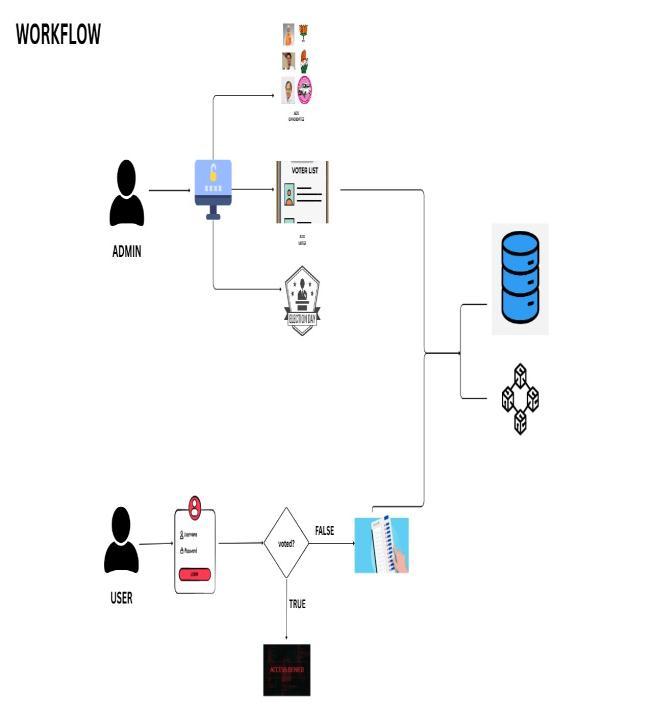
Toensurethatonlyauthorizedvoterscanparticipateinan election, Trust Vote uses OTP-based voter authentication. During the login process, the voter provides registered credentials and receives a one-time password to verify identity. Once the OTP is validated, the system confirms votereligibilityandgrantsaccesstothevotingpanel.This authenticationprocesssignificantlyreducesimpersonation risksandpreventsunauthorized usersfromcastingvotes. Afterauthentication,thesystemcheckswhether thevoter hasalreadyvotedinthecurrentelection.Ifavoteisalready recorded for that voter, the system blocks further voting attempts,ensuringstrictpreventionofduplicatevoting.
Aftersuccessfulauthentication,thevoterselectsacandidate throughthesecureinterfaceandsubmitsthevote.Thevote is then encrypted and digitally signed to ensure confidentiality and authenticity. The signed vote is transmittedtotheblockchainnetworkwhereitisrecorded asatransaction.Sinceblockchainisimmutable,onceavote isstored,itcannotbemodified,deleted,orreplacedbyany party.Smartcontractsvalidateeachvotebeforeacceptance, ensuring that the voter is eligible and has not voted previously. This mechanism guarantees vote integrity, eliminates manipulation, and provides a tamper-proof election environment. The blockchain ledger maintains a transparentandverifiablerecordofallvotingtransactions withoutexposingvoteridentity.
TrustVoteprovidesautomatedvotecountingandreal-time result generation using smart contracts. As each vote is storedonthe blockchain,the smart contractupdatesvote counts securely without manual intervention. Once the election ends, the final result is generated instantly and displayed to authorized stakeholders. The decentralized natureofblockchainensuresthatresultscannotbealtered after declaration. Additionally, the system provides auditability by allowing election administrators to verify election records directly from the blockchain. Since each transactionistimestampedandcryptographicallysecured, the entire election process becomes transparent and trustworthy. This improves voter confidence and ensures accountabilitywhilemaintainingprivacyandanonymity.
TheimplementationofTrustVoteiscarriedoutusinga layered architecture that integrates a web-based voting interface,backendservices,databasestorage,andblockchain smartcontracts.Thesystemisdesignedtoprovidesecure authentication,electioncreation,votecasting,andautomatic result generation. The complete workflow is controlled
International Research Journal of Engineering and Technology (IRJET) e-ISSN: 2395-0056
Volume: 13 Issue: 02 | Feb 2026 www.irjet.net p-ISSN: 2395-0072
through backend APIs and smart contract logic, ensuring transparency and preventing manipulation. The system architecturediagramisincludedtorepresenttheinteraction betweentheuserinterface,applicationserver,database,and blockchainnetwork.
ThefrontendmoduleofTrustVoteisdevelopedasauserfriendly web interface that supports both voters and administrators.Itprovidesseparatepanelsforvoterlogin, election participation, candidate selection, and viewing election results. The administrator interface supports election creation, candidate management, and monitoring election activity. The frontend communicates with the backend server using secure HTTP requests and displays real-timeresponsessuchasauthenticationstatus,election availability,andvotesubmissionconfirmation.Theinterface is designed to be simple and responsive so that users can easilycastvotesfromremotelocations.
ThebackendofTrustVoteisimplementedusingaserversideframeworkthatmanagesthecoreelectionoperations. The backend provides REST APIs for admin login, voter authentication,electioncreation,candidateregistration,vote casting, and result retrieval. It handles validation of input data, manages session flow, and ensures secure communication between modules. The backend also interacts with the blockchain network through smart contractfunctionstorecordvotesandfetchelectionresults. Middlewarefunctionsareusedforauthorizationandaccess control, ensuring that only verified admins can create electionsandonlyauthenticatedvoterscancastvotes.
MongoDB is used as the database layer to store electionrelatedinformationsuchasadministratordetails,candidate profiles,electionmetadata,andvoterregistrationrecords. The database contains collections such as admins, candidates, elections, and voters. Admin credentials and voterdetailsarestoredsecurely,andelectiondetailssuchas electionname,description,candidatelist,andelectionstatus are maintained for system operations. MongoDB provides fast retrieval of data and supports flexible schema design, whichisusefulformanagingdynamicelectioninformation. Thedatabasestoresonlyrequiredmetadata,whiletheactual votetransactionsarestoredsecurelyontheblockchain.
TheblockchainlayeristhecoresecuritycomponentofTrust Vote.Smartcontractsaredeployedtomanagevotingrules suchasvotervalidation,preventionofdoublevoting,vote recording, and automated vote counting. When a voter submits a vote, the backend triggers a smart contract functionthatverifiesvotereligibilityandrecordsthevoteas an immutable blockchain transaction. Each transaction is cryptographically secured and permanently stored on the blockchainledger.Sincetheblockchainisdecentralizedand tamper-proof,votescannotbemodifiedoncestored.Smart contracts also maintain the vote count for each candidate andgenerateresultsautomaticallyoncetheelectionends. This ensures transparent and reliable election outcomes withoutmanualintervention.
The Trust Vote system was implemented and tested to analyse its functionality, security, performance, and reliability in organizational election environments. The system successfully supports the complete election workflow,includingelectioncreation,voterauthentication, votecasting,blockchain-basedvotestorage,andautomated result declaration. The implementation demonstrates that blockchaintechnologycombinedwithsmartcontractscan provide a transparent, tamper-proof, and efficient voting platform.
The system was tested to verify whether all functional modules operate correctly. The administrator module successfully performed election creation, candidate registration, and election monitoring. The voter module allowed only authenticated users to access the voting interface.AftersuccessfulOTPverification,voterswereable toviewactiveelections,selectcandidates,andsubmitvotes. Thesystemrecordedeachvotetransactionsuccessfullyand stored it securely. The end-to-end voting process was
International Research Journal of Engineering and Technology (IRJET) e-ISSN: 2395-0056
Volume: 13 Issue: 02 | Feb 2026 www.irjet.net p-ISSN: 2395-0072
completedwithoutmanualintervention,confirmingthatthe proposedworkflowisfullyfunctional.
Security testing focused on preventing vote manipulation, unauthorizedvoting,anddoublevoting.Thesystemensured thateachvoteisencryptedanddigitallysignedbeforebeing stored. The blockchain layer stored votes as immutable transactions, preventing modification or deletion after submission.Smartcontractvalidationsuccessfullyrejected duplicate voting attempts, ensuring that each voter could castonlyonevoteperelection.Theseresultsconfirmthat the system maintains strong vote integrity and resists commonelectionfraudscenarios.
The performance of Trust Vote was evaluated based on responsetime,voterecordingspeed,andresultgeneration time.Thesystemdemonstratedquickvoterauthentication and fast vote submission through the web interface. Blockchain-basedvoterecordingwasperformedefficiently, andvotetallying wasupdatedin real time astransactions wereadded.Oncetheelectionended,thefinalresultswere generated instantly without delays. This performance improvementshowsthattheproposedsystemisfasterand more efficient than traditional manual vote counting methods.
TrustVotewasevaluatedfortransparencyandauditability by verifying whether election records can be securely reviewed.Theblockchainledgermaintainedacompleteand traceable record of all vote transactions. Authorized administrators were able to audit election activity and confirmvotecountsusingblockchaindatawithoutexposing voter identity. This improved trust in the election process andensuredaccountability.Theauditresultsdemonstrate thatblockchainprovidesareliableverificationmechanism, making the system suitable for organizational decisionmakingwheretransparencyiscritical.
TrustVoteisasecureandtransparentblockchain-based digitalvotingsystemdesignedtoimprovethereliabilityof organizationalelections.Theproposedsystemsuccessfully overcomes the major limitations of traditional and centralized e-voting methods by ensuring strong voter authentication, prevention of double voting, tamper-proof votestorage,andautomatedresultgenerationusingsmart contracts.Byrecordingvotesonanimmutableblockchain ledger,thesystemguaranteesintegrity,transparency,and auditability while preserving voter privacy. The implementationandtestingresultsconfirmthatTrustVote
providesfast,accurate,andtrustworthyelectionoutcomes withreducedmanualeffortandoperationalcost.Hence,the system proves to be an effective and modern solution for conductingsecuredigitalelectionsinuniversities,corporate environments,andotherorganizationswherefairnessand trustareessential
In the future, Trust Vote can be enhanced by integrating strongerbiometricauthenticationsuchasfingerprintorface recognitionalongwithOTPverificationtofurtherimprove voteridentityvalidation.Thesystemcanalsobeextendedto support large-scale elections by implementing scalability improvements such as sidechains or Layer-2 blockchain solutionstoreducetransactioncostandincreaseprocessing speed.Additionalprivacy-preservingtechniqueslikezeroknowledge proofs can be introduced to provide stronger vote confidentiality while still maintaining end-to-end verifiability.Theplatformcanbeimprovedbydevelopinga fully featured mobile application, enabling offline voting synchronization,andsupportingmultilingualinterfacesfor better accessibility. Furthermore, real-time analytics dashboards and advanced audit tools can be added for administratorstomonitorelectionperformanceanddetect suspiciousactivitiesmoreeffectively.
[
1] S. Nakamoto, “Bitcoin: A Peer-to-Peer Electronic Cash System,”2008.
[2] N. Szabo, “Smart Contracts: Building Blocks for Digital Markets,”1996.
[3]M.Crosby,P.Pattanayak,S.Verma,andV.Kalyanaraman, “Blockchain Technology: Beyond Bitcoin,” Applied InnovationReview,no.2,pp.6–19,2016.
[4]A.B.ShahzadandM.Crowcroft,“TrustworthyElectronic Voting Using Blockchain,” IEEE Security & Privacy Workshops,pp.1–6,2019.
[5]P.TarasovandH.Tewari,“TheFutureofE-Voting,”IACR CryptologyePrintArchive,2017.
[6] K. B. Frøystad, “Blockchain-Based Electronic Voting System,”InternationalJournalofComputerApplications,vol. 179,no.7,pp.1–6,2018.
[7] R. Mercuri, “Electronic Vote Tabulation Checks and Balances,” Ph.D. Dissertation, University of Pennsylvania, 2002.
[8] A. Kiayias, T. Zacharias, and B. Zhang, “End-to-End VerifiableElectionsintheStandardModel,”EUROCRYPT,pp. 468–498,2015.
International Research Journal of Engineering and Technology (IRJET) e-ISSN: 2395-0056
Volume: 13 Issue: 02 | Feb 2026 www.irjet.net p-ISSN: 2395-0072
[9]D.Chaum,“Secret-BallotReceipts:TrueVoter-Verifiable Elections,”IEEESecurity&Privacy,vol.2,no.1,pp.38–47, 2004.
[10] M. Swan, Blockchain: Blueprint for a New Economy, O’ReillyMedia,2015.
2026, IRJET | Impact Factor value: 8.315 | ISO 9001:2008