
International Research Journal of Engineering and Technology (IRJET) e-ISSN: 2395-0056
Volume: 13 Issue: 02 | Feb 2026 www.irjet.net p-ISSN: 2395-0072
International Research Journal of Engineering and Technology (IRJET) e-ISSN: 2395-0056
Volume: 13 Issue: 02 | Feb 2026 www.irjet.net p-ISSN: 2395-0072
Machale Maithili Ramprasad1 , Prof. Mrs. Vidya. T. Thakare2
1Student, Department Of Computer Engineering, JSPM’s Rajarshi Shahu College Of Engineering, Polytechnic, Tathawade, Pune, Maharashtra, India.
2Co-Ordinator, Department Of Computer Engineering, JSPM’s Rajarshi Shahu College Of Engineering, Polytechnic, Tathawade, Pune, Maharashtra, India.
Abstract – The fast and rapid growth of digital techniques, digital devices, and online platforms these have led to significance of cyber-related crimes and thefts, making these digital evidence a critical component in the modern criminal investigation. The traditional forensic rely heavily on manual techniques and analysis consuming time, error-prone and inefficient when dealing to large volumes of heterogeneous data. This Digital Forensic Detection System will help us analyze and is an advanced tool designed to assist law enforcement agencies. The proposed system focuses more on automating evidences processing through data pre-processing, machine learning based classification and feature extraction allowing it to distinguish spam, suspicious data from non-relevant information and data. It will use and with the help of AI (Artificial Intelligence) help creates images when put any descriptive instructions. By leveraging AI-based detection system and mechanism, it will help in enhancing the system, increasing investigation speed, accuracy, and reliability by decreasing the human dependency. It’s proposed approach is to assist law enforcement agencies, support law and also forensic experts by providing excellent and efficient, scalable, and intelligent solutions for the Digital Forensic Detection System.
Key Words: Digital Forensic Detection System, Artificial Intelligence (AI), Machine Learning, Evidence, Enforcement Agencies, Cyber-related crimes,Investigation.
Theincreasingdependencyoninternet-basedservicesand digitaldeviceshaveaffectedinresultingtherapidincrease orriseincyberrelated crimes,makingdigital evidencesa vital and weak component of this modern investigations. Cyber-crimes such as cyber fraud, data theft, identity manipulation, unauthorized access, and digital forgery at larger volumes of all the electronic data that can be used as potential evidences against one or a person. The main and one of which is an important domain that rely on eyewitnesses that can recognize, elaborate, explain and descript information when an image or video evidence of the suspect is unavailable. In such cases, facial sketches play a vital role in helping the forensic and law enforcement agencies to identify and track the main culprits.
Thetraditional forensicsketchingrequiremanual process that heavily depends on the artist skills, experience, and understanding of forensic. Hence making it more time consuming,subjectiveandpronetoinconsistenciesdueto human memory limitations. With the emerging of digital technologies, the digital forensic sketching has advanced too, by acting as an important tool in forensic investigation.
The development in Artificial Intelligence (AI) and image processing using the DALL-E technology allowing to open new possibilities for improving forensic facial sketch analysisandgeneration.Bythisitcuratesanassistancein automatingthefacialprocesses,reducinghumanbias,and enhancing features accuracy. It helps in analysing facial components such as eyes, nose, mouth and facial structures, with AI-based systems it will help generate more realistic and consistent facial sketches better representbyeyewitnessdescriptions.
To create a simple app that produces pictures basedonadescriptioninputtedbyusers.
To create realistic facial images using AI technologyfromtext.
Aiding the police and investigators in the quicker creation of visual profiles of suspects ormissingpersons.
To increase accuracy and efficiency in recognizingpersonsincriminalinvestigations.
To offer a facility to help solve crimes or find individualsquickly.
Toensurethattheapplicationisuseful tolawenforcement and forensic professionals, it is essentialtomakeituser-friendlyandeasily
The system for digital facial sketching for forensic identificationcomprisesanumberofinterconnectedunits thatworktogethertoprovideinvestigatorswithatoolfor automatically creating suspect facial sketches from eyewitness descriptions. The system comprises a user interfacemodule,whereinvestigatorsoreyewitnessesare
International Research Journal of Engineering and Technology (IRJET) e-ISSN: 2395-0056
Volume: 13 Issue: 02 | Feb 2026 www.irjet.net p-ISSN: 2395-0072
able to provide descriptive information like facial type, eyes, nose, mouth, hair type, and other associated characteristics. These are then handled by a description pre-processing module that undertakes standardization and verification of the information to guarantee its accuracy and uniformity. The system has a database that contains a set of predetermined building block units of faces that are used to automatically create digital facial sketches. The main module is the intelligent sketch generation module that applies image processing and intelligent algorithms to construct faces from the pristine input information. The system automatically creates a compositesketchthatsymbolizesthesuspectwhosefacial features have been described and used to generate the sketch. The resulting sketch is then scrutinized and saved for additional forensic examination or comparison with any recorded faces. The system brings all these units immaculately together to avoid hitches and inefficiencies thatmayaffecttheautomatedsketchingoffaces
Facial sketch synthesis has been an intensely researchedtopicinforensicanalysis,especiallyin instances where photographs of suspected persons are not readily available. The problem in Random Sampling for Fast Face Sketch Synthesis proposed an innovative sketch synthesis scheme that employed random sampling methods to achieve fast computational complexity in generating facial sketches. The scheme mainly targets an improvement in computational speed and minimizing reliance on manually created facial sketches needed in forensic analysis. Nonetheless, it highly depends on the variability in training samples, and thus any complexities in facial demonstrations can result in inaccurate results.
Application of artificial intelligence in forensic science has received various considerations in effortstoimprovetheinvestigationefficiencyand accuracy. In the topic "Artificial Intelligence in Forensic Science," the application of artificial intelligence in forensic science through mechanisms such as machine learning, image processing, and pattern recognition is discussed in the context of how such technology can be employed to assist in forensic investigation through the automated analysis of forensic evidence. Even though the topic focuses on the benefits attainable from the forensic application of artificial intelligence technology, there are various challenges outlined in the context of ethics in artificial intelligence forensic applications.
Deep learning methods have further enhanced facial sketch synthesis methods. The paper **Deep Neural Representation Guided Face Sketch Synthesis** proposes a deep neural network-based approach, which learns feature representationto efficiently producerealistic and detailed facial sketches. Deep neural representation helps in improving the similarity between facial sketches and real facial images. Though it is more accurate, it is expensive in terms of data requirements and computational costs, thus hindering it to some extent for practicaluseinreal-worldforensicscenarios.
The literature available on this topic that, despite major advancements in the synthesis of facial sketches through artificial intelligence, there is still a need for an effective solutiontothisnecessarytaskintheformofadigitalfacial sketchingsystem.
HardwareRequirements:
Theproposeddigitalfacialsketchingsystemisintendedto be compatible with readily available hardware platforms. ThehardwarerequirementsofthissystemincludeanIntel Corei5processororasimilarmulti-coreprocessor,which would enable efficient execution of image processing and artificial intelligence tasks.Itwould alsoneed a minimum of 8 GB of RAM to enable smooth execution of various parallel processes, including data preprocessing, feature selection,andfacialsketching.
Sufficient storage capacity is required in maintaining the datasets of facial features, the model files, the generated sketchimages,andthesystemlogs.Assuch,itisadvisedto have a minimum of 500 GB SSD storage for faster data accessibility and better responsiveness of the system. Thoughitwill bepossibletoexecutethesystemusingthe CPU execution method, having the GPU facility helps in better system execution using deep learning or text-toimagemodels.
SoftwareRequirements:
This proposed system utilizes the integration of some of the best web development and AI technologies to effectively realize facial sketch synthesis. The frontend of the system is developed using HTML5, CSS3 with Bootstrap,JavaScript,andReact.jstoprovidearesponsive, interactive, and user-friendly interface for eyewitness description entry. This frontend ensures seamless communicationbetweenusersandthebackendservices. Theback-endisbuiltonPython,ensuringdataprocessing, model invocation, and the generation of sketches. Natural language processing models are trained to process eyewitness textual descriptions into well-structured parametersintheformofselectedfacialfeatures.Text-to-
Volume: 13 Issue: 02 | Feb 2026 www.irjet.net
image and image synthesis models then provide face sketches based on the inputs received. The system may leverage shared Python packages and libraries for machine learning, deep learning, and image processing in support of model training and inference. Software architecturesoensuresscalability,modularity,andeaseof enhancementsinthefuture.
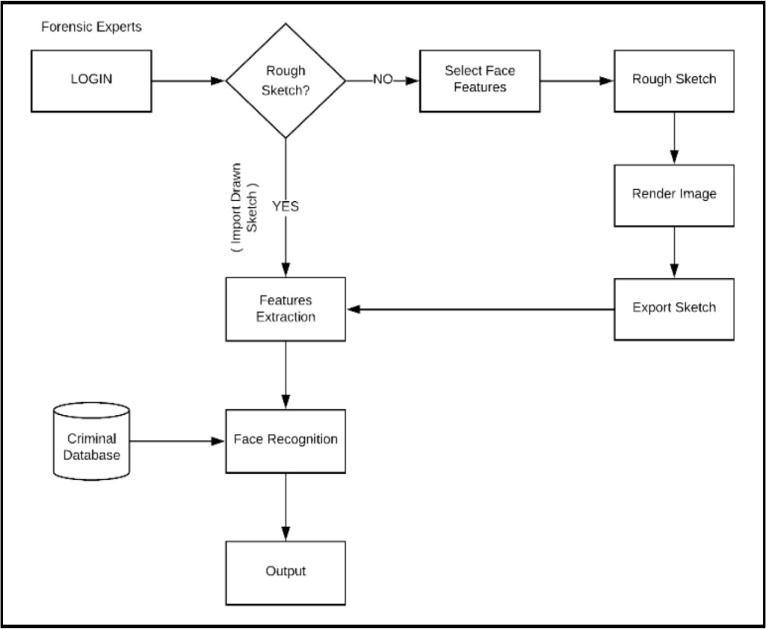
The design of the digital facial sketching system is intended to help forensic analysts produce and analyze facial sketches of suspected individuals. The approach commenced with the logging into of the system by the forensicanalysttoguaranteeauthorizeduseofthesystem. Onceloggedinto,thesystemevaluatesifthereisaninitial facial sketch of the suspected individual available. In case there is no initial facial sketch, the user is required to provide facial feature information such as face type, eyes, nose,mouth,andotherdetails.Dependingontheprovided information,aninitialfacialsketchiscreateddigitally.
After the rough sketch has been completed, the system then renders the image in an attempt to create a clearer digital facial sketch. The sketch can then be exported and processed further. The system also enables the user to import a sketch if a rough sketch has been obtained. The sketch then goes through a feature extraction stage, wherebykeytraitsonthehumanfacearetranslatedintoa featurespace.
The extracted facial features are then matched with the stored criminal records in a database using a face recognition module. The module carries out a similarity analysis between the sketched image and the existing facialimagesinthedatabasetohelpinidentificationofthe suspect.Lastly,thesystemgeneratesanoutputcontaining possibleresultsforidentification,therebyhelpingforensic analystsintheidentificationstage.
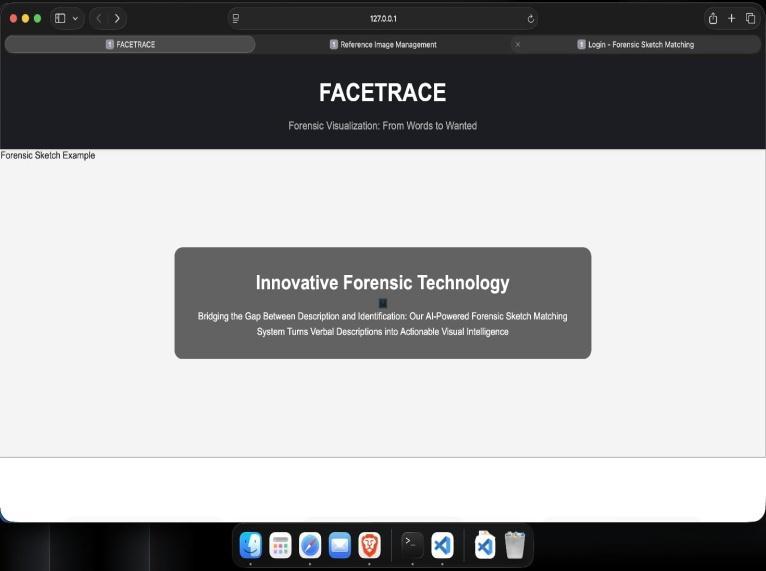
The system was implemented and tested, and the results are indicated and well analyzed that it can showcase the facial sketches with giving accurate and generated sketches with structured and defined. It displays the generatedimageandallthefeatures.
Table-1. SystemPerformanceMetrics.
InPage 98.3% Percentage
GenerateSketch Time 3.4sec Time

Fig2. LoginPage

Fig3. RegistrationPage
International Research Journal of Engineering and Technology (IRJET) e-ISSN: 2395-0056
Volume: 13 Issue: 02 | Feb 2026 www.irjet.net p-ISSN: 2395-0072

This paper, therefore, proposed a digital facial sketching system to aid forensic investigations in identifying suspectswhenphotographicevidenceisnotavailable.The proposed system provides an intelligent and structured approach for forensic experts to create facial sketches based on eyewitness descriptions. The proposed system reduces dependence on manual sketching by integrating digital sketch generation with feature extraction and face recognitionmechanisms,henceimprovingtheefficiencyof forensicinvestigations.
The architecture provides a practical, user-friendly environmentthatenablesinvestigatorstogenerate,refine, and analyze facial sketches effectively. Using intelligent techniques will significantly improve the accuracy and consistency of generated sketches while comparisons are enabled with existing criminal databases. In general, the digital facial sketching system proposed in this paper presents its potential as a valuable tool to law
enforcement agencies by enhancing investigation speed, reliability,anddecisionsupportincriminalcases.
[1.] Review on Real Time Approach to Identify a Person basedonHanddrawnSketchUsingDeepLearning. https://ieeexplore.ieee.org/document/10351482
[2.] An Enhanced Forensic Analysis and Security SurveillanceUsingDeepReinforcementLearning. https://ieeexplore.ieee.org/document/10391428
[3.] Coupled information theoretic encoding for face photo-sketchrecognition. https://ieeexplore.ieee.org/document/5995324
[4.]Artificial IntelligenceContributiontoForensicScience CrimeInvestigation https://ieeexplore.ieee.org/document/10220704