
International Research Journal of Engineering and Technology (IRJET) e-ISSN: 2395-0056
Volume: 12 Issue: 04 | Apr 2025 www.irjet.net p-ISSN: 2395-0072
D.N.J
Abstract -
International Research Journal of Engineering and Technology (IRJET) e-ISSN: 2395-0056
Volume: 12 Issue: 04 | Apr 2025 www.irjet.net p-ISSN: 2395-0072
D.N.J
Abstract -
Sandhya 1 , M.R.S.N visranthamm2 , Ch.Deepthi3 , G.Poojasri4 , K.Chandra Sekhar 5
1Student & AMRITA SAI INSTITUTE OF SCIENCE AND TECHNOLOGY
2Assistant Professor & AMRITA SAI INSTITUTE OF SCIENCE AND TECHNOLOGY
3Student & AMRITA SAI INSTITUTE OF SCIENCE AND TECHNOLOGY
4Student & AMRITA SAI INSTITUTE OF SCIENCE AND TECHNOLOGY
5Student & AMRITA SAI INSTITUTE OF SCIENCE AND TECHNOLOGY ***
Thisresearchpresentsthedesignandimplementationofa digital clock integrated with a stopwatch feature using Field Programmable Gate Array (FPGA) technology. The project utilizes Verilog Hardware Description Language (HDL) to create a multifunctional timekeeping system capable of operating in two modes: digital clock and stopwatch. The clock mode displays time in minutes and seconds (MM:SS), while the stopwatch mode allows the user to start, stop, and reset elapsed time. Mode selection and control are handled through input signals, offering a flexibleanduser-interactiveexperience.
The architecture includes key modules such as Digiforclockfunctionality,stopforstopwatchcontrol,and Display for 7-segment display decoding. Timing is accuratelymanagedusingtwointernalclockdividers:one for generating a 1Hz signal for time progression and another for refreshing the 4-digit 7-segment display. Multiplexing logic is employed to drive the display efficiently, providing clear visual feedback of the current timeorstopwatchvalues.
The FPGA-based approach ensures high-speed operation, precise timing, and reconfigurability without requiring external microcontrollers. The design is synthesized and tested on an FPGA development board, confirming correct functionality under various input conditions. This project not only demonstrates the capabilities of FPGAs in digital system design but also provides an educational platform for understanding realtime hardware control and display interfacing. The implementation highlights the potential of FPGAs in embedded systems where reliability, performance, and real-timeresponsearecritical.
Keywords: FPGA(FieldProgrammableGateArray),Digital Clock ,Stopwatch ,Verilog HDL ,7-Segment Display ,Timekeeping ,Clock Divider ,Multiplexing ,Embedded Systems,Real-TimeSystems,DigitalElectronics
1.INTRODUCTION
Inthecurrentlandscapeofdigitalelectronicsand embedded systems, the importance of timekeeping
mechanisms hasbecome moresignificantthan ever. Time has always been a vital parameter in the operation and regulation of processes, not just in human life but also in machine operations. From microcontrollers regulating home appliances to high-performance processors synchronizing tasks across network systems, time forms the foundation of reliable execution. Among various methods of timekeeping, digital clocks remain one of the mostwidelyutilizedandillustrativesystems,offeringboth functionalityandconceptualclarityinunderstandingrealtime digital systems. One of the most instructive and functionallyrichplatformsforimplementingsuchsystems istheFieldProgrammableGateArray(FPGA),whichoffers designers immense flexibility and control over hardware behavior. This research project focuses on the design and implementation of a digital clock system using FPGA technology, incorporating additional features such as a stopwatchanddynamicmodeswitching,allcontrolledand developed through the Verilog Hardware Description Language(HDL).
Historically, digital clocks have evolved from simple seven-segment LED-based designs to integrated LCD and OLED displays with microcontroller-driven intelligence. These systems, while effective in delivering user-friendly interfaces and timekeeping functionalities, often face constraints in speed, flexibility, and performance when scaled or modified. This is where FPGA-based systems shine. Unlike microcontrollers or ASICs (Application-Specific Integrated Circuits), FPGAs allow developers to redefine hardware behavior dynamically without redesigning the physical circuitry. This makes FPGAs highly advantageous for time-critical applications and system designs that require customization,real-timeresponsiveness,andparallelism.
FPGAdevicesaresemiconductorcomponentsthat consist of a matrix of configurable logic blocks (CLBs) interconnected via programmable routing. By using a hardware description language such as Verilog, designers can define the logical behavior of a circuit, which is then mapped onto the FPGA's resources. This methodology eliminates the latency introduced by software interpretation in traditional microcontroller systems and brings about deterministic, hardware-level control. For a
International Research Journal of Engineering and Technology (IRJET) e-ISSN: 2395-0056
Volume: 12 Issue: 04 | Apr 2025 www.irjet.net p-ISSN: 2395-0072
timekeeping device such as a digital clock, this results in extremely precise timing accuracy, efficient control mechanisms, and the ability to incorporate complex features like stopwatches, alarms, and event timers all onasingleprogrammableplatform.
Themotivationbehindthisprojectstemsnotonly from the desire to create a fully functional digital clock system but also from the educational and developmental value it provides. This project embodies the core principles of digital electronics timing, counting, state machines, multiplexing, display interfacing, and user interaction all wrapped within a practical and familiar application.Itactsasapracticalgatewayforstudentsand engineers to delve into the world of HDL programming, timing analysis, FPGA synthesis, and real-time digital systems. The decision to include stopwatch functionality and a mode selection feature further enhances the complexity and educational richness of the project by incorporating real-time user control and multi-mode operation, providing a deeper exploration into eventdrivendesignlogic.
The digital clock designed in this project focuses on the accurate display of time in the format MM:SS (minutes and seconds), using a four-digit seven-segment display. To achieve this, a reliable and stable one-second time base must be generated from the high-frequency system clock often a 50 MHz or 100 MHz oscillator. The design thus incorporates clock division techniques to generate a 1Hz signal suitable for time counting. This is followed by binary counters that represent seconds and minutes, which are then decoded and mapped onto the seven-segment display using multiplexing logic. Multiplexing allows the sharing of display pins across multiple digits by rapidly switching between them, creating the illusion of a simultaneous display to the humaneye.
Alongside the digital clock, a stopwatch module has been integrated into the system. This stopwatch is activated using start and stop inputs and runs independently of the clock display. The logic used here includes event triggers, edge detection, and toggling mechanismstoswitchbetweenrunningandpausedstates. This logic is also robust against signal bouncing, ensuring reliable operation frommechanical buttons. Theability to reset the stopwatch independently while the clock runs simultaneously demonstrates the FPGA’s capability to manage concurrent operations, a feat difficult to achieve withlimitedmicrocontroller-basedsystems.
To facilitate user interaction, a mode selection mechanismisincorporatedintothedesign.Withthepress ofa buttonortoggleswitch, theuser canchoose between digital clock mode and stopwatch mode. Internally, this is implemented using conditional logic that routes the appropriate outputs to the display based on the mode
signal. In digital clock mode, the system displays current time in MM:SS format, whereas in stopwatch mode, it displays elapsed time using the same format but derived from a different logic block. This modular design highlights the efficiency of code reuse and abstraction in Verilog, and the flexibility of FPGA hardware to accommodate multiple operational behaviors within a singledesignentity.
Anessentialaspectofthedesignistheinterfaceto the seven-segment display. The seven-segment display driver module is responsible for translating 4-bit binarycoded decimal (BCD) inputs into the corresponding 8-bit segment patterns to illuminate the appropriate segments of each digit. Since seven-segment displays are limited to showing one digit at a time when used in a multiplexed configuration, a separate multiplexing module is developedtocyclethroughthedigitsatahighrefreshrate. This refresh rate is carefully chosen to balance between human visual persistence and display flicker avoidance, typically achieved through another clock divider circuit derivedfromthesystemclock.
From a developmental perspective, the system is described and simulated using Verilog HDL. Simulation plays a crucial role in validating the functionality before hardware synthesis. Testbenches are created to verify individual modules such as clock dividers, counters, display drivers, and the stopwatch logic. Once the behavior is verified through simulation, the design is synthesized using FPGA development tools like Xilinx Vivado or Intel Quartus, and deployed onto an FPGA developmentboardsuchastheXilinxSpartanorIntelDEseries boards. On-board buttons serve as control inputs, while the seven-segment display shows the resulting outputs.
One of the challenges encountered during the implementationofthisprojectisensuringtimingaccuracy and synchronization across different functional modules. Clock skew, metastability, and signal bouncing from input devices must be addressed through proper design techniques such as synchronous design practices, signal debouncing, and state machine implementation. In addition, power consumption and resource utilization are evaluated to ensure the design remains efficient and scalable.
In terms of scalability and extension, this FPGAbased clock design can be expanded to include features like 24-hour time format, alarm functionality, countdown timer, lap timing for the stopwatch, and even interfacing with external sensors or serial communication modules. These enhancements further elevate the value of the design and present opportunities for future work. Furthermore, the clock system can be made wireless or IoT-enabled with additional peripheral modules, allowing
International Research Journal of Engineering and Technology (IRJET) e-ISSN: 2395-0056
Volume: 12 Issue: 04 | Apr 2025 www.irjet.net p-ISSN: 2395-0072
remote time synchronization or mobile control through networkinterfaces.
This project not only offers practical benefits but also academic and professional growth. It introduces studentsandaspiringengineersto the real-worldprocess ofdigitalsystemdevelopment,fromconceptualdesignand HDL coding to simulation, synthesis, and hardware implementation. It reinforces the concepts of modularity, design abstraction, and reusability hallmarks of robust system design. Moreover, the project aligns with the growing demand for FPGA expertise in industries such as telecommunications, aerospace, automotive electronics, and embedded system design, where deterministic and high-performancesystemsarecritical.
In conclusion, the implementation of a digital clock using FPGA technology stands as a testament to the power and flexibility of reconfigurable computing platforms.Bycombiningprecision,efficiency,andmodular design, the project exemplifies the significant role that FPGAscanplayinbotheducationalsettingsandindustrial applications. The integration of stopwatch functionality and dynamic mode switching adds layers of complexity and practical utility, transforming a simple timekeeping deviceintoamultifunctionaldigitalsystem.Thisworknot onlydeliversafullyfunctionalanddemonstrableoutcome butalsolaysastrongfoundationformoreadvanceddigital design projects, positioning it as a valuable learning tool andtechnologicalachievement.
Implementing a digital clock using an FPGA (Field-Programmable Gate Array) requires a comprehensive understanding of various hardware componentsandtheirintegration.Thissectiondelvesinto theessentialhardwarerequirements,providingadetailed overviewofeachcomponent'sroleinthesystem.
The cornerstone of this project is the FPGA development board. Boards such as the Xilinx Spartan-6, Artix-7,orIntel'sCycloneseriesarewell-suitedfordigital clock implementationsduetotheiramplelogic resources, I/O capabilities, and integrated clock management features. These boards typically come equipped with a high-frequencyoscillator,oftenaround50MHz,servingas the primary clock source for the system. The FPGA's reconfigurable nature allows for the implementation of customlogiccircuits,includingcounters,multiplexers,and display drivers, essential for timekeeping and display control.
Accurate timekeeping is paramount in a digital clock. WhiletheFPGAboardprovidesahigh-frequencyclock,it's
necessary to derive a 1 Hz signal for second-by-second time increments. This is achieved through clock division, where a counter within the FPGA reduces the highfrequency input to a lower frequency. For enhanced accuracy, an external 32.768 kHz crystal oscillator can be employed, a standard in timekeeping applications due to its precise frequency, which divides evenly into 1 Hz. The FPGA's internal Phase-Locked Loops (PLLs) or Digital Clock Managers (DCMs) can also be utilized for clock generation and management, ensuring synchronized operationacrossthesystem.
Visual representation of time is facilitated through 7-segment LED displays. Depending on the desired format (HH:MM or HH:MM:SS), four to six digits are required. These displays canbeof the commonanode orcommoncathodetype,witheachsegmentrepresenting a partof the digit.To prevent excessivecurrentdrawand potential damage, current-limiting resistors, typically ranging from 220Ω to 330Ω, are connected in series with each segment. Multiplexing is employed to control multipledigitsusingfewerI/Opins.Inthistechnique,the FPGArapidlycyclesthrougheachdigit,activatingoneata time at a speed imperceptible to the human eye, creating theillusionofacontinuousdisplay.
User interaction is facilitated through push buttons and switches, allowing functionalities such as mode selection (clock or stopwatch), start/stop operations, and resets. Mechanical switches are prone to bouncing, which can cause multiple unintended transitions. To mitigate this, debouncing techniques are implemented,eitherthroughhardware(usingRCcircuits) or software (by incorporating debounce logic within the FPGA). Proper debouncing ensures reliable and predictable user inputs, crucial for the accurate operation oftheclockandstopwatchfunctions.
A stable and regulated power supply is essential for the reliable operation of the FPGA and peripheral components.MostFPGAboardsoperateat3.3Vor5V,and it's imperative to ensure that all connected components are compatible with the board's voltage levels. Overvoltageorundervoltageconditionscanleadtoerratic behavior or permanent damage. In prototyping environments,powerisoftensuppliedviaUSBorexternal adapters, while in finalized designs, dedicated power regulationcircuitsmaybeimplemented.
During the prototyping phase, breadboards and jumperwiresarecommonlyusedtoestablishconnections
International Research Journal of Engineering and Technology (IRJET) e-ISSN: 2395-0056
Volume: 12 Issue: 04 | Apr 2025 www.irjet.net p-ISSN: 2395-0072
betweentheFPGAandperipheralcomponents.Thissetup allows for easy modifications and testing. However, for more permanent and reliable connections, especially in production environments, designing a custom printed circuit board (PCB) is advisable. A PCB ensures secure connections,reducesnoiseandinterference,andprovides amorecompactandprofessionalappearance.
Programming the FPGA requires a compatible programmer, such as a JTAG or USB-based device, to upload the synthesized design onto the hardware. DevelopmentenvironmentslikeXilinxISE,Vivado,orIntel Quartus Primeareusedto write,simulate,andsynthesize the Verilog or VHDL code. These tools offer features like timing analysis, logic simulation, and debugging capabilities,whichareinvaluableduringthedevelopment process. Simulation tools, such as ModelSim, allow for thorough testing of the design before deployment, ensuring functionality and performance meet the desired specifications.
Dependingonthecomplexityanddesiredfeatures of the digital clock, additional components may be incorporated. For instance, display driver ICs like the MAX7219 can simplify the control of multiple 7-segment displays, offloading the multiplexing logic from the FPGA. Incorporating features like alarms or timers may require additionalmemoryelementsoraudiooutputcomponents, suchasbuzzersorspeakers,controlledbytheFPGA.
In conclusion, the successful implementation of a digitalclockusinganFPGAhingesonthecarefulselection and integration of various hardware components. Each element, from the FPGA board to the display units and user interface components, plays a pivotal role in the system's overall functionality and reliability. A thorough understanding of these hardware requirements ensures the development of an efficient, accurate, and userfriendlydigitalclocksystem.
Implementinga digital clock usinganFPGA(Field Programmable Gate Array) is a challenging yet rewarding task that involves several key components working together seamlessly. This process integrates various hardwareelementsandrequiresprecisedesignofboththe logic and timing components to ensure that the system works as expected. The implementation process can be broken down into the design phase, coding phase, simulation phase, and testing phase, each critical in ensuringtheaccuracyandfunctionalityofthefinalsystem.
The first step in the implementation of a digital clockusingFPGAisdesigningtheoverallarchitecture.The system needs to take in a clock signal, process it, and outputthetimetoa 7-segmentdisplay.Attheheartofthe system lies the FPGA, which controls all the components. The design begins by understanding the requirements, which include displaying time in a format such as hours and minutes (HH:MM). The user should also be able to reset the clock, and optionally switch it into a stopwatch mode. For this, the digital clock is split into various modules,suchastheclockgenerator,timecounter,display multiplexing,anduser interfacecomponentslike the reset buttonandmodeselectionswitch.
The FPGA board will have an external clock, typically at a frequency of 50 MHz. This clock is fast, and we need to convert it into a much slower clock signal to drive the digital clock. The clock generator's purpose is to generate a 1 Hz signal by dividing the input clock. This is accomplished by creating a counter inside the FPGA that incrementswitheachpulseofthe50MHzclock.Oncethis counter reaches a certain value, corresponding to a 1 Hz signal, it will reset, producing a single pulse. This 1 Hz pulse is then used to increment the seconds on the digital clock. For example, if the clock is running in an MM:SS format,thesecondswouldincrementevery1Hzpulse.
For accurate clock generation, it is common practice to use the FPGA's built-in clock management components like Phase-Locked Loops (PLLs) or Digital Clock Managers (DCMs). These components can manage the distribution of clock signals throughout the FPGA, providing additional stability and synchronization in complexdesigns.
The next important module is the time counter. This counter will keep track of the time and increment it accordingly. The system design typically uses a counter that increments the seconds once every 1 Hz pulse. Once the seconds reach 60, the counter for the minutes increments,and similarly, when the minutes reach 60, the hours counter increments. The time can be formatted in several ways;forexample,thehourscanbedisplayedina 12-hour or 24-hour format, depending on the system's requirement.
The counter can be implemented using simple binary counters or BCD (Binary Coded Decimal) counters foreachofthetimecomponents.InBCD,eachdigit(hours, minutes, and seconds) is represented by a 4-bit binary number, which makes it easier to interface with the 7segment display. If using BCD, each time unit (hours,
International Research Journal of Engineering and Technology (IRJET) e-ISSN: 2395-0056
Volume: 12 Issue: 04 | Apr 2025 www.irjet.net p-ISSN: 2395-0072
minutes,andseconds)willrequireaseparatecounterthat cancountupto9or5,dependingonwhetherit'strackinga single-digitoratwo-digitnumber(likeminutes00-59).
Thecounteralsoneedstohandleresetting.Areset signal, either from a user input or an external trigger, is required to set the time back to the starting point. This signal can be provided via a push button connected to the FPGA, or through a software-controlled reset. The reset functionality will clear the current time registers and set theclockbackto00:00.
A digital clock typically uses a 7-segment display toshowthetime.Thesedisplaysconsistofsevensegments arranged in a figure-eight pattern, with each segment capable of displaying a part of a digit. The 7-segment displaysarecontrolledbysendingsignalstotheindividual segments, where a high signal (usually 3.3V or 5V depending on the board) will light up that particular segment.
Whenimplementingthedisplay,wemustconsider that each 7-segment display has a maximum of 8 lines to control.Sincethedigitalclockmayhaveseveral digits(for example, two digits for the minutes and two digits for the seconds), we need to implement multiplexing. In multiplexing, the FPGA will display each digit in rapid succession, butata rate fastenough to give the illusionof simultaneously displaying all digits. This can be achieved by activating one digit at a time and cycling through them at a high frequency, typically around 60 Hz, which is sufficientforthehumaneyetoperceiveascontinuous.
Multiplexing requires the FPGA to cycle through the display digits, activating one at a time while deactivating the others. This is done in a round-robin fashion,whereeachdigitgetsasmallwindowoftimetobe shown. A counter controls which digit is currently active, and the FPGA outputs the appropriate data to the 7segment display. In addition to controlling the multiplexing, the FPGA must send the correct values for eachdigit(e.g.,0,1,2,etc.).Toconvertabinaryvalueintoa corresponding 7-segment code, a lookup table or a combinatoriallogiccircuitisused.
In any real-world digital clock, user interaction is key. The user must be able to reset the time and possibly switchbetweendifferentmodes(e.g.,fromadigitalclockto a stopwatch). These functionalities are typically implementedusingpushbuttonsorswitchesconnectedto the FPGA. A mode selection switch allows the user to switchbetweendifferentoperationalmodesofthesystem. A start/stop button enables the stopwatch mode, while a resetbuttonclearsthecurrenttime.
It is important to ensure that the buttons are debounced. Mechanical switches tend to "bounce" when pressed,whichcouldresultinmultipleunintendedpresses being detected. Software debouncing can be used to solve this issue. This is achieved by reading the button input multiple times and confirming that the state is consistent over a short period before accepting the input. Alternatively, hardware debouncing circuits can be implementedusing resistors andcapacitors tosmoothout thesignal.
Afterdesigningalltheindividualmodules,thenext step is to integrate them into a single FPGA design. The FPGA's logic resources are interconnected to ensure the digital clock works as expected. This integration involves connecting the clock signal to the counter, connecting the counter outputs to the display decoder, and routing the displaysignalstothe7-segmentdisplay.
In addition to the basic functionality, a robust communication structure is necessary. The FPGA must be able to manage all the components efficiently. One key concern is the timing of each module and how they synchronize. Since FPGAs allow for parallel processing, several components can operate simultaneously, but careful attention must be paid to synchronization and signal propagation to ensure the system operates smoothly.
Once the design has been integrated, the next phase is simulation. FPGA designs are usually tested in simulation environments before actual implementation to ensure thelogic behaves asexpected. ToolslikeModelSim or Vivado's built-in simulation environment allow designerstosimulatethedesignandexaminehowitreacts to different input signals (e.g., clock pulses, reset signals, buttonpresses).
Simulation is critical because it helps identify potential issues with timing, signal integrity, and logic errors.Itisoftenmucheasiertofixbugsinsimulationthan duringphysicalhardwaretesting,assimulationtoolsallow forstep-by-stepdebuggingandmonitoringofsignals.
After successful simulation, the design can be loaded onto theFPGAhardware.Atthisstage,testinginvolvesverifying the digital clock's functionality by checking if the time is displayed correctly, ensuring that the reset functionality works, and confirming that user inputs are correctly processed.
After all the components are tested and verified, the final step is to deploy the design onto the FPGA
International Research Journal of Engineering and Technology (IRJET) e-ISSN: 2395-0056
Volume: 12 Issue: 04 | Apr 2025 www.irjet.net p-ISSN: 2395-0072
hardware. The system is now ready to operate in a realworld environment. The FPGA is configured with the design,andtheusercaninteractwiththeclockbypressing buttonstoresetthetime,switchmodes,andstart/stopthe stopwatch.
At this stage, power consumption, speed, and reliability are evaluated. The FPGA clock, the display multiplexing,andothercomponentsmustworkseamlessly togethertoensurethesystemoperatescorrectly.
This process is a practical demonstration of FPGA's power in creating embedded systems and shows how complex logic can be implemented efficiently on reconfigurablehardware.Theexperiencegainedfromsuch a project serves as a foundation for tackling even more complex designs, such as those involving multimedia processing,communicationsystems,andadvancedcontrol systems.
3.1.1
The hardware integration of a digital clock using FPGA involves combining multiple components and systems into a unified whole. FPGA-based designs are highly flexible and can accommodate various types of digital circuits, making them suitable for projects like the digitalclock.Theintegrationofhardwareforsuchprojects requires a thorough understanding of the components involved and how they interact with each other. The following discussion outlines the various components that must be integrated, the interconnections between them, and the necessary design steps to achieve a functional digitalclockonanFPGA.
3.1.2Introduction
Hardware integration refers to the process of combining individual hardware components into a complete,functioningsystem.Inthecaseofadigitalclock, this involves integrating various hardware subsystems suchastheFPGAboard,clockgenerators,countermodules, user input systems, and output displays. Each subsystem must be designed to work together smoothly and efficiently. A key factor in FPGA hardware integration is understanding the concept of parallelism, which enables multiplecomponentstofunctionsimultaneously,aswellas synchronization, which ensures the proper timing of events.
The digital clock's hardware integration must allow it to take in the system clock, process it, and output time information to a visual display. The FPGA board serves as the central controller, coordinating the functioning of all connected components. This includes reading input signals, processing them according to the designlogic,anddisplayingoutputona7-segmentdisplay.
3.1.3Components
Inthissection,wewilldescribetheprimarycomponentsof thehardwareintegrationfortheFPGA-baseddigitalclock.
TheFPGA(FieldProgrammableGateArray)isthe central component of the system, responsible for controlling all other hardware components. The FPGA's main function in a digital clock system is to handle the clock signals, manage the timekeeping logic, and output data to the display. The FPGA is reconfigurable, allowing designers to modify its behavior by programming it with specificlogic.
The FPGA must be capable of handling the clock inputsignal,dividingitdowntotherequiredfrequencyfor timekeeping, managing user inputs (such as buttons for reset or modeselection),and outputtingcontrol signalsto drive the 7-segment displays. Additionally, the FPGA must communicate with various modules, such as the counter and the clock divider, ensuring that each component operatesinsynchrony.
The clock input provides the timing signals that are necessary for the operation of the digital clock. A standardFPGAboardoftenhasanexternaloscillatorwitha clock frequency of 50 MHz or higher. This high-frequency clock is not directly usable for timekeeping in a digital clock, as timekeeping requires very slow pulses, typically onepulsepersecond.
To convert the high-frequency input into a usable timekeeping signal, a clock divider circuit is implemented within the FPGA. The clock divider divides the input clock byalargefactor,forexample,50millionfora1Hzoutput. The resulting 1 Hz signal is then used to increment the seconds counter in the timekeeping module. This is an essential part of the hardware integration, as accurate timekeepingreliesongeneratingastable1Hzclockpulse.
The timekeeping module is responsible for maintaining and updating the current time. This is achieved using a counter, typically implemented as a binary or BCD (Binary Coded Decimal) counter. The counterwillincrementoneveryclockpulse,andthetimeis represented as a series of four 4-bit digits, corresponding tohours,minutes,andseconds.
In a digital clock, the counter is usually designed with separate modules for hours, minutes, and seconds. Forexample,thesecondscounterwillincrementfrom0to 59,andonceitreaches59,itwillresetto0andincrement the minutes counter. Similarly, the minutes counter will
Volume: 12 Issue: 04 | Apr 2025 www.irjet.net p-ISSN: 2395-0072
increment from 0 to 59, and the hours counter will incrementfrom0to23(ina24-hourclockformat).
The integration of the timekeeping counter into theFPGA design requires careful attentionto the synchronization of these counters, ensuring that they increment correctly in response to the 1 Hz pulse generated by the clock divider. Additionally, the counters mustbedesignedwithresetfunctionalitytoallowtheuser toresettheclocktoaspecifictime.
A key aspect of the digital clock design is the displaysystem,whichvisuallypresentsthecurrenttimeto the user. The mostcommondisplayusedfor digital clocks isthe7-segmentdisplay,whichconsistsofsevensegments arranged in a figure-eight pattern. Each segment can be turnedonorofftoformanumber,andthecombinationof segmentsdeterminesthedisplayeddigit.
In a typical FPGA-based digital clock, multiple 7segmentdisplaysareusedtoshowthetime.Forexample,a four-digit 7-segment display could be used to show hours and minutes in the format HH:MM. To control these displays, a display driver circuit is required. The FPGA outputssignalstothedisplaydriver,whichinturncontrols theon/offstateofeachsegment.
Oneimportantconsiderationinthedisplaysystem is multiplexing. Since the 7-segment displays typically sharecommonanodeorcathodelines,onlyonedisplaycan be turned on at a time. Therefore, the FPGA must implement multiplexing, rapidly switching between the displays to give the appearance of simultaneous output. This is done by activating one display at a time in quick succession,updatingthedigitshownoneachdisplaywhile ensuring that the timing is precise enough that the user perceivesacontinuousdisplay.
Thedisplaysystemalsorequiresalookuptableor a combinational logic circuit to convert the 4-bit binary values representing the digits into the corresponding 7segment display codes. Each binary value (0-9) must be mapped to a specific combination of segments that form thecorrectdigit.
The user input system allows the user to interact with the digital clock, for example, to reset the time or switch between different operational modes. In most FPGA-baseddesigns,theuserinputsystemisimplemented using physical buttons or switches. These switches can include a reset button, a start/stop button (for stopwatch mode),andamodeselectionbutton.
The reset button is used to clear the current time and set the clock to a predefined starting time (usually 00:00).Themodeselectionbuttonallowstheusertotoggle between different modes, such as switching from a standard digital clock mode to a stopwatch mode. The start/stop button in stopwatch mode allows the user to beginorhaltthestopwatchtimer.
InFPGAdesigns,onekeyissuewithbuttoninputs is "switch bouncing." Mechanical switches can generate multiple transitions when pressed, causing multiple unintended signals to be detected. To resolve this, debouncingcircuitsaretypicallyimplemented.Debouncing can be achieved using either hardware circuits (e.g., RC filters) or software techniques, where the FPGA reads the buttonstatemultipletimesinquicksuccessionandignores rapidstatechangescausedbybouncing.
The FPGA board and the associated components (clock divider, counter, displays, and user input system) require a stable power supply. Most FPGA boards operate on 3.3V or 5V, depending on the specific model of the board. In addition to providing power to the FPGA, the powersupplymustalsobeabletodeliversufficientcurrent to power the display system, which can require more powerthantheFPGAitself.
Power regulation is a critical part of hardware integrationbecauseanyinstabilityinthepowersupplycan result in erratic behavior or malfunctions. Voltage regulatorsorDC-DCconvertersaretypicallyusedtoensure that the FPGA and all components receive the correct voltage levels. The use of proper decoupling capacitors is also essential to smooth out any fluctuations in the power supply.
The FPGA’s I/O pins play a critical role in hardware integration, as they provide the necessary interface between the FPGA and the external components, suchasthe7-segmentdisplaysandtheuserinputbuttons. The I/O pins must be properly configured and routed to connecttotheappropriatecomponentsontheFPGAboard.
In the case of the 7-segment display, for example, eachsegmentofthedisplayistypicallyconnectedtooneof the FPGA's I/O pins. Similarly, the buttons for reset, mode selection, and start/stop are connected to other I/O pins. Each of these pins must be configured for the correct direction (input or output) and, if necessary, have pull-up orpull-downresistorstoensureproperlogiclevels.
Signal routing is another important aspect of hardware integration. The FPGA's internal routing resources must be carefully used to ensure that signals
International Research Journal of Engineering and Technology (IRJET) e-ISSN: 2395-0056
Volume: 12 Issue: 04 | Apr 2025 www.irjet.net p-ISSN: 2395-0072
from one module can reach the appropriate destination. Thismayinvolveusingmultiplexersorotherlogictoselect signalsbasedonthecurrentmodeofoperation.
Each component plays a vital role in the overall functionality of the digital clock, and their integration requires careful attention to timing, synchronization, and signal routing. Once the hardware is successfully integrated, the FPGA-based digital clock can provide accurate timekeeping and an intuitive user interface, demonstratingthepowerofFPGAtechnologyinembedded systemsdesign.
Hardware integration in FPGA-based projects like digitalclocksshowcasesthepowerandflexibilityofFPGAs increatingcustomdigitalsystems.Byintegratingtheright components and ensuring that they work together harmoniously,designerscancreatefunctionalandefficient digitalsystemsforawiderangeofapplications.
Software development for FPGA-based systems such as a digital clock involves the design and implementation of various hardware modules using hardware description languages (HDLs) like Verilog or VHDL. The objective of FPGA software development is to create the logic that mimics the desired system behavior directly on hardware. This process differs significantly fromconventional softwareprogramming,asitfocuseson parallel execution and hardware resource management rather than sequential program execution on a generalpurposeprocessor.
In FPGA-based systems, each logic block runs concurrently, making parallelism a crucial factor in ensuring system efficiency. The software development process, therefore, involves creating individual modules thathandlespecifictasks,ensuringtheyinteracteffectively with one another. In the case of the digital clock, several key functionalities need to be implemented in software, such as clock division, timekeeping, display driving, and inputhandling.
Oneofthefirsttasksinthesoftwaredevelopment for a digital clock is implementing the clock divider module. Since most FPGA boards run at high frequencies (typicallyintherangeofMHz),andtheclock inputforthe digital clock requires a low frequency (such as 1 Hz for seconds),aclockdividerisnecessary.Thismoduledivides the high-frequency input clock into a low-frequency clock signal that will be used for timekeeping purposes. The software for this module will use a counter to count the clock cycles and toggle an output pulse at the appropriate frequency.Forinstance,iftheFPGA’sclockfrequencyis50
MHz,aclockdividerwilldivideitby50milliontogenerate a1Hzpulse,idealfortickingsecondsinadigitalclock.
The development of the clock divider involves determining the appropriate divider factor based on the FPGA’s clock speed. The clock divider ensures the clock signal is manageable and that the digital clock module operatescorrectlyata1Hztimebase.
Thetimekeepingmoduleisthecorecomponentof the digital clock. Its job is to track the current time, including hours, minutes, and seconds. The module must incrementthesecondscounterattheappropriateintervals and, when the seconds reach 60, reset to 0 and increment theminutescounter.Similarly,whentheminutesreach60, it will reset to 0 and increment the hours counter. This module must also handle the reset functionality, allowing theusertosetthetimemanuallyorresettheclockbackto zero.
The timekeeping module also has to account for the rollover from one time unit to the next. For example, whenthesecondsreach60,theclockshouldrolloverto00 and increment the minute count. Additionally, it should handle the transition between minutes and hours, especially when moving from 59 minutes to 00 minutes andfrom23:59to00:00ina24-hourclockformat.
The display driver module controls the display of thetimeonthe7-segmentdisplay.Adigitalclock typically usesa7-segmentdisplaytoshowtimeintheformofhours, minutes, and seconds. The software must convert the binaryvaluesrepresentingeachdigit(from0to9)intothe appropriatesignals thatcontrol thesevensegmentsofthe display.Each 7-segmentdisplay is made up of sevenLEDs arranged in a figure-eight shape, and different segments arelituptoformthenumbers0through9.
The software for the display driver will use a lookuptableorcasestatementstomapthebinaryvaluesof each digit to the corresponding segments. The module needs to handle multiple digits, updating the display to showthecorrecttime.Itshouldalsobecapableofhandling multiple time units such as seconds, minutes, and hours, displayingtheminsequence.
In addition to controlling the 7-segment display, the display driver needs to implement multiplexing logic. Since the digital clock typically uses multiple 7-segment displays to show the time, multiplexing is used to rapidly switch between the displays, creating the illusion that all digitsareshownatonce.Thisisachievedbyupdatingone display at a time in a fast cycle, and the human eye perceivesthisasacontinuousdisplayofalldigits.
Volume: 12 Issue: 04 | Apr 2025 www.irjet.net p-ISSN: 2395-0072
An important part of the digital clock is the input handlingmodule.Thismoduleisresponsibleforprocessing user inputs, such as buttons that set the time or start and stop a stopwatch. Inputs are typically handled through mechanical switches, which can suffer from noise and bouncingeffects.Debouncingisrequiredtoensurethatthe FPGA reliably detects a single press of a button, without falsely registering multiple presses due to the mechanical propertiesoftheswitches.
Debouncing is often implemented in software by samplingthebuttonstateatregularintervalsandensuring that the signal remains stable for a predefined period before recognizing the input as valid. The input handling module processes signals from switches and generates corresponding actions, such as setting the clock, resetting theclock,orswitchingbetweendifferentmodes(e.g.,clock modeandstopwatchmode).
The input handling logic needs to be integrated with the overall control flow of the digital clock. For example, the system should allow the user to toggle between the clock mode and stopwatch mode, with the display updating to show either the current time or the stopwatch reading. The software for input handling must ensurethatthesystemrespondspromptlyandcorrectlyto userinteractionswhilemaintainingstableoperation.
Inmanydigitalclockdesigns,thesystemsupports multiple modes of operation. For example, the clock may haveamodefordisplayingthecurrenttimeandamodefor actingasa stopwatch. Themode selectionlogicallowsthe user toswitchbetween these modes by pressing a button. This module controls which set of values (time or stopwatch)isshownonthe7-segmentdisplay.
In software, the mode selection logic can be implemented as a simple condition check, where the system alternates between different displays based on the input mode select signal.For instance, when thesystemis in the digital clock mode, the software will update the display with the current time, and when the system switches to the stopwatch mode, it will display the stopwatchvalues.
OneofthecriticalaspectsofFPGA-basedsoftware development is synchronization. Since FPGAs are inherentlyparalleldevices,ensuringthatdifferentmodules operate synchronously and share data correctly is crucial. For example, the timekeeping module and the display driver module must be synchronized to ensure that the time is updated correctly on the display at regular intervals.
Moreover, proper timing considerations are essential to ensure that the digital clock operates with accuracy.Anyerrorintimingorsynchronizationcouldlead to incorrect timekeeping, which is not acceptable in a digital clock. Thus, the software must handle time signals carefully, particularly the 1 Hz signal generated by the clock divider, ensuring that it drives the timekeeping moduleatthecorrectfrequency.
Testing and debugging FPGA-based software can bemorechallengingthantraditionalsoftwaredevelopment duetothehardwarenatureofthesystem.SimulatingFPGA designsbeforehardwareimplementationiscrucialtocatch errors early in the design process. FPGA software development tools often include simulation environments that allow developers to test their designs in a virtual setting, providing a way to verify functionality before deployment.
Once the design has been simulated and tested, it can be synthesized and implemented on the FPGA hardware. At this point, further testing is required to ensure that the system works as expected on the actual FPGA device. Debugging FPGA software typically involves checking the behavior of the system in real-time, using toolslikelogicanalyzersandon-chipdebugginginterfaces tomonitorsignalsanddetectissues.
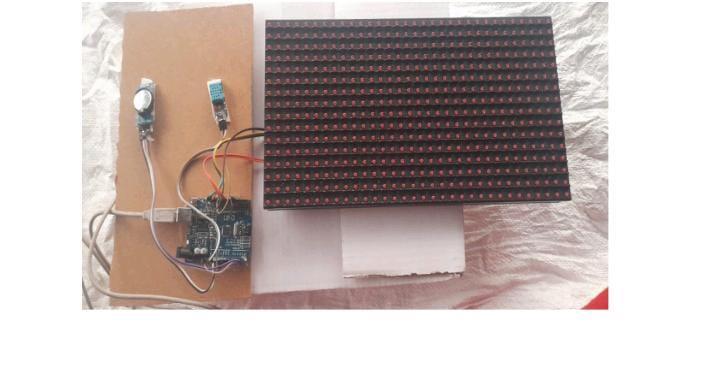
The real-time implementation of an FPGA-based digital clock project involves taking the design, which has been simulated and tested in a virtual environment, and deployingitontoanactualhardwareplatformforphysical operation. This is a critical phase of the project, where all theoretical designs are brought into the real world, and the system’s functionality is verified under actual operating conditions. The real-time implementation process can be divided into several key stages, including hardwaresetup,softwaredeployment,integration,system testing, and performance evaluation. Each of these stages requires careful planning, precise execution, and
Volume: 12 Issue: 04 | Apr 2025 www.irjet.net p-ISSN: 2395-0072
troubleshooting to ensure that the final product operates as intended. In this section, we will discuss each of these phases in detail, from initial hardware setup to final systemoptimization.
The first step in the real-time implementation of the FPGA-based digital clock is setting up the physical hardware. This involves selecting the appropriate FPGA board, connecting necessary peripheral components, and ensuring that all hardware elements are functioning correctly. The FPGA board chosen for the project must have the required resources, such as sufficient logic cells, input/outputpins,andclock sources,tohandlethedigital clock’sfunctionality.
An important consideration during hardware setup is the display system. In this case, the digital clock will typically utilize a 7-segment display or an array of 7segment displays to show the time. Depending on the FPGA’savailablepins,multipledisplays maybeconnected via multiplexing or parallel connections. In this real-time implementation, the FPGA’s input/output pins will be connected to the anode and cathode terminals of the 7segment displays. Proper wiring and signal routing are essential to ensure the display works correctly and the FPGAcandrivethesegmentswithoutinterference.
Additionally, buttons for user interaction, such as setting the time, starting, and stopping the stopwatch, mustbeintegratedintothehardwaresetup.Thesebuttons must be connected to the FPGA’s input pins, and considerations for debouncing (to avoid noisy signals due to mechanical switch bouncing) must be factored into the implementation.
Power supply and clock sources are also integral components of hardware setup. The FPGA board must be powered correctly, and the clock signal needs to be supplied at the correct frequency. In many FPGA systems, anexternaloscillatororcrystalisusedtogenerateastable clock signal. For this digital clock system, the clock will needtobedividedtogeneratethe1Hzsignalrequiredfor timekeeping.
Once the hardware is physically set up, the next step is the deployment of the software onto the FPGA. SoftwaredeploymentinanFPGAsystemisquitedifferent from traditional software installation on a generalpurpose computer. FPGA software is typically developed using hardware description languages (HDLs), such as Verilog or VHDL, and is compiled into a configuration bitstreamthatisloadedontotheFPGA.
The first task in software deployment is to synthesize the HDL code, which converts the written
designintoaformthattheFPGAcanunderstand.TheHDL code is written in such a way that it describes the hardware behavior of the system. For example, the clock divider, timekeeping logic, display driver, and input handling modules are all described in Verilog or VHDL. The synthesis tool takes this HDL code and generates a netlist, which is essentially a set of instructions for configuringtheFPGA’sinternallogicblocksandrouting.
Once the design has been synthesized, the next stepistoimplementthedesign.Thisinvolvesmappingthe synthesized netlist onto the FPGA’s resources, such as logic cells, flip-flops, and routing channels. After implementation, a bitstream file is generated, which is usedtoconfiguretheFPGA.Thebitstreamfilecontainsall the necessary configuration information for the FPGA to perform the desired operations. This file is then loaded ontotheFPGAusingaprogrammerorUSBcable.
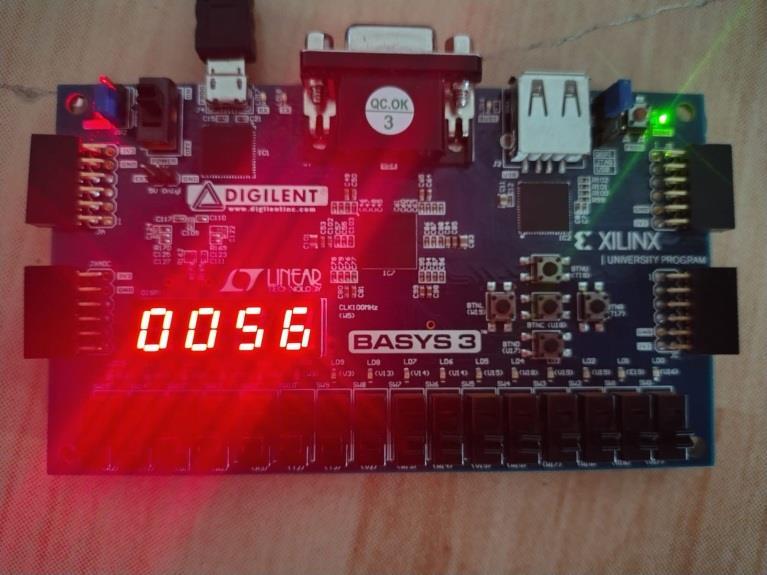
With the bitstream loaded onto the FPGA, the hardware can now execute the software, controlling the clock and display as intended. During this phase, the system will begin operating according to the specified logic, and the clock’s time should be displayed on the 7segmentdisplay.
AftertheFPGAsoftwareisdeployedandtheclock beginstofunction,thenextstepisintegration.Inreal-time implementation, integration involves ensuring that all system components work together seamlessly. This includesverifyingthattheclockdivision,timekeeping,and display driving modules interact properly and that the userinputsareprocessedcorrectly.
For example, when the user presses the "start" button, the stopwatch should begin counting, and when the user presses the "stop" button, the stopwatch should pause. The time should be displayed correctly on the 7segment displays, and the transition between the digital clock mode and stopwatch mode should be smooth. Integration also involves testing the various inputs, ensuring that they are properly debounced and that the systemrespondsaccuratelytousercommands.
One key aspect of integration in FPGA systems is managingtimingandsynchronization.SinceFPGAsystems can execute multiple processes concurrently, it is crucial to ensure that signals are properly synchronized across modules. For instance, the clock divider’s output needs to beaccuratelysynchronizedwiththetimekeepingmodule’s inputs to maintain correct time. If there are timing issues or glitches in the signal propagation, the clock may drift, leading to inaccurate timekeeping. Therefore, careful attention must be given to ensuring that all clock signals anddatapathsarecorrectlysynchronized.
Volume: 12 Issue: 04 | Apr 2025 www.irjet.net p-ISSN: 2395-0072
Once integration is complete, the system enters the testing phase. Real-time testing is essential to verify thattheFPGA-baseddigitalclockoperatescorrectlyunder various conditions. Testing involves both functional and performance evaluations. Functional testing ensures that the system behaves as expected, while performance testing evaluates the accuracy, reliability, and responsivenessoftheclocksystem.
Functional testing begins by checking the digital clock’sabilitytodisplaythecorrecttime.Theclockshould increment seconds, minutes, and hours correctly, rolling overat theappropriateintervals(e.g.,from59seconds to 00,from59 minutesto 00, andfrom23hoursto00).The user interface, including the buttons for setting the time, starting, and stopping the stopwatch, should work as expected. In stopwatch mode, the stopwatch should start counting when the start button is pressed, stop when the stopbuttonispressed,and resetwhenthereset button is pressed.
Additionally,thetransition between modes(from digital clock mode to stopwatch mode) must be smooth, and the display should update accordingly. The system’s ability to handle multiple button presses, switch between modes, and display the correct time should be verified duringtesting.
Performance testing focuses on the system’s accuracy in timekeeping. For a digital clock, it is essential that the time is kept accurately. In FPGA systems, timing errorscanarisefromissuessuchasclockskew,improper synchronization, or incorrect clock division. Performance testingensuresthattheclockdoesnotdriftovertimeand that the 1 Hz time base is accurate. The system should be testedfor prolongedperiods(e.g.,several days)to ensure that the timekeeping remains consistent and accurate throughoutitsoperation.
Another aspect of performance testing is the responsiveness of the user interface. The clock should respond immediately to user inputs, such as setting the time,startingthestopwatch,orswitchingbetweenmodes. Delays or lag in responding to inputs can negatively impact the user experience, so this aspect of the system mustbethoroughlytested.
During the real-time implementation process, issues are likely to arise that need to be addressed. Commonissuesin FPGA systemsincludeincorrecttiming, signal glitches, and hardware malfunctions. Troubleshooting these issues involves analyzing the system’s behavior and identifying the root cause of the problem.
One common approach for troubleshooting FPGA systems is to use hardware debugging tools such as logic analyzers, oscilloscopes, and in-system debugging interfaces. These tools allow developers to monitor the behavior of signals within the FPGA and identify any anomaliesorerrors.Forexample,iftheclockdividerisnot generatingthecorrectoutput,alogicanalyzercanbeused to check the waveform and identify any timing mismatchesorincorrectconfigurations.
Optimization is another critical step in real-time implementation. Although FPGA systems are inherently parallel, there may still be opportunities to improve the system’s efficiency. For instance, resource optimization can help reduce the amount of logic required for certain modules, making the system more efficient and leaving resources available for other tasks. Optimizing the clock divisionordisplaymultiplexinglogiccanalsoimprovethe system’sperformance.
1.High Precision Timekeeping:
FPGA-based digital clocks provide high accuracy due to precise control over clock division and timegeneration.
The 1Hzclock used fortimekeepingis generated through an accurate clock division process, ensuringminimaldriftovertime.
2.Customization Flexibility:
FPGAs allow for customizability in design. The digital clock system can be tailored for specific usecases,suchasaddingadditionalfeatureslikea stopwatch, alarm functionality, or even integratingothercustomperipherals.
International Research Journal of Engineering and Technology (IRJET) e-ISSN: 2395-0056
Volume: 12 Issue: 04 | Apr 2025 www.irjet.net p-ISSN: 2395-0072
3.Low Power Consumption:
FPGAs are known for their energy-efficient operation, especially when compared to generalpurpose processors. The digital clock implemented on FPGA consumes less power, making it ideal for battery-operated devices or energy-consciousapplications.
4.Parallel Processing Capabilities:
FPGAs excel at parallel processing, meaning that multipleoperations(suchastimekeeping,display updating, and input handling) can occur simultaneously without significant delays. This leadstofasterandmoreresponsivesystems.
5.Real-Time Operation:
FPGAs operate in real-time, ensuring that the digital clock is continuously and accurately updated without the delays or overhead found in software-based systems. This real-time processing makes the system more reliable and predictable.
6.Scalability:
ThedesignonanFPGAcanbeeasilyexpandedor modified. For example, more features (e.g., additionalalarms,differenttimezones)orhigherresolutiondisplays(e.g.,addingmoresegmentsor connecting multiple displays) can be added with minimalchangestotheunderlyinghardware.
7.Reliability and Durability:
FPGA-based systems are typically more reliable and durable than microcontroller-based systems. They are resistant to environmental factors like temperature fluctuations, which makes them suitableforindustrialoroutdoorapplications.
8.Cost Efficiency:
FPGAs can be cost-effective for small-to-medium scale production runs, as they avoid the need for custom ASICs or expensive processors. Once the designisimplemented,the costofreplicationcan below.
In conclusion, implementing a digital clock using FPGA provides numerous benefits that make it an ideal solution for accurate, reliable, and efficient timekeeping. TheprecisionofferedbyFPGA-basedsystemsensuresthat the clock remains accurate over long periods, with minimal drift, which is a critical feature for many applications. The flexibility of FPGA allows for easy
customization, enabling the addition of various functionalities such as a stopwatch or alarm system, depending on the user's requirements. Moreover, the ability to perform parallel processing ensures that all operations, such as time updates, display refreshing, and input handling, can be executed simultaneously, making thesystemhighlyresponsive.
ThelowpowerconsumptionofFPGAdevicesand their durability make them suitable for battery-operated devicesandharshenvironmentalconditions.Additionally, the scalability of FPGA designs ensures that future modifications or expansions can be incorporated with ease,extendingthelifetimeandusabilityofthesystem.By utilizingFPGA,thedevelopmenttimeisshortened,andonthe-fly modifications can be made to improve system performance, providing a significant advantage in fastpaceddevelopmentenvironments.
In summary, FPGA-based digital clocks offer a highly efficient and robust solution for timekeeping and other embedded applications. With their high precision, low power consumption, scalability, and flexibility, FPGAs are an excellent choice for both educational and practical applicationsinavarietyofindustries.
[1] Xilinx Inc. (2016). FPGA-Based Digital Design. Xilinx WhitePaper.Retrievedfromhttps://www.xilinx.com.
[2] Simmons, L. M., & Thompson, R. M. (2014). Digital Logic Design: A Design Manual for Implementation of FPGA,ASIC,andCMOSCircuits.Springer.
[3]Brown,S.D.,&Vranesic,Z.G.(2009).Fundamentalsof Digital Logic with VHDL Design. McGraw-Hill Higher Education.
[4] Cohen, D. S. (2017). FPGA Prototyping by VHDL Examples:XilinxSpartan-3Version.Wiley-Interscience.
[5]MaximIntegrated(2015).UnderstandingFPGADesign for Digital Signal Processing. Maxim White Paper. Retrievedfromhttps://www.maximintegrated.com.
[6] Wakerly, J. F. (2011). Digital Design: Principles and Practices.PearsonEducation.
[7] Wang, H., & Li, D. (2019). High-Performance FPGA Design:FromAlgorithmstoHardware.Springer.
[8] Brown, A. E., & McMillan, P. J. (2018). FPGA-Based Time Measurement Systems. Journal of Embedded Systems,35(2),245-258.
[9]Meyer-Baese, U. (2007). Digital Signal Processing with FieldProgrammableGateArrays.Springer