
International Research Journal of Engineering and Technology (IRJET) e-ISSN: 2395-0056
Volume: 13 Issue: 03 | Mar 2026 www.irjet.net p-ISSN: 2395-0072

International Research Journal of Engineering and Technology (IRJET) e-ISSN: 2395-0056
Volume: 13 Issue: 03 | Mar 2026 www.irjet.net p-ISSN: 2395-0072
Dr. V. Chandrasekaran1 , R. Ruthresh2 , V. Naveen3, S. Viswa Ganesh4
1Professor, Dept. of Medical Electronics Engineering, Velalar College of Engineering and Technology, Tamil Nadu, India.
2Student, Dept. of Medical Electronics Engineering, Velalar College of Engineering and Technology, Tamil Nadu, India.
3Student, Dept. of Medical Electronics Engineering, Velalar College of Engineering and Technology, Tamil Nadu, India
4Student, Dept. of Medical Electronics Engineering, Velalar College of Engineering and Technology, Tamil Nadu, India.
Abstract - Muscle fatigue is a critical factor affecting performance, rehabilitation, and workplace safety, yet continuous monitoring is often limited to expensive and nonportable clinical systems. This paper presents a low-cost wearable EMG-based muscle fatigue analyzer designed for real-time monitoringofmuscle activity. The proposedsystem acquires surface electromyography signals using electrodes placed on the muscle and processes them through a signal conditioningmoduleandmicrocontroller.Keyfeaturessuchas signal amplitude and frequency are analyzed to identify fatigue progression. The system classifies muscle condition into normal, moderate fatigue, and severe fatigue using threshold-basedlogic.Areal-timedisplayprovidesimmediate feedback to the user, making the system suitable for applications in sports training, physiotherapy rehabilitation, and industrial fatigue monitoring. The device is compact, portable, and built using affordable components, making it accessible for practical use. Experimental validation demonstratesthatmusclefatigueleadstoanincreaseinsignal amplitudeandadecreaseinfrequencycomponentsovertime, which are accurately captured by the system. The results confirm stable signal acquisition and reliable fatigue classification across multiple trials. The proposed solution bridges the gap between biomedical signal processing and wearable health technology by offering an efficient and economical alternative for continuous muscle fatigue monitoring.
Key Words: Wearable Device, EMG Signal, Muscle Fatigue Detection, Real-Time Monitoring, Rehabilitation.
Muscle fatigue is a significant physiological phenomenon that affects human performance in various fields such as sports,rehabilitation,andindustrialworkenvironments.Itis generallycharacterizedbyadeclineinthemuscle’sabilityto generate force due to prolonged or repetitive activity [1]. Early detection and monitoring of muscle fatigue are essentialtopreventinjuries,optimizetrainingefficiency,and improve recovery outcomes. However, conventional methods for fatigue analysis rely on laboratory-based electromyography systems, which are expensive, nonportable, and not suitable for continuous real-time monitoring.
With the advancement of wearable technology and embeddedsystems,thereisagrowingneedforlow-costand portable solutions that can provide real-time feedback on muscleactivity.Surfaceelectromyographyiswidelyusedas a non-invasive technique to measure electrical signals generatedbymusclecontractions[2].Thesesignalscontain valuable information about muscle condition, including fatigueprogression,whichcanbeanalyzedusingbothtimedomainandfrequency-domainfeatures.
This paper presents the design and development of a wearableEMG-basedmusclefatigueanalyzerthatenables real-timemonitoringusing affordableand easilyavailable components. The system processes EMG signals using a microcontrollerandclassifiesfatiguelevelsbasedonsignal characteristicssuchasamplitudeandfrequencyvariations. The proposed solution aims to bridge the gap between clinical-grade monitoring systems and practical wearable applications.
Thegrowingdemandforcontinuoushealthmonitoring hasledtoincreasedinterestinwearablebiomedicaldevices. However, most existing muscle monitoring systems are expensive, bulky, and confined to clinical environments, limiting their accessibility for everyday use. This creates a significant gap between advanced medical technology and practical real-world applications. A low-cost wearable solutionenablescontinuousmonitoringofmuscleactivityin aportableanduser-friendlymanner.Byutilizingaffordable components and efficient embedded processing, such systems can provide real-time feedback without requiring specialized infrastructure. This approach makes muscle fatiguemonitoringaccessibletoawiderpopulation,including athletes,patients,andindustrialworkers.
Muscle fatigue plays a critical role in determining performanceandrecoveryinbothsportsandrehabilitation settings.Inathletes,prolongedorintensephysicalactivity leads to fatigue, which increases the risk of injury and reduces overall performance efficiency. Similarly, in physiotherapyandpost-surgeryrehabilitation,monitoring fatigue levels is essential to ensure safe and effective
International Research Journal of Engineering and Technology (IRJET) e-ISSN: 2395-0056
Volume: 13 Issue: 03 | Mar 2026 www.irjet.net p-ISSN: 2395-0072
recovery.Improperassessmentofmusclefatiguecanresult in overtraining, delayed healing, and long-term musculoskeletal issues. Therefore, real-time fatigue monitoringhelpsinoptimizingtrainingintensity,preventing injuries,andimprovingrehabilitationoutcomes.Continuous trackingofmuscleconditionallowspractitionersandusers tomakeinformeddecisionsregardingexercisedurationand intensity
Surface electromyography (EMG) is a widely used noninvasive technique for measuring the electrical activity generated by muscle contractions. EMG signals provide valuableinsightsintomusclebehavior,includingactivation level, coordination, and fatigue. During muscle fatigue, characteristic changesoccur intheEMGsignal,suchasan increase in signal amplitude and a decrease in frequency components. These variations can be effectively analyzed using signal processing techniques such as Root Mean Square (RMS) and frequency analysis. Surface EMG-based fatiguedetectionoffersareliableandpractical methodfor real-timemonitoringwithoutcausingdiscomforttotheuser. Its integration with wearable systems enables continuous assessment of muscle condition in both clinical and nonclinicalenvironments.
2.PROPOSED
The proposed system focuses on real-time detection of muscle fatigue using a wearable EMG-based device. It acquiresbioelectricalsignalsfrommuscles,processesthem using embedded techniques, and classifies fatigue levels basedonsignalcharacteristics.Themethodologyintegrates signal acquisition, processing, and real-time output into a compactandlow-costwearablesystem.
TheproposedsystemconsistsofsurfaceEMGelectrodes,a signal conditioning module, an Arduino Nano microcontroller, and a display unit. The electrodes are placed on the target muscle to capture electrical signals generated during muscle contraction. These signals are typicallyweakandnoisy;therefore,theyareamplifiedand filtered using the EMG sensor module. The conditioned signal is then fed into the microcontroller, where it is convertedintodigitalformandprocessedinrealtime.Based on the processed data, the system classifies fatigue levels and displays the output instantly, enabling continuous monitoring.
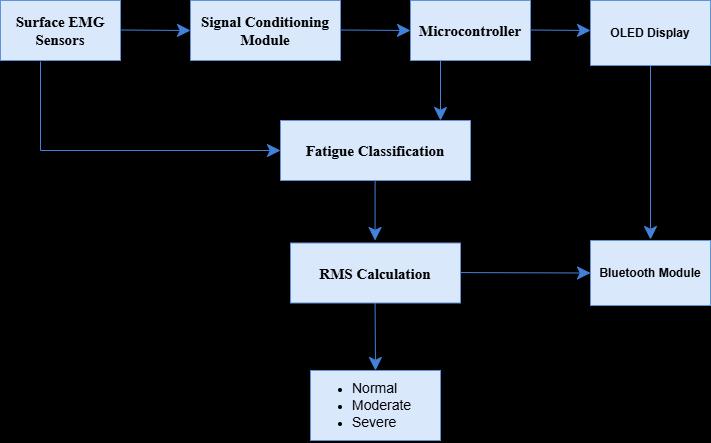
Theextractedfeaturesareusedtoclassifymusclefatigueinto threelevels:Normal,ModerateFatigue,andSevereFatigue. Initially, when the muscle is not fatigued, the RMS value remainslowandfrequencycomponentsarehigh.Asfatigue develops, the RMS value increases while the frequency decreases gradually. In severe fatigue conditions, the RMS reaches higher values and frequency components show a significantdrop.Athreshold-basedclassificationmethodis used to determine the fatigue level in real time. This approachissimple,efficient,andsuitableforimplementation onembeddedsystems.
Thesystemprovidesreal-timefeedbackthroughanLCDor OLEDdisplay.Theprocessedresults,includingfatiguelevel, arecontinuouslyupdatedandshowntotheuser.Thisallows immediateunderstandingofmuscleconditionduringactivity. The wearable design ensures portability and ease of use, making the system suitable for continuous monitoring in sportstraining,rehabilitation,anddailyactivities.Therealtime output helps users take necessary actions to avoid overexertionandimproveperformance.
TheproposedwearableEMG-basedmusclefatigueanalyzer presents an effective and low-cost solution for real-time monitoring of muscle activity. The system successfully acquires surface EMG signals, processes them using embeddedtechniques,andclassifiesfatiguelevelsbasedon amplitudeandfrequencycharacteristics.Theexperimental resultsdemonstratethatmusclefatigueisassociatedwithan increase in signal amplitude and a decrease in frequency components,whichareaccuratelydetectedbythesystem.
International Research Journal of Engineering and Technology (IRJET) e-ISSN: 2395-0056
Volume: 13 Issue: 03 | Mar 2026 www.irjet.net p-ISSN: 2395-0072
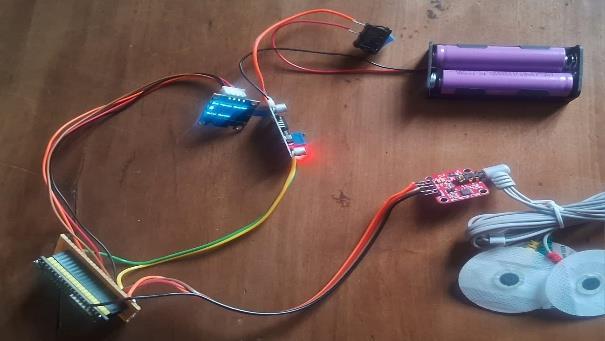
Thedevelopeddeviceoffersacompactandportabledesign, making it suitable for practical applications in sports training,physiotherapyrehabilitation,andindustrialworker monitoring. The use of simple hardware components and efficient signal processing ensures reliable performance while maintaining low cost and power consumption. The system provides real-time feedback, enabling users to preventoverexertionandimproveoverallperformanceand recovery.
Overall, this project successfully bridges the gap between biomedicalsignalanalysisandwearablehealthtechnology.It demonstrates the feasibility of implementing real-time muscle fatigue detection using affordable and accessible components, paving the way for future advancements in personalizedhealthcareandsmartwearablesystems.
[1] W.Zhang,Z.Bai,P.Yan,H.Liu,andL.Shao,“Recognition ofhumanlowerlimbmotionandmusclefatiguestatus usingawearableFES-sEMGsystem,”Sensors,vol.24,no. 7,p.2377,Apr.2024.
[2] Y. Chen, S. Li, J. Kuang, X. Zhang, and Z. Zhou, “Biomechanical monitoring of exercise fatigue using wearabledevices:Areview,”Bioengineering,vol.13,no. 1,2025.
[3] S.Kim,J.Lee,andH.Park,“Developmentofawearable EMGmonitoringsystemusingwirelesscommunication,” IEEE Sensors Journal, vol. 20, no. 15, pp. 8785–8792, 2020.
[4] M. F. Rahman, M. S. Islam, and M. A. Rahman, “A wearable real-time EMG data acquisition system for muscle activity monitoring,” 2019 International ConferenceonElectrical,ComputerandCommunication Engineering(ECCE),IEEE,pp.1–5,2019.
[5] A.Subasi,“ClassificationofEMGsignalsusingmachine learning methods,” Expert Systems with Applications, vol.39,no.5,pp.5109–5117,2012.(Foundational,still widelycited)
[6] Z. Liu, W. Huo, Z. Yu, P. Bentley, and R. Vaidyanathan, “Continuousestimationofneuromuscularfatigueusing wearablesensingsystems,”IEEEJournalofBiomedical andHealthInformatics,vol.29,no.11,pp.7969–7982, 2025.
[7] Y.Han,W.Zhao,X.Chen,andX.Meng,“High-speedlowconsumptionsEMG-basedmicro-gesturerecognitionfor wearabledevices,”IEEEAccess/arXivpreprint,2024.
[8] Y. Zhang et al., “Multimodal fatigue detection system using sEMG and IMU signals with hybrid CNN-LSTM model,”Sensors,vol.25,no.11,2025.