
International Research Journal of Engineering and Technology (IRJET) e-ISSN: 2395-0056
Volume: 13 Issue: 02 | Feb 2026 www.irjet.net p-ISSN: 2395-0072
International Research Journal of Engineering and Technology (IRJET) e-ISSN: 2395-0056
Volume: 13 Issue: 02 | Feb 2026 www.irjet.net p-ISSN: 2395-0072
Ishaan Kauhaad Learning Paths School
Abstract - Rice-stubbleburningisamajorenvironmental concern contributing significantly to release of particulate matter in the air and greenhouse gas emissions. Despite policy interventions, waste management remains a challenge due to limited economically feasible alternatives. Thestudypresentsdevelopmentofbiodegradablecomposite material from rice stubble using low-cost easily available natural binders. Multiple ways and binder systems were experimentally evaluated including hot water treatment, acid and alkali pretreatments and various natural binders. Early formulations suffered from many problems such as brittleness, uneven drying and poor reproducibility. Through systematic improvements a composition comprising alkali-treated finely ground rice stubble combined withtamarindpowder(imlipowder)asanatural binder and chalk powder as a hardening agent was developed.Thedevelopedmaterialdemonstrated mutability in its uncured state, enabling fabrication into different shapes. Following curing the composite hardened into a rigidstructurewithimprovedsurfacefinishandmechanical stability.
Key Words: rice-stubble, agro-waste utilization, natural binders, biodegradable composite, sustainable material
Rice cultivation substantial quantities of post-harvest residuecommonlyknownasricestubble.Inmanyregions particularly in northern India this residue is burned frequently to rapidly clear fields for subsequent cropping cycles. Crop residue burning releases large amounts of PM-2.5 and PM-10 particulate matter and greenhouse gases, resulting in severe seasonal air pollution and adversehealthandenvironmentalimpacts[1].
Transforming agricultural waste into value added materials represents a promising approach to mitigating residue burning while simultaneously supporting sustainable material development. Natural fibre-waste composites derived from agro-waste such as bagasse, bamboo and hemp have been extensively studied [8],[9]. However rice stubble remains unutilized due to its high silica content, lignin-rich structure and processing challenges[3].
This research aims to develop a low-cost, biodegradable composite material using rice stubble and
naturallyderivedbinders.Thestudyfocusesonenhancing fiber pretreatment, binder selection, and curing behavior to achieve acceptable mechanical integrity and reproducibilitywhilemaintainingsustainability.
2.1
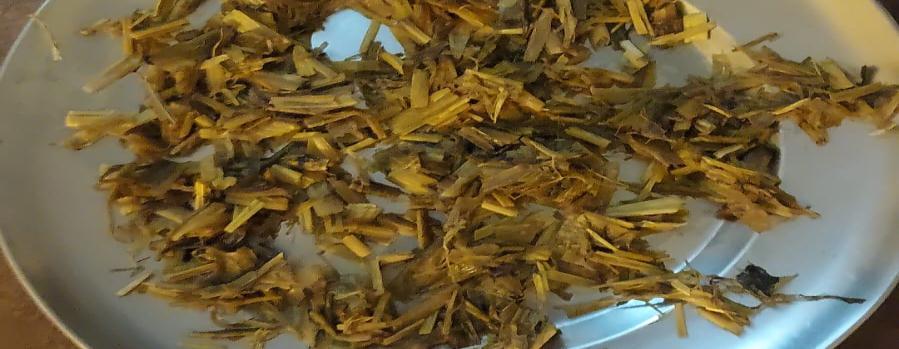
Rice stubble was collected from local agricultural sources. This stubble was manually cut into small segmentstofacilitatechemicaltreatmentandgrinding.
Initialtrialsinvolvedsoakinginhotboilingwaterforat least 12 hours in order to soften the fibres, followed by mechanical grinding to form a fibrous paste. Wheat flour and cornstarch were added as binding agents and water wasusedtoattainasemi-solidstructure.Themixturewas manuallycompressedusingamechanicalcompressorinto aflatsurfaceandsun-driedforapproximately24hours.
To enhance the softening of fibres, chemical pretreatment was also considered. Initially dilute hydrochloric acid was employed; however, reaction with starchbinders(cornstarch)causedpastesolubilityandlow compressibility. Later sodium hydroxide (NaOH) was employed because of its ability to decompose lignin and enhance fibre compatibility [4], [5]. The cut rice stubble was treated with NaOH solution for at least 12 hours and thenwashedwithwatertoremovealkalinity.
To enhance sustainability and strength, food based binders (wheat flour) were replaced. Calcium Carbonate (CaCO3)commonlyknown aschalk powder wasadded as ahardeningagentandcornstarchwaskeptasatemporary binder. Although this formulation produced harder samples,surfacecrackingandinconsistentreproducibility wasobservedacrossbatches.
Cornstarch was replaced by tamarind (imli) powder becauseofitshygroscopicnatureandcontrolledsolubility
International Research Journal of Engineering and Technology (IRJET) e-ISSN: 2395-0056
Volume: 13 Issue: 02 | Feb 2026 www.irjet.net p-ISSN: 2395-0072
[7]. Alkali-treated rice stubble was ground with a limited amount of water to prepare a semi-solid pulp. The pulp was then mixed with tamarind powder and calcium carbonate in a specific ratio. Experimental trials were carried out for different ratios of pulp, binder and hardenerbyvaryingproportionsoftamarindpowderand calciumcarbonate.Anoptimizedratiowasobtainedbased on the qualitative evaluation of mould ability, surface cracking, and hardness after curing. Samples were cured andambientconditions.
TRIAL FIBRE : BINDER : HARDENER OBSERVATION
1 9:10:7 Brittle,cracks
2 9:12:7 improvedbut inconsistent
3 9:15:7 bestoutcome
4 9:18:16 surfacenotatall smooth
4. DISCUSSION
The experimental results highlight the importance of binder selection and moisture control in rice-stubblebased composites. Acid pretreatment negatively affected binder performance by increasing solubility, whereas alkali treatment improved fiber compatibility by partially removing lignin and enhancing fiber bonding [4]. Replacing food-based binders (wheat flour) improved sustainabilityandreducedvariabilitybetweensamples.
Tamarind powder proved effective as a natural binder by maintaining moisture equilibrium during curing, enabling gradual hardening and improved surface finish. However, extended curing time remains a limitation that may affect scalability. Future research should investigate accelerated curing techniques and alternative natural binderstofurtheroptimizeperformance.
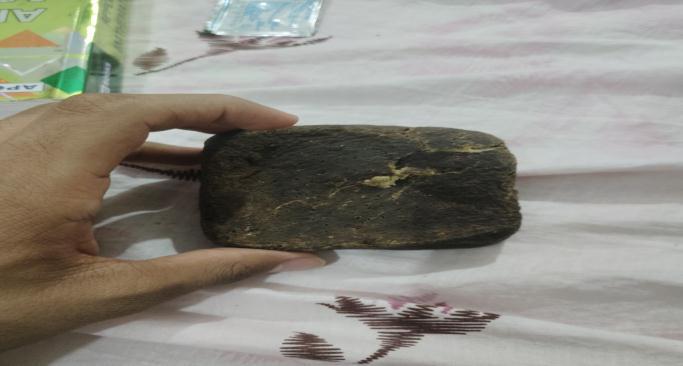
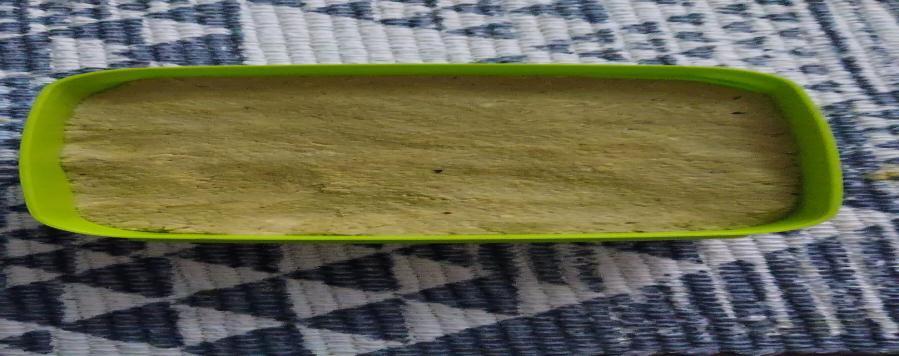
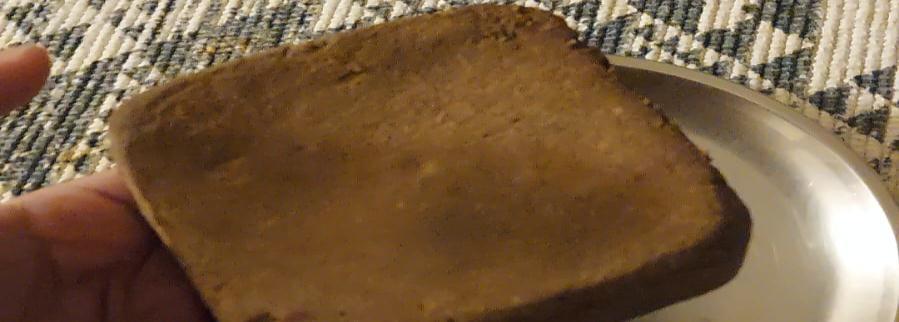
The optimized composite showed marked improvements in hardness, surface smoothness and mouldability over previous compositions. Initial rigidity was attained over 24 hours of drying and complete mechanical hardening took about 5 days. The composite could be moulded into varying geometries by altering mould size without compromising structural stability. Compared to starch compositions, the tamarind-bound composite showed lower levels of cracking and better moisturedistribution.
International Research Journal of Engineering and Technology (IRJET) e-ISSN: 2395-0056
Volume: 13 Issue: 02 | Feb 2026 www.irjet.net p-ISSN: 2395-0072
The primary limitation of the developed composite is the extended curing period of approximately five days required to achieve maximum hardness. Additionally, standardizedmechanicaltestingwasnotconductedinthis study. Future work will focus on quantitative strength characterization, accelerated drying methods, and longterm durability assessment under varying environmental conditions.
This study demonstrates the feasibility of producing a biodegradable, mouldable composite material from rice stubble using low-cost, natural additives. Through systematic experimentation and optimization, a structurally robust composite was developed that addresses key environmental and material challenges associated with agricultural waste utilization. The proposedapproachoffersapracticalpathwayforreducing residue burning while enabling sustainable material innovation.
[1] R. Singh, S. K. Kaskaoutis, and A. Sharma, “Crop residue burning and its impact on air quality in northernIndia,”EnvironmentalPollution,vol.245,pp. 638–645,2019.
[2] A. Pandey et al., “Biotechnological potential of agro-industrial residues,” Bioresource Technology, vol.74,no.1,pp.69–80,2000.
[3] D. Fengel and G. Wegener, Wood: Chemistry, Ultrastructure, Reactions. Berlin, Germany: Walter de Gruyter,1989.
[4]J.George,M.S.Sreekala,andS.Thomas,“Interface modification of natural fiber composites,” Polymer Engineering & Science, vol. 41, no. 9, pp. 1471–1485, 2001.
[5]A.K.BledzkiandJ.Gassan,“Compositesreinforced with cellulose based fibres,” Progress in Polymer Science,vol.24,no.2,pp.221–274,1999.
[6] L. Averous, “Biodegradable starch-based plastics,” Macromolecular Symposia, vol. 198, no. 1, pp. 81–90, 2003.
[7] A. Kulkarni et al., “Tamarind seed polysaccharide applications in biodegradable materials,” CarbohydratePolymers,vol.90,no.1,pp.1–7,2012.
[8] A. Ashori, “Wood–plastic composites from agrowastematerials,”BioresourceTechnology,vol.99,no. 11,pp.4661–4667,2008.
[9] A. K. Mohanty, M. Misra, and L. T. Drzal, “Sustainable biocomposites from renewable resources,” J. Polymers and the Environment, vol. 10, no.1,pp.19–26,2002.