
International Research Journal of Engineering and Technology (IRJET) e-ISSN: 2395-0056
Volume: 12 Issue: 05 | May 2025 www.irjet.net p-ISSN: 2395-0072
International Research Journal of Engineering and Technology (IRJET) e-ISSN: 2395-0056
Volume: 12 Issue: 05 | May 2025 www.irjet.net p-ISSN: 2395-0072
Harshit Singh1
1Student, Department of Mechanical Engineering, AISSMS College of Engineering, Pune, India
Abstract - The increasing demand for renewable energy has made the world more dependent on solar power systems. The efficiency of solar panels is dramatically decreased by the accumulation of debris and dust, necessitating effective and low-maintenance cleaning solutions. This project suggests a cost-effective and semiautomated solar panel cleaning system that minimizes manual effort and provides constant panel performance. The system uses an automatic water pump, sprinkler, and brush for cleaning stains and dust from the panel's surface. Made of easily procurable andcheaper components, the prototype shows the accessible method to keep single solar panels, especially those mounted at distant or communal locations such as streetlights. The design puts stress on how easy it is to install, its low operation cost, and the ability to scale up further automation with the use of microcontroller-based systems. This solution shows a bright direction in improving efficiency and reliability of solar powersystemsinaneco-friendlyway.
Key Words: renewable energy, solar panels, semiautomated, cleaning system, cleaning stains and dust, automation,improvingefficiency
With the prevalence of today's rising energy needs and environmental issues, solar photovoltaic (PV) technology has become universally used as a green, renewable, and sustainablesourceofpower.
Much as it has numerous benefits, one of the key operationalchallengesofPVsystemsisthesettlingofdust, dirt,birdfeces,andotherparticulatematteronthesurface of solar panels. Soiling effect can drastically lower the energy conversion efficiency, with research suggesting losses of between 2030% in some environments if cleaning is ignored from time to time. Manual cleaning techniques not only take long and are arduous to execute but also are impracticable in bigger-scale or in-site installations, causing high costs of operation and downtime. As a response to this limitation, the current work presents an automatic solar panel cleaner system that comprises mechanical and fluid-dispensing elements toprovidealow-cost,low-maintenancecleaningscheme.
The suggested design incorporates a small, motorpoweredcentrifugalwaterpumpthatdeliverspressurized water through a polymer pipe network and adjustableangle sprinklers, efficiently removing surface contaminants.
Arotatingbrushmechanismalsoassistsintheremovalof persistent stains and residues. The cleaning unit is mounted on a single PV panel module and can be configured for modular deployment on multiple panels. The architecture of the system permits possible automation by integration with microcontrollers such as Arduino and sensors to measure dirt levels, allowing for condition-based or scheduled activation. Through the use of off-the-shelf components and cost-effectiveness, the project realizes a total of minimum material cost, which makes it extremely affordable for small-scale and decentralized solar installations like rooftop arrays and solar-powered street lighting systems. Not only does this research show a practical solution to a long-standing maintenance problem, but it also helps to improve the long-term efficiency and viability of solar power systems invariousenvironmentalconditions.
The performance of solar photovoltaic (PV) systems is considerably impacted by the buildup of dust, dirt, and other environmental contaminants on solar panels' surfaces,especiallyindry,urban,orindustrialareas.
Conventional cleaning techniques are largely laborintensive, consuming large quantities of labor, time, and water and are oftentimes impractical for remote or highAltitude locations like rooftops and streetlights. This not only adds to operational expenses but also causes low energy yield and a reduced lifespan for solar panels from poormaintenance.Thus,a pressingrequirementexistsfor a low-maintenance, automatic, and affordable cleaning system that can be easily added to current solar panel installations to maintain performance, minimize human intervention, and generally increase the viability of solar powersolutions.
The process of developing the automatic solar panel cleaning system was conducted by a structured engineering design process with the steps encompassing problemanalysis,selectionofthecomponents,mechanical assembly, and functional testing. The steps below detail the methodology from concept to implementation are as follows:
The project started with the identification of the fundamental issue: the degradation of solar panel
International Research Journal of Engineering and Technology (IRJET) e-ISSN: 2395-0056
Volume: 12 Issue: 05 | May 2025 www.irjet.net p-ISSN: 2395-0072
performance caused by dust buildup. A survey of current manual and semi-automatic cleaning methods identified the necessity for an autonomous, water-based, low-cost cleaning system. The major requirements were established,suchasminimalhumanintervention,lowcost of operation, compatibility with small-scale PV installations, simplicity of installation, and low maintenance.
There were some design options considered, such as robotic wiper mechanisms, air-blowing mechanisms, and brush models. A water-based mechanism with an incorporated stationary pipe-and-sprinkler system was selectedasitissimple,efficient,andcost-effectiveforlowcost implementation. CAD software (e.g., SolidWorks or AutoCAD) were optionally employed for minimal schematicdesignofthemountinglayoutandfluiddelivery system.
On the basis of performance, availability, and budget,thefollowingpartswerechosen:
Solar Panel: A standard panel (size: 0.42m × 0.24m×0.02m)wasusedasthebasemodule.
Water Pump: A 20-watt centrifugal AC pump (165220V, 1150 L/h flow rate) was chosen for watersupply.
PipingSystem:FlexiblePVCpipes(0.01minner diameter)forwaterdistribution.
Sprinklers: Adjustable nozzles with 120180° spray range were used for uniform water distribution.
Brush Mechanism (optional): A motorized or hand-poweredsoft-bristlebrushwasemployed forstainremoval.
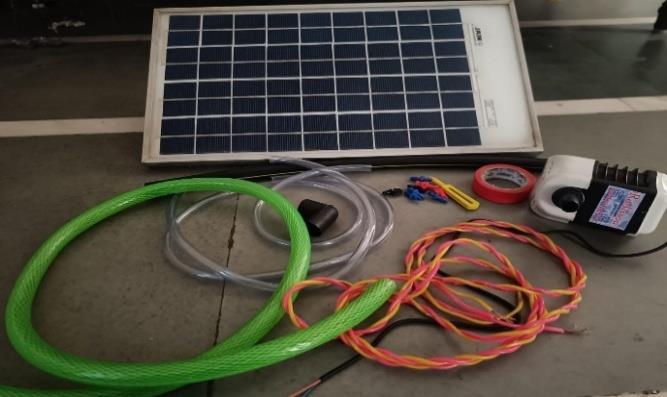
Wiring and Electrical Tape: For insulation and electricalconnections.
Controller (Extension Possibility): Future integrationwithmicrocontrollers(e.g.,Arduino UNO), solenoid valves, and dirt sensors is facilitatedinthedesign.
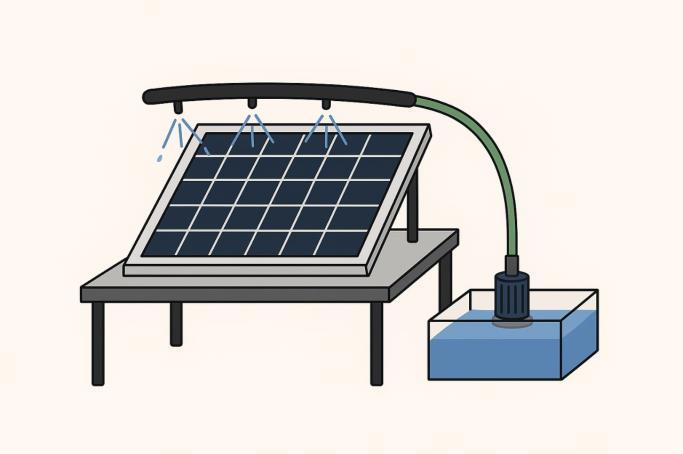
1. Thepipesystemwasattachedtothepump,and sprinklers were evenly mounted along the top edgeofthepanelframe.
2. Awaterreservoir wasattachedtothe pumpto ensureconstantwatersupply.
3. The brush mechanism was either clamped at one end or hand-held, with the possibility of automatingitwithamotorizedrack-and-pinion system.
4. All wiringconnections were well-insulatedand securedwithcableclamps.
5. The cleaning unit was clamped onto the panel with brackets, making it easy to remove or service.
The system was evaluated for flow efficiency, spray coverage, cleaning performance, and power usage. Water pressure was set so that dirt was effectively removed without water wastage or damage to the panel surface. The sprinkling cycle was cycled several times, and brush performancewastesteddryandwet.
2. WORKING
2.1 Working Principle
The self-cleaning system for solar panels works on the principles of mechanical agitation and fluid dynamics to removedustanddebrisfromthesurfaceofsolarpanels.
The system relies on a pressurized water delivery system, usingasubmersiblepumptodrivewaterthroughapiping systemintoaseriesofstrategicallyplacedsprinklers.
These sprinklers spread water over the panel surface in a wide-anglespray,withthehelpofmechanicalbrushesthat further clean the panel to remove more stubborn contaminants like mud, bird droppings, and stains. Removal of the surface impurities enhances the photovoltaic efficiency of the panels by reducing the scattering and absorption losses due to dust deposition. The system has been made with the least intervention by humans possible and can also be optimized with the
International Research Journal of Engineering and Technology (IRJET) e-ISSN: 2395-0056
Volume: 12 Issue: 05 | May 2025 www.irjet.net p-ISSN: 2395-0072
inclusion of microcontrollers like Arduino to switch on automatically according to sensor reading (e.g., dust value orfallinsolarirradiance).
2.2 System Working
For cleaning of solar panel following procedure of given stepsisusedtoachievedesiredresults:
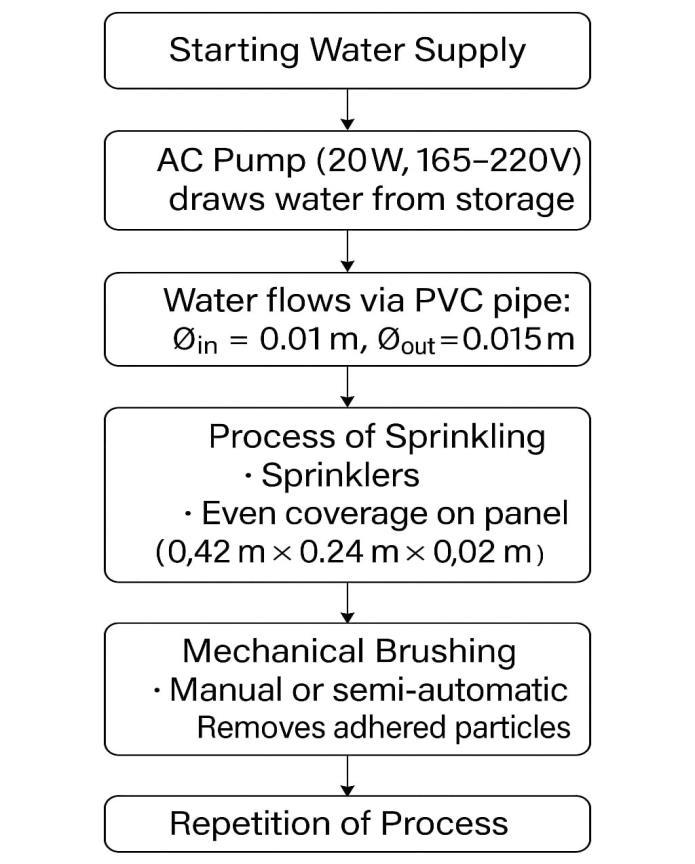
3: FlowchartOfCleaningSystem
1.StartingWaterSupply:
The operation drives a 20-watt single-phase AC pump (165-220V)forwithdrawalofwaterfromanouterstorage.
The water gets drawn through the use of PVC pipe (Øin = 0.01m,Øout=0.015m)forprogressiontowardssprinkler manifold.
2.ProcessofSprinkling:
Sprinklers spaced at proper intervals spread water in a range of 120°-180°, providing uniform coverage of the solarpanelsurface(0.42m×0.24m×0.02m).
3.MechanicalBrushing:
After sprinkling, manual or semi-automatic brushes pass overthewettedsurfacetoremovestuckparticles.
4.RepetitionofProcess:
The process is repeated two to three times, depending on thedustanddebrisaccumulatedonthepanel.
Duringthecompletionofthecleaning,thesystemshutsoff water supply, and the panel dries up, leaving clean panel andoperatingatenhancedefficiency
3. OBSERVATIONS
The experimental operation and application of the automaticsolarpanelcleaningsystemprovideda number of practical and performance-based observations. These observations were noted during repeated test cycles performed on a typical photovoltaic panel under controlledenvironmentalconditions.
3.1 Operational Performance
Thewater jetpressurecreatedby the 20-watt pump wassufficienttoloosenweaklystuckdust particlesfromthepanelsurface.
Sprinkler coverage sufficiently covered the majority of the panel surface, confirming proper angular orientation (120°-180° range) to ensure uniformwaterdistribution.
Manualbrushing,whencombinedwithsprinkling water, further facilitated removal of persistent debrissuchasbirddroppingsanddriedmud.
A 2-3 cycle repetition was determined to provide a visibly clean panel, which indicates an effective integrationoffluidandmechanicalaction.
International Research Journal of Engineering and Technology (IRJET) e-ISSN: 2395-0056
Volume: 12 Issue: 05 | May 2025 www.irjet.net p-ISSN: 2395-0072
3.2 Cleaning Efficiency
Visual observation pre- and post-cleaning revealedasignificantdecreaseindustdeposit.
Acomparisonofsimulatedpoweroutputpre-and post-cleaning revealed enhanced light exposure andenergyconversion,thoughaccurateelectrical measurement was not included in the present stage.
The overall cleaning time per cycle was found to average2-3minutes,thusshowingtimeefficiency forsmallandmedium-sizedpanels.
3.3 Component Durability
There was no noticeable wear on sprinkler or brush mechanisms during first-time usage, showing component durability under regular operatingconditions.
3.4 Limitations Observed
User intervention is required for the operation of manual pump and brushing; full automation currentlyisabsent
Efficiency in cleaning may be varying based on weather,debris,andinstallationangleofpanel
Usage of water is continuous in operation; optimizingflowrateorpracticingwaterrecycling canmakeitmoresustainable
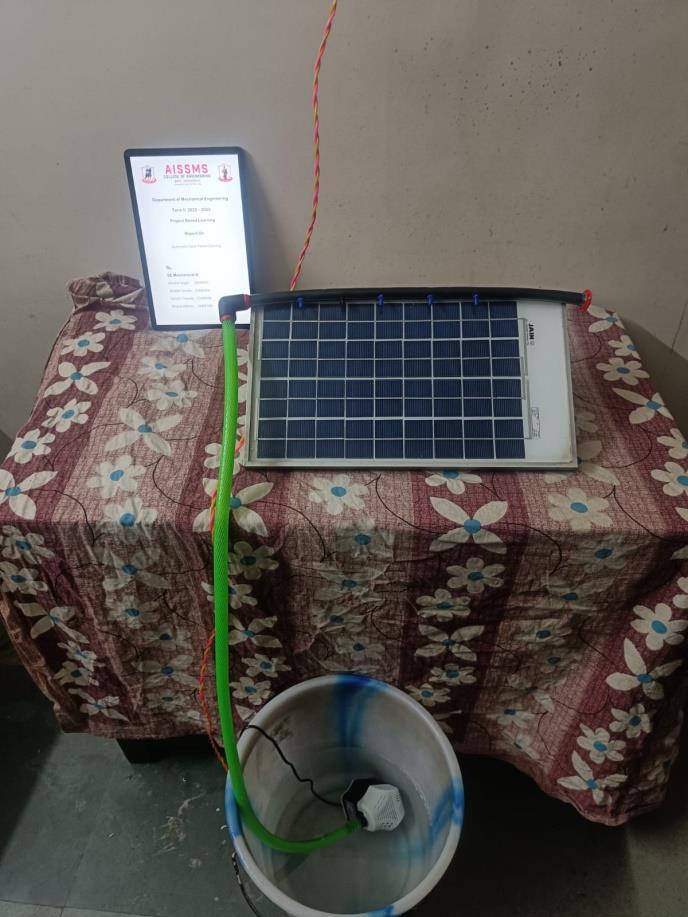
In future technologies complete automation with microcontrollers such as Arduino with integration of IoTsensors for intelligent control, water use reductions via recyclingandormist-spraysystems.
The design can scale up for larger installations and be flexible to accommodate varied panel orientations. The additionofmotorizedbrushesandtheuseofsafelonglife sustainable materials will improve efficiency and longevity. These elements will make the system more autonomous,energyefficient,andhavethepotentialtobe used on a wide scale for the solar energy sector which is expanding
The development of an automated solar panel cleaning system addresses a primary solar energy maintenance dust and debris accumulation that decreases panel efficiency.
The proposed design is a low-cost, high-efficiency, and viablemethodofcleaningviaasystemutilizingwaterjets andbrushing.
The system reduces man-hours and time significantly, henceidealforone-panelandminorinstallations.Asmuch as the current version is semi-automatic, its modularity allows for unparalleled future potential towards automation and scale-up. Based on future automations, waterconservation,andsmartmonitoringcapabilities,the systemhasthe possibilityofbeing an efficient addition to greensolarpowerinfrastructure.
[1] B,Manju&Bari,Abdul&M,Pavan.(2018).Automatic Solar Panel Cleaning System. International Journal of Advances in Scientific Research and Engineering. 4. 26-31.10.31695/IJASRE.2018.32778.
[2] Patil S. A, Patil A. R, Chougule V. N, Sanamdikar S. T. Design and Analysis of Automated Solar Panel Cleaning System. Curr World Environ 2023;18(3). DOI:http://dx.doi.org/10.12944/CWE.18.3.11
[3] S. Gochhait, R. Asodiya, T. Hasarmani, V. Patin and O. Maslova, "Application of IoT: A Study on Automated Solar Panel Cleaning System," 2022 4th International ConferenceonElectrical,ControlandInstrumentation Engineering (ICECIE), KualaLumpur, Malaysia, 2022, pp.1-4,doi:10.1109/ICECIE55199.2022.10000375.