
International Research Journal of Engineering and Technology (IRJET) e-ISSN: 2395-0056
Volume: 13 Issue: 04 | Apr 2026 www.irjet.net p-ISSN: 2395-0072

International Research Journal of Engineering and Technology (IRJET) e-ISSN: 2395-0056
Volume: 13 Issue: 04 | Apr 2026 www.irjet.net p-ISSN: 2395-0072
5
1 Assistant professor, Department of Civil Engineering, SanketikaVidya Parishad Engineering College, visakhapatnam, A.P 530041, INDIA
2 B. Tech Student, Department of Civil Engineering, SanketikaVidya Parishad Engineering College, visakhapatnam, A.P 530041, INDIA
3 B. Tech Student, Department of Civil Engineering, SanketikaVidya Parishad Engineering College, visakhapatnam, A.P 530041, INDIA
4B. Tech Student, Department of Civil Engineering, SanketikaVidya Parishad Engineering College, visakhapatnam, A.P 530041, INDIA
5 B. Tech Student, Department of Civil Engineering, SanketikaVidya Parishad Engineering College, visakhapatnam, A.P 530041, INDIA
ABSTRACT: No ordinary cement here. Instead, fly ash steps in as the base ingredient. Not alongside but working through chemical shifts when hydrated lime enters. That lime does more than sit - triggers reactions vital for hardening. Into the mix also slips nano-silica fume, unseen but active. Together they form a blend that skips traditional Portland methods. Making it means fewer CO₂ releases at factories. Waste becomes worth - industrial leftovers get reused. Strength matters just as much as green claims. So testing ensures it holds up under real demands. Durability cannot lag behind standard materials. Aiming not to impress - but to perform where buildings rise. Tiny bits of silica go into the mix in small amounts, boosting how fast it reacts while plugging tiny gaps inside. Instead of just listing steps, picture this: fly ash shifts between zero and seventy percent, lime climbs as high as thirty, nano-silica sneaks in anywhere from nothing to six. Testing checks how easily it flows plus how much weight it handles when squeezed. Early on, the stuff built with nano-silica pushes back harder against breaking, lets less water sneak through. Denser? Yes. Tougher over time? Absolutely. Fly ash teams up with limenot perfectly every time - yet often locks together well enough to help everything hold firm. One more thingcutting out regular cement cuts pollution and saves money too. Because it leans less on ordinary Portland cement, this new blend slashes greenhouse gases while pushing greener building methods forward. Industrial leftovers such as fly ash find purpose here, easing landfill strain and preserving raw supplies. Wrap it up: mixing lime, fly ash, and tiny silica particles creates strong, clean concrete without emissionsheavy ingredients. When mixed right and checked closely, it performs just like standard concrete across many uses - both load-bearing and lighter-duty ones.
Key Words: Cement free concrete, Fly Ash , Hydrated Lime , Silica Fume , Pozzolanic Reaction, Compressive Strength .
For centuries, concrete has built the backbone of human settlements - roads, bridges, pipes, factories. Not just todaybutsinceRomeruled,itstandsstrongthroughtime and weather. What holds it together. A substance called cement,mostoftenonenamedOrdinaryPortlandCement. Back in the 1800s, that mix changed everything: faster setting, tougher results, fit for almost any shape needed. Waterkicksoff a reaction incement,creatinga substance called C-S-H gel. This glue-like product holds bits of stone and sand tightly bound. Strength comes from how those pieces link through the formed gel. Thanks to its toughness and reliability, concrete made with cement dominatesbuildingworkworldwide.
Yet here's the catch - making cement harms nature more than most admit. High heat, near 1450°C, breaks down limestone, a step that spills huge volumes of CO₂ straight into air. Burning fuel adds even more gas, while the chemistryitselfletsloosestill greaterloads.Across Earth, factories turning out cement account for roughly 7 to 8 percent of human-made carbon pollution. That weight pushes climate shifts faster. Beyond gases, it guzzles raw stuff - clay, stone, oil - not one bit sparingly. Land pays a price; balance in ecosystems wobbles. As cities rise everywhere, demand swells, dragging heavier tolls on planetsystems.Sustainability?Itslipsfurthereachyear. Old experiments with natural ashes - like those Romans put into seawater concrete - first hinted at ways to build without cement. Not until the 1980s did labs start taking such mixtures seriously, looking for greener options
International Research Journal of Engineering and Technology (IRJET) e-ISSN: 2395-0056
Volume: 13 Issue: 04 | Apr 2026 www.irjet.net p-ISSN: 2395-0072
beyond traditional graypowder. One waste product, from burningcoal,turnedoutuseful:flyashcarriedjustenough reactive glassy particles to react well. Instead of heatheavyprocesses,mixingitwithlimeopensadifferentpath -onewherestrengthgrowsquietlythroughgelformation. Tiny doses of synthetic silica speed things up, weaving tight networks that glue everything together, molecule by molecule.
Concreteuseclimbsfastasbuildingworkexpands,relying heavily on Ordinary Portland Cement to hold things together. Yet making this cement harms nature in serious ways. Heating limestone until it breaks down needs intense heat, pulling from oil, coal, or gas supplies while pouring out thick clouds of carbon dioxide. This single sector pumps out around 7 to 8 percent of Earth's CO₂ emissions each year. As ice melts, weather shifts, and ecosystemsweaken,findinggreeneroptionsfeelslesslike choice - more like necessity. Old methods now push us towardnewanswers.
Concrete without cement helps push greener building methods forward. With nations aiming to balance carbon output, shifting toward cleaner materials matters more every year. Removing most or all traditional cement slashesCO₂,sinceclinkerproductionissoemissionheavy Structures built this way leave a lighter mark on the planet,quietlychanginghowthingsaremade. Because fly ash is often nearby, concrete without cement mightsavemoneyinsomeareas.Ratherthanpayingtoget rid of waste, factories can send it to builders who need it. That shift lowers expenses for building projects. It helps natureatthesametimeasbudgets.
1. 2001, Sabir's team looked closely at how metakaolin and heated clays behave when mixed into concrete. Though their study didn’t center on fly ash or tiny silica particles, it revealed something useful - ultrafine reactive materials can make concrete stronger andlastlonger.Thatidealinesupwellwithswapping out regular cement for alternative binders. So even without targeting specific additives, the work still backsthemovetowardlesscementinmixes.
2. (2) Concrete made with lots of fly ash might just step inwhereregularcementonceruled.Insteadofrelying on ordinary Portland cement, this approach leans heavily on industrial leftovers. When mixed right, fly ashholdsupwellunderpressure-noneedtosacrifice toughness. Strength stays solid even when cement fades out of the recipe. Ideas about skipping cement
entirely gain weight through such findings. The original thinking came from Malhotra and Mehta backin2002.
3. Starting off, tiny bits of silica speed up how cement mixes with water. These small parts help form new material by offering spots where reactions begin. The waythemixtureholdstogethergetsstrongerbecause gaps inside become smaller. Evidence shows such nanoparticles change how the paste forms over time. Results back up their role in making concrete more durable. Using them fits well when looking for differentwaystobindmaterials.Workdoneby Li and others in 2004 laidouttheseeffectsclearly.
4. Early reactions get a boost when tiny silica particles arepresent,accordingtofindingsby Bjornstrom and team in 2004.ThesesmallbitsspeeduphowfastC-SHforms,packingthestructuretightersooner.Because of this shift in timing and density, alternatives to ordinary Portland cement can benefit just fine. The role of nano-silica fits well within such mixtures, helpingthemevolvefasterfromstart.
5. Looking into how long geopolymer materials last when exposed to sulfates, Bakharev back in 2005 found they hold up well under harsh chemistry. Because of this behavior, cement-free concrete using different binding agents gains a solid point on longevity.
6. Nanotechnology might change how concrete behaves, accordingtoSobolevand Ferrada-Gutierrez back in 2005. Because of tiny particles like nano-silica, materials pack tighter and react faster. Strength goes up while liquids pass through less easily, thanks to these additives. Their research supports using nanosilicaevenwhenthereisnocementinvolved.
7. From their lab tests, Hardjito and Rangan in 2005 explored how fly ash turns into geopolymer concrete. Results showed it often matches regular concrete squeeze strength - sometimes beats it. Because of its makeup, it withstands harsh chemicals better and cracks less when drying out. People now reference theirmethodswhendecidingingredientmixesorheat treatments. Years later, engineers still rely on those earlyblueprints.
8. Concrete gains strength when fly ash is finer and curedwell, Thomas pointed out in 2007.Becauseof this, using lime along with nano-silica creates strong mixtureswithoutcement.Hisworkshedslightonhow these materials interact effectively. Though not obvious at first, small changes in processing make a noticeabledifference.
International Research Journal of Engineering and Technology (IRJET) e-ISSN: 2395-0056
Volume: 13 Issue: 04 | Apr 2026 www.irjet.net p-ISSN: 2395-0072
9. Startingoff, Duxson and colleagues looked into how geopolymers are built, handled, and used across industries. Instead of traditional methods, they found thatmaterialslikeflyashandslag-whentriggeredby certain chemicals - can create solid binders. While examiningperformancetraits,thesemixturesshowed high heat tolerance, stood up well against corrosive substances,yetalsoloweredecologicalharm.Because ofthesefeatures,suchsystemsmightonedaytakethe placeofordinarycementwithoutlosingstrength.
10. Barbhuiya and team looked at how high-fly-ash concretebehaveswhenmixedwithhydratedlimeand silica fume. Early reactions got a boost because lime sped things up. Strength went wayup thanksto silica fume - both squashing and pulling forces held better. Together, those extras made the inside structure tighter, leaving fewer gaps. Less space between particles opened doors for mixes using little or no cement.
11. Starting off, Provis and van Deventer in 2009 looked into how geopolymers form along with changesintheirtinyinternalstructurewhenactivated by alkaline substances. Instead of just listing steps, they detailed the actual chemistry behind building strong, three-part silicon-aluminum frameworks. Because of these formations, materials gain impressive resistance and toughness over time. Beyond theory, their research helps shape ways to make geopolymer concrete from waste like fly ash foundinindustry.
12. Concretegetsaboostwhentinyparticlesjointhemix. Tiny bits of silica change how fast the material sets. These small elements patch gaps inside the structure. Strength goes up because of their presence. Early results look good, so do those seen later on. Less cement can be used without losing quality. That idea camefromlookingcloselyatpastwork. Sanchez and Sobolew took a close look back in 2010.
13. Back in 2011, Nazari and Riahi took a close look at how nano-silica changes high-strength concrete. Strength gains showed up clearly under pressure and whenbent.Poresinsideshrank quite noticeably.Tiny structures within the mix grew more tightly packed. Because of these shifts, slipping nano-silica into test batchesmadesolidsense.
14. Looking into how tiny silica particles affect concrete, Rashad took a close look back in 2013. Strength and resilience get a boost - so long as the material spreads evenly through the mix. Evidence piles up showingitworkswellevenwithoutregularcement.A full picture emerges,pointingtowardsmarterchoices inbuildingmaterials.
15. Concrete needs grow fast as cities expand, pushing pressure on building supplies. When towns swell, materials like cement become critical players in development patterns. A 2007 housing plan pushed greener options in construction work across regions. Making regular cement pulls heavily from earth’s reserves during manufacturing phases. Each batch released into air systems adds more CO₂ than earlierstepsallowed.Onewaytotackletheproblem? Usinggeopolymerconcretefromflyash-leftoverstuff from coal power stations. Across India, heaps of it exist though hardly anyone uses it fully yet. Workability gets better when superplasticizers come into play. Strength steps up thanks to tiny particles like nano silica or nano carbon bits mixed in. What does this research do? It looks at how cement-like substances without CO₂ impact geopolymer concrete behavior.
16. Looking at high-volume fly ash mixed with hydrated lime and nano-silica, Gunasekera and team in 2020 checkedhowitaffectsstrengthandinternalstructure. Because of nano-silica, water reactions kicked off faster, particles fit together better, showing clear jumps in strength within days along with solid improvement by day 28. Work like their points toward using nano-silica in mixes without much cement,helpingthemperformwell.
17. Amixwithoutcement wascreatedby Roychand and team in 2021, meant for sewer pipelines, built from fly ash, tiny silica particles, slag, along with lime that absorbed water. Better protection against acidic damageemergedintheirtesting,whenmeasurednext to regular Portland cement material. Because there’s no leftover calcium hydroxide, the structure holds up longer.Environmentsthatweardowntypicalconcrete dolessharmtothisversion.
1. Onewaytobeginisbyexamininghowflyashbehaves on its own. Lime’s role shows up clearly when tested separately. Nano silica reveals subtle effects only under close observation. Each material brings somethingdistinctwhenmixedwithoutcement.Their combined actions shift depending on proportions. Closeattentionuncoverspatternsothersmightmiss.
2. Startingwithflyash,mixdesignsformwithoutcement by blending varying amounts of lime alongside nano silica. Different ratios shape each batch, altering performance quietly behind the scenes. Proportions shift step by step, guided by material behavior rather than fixed rules. Through gradual adjustments, workable mixes emerge under changing conditions. Testing reveals how these elements interact when
International Research Journal of Engineering and Technology (IRJET) e-ISSN: 2395-0056
Volume: 13 Issue: 04 | Apr 2026 www.irjet.net p-ISSN: 2395-0072
cementisfullyleftout.Eachversionreflectsabalance foundamongcomponentsplayingdistinctroles.
3. Checking how well concrete without cement flows, using common lab methods like the slump trial. Testing its behavior begins here, through routine checks that show performance. A usual methodslumpmeasurement - helpssee if it movesright. This looks at flow traits by applying familiar procedures stepbystep.Standardtrialsrevealwhethermixworks smoothlyduringplacement.
4. Testing how strong cement-free concrete is when squeezed, pulled apart, or bent helps understand its performance under different forces. Strength under pressure reveals load capacity, while resistance to crackingshowsdurabilityduringreal-worlduse.Each measure gives insight into where this material might workwell-orfail.
5. One way to look at how tiny glass particles affect toughening and inner patterns in concrete without cement. A closer peek shows these minuscule specks shifting how the mix sets up. Sometimes strength climbs when those bitsspreadthrough the paste. The weave inside change, not always predictably. Tiny spacesrearrangeasthematerialfirmsup.
6. Cement-free mix stands against regular concrete in a testofstrength.Onewatcheshoweachholdsupunder pressure instead of assuming results. Performance shows through stress trials rather than guesses on paper. Trial outcomes shape conclusions without leaningonpastbeliefs.
7. 7.To determine the optimum mix proportion that providesmaximumstrengthanddurability.
8. 8.To assess the potential of cement-free concrete as a sustainableandeco-friendlyconstructionmaterial.
1. 1.Investigationofthephysicalandchemicalproperties offlyash,lime,andnanosilica.
2. 2.Development of different mix proportions for cement-freeconcrete.
3. Checking how easy concrete is to work with often involvestried-and-truemethodsliketheslumptest.
4. Concrete samples get tested for how much squeeze they can takeafter restingseven days. Following that, another roundhappens when two weeks have passed sincepouring.Bythefourthweekmark,onelastcheck measurestheirfullresistancetopressure.
5. Concrete without cement gets tested for how it handlespullingapartplusbendingforces.
6. 6.Analysis of the influence of nano silica on the strengthanddurabilityoftheconcrete.
Looking at how things are done comes down to the stepby-step approach taken during testing, especially when
checking how well concrete without cement works. For thiswork,batchesofconcreteusedflyash,hydratedlime, and nano-silica instead of traditional binders, each mix adjusted in amount. Once gathered, ingredients got weighed carefully before blending together and poured intomoldsshapedlikecubes.Thesemoldedsamplesthen sat in a curing environment for spans of 7, 14, 21, or 28 days. When ready, they went through checks - like measuring how much pressure they could take - to see howstrongtheyturnedout.
Materials Used- Fly ash, Hydrated lime, Nano Silica Fume, Fine Aggregate, Coarse Aggregate, Water.
Fly Ash:-Finepowderleftafterburningcrushedcoalgives rise to fly ash. This type of material, specifically Class F, servedasthemainbindingagentinthestudy.
Onekeyingredientformakingcement-freeconcretecame from trusted suppliers, helping keep tests steady and resultsclear.Fromalocalpowerstationorbuilder'syard, fly ash arrived carefully packed, then kept away from damptostayusable.
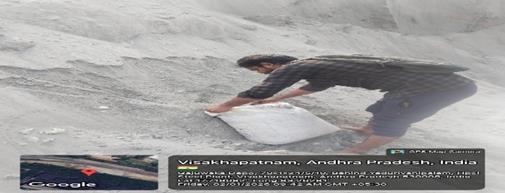
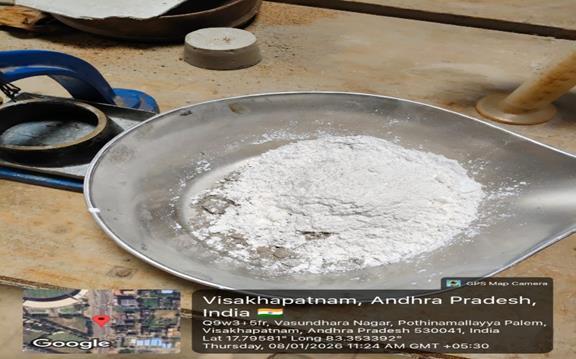
Hydrated Lime:- Starting with quicklime, water gets carefullyaddedtomakehydratedlime.Calciumhydroxide forms during this step, which helps fly ash work in concrete without cement. From a nearby shop came the materialusedhere.Storedawayitstayed-sealedtight-to blockdampnessandoutsideair.
International Research Journal of Engineering and Technology (IRJET) e-ISSN: 2395-0056
Volume: 13 Issue: 04 | Apr 2026 www.irjet.net p-ISSN: 2395-0072
Nano-Silica fume:- Tiny glass-like particles, made of disordered silicon dioxide, pack a huge surface relative to their size. Used here in low amounts, these fine specks boostedhowmuchforcethematerialcouldhandle. Outofnowhere, nano-silica powderarrivedbymail order froma web-basedlabvendor-handledwithcarebecause the particles are incredibly tiny. Sand showed up first amongthematerials,followedcloselybylargerstonebits, both pulled from nearby builders’ supply yards. Testing happened afterward, just to check if grain sizes lined up with what official guidelines expect. Before anything mixed,a washcyclecleared off dirtandstraydebrisfrom everybatch.
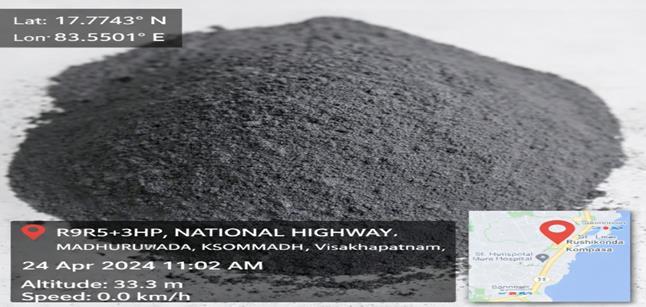
Fine Aggregate :-Small stones washed down by rivers made up the fine material in this work, fitting what the standard calls Zone II under IS 383:2016. Though nature shaped them, rules still classified their size. Each grain passedtestsbeforeenteringmixtures.Watercarriedthese particles for ages before collection. Their smooth edges camefromlong travel. Whatsettlesheremeetsa national benchmark. Roundness matters more than color when blending. Dust levels stayed low due to constant washing. Shape affects how things hold together later. Size range fitsrightintomid-gradesorting.
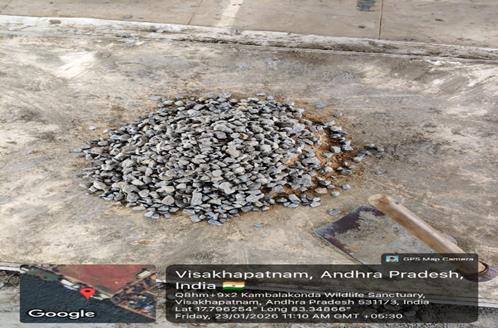
Coarse Aggregate :-A mix of crushed stone, around 20 mm in size, went into the tests. This larger gravel type helped form the concrete batch. The pieces were rough and broken, not smooth. Each sample followed the same grain pattern. Size consistency mattered throughout the process. Material came straight from the quarry run. Testingreliedonuniformchunksonly.
Water :- From time to time, clean drinking-grade water wentintobothblendingandhardeningtheconcretemix.
MIX CALCULATION FOR M20 CONCRETE USING FLYASH, HYDRATED LIME AND NANO SILICA FOR 1m³
1. Dry Volume of Concrete DryVolume =1×1.54=1.54m3
2. Mix Ratio
Assumedmixratio:1 15
Totalparts:1 1.5 = 5.5
3. Volume of Each Material
BinderVolume
= . 8m3
FineAggregateVolume
CoarseAggregateVolume
3
4. Convert Binder Volume to Weight
Densityofbinder≈1440kg/m³= 8×144 =4
Totalbinder≈400kgperm³
4. Convert Binder Volume to Weight
Densityofbinder≈1440kg/m³= . 8×144 =4
Totalbinder≈400kgperm³
M1 Mix:
Flyash=70%
Hydratedlime=30%
Flyash=4 × .7 = 8
Hydratedlime=4 × =1
International Research Journal of Engineering and Technology (IRJET) e-ISSN: 2395-0056
Volume: 13 Issue: 04 | Apr 2026 www.irjet.net p-ISSN: 2395-0072
M2 Mix:
Flyash=70%
Hydratedlime=28%
Nanosilica=2%
Flyash=280kg
Hydratedlime=4 × 8=11
Nanosilica=4 × . =8
M3 Mix:
Flyash=70%
Hydratedlime=27%
Nanosilica=3%
Flyash=280kg
Hydratedlime=4 × . 7=1 8
Nanosilica=4 × . =1
M4 Mix:
Flyash=70%
Hydratedlime=24%
Nanosilica=6%
Flyash=280kg
Hydratedlime=4 × . 4=96
Nanosilica=4 × . 6= 4
6. Aggregate Quantity
1. FineAggregateDensity≈1600kg/m³= 4 ×16 =67
2. CoarseAggregateDensity≈1500kg/m³= .84×15 =1 6
3. WaterRequirementAssumeWater–BinderRatio= 0.50=Water =4 × .5
MIXING PROCESS
Dry Mixing
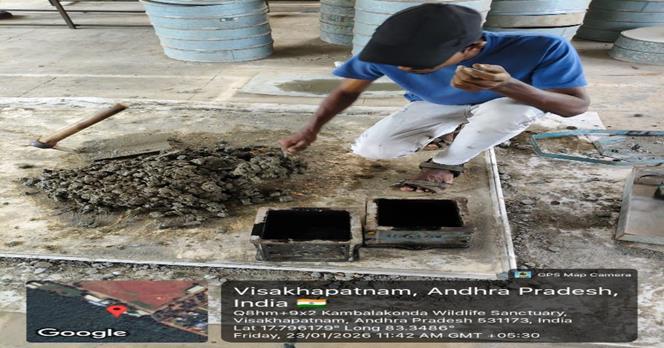
Concrete blending happened inside a lab setting, aiming for even consistency throughout. Right at the start, each component - fly ash, hydrated lime, nano-silica, fine sand, plus coarse stones - got weighed precisely based on set ratios. With everything dry laid out, these elements went into an empty mixing space, stirred well so binders could spreadevenlyamongthegrains.
Water addition
Later on came the slow addition of measured water into the dry blend, with constant stirring throughout. Mixing went on until everything felt even and ready to shape without clumping. Attention stayed sharp so every part blended well, avoiding any small knots in texture. Right after finishing, the batch moved straight into filling molds shapedlikecubes,setasidelaterforchecks.
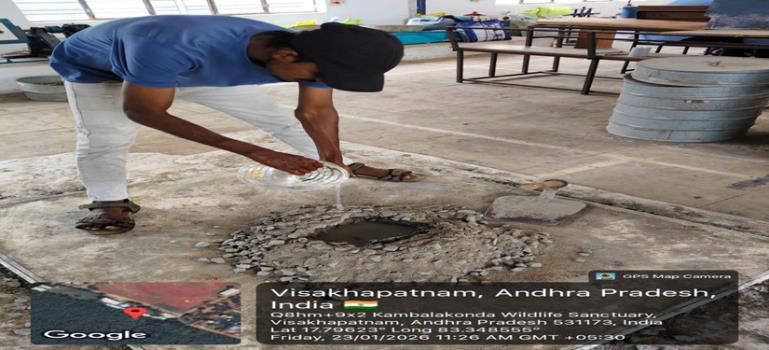
Final mixing
Nextcametheslowpourofwaterintotheblendofflyash, hydratedlime,nano-silica,fineandcoarseaggregatesalreadystirreddry.Witheverythinginside,spinningit longermadesuretextureturnedeven,readytouse.
International Research Journal of Engineering and
Volume: 13 Issue: 04 | Apr 2026 www.irjet.net
Table
Table :2 Slump cone Test and results
International Research Journal of Engineering and Technology (IRJET) e-ISSN: 2395-0056
Volume: 13 Issue: 04 | Apr 2026 www.irjet.net p-ISSN: 2395-0072
Table -5 Cost Comparison
Chart -4
CompressionTestofNewBinderCubesWith 3%Silica(mix3)
Chart -5
Compression
Chart -6
RateAnalysisistheprocessofcalculatingthecostofone unitofworkbyconsideringthecostofmaterials,labour, equipment,transportation,overheads,andcontractor’s profit.
Purpose of Rate Analysis
1. Todeterminetheunitcostofconstructionwork. 2. Toestimatethetotalcostofaproject. 3. Tocheckwhetherthecontractor’squotedrateis reasonable. 4. Toprepare
International
Volume: 13 Issue: 04 | Apr 2026 www.irjet.net p-ISSN: 2395-0072
setmatchedupcloselywithregularcementoncesilica fumewasmixedin.
6. Fine movement in the mix stayed within expected range across all batches, delivering consistent slumpingbehavior-yetstiffnessbegancreepinginas more silica got added. Concrete held its shape but sloweddownwhenricherinfinepowder.
NannoSilicaFume
Binder Cost Comparison for 1 m³
Chart -7 Costcomparison
1. A new binder emerged without cement, built from fly ash combined with hydrated lime. Success came throughrealtesting,showingitcanstepinforregular Portland Cement. Feasibility showed up in performance, not just theory. This path opens doors minus reliance on traditional materials. Proof lives in theresults,quietbutclear.
2. Starting with silica fume made the chemical process stronger, so the material held together more tightly. Because of that change, overall durability increased noticeably.
3. Compressive strength peaked at 4 weeks - reaching 19.11N/mm²-withmixtureM3.Thatblendheld70% flyash,whilelimemadeupmostoftherest,sittingat 27%.Asmallportion,just3%,camefromsilicafumes. Peak performance emerged clearly here, standing out amongtheothers.
4. Strength went up over time in every batch, showing that concrete without cement can still gain durability asithardens.Eachmixfollowedasimilarpath,slowly buildingfirmnessthroughextendedcuringperiods.
5. Starting at first, the early hardening phase stayed insidenormalranges.Lateron,thepointwhenitfully
7. Water amounts stayed between 0.43 and 0.50 compared to binder, showing careful balance across every mix. Though exact needs differed slightly, each blend used moisture efficiently. Because of that, consistency remained steady without excess. Still, small shifts in proportion mattered. Even so, results showedreliablecontrolthroughouttesting.
8. Looking at the numbers, mix M1 came out cheaper than regular cement without losing strength. Not far behind, M2 also cut costs but still held up well under pressure.ThenthereisM3-samestory,lessexpense, yet strong enough for standard use. Each of these alternatives manages savings while doing what they needtodo.
9. A surprise twist unfolded when fly ash, normally discarded, stepped into the spotlight. Waste took center stage, quietly cutting down pollution. Sustainability got a nudge - not through grand gestures but small shifts. Factories shrugged off old habits. Smokestack leftovers found new purpose, groundingprogressinwhatwasonceoverlooked.
1. Sabir, B., Wild, S., & Bai, J. (2001). Metakaolin and calcined clays as pozzolans for concrete: A review. CementandConcreteComposites,23(6),441–454.
2. Malhotra, V. M., & Mehta, P. K. (2002). Highperformance, high-volumeflyashconcrete: Materials, mixture proportioning, properties, construction practice,andcasehistories.CANMET.
3. Li,H.,Xiao,H.,Yuan,J.,&Ou,J.(2004).Microstructure ofcementmortarwithnanoparticles.CompositesPart B:Engineering,35(2),185–189.
4. Björnström, J.,Martinelli,A.,Matic,A.,Börjesson,L.,& Panas,I.(2004).Acceleratingeffectsofcolloidalnanosilica for beneficial calcium–silicate–hydrate formation.ChemicalPhysicsLetters,392,242–248.
5. Bakharev, T. (2005). Resistance of geopolymer materials to sulfate attack. Cement and Concrete Research,35(6),1233–1246.
6. Sobolev, K., & Ferrada-Gutierrez, M. (2005). How nanotechnology can change the concrete world. AmericanCeramicSocietyBulletin,84(10),14–17.
International Research Journal of Engineering and Technology (IRJET) e-ISSN: 2395-0056
Volume: 13 Issue: 04 | Apr 2026 www.irjet.net p-ISSN: 2395-0072
7. Hardjito,D.,&Rangan,B.V.(2005).Developmentand properties of low-calcium fly ash-based geopolymer concrete(ReportNo.GC1).CurtinUniversity.
8. Thomas, M. (2007). Optimizing the use of fly ash in concrete.PortlandCementAssociation.
9. Duxson, P., Fernández-Jiménez, A., Provis, J. L., Lukey, G. C., Palomo, A., & Van Deventer, J. S. J. (2007). Geopolymer technology: The current state of the art. JournalofMaterialsScience,42,2917–2933.
10. Barbhuiya,S.A.,Gbagbo,J.K.,Russell,M.I.,&Basheer, P.A.M.(2009).Propertiesofflyashconcretemodified with hydrated lime and silica fume. Construction and BuildingMaterials,23(10),3233–3239.
11. Provis, J. L., & Van Deventer, J. S. J. (2009). Geopolymers: Structure, processing, properties and industrialapplications.WoodheadPublishing.
12. Sánchez, F., & Sobolev, K. (2010). Nanotechnology in concrete – A review. Construction and Building Materials,24(11),2060–2071.
13. Nazari, A., & Riahi, S. (2011). The effects of nano-SiO₂ on properties of high-strength concrete. Composites PartB:Engineering,42(3),570–578.
14. Rashad, A. M. (2013). A comprehensive overview about the influence of nano-silica on concrete properties. Construction and Building Materials, 47, 357–375.
15. Vijayalakshmi, & Koti. (2017). Effect of nanotechnology on fly ash geopolymer concrete. International Journal of Civil Engineering and Technology,2(6).
16. Gunasekera, C., Sandanayake, M., Zhou, Z., Law, D. W., &Setunge,S.(2020).Performanceofflyash–hydrated lime concrete with nano-silica. Construction and BuildingMaterials,253,Article119225.
17. Roychand,R.,Li,J.,DeSilva,S.,Saberian,M.,Law,D.,& Pramanik, B. K. (Year). Cement-free pipe material for improved sewer durability. Journal of Cleaner Production,164.