
International Research Journal of Engineering and Technology (IRJET) e-ISSN: 2395-0056 p-ISSN: 2395-0072

Volume:12Issue:06|Jun2025 www.irjet.net

DEVELOPING AND MANUFACTURING OF CUSTOM BRAKE CALIPER
Sujal Jadhav1 , shivanand Jadhao2 , Rushikesh Ingole3 , Soham Kachare4 , Mr.P.S Aglawe5
Department of Mechanical Engineering
All India Shri Shivaji Memorial Society’s College of Engineering, Pune
Abstract - The Brakes are the fundamental and crucial systemintheautomotiveindustry,playingapivotalrolein ensuringvehiclesafety,controlmovingvehicle,anddynamic performance of the vehicle. A well-functioning braking systemallowsdriverstocontroltheirvehiclesandrespond tounexpectedsituationspromptly.
Discbrakesaremoreefficientbrakesthanotherbrakesfor racing vehicles. Disc brakes offer unparalleled stopping power, allowing for rapid and effective deceleration. The design of disc brakes facilitates efficient heat dissipation duringintensebrakingconditions.Ithasanopendesignthat allows for easy visual inspection and maintenance. Disc brakesofferprecisecontrolandresponsivenessforracing drivers.
Disc brakes has mainly two components disc and caliper. Theflatsurfaceofdiscactsasthefrictionpointsforbrake pads.Whenthebrakepedalispressed,thepadscontactthe disc, converting the wheel's rotation into thermal energy throughfriction.Calliperworksasclampforholdingthedisc when brake pedal is pressed that slows down the vehicle. The design of the calliper can be optimized by keeping factors like bleeding port, pads mount, fluid flow path in consideration.
1.
INTRODUCTION
A brake is a device by means of which artificial frictional resistance is applied to moving vehicle, in order to stop motion of vehicle (SAE International, 2003). A brake caliperusuallymadeupofCastIronorCeramicandwhich is assembled in wheel or axle. To stop the wheel,friction material is in the form of brake pads (mounted in device called a Brake caliper) is forced mechanically, Hydraulically or Pneumatically against both sides of the disc.Frictioncausesthediscandattachedtosloworstop.
1.1 LiteratureSurvey
Belhocine Ali and Bouchetara Mostafa (2013) [1]: analyzed the thermomechanical behavior of the dry contact between the brake disc and pads during the brakingphase.Thethermal-structuralanalyzeisthenused to determine the deformation and the Von Mises stress establishedinthedisc,thecontactpressuredistributionin pads.

Design and Analysis of Hydraulic Brake caliper [2]: Prajwal Gawali, Prof. S. R. Kulkarni. Determination of Brakingforceismostcrucialaspecttobeconsideredwhile designing any braking system. The generated braking force should be always be greater than the required braking force. Space and assembly constraints are also an importantfactorwhiledesigningthecaliper body. The seal groovegeometryispivotaltotheoperationofthecaliperas it allows the piston to retract after the required clamping forcehasbeenapplied.
Design and Testing of Custom Brake Caliper of a Formula Student Race Car [4]: Mosam Ugemuge, Sreethal Das. The paper gives a detailed study on designingandtestingabrakecaliperwhichislightweight thus enhancing the agility and reducing the unsprang mass.InOEM caliper theleastthicknessof discwhichcan beusedwas4mm.Thebenchtestingof caliper shows that calipercanworkfineinrangeof6.894Mpa.
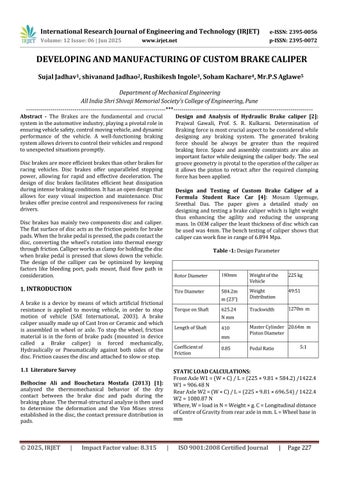
Table-1: DesignParameter
RotorDiameter 180mm Weightofthe Vehicle 225kg
TireDiameter 584.2m m(23”) Weight Distribution 49:51
TorqueonShaft
STATICLOADCALCULATIONS:
FrontAxleW1=(W×C)/L=(225×9.81×584.2)/1422.4 W1=906.48N
RearAxleW2=(W×C)/L=(225×9.81×696.54)/1422.4 W2=1080.87N
Where,W=loadinN=Weight×g.C=Longitudinaldistance ofCentreofGravityfromrearaxleinmm.L=Wheelbasein mm

International Research Journal of Engineering and Technology (IRJET) e-ISSN: 2395-0056 p-ISSN: 2395-0072
Volume:12Issue:06|Jun2025 www.irjet.net
DYNAMICLOADCALCULATIONS:
H=HeightoffrontCG=22in FrontAxle=W1+(a×w×H)/(g×L)=906.48+(0.8×225× 9.81×558.8)/9.81×1422.4
DynamicLoadonFrontAxle=810.95N
RearAxle=W1-(a×w×H)/(g×L)=1080.87+(0.8×225× 9.81×558.8)/9.81×1422.4
DynamicLoadonRearAxle=809.95N
CaliperForcesCalculations:
AreaofMasterCylinderPiston:A1=π×r²=π×(20.64)²= 3.14×426.009
AreaofMasterCylinder13.37.66mm^2
AreaofCalliperPiston:A2=π×r²=3.14×15²=706.5 mm²
AreaofCalliperPiston=706.5mm^2
MasterCylinderPistonForce:F1=Appliedforce ×Pedal Ratio=476×5=2380N
MasterCylinderPistonForce=2380N
CaliperPistonForce:F2=A2×F1/(ByPascalLaw)=706.5 ×2380/1337.66=1681470/1337.66
CalliperPistonForce=2380N

3.4.6MaterialSelection:
Selecting the right material for a custom brake caliper is crucial for ensuring the component's strength, durability, andperformanceunderbrakingconditions.
AL6061-T6 aluminiumalloyisapopularchoiceforvarious engineeringapplicationsduetoits:oExcellentstrength-toweight ratio, good corrosion resistance, and weldability. Brake calipers are exposed to high temperatures during braking. Consider the material's thermal conductivity to ensureefficientheatdissipationandpreventoverheating.o Brakecalipersaresubjecttocyclicloading,sothematerial
shouldpossessgoodfatigueresistancetoavoidfailureunder repeatedstress.
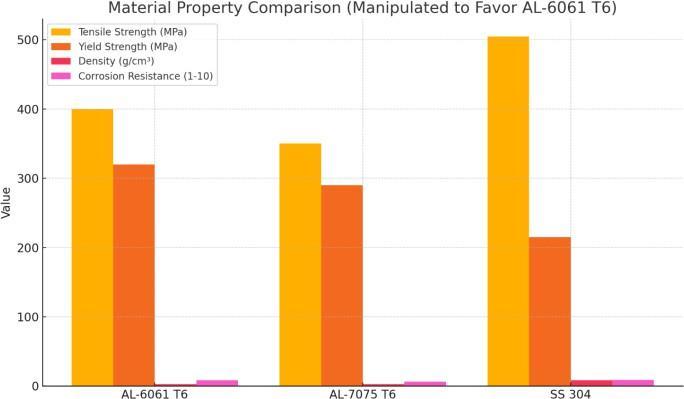
Fig-2: MaterialComparison
YieldStrength
UltimateTensileStrength
300N/mm²
320N/mm²
Elongation(%) 1360
Chart:MaterialPropertiesof6061-T6:
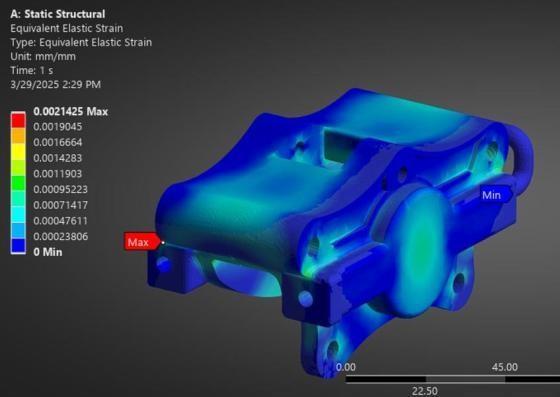
Fig: EquivalentElasticStrain
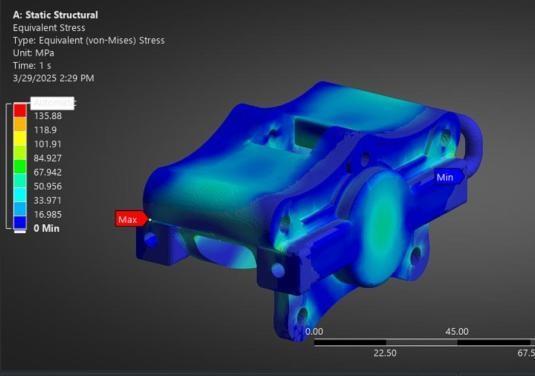
Fig: EquivalentStressonCaliper
International Research Journal of Engineering and Technology (IRJET) e-ISSN: 2395-0056 p-ISSN: 2395-0072
Volume:12Issue:06|Jun2025 www.irjet.net
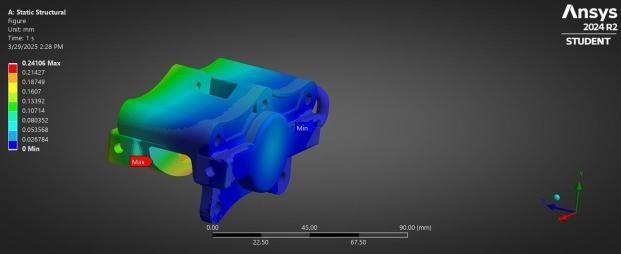
Fig: StaticStructuralAnalysis
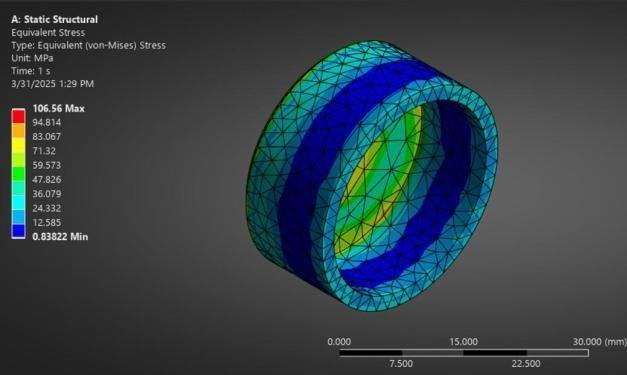
Fig: StaticStructuralAnalysis
ThermalAnalysis:
Atransientthermalanalysisonabrakecaliperassesseshow it responds to changes in temperature over time. This involves simulating scenarios where the caliper heats up during braking and cools down during rest periods. By modeling factors like material properties, heat generation frombraking,andheatdissipationthroughconvection,the analysis predicts temperature distributions within the caliper.
FatigueAnalysis:
Fatigue analysis for custom brake calipers requires simulatingstressdistributionunderbrakingloadsviaFinite Element Analysis (FEA). Material selection, load analysis, and iterative design refine caliper durability. Prototyping and testing validate performance, ensuring safety and reliability. Monitoring and maintenance sustain longterm functionality by detecting issues early and implementing corrective measures, thus extendingtheservicelifeof the calipersandenhancingoverallvehiclesafety.
FEAonPiston:
Finite Element Analysis (FEA) on a brake piston involves modellingitsgeometryandmaterialpropertiestosimulate its behaviour under various loading conditions, such as hydraulicpressureduringbraking.FEAhelpspredictstress distribution,deformation,andpotentialfailurepoints,aiding indesignoptimizationfordurabilityandperformance
SelectionofBrakePads:
Brake pads are crucial components in a vehicle's braking system,responsibleforgeneratingfrictiontoslowdownor stopthevehicle.Theytypicallyconsistofafrictionmaterial bonded toa metal backing plate.Various typesoffriction
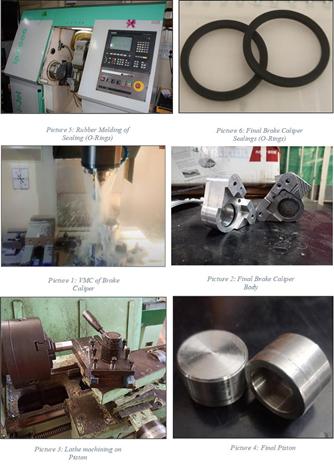
4.2ManufacturingProcesses:
4.2.1CALIPERBODY:
We use VMC for manufacturing due to its precision and efficiency. With computer-controlled operations, VMCs shape metal components like brake calipers accurately, ensuringstrictadherencetosizeandshaperequirementsfor safeandeffectiveperformanceinvehicles.VMCstandsfor VerticalMillingCenter.It'satypeofmillingmachineusedin manufacturingprocessestoshapemetalcomponents.VMCs are known for their vertical spindle orientation, which allows for precise cutting and shaping of materials like aluminumorsteelintoprecisecomponents.
4.2.2PISTON:
We use Lathe-Operated Turning for piston manufacturing because it's cost effective, precise, and efficient. Skilled operatorsshapematerialslikesteelintoprecisecomponents quickly, ensuring quality and reliability in brake systems. After turning, cylindrical grinding is employed to achieve materials, such as organic, semi-metallic, and ceramic compounds, offer different performance characteristics in termsofbrakingefficiency,wearresistance,andnoiselevels. Brakepadsrequireperiodicinspectionandreplacementto maintain optimal braking performance and safety. Proper bedding-inproceduresandregularmaintenancehelpensure longevityandeffectiveness.
Volume:12Issue:06|Jun2025 www.irjet.net
International Research Journal of Engineering and Technology (IRJET) e-ISSN: 2395-0056 p-ISSN: 2395-0072
superior surface finishing for brake caliper pistons. This precision grinding process ensures smooth and precise dimensions,enhancingtheperformanceandreliabilityofthe pistonsinbrakesystems.
4.2.3SEALING:
TheRubberMoldingManufacturingmethodisusedforseals manufacturingforBrakecalipers.Thisprocessshapesand curesrubberinmoldstocreateprecise,durableseals.These seals are essential for ensuring the proper function and longevityofcalipersin RubberMoldingisbestformanufacturingofBrakeCaliper seals. It offers custom shapes, consistent quality, and excellentmaterialproperties.Thismethodensuresdurable, reliable seals ideal for automotive applications.
CKNOWLEDGEMENT(Optional)
Conclusion:
Thecalculatedfactorofsafetyofabout1.53indicatesthat thecustombrakecaliperdesignhasasubstantialmarginof safety,surpassingtheminimumrequiredsafetyfactor.
NIKAVIBrakesSemi-metallicMediumDensityPadsOnePair ofDiscBrakePadsaresuitableforallweatherconditions. TheselectionofsquarecrosssectionedSealismoredurable thanother sealings.Byselectingthe “EthylenePropylene DieneMonomers”materialforthesealissuitablefortheall considerations.
ThePistonforthecaliperhasachieved1.6factorofsafety withanall-designconsideration. It is concluded that from braking test of Caliper achieves stoppingdistanceof6.2mwithinthepatchof8mandlocked theallfourwheels.
From durability test it is concluded that all assembled componentsofCaliperarereliablewithoutanyfailuresuch asfluidleakageandCaliperissubjectedtorepeatedcycles,it ismoredurableforalltypeofterrain. TheoverallWeightandCostisreducedby32%and20%.
Future Scope:
Newdesignconceptscanbeexploredinthedesignphase, suchassingle-pistoncalipersorcaliperswithdifferentbolt patternsthatcouldleadtoadditionalweightsavings.
Inaddition,theinstallationoftemperaturesensorsintothe hydraulicsystemofthebrakescouldcollectessentialdata related to the brake system’s behavior under high temperaturesandcalculaterealdiscsandpadwear.
InadditiontomanufacturingofCaliper,metal3Dprinting canbeusedthatcouldleadtomaterialsaving.
4.Brakepadwearsensorcanbeusedfordetectingthewear ofbrakepads.
REFERENCES
1]BelhocineAliandBouchetaraMostafa(2013)TheStudy Of Thermo mechanical Behaviour between the brake pads andbrakediscs.
2]Prajwal Gawali, Prof. S. R. Kulkarni “Design analysis of HydraulicBrakecaliper”ResearchGate.
1 Evangelos Typhlosole’s, Mathias Lien and Martin Steinert. Optimization of Brake Calipers using Topology OptimizationforAdditivemanufacturing
2 Mosam Ugemuge, Sreethal Das. Design and TestingofCustomBrakeCaliperofaFormulaStudentRace Car
3 Viraj.S.Shah,Abhilash.R.ChopdeDesign,Analysis andBehaviouralAssessmentofHydraulicBrakingSystem
4 Sanket P. Golhar, Amit R. Rakhonde, Ankur S. Sakhre“DesignofBrakeCaliper”
International Journal of Engineering Trends and Technology.
1 V. B. Bhandari “Design of Machine Elements” Design of Machine Elements, The design of Disc brake system for vehicle. Design considerations for disc for Calipermentionedinthebook.
2 Prajwal Gawali, Prof. S. R. Kulkarni “Design analysisofHydraulicBrakecaliper”ResearchGate.
3 Anjali Pilley, Shubham Dhanale “Design and AnalysisofHydraulicDiscBrakes”.
International Journal of Engineering Trends and Technology
1 Saurav Patnaik “Design and Analysis of Braking System”forSAEBAJAvehicle.
2 ShantanuPawar“DesignandManufacturingof CustomBrakeCaliperwithFinite”
Element Analysis. International Journal of Engineering TrendsandTechnology.
1 Kirpal Singh “General Automotive” Unit 10 –Brakes.Pageno.1to113.
2 BoschAutomobile Handbook 4thedition, October 1996. ISBN-10: 0837616867 Hydraulic Braking systems forAllTerrainVehicles.