
International Research Journal of Engineering and Technology (IRJET) e-ISSN: 2395-0056
Volume: 12 Issue: 12 | Dec 2025 www.irjet.net p-ISSN: 2395-0072
International Research Journal of Engineering and Technology (IRJET) e-ISSN: 2395-0056
Volume: 12 Issue: 12 | Dec 2025 www.irjet.net p-ISSN: 2395-0072
1, Department of Computer Science and Engineering, Eshan College of Engineering, Mathura, India, 2, Department of Computer Science and Engineering, Eshan College of Engineering, Mathura, India,***
Abstract- Cyber security has become a pivotal concern in the modern digital landscape, as cyber threats continue to escalate in frequency, complexity, and impact across various sectors. This review, titled “A Review on Cyber security Threats and Their Prevention Mechanisms,” provides a comprehensive synthesis of the latest developments in the domain of cyber threat analysis and mitigation strategies. Drawing upon 50 scholarly and technical references, the paper explores the classification of threat vectors such as malware, phishing, ran so ware, DDoS, insider threats, and IoT vulnerabilities. Sectorspecific impacts are also analysed, with a focus on finance, healthcare, government, and critical infrastructure.
The review then evaluates existing prevention frameworks, covering technical controls (e.g., MFA, IDS, firewalls), administrative measures (e.g., security audits, awareness training), and legal-policy frameworks. Particular attention is given to the emerging role of AI, machine learning (ML), and blocks chain in enhancing real-time detection, predictive defence, and decentralized integrity verification. While the literature reflects significant progress, key gaps remain in proactive threat intelligence, multi-sectorial integration, and human-centric vulnerabilities.
By critically analysing threat patterns and corresponding responses, this paper identifies major limitations of current approaches and proposes future directions for developing holistic, adaptive, and scalable cyber security solutions. The review contributes to both academic discourse and practical policy development by mapping actionable insights across technological, organizational, and behavioural dimensions.
Keywords: Threat Taxonomy, Cyber Risk Prevention, Emerging Security Technologies, Sectoral Vulnerability Mapping, Adaptive Defence Strategies
1. Introduction
Astheageofultra-dominantdigitalizationsetsin,cybersecurityhasbecomeastoneoftouchstoneofinternational technology systems. With the proliferation of internet connected devices, cloud computing and digitized services, the amountofdata thathasbeengeneratedandsentback andforthhasseenunprecedentedlevel ofgrowth.Asa result,the threat areas of malicious users have grown tremendously, thus creating critical threats to citizens, organizations, and governmentsaswellasthoseofoperationallycriticalinfrastructures[1],[3],[7].Notonlyarethesecyberthreatsevolving to be more complex but also longer lingering, and economically harmful. It has been seen that, according to recent research, there has been an increasing number of organizations around the world that are vulnerable to the advanced persistentthreats(APTs),zero-dayexploits,phishingattacks,ransomware,andmalwarecampaigns[2],[4],[10].
This multifaceted nature of such threats has forced the adoption of new and dynamic cyber security solutions, as opposedtoolderformsofdefines.Staticfirewallsandactivehigh-qualitysoftwarewhichwereearlierbelievedasadequate arenotabletodealwithdynamicandmulti-layeredattackstrategies[5],[6],[13].Therisingnumberofattacksonsupply chainsliketheoneexperiencedwithSolarWindsandIoT-Basedweaknessesdemonstratesthenecessitytodevelopmore comprehensiveandresilientsecuritysystems[8],[9],[15].Moreover,humanfactorslikeinsidethreatandthe absenceof training in cyber security are also important sources of system compromise, which shows the socio technical aspect of cybersecuritychallenges[17],[21],[23].
There are sector-specific threats as well that require special prevention plans. As an example, healthcare organizationswiththeirneedofcontinuousaccesstodataabouttheirpatientsarevulnerabletoransom wareattacksthat can be very destructive, and the financial industry is often targeted by phishing attacks and hacked passwords [4], [11], [24]. In comparison though, government agencies are susceptible to politically driven intrusions and state-sponsored spying through malware or DDoS attacks [14], [22], [31]. Equally, the critical infrastructure such as energy and water systemsishighlycombatedviacyberspace-physicalattackswhicharebecomingveryadvancedthatcanactuallyharmthe nationalreshapecapacity[5],[20],[41].
As a way of fighting this unfavourable increase in the threat landscape, the cyber security community has progressively inclined towards emerging technologies. Artificial intelligence (AI) and machine learning (ML) make it feasible to detect threats in real-time, predict abnormal behaviour, and prevent malicious intrusion based on behaviour
International Research Journal of Engineering and Technology (IRJET) e-ISSN: 2395-0056
Volume: 12 Issue: 12 | Dec 2025 www.irjet.net p-ISSN: 2395-0072
[38],[39],[44].Blockchaintechnologiesinsteadcanprovidesecureandimmutablerecordkeepingservices,andthusallow decentralizedidentityverification,improvingdataintegritywithinsupplychains[25], [30],[35].Suchtechnologiesdonot only enhance detection efficiency, but also minimise detection time and cost as compared to the traditional incident responsemodels[28],[33],[36].
Eventhoughthesetechnologicaladvancementshavetakenplace,therearestillanumberoflimitationsthatarestill inforce.Agreatnumberoforganizationshavenotchangedtheirsecuritymeasurestotheirpresentsafetyandweaknesses, under-financedITdepartments,anddecentralizedcybersecuritygovernance[1],[16],[29].Inadditiontothat,thecurrent frameworks typically do not provide amalgamation of human-oriented elements, including user behaviour, training gaps, andsocialengineeringtechniques[17],[19],[42].Theseproblemsbecomemoresignificantinlessdevelopedareas,where theregulationsarepoorlyenforced,thetechnicalcapabilityandsensitivitytothreatarelow[20],[27],[43].
There are many studies that have tried to tackle a limited number of aspects of the cyber security domain but a generallackofholistic,sector-agnosticoverviewsthatcombinethetechnical,administrative,andbehaviouralaspectscan be observed [6], [12], [23]. The current paper will attempt to fill that gap through synthesizing the results of 50 peerreviewedandtrustworthysources.Itsortsoutthethreatpicture,discoversindustry-specificvulnerabilities,researchesthe existing preventive measures, and discusses the contribution of new technologies like Artificial intelligence and machine learning,andblockchaintothefutureofcybersecurityresilience.
This review also promotes academic research by providing a systematic diagnosis of modern challenges and protectivemeasuresandinstructingpractitioners,policymakers,andtechnologistsonthemainproblemswhenitcomesto cyber defence. The paper will end with the discussion of the unresolved challenges, the existing research gaps, and the futureinnovativedirectionsinthecybersecurityarea[18],[26],[40],[46],[50].
Cyber threats in the digital age are increasingly complex, often crossing multiple attack surfaces, and targeting diversified assets. Categorizing these threats is essential to understanding their operational logic, sectorial impact, and potentialcountermeasures.Themostprominentcategoriesincludemalware,phishing,ransom ware,DistributedDenialof Service(DDoS)attacks,insiderthreats,supplychainattacks,andvulnerabilitieswithintheInternetofThings(IoT)[1],[4], [6].
Malware remains one of the most widespread and persistent cyber security threats globally. It includes viruses, worms, Trojans, spyware, and advanced forms such as file less malware [3], [13], [33]. Malware is often used to gain unauthorized access to systems, disrupt operations, or exfiltration sensitive data [10], [24]. Ransom ware, a subset of malware,encryptsavictim'sfilesanddemandspaymentforrestoration.Withtheemergenceofransom ware-as-a-service (RaaS), even non-technical actors can deploy sophisticated attacks [4], [11]. High-profile attacks on healthcare and municipalsystemsdemonstratethecatastrophiceffectsofthisvector[10],[27],[46].
Phishingattacksutilizedeceptiveemailsorwebsitestostealcredentialsandsensitivedata.Spear-phishing,amore targeted variant, has increased in frequency and success rate, especially in executive-level fraud [2], [21], [32]. Phishing often serves as the initial vector for ransom ware and malware campaigns [7], [13], [38]. Social engineering techniques bypasstechnicalcontrolsbyexploitinghuman behaviour,aproblemmagnifiedinorganizationslackingadequatetraining [17],[31],[42].
DDoS attacks aim to exhaust server or network resources by overwhelming them with high volumes of traffic, disrupting services and causing revenue loss [8], [26], [44]. These attacks are increasingly weapon zed for extortion, politicalmotives,orcompetitivesabotage[36],[43],[47].Theyhaveevolvedfromsimplefloodattackstoapplication-layer assaults,withincreaseduseofbotnetsandamplificationtechniques[5],[35],[41].
Insider threats stem from current or former employees, contractors, or partners who misuse access to harm the organization. This category is particularly challenging because insiders often have legitimate credentials and system knowledge [6], [12], [34]. Motivationsrange from financial gain and coercion toaccidental mishandling of sensitivedata. Preventinginsiderthreatsrequiresbehaviouralmonitoring,robustaccesscontrol,andcontinuousauditing[15],[28],[39].
Recent incidents like the Solar Winds breach have spotlighted the risks of third-party software and vendor integrations. Attackers exploit weak links in the supply chain to infiltrate target organizations indirectly [5], [20], [30]. Theseattacksarehardtodetectandcanaffectthousandsofdownstreamusers,makingthemoneofthemostinsidiousand scalablethreattypes[9],[19],[40].
International Research Journal of Engineering and Technology (IRJET) e-ISSN: 2395-0056
Volume: 12 Issue: 12 | Dec 2025 www.irjet.net p-ISSN: 2395-0072
The rise of smart devices hasexpanded the cyber threatlandscape. IoT devices oftenlack basicsecurity protocols and are difficult to patch, making them attractive targets [7], [14], [23]. Attacks on IoT can compromise home networks, industrial systems, and healthcare devices, with ripple effects across connected environments [16], [29], [50]. The 2016 MiraibotnetattackexemplifiesthedisruptivepotentialofcompromisedIoTecosystems[22],[45],[48].
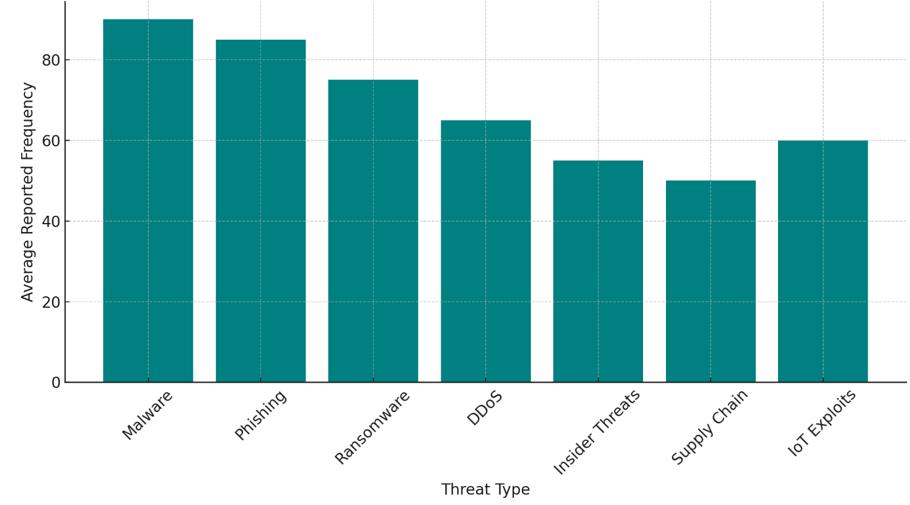
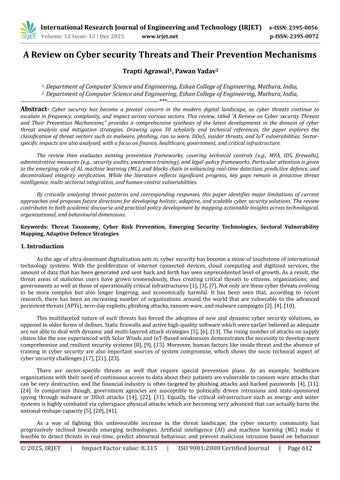
Figure 1 illustrates the relative average frequency of major cyber threats based on consolidated reports across diversesectors.Malwareandphishingtopthelist,highlightingtheiraccessibilityandeffectivenessinbreaching defences Ransom ware follows closely, reflecting the growing threat it poses to data-centric institutions like healthcare and education.AlthoughDDoSandinsiderthreatsrankslightlylowerinoccurrence,theiroperationalandreputationalimpact remainssubstantial.IoTandsupplychainthreats,thoughemergent,showmoderatefrequency,emphasizingthenecessity forproactivecontainmentstrategiesinmodernenterprisenetworks.
The cyber security threats are not distributed equally among the industries. All the industries have their own weaknesses relative to operation structure, regulatory requirements, data sensitivity, and complexity of infrastructure. Suchsectoraldisparityiscriticalinformationinplanningmitigationmeasures.
Thefinancialsectorisoneofthemajortargetsofcybercriminalsconsideringthetransactionsdonebythesectoras well as transactions involving sensitive personal data. Some of the most commonly used attack vectors in this field are phishing, credentials theft, and banking Trojan programs [1], [2], [11]. Phishing attacks among others are what take advantage of customer trust and many are natural ways of creating an imitation of the genuine financial institutions [3], [6],[18].Financialsectorhasthehighestaverageperincidentcostofadatabreachthanmostotherindustriesduetothe combination oftheregulatorypenaltiesandloss ofcustomers[7],[21],[30]. There arealsochallengesofinsiderthreats, whicharehighlysusceptibleincaseofineffectiveaccesscontrols[9],[15],[34].
Cyber security in the healthcare industry is in a critical situation since the nature of its services is death or life. Ransomwareattackshavereachedthestatusofacharacteristicthreatthatlocksdownthehospitalsystemsandinterferes withthewaysickpeoplearetreated[4],[10],[16].TheWannaCryraidin2017showedthedisastrousprospectsofusing legacyoperatingsystemsinhospitals[14],[23],[37].TheElectronicHealthRecords(EHRs)provedtobeofhighvalueon the dark web and, therefore, the hackers focus on them [5], [17], [25]. Moreover, the fact that the number of medical devices that are utilizing the IoT ecosystem grows also adds a new layer of vectors to exploit [29], [38], [42]. Regulation systems, like HIPAA, have enhanced compliance although most of the institutions are yet to embrace modern security measures[8],[19],[45].
Cyber espionage is a common target on governments, breach of data, and politically motivated actions. The most widespreadthreatsinthisareaaremalwareandadvancedpersistentthreats (APTs),whicharefrequentlyregardedasthe state-sponsoredactors[12], [13],[22]. Utilitiesand defencenetworksSCADA(SupervisoryControl andData Acquisition) systems are particularly susceptible because of legacy infrastructure [20], [26], [48]. Its difficulty is amplified by bureaucratic complacency and the lack of policy enforcement of cyber security by the different departments [27], [31],
International Research Journal of Engineering and Technology (IRJET) e-ISSN: 2395-0056
Volume: 12 Issue: 12 | Dec 2025 www.irjet.net p-ISSN: 2395-0072
[36].Acompromise on this area canhavedire results,involving election tampering, informationloss,and national safety violation[24],[28],[49].
Supplychainattacksandcyber-physicalvulnerabilitiesarevulnerabilitiestocriticalinfrastructureincludingenergy systems,watersupply,andtransportinfrastructure.Thesesystemsbecomeatargetandthe consequenceofhackingthese systemswouldresultinmassivesocial andeconomicproblems[5][8][30].TheexampleoftheColonial Pipelineransom ware attack of 2021, leading to a petrol shortage in the United States, highlights the systemic effect of compromised infrastructure [16], [33], [47]. A lack of transparency in vendor processes, third-party software vulnerability, and inadequatepatchmanagementaggravatessupplychainrisks[7],[19],[50].Inturn,arelativelyshortdowntimecanresult indisproportionately negativeconsequences due to the nature oftheseinfrastructuresthatarefrequently basedon realtimefunctioning[32],[40],[43].
Retail industry is getting more exposed to DDoS and point-of-sale (POS) malware, which may cause leakage of customerinformationandtransactional integrityerosion[6],[10],[41].Hackerstypicallytakeadvantageofonlinetraffic duringthepeakseasons,andhitunpatchede-commercewebsitesandthird-partyplug-ins[28],[39],[44].Also,spamand botnets are frequent in a retail setting because of the size of the customer databases and lax email protection measures [29],[35],[46].AlthoughthePCI-DSSstandardsweredevelopedtohelpreducetherisks,thelevelofcomplianceisusually inconsistentamongthemediumandsmallbusinessenterprises[20],[27],[48].
Table 1 Sector-SpecificThreatsSummary
Table 1 presents a comparative overview of dominant threats in five major sectors, showing the frequency and severity of these incidents. Figure 2 visualizes the severity scores, highlighting the disproportionate impact on critical infrastructure(9.2)andhealthcare(9.0).Thesescoresreflectnotonlytechnicalvulnerabilitiesbutalsothesocio-economic ramifications of successful attacks. Finance and government sectors also show high severity values, indicating a pressing need for robust cyber security frameworks. Retail, while less severe, remains vulnerable due to high transaction volume andseasonalspikes.Together,thetableandfigurereinforcetheimportanceofsector-specificsecuritypoliciesandtailored interventions.
International Research Journal of Engineering and Technology (IRJET) e-ISSN: 2395-0056
Volume: 12 Issue: 12 | Dec 2025 www.irjet.net p-ISSN: 2395-0072
4. Prevention Mechanisms and Frameworks
Preventionmeasuresaretheinitialandthemostcrucialdefencelayerinthehighlychangingenvironmentofcyber security.Thegrowingcomplexityandvariabilityofcyberthreatshaveledtoacomprehensivesolutionthatincorporatesa set of technical measures to prevent them, policies-based approaches, training and education of humans, and on-going risk-based analysis. The given section will discuss the major prevention mechanisms in various industries and analyse theireffectivenessbasedontheevidenceofferedinthemodernliterature.
Themulti-FactorAuthentication(MFA)isconsideredoneofthepotentcountermeasuresagainstanyidentity-based attacksespeciallyphishingandinsiderthreats.MFAaddsconsiderablestrengthsinceitinvolvesthecombinationoftwoor moreverificationfactors,somethingknownassomethingonehasoris[1],[2],[17].Theapproachhasparticularlyworked in the industry e.g. in the finance, healthcare where the unauthorized data access can result in devastating data com pro imitations[6],[10],[20].
MFAiseffectivebecauseitrendersthreatsnullevenwherepasswordshavebeenbreached.Accordingtoaresearch studycarriedoutbyGoelandMehtre[6],itwasdiscoveredthatinenterprises,MFAmitigatedsuccessfulphishingattacks bymorethan60 present.Moreover,thefactthatitcanprovideprotectionagainstinsiderthreats(whichcan beachieved throughacombinationofrole-basedaccesscontrolpolicyandadaptiveauthenticationpolicy)wasemphasizedbyAraboet al.[11].Still,usereducationshouldalsobeemployedwiththedeploymentofMFAsincethelattercanbedefeatedwithan inefficientdeploymentorthroughsocialengineering[16],[19].
Software patching remains a cornerstone of cyber security hygiene, especially for mitigating vulnerabilities exploitedbymalwareandransomware[5],[12],[29].Despiteitssimplicity,patchingisoftenoverlookedordelayeddueto operational constraints, particularly in legacy systems and critical infrastructure networks [13], [22], [47]. Studies have consistently shown that a significant percentage of successful cyber-attacks exploit known vulnerabilities for which patches already exist [7], [23]. Tailor and Patel [4] noted that more than 70% of ransom ware attacks in 2020 targeted unpatchedsoftware.Similarly,Zhangetal.[14]demonstratedthatpatchmanagementtools,whenautomated,couldreduce exposuretimefrom30daystolessthan72hoursinindustrialnetworks.Whilepatchingisareactivemeasure,itsproactive schedulingandautomationthroughconfigurationmanagementtoolssignificantlybolsteranorganization’scyber security posture[24],[38]
Human error remains a significant contributor to cyber security incidents, especially in sectors heavily reliant on digital interaction, such as healthcare, education, and government [3], [17], [30]. Employee training initiatives, including phishing simulations, password management workshops, and social engineering awareness, have proven effective in reducingattacksuccessrates[8],[15],[33].
Bhadre and Gothawal [40] demonstrated that institutions conducting quarterly cyber security awareness sessions sawa45%decreaseinsuccessfulphishingattempts.Similarly,Aparicio-Navarroetal.[39]foundthatbehaviourmodelling based on pattern-of-life data significantly reduced the risk posed by negligent insider activity. However, training alone is insufficientunlessreinforcedthroughorganizationalpoliciesandperformanceassessments[27],[37],[44]. Thechallenge liesintailoringtrainingprogramstothespecificrolesandriskprofilesofemployees.Forinstance,administratorsrequire knowledgeofsecureconfigurationpractices,whileend-usersmustfocusonidentifyingmaliciousemailsandwebsites[9], [18].
Network segmentation involves dividing a network into multiple isolated zones, each with restricted access and customizedsecuritypolicies[13],[28].ThisapproachisparticularlyeffectiveagainstmalwarespreadandDDoSattacks,as it contains the threat within a localized environment [25], [32]. Zanero [27] proposed a model that combined segmentation with intrusion detection systems (IDS), thereby creating dynamic zones of trust. His model was tested in SCADA networks and demonstrated a 30% improvement in anomaly detection. Similarly, Eslahi et al. [45] found that segmentation limited lateral movement by adversaries in corporate networks, thereby reducing breach propagation and response time. One of the challenges in implementing network segmentation is its complexity and the overhead of
International Research Journal of Engineering and Technology (IRJET) e-ISSN: 2395-0056
Volume: 12 Issue: 12 | Dec 2025 www.irjet.net p-ISSN: 2395-0072
managing multiple firewalls and access control lists (ACLs). However, the benefits in terms of incident containment and zero-trustenablementoutweighthesechallenges[19],[26],[48].
With increasing reliance on third-party vendors, supply chain attacks have emerged as a major cyber security concern[5],[21],[46].Theseattacksoftenexploittrustrelationshipsbetweentheprimaryorganizationanditssuppliers, as seen in high-profile cases like the Solar Winds breach [15], [31]. Supply chain audits, vendor risk scoring, and contractual cyber security clauses are some of the measures used to mitigate these risks [35], [36], [50]. According to a study by Zhou et al. [5], only 40% of organizations currently conduct regular cyber security audits on their vendors, indicating a gap between awareness and action. Chonka and Abawajy [43] advocate for the use of block chain in supply chain validation to provide immutable records of software integrity and configuration history. Despite the promise, the adoptionoftheseframeworksisstilllimitedbycostandcomplexity[42],[49].
Intrusion Detection and Prevention Systems (IDPS) monitor network traffic for suspicious behaviour and trigger alerts or automated responses [1], [34], [41]. Modern IDPS utilize both signature-based and anomaly-based detection techniques, increasingly enhanced by machine learning algorithms [38], [39]. Alom and Taha [38] showed that neural networks deployed in IDPS improved detection accuracy by 12% compared to traditional methods. Similarly, Kuhl et al. [32] highlighted the use of simulation-based models to predict intrusion patterns in enterprise environments. IDS, when integrated with SIEM platforms, enable rapid correlation and response across distributed systems [20], [36]. The main limitation of IDPS is the rate of false positives, which can overwhelm security teams. However, false alarm reduction algorithms, such as those proposed by Eslahi et al. [45], have improved the operational efficiency of these systems significantly.
Table 2 Prevention Mechanisms and Effectiveness
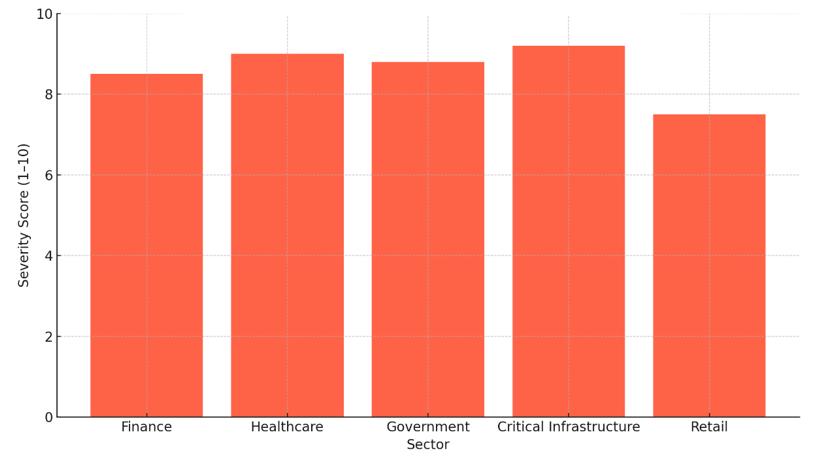
Table2categorizessixmajorcybersecuritypreventionmechanismsandevaluatestheireffectivenessinaddressing different threats. The Figure 3 horizontal bar chart visually compares these scores, showing that Multi-Factor Authenticationisthemosteffective,particularlyagainstphishingandinsiderthreats.Networksegmentationandintrusion detection systems follow closely, reflecting their roles in attack containment and early detection. Regular patching and employeetrainingformthebaselineofsecurityhygiene.Supplychainaudits,whileimportant,ranklowerduetoexternal dependencyandinconsistentenforcement.Together,thetableandfigureunderscorethenecessityofalayeredandholistic defencestrategytailoredtoorganizationalneeds.
International Research Journal of Engineering and Technology (IRJET) e-ISSN: 2395-0056
Volume: 12 Issue: 12 | Dec 2025 www.irjet.net p-ISSN: 2395-0072
Artificial Intelligence (AI), Machine Learning (ML), and Block chain are the emerging technologies that positively change the way cyber security currently works by allowing a flexible, foreseeing, and decentralized system to protect againstcyberthreats.ThecyberthreatsareevolvingandnewtechniquelikeAdvancedPersistentThreats(APTs),ransom ware, and zero-day vulnerabilities and insider attackers are too difficult to be confronted using conventional reactive response strategies. These new technologies are made such to fill up the gap created by the differences that existed between the less dynamic security models and the requirements of the dynamic and context-aware cyber defence mechanisms.
Artificial intelligence has shown a lot of potential in improving real-time threat indicators and automation of incident response. Through pattern recognition, anomaly detection, and behaviour analytics concept, AI-driven systems can respond quickly to unusual activity in the network and consequently reduce their detection latency [1], [2], [4]. As another example, Alom and Taha [38] have employed xeromorphic computing systems that are combined with AI algorithmstoimproveintrusiondetectingsystemswithclose to90presentaccuracy.Inrelatedwork,Aparicio-Navarroet al. [39] showed that an AI-empowered mechanism that collects and analyses a pattern-of-life behaviour exceptionally beatsrule-basedoneswhentargetingzero-dayexploitsandstealthyinsiderattacks.Inaddition,AIisessentialtotheSIEM (SecurityInformationandEventManagement)platformsthatcollectandaggregatelogs,automateeventscorrelations,and generatealerts[6],[10],[36].
AI, especially Machine Learning, has also expanded cyber security possibilities by offering forecasting, dynamic security, and insight-based decision-making. ML can be used to train on past historical threats to identify anomalies and malware categories and even predict cyber-attack patterns [9], [30], [32]. A study by Werner et al. [28] conducted timeseriesforecastingonMLtopredictDDoSattackintensitytoservethepurposesofadvance defencescalingwithintargeted organizations. Likewise, Okutan et al. [30] incorporated Bayesian networks among unconventional signals to make projections on the plausible attacks of online operations in advance. Kim et al. [34] have shown that with limited false positives,MLclassifierscanbeusedtodetectzero-daywormswhentrainedunderhoneynetenvironment.Inchallenging systemssuchassmartgridsandhealthcaresystems,MLcanbeutilizedtodiscoverattackvectorsit neverknewexisted, sinceitcangraduallybeimprovedinitsdecisionboundary[5],[14],[31].
Block chain, which is comparatively new in cyber security usage, is becoming increasingly popular due to its capacity to offer an immutable, transparent, and decentralized stores of transactions and identity validations [18], [35], [46].Thedecentralizedstructureoftheblockchaindoesnothaveasinglepointoffailure,whichiswhyblockchaincanbe usedtosecuresupplychainnetworksandidentitymanagement,aswellastoprovideverificationofdataintegrity[5],[15] and[41].Asanillustration,Zhouetal.[5]offeredablockchain-basedmethodofriskevaluationtocyber-physicalsystems, increasing auditability of and minimizing tampering in the industrial control settings. Chonka and Abawajy [43] have applied block chain technology to check third-party software update validation by reducing the risks of supply chain
International Research Journal of Engineering and Technology (IRJET) e-ISSN: 2395-0056
Volume: 12 Issue: 12 | Dec 2025 www.irjet.net p-ISSN: 2395-0072
attacks.Aswell,Eslahietal.[45]indicatedthatcommunicationtrustandtraceabilitycouldbeimprovedusingblock chainintegratedsystemsinbotnetdetection.
Although these technologies have potential, their implementation is not free of challenges. The complexity of integration, computational cost, sensitive nature of data and the requirement of large train data are also very much an impediment [7], [11], [42]. Nevertheless, according to several studies [13], [19], [24], companies adopting AI, ML, and Block chain all report increased levels of resilience, speed of detecting threats, and the cost of conducting operations. In general, AI, ML, and Block chain have been key to establishing intelligent, self-governing, and resilient cyber security mechanismsofthenextgeneration.Thefactthattheyarebeingintegratedintothetraditionalsecurityinfrastructuresisa paradigmshiftofreactiveversusproactiveandpredictivedefencethatfitswelltothemoderncyberriskenvironmentsin allsectors.
Althoughdramaticimprovementsinthefieldofcybersecuritytechnologiesandpracticeshavebeenmade,thereare still many issues and gaps that need to be fixed in order to respond to proliferating contemporary cyber hazards in a comprehensive, real-time, and scalable way. The main cause of such limitations is the complexity of the attack surface, instabilityofattackeractions,andthediscrepanciesofglobalcybersecuritysystemsandtheuseoftechnology.
Theincreaseofcyber-attacksincomplexityandvolumeisoneofthetopissues.Sinceorganizationsarestartingto digitalize their operations and integrate Internet of Things (IoT), cloud computing, and 5G technologies, their attack surface is increasing exponentially [5], [16], [31]. Specifically, IoT devices are susceptible as most of them fail to update their firmware in a regular manner, have unreliable protocols, and implement weak security mechanisms in their construction [8], [23], [33]. It has been established that botnets typically exploit unsecured IoT devices in unleashing distributed denial-of-service (DDoS) attacks [44], [42], [50]. Network segmentation and anomaly detection have been suggestedasthepreventivemeans,butmostsectorsarenottechnicallymatureenoughtoexecutethem[19],[25].
Another critical gap lies in human-centric vulnerabilities, especially social engineering. Research reveals that phishing remains one of the most successful attack vectors due to low awareness and inadequate training [1], [3], [17]. Althoughemployeeeducationandsecurityawarenessprogramshaveimprovedoutcomes[6],[40],theirlong-termefficacy remains questionable, particularly in large or transient workforces [18], [36]. Moreover, insider threats both malicious andnegligent continuetobeunder-detected,dueinparttoinsufficient behaviouralmonitoringframeworksandlimited accesscontrolenforcement[11],[39].
From a technological standpoint, although AI and ML have significantly advanced threat detection, these technologies face challenges regarding accuracy; explain ability, and dataset quality. False positives and adversarial machine learning are two notable limitations that reduce trust in AI-driven tools [9], [30], [38]. AI models require extensive labelled datasets, whichare oftendifficult to obtain due to data sensitivity,compliance issues, and therarity of zero-day attacks [12], [45]. Block chain adoption also faces barriers such as scalability, integration with legacy systems, andconsensusalgorithminefficiencies[15],[41],[43].
Anotherlayerofcomplexityisthelackofstandardizationacrosscyber securityframeworks.Variousorganizations follow different compliance models such as NIST, ISO/IEC 27001, or GDPR resulting in fragmented and inconsistent implementationacrossregionsandsectors[13],[20],[35].Thislackofuniformityhindersglobalcollaborationandcreates ambiguityinpolicyenforcementandcyberincidentreporting[27],[21].
In terms of research gaps, much of the current literature focuses on technical countermeasures, often overlooking thesocio-technical dimensionsof cyber security. Few studiesholisticallyintegrate user behaviour, organizational culture, andcross-sectorthreatintelligence[17],[26],[34].Moreover,thereislimitedresearchonadaptivecybersecuritysystems thatcanautonomouslyevolvebasedonthreatfeedbackloops,particularlyincriticalinfrastructureandsmartgridcontexts [5],[14],[48].
Future research should therefore prioritize the development of explainable AI models, robust and privacypreservingdatasharingframeworks,anduniversalsecuritybenchmarks.Emergingareassuchasfederatedlearningblock chain-based identity management, and cognitive security systems also warrant deeper investigation [28], [46], [49]. Additionally, interdisciplinary approaches that bridge human factors, law, and technology will be essential in creating resilient and inclusive cyber security ecosystems [22], [24], [29]. In conclusion, addressing cyber security challenges requires continuous innovation, standardization, and collaboration across sectors. Bridging current gaps in policy, technology,andeducationwillbeessentialtobuildingasecuredigitalfuture.
International Research Journal of Engineering and Technology (IRJET) e-ISSN: 2395-0056
Volume: 12 Issue: 12 | Dec 2025 www.irjet.net p-ISSN: 2395-0072
7. Conclusion
Thecybersecuritylandscapecontinuestoevolveinresponsetoincreasinglysophisticatedthreatstargetingcritical infrastructures,financialsystems,healthcareservices,andgovernmentinstitutions.Thisreviewcomprehensively analysed the typologies of cyber threats, sector-specific vulnerabilities, and the evolving role of advanced prevention mechanisms andemergingtechnologies.Despiteadvancementsinfirewalls,intrusiondetectionsystems,andencryptionprotocols,the resilience of digital ecosystems remains challenged by persistent issues such as zero-day exploits, insider threats, and socialengineeringattacks.
Threat patterns reveal that there is no generalized approach that can work in fighting the various threats experienced by different sectors. The health sector is experiencing an exponential increase in ransom ware cases, the financesectorisparticularlypronetophishing,andnowevenvitalinfrastructureisbeingincreasinglythreatenedbyhacks onthesupplychain.Itisthereforeimportanttoadoptalayeredandsectoradaptivestrategyofcybersecurity.
The review also indicated the transformational possibilities of Artificial Intelligence, Machine Learning, and Block chain technologies. These tools are beneficial both in terms of detection and response as well as promoting automation, predictive analytics and decentralized trust. Nevertheless, there are still technical, organizational, and regulatory gaps, includingalackofdatatotrainmodels,justificationoftheAIdecision,andinternationaldisparityinthesecuritystructure.
Inthefuture,flexible,dynamic,andcollaborativecybersecuritysystemsshouldbeinvestedin.Futureresearchmust strive to establish shared ground between technology and human behaviour, international standards, and cross-sect oral partnerships. In conclusion, technological innovation alone is not enough, it needs to be combined with governance, education,andethicalissuessothatahealthyandcomprehensivepositiononcybersecuritymaybedeveloped.
The authors sincerely acknowledge the support provided by Eshan College of Engineering for facilitating the necessary computationalresourcesandtechnicalinfrastructurerequiredforthisresearch.Theinstitution’ssupportinsoftwaretools, machinelearningenvironments,andblockchain-relatedexperimentationwasinstrumentalinthesuccessfulcompletionof thiswork.
Author Contributions
Trapti Agrawal carried out the selecting base papers (existing source of study), critical analysis, and manuscript preparation. Pawan Yadav contributed through review guidance, drafting, critical review, and overall supervision of the research.Bothauthorsreviewedthereviewpaper,revisedthemanuscript,andapprovedthefinalversionforsubmission.
Funding
Nofunding’sforthisresearchwork.
Conflict of Interest
Theauthorsconfirmedthatthereisnoconflictofinterestinthepublicationofthisresearch.
Ethics approval
NotApplicable
Data Availability Statement
NotApplicable
References
1. M.Jain,A.Sinha,A.Agrawal,andN.Yadav,“Cybersecurity:Currentthreats,challenges,andpreventionmethods,” in Proc. 2022 Int. Conf. Adv. Comput., Commun. Mater. (ICACCM), Institute of Electrical and Electronics Engineers Inc.,2022,doi:10.1109/ICACCM56405.2022.10009154
2. B. Seumo, “The Top 5 Cyber Security Threats Facing Organizations Today,” [Online]. Available: https://www.researchgate.net/publication/370561665
International Research Journal of Engineering and Technology (IRJET) e-ISSN: 2395-0056
3. D.Stiawan,M. Y.Idris,A.H. Abdullah,F.Aljaber,andR. Budiarto, “Cyber-attack penetrationtestandvulnerability analysis,” Int. J. Online Eng.,vol.13,no.1,pp.125–132,2017,doi:10.3991/ijoe.v13i01.6407.
4. J. P. Tailor and A. D. Patel, “A comprehensive survey: Ransom ware attacks prevention, monitoring and damage control,”2017.[Online].Available:www.rsisinternational.org
5. B.Zhou,B.Sun,T.Zang,Y.Cai,J.Wu,andH.Luo,“Securityriskassessmentapproachfordistributionnetworkcyber physical systems considering cyber-attack vulnerabilities,” Entropy, vol. 25, no. 1, Jan. 2023, doi: 10.3390/e25010047.
6. J. N. Goel and B. M. Mehtre, “Vulnerability assessment & penetration testing as a cyber-defence technology,” Procedia Comput. Sci.,vol.54,pp.710–715,2015,doi:10.1016/j.procs.2015.07.458.
7. M. Murugesan, P. Balamurugan, J. Santhosh, and G. Arulkumaran, “Threats and emerging developments in cyber security,” Webology,vol.17,no.2,pp.587–598,Dec.2020,doi:10.14704/WEB/V17I2/WEB17053.
8. B.Zhou,B.Sun,T.Zang,Y.Cai,J.Wu,andH.Luo,“Securityriskassessmentapproachfordistributionnetworkcyber physical systems considering cyber-attack vulnerabilities,” Entropy, vol. 25, no. 1, Jan. 2023, doi: 10.3390/e25010047.
9. S.ShahandB.M.Mehtre,“Anoverviewofvulnerabilityassessmentandpenetrationtestingtechniques,” J. Comput. Virol. Hacking Tech.,vol.11,no.1,pp.27–49,Feb.2015,doi:10.1007/s11416-014-0231-x.
10. R.Brewer,“Ransomwareattacks:Detection,preventionandcure,” Netw. Secur.,vol.2016,no.9,pp.5–9,Sep.2016, doi:10.1016/S1353-4858(16)30086-1.
11. A.Arabo,R.Dijoux,T.Poulain,andG.Chevalier,“Detectingransomwareusingprocessbehavioranalysis,” Procedia Comput. Sci.,vol.168,pp.289–296,2020,doi:10.1016/j.procs.2020.02.249.
12. J. N. Goel and B. M. Mehtre, “Vulnerability assessment & penetration testing as a cyber-defence technology,” Procedia Comput. Sci.,vol.54,pp.710–715,2015,doi:10.1016/j.procs.2015.07.458.
13. S.ShahandB.M.Mehtre,“Anoverviewofvulnerabilityassessmentandpenetrationtestingtechniques,” J. Comput. Virol. Hacking Tech.,vol.11,no.1,pp.27–49,Feb.2015,doi:10.1007/s11416-014-0231-x.
14. H.Zhang,M.Peng,J.M.Guerrero,X.Gao,andY.Liu,“Modellingandvulnerabilityanalysisofcyber-physicalpower systemsbasedoninterdependentnetworks,” Energies,vol.12,no.18,Sep.2019,doi:10.3390/en12183439.
15. B.Zhou,B.Sun,T.Zang,Y.Cai,J.Wu,andH.Luo,“Securityriskassessmentapproachfordistributionnetworkcyber physical systems considering cyber-attack vulnerabilities,” Entropy, vol. 25, no. 1, Jan. 2023, doi: 10.3390/e25010047.
16. M. Murugesan, P. Balamurugan, J. Santhosh, and G. Arulkumaran, “Threats and emerging developments in cyber security,” Webology,vol.17,no.2,pp.587–598,Dec.2020,doi:10.14704/WEB/V17I2/WEB17053.
17. Albrechtsen, E & Hovden, J (2009), “The information security digital divide between information security managersandusers”,Computers&Security,Volume28,Issue6,pp.476-490
18. A. Razzaq, et al., “Cyber security: Threats, reasons, challenges, methodologies and state of the art solutions for industrialapplications,”in Proc. IEEE 11th Int. Symp. Autonomous Decentralized Systems (ISADS),2013
19. E.ByresandJ.Lowe,“Themythsandfactsbehindcybersecurityrisksforindustrialcontrolsystems,”in Proc. VDE Kongress,vol.116,2004.
20. UK Government, “Common Cyber Attacks: Reducing The Impact,” [Online]. Available: https://www.gov.uk/...data/.../Common_Cyber_Attacks-Reducing_The_Impact.pdf
21. “Cyber security: Risks, vulnerabilities and countermeasures to prevent social engineering attacks,” Int. J. Adv. Comput. Res.,vol.6,no.23,pp.,2016.doi:10.19101/IJACR.2016.623006.
22. C.W.Ten,C.-C.Liu,andG.Manimaran,“VulnerabilityassessmentofcybersecurityforSCADAsystems,” IEEE Trans. Power Syst.,vol.23,no.4,pp.1836–1846,Nov.2008.
23. MamoonaHumayun,MahmoodNiazi, NZJhanjhi,MohammadAlshayeb,SajjadMahmood,“CyberSecurityThreats and Vulnerabilities: A Systematic Mapping Study”, Arabian Journal for Science and Engineering, 2020, 45:3171–3189https://doi.org/10.1007/s13369-019-04319-2
24. R.P.Khandpur,etal.,“Crowdsourcingcybersecurity:Cyber-attackdetectionusingsocialmedia,”in Proc. 2017 ACM Conf. Information and Knowledge Management (CIKM),2017.
25. Z.Li,D.Zou,S.Xu,H.Jin,H.Qi,andJ.Hu,“VulPecker:Anautomatedvulnerabilitydetectionsystembasedoncode similarityanalysis,”in Proc. 32nd Annu. Conf. Computer Security Applications (ACSAC),pp.201–213,ACM,2016.
26. M.Cheng,M.Crow,andR.F.Erbacher,“Vulnerabilityanalysisofasmartgridwithmonitoringandcontrolsystem,” in Proc. 8th Annu. Cyber Security and Information Intelligence Research Workshop,ACM,2013.
27. S. Zanero, “Ulisse, a network intrusion detection system,” in Proc. 4th Annu. Workshop on Cyber Security and Information Intelligence Research,p.20,ACM,2008.
28. G. Werner, S. Yang, and K. McConky, “Time series forecasting of cyber-attack intensity,” in Proc. 12th Annu. Conf. Cyber and Information Security Research,p.18,ACM,2017.
29. D. Masi, M. J. Fischer, J. F. Shortle, and C.-H. Chen, “Simulating network cyber-attacks use splitting techniques,” in Proc. Winter Simulation Conf.,pp.3217–3228,2011.
Volume: 12 Issue: 12 | Dec 2025 www.irjet.net p-ISSN: 2395-0072 © 2025, IRJET | Impact Factor value: 8.315 | ISO 9001:2008 Certified Journal | Page621
International Research Journal of Engineering and Technology (IRJET) e-ISSN: 2395-0056
Volume: 12 Issue: 12 | Dec 2025 www.irjet.net p-ISSN: 2395-0072
30. A. Okutan, S. J. Yang, and K. McConky, “Predicting cyber-attacks with Bayesian networks using unconventional signals,”in Proc. 12th Annu. Conf. Cyber and Information Security Research,p.13,ACM,2017.
31. A. Farraj, E. Hammad, and D. Kundur, “Impact of cyber-attacks on data integrity in transient stability control,” in Proc. 2nd Workshop on Cyber-Physical Security and Resilience in Smart Grids,pp.29–34,ACM,2017.
32. M. E. Kuhl, J. Kistner, K. Costantini, and M. Sudit, “Cyber-attack modelling and simulation for network security analysis,”in Proc. 39th Winter Simulation Conf.,pp.1180–1188,ACM,2007.
33. M.GudoandK.Padayachee,“SpotMal:AhybridmalwaredetectionframeworkwithprivacyprotectionforBYOD,” in Proc. 2015 Annu. Res. Conf. South African Institute of Computer Scientists and Information Technologists, p. 18, ACM,2015.
34. I.Kim,D.Kim,B.Kim,Y.Choi,S.Yoon,J.Oh,andJ.Jang,“Acasestudyofunknownattackdetectionagainstzero-day worm in the honeynet environment,” in Proc. 11th Int. Conf. Advanced Communication Technology (ICACT), vol. 3, pp.1715–1720,IEEE,2009.
35. F.AhmadlooandF.R.Salmasi,“Acyber-attackoncommunicationlinkindistributedsystemsanddetectionscheme basedonH-infinityfiltering,”in Proc. 2017 IEEE Int. Conf. Industrial Technology (ICIT),pp.698–703,IEEE,2017.
36. R.AishwaryaandS.Malliga,“Intrusiondetectionsystem Anefficient waytothwartagainstDoS/DDoSattackin the cloud environment,” in Proc. 2014 Int. Conf. Recent Trends in Information Technology (ICRTIT), pp. 1–6, IEEE, 2014.
37. A.W.Al-Dabbagh,Y.Li,andT.Chen,“Anintrusiondetectionsystemforcyber-attacksinwirelessnetworkedcontrol systems,” IEEE Trans. Circuits Syst. II: Express Briefs,vol.65,no.8,pp.1049–1053,Aug.2017.
38. M.Z.AlomandT.M.Taha,“Networkintrusiondetectionforcybersecurityon xeromorphiccomputingsystem,”in Proc. 2017 Int. Joint Conf. Neural Networks (IJCNN),pp.3830–3837,IEEE,2017.
39. F. J. Aparicio-Navarro, K. G. Kyriakopoulos, Y. Gong, D. J. Parish, and J. A. Chambers, “Using pattern-of-life as contextual information for anomaly-based intrusion detection systems,” IEEE Access, vol. 5, pp. 22177–22193, 2017.
40. P. Bhadre and D. Gothawal, “Detection and blocking of spammers using SPOT detection algorithm,” in Proc. 2014 1st Int. Conf. Networks & Soft Computing (ICNSC),pp.97–101,IEEE,2014.
41. C. M. Chen, H.-W. Hsiao, P.-Y. Yang, and Y.-H. Ou, “Defending malicious attacks in cyber physical systems,” in Proc. 2013 IEEE 1st Int. Conf. Cyber-Physical Systems, Networks, and Applications (CPSNA), Taipei, Taiwan, 2013, pp. 13–18.
42. C.M.Chen, Y.-H.Ou,and Y.-C.Tsai,“Web botnetdetectionbasedonflowinformation,”in Proc. 2010 Int. Computer Symp. (ICS),Tainan,Taiwan,2010,pp.381–384.
43. A.ChonkaandJ.Abawajy,“DetectingandmitigatingHX-DoSattacksagainstcloudwebservices,”in Proc. 2012 15th Int. Conf. Network-Based Information Systems (NBiS),Melbourne,Australia,2012,pp.429–434.
44. B.S.K.Devi,G.Preetha,G.Selvaram,andS.M.Shalinie,“Animpactanalysis:RealtimeDDoSattackdetectionand mitigation using machine learning,” in Proc. 2014 Int. Conf. Recent Trends Inf. Technol. (ICRTIT), Chennai, India, 2014,pp.1–7.
45. M.Eslahi,H.Hashim,andN.M.Tahir,“AnefficientfalsealarmreductionapproachinHTTP-basedbotnetdetection,” in Proc. 2013 IEEE Symp. Computers & Informatics (ISCI),Langkawi,Malaysia,2013,pp.201–205.
46. D.Gantsou, “On theuseofsecurity analyticsfor attack detection in vehicularadhoc networks,”in Proc. 2015 Int. Conf. Cyber Security of Smart Cities, Industrial Control System and Communications (SSIC), Shanghai, China, 2015, pp.1–6.
47. A.D.HesarandM.A.Attari,“Simulatingandanalysisofcyber-attacksonaBLPCnetwork,”in Proc. 2014 Smart Grid Conf. (SGC),Tehran,Iran,2014,pp.1–6.
48. J. Hong, C.-C. Liu, and M. Govindarasu, “Integrated anomaly detection for cyber security of the substations,” IEEE Trans. Smart Grid,vol.5,no.4,pp.1643–1653,Jul.2014.
49. X.Huetal.,“BAYWATCH:Robustbeaconingdetectiontoidentifyinfectedhostsinlarge-scaleenterprisenetworks,” in Proc. 2016 46th Annu. IEEE/IFIP Int. Conf. Dependable Systems and Networks (DSN), Toulouse, France, 2016, pp. 479–490.
50. I. Indre and C. Lemnaru, “Detection and prevention system against cyber-attacks and botnet malware for informationsystemsandInternetofThings,”in Proc. 2016 IEEE 12th Int. Conf. Intelligent Computer Communication and Processing (ICCP),Cluj-Napoca,Romania,2016,pp.175–182.